
"Well, excuse me for living, Anita Bryant"

Most of us have what in common parlance is known as baggage. If you were to rummage through mine, you’d come across a few reels of film. Moving images that get pushed around like a burden too heavy to carry, celluloid that somehow came to deposit itself under the by now leathery skin of my much travelled case. One such movie, to me, is Robert Wise’s I Want to Live (1958). Few moments in film made a greater impression on me than Susan Hayward’s final scenes in this hysterical nightmare of a melodrama, which I first saw when I was a child of seven or eight (we have so few accurate records for experiences such as watching television).

I was staying with my grandmother who saw it fit to sit me in front of the tube all day, flicking between the two available channels, and letting me “gorge and guzzle” like an Augustus Gloop picking the plate of Mike Teavee until I had to be taken back to my parents after developing a fever from the exposure to all those images flashing before me. I have not watched I Want to Live since. Since last night, that is.

Violent and brash, I Want to Live is hardly what you might call family fare; here in Britain, it still carries an advisory label suggesting the age of fifteen as the appropriate time for exposure. How terrifying it was for me, the boy I still know, to witness the execution of a human being, the slow death by poison staged with minute precision. There was that phone that would not ring, that call that would not come. After all these years, I was convinced it would be ringing, after all, if only too late to save the life of Barbara Graham (played by Susan Hayward, pictured above).

As I said, I had not seen this film since that first time. Along the way, I heard it mentioned, gradually realizing it to be an iconic picture, a title in scarlet lettering, the kind of incendiary pulp to which the likes of me are drawn. I knew early on what “the likes of me” were; but I was as yet unfamiliar with the secret language shared among my kind, something understood.

Years later, living in New York, I caught a rerun of the Golden Girls, the sitcom to which I, a non-immigrant German studying in the US, owed much of my colloquial English. There was Sophia Petrillo, locking herself up in the bathroom, upset that her daughter Dorothy does not approve of her wedding (to her Jewish boyfriend, Max Weinstock). The caterer storms in, overhearing the reconciliation of elderly mother and grown-up child. “This is more moving,” he breaks out, “than Susan Hayward’s climactic speech in I Want to Live.” “You’re ready to fly right out of here,” sneers Dorothy’s roommate Blanche at the sight of this Pangbornian display. “Well, excuse me for living, Anita Bryant!” the insulted caterer fires back.

I am with the caterer. In fact, I have been with the caterer and their friend Dorothy since I was about five. Perhaps, this is why I responded so strongly then to what the film claims to be a wrongful sentencing, the incarceration and sacrificing of an exuberant outcast. Not that I am trying to hand out psychoanalytic cheese puffs here.

Still, it was strange to revisit Graham’s final moments last night, so many decades later, seeing myself watching an old movie, still recognizing that boy. What was my grandmother thinking? It struck me that this was the woman who, years later, told me that she knew about the concentration camps and the gassing of the Jews. The same woman who refused to talk to or correspond with me after it had become clear that I was to remain a caterer and would never have that wedding.

There she sat with me, watching a woman going into the gas chamber. Was she reminded of the many deaths she had condoned? Was there a secret chamber of her heart into which no poison could rush? Would she have turned the switch on me and my pink triangular kind?

As if any underscoring of such melodramatic excesses were needed, Graham went out with a bang. Not just metaphorically. The lamp of our movie projector (one of those $500 bulbs) imploded just before she was led to that chamber. There won’t be any screenings for a while, except for those pictures that keep flickering on the back of my eyelids, reels in the baggage to be pushed around until it is time for me to push off . . .

Digging the Mole: Language, Memory, and the Dirt of Native Soil

Well, I am back in Wales after a week in the Czech capital. And, as is always the case following such travels, I seem to have left behind some part of me that keeps spinning, endlessly and unclaimed, like a piece of luggage on a carousel forcing it back into view with every turn. Retrieving some of its content piecemeal—and in full view of anyone around me—I am devoting the next few entries in the broadcastellan journal to the grabbing at that stubbornly revolving case and the spreading out of whatever I might snatch from it for all to see.

Traveling to Prague was not simply a matter of going on a trip to me—unless, you might say at the risk of sounding like some hideous pop tune, it was a matter of going on a trip “to me.” It was the closest I have been to walking on what my German passport claims to be home turf in about seventeen years (apart from a subsequent stopover in Amsterdam, during which we took the train into town for a meal and a walk along the grachten).

If that nearness to what I have been trying to get away from weren’t enough to cause anxiety, Prague is full of reminders of the cultural contributions of my forebears, from the writings of Franz Kafka to the attempt at exterminating Jewish culture, impressions to be shared in subsequent entries. I was relieved, amid “collective guilt”-ridden visits of the Jewish Quarter and the angst-fest that is the Kafka Museum, to come across Krtek, the mole. Perhaps it was a matter of closing my eyes and ears for a while (moles, unlike Krtek, being short-sighted and hard of hearing) and of not resurfacing for a while, getting so close to being home-soiled.

I grew up digging Krtek, a cartoon character created by Zdeněk Miler. Former Czechoslovakia was a chief purveyor of children’s television entertainment both in Eastern Europe and Germany during the 1970s. As it turns out, Krtek is celebrating his fiftieth birthday this year, which is why he was prominently on display in the shopwindows of Prague. I could not resist sharing my rediscovery by donning above t-shirt. Never mind that I look like Mr. Magoo avoiding the glare of an otherwise welcome sun.

To me, Krtek will always be “Der Kleine Maulwurf,” which is how I got to know him during my childhood. “Maulwurf”! What a wonderful word. Literally, it means “snout throw” (or “muzzle toss”). The German language is marked by a directness largely lacking in Latin-quartered English, an openness and simplicity I did not come to appreciate until I dug a hole out of the place I chose not to call Heimat and picked up the works of Scottish philosopher Thomas Carlyle, whose to English ears mannered idiolect (termed “Carlylese”) comes alive in metaphors and loan-translations.

A number of poets and novelists living in Prague in the early 20th century circulated their thoughts in the linguistic isolation cell of German, a marginality so keenly felt by Kafka. Being already in a heap of clay dug up by Krtek, I am currently reading Gustav Meyrink’s Der Golem (1915), the famous legend of the clay-made aider of the Jews, about which and whom I will have more to say in the near future.

Having lived outside Europe for so long, I am sometimes overwhelmed (and not always pleased) by the memories tossed back in my face at the mere sight of something like a little mime of a mole, memories that come to life chiefly in images but, when recalled in words, insist on sticking out my native tongue at me.

I know. It seems as if I were making a mountain out of one of his hills; but watching Krtek in this charming little movie, I am reminded how much he, too, dug the radio, and how this love for foreign sounds brought about his isolation . . .

"Endangered Sounds"?

Well, let’s see. No, wait. Let’s listen instead. “Now I will do nothing but listen, / To accrue what I hear into this song, to let sounds contribute / toward it.” Walt Whitman wrote these lines. What are the notes to the song of my self? What are the echoes of my everyday? What do these sounds have to do with me?

When I moved to Wales, far from the hubbub of Manhattan, I had to get used to a whole new soundscape. I haven’t quite gotten used to it yet; particularly not to the howling of the wind. These days, there is a new sound in the living room. Yet it is so old, Whitman might have heard it. It is not a Welsh sound, but one made in Brooklyn. It is the sound of our Ansonia clock, anno 1881 (pictured above), which is now part of the ambiance in which I breathe and move.

I have been listening to the BBC Radio 4 documentary “Endangered Sounds.” What might that be, an endangered sound? In my adolescence, I began to wonder about the perishable fabric of my sonic everday. I began to record noises and voices in an attempt to capture where—and who—I was. I did not trust my archival mind as a storehouse of sonic markers of place and time. We tend to make records of our lives in words and images rather than sound. The image seems to be more desirable as a keepsake—more reliable and persuasive. It dominates our senses. Is it any wonder we feel out of touch with the past if we insist on turning it into graphic objects.

I remember sitting in Central Park one afternoon, thinking how serene my environs were. I recorded the sounds of that afternoon and played them back at home, only to realize how noisy that spot had been. The images were so powerful, they drowned out the sounds of the metropolis—the cars rushing by just behind the trees, the buzz of commerce puncuated by sirens. I took no notice of what was out of sight (though hardly out of earshot); I did not hear what the eye fooled me into believing absent. I listen for them now that I am gone. I miss them more than the sights, stored in my mind, preserved on paper, and displayed in this journal.

“Endangered Sounds” provokes thoughts about our changing environment, about noise pollution, about the loss and luxury of silence: the nostalgia for our silenced past, the awareness that, as technology advances, we lose ourselves soundscapes whose sameness is robbing us of our identity—an alienating, Kmartian sub-urbia, a generic soundtrack as mind-numbing as Muzak. For all this, “Endangered Sounds” frustrates as much as it intrigues, especially since it does not resound with many of the authentic sounds it declares to be on the brink of extinction, some of which were recreated in stock recordings, others crushed in musical beats.

Rather than preserving sound, the program serves as a reminder of loss; it is a memorial service for our silenced past. It suggests that, in the near future, technology will permit us to deaden what we do not wish to hear, to create bubbles of choice sound and tranquility distilled from the din of civilization. Manufacturers of sound are hard at work to sell us back what commerce and progress has robbed us of.

Do we really need highly sophisticated computer technology to create our individual sound spheres? When I lived in Germany and dreamed of New York City, I would listen to the sounds of streets and avenues I had recorded while away from what was not truly home. The sirens, the footsteps on the sidewalks, the babble of the passers-by—they provided more comfort than the electronic tunes I merely consumed. Unlike the artifice of those purchased sounds—a sonic anywhere to take the place of the here and now—the metropolitan noises I had recorded were real and concrete. My feet had touched those steps, my shoulders had brushed against those voices, my nose had taken in the fuel with whose burning the traffic resounded. That was somewhere—a there I felt—and I knew I had to go back there to stay.

These days (owing to the electronic blasts of the past, no doubt) I am somewhat hard of hearing; but instead of deadening my everyday in specious phonics or phoney silences—some New Age orchestrations of an assembly-lined existence—I seek and find comfort in sounds whose source I can identify and take in with my other senses—the fire I feel against my skin, the yawning of our none-too-pleasant smelling dog on the carpet, and the clock on the mantelpiece (which, in the picture above, reflects both me and the dog on its surface); and instead of losing myself in the folds of a custom-made soundcarpet, I wrap myself in this resonant quilt and know myself to be . . . at home.

Dr. Mabuse, Terrorist

Now that Hannibal is rising again and even The Shadow is being cast anew in another attempt at translating radio’s invisible terrors to the big screen, I wonder how long it will take for Hollywood to rediscover Fritz Lang’s Dr. Mabuse, a pulp character combining the ruthlessness and intelligence of the former with the mental powers and omnipresence of the latter. In this age of urban terrorism and surveillance, of cynicism and weaponized paranoia, Mabuse would be just the figure to capture the Zeitgeist. A few days ago, I re-encountered him in the 4 ½ hour, two-part silent thriller Dr. Mabuse, der Spieler (1922) and its masterful talkie sequel Das Testament des Dr. Mabuse (1933).

His genre-defying Testament having been banned by the Nazis, who read it as a comment on their hate-mongering and fear-founded regime, Lang later returned to West Germany to direct an Orwellean update titled Die Tausend Augen des Dr. Mabuse (1960), which then metastasized into a spy and crime movie franchise akin to the lurid and hugely popular Edgar Wallace chillers that lured German teenagers, my father among them, to the movie houses.

I was about five years old when I first heard his name, by which time Mabuse had long ended his box-office reign of terror (sporadic resurfacings in movies and audio books notwithstanding). It was during a walk around the neighborhood of the bleak industrial satellite of a town I was obliged to call home, when my father pointed out a walled-in plot of ground and told me, with an air of mystery escaping his breath (which in later years would merely reek of distilled disillusionment), that that was the garden of Dr. Mabuse.

Ma-boo-ze. Now, there was no ready image of this figure in the inventory of my mind; but those three syllables alone were so rich in romance and intrigue that I could not wait to be lifted up to see just what was lurking behind that unassuming row of bricks and mortar.

Gnomes. A whole colony of them. Common enough in the horticulture of the petit bourgeois, these forms took on a magical, even sinister aspect. Had they been ordinary folks—small children, perhaps—petrified into subhumanity, the playthings of a scientist or some such latter-day sorcerer? Later, it occurred to me that my father might have confused the place with the Island of Dr. Moreau or the secluded playground of Dr. Cyclops, whose very different experiments I still associate with the mobsterism of Mabuse.

At any rate, I don’t even recall the story Papa had made up in an effort to make a dull walk in dispiriting surroundings seem like an adventure (eventually fading superheroic powers for which I loved him). All I remember is that, from that day on—until we finally moved to the alternate dread of middle-class suburbia—I always insisted on seeing those garden features whenever we passed that wall; and long before I spotted him on television, Mabuse was a prominent if indistinct figure in the imaginary landscape of the mind—which is precisely where he roamed after losing his own.

Based on a serialized magazine story by Norbert Jacques—as the documentary extras on the DVD release of the 1922 film will tell you—Mabuse continued to terrorize the world long after he had been locked up as a seemingly harmless imbecile. In the silent film, he is a man of many disguises; in the sequel, he inhabits the bodies of whomever he chooses as executors of his will. He was modernity’s first indiscriminal, a proto-fascist who sought to force the multitude into submission or blow them to bits, if necessary.

Operating his ministry of fear by giving orders both telephonically and telepathically, the all-seeing, all-knowing Mabuse was a shape-shifting Big Brother, The Thing with a method and a masterplan. His terrorist network is an ideal setup for an open-ended series of thrillers that can withstand the death of its central characters and the departure of its leads. Will Mabuse return? Or has he altogether demolished our shelters of fiction, free now to menace the streets of metropolis, the hallways of big business, and the corridors of political power? Perhaps, we all are gnomes in the penal complex of his walled-in garden.

My Anglo-American Diet

Well, I consume plenty of them. Movies, I mean. Almost every night I take one in, along with some potato chips and a tall glass of gin and tonic. Now, looking in the mirror, I pretty much know where the chips and the gin are going, being that the residue lingers prominently around my waste. I don’t mind that much. I’m talking celluloid, not cellulite.
So, how does this motion picture diet affect me? What remains of these pictures after my eyes have lapped them up, my mind downed them? Granted, I don’t always ingest; once in a while I drop off in the very act of feasting (Elia Kazan’s Boomerang didn’t come home some nights back). Sometimes my attention throws in the napkin, losing itself like a crumb in the pleat of a leading lady’s dress or finding itself deserting the table at the sight of a mustachioed villain. Still, I pretty much finish off about three or four movies a week; and I’d sure like to know just where they are going and what they are doing to me once they have rolled off our screen, a large window blind serving as a conveyor belt for digitized treats.

I have been living in the UK for two years now; but, aside from a few British favorites such as Brief Encounter (pictured, and discussed here) or the occasional TV dinner (with the recently reunited Royle Family for instance), I still take in almost exclusively American fare. Last night, for instance, I took out two DVDs: Alfred Hitchcock’s pre-Hollywood melodrama Juno and the Paycock and Orson Welles’s post-Holocaust thriller The Stranger; it was the latter that got a viewing, the former being once again returned to the drawer, yet unwatched. Perhaps I was just not in the mood for Irish stew; but the “go west” pattern in my viewing habits is all too apparent.

In fact, I am so American in my pop-cultural intake that I even missed yesterday’s 15,000 broadcast of The Archers, that British institution of a radio serial. I was too busy thinking about the mid-term elections in the US to devote time to a venerable program that, truth be told, I have never listened to even once, despite my love for radio dramatics. Do I need to point out that I am a German native (something I’d prefer to forget)? What is it, aside from having lived in the US for fifteen years and devoting an inordinate number of them to the study of American radio drama, that makes me embrace American culture of the 1930s, ‘40s and ‘50s yet ignore or outright dismiss so much else, contemporary and internationally?

For one thing, I know what to expect from traditional Hollywood entertainments. I appreciate their formula, accept their limitations. Not unlike Victorian novels, they please me even when they leave me wanting (and Welles’s Stranger is surely a less than satisfying dish of hokum, squandering nearly all its potential to explain what it merely exploits—post-war doubts about a reformed Germany, a policing of thought for the sake of a secure nation, and a global peace founded on democratic principles). They agree with me, even when my mind insists they are nutritionally deficient and dangerously high in sodium, considering that you have to take many of these melodramas with so much more than a grain of salt. And as long as my heart’s still pumping enough blood through those hardening arteries, I keep the transatlantic meals on reels program going.

Sure, watching Hollywood movies does not make you an American. You might as well try to enter the Green Card lottery with a ticket stub. Instead, you keep circling Ellis Island, feasting your eyes on the Statue of Liberty looming in the haze. Marveling at the prospect in light of last night’s election, you can almost imagine yourself chewing the scenery in a Frank Capra feature.

They Call Me Montague; or, A Question of Naming

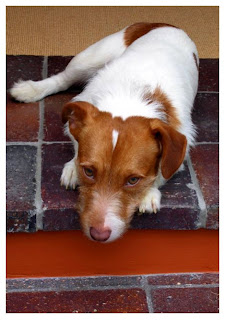
Well, this is our new companion. Earlier today, we picked him up from a farm in South Wales where he had been in foster care after his original keepers (a family falling apart) had handed him over to a charity. I decided to call him Montague, or Monty, after Monty Woolley and his radio character, the Magnificent Montague—irascible, swellheaded, and hopelessly demoted. Now, “Montague” used to be my nom de blog as well; so, I’m only passing it on to the little one now resting next to me.

Will Montague grow into his name? Will he defy it or make it his own, after having been confronted, pell mell, with such an appellation? As yet, he barely responds when thus addressed. After all, until a few hours ago, he used to go by another name.

The act of naming and the meaning of names, the study of which is called onomastics (since every field of scholarly investigation must have a title validating it as such), has always fascinated me. As a child, I sensed naming to be a decided gesture of ownership, an announcement of having brought into being—that is, brought into my life—something that, before I laid claim to it thus definitively, had been vague, obscure or utterly unknown to me.

After I had named the toys in my room, I began to name the fictional characters I drew or wrote about. Could I make up my own life in this arbitrary, willful way, despite being stuck with a name for life? Somehow, I thought the answer must be a resounding “no.” I had already been claimed by others.

My interest in names and naming only intensified when I read the works of Charles Dickens, who had a knack for the game of the name: proper nouns that might not be proper at all, but that keep you wondering, that arouse your suspicion, that conjure up a face in a few syllables. In an essay on the subject, I called this quality in Dickens “Onomancy”—the act of conjuring up the spirit of a character by virtue of a moniker. It is a game in which the reader is invited to guess whether nomen truly is omen.

In Dickens’s Little Dorrit, for instance, you will encounter a rich assortment of suggestive surnames, such as Plornish, Flintwinch, or Stiltstalking, and sobriquets such as Pet, Tip, or Altro. It has its mispronounced names (Biraud for Rigaud, Cavallooro for Cavalletto) and its unpronounced names (A. B., P. Q., and X. Y.). It has its aptonyms (Messrs. Peddle and Pool, solicitors) and eponyms (Barnacleism); its cognominal chameleon (Rigaud, alias Blandois, alias Lagnier) and its renamed renegade (Harriet Beadle, alias Hattey, alias Tattycoram); its allegoric Everyman (Bishop, Bar, or Bench) and its Nobody. After all, it is a story about losing and regaining a reputation—a story of how to make a name a good one.

In old-time radio drama, names were rarely quite this fanciful—but they were called out and repeated far more often than in everyday life. The creators of such plays assumed, and wrongly—that names, heard only once, would not sink in; that it would be confusing for the listener to discern just who was talking to whom. To be sure, some producers, like the Hummerts, went rather too far with such designations; but perhaps this is why Mr. Keen, Tracer of Lost Persons, managed to make such a name for himself, despite the fact that he was dull as . . . , well, let’s not start with the name calling.

As tempting as it might be, there won’t be any mention of names in the radio play I am currently imagining. The listener will have to distinguish between no more than two main characters, individuals who are nothing to one another. Their personalities won’t be pronounced by mere proper nouns; instead, they have to speak for themselves. That is, I have to put words into their mouths first—if Montague, wild and woolly, will permit me to divert my attention. The named one, you see, has already laid claim to me.

Old-time Radio Primer: B Stands for broadcastellan

Well, before I was being whisked off for a daytrip in observation of one of those red-letter days on which we are expected to celebrate the gradual approach of our inevitable demise, I subjected myself to a rather probing interview, conducted by the eminent if irascible radio reporter Wally Windchill. Are we ready, Mr. and Mrs. North America, and all the ships at sea?

As the laundry basket said to the ironing board: let’s go to press.

Windchill: You call yourself “broadcastellan.”

broadcastellan: Yes. Only in the blogosphere, mind you.

Windchill: I get it, a surfname; but what does it stand for?

broadcastellan: Well, it all started about a year ago, when, one quiet afternoon . . .

Windchill: Please, we are pressed for time.

broadcastellan: Sorry. The handle is meant to suggest that I am writing about broadcasting and that I consider myself a keeper of records, one who manages a neglected vault of half-forgotten radio treasures. A castellan in the castles on the air.

Windchill: So, it’s another one of your awful puns, basically.

broadcastellan: A pun, at any rate.

Windchill: Never mind the rate; it’s cheap. But about radio. As your first and only reviewer on one of those traffic generator sites put it so succinctly in his single-word comment: “Why?”

broadcastellan: Well, I am very much intrigued by aural drama as an alternative to visual entertainment; and, having written a dissertation on the potentialities and shortcomings of these stories in sound, as they played out in the minds of millions during the 1930s and ’40s, I thought I had something to share that . . .

Windchill: You don’t do short sentence, do you?

broadcastellan: Not true! I even “do” incomplete ones. On occasion.

Windchill: Cute. But, about radio. Why the old stuff?

broadcastellan: Radio drama has a fascinating history. It’s a tradition that, in the US at least, has been all but abandoned in favor of television.

Windchill: And that’s bad?

broadcastellan: I think so, yes.

Windchill: But why American radio? You live in England, don’t you?

broadcastellan: Wales, actually.

Windchill: As if anyone outside the UK could tell the difference. Why not British radio, then? I hear it’s still going strong over there.

broadcastellan: I am just not that impressed by what’s being done nowadays. Back in the 1930s and ’40s, radio was it, not fringe culture. The voices, the sound effects, the storytelling—the commercials. It’s the showmanship I admire, the theatricality. And nobody does showmanship better than the Americans. What I love particularly about US radio is its strong connection to old Hollywood; hearing those great stars. Everyone did radio in the 1930s and ’40s—everyone, except Garbo, who very nearly did. They don’t have stars nowadays; just celebrities.

Windchill: I see.

broadcastellan: Besides, I didn’t grow up with those voices. In Germany, where I’m from, movies are dubbed. Radio taught me a lot about the sound of American English, about idiom and jargon.

Windchill: Not that you got it down. Some queer diction you’ve got going on there, Mr. “broadcastellan.” So, you’re going to keep exposing others to your . . . radiology? Not a lot of people out there care, you know.

broadcastellan: I am aware of that, but undaunted by the general indifference. Yes, I’ll keep on blogging. My first anniversary is coming up, on 22 May.

Windchill: I guess we’re going to read all about that in a few days, then.

broadcastellan: Probably. Perhaps we could do another interview.

Windchill: It would have to be a slow newsday.

On This Day in 1949: US Listeners Are Transported to Mexico

Well, it might just make it after all. Our elm tree, that is. It was uprooted and replanted over a year ago and did not take kindly to the forced relocation. This morning, when I replenished the bird feeder that dangles from its bare branches, I noticed a few tentative buds. Encouraged by those signs of life, I am going pay more attention to this horticultural casualty over the next few weeks. The uprooted and transplanted don’t always adjust well to their new environs. Sometimes, they seem altogether out of place. Take Miss Marple, for instance.

Last night, a new dramatization of Agatha Christie’s Sittaford Mystery premiered on British TV channel ITV1. Now, what was Miss Marple doing at Sittaford? She sure wasn’t sent there by her brainmother, who created Sittaford without Marple in mind.

Nothing quite fits together in this adaptation, which tries to update Christie’s early 1930s séance mystery with noirish touches and hard-boiled wit. Transport the story into the 1950s, throw in an ex-James Bond (Timothy Dalton), a dash of Indiana Jones, a taste of not-so-sweet honey (an enigmatically skeletal Rita Tushingham), and some hints at lesbianism—and, voila (now I am being Poirot), you’ve got yourself a caper with a serious identity crisis.

I have always been driven by and torn between two impulses: to stick to what I know and try to stay away from it. The familiar can be comforting and reassuring. In my readings, for instance, or in my appreciation of drama, I tend to be downright Victorian in my tastes. As much as I was intrigued by the story of (or behind) Bennett Miller’s Capote, with which I caught up this weekend, I would have preferred it to be a little less analytical. I did not get to feel for or identify with any of the characters, as fascinated as I was by the situation in which they found themselves.

Miller seems to have taken a Terrence Rattigan approach by trying to concretize ideas rather than plots and characters. Such attempts are, perhaps, best left to essays, writings in which blossoming ideas are more likely to reach maturity and take root in the mind of an audience to whose efforts in abstraction any singled-out specifics might be distracting.

And yet, the familiar can also be stultifying and stifling, making the getting away from it seem a matter of life and death. On this May Day—the celebration of spring and renewal, that, not altogether inappropriately, shares its name with the internationally recognized distress call—I am looking westward, toward my former home, observing how the subject of immigration develops in the country of immigrants, and how US-Mexican relations received yet another blow, as millions are encouraged to stay away from work or refuse the purchase of US goods. However contentious the subject, it is not one to be avoided; and, rather than being a vehicle for escape, old-time radio, once again, serves as a reminder of some of Mexico’s other migratory misfortunes.

On this day, 1 May, in 1949, listeners of You Are There, a series of fictionalized radio documentaries, were given the opportunity to witness the assassination of emperor Montezuma, presumably by his own people. Among the voices from the past “interviewed” for the program, Canada Lee can be heard as an Aztec prince, the oppression of African-Americans being thereby likened to the life of the Aztecs under Montezuma.

Also on mike to give her views of the situation is the emperor’s daughter, who vows to leave Mexico with her husband, the invading Spaniard Cortez: “If the house of my father must be overthrown to deliver my people from hideous darkness, I say let it be overthrown.” That Cortez returns to Mexico to plunder its treasures is offered as a “footnote” at the conclusion of the broadcast.

On that same day, conceited skinflint Jack Benny went down to Mexico (or some Hollywood simulacrum of it, such as the above scene from Masquerade in Mexico) in hopes of a better life—one enriched by foreign gold or by a shiny Oscar—in an irreverent take on The Treasure of the Sierra Madre. He neither succeeded in the quest, nor in its dramatization, but delighted his audience as he died trying.

The radical tourism we label “immigration” has frequently been romanticized as adventurous or trivialized as opportunist; to criminalize it now will do still less to explain, let alone discourage, such wayward and often desperate acts of displacement. I, for one, have not set foot on my country of origin for nearly sixteen years. Anxious to fall away from the family tree, to take root elsewhere or rot, I migrated to New York City. A decade and a half (and some degrees) later, I moved on, to Britain, a country that seems stranger to me than I had anticipated.

Many who leave their native land are not unlike that elm tree in our garden, struggling and unstable; but I know that whatever it is that uproots us must be stronger than that which holds us in place.

A Case for Ellery Who?: Detecting Prejudice and Paranoia in the Blogosphere

Well, only a few short hours ago I was writing about the constitutional freedoms that US citizens enjoy and the appeal American writers like Pulitzer Prize winner Marc Connelly made to 1940s radio listeners of the The Free Company (and “The Mole on Lincoln’s Cheek” in particular) to cherish and defend such liberties. I suppose that includes the freedom to sever one’s connections to anyone we realize to be incompatible or determine to be objectionable, regardless of any interests or passions we might otherwise share. Now, I don’t wish to make a Brokeback Mountain out of a molehill; but I have to confess that I am rather dismayed at the length one of my former readers went to in order to disassociate himself from my ramblings, sentiments he previously appreciated and endorsed. Allow me to expound.

I am always eager to read about and hear from others who, like me, are interested in early-to-mid 20th-century American popular culture; they need not be like me in other respects or feel themselves to be other, like me. Now that I am outside the academy and live somewhat remotely, I am thrilled to communicate with those who are drawn to the neglected yet fertile fields of silent movies, pre-code Hollywood, and old-time radio.

As may have become clear to the few who visit this site with some regularity, I am neither nostalgic nor flippant (or camp) in my approach to such marginalized topics. Nor am I an historian. The chief reason for keeping this journal is to share what I think matters to a few, regardless of how immaterial it may be to the many. Just who are these few, I sometimes wonder. And sometimes I get an answer that is disheartening if not, upon reflection, entirely uncommon.

Yesterday, I decided to add another online journal to my short list of links (see right). On said blog, I had left a comment about the sorry state of many old-time radio recordings, a remark that was kindly and publicly acknowledged, and received one in return regarding the career of actress Lurene Tuttle.

Pleased to have come across another old-time radiophile (I dislike lazy acronyms and refuse to stoop to letter combinations like OTR), I sent a message to the Tuttle expert, inviting him to be linked on my page. The response so startled me that I decided to drop today’s feature—much to my regret of disappointing an admirer of screen legend Kay Francis —and write instead about this sad case of blogophobia, the fear of being linked to and associated with someone as repulsive as myself.

I assure you, this is not a case of a bruised ego. I always assumed the most repellent aspect of broadcastellan to be its syntax and diction, its subject being merely inconsequential to most. It turns out, however, that the invitation was rejected as a direct response to . . . my blogroll.

According to the e-missive sent to me, one of the sites listed on the right is so offensive that said Tuttle-tale decided not only to refuse the link, but to erase the two comments I had left on his blog, even if doing so meant having to delete the posts to which they were attached—one of which journal entries having welcomed my “intelligent” remarks (about Vic and Sade) and greeting me as the first reader to leave a response. However obliging, I won’t go so far as to delete my essay about Ms. Tuttle in order to assist in this erasure, an obliterating not only of the former association but of the prejudice behind its severance.

What has this to do with Ellery Queen, apart from the double entendre intended? Well, even during the McCarthy era, in which small-mindedness reached its peak in the US, programs like The Adventures of Ellery Queen encouraged listeners to be open and embracing of those whose constitutionally protected beliefs, creeds, and pursuits of happiness differed from their own. Here, for instance, is the message attached to “One Diamond,” first heard on the Ellery Queen program on 6 May 1948:

This is Ellery Queen, saying goodnight ’till next week, and enlisting all Americans every night and every day in the fight against bad citizenship, bigotry, and discrimination—the crimes which are weakening America.

Should you find this message offensive and the people I chose to include in my blogroll abhorrent, I ask you—kindly but resolutely—to turn away and divest yourself of any associations with broadcastellan you might have sought or tolerated until now.

Milestone Reflections; or, Who (Besides Me) Is Blogging about Old-Time Radio?

Well, this is my 100th entry into broadcastellan, a journal commenced, slowly and tentatively, one afternoon in May 2005, at which point in my life I decided to reintroduce myself to the world in the guise of “The Magnificent Montague.” Posting such a collection of essays over a period of eight months on matter I ventured to term (or perhaps mislabel) “unpopular culture” is not a particularly impressive achievement, to be sure, but one that might nonetheless serve as an occasion to sum up or, however uncharacteristic of me, look ahead.

Instead of going on about myself, however, I will lean against my soon to be toppled milestone to survey the so-called blogosphere in order to find out who else is blogging about these days. According to technorati, there has been at least one mention per day of the term “old-time radio” for the past thirty days. During three of those twenty-four hour periods, more than ten posts have been devoted to some aspect of this comprehensive subject. While not the most impressive display of interest, there sure are enough listeners out there to get a conversation going. Listening, to me, has always been an intimate experience. I much prefer headphones over loudspeakers, for instance, to take in the voices of comedy and the sounds of mystery.

Writing too, has long been a private matter, a momentary or prolonged exclusion of the world for the purpose of gathering thoughts and expressing ideas. While working on my dissertation, it took me years to compose something approaching a draft I felt confident enough to share. But now that writing and publishing happen almost simultaneously on the internet, I have become more eager to discuss and debate than to churn out a series of more or less engaging essays for the benefit of myself and the amusement of strangers.

Recent posts about old-time radio include the suggestion of listening to old mystery programs in the dark, reminiscences about a childhood enriched by the theater of the imagination, and an account of a first-time encounter with the Mercury Theatre‘s “The War of the Worlds.”

While other web journalists marvel at the dubious scientific advancement of breeding glow-in-the-dark pigs, this one describes the joy of taking The Great Gildersleeve, Jack Benny, Fred Allen, and The Shadow for an airing on his mobile phone, and this one provides a link to an internet tv channel featuring radio shows like The Saint. Someone else relates how pleased he was to have made a small investment in order to download recordings of programs like Inner Sanctum from the internet; and yet another confesses her love for the voice of Gale Gordon.

For the most part, these listening experiences are merely shared in passim rather than at any great length; but perhaps this is going to change as radio plays are becoming more readily accessible and more a part of everyday culture again. I sure hope so. In anticipation of such developments, I shall retreat to get some melodrama, comedy or variety streaming into my ears.

So, what’s on your iPod (or on whatever gadget you choose to catch up with old-time radio)?