

Her name was Lola Lola. She was a showgirl. Never mind yellow feathers in her hair. Her dive wasn’t exactly the Copa. She was a practical kind of dame who worked up a sweat making those drool who followed her curves as she did her “Head to Toe” number over at the Blue Angel. She wasn’t the “Angel” . . . at least not until Paramount took her under its ample wing and transformed her into a goddess, a Blonde Venus whose heavenly body was beyond the touch of mortals. It was certainly beyond the thought of body odor.
Last night, as I watched Der Blaue Engel (1930), the German classic responsible for Marlene Dietrich’s career in Hollywood, I thought of that transformation and thought of it as a fortunate mistake. Fortunate because it gave us this iconic figure—slimmer, trimmer than that of the fleshy Lola—and a face that was all cheekbones and arched, pencilled brows. A mistake because all that glamour inhibited an actress who henceforth was thought of as a star, dazzling and distant.

In Hollywood, Dietrich was an exotic figure whose very voice spelled foreign. In Der Blaue Engel, she had an accent as well; but one that told German audiences that she was a girl of the streets and not a creature from Mount Olympus.
Right at the beginning of the film, Lola Lola gets a dousing; her image, that is, which is on display in a shop window. She seems in need of it; her life and trade being none too clean. “Mensch, mach Dir bloss keen Fleck,” she snaps at her short-tempered boss (“don’t soil yourself”), just before she sets out to reduce the respectable academic Dr. Rath (“Dr. Council”) to Professor Unrat (“Professor Refuse”). That is where that box of soap powder comes in, with which the showgirl washes her undies (as pictured above).
Those are Lux flakes, prominently displayed in the center of the frame. Some six years after the success of The Blue Angel, Dietrich once again became associated with the stuff, without having to come in contact with it. On 1 June 1936, she became the first actress to appear in the overhauled Lux Radio Theater, whose stage had been moved from Broadway to Hollywood. After slipping into the role of Amy Jolly in an adaptation of her first American picture (Morocco), Dietrich had a chance to sing Lola Lola’s signature song “Falling in Love Again,” perhaps as a plea to an audience rather less enthralled by her than poor Dr. Rath. In German, that had been “Ich bin von Kopf bis Fuss auf Liebe eingestellt,” lines that translate as follows:
I am from head to toe
Ready for love
Since that is my world
And else nothing.
From head to toe, and every body part in between. Die “fesche Lola” was all flesh; what was returned to us from Paramount Olympus was a shape in shadow and light, a statue made of glamour and enlivened by suggestion. And when audiences were through adoring her, whether irritated by her anaemic vehicles or incensed by the bloodshed in Europe, it was tough for Dietrich to regain the earthiness she had agreed to renounce . . .
.jpg)
 “I don’t have much respect for biographers,” I once told John N. Hall, noted author of Trollope: A Biography and Max Beerbohm: A Kind of Life. I was being mischievous, knowing my professor to have a sense of humor that makes him just the man to examine the lives and fictions of the humorists who attract him. Indeed, I have rarely met an academic whose mentality was better suited to his subjects. I was not merely being facetious, though. I was also being honest. I don’t read biographies; not cover to cover, at least. I am too impatient to go through a series of incidents designed to trace the traits and career of a famous so-and-so to great-grandparents who were semi-literate peasants from Eastern Europe, to illustrate what impact the childhood agony of losing a balloon during a rainstorm had on an artist’s psyche, or explain what it really means to be a supposed nobody before becoming an alleged somebody.
 You might say that I am not easily impressed by facts and downright doubtful of them; that I am unconvinced a life can be told by means of sundry scraps of evidence culled from contemporary sources or the recollections of contemporaries whose lost marbles are dutifully dredged from the gully of memory lane. It’s all that; but I would like to think that respect has something to do with it as well—respect for a creative mind expressing itself in a work of art by someone who might not be willing or able to open up otherwise. In other words, I take what an artist is willing to give, even if the limited supply of such works are dictated, to some extent, by market demands.

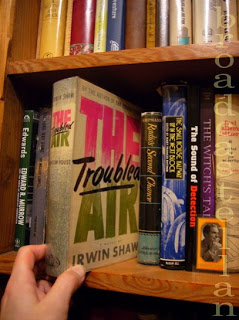 This being the birthday of novelist Irwin Shaw (1913-1984), I dusted off my copy of The Troubled Air (1951) to pay tribute to a radio writer who successfully channelled his anger and frustration by feeding it to the press, a rival medium that was only too pleased to get the dirt on broadcasting. Like his
  As usual, I am slow to catch up. A few years ago, the BBC relinquished the rights to televising the Oscars; and since we are not subscribing to the premium channel that does air them, I am relying on the old wireless to transport me to the events. So, here I am listening to …
  As much as I dislike mathematics and however arithmetically challenged I am without a calculator, I very much enjoy compiling lists and studying figures such as box office statistics. I am less interested in watching contemporary film than in finding out how many others have. It gives me an idea of what is popular without having to subject myself to yet another sequel of an indifferently constructed CGI clones. My kind of picture is, on average, at least half a century old. Today, I considered the list of films I have screened of late and rated them, on a scale from one to ten, at the Internet Movie Database. It is not an easy task, this kind of opining by the numbers, as I
  Not that I am entirely visual-minded on this my day of reckoning. Once again, I am cataloguing my library of books on broadcasting, a collection that has grown considerably since last I attempted to inventory it. While I am at it, I am scanning some of the covers, so aptly referred to as dust jackets and put them on display where they are more likely to tickle someone’s fancy rather than irritate throat and eye. Pictured are first editions of Francis Chase’s Sound and Fury: An Informal History of Broadcasting (1942), Charles Siepmann’s Radio’s Second Chance (1946), and fred allen’s letters, edited by Joe McCarthy (1965).
 There is “no glory in radio,” Allen remarked in a letter to Abe Burrows (
 Harry Heuser