

“I can’t figure you out. You’re silk on one side and sandpaper on the other,” a puzzled Jed Towers tells the deranged young woman who caught his eye. The film, Don’t Bother to Knock (1952); the stars, Richard Widmark and Marilyn Monroe. Widmark, who died today at the age of 93, might have been describing his screen persona: abrasive and easily frayed if you rubbed him the wrong way. There is another side, as well, to Widmark’s career as an actor. He started out being all voice, invisible to his audience. He was an established radio actor who hit the big time in pictures with his breakout performance in 1947 with Kiss of Death (revived on the air in this Lux Radio Theatre production from 12 January 1948).
 Widmark (shown here during a Theatre Guild broadcast, an image freely adapted from David R. Mackey’s Drama on the Air [1951]) entered broadcasting in the late 1930s. By the early 1940s, he had made a name for himself in daytime serials (Front Page Farrell, Joyce Jordan, MD) and proven his versatility in a number of plays produced by the prestigious Columbia Workshop. On Words at War, he was the narrator of “Gunners Get Glory” (9 May 1944), a dramatized account of a merchant ship torpedoed by a Nazi submarine. He was frequently featured on Cavalcade of America (here, for instance, in “The Man with the Cargo of Water” [12 September 1950]), Inner Sanctum Mysteries (in thrillers like “Make Ready My Grave” [23 April 1946]), and Suspense, where he was cast as “Mate Bram” (14 April 1952) in a chilling true-crime story of an amnesiac serial killer on the high seas who contemplates the horrors of the deed he cannot recall committing:
They put me in irons, locked in my own quarters. And here I’ll stay. There’ve been no more murders in the three days past, which does not stand in favor of another killer being aboard, and my being innocent. What I’ve written, my good friend, is the whole truth [. . .]. In my own mind, I am not convinced that I am guilty. For one reason, that however violent I’ve been, I have never killed before . . . before! Never . . . killed . . . before!
A few months later, after his performance in ”How Long Is the Night” (13 October 1952) Widmark was presented with the first annual “Golden Mike” award, being named “best actor” of 1951 by his peers, the regular radio performers who supported the guest stars on Suspense.
Like most film stars of the 1950s, Widmark continued to make occasional return trips to the broadcasting studio in adaptations of Hollywood movies (such as this Hollywood Soundstage production of “The Postman Always Rings Twice” [24 January 1952]); but aside from such standard fare, he was also heard in prominent parts of literary distinction, including the roles of anti-hero Winston Smith in an adaptation of George Orwell’s Nineteen Eighty-Four on the Theatre Guild program (26 April 1953) and Iago in a two-part adaptation of Shakespeare’s Othello that aired on Suspense (4 May and 11 May 1953).
In 1979, long after radio drama had become pretty much a thing of the past, or at any rate a marginal and neglected field of the performing arts in American culture, Widmark once more returned to the medium in which his acting career originated, performing in a number of plays soundstaged by the Sears Radio Theatre. Listening to his voice—”silk on one side and sandpaper on the other”—you can easily figure out why he was truly at home behind the microphone . . .


.jpg)
 “I don’t have much respect for biographers,” I once told John N. Hall, noted author of Trollope: A Biography and Max Beerbohm: A Kind of Life. I was being mischievous, knowing my professor to have a sense of humor that makes him just the man to examine the lives and fictions of the humorists who attract him. Indeed, I have rarely met an academic whose mentality was better suited to his subjects. I was not merely being facetious, though. I was also being honest. I don’t read biographies; not cover to cover, at least. I am too impatient to go through a series of incidents designed to trace the traits and career of a famous so-and-so to great-grandparents who were semi-literate peasants from Eastern Europe, to illustrate what impact the childhood agony of losing a balloon during a rainstorm had on an artist’s psyche, or explain what it really means to be a supposed nobody before becoming an alleged somebody.
 You might say that I am not easily impressed by facts and downright doubtful of them; that I am unconvinced a life can be told by means of sundry scraps of evidence culled from contemporary sources or the recollections of contemporaries whose lost marbles are dutifully dredged from the gully of memory lane. It’s all that; but I would like to think that respect has something to do with it as well—respect for a creative mind expressing itself in a work of art by someone who might not be willing or able to open up otherwise. In other words, I take what an artist is willing to give, even if the limited supply of such works are dictated, to some extent, by market demands.

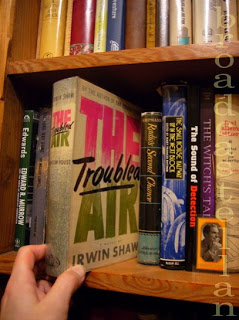 This being the birthday of novelist Irwin Shaw (1913-1984), I dusted off my copy of The Troubled Air (1951) to pay tribute to a radio writer who successfully channelled his anger and frustration by feeding it to the press, a rival medium that was only too pleased to get the dirt on broadcasting. Like his
  As usual, I am slow to catch up. A few years ago, the BBC relinquished the rights to televising the Oscars; and since we are not subscribing to the premium channel that does air them, I am relying on the old wireless to transport me to the events. So, here I am listening to …
  As much as I dislike mathematics and however arithmetically challenged I am without a calculator, I very much enjoy compiling lists and studying figures such as box office statistics. I am less interested in watching contemporary film than in finding out how many others have. It gives me an idea of what is popular without having to subject myself to yet another sequel of an indifferently constructed CGI clones. My kind of picture is, on average, at least half a century old. Today, I considered the list of films I have screened of late and rated them, on a scale from one to ten, at the Internet Movie Database. It is not an easy task, this kind of opining by the numbers, as I
  Not that I am entirely visual-minded on this my day of reckoning. Once again, I am cataloguing my library of books on broadcasting, a collection that has grown considerably since last I attempted to inventory it. While I am at it, I am scanning some of the covers, so aptly referred to as dust jackets and put them on display where they are more likely to tickle someone’s fancy rather than irritate throat and eye. Pictured are first editions of Francis Chase’s Sound and Fury: An Informal History of Broadcasting (1942), Charles Siepmann’s Radio’s Second Chance (1946), and fred allen’s letters, edited by Joe McCarthy (1965).
 There is “no glory in radio,” Allen remarked in a letter to Abe Burrows (
 Harry Heuser