
The Extinguished Lamp; or, Do You See Florence Nightingale?

I have been frequently miscast in the story of my life. And matters weren’t always helped by my being in charge of the casting. I was never more out of my element, which is neither quite earth nor air, as during those twenty months of civil service that I spent vaguely resembling a nurse’s aide. The stethoscope dangling around my neck may have fooled some of the patients some of the time; but my half-hearted attempts at hospital corners soon ruined whatever impression such a prop could have made upon them. Not that Hollywood fares any better in its imitations of strife, even though more harm comes to the reputation of the nursing profession than to the sick and injured by giving the so-called White Angel a tint of the Blue. Unless cast in minor roles, Hollywood nurses are as glamorous and rhinestonian as showgirls.

How much more realistic might the portrayal of those bed-pans carrying pulse-takers be once the pressure of making them look pretty—rather than the part—is removed? I asked myself that while listening to “White Angel,” broadcast on this day, 9 July, in 1946. Adapted for radio’s Encore Theater from the 1936 melodrama of the same title, the play stars Virginia Bruce (pictured) in the role of Florence Nightingale (impersonated on the screen by Kay Francis).

Even with the lights switched off, it was difficult for me to get the image of Ms. Bruce out of my head, to picture a nurse among the suffering and picture her suffering among them. As the title, “White Angel,” suggests, the portrait is altogether too clean to be genuine. At best, it is a eulogy, as idealized as Longfellow’s “Santa Filomena”:

A lady with a lamp shall stand
In the great history of the land,
A noble type of good,
Heroic womanhood.

Hollywood stars never truly disappeared when they stepped behind the microphone; not only did their names conjure up their faces, but their voices bespoke their presence. If sponsors paid for the services of a Ms. Bruce, they insisted on her sounding like Ms. Bruce. The audience, likewise, expected no less. Ms. Bruce does not disappoint; which means, of course, that she is altogether unconvincing as Ms. Nightingale. There is not a bead of sweat, not a drop of blood in her performance. Hers is the dignity of a socialite, of a lady serving cocktails rather than mankind in the Crimean.

“Why have women passion, intellect, moral activity—these three—and a place in society where no one of the three can be exercised?” Ms. Nightingale once asked. Hollywood could take you places, but it got you there in high heals and concealed the calluses. Reality, in the case of the Encore Theater, entered the stage only for a curtain call, during which Ms. Bruce spoke on behalf of the sponsor, the drug company Schenley Laboratories. Not to push penicillin, whose healing powers were extolled during the commercial break, but to urge the “Women of America” to do something more worthwhile than to dream of being Virginia Bruce:

“Today the need for nurses is desperate. If you are a high school graduate between the ages of 17 and 35, in good health, apply at the hospital nearest your home. Remember, nursing is one of the highest vocations a woman can follow.” After which bit of practical pathos the actress exited the broadcasting studio with a check for services rendered. Did any young woman walk into a hospital that week, saying “Virginia Bruce” sent me? And how many stuck it out not cursing the “White Angel” thereafter? I wonder.

Thanks for the Autograph. Now, Who the Hell Are You?

Don’t tell me. You’ve had a great time at the beach, enjoyed a picnic with friends and family, followed by a splendid fireworks display on a balmy evening. I mean it, don’t tell me! It’s been raining here for, let’s see, about three weeks, ever since my return from New York City; and today I read a forecast telling me that, after the “wettest June since records began,” July here in Britain is going to be a washout and that August and September “will not be worth waiting for.” Is it any wonder I am becoming more cantankerous by the minute?

To keep it gay, I dug up (and Ted Turnerized) this autograph a friend of mine from the indubitably sunnier and less lugubrious San Francisco sent me a few years ago. His mother was an avid radio listener and autograph hunter back in the pre-Television age I set out to recall in this journal. Previously, I’ve raided her collection for images of Baby Rose Marie, Rudy Vallee, and the Merry Macs.

So, who is this Del Casino? I reckon he is the same chap the Internet Movie Database insists on calling “Del Cansino,” a once popular singer whose star is rather a dark one by now. Perhaps that is not such an apt metaphor, considering that dark stars are at least detectable by their radio emissions, of which, in the case of Mr. Casino, there appear to be none.

Here he is, in an early 1940s “soundie,” crooning the pretty if none too memorable ”One Look at You.” You’d be able to tell a lot from one look at me just now; but you probably wouldn’t end up writing love songs about it. I’ll try to snap out of this mood and vow to return in good cheer anon.

The Bourne Imperative

Well, I’m not sure whether I could stomach Lorna Luft and Dallas alumnus Ken Kercheval in a touring production of White Christmas; but Matthew Bourne’s Bizet ballet The Car Man was certainly worth a trip to the splendid Canolfan Mileniwm Cymru (Wales Millennium Centre) in Cardiff Bay. Inspired by James M. Cain’s oft-adapted 1934 novel The Postman Always Rings Twice (revived on 24 January 1952 on Hollywood Sound Stage, starring radio stalwart Richard Widmark), The Car Man is set in mid-20th century small town America (the fictional Harmony, pop. 375), The Car Man tells the story of the titular drifter who falls for the accommodating wife of his new boss (a vixen named Lana, after the actress who played her in the 1946 film version). Though easily duped, the cuckold is bound to find out, eventually, and to be less than accepting of the triangular situation.

Unlike his whimsical if choreographically frivolous Edward Scissorhands (my impressions of which I shared previously), Bourne’s earlier Car Man is proper dance theater, with an exceptional performance by Michela Meazza as Lana.

While firmly within the tradition of 19th-century melodrama without resorting to camp, The Car Man bears no resemblance to Carmen. Indeed, the story as told in movement, light, and a generous amount of stage blood is far easier to follow than that of Bizet’s opera or the Prosper Mérimée novella upon which it is based, a plot comedian Ed Wynn insisted on translating for the listening audience of Tallulah Bankhead’s radio variety program The Big Show on 26 November 1950, as opera star Lauritz Melchior struggled to perform Pagliacci: “And as the curtain rises, we see Carmen walking out of the cigarette factory. We know it’s a cigarette factory because there are doctors walking in and out of the building.”

Those medical practitioners, of course, were meant to endorse tobacco rather than treat the workers or assess the risks of smoking.

“Carmen has many admirers,” Wynn continued, “and to each one of them she has given a lock of her hair. Isn’t that beautiful? So, Carmen, or as she is now called by her friends, Baldy, [. . .].”

Not that Mr. Wynn could have possibly prepared me for the theatrical experience of The Car Man. In keeping with his celebrated all-male revision of Swan Lake, the old love triangle has been colored pink; or, rather, it is getting another—an outré—angle, as Bourne tosses a male admirer of Lana’s lover into the bloody mix of lust, jealousy, and murder. Being granted views of a communal shower, a private bedroom, and life behind bars—or wherever else you might expect intimate encounters of the same and opposite sex on a sultry evening, Bourne’s audiences can and should expect the full bodyworks.

Cheerio, Helen Keller!

Well, I’m not exactly a “shut-in”; but being visited by a late bout of seasonal allergies and looking out, red eyed and slightly hung over, at what has been declared the rainiest June on record, I sure can relate to The Story of Cheerio, a copy of which 1936 autobiography I picked up at the rare books room at Manhattan’s legendary Strand earlier this month. According to the cover, Cheerio is the “intimate story of radio’s most beloved character who has dedicated his life to the spreading of cheer, hope and kindliness. With inspiring human stories from the homes of his radio audience of ‘shut-ins.”
Seems like someone shut up this hero of the homebound, Charles K. Field, whom former president Herbert Hoover applauded for his “altruistic” use of the radio, but of whose fifteen years in broadcasting little survives today. A vintage recording of Cheerio in action can be heard at the close of the 19 September 1956 edition of Recollections at Thirty. Now, I’m not sure how much sentiment I can take on a biliously rebellious stomach; but I’m glad I decided to leaf through this as yet unread volume yesterday, when I came across this letter from Helen Keller, who was born on this day, 27 June, in 1880. It is a birthday letter, no less, read on the air on her 55th birthday. “Dear Cheerio,” it reads,

this is my birthday message. Please tell them I like to think God has made his shut-ins special transmitters of hope to the world. It is our lofty duty to defy the seeming omnipotence of Fate. To love. To endure. And to create, from our own wreck, the thing we desire. If we succeed in growing the sweet flowers of happiness among the rocks and crannies of our limitations, others will be inspired to nobler achievement. This alone is compensation. This is joy and victory! As I stand at the doorway of a new birthday, with its new opportunities and new tasks of faith and courage, may I ask my handicapped comrades to rejoice, with me, in that inner vision which makes us superior to outward circumstances and enables us to be one with all great ideals, all heroism, all deeds of beauty. Sincerely yours, Helen Keller.

Though not able to listen to the wireless, Keller was no stranger to the airwaves. When the story of her teacher, Anne Sullivan Macy, was dramatized on the Cavalcade of America program (on 2 March 1938), Keller stepped behind the microphone for a brief message to the multitude. Cheerio, Ms. Keller, for making me come back to my senses on this shot-through-gauze, shut-the-blinds, best-slept-through Wednesday afternoon.

Shadow Players

When I read that Lamont Cranston is being resurrected for another big screen adventure scheduled to begin in 2010, I decided to catch up with one of the earlier Shadow plays. The Shadow, of course, always played well on the radio. On this day, 26 June, in 1938, he was again called into action when a “Blind Beggar Dies” after refusing to share his pittance with a gang of racketeers. The blind beggars alive to such melodrama and asking for more were millions of American radio listeners tuning in to follow the exploits of that “wealthy man about town” who was able to “cloud men’s minds” while opening them to the wonders of non-visual storytelling.

On the screen, the Shadow never quite managed to immaterialize; a previous attempt at delineating The Shadow on the screen, in the form and figure of Alex Baldwin, failed to attract audiences large enough to warrant a franchise.

Considerably less accomplished than the 1994 adaptation was the 1937 feature The Shadow Strikes, which bears little resemblance to the myth conceived for radio (initially as a mere sales gimmick for Street and Smith story magazines, publications popular during the first half of the 20th century).

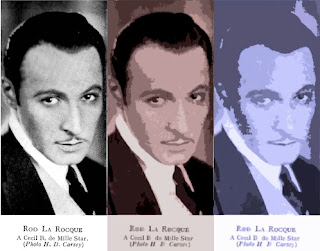
At just about the time when Orson Welles made his debut in the role on radio (as mentioned here), the mysterious crime fighter was impersonated on the screen by silent screen star Rod La Rocque, whose image I came across today while leafing through the recently acquired rarity Alice in Movieland, a gossipy little volume written back in 1927, when La Rocque was still remembered as a major Cecil B. DeMille player by, well, almost everyone:

You would have thought Rod La Rocque and Vilma Banky [the silent screen star with whom La Rocque was about to tie the knot] sure to be recognized at sight anywhere short of the South Pole. But not so!

At a preview of a DeMille picture at a Hollywood theater, seats had been roped off for the stars, as one among whom La Rocque was not being recognized by the usher.

Rod and Vilma crept away. Slow fade-out! I think, however, they did contrive later to annex the two worst seats in the theatre, behind a pillar of something. But all the easier to hold hands.

One of La Rocque’s last movies, The Shadow Strikes, is strictly of the ‘slow fade’ variety, even though the character La Rocque portrayed was so in the 1930s that a follow-up was released half a year later, featuring the same leading man.

Never mind that La Rocque does not get to utter that menacing laugh and is not equipped with mental powers superior to those of other popular crimefighting acts just outside the law, the Falcon, say, or the Saint. The producers of the movie did not even bother to check the spelling of the name of his alter ego when it appeared on the cover of a newspaper.

So, what fate awaits this great figure of 20th-century popular culture? Will he return only to receive a final blow, like a beggar too impoverished to pay up? Will those who watch him on the screen follow him back to the airwaves, into the shadows where he truly belongs?

Laddie of Burlesque: David Hyde Pierce Steps Through Curtains

This one seemed strangely familiar. It felt as if I had seen and heard it all before—which is not to say that the déjà vu was an unpleasant sensation. I am referring to Curtains, the final Kander and Ebb collaboration now playing at the Al Hirschfeld Theatre (pictured). Time Out New York called it ”your grandmother’s musical,” which bit of sexist ageism suggests dentures rather than bite. It so happens, I’m with grandma when it comes to a grand night out. At the theatre, that is. I take in musicals to be charmed rather than provoked, to be tickled or wowed rather than indoctrinated. Give me showtunes I can recall and perhaps even attempt to hum (at Marie’s Crisis, say, the Village piano bar where we spent a few hours of merry sing-along on Tony’s night). Besides, I’ve got a mirror for warts ‘n all.

So, Curtains is really my kind of show, if only it weren’t so obviously and deliberately steeped in Broadway musical history as to evoke other and unquestionably superior ones. A backstage murder mystery, Curtains is set in the late 1950s, which is a fine excuse for pastiche, as is its show within a show construction.

Most of its songs are echoes of the period (“Show People” is something you’d expect to be belted out by Ethel Merman), even though the show being rehearsed seems to date back to the 1930s and the sentimental “I Miss the Music” recalls the to me well-nigh intolerable Andrew Lloyd Webber, especially in the earnest interpretation by the to my ears miscast-for-comedy Jason Danieley. That the show is being tinkered with as its cast is being knocked off seems an excuse for the repetition of an inferior number like “In the Same Boat.”

Curtains, of course, offers its own response to captious reviewers “What Kind of Man?”:

What kind of putz
Would squeeze your nuts like that?

Musicals aside, what the show brought to my mind was The Lady of Burlesque (1943) starring Barbara Stanwyck, which I saw earlier this year (for an itemized list of my movie diet, turn right). In that comedy-thriller, a show must go on while a killer is on the loose and an investigation underway. In the case of Curtains, though, it is not the leading lady but the detective who takes center stage and—despite the obvious handicaps of lacking a leading man’s looks or voice, not to mention a convincing Boston accent—takes it in strides at that.

I happen to have been at the Hirschfeld on the day that the show’s male lead, Tony-winning David Hyde Pierce, lifted the curtain on his private life and came out of the closet at last; on stage, he was busy turning a double life into a single one (negotiating his love for musicals with the business of solving crime), and being single into a happy double (by teaming up romantically with one of the suspects). It might be “your grandmother’s musical”; but its leading man is finally breaking with conventions that seemed out-of-date two decades ago.

Great Match, Ill Served: Angela Lansbury and Marian Seldes in Deuce

Well, I had been given ample warning. About Deuce, I mean, the Terrence McNally play starring American Theater Hall of Famers Angela Lansbury and Marian Seldes. Reviewers and friends uniformly panned it. Not content to take their word for it, I set out to see for myself, only to confirm that Deuce truly is an insipid trifle of a play, a plotless, actionless one-acter whose greatest offense is its squandering of talent: two captivating leads let down by a leaden script and reduced to longshots by an extravagant set on the large stage of Broadway’s Music Box theater.

That set—the impersonal space of a tennis stadium filled with electronically simulated spectators (or spectres)—echoes and amplifies the hollowness of the production, but appears to have been designed (by Peter J. Davison) to give audiences certain to tire something to look at or look out for—as if Lansbury and her accomplished co-star weren’t reason enough to head out for the theater. They aren’t, if onlookers cannot zoom in on and get close to these two, as is warranted and promised by the potentially intriguing premise, the opportunity to eavesdrop on a private exchange between two celebrities dragged out of retirement and forcefully reunited for a belated tribute.

Their talk, however ably delivered, is devoid of anything amounting to revelations. They are long-ignored and finally acknowledged tennis legends who (surprise!) happen to be real women with long personal histories and strong opinions—opinions shared in lines so insipid that the playwright felt obliged to spice them up with profanities in hopes of getting spectators to stir, gasp and guffaw at expressions supposedly too vulgar to escape the mouths of our venerable elders.

You know you are faced with a dramatic dud when you open the Playbill to discover that even leading lady Lansbury struggles to give it to you in a nutshell too rotten to contain much good: “The play is about age—about becoming old and not being in the mainstream in the world of tennis today.” Who is the target audience? Martina Navratilova? Then again, it is also a “metaphor for age and the problem that women have with old age.” Like finding good parts, I suppose.

The gimmick of the play (and it is little more than that) is the juxtaposition of the real women behind the legend with the shallowness and vanity of the television sportscasters prattling overhead like a pair of false gods, a vapid chat (reminiscent of the characters created, to far better effect, by Christopher Guest in mockumentaries like Best in Show and For Your Consideration) in contrast to which the play offers next to nothing.

Deuce might be better served on radio, which is the ideal medium for intimate talk and character studies. Radio plays do not suffer from a lack of action or circular construction, from being anecdotal and fragmentary. Radio theater, which does not lose sight of its actors on enormous sets, is well suited to the conveying of an impression (a sense of dread, say) or the imparting of an idea. On the stage that sort of thing or nothingness is a deucedly bad one.

Now, I don’t care whether I’ll ever get to see another play by Mr. McNally (who’s rather more amusing, if similarly trifling Love! Valour! Compassion!, starring Nathan Lane, I saw back in 1995). I do mind, however, that this might have been my last chance to see Ms. Lansbury on the stage. As a swansong, Deuce is tantamount to Trog.

Some fifty years prior to her nonetheless Tony award nominated performance in Deuce, Lansbury played a retired stage actress on radio’s “outstanding theater of thrills,” Suspense,” in a melodrama titled “A Thing of Beauty” (29 May 1947). A woman willing to kill for a good part or to forge an alliance with someone she does not respect, she ends up having, quite literally, lost face. Now, there’s a metaphor!

The Confidante Game: Trading on That Old Acquaintance

Well, here’s an acquaintance worth making. Old Acquaintance, that is, the Roundabout Theatre Company’s revival of which is currently in previews at the American Airlines Theatre. Judging from the walkers and hearing aids on display at last Tuesday’s performance—not to mention the gas passed noisily in the lobby—I suspect that quite a few of the folks in attendance that evening got to see John Van Druten’s comedy during its original run back in 1940-41, while some of the friends of Dorothy’s we passed in the aisle were most likely on intimate terms with the 1943 film adaptation starring Bette Davis and Miriam Hopkins, two leading ladies on less than friendly terms.

Whether or not you (think you) are familiar with this story of a longtime rivalry redefined as friendship, the Roundabout production is likely to teach you a lesson or two about the nature of that least clearly defined of social compacts and about Hollywood’s (s)elective affinities with Broadway.

I caught up with Vincent Sherman’s soon-to-be-remade melodrama (and one of its radio versions) only after seeing the play, which made me appreciate the stage version’s maturity all the more. Van Druten, who was involved in the screen adaptation of Old Acquaintance, sure learned how to compromise in order to make it in Tinseltown. That he turned his sparkling comedy into an even larger crowd-pleasing sentimental melodrama is all the more remarkable considering that the English playwright’s first drama, Young Woodley (1925), had initially been banned in Britain for its treatment of sexual awakening. Production code conformity in the case of Old Acquaintance—as in most cases—meant turning mature women with careers as well as sex lives into silly girls or stoic old maids.

The silly girl in the Hollywood version is Miriam Hopkins, whose Millie is so envious of the publicity enjoyed her novelist friend Kit that she, however ill equipped for literary fame, turns to the writing of romances. The old maid is Bette Davis, whose romantically luckless Kit is willing to hand down her much younger lover to Millie’s daughter, Deidre, for which sacrifice she is duly rewarded with a cup of human kindness, shared with a remorseful Millie by the fire that warms them when the heat of passion is no longer in the Hallmark cards.

All this bears little resemblance to Van Druten’s original three-act play, a witty, tightly constructed comedy of manners. As one astute online reviewer of the movie points out, it becomes difficult to understand why Kit and Mollie became such old acquaintances once their careers are pushed into the background. In the stage play, it is Millie who, though a trash novelist herself, enjoys Kit’s respect as a keen and candid editor of Kit’s ponderous, overly analytic storytelling. However different in temperament, Kit and Mollie come across as equals, which explains at once their closeness and their rivalry.

On stage, Old Acquaintance echoes La Rochefoucauld’s maxims that friendship is “nothing but a transaction from which the self always means to gain something” and that in the “misfortunes of our friends we always find something that isn’t displeasing to us.” Concurring with the latter, satirist Jonathan Swift remarked about his relationship with fellow authors:

To all my Foes, dear Fortune, send
Thy Gifts, but never to my Friend:
I tamely can endure the first,
But, this with Envy makes me burst.

In the 2007 Broadway revival, Margaret Colin’s Kit is less pathetic than Davis’s, while Harris’s portrayal of Mollie is more sympathetic than that of Hopkins (who reprised her role, opposite miscast Alexis Smith, in the 29 May 1944 Lux Radio Theatre production). If not nearly as assured and brilliant in her comic timing or line reading as Rosalind Russell, with whom in mind the rights to Old Acquaintance were secured by Warner Brothers, Colin is both real and regal. Davis, who was asked to drop her pajamas to expose her less-than-glamorous legs, is matronly by comparison, suggesting that she sacrificed her juvenile beau to play surrogate mother to her best friend’s daughter.

The marvellous Harriet Harris, in turn, hands Millie back her brains. Whereas Hopkins’s character comes across as an impulsive, overgrown schoolgirl, spiteful and pouting, Harris’s Millie is calculating, smart, and rather dangerous (not unlike her Tony Award winning Mrs. Meers, in Thoroughly Modern Millie and her scheming Felicia Tilman in Desperate Housewives). Not content to see her best friend succeed, Millie intends to succeed her in fame and fortune. Her dramatic outbursts are an expression of her frustration when she realizes that the unmarried and childless Kit is not only a better mother to her daughter, but that she might also have been a better, and more desirable wife to her former husband.

If you prefer expensive theatre seats to cheap Hollywood sentiment, the revival of Old Acquaintance is your ticket.

[At the time of writing this I was as yet unaware that, before becoming a playwright, John Van Druten taught in Aberystwyth, the Welsh town to which I relocated from New York City in 2004.]

Digest, Please!

Well, it’s a different kind of animal. The kind that digests in the very instance of ingestion. Webjournalism, I mean. It matters little whether or not you write for a living, as long as you write what you are living while you are living it, while you experience or witness what is being stored and storied. My digestive system operates far less efficiently, I’m afraid, which is why I frequently end up with a digest of my day-to-day.

It is not that I regurgitate the past. I very much live in the moment, a skill (or nearsightedness) I developed living the United States, the empire of “now.” And yet, by the time I manage to keep up with them, those moments have lost their momentum. They are memories the writing down of which is the reheating of yesterday’s repasts. Instead of journalizing my journey as it happens, I delay the act of relaying it by sharing recollections edited, according to a Wordsworthian scheme of spontaneity, in motionless and remote tranquility.

This is what I feel compelled to do now—catching up with myself. After all, taking bites out of the Big Apple for a month left me with plenty to digest, even if some of pieces of my intake turned out to be as unpalatable as the Tony Award-winning musical Spring Awakening or as bland as the Terrence McNally’s Deuce, a sentimental exchange starring the ill-served if indefatigable Angela Lansbury.

Only a few days ago I spent an afternoon at Coney Island, walking past Nathan’s (not eating the hot dogs that once got me terribly sick) and riding the old Cyclone—whose twists and curves once caused me to break the bones of my best friend sitting beside me. Today, I am cleaning up after a sick dog that swallowed a bone far too large to be digested, hoping he will be spared an operation, hoping I am going to be spared something akin to “The Odyssey of Runyon Jones” (Norman Corwin’s radio play about a boy determined to retrieve his dead dog from “Curgatory”).

It is retrospection that saves me from exposing myself at my most vulnerable—in the in-between of everyday living. It is life tidied up and tied up neatly. It is loose ends woven into a security blanket. Digest, please!

Murder in the Backroom; or, No Place for a Lady

Well, they are still at it. Slamming doors, screaming bloody murder, getting into fisticuffs—all in a perfectly orderly manner, standing upright, their eyes focused on the sheets of paper in their hands. The W-WOW! players, I mean, who meet on the first Saturday of each month, from September to June, to step into the “broadcasting” studio in the (pictured) backroom of the aforementioned Partners & Crime bookstore on Greenwich Avenue in downtown Manhattan

Last night, for their final performance before going on summer hiatus, the W-WOW! troupe recreated episodes from Broadway Is My Beat (“Francesca Brown,” originally broadcast on 2 June 1951) and Richard Diamond, Private Detective (“The Carnival Case,” from 16 August 1950). Capably delivering their lines, the two leading men—Steven Viola as Danny Clover in Broadway Is My Beat and Michael H. Johnson as Richard Diamond—were more than amply supported by the four ladies of the fancifully titled Cranston & Spade Theatre Company. Indeed, they were upstaged by them, and that despite the fact that the titular character of the evening’s first offering was dead before the action got under way.

Sheila York brought sex appeal to the role of a carnival gypsy who beckons Diamond into “the inner sanctum,” which gives the leading man a chance to quip: “Haven’t I heard you on the radio?” As a former DJ, the woman who played her sure has experience in broadcasting. And aside from being a competent voice artist, York is also a published novelist who draws inspiration from the medium in which she worked. Her latest thriller, A Good Knife’s Work, takes readers inside the business of radio drama in the 1940s—with a female detective as a guide.

Voice-over artist and teacher Karla Hendrick has a voice most likely to succeed in that business, standing out even in parts no larger than that of a gum-chewing waitress cracking wise with the gumshoe. In charge of musical transcription and accompaniment was Heather Edwards, while DeLisa M. White handled the sound effects, delivering blows and popping balloons according to the cues in the script.

For now, the ladies of W-WOW! are adjuncts to the dramas presented by the players, deliver commercials, play sidekicks, sirens, or servants. Sure, Diamond’s girlfriend Helen knows how to handle a gun (as is demonstrated in one of the script’s sly takes on traditional gender roles); but maybe the company should take on some of the radio thrillers featured in Jack French’s Private Eyelashes and revive that rare breed of crime-solving radio heroines. So, how about it, Messrs. Cranston & Spade?