On This Day in 1943: Silent Screen Legend Dies on the Air

Some thirty years after making her debut in silent movies, Lillian Gish became all voice when, on 9 September 1943, she appeared before the mind’s eye of listeners to CBS’s thriller anthology Suspense. Gish’s performance in the play “Marry for Murder” was announced as one of the “rare radio appearances” by a star who “occupied a unique place in the affections of moviegoers ever since the screen first became of age.” Together with her sister Dorothy (left, in a picture taken from Billips and Pierce’s informative Lux Presents Hollywood), Gish had twice performed on the then new and ambitious Lux Radio Theatre, assuming the part of Jo in “Little Women” (21 April 1935) and recreating one of her most famous silent screen roles in “Way Down East” (25 November 1935)—but that had been years ago in the early days of network drama.

You had the right to remain silent, dear

In the late 1930s, she had twice been a panelist on the celebrity quiz program Information, Please and was later to act in a number of dramatic anthologies and variety programs, including Arthur Hopkins Presents and the Theater Guild on the Air. In a medium that demanded and devoured talent daily, her isolated guest spots had been few and far between. Even more rare had been her roles in film after the demise of her mute métier (Top Man, her fourth sound film, was to open in the US a few days after the “Marry for Murder” broadcast); so, the sounding of a silent screen belle must have remained somewhat of a novelty act to many American listeners. Unfortunately, the evening’s entertainment had little of the grace and passion of Miss Gish’s celebrated on-screen histrionics.

Heard again tonight on the WRVO Playhouse, “Marry for Murder” is a routine affair, an is-she-or-ain’t-she thriller that requires little guess work from the audience and yields even fewer surprises. It is a story told too often—and often better, too—on Suspense. Still, the tone of Ray Collins’s narrative and the ominous sounds of the fog horn add some slight intrigue to the Way Down East yarn of recent widow and newlywed Letty Hawthorne, “a frightened, neurotic creature who seemed destined to be a perfect victim” for her domineering husband.  Living rather close to “Philomel Cottage” or taking more than a page out of “The Diary of Sophronia Winters,” aren’t they?

The story is told from the perspective of Letty’s friend Phil (Collins), an attorney who was called upon to assist in drawing up a new will for Letty’s husband Mark. When Letty expresses herself anxious to compose a will as well, Phil—a lover of whodunits—speculates whether Mark might not have urged his wife to do so in order to do her in and get her dough. Heard through a filter, Letty’s words “but if I’m found dead” repeat in Phil’s ear until he is convinced of Mark’s villainous intentions. That is, until . . .

Since the three-character play opens with the announcement that Letty is dead, the directions the plot could take are rather limited (unless we are to distrust Phil’s narrative altogether). Radio thrillers often suffer from simplifications, restrictions demanded not only by the lack of time allotted to each play in a medium catering to commerce but by the difficulties aural drama poses for an audience that struggles to take in complex information when playing a puzzle by ear.

“Marry for Murder” might still have been an intriguing character study, like those starring the formidable Agnes Moorehead. Ms. Gish, alas, overdoes the contrast between mousy and monstrous, and her line readings are not always assured. Her Letty here bears little resemblance to her haunted namesake in The Wind (1928), her final silent. Now, I won’t stoop to saying that the actress was a Gish out of water—but she was not quite in her element here. Let’s see whether I can manage to dig up a more satisfying anniversary tomorrow . . .

“We interrupt this broadcast”; or, How to Be Away

Well, as I’ve been casting it broadly in the previous three posts, I’m off on a weeklong visit to Madrid. Sure, I could have taken my laptop along with me to continue my journal while away; or I might have taken a mobile phone to send messages and images (like the one here, of this morning’s glorious Welsh sunrise) on the go. Instead, I decided to leave both computer and phone at home and to sign off for the duration.

The privilege of being away appears to be one of the disappearing pleasures of privacy. It is a concept no longer readily grasped by those born in the cellular, wireless, and instant-message age. Perhaps that is why the television series Lost has become such a success (surely it is not the writing): to be unavailable to the world is now thought of as a loss tantamount to being shipwrecked. Treat yourself to a retreat some time. Avail yourself of a chance at being unavailable.  Experience the abandon of abandoning your everyday.  To have something to write home about . . . and keep it.

You don’t have to get all Piano Manly about your getaway. Just tell those you care about that you’re out of town or country and enjoy the freedom of being incommunicado. Tell the world to get lost, then shroud yourself in silence.  As long as there is someone or something worth coming back for, eventually . . .

“A symmetry of unborn generations”: A Guernica for Radio

One of the many attractions of Madrid I will make sure not to miss is Picasso’s Guernica (1937), the most famous 20th-century painting in the Reina Sofía collection. A report from the commonplace-turned-combat zone, Guernica is a piece of anti-totalitarian propaganda commemorating the world’s first civilians-targeting air attack: the 26 April 1937 raid on the busy market town of Gernika-Lumo, masterminded by General Franco and carried out by the Condor Legion of Nazi Germany.

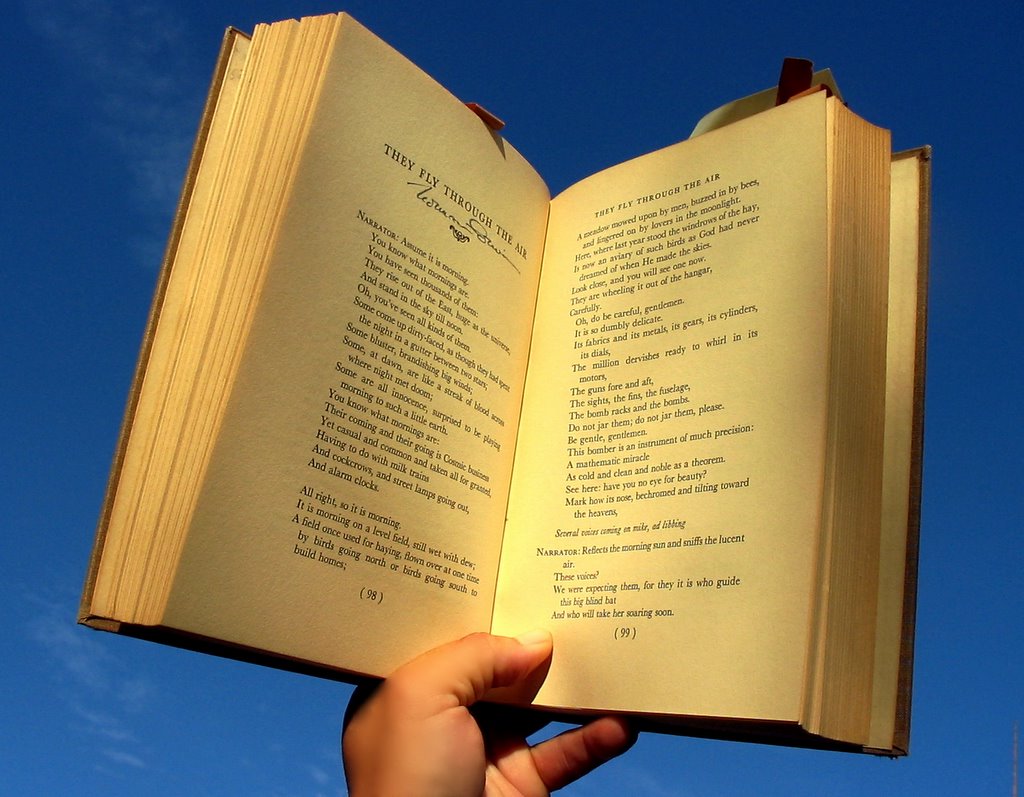
Holding up to the sky my copy of Corwin’s play “They Fly Through the Air,” signed by its author

For a long time, the painting was kept out of Spain and was mostly on display at the MoMA in New York City, where, during the Vietnam War, it became a site for vigils held by members of the peace movement, one of whom went so far as to deface it with red spray paint. It was Picasso’s wish that Guernica be returned to his homeland only after the reestablishment of democratic rule. A swiftly executed and brutally manipulative commentary on modern warfare, it invites comparisons to the three best-known American verse plays for radio, Archibald MacLeish’s “Air Raid,” Edna St. Vincent Millay’s “Murder of Lidice,” and Norman Corwin’s “They Fly Through the Air with the Greatest of Ease.”

MacLeish’s “Air Raid,” in contrast to Picasso’s painting, overtly implicates the civilian population, including his radio listeners, castigating them for their supposed ignorance and inertia. As in “The Fall of the City,” MacLeish attacks those falling rather than sentimentalizing their plight. His are bold performances, but his cruel warning turns listeners eager for news into silent partners of war who are asked to “stand by” as they tune in while women and children, refusing to heed warnings of an impending blitz, are being attacked and annihilated:

You who fish the fathoms of the night
With poles on roof-tops and long loops of wire
Those of you who driving from some visit
Finger the button on the dashboard dial
Until the metal trembles like a medium in a trance
And tells you what is happening in France
Or China or in Spain or some such country
You have one thought tonight and only one:
Will there be war? Has war come?
Is Europe burning from the Tiber to the Somme?
You think you hear the sudden double thudding of the drum
You don’t though . . .

Not now . . .

But what your ears will hear with in the hour
No one living in this world would try to tell you.
We take you there to wait it for yourselves.
Stand by: we’ll try to take you through. . . .

Millay’s “Murder of Lidice” recalls the innocent lives of those slain by Richard Heydrich, Deputy Reich Protector of Bohemia and Moravia, in Lidice. Artistically, the play is indefensible and shockingly inept in its bathos. In Millay’s Grand Guignol of Nazi terror, Heydrich the Hangman, whom the villagers have assassinated, is heard, from the beyond, planning his revenge:

He howls for a bucket of bubbly blood—
It may be man’s or it may be of woman,
But it has to be hot, and it must be human!
Oh, many’s the sweet warm throat he’ll suck.

In “They Fly Through the Air,” Corwin’s narrator goes in search of a language appropriate to the negotiation of art and propaganda. As I point out in Etherized Victorians, the play is a response to the perversion of poetic diction by the fascist cause. Viewed from above, Mussolini reportedly remarked, exploding bombs had the beauty of a “rose unfolding.” Throughout the play, metaphors are at war with plain speech, both in the service of motivating the masses:

What words can compass glories such as we have seen today?
Our language beats against its limitations [. . .].

Our rhythms jangle at the very start.
Our similes concede defeat,
For there is nothing that can be compared to that which lies beyond compare.
You see? We are reduced already to tautologies.
It’s awe does that.
The wonder of it all has set us stammering.

What is the language of war? How does it differ from the idiom of peace? And how shall war—often furious but not always futile—be rendered, recorded, and remembered in words or images? When I look at Guernica this week, I will ask myself these questions. Quite possibly, I will shiver when exposing it to the limitations of my shrinking lexicon.

Flinging the Book: Archibald MacLeish, the Airwaves, and the Anniversary of Atahuallpa’s Death

Archibald MacLeish (right) with (from left to right) Orson Welles, Betty Garde, and Ray Collins in rehearsal for Air Raid (1938)

Well, I thought I’d better carry on with my Spanish lessons, having discovered, upon leafing through the travel guides, that I am not merely linguistically challenged but culturally ignorant as well.

 According to one guidebook (admittedly, a someone dated volume), the citizens of Madrid—the madrileños—have a “lingering suspicion of foreigners” and are reluctant to speak English. Granted, it’s been a while since conquistadors rather than tourists filled Spain’s coffers, but the Spaniards have been known to be somewhat insensitive when it comes to other cultures. There sure is dirt under the old welcome mat.

On this day in 1533, for instance, Francisco Pizarro put an end to the Incan empire by doing away with emperor Atahuallpa. The Incas were not a chirographic people and did not appreciate having the book flung at them—especially not the good book. Intrigued by the thought that the demise of the Inca meant not only the loss of their aureate treasures but of their aural tradition, I flung my travel guides aside and tuned in again to one of the more ambitious if lesser known American radio series of the 1940s, Archibald MacLeish’s American Story.

A Pulitzer Prize winner for his poem Conquistador (1933), MacLeish (above, right, in a photograph reproduced in Irving Settel’s Pictorial History of Radio), was one of the first American writers to take radio seriously and to encourage others to emerge from their ivory towers by broadcasting their choice words to the masses. After all, he remarked in the foreword to The Fall of the City, his first and most significant contribution to the aural arts, “what poet ever lived who was really satisfied with writing the thin little books to lie on the front parlor tables?”

As a Librarian of Congress, MacLeish enjoyed ready access to many an obscure document—and radio offered an opportunity of sharing this wealth of unheard words. Rather than dramatizing scenes from history books, MacLeish wanted to let ancient texts speak for themselves:

To place historical personages in historical situations and then imagine the words they must have spoken to each other is to imitate the historical dramas of the stage at the expense of radio’s unique function and unique opportunity.  Because radio is limited mechanically to sound, and particularly to the sound of speech, radio is capable of a concentration upon the speech itself, the text itself, which can give words a life and a significance they rarely achieve outside the printed page—and which they achieve there only for the most gifted and fortunate readers.

In “The Many Dead,” one of the scripts for the American Story series, MacLeish drew on the writings of Pizarro’s secretary Francisco de Xeres to recount the death of emperor Atahuallpa. In order to convey this sobering story without turning it into sensational melodrama, the poet-historian chose to deliver the “pertinent excerpts” of Xeres’s official account in the somber and matter-of-fact voice of a clerk, a newscaster of his time:

The Governor [Pizarro] asked the Father Friar Vicente if he wished to go and speak to Atahuallpa with an interpreter. He replied that he did wish it, and he advanced with a cross in one hand and the Bible in the other [. . .] and [. . .] thus addressed him: “I am a Priest of God, and I teach Christians the things of God, and in like matter I come to teach you. What I teach is that which God says to us in this Book [. . .].”

Atahuallpa asked for the book that he might look at it, and the priest gave it to him closed. Atahuallpa did not know how to open it, and the Priest was extending his arm to do so, when Atahuallpa, in great anger, gave him a blow on the arm, not wishing that it should be opened [. . .].  Then he opened it himself, and, without any astonishment at the letters and paper, as had been shown by other Indians, he threw it away form him five or six paces . . . .

Then the Governor put on a jacket of cotton, took his sword and dagger, and, with the Spaniards who were with him, entered amongst the Indians most valiantly.
 Then the Governor put on a jacket of cotton, took his sword and dagger, and, with the Spaniards who were with him, entered amongst the Indians most valiantly.

According to Xeres’s account, Pizarro and his men “fearlessly seized” Atahuallpa and the infantry of the Spaniards “made so good an assault” on the fleeing natives that “in a short time most of them were put to the sword.”  Pizarro was said to have protected the emperor from the Spaniards—to give him the benefit of a proper execution—and was slightly wounded as a result.  “It was a very wonderful thing,” the clerk concludes, “to see so great a lord taken prisoner in so short a time [. . .].”

The men with the books have generally proved victorious over the vocal but readily muted thinkers who spread their words without the benefit of the printing press. Atahuallpa, bereft of his voice after rejecting the book, chose death by strangulation. Even MacLeish, as Librarian of Congress, largely failed in his attempt to return written records to the air and revive the breath that gave them life. Who, after all, still listens to his American Story today?

Now, I hear that the madrileños are a noisy, boisterous people; perhaps the powerful, silencing, and not-so-good book instilled them with confidence. . . .

Back in the X Factory; or, the Legacy of Major Bowes

Today marked the beginning of the second season of The X Factor on ITV1. It had pathos, it had romance, and it had its fair share of wackiness—just like Major Bowes’s Original Amateur Hour. The Major, pictured left in his lavish New Jersey home, was the first talent scout to enter broadcasting, to captivate and to make millions. According to radio historian John Dunning, the “rise of Major Edward Bowes in the summer and fall of 1934 led to a national rage of frantic and sometimes tragic proportions.” It offered hope to many a poor laborer and fueled the delusions of many a talentless wretch.

Major Bowes in a contemporary publicity photo

To get on Bowes’s programs, contestants were known to have sold their homes and hitchhiked to the studios of the Columbia Broadcasting System in New York City. Back in 1935, Bowes’s program attracted up to 10,000 amateurs a month, of which about 25% could audition each week.   Of these 500 to 700 hopefuls, twenty were chosen to perform on the Major’s weekly broadcasts, a ratio of rejection that, during the Great Depression, caused hundreds of homeless rejects to apply for shelter in the Big Apple.

The X Factor does not come close to such real life drama, of course—drama, that, back then, was not part of the program, but the harsh reality behind the scenes.  Still there were poignant moments of blind ambition on tonight’s X Factor premiere, snapshots that told of shattered dreams, thwarted ambitions, and years of therapy.  How dairy farmer Justin, who returned as drag queen Justine to win over the flabbergasted judges, got through the audition process must be attributed to the producers’ desire to stir up controversy and keep reality-show fatigued audiences watching and voting.

Simon Cowell may have claimed to be in search of someone “normal” this time around, but the producers certainly seem to be after amateurs with the F factor—freaks to be gawked at, fools to be ridiculed, and frumps to be pitied.  The Major, who cut off performers with his gong, was accused of setting up contestants for ridicule as well, even though he denied such charges.  Then as now, the audience went for the joy ride and flocked to the public beheading of swellheaded nobodies and self-awareness lacking airheads.

The major auditioned all sorts of wannabes, such as jugglers, tap dancers, and mimes—which, to be sure, did not make for the best in aural entertainment. On The X Factor, the moves, the make-up, and the general stage presence is all part of the act, to be appreciated or, if wanting in quality, deplored by those tuning in.  As in the case of 16-year-old Trevor, appearances and voice might be at odds, leaving viewers to decide whether vocal cords really matter more than personas in today’s celebrity business. 

Once the audition clip shows are over, contestants will be given a chance to call in their votes.  The Amateur Hour was interactive as well. Each week the program aired, an American town was chosen as a so-called “honor city,” which made its citizens eligible to cast their votes along with the NYC audience. Votes were phoned in or submitted in writing.

As is the case for programs like American Idol today, talent was later sent on tour across the country.   Yet whereas today’s instant celebrities are given the opportunity to make a fortune, the Amateur Hour, which made Major Bowes a millionaire, at best secured found talent a salary of $100 per week.

Today, even the William Hongs among the contestants get lavished with record contracts. Don’t remember William Hong? Well, I guess his 15 minutes of infamy were up last fall.  The main question for me as I tune in to The X Factor is whether there will be another Rowetta.  Don’t remember her either? Major Bowes’s gong sure is beaten faster these days.

Spotting “The Mole on Lincoln’s Cheek”; or, The Free Company We Didn’t Keep

My headphones have been buried so deeply in the sands of time that I have only recently begun to pay attention to the mission of Cindy Sheehan, to the anti-war movement she seems to have reinvigorated, and to the controversy she is stirring by insisting on talking to the US president at his ranch down in Texas. The American home front is showing signs of battle fatigue. Well, perhaps the phrase “home front,” so commonly used during World War II, is inappropriate these days, considering the lack of universal support the Iraq-centered war on terror has been receiving.

Expressions of frustration, confusion, and anger seem to become more forceful and frequent as, after years of fighting, both the end of the war and the ends of it remain uncertain. Is it illusory or perhaps even misguided to hope for a voice of reason to unite the masses, a voice not strident yet unequivocal, not irate but assertive, not jingoistic but inspirational? Radio once seemed to have given nations such a voice, but was often in danger of becoming the medium of fascism.

Unlike those who go indifferently about their business while being mute beneficiaries of democratic freedoms, few protesters would deny that American ideals are worth fighting for in words and actions; indeed, people like Sheehan, a mother who lost her son in combat, are fighting for the realization of such ideals by insisting on publicly voicing their concerns, concerns that by now are shared even by many of those responsible for the reelection of the US president in 2004.

The question on the minds of many Americans and their allies today is, of course, whether the war in Iraq has in any constructive way contribute to the defense of their freedoms or whether it might not have further endangered them either directly (through increasing acts of global terrorism) or indirectly (through anti-terrorist measures curtailing civil liberties).

It is a mistake to assume, however, that, in 1942, US citizens were any more united about going to war then they are now, or that they had a clearer understanding of the stakes and aims of such an enterprise. As I learned from Gerd Horten’s book Radio Goes to War, a government survey revealed that half of those questioned just months after the attack on Pearl Harbor were not even sure what the war was about. Many had been convinced to embrace an isolationist position. Media tycoon Randolph Hearst was one of the most influential figures to warn Americans that war was bad because it was not good for business. And radio was big business.

Back then, noted American playwrights, journalists, and novelists spoke up against isolationist—that is anti-war—propaganda, reminding citizens that inertia could mean surrender to fascism, that there are nearly as many wrong reasons for not going to war than they are for engaging in it.

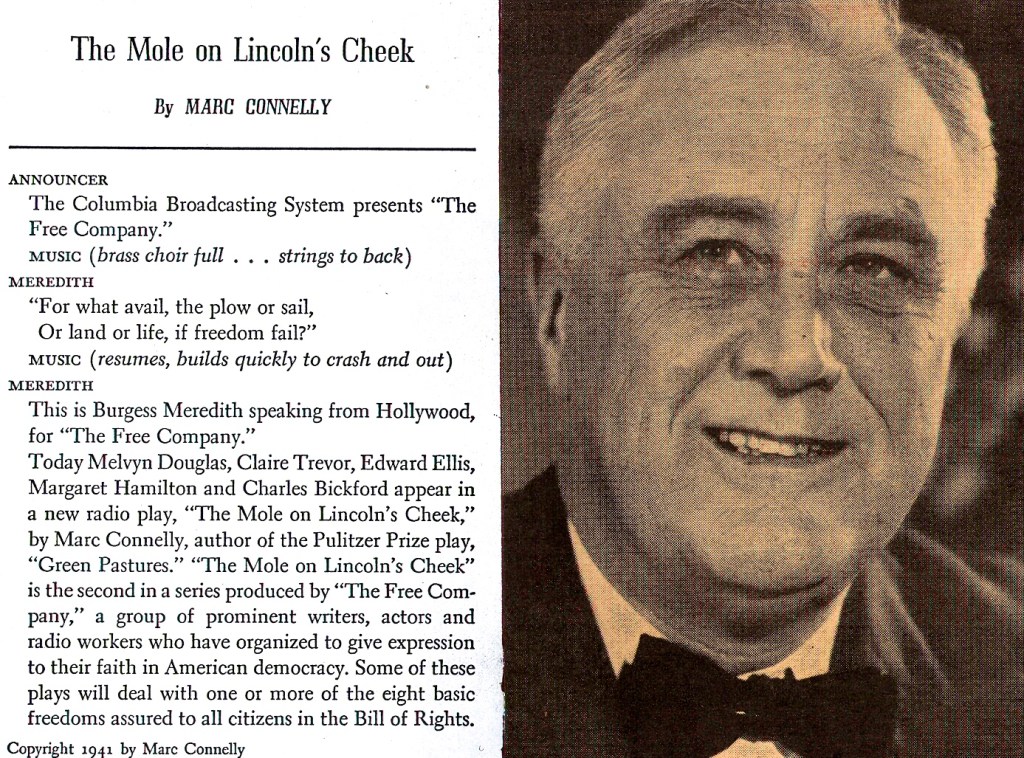
One such group of artists who set out to inspire the American public in the months prior to Pearl Harbor was the Free Company, a “group of leading writers, actors and radio workers who had “come together voluntarily to express their faith in American democracy.” They were “unpaid, unsponsored and uncontrolled. Just a group of Americans saying what they [thought] about [America] and about freedom.” And they chose a commerce-driven medium like radio to bring their point across.

As Burgess Meredith told the radio audience of Marc Connelly’s play “The Mole on Lincoln’s Cheek”: “Our freedom [ . . . ] has this meaning . . . that here, in our land, the truth may be taught, always.” He urged Americans to “resist all attempt to suppress truth or to distort it. Let us consider again,” he continued,

the most powerful words ever spoken against the enemies of man—the lightning-charged words of Lincoln at Gettysburg. And let us renew, in this threatening hour, his high resolve that the government of the people, by the people and for the people shall not perish from the earth.

Could a group like the Free Company—which consisted of Pulitzer Prize winners including Maxwell Anderson, Archibald MacLeish, Stephen Vincent Benét, Marc Connelly, and Paul Green—unite for a series of radio (or television) broadcasts today to unite a largely disillusioned people divided by confusion and cynicism, a people more eager to expose the mole on Lincoln’s cheek than to conceal it?

Would they deem a continuation of the present war unjustifiable or argue a withdrawal from Iraq to be a surrender to terrorism? And just how open would a skeptical public be to any effort to “resist all attempts to suppress truth or to distort it,” how willing to accept any attempts to achieve a consensus?

“God and Uranium”: Corwin, VJ Day, and the Disorientation of American Culture

Today, August 14, marks the 60th anniversary of VJ Day—the supposedly glorious day ending the second World War, a day of triumph in the wake of terror and devastation in Hiroshima and Nagasaki. On US radio, poet-journalist Norman Corwin commemorated the event with this hastily composed script:

Congratulations for being alive and listening. 

Millions didn’t make it. They died before their time, and they are gone and gone, for the Fascists got them. . . .  

Fire a cannon to their memory!

[Cannon.] 

God and uranium were on our side.

And the wrath of the atom fell like a commandment, 

And the very planet quivered with implications. 

Tokyo Rose was hung over from the news next day 

And the Emperor, he of the august stupid face, prayed to himself for succor. 

Sound the gun for Achilles the Atom and the war workers: Newton and Galileo, Curie and Einstein, the Archangel Gabriel, and the community of Oak Ridge, Tennessee.

Jubilantly joining the concept of God and the reality of uranium as if blessing the killing of thousands of civilians by the US and their allies, the celebratory broadcast titled “14 August”—expanded and rebroadcast five days later as “God and Uranium”—is one of Corwin’s few artistic misfires; insensitive, smug, and crudely patriotic in its derision of the “stupid”-looking emperor and his nuked subjects.

Did Americans really need to commemorate the dead by “[s]ound[ing] the gun,” by firing yet another cannon? After all, it was US weaponry, not “the Fascist,” that “got them” over in Japan. Unlike the subdued “On a Note of Triumph,” “God and Uranium” is an unquestioning sanction of total warfare, of nuclear means justifying the end—the end of a culture: “The Jap who never lost a war has lost a world: learning, / This too is worth a cheer.”

The “very planet quivered with implications,” all right, but the broadcast does not acknowledge the potentially terrible consequences of nuclear armament. These days, the implications continue to make themselves felt as more and more nations join the “community of Oak Ridge, Tennessee” and aspire to becoming atomic superpowers.

Instead, rather too sure about a peaceful future, Corwin’s salute to the victors asserts that the “peoples have come a long way since the time of Cain.” He claims that, “[e]ffective 15 August, peace, its care and handling, becomes our ward.” It appears that the US still fancies itself to be such a “ward,” imposing its views onto the world, jeopardizing the lives of thousands of civilians in a quest for a Western-centric conception of peace.

“14 August” was “written overnight, alas,” Corwin remarked somewhat apologetically shortly after the war; it was a project he did not want to accept at the time. A mere two and a half months later, on October 29, 1945, he offered far more sobering reflections of atomic power with “Set Your Clock at U235,” a broadcast that contributed to the appearance of his name in Red Channels:

Now we are in it together:

The rich with their automatic comforts, and the family bunkering seven in a room. 

The highly trained, who understand the poems and the engines; and those whose culture measures five hundred words 

across the middle: Old people tired of wars and winters, and children who do not yet know they are made of matter: 

The famous face in four colors, nationalized on the cover of the magazine; and the crowd face, the background face, gray, nameless, out of focus: 

Now we are in it, in it together.

The secrets of the earth have been peeled, one by one, until the core is bare:

The latest recipe is private, in a guarded book, but the stink of death is public on the wind from Nagasaki: 

The nations have heard of the fission of the atom and have seen the photographs: skies aboil with interlocking fury, mushrooms of uranium smoke ascending to where angels patrol uneasily.

As if coming to his senses after having toasted victory rather too shrilly, Corwin encouraged listeners to “reset the clock.” No longer was 15 August proposed as a ringing in of peace, but as the beginning of a new age of terror. As such it now behooves us to consider the legacy of VJ Day—the ticking of the atomic clock, the spiral of retaliatory actions, and the fallacy that a war well waged could end all wars. 

After all, we are still “in it together. . . .”

The Caterpillar and the Butterfly: Fantasy Metamorphosed, from Corwin’s “Curley” to Burton’s “Charlie”

When I dipped my toe into the cool Irish Sea yesterday afternoon, I thought to myself “How detached I am from the enveloping present, how remote from the surrounding world.” Sure, I dip into the currents of culture now and again, but little of what is current seems to have any grip on me. I just shake my mind like that wet toe and retreat. Not that the beach was any more comforting for being terra firma. I was chilled by a feeling of rootlessness, intensified, no doubt, by my relatively recent transplantation to the west of Britain. And yet, here I am, nowhere and anywhere, tending to my journal. Well, according to Technorati, there is one born every second.

Not permitting myself to become wistful, I slipped into the darkness of a movie theater to take on the latter-day mongrel that is Charlie and the Chocolate Factory.  What a reassuring experience it turned out to be. Once again, I know where I am—and why I am there and loving it. The “there,” of course, is nothing but the sanctuary of my confirmed biases.

Tim Burton’s re-adaptation of Roald Dahl’s 1964 story is a mongrel indeed. It is a cautionary tale for children playing itself out as a computer game. Curb your greed, your arrogance, and your precociousness, it tells children, or you will suffer the fate of obnoxious brats like Augustus, Violet, Veruca and Mike. Obey your elders, even a deranged manchild like Willy Wonka, and your humility will be amply rewarded. The eponymous kid is too much of a goody-two-shoes to make a compelling hero (and, given the lesson learned by Wonka himself, retaining the title of the 1971 adaptation would have made more sense).

The trouble with Charlie is not its muddled message about innocence and purity, however; it is that, in its now treacly, now quirky delivery, in its very conception, there is too much of Augustus Gloop and Mike Teavee to render it sincere.  Charlie is a self-conscious if diverting botch. It is eye candy with a cavity built in; it is at once a celebration and a negation of fantasy. Does not Dahl’s description of Augustus Gloop sound like a critique of Hollywood blockbusters, of the spirit of Disneyfication? Listen:

How long could we allow this beast

To gorge and guzzle, feed and feast

On everything he wanted to?

Great Scott! It simply wouldn’t do!

However long this pig might live,

We’re positive he’d never give

Even the smallest bit of fun

Or happiness to anyone.

So what we do in cases such

As this, we use the gentle touch,

And carefully we take the brat

And turn him into something that

Will give great pleasure to us all . . .

It is telling that Burton’s movie very nearly drowns out these words in its lavish production numbers. In time it will metamorphose into DVDs and computer games, into the videodorous playthings of Mike Teavee. Conveying the warning about being a guy like Burton’s movie once again drowns the message by dreamcoating it in Technicolor:

The most important thing we’ve learned,


So far as children are concerned,


Is never, NEVER, NEVER let


Them near your television set—


Or better still, just don’t install


The idiotic thing at all.

In almost every house we’ve been,


We’ve watched them gaping at the screen.


They loll and slop and lounge about,


And stare until their eyes pop out.


(Last week in someone’s place we saw


A dozen eyeballs on the floor.)


They sit and stare and stare and sit


Until they’re hypnotised by it,


Until they’re absolutely drunk


With all the shocking ghastly junk. . . .


IT ROTS THE SENSES IN THE HEAD!


IT KILLS IMAGINATION DEAD!


IT CLOGS AND CLUTTERS UP THE MIND!


IT MAKES A CHILD SO DULL AND BLIND


HE CAN NO LONGER UNDERSTAND


A FANTASY, A FAIRYLAND!


HIS BRAIN BECOMES AS SOFT AS CHEESE!


HIS POWERS OF THINKING RUST AND FREEZE!


HE CANNOT THINK–HE ONLY SEES!

And what else, other than reading, “used the darling ones to do?” in the days “[b]efore this monster was invented?” Well (you may have guessed it, coming from me), they listened to the radio, that forgotten generator and amplifier of fantasy. Long before colorful butterflies like Charlie and the Chocolate Factory dazzled kids with a flutter of images, there was “My Client Curley,” Norman Corwin’s madcap adventures of a boy, Stinky, and his dancing caterpillar.

Stinky has to learn what Charlie seems to know and Burton doesn’t quite remember: money talks so loudly at times, it threatens to mute happiness and muffle the imagination. Unlike Burton, who clutters his film with pointless references to popular culture (Busby Berkeley, Psycho, the Beatles), Corwin offers a poignant mass media satire, of a world of commerce, sensationalism, and mediocracy.

Throughout it all, the dancing caterpillar comes vividly alive without uttering nary a syllable. There he is, in all his terpsichorean splendor. I’m there, too, knowing why I love old-time radio. Not because it is past, but precisely because it is present whenever I put my mind to it. So, to appropriate Dahl’s words for a plea for the theater of the mind, “please, oh please, we beg, we pray, / Go throw your TV set away, / And in its place you can install /A lovely [radio] on the wall.” Well, okay, keep the TV—but do give Corwin’s “My Client Curley” a try.

In Bed With Orson; or, How I Got the Wandering Ear

Elsa Maxwell, Claudette Colbert and Orson Welles

What I didn’t get to tell in Etherized Victorians, my doctoral dissertation, is how I love to cuddle up with a good voice. Aside from being rather too intimate an aspect of my passion for old-time radio to be shared in an academic paper, the sensuality and sway of the human voice, regardless of the words it conveys—seemed to be decidedly beyond the boundaries of my vocabulary.

I am hardly one to shy away from lexical experimentation; but I felt that I could not approach the subject—the mystique—of the vocal with the clarity and precision I aim for in all my linguistic playfulness. How, for example, could I describe the lush, seductive performances of Ann Sothern (as Maisie) and Natalie Masters (as Candy Matson), the sinister melancholy and paroxysmal fury of Peter Lorre (on Mystery in the Air, for instance), or the tender, tattered quavering of Gertrude Berg (matriarch of The Goldbergs) as I listen to them burble, groan, hiss and whimper, as I hear them snarling at or whispering to me?

How could I intellectualize the suave and mannered cadences of Vincent Price as the Saint or the hammy bluster of Orson Welles as Harry Lime? Some passions are not to be explained, to be argued out of existence. They are to be reveled in, secretly, in the shelter of darkness.

There are many such pleasures to be had listening to recordings of US radio broadcasts of the 1930s, ‘40s and ‘50s, a period during which voices were trained for and attuned to the special demands of the microphone. For me, they can be found and felt when encountering a friendly and well-groomed speaking voice of an announcer like Harry Bartell; a distinguished, eloquent recital like Ronald Colman’s (as in his D-Day reading of Edna St. Vincent Millay’s “Poem and Prayer for an Invading Army”); a tough, noirish delivery like Joseph Cotton’s (on Suspense); an unsentimental everymanliness like Joe Julian’s (on Corwin’s An American in England); a glamorous, sultry purring like Marlene Dietrich’s (as the peripatetic adventuress of Time for Love), Ilona Massey’s (as a spy-catching baroness in Top Secret) or Tallulah Bankhead’s (in her memorable role as hostess of the Big Show); a warm, avuncular drone like Nigel Bruce’s (as Sherlock Holmes sidekick and narrator Doctor Watson), a smart and charming lilt like Claudette Colbert’s (frequently heard on the Lux Radio Theater; above, in bed with Welles and etiquette maven Elsa Maxwell) or a queer pomposity like Monty Woolley’s (in his role as the Magnificent Montague).

Quite often, these voices had to convey lines better left unspoken, words unworthy of the actor’s talent. Yet through the magic of timbre and intonation, gifted performers could imbue almost any line with feeling, subtlety, or sly innuendo. And I’m not even talking about the suggestive reading Mae West lent to her characterization of Eve that got her banned from the airwaves. Last night I went to bed with Dane Clark. I didn’t quite get through his performance of John Andrews in a NBC University Theater production of John Dos Passos’s “Three Soldiers,” but his voice still lingers in my mind’s ear this morning.

Ever since I got my first radio, as a child, I have gone in search of voices, soothing, thrilling, enticing. I was eavesdropping on a hidden realm the passage to which was the canal of an eager ear pressed close against the speaker. It was my keyhole to the world about which I knew yet little, a world to which I did not yet belong. It was a levitating grown-up table, an off-limits chamber made of air and furnished by my imagination. Today, these disembodied voices come to me mainly by invitation. Whom, I wonder, am I going to take upstairs with me tonight?

The Eyes Have It: A Case of Overruled Aurality

Mary Pickford, from silent screen to radio

Eye or ear—which sense organ do you value more? Which one would you more willingly relinquish? Do we rate or trust our perceptions according to a hierarchy of the senses? I frequently ask myself these questions as I lie there listening in the dark, as I set out to get lost in an imaginary landscape only to switch on the light once more in order to return to what is real and to focus my mind’s eye on the screen of my computer. Ours is such a visually conceived, mapped, and organized world—a world demanding and indeed dependent on “ocular proof”—that I gather most of us would rather part with our hearing than with our sight.

Our lexicon provides clear signs of how we “see” ourselves and “look” at our world; it makes plain, “at a glance,” that we have more “regard” for the icon than for the echo. We say “I hear you” when, in commiseration, we find a mirror image of our thoughts in the words of another; we say “I see what you mean” to signal that we have gained understanding, to show that we have gleaned “insight” from such communications. The ear merely confirms what the eye alone can truly demonstrate; and the ability to see clearly is of such significance to us that we tend to believe that a picture is worth more than a thousand words. Were the radio listeners of the pre-TV era—audiences in the true sense of the word—more likely to give up their eyes and to lend an ear?

To be sure, in the 1930s and ’40s, radio listening was America’s favorite pastime; according to one survey, more Americans were willing to forgo moviegoing and reading than go without their radios. The ways in which Hollywood attempted to catch up with or cash in on radio—after a decade of distrust, rivalry, and neglect—seem to attest to radio’s formerly central role in American culture.

The other night I was watching Look Who’s Laughing, a 1941 trifle starring a number of well-known radio players including ventriloquist Edgar Bergen, his puppet Charlie McCarthy, Jim and Marion Jordan (of Fibber McGee and Molly fame), Harold Peary (the Great Gildersleeve), as well as radio announcer Harlow Wilcox. Although carelessly tossed together, this production proved to be RKO’s most profitable production that year.

Radio personalities sure could sell a picture. And yet, rather than showing how powerful broadcasting was at the time, films like these suggest instead how dependent on visuals American audiences truly were. Not satisfied to imagine, they wanted images of the voices on the air. They bought radio magazines, flocked to studio broadcasts, and paid money to find on the big screen what the radio promised to deliver free of charge. Radio only delivered promises. It teased listeners with messages like “if you could only see us now” or “come and get it,” titillations ideally suited to commerce: to have means to behold.

Movies turned radio performers into stars or prevented former vaudevillians like Edgar Bergen from becoming invisible. Many movie stars (like Mary Pickford, above) stepped up to the microphone and were paid handsomely to address or perform for the masses. Radio—live entertainment for the living room—kept many an actor alive during the Depression; but it was screen and press exposure that assured a larger-than-life star status. Hollywood’s supplementality, its ability to augment or substitute reality, to make us see and believe, tells us much about the tyranny of vision. Now excuse me while I close my eyes . . .