"I wandered lonely [in a crowd . . .]"

I have celebrated a great many anniversaries here; and the birth of William Wordsworth, 7 April 1770, would sure be among the most deserving of my—or anyone else’s—taking note. Yet a far more intimate anniversary is on my mind tonight, hard-driven to distraction as I am in the fear that my old Mac is once again giving up the ghost after two reincarnations. This time around, the ghost-busted machine refuses to recharge, and, in a race against the time of its expiration, I am spiriting away whatever signs of my life might otherwise remain secreted within its juiceless shell. To paraphrase Dryden, I must pound the keyboard while it is still hot, but shall have to polish the issue at leisure, hardware permitting. So, what is the occasion for my ad hoc bowdlerization of one of Wordsworth’s most famous poems? On this day, 7 April, back in 1985, I first stepped into the noisy wilderness of Gotham, this “Tapestry” of sound that Norman Corwin and other radio experimenters captured or recreated for their virtual tours. Touring in the flesh, I, too, became engrossed in its soundscape, walking around town with a borrowed tape recorder and, having returned home, experience it anew in the quiet of the four walls that could no longer shut me up. Compared to the shiny, fenced in theme park it is today, Manhattan was still a fairly hostile jungle during those days, but all the more exciting for being dark and devious and full of unthought-of dangers.

Little did I know that within the course of three short weeks, my rather miserable adolescent existence would get such a kick in the well-ironed pants. How could I ever forget the delights and the dread that awaited the innocent abroad who was far too blasé for his own good? I had a lot to learn, and those twenty-one days were a crash course in survival, which I very nearly flunked: giving all the dough I had left for my trip to a team of confidence tricksters, being invited by a stranger on the street to see the Modigliani he claimed to have in his mid-town lair and not finding the promised masterpiece but myself violated instead, and, still capable of the love I had never experienced and the trust in humanity I nearly lost, falling under the spell of a charming young waiter at jazz bar on Spring Street who would turn my head and the mousy curls on it into something curiously yellow. The physical scar (previously scratched open here) was hidden from view; but those neon locks signalled to everyone back home that the boy who returned was not the one who had gone out into the world:

I wandered lonely in a crowd
That walked on by with dreads and frills,
When all at once I, too, stood out,
With locks like golden daffodils;
Beside the cabs, beneath the streets,
Alive and dancing (mercy, Keats!).

Indifferent as the stars that hide
Yet shimmer to discerning eyes,
They brushed in Harry’s new-found pride
Against the margin of their lies:
Ten thousand saw them at a glance,
When my head’s tossed, who’s got a chance?

The weaves beside them danced; but they
Out-did the sparkling pates in glee:
A fellow could not but be gay,
Show colors true for all to see.
I gleamed—they gawked—yet dreamed no more
What change those locks would have in store:

But now, when on my couch I lie
In vacant or in somber mood,
They flash upon that inward eye
Which is the sight of solitude;
My older self to memory thrills,
And dances like those daffodils.

Disappearing Acts

“Last night, I couldn’t sleep, and lit the light to read. I saw the bulb go out. It faded out, as though the power went off by slow degrees.” This is one of the voices describing the disconcerting events that occurred “At Midnight on the 31st of March.” It is the dramatization of a story in blank verse by Josephine Young Case (published in 1938) which, the result of fortuitous timing or a bad case of literal-mindedness, was broadcast on this day, 31 March, back in 1943. It was one in a series whose literary aspiration was signalled by its title Author’s Playhouse (just where to place the apostrophe I am not quite sure). A transcript of the broadcast may be perused here; while an excerpt of the original work has been shared and discussed here by a fellow webjournalist). “At Midnight” is a peculiar, disturbing look at a small-town community dealing with the disappearance of the world its members knew or thought to have known, had created for themselves, learned to accept as binding or let shape them without questioning its nature.

“Our lights went out at midnight,” another speaker recalls how the end of their world began. “And the radio programs died out, too. And I’ve got a battery set. But I couldn’t get nothin’ but static.” A third one marvels that, beyond their village, there were no “towns at all. Not any house or road. Only the river, and the creeks, and the trees.” “At Midnight” offers no solutions, no explanations. It is the vanishing of a world with which those who used to inhabit it are forced to deal.

Tuning in, I was not only reminded of our current spell without a drop of heating oil or my remoteness from the city I once called home, but of a threat to all I knew or wondered at when, as a child, I overheard my parents talking about a prediction that the world would come to an end before dawn, leaving me to ponder an unfathomable chaos. “And what will come to us?” another voice “At Midnight” echoes the distant fears none but a thoughtless adult would call childish. “Yes, where will we be?”

“At Midnight” encourages us to rethink what we generally consider the end of the world—the end and the ends of our life. The show, an adage has it, must go on, as it had to on 1 April, back in 1946, when Noah Beery, scheduled to appear with two of his family members in a Lux Radio Theater production of Barnacle Bill, died shortly after the rehearsals. Producers of the well-oiled Lux program found an immediate replacement, with brother Wallace and niece Carol Ann clinging like the titular organism to their comedy vehicle so that it could take off as scheduled. Noah Beery’s voice now speaks to us from the beyond as, in this rare case, an transcription disk, unaired and long-forgotten, has given it a now public afterlife.

“Yes, where will we be?” I keep thinking as I go on making a largely unheeded record of the lives I know, and lead, and dream of . . .

Once Over “Lightly”?

My blood is running cold tonight; and the chiller responsible for it is no mere work of fiction. Our house has all the comforts of a mausoleum. The faucets are spouting glacial water; and “daylight savings,” which went into effect last night, meant no appreciable gain in solar heat. We ran out of oil, and, except for the benefit of a fire blazing in the living room, are feeling the want keenly, as hail the size of chickpeas pelted our conservatory roof this afternoon. So, reaching for a certain volume in my library with hands in gloves, like a thief anxious not to leave incriminating fingerprints, was quite beyond playacting. Never mind the melodramatic embellishment. Warmth was the effect I was after.

There is something comforting (and very British besides) about sitting by the fire while contemplating cold-blooded crimes as perpetrated by the villains of a cozy whodunit. The aforementioned John Dickson Carr is the man of this frigid hour. His “Dead Sleep Lightly” was first broadcast on this day, 30 March, in 1943, with noted theater actor Walter Hampden, screen star Susan Hayward, and Lee Bowman (who would play opposite Hayward in Smash-Up) in the leads.

As I picked up the script (published in an anthology of the same title), I wondered how its production would measure up to the words on the page. As it turns out, the published script differs significantly from the play as broadcast in the United States. Revising it for a British audience, the author did not simply go once over “Lightly.”

To begin with, as Carr biographer Douglas Greene points out in his foreword, the BBC script (produced on 28 August 1943 as part of the series Appointment with Fear) is considerably longer (about thirty percent). Carr struggled with twenty-odd minute frame allotted for his puzzlers when they aired on Suspense, a brevity that forced him to be simplistic or otherwise render his plots overly complicated. Like most Carr thrillers, “The Dead” invites listeners to figure out not only whodunit, but how it was done. On the air, the mysteries could not be quite as confounding yet fair as they appear on the page, where, undisturbed by the ticking of the studio clock, readers may gather clues and ponder them at leisure.

That said, the lengthened script is not any more intricate in its construction than the shorter dramatization. Removed from the romantic mist of atmospheric sound effects, its clues are strewn in plain sight. Nor does the provision a guide (Gideon Fell, Carr’s serial killer-catcher) enhance the thrill of the hunt. The US version does without such a voice of authority, a detective who examines the facts for us and solves the mystery in due course; instead, those tuning in find themselves in the company of the parties most immediately affected.

“Ashes to ashes, dust to dust.” With these apposite words the Suspense drama gets underway. We are at a funeral on a rainy spring morning; but the buried body is not the one referred to in the title. We are being misled or meant to stumble upon something along the way, just like crotchety Mr. Templeton (or Pemberton, as Carr renamed the character in his revised script). The man has just been confronted with his none too comforting past, a moral blot that the British version darkens to the point at which American broadcasters generally draw the line, in fear of offending the puritanically overzealous among the public they were meant to serve. The victim, you see, is no honorable fellow and might well deserve persecution. In the more sentimental original, he may just have the ghost of a chance at redemption.

Fair play or foul, “The Dead” is made for airplay. There is a disembodied voice at the cold heart of it all. What I appreciate most about listening and not having to turn the pages on a day like this is that, while taking it all in, I can keep these icy digits up my sleeves . . .

The Everlasting “Huh?”: Thoughts on Being a Member of Estate 4.0

Herewith, my five-hundredth entry in the broadcastellan journal. Without making a big to-do about it, I shall mark this occasion by summoning the irascible, inimitable Thomas Carlyle (1795-1881), whose carte de visite (pictured) lies among the books and papers in my attic room, the “Sage of Chelsea” whose house in 24 Cheyne Row I can be seen inspecting below. Featured here as a character in a radio play about Margaret Fuller, America’s first female foreign correspondent (“The Heart and the Fountain” [28 April 1941], Carlyle had much to say about the press, to which he referred as the “fourth estate.” Perhaps, that makes us web journalists the estate 4.0. What is our role, our place, our worth? Whether derided, courted or ignored, we carry on surveying and opining, spreading and reprocessing what goes for news these days. In my case, chiefly old news.

According to Carlyle, “fourth estate” is no mere “figure of speech, or a witty saying,” but “a literal fact,” and a “very momentous” one at that. Publishing one’s thoughts, the Scottish philosopher-historian remarked, “is equivalent to Democracy: invent Writing, Democracy is inevitable.” What might he have said about the phenomenon of web journalism? I shall put a few words in his mouth, a cheekiness duly signalled by brackets, and update his thoughts as expressed in Heroes and Hero-Worship (1840):

Writing brings [publishing]; brings universal everyday extempore [publishing] as we see at present. Whoever can speak, speaking now to the whole nation, becomes a power, a branch of government, with inalienable weight in law-making, in all acts of authority. It matters not what rank he has, what revenues or garnitures. The requisite thing is, that he have a tongue which others will listen to; this and nothing more is requisite. The nation is governed by all that has tongue in the nation: Democracy is virtually there [. . . ]!

On all sides, are we not driven to the conclusion that, of the things which man can do or make here below, by far the most momentous, wonderful and worthy are the things we call [Blogs]! Those poor [digital bits and bites, . . . ] what have they not done, what are they not doing!—For indeed, whatever be the outward form of the thing [. . . ],

is it not verily, at bottom, the highest act of man’s faculty that produces a [Blog]]? It is the Thought of man; the true thaumaturgic virtue; by which man works all things whatsoever. All that he does, and brings to pass, is the vesture of a Thought. This [modern world], with all its houses, palaces, steam-engines, cathedrals, and huge immeasurable traffic and tumult, what is it but a Thought, but millions of Thoughts made into One—a huge immeasurable Spirit of a Thought, embodied in brick, in iron, smoke, dust, Palaces, Parliaments, [cars, highways], and the rest of it! Not a brick was made but some man had to think of the making of that brick.—The thing we called [digital bits and bites] is the purest embodiment a Thought of man can have. No wonder it is, in all ways, the activest and noblest.

All this, of the importance and supreme importance of [bloggers] in modern Society, and how [web journalism] is to such a degree superseding the Pulpit, the Senate, the academia and much else, has been admitted for a good while; and recognized often enough, in late times, with a sort of sentimental triumph and wonderment. It seems to me, the Sentimental by and by will have to give place to the Practical. If [bloggers] are so incalculably influential, actually performing such work for us [. . .] from day to day, then I think we may conclude that [web journalists] will not always wander like unrecognized unregulated Ishmaelites among us! Whatsoever thing, as I said above, has virtual unnoticed power will cast off its wrappages, bandages, and step forth one day with palpably articulated, universally visible power.

Perhaps, I am squandering this magical potential, the thaumaturgy of casting myself broadly, by writing obscurely on the obscure, all the while revelling in my own obscurity. And yet, without romancing the scale, the struggle and the thrill of writing seem to outweigh any desire I might have to be read, let alone understood . . .

Ham and Accents

“Good evening, ladies and gentlemen. The Lady Astor Screen Guild Players have a surprise for you tonight.” Such a promise may well have sounded hollow to many of those tuning in to the Guild program broadcast on this day, 27 March, back in 1944. That it was grandiloquently voiced by the avuncular-verging-on-the-oleaginous Truman Bradley, whom American radio listeners knew as a voice of commerce, hardly imbued such a potential ruse with sincerity. And yet, the program is indeed a surprise, and a welcome one at that. The broadcast is a rarity in scripted radio comedy: one of those occasions when ham is not only sliced generously but consumed with gusto. Granted, I may be somewhat of a hypergelast, the kind of fellow Victorian poet-novelist George Meredith denounced as a fool who laughs excessively. Still, believe me when I say in a voice that has nothing to advertise but its own taste, poor or otherwise: this is one is a riot.

Affable character actor Jean Hersholt, then President of the Motion Picture Relief Fund and star of his own sentimental radio series (Doctor Christian), takes over from the announcer to introduce the players for the evening. You can buy a line from a man like Hersholt. His is a thick, honest-to-goodness accent that sounds trustworthy compared to whatever slips from the trained tongues of promotion.

Tonight, he tells us, “we have Barbara Stanwyck, Basil Rathbone, and director Michael Curtiz, three of filmdom’s outstanding personalities who will offer. . . .” At this moment, Hersholt is cut short by the one who generally occupies that spot, the man entrusted with the dearly paid-for delivery of cheap assurances.

“Uh, just a minute, Jean,” Bradley interjects, “I thought that Jack Benny was supposed to be one of the guests here tonight.” This exchange sets up the slight comedy known as “Ham for Sale,” a fine vehicle for Jack Benny, the master of comic deflation, the jokester known for his largely unfulfilled aspirations as a thespian and classical musician.

According to Hersholt, Benny got “a little temperamental”; so he will not be heard on the program. Hersholt’s recollections give way to a dramatized account of Benny’s response to the proposed broadcast. “I haven’t got anything against you, Jack. But you’re a comedian; and, frankly, I don’t think you have enough dramatic ability to play the lead opposite Miss Stanwyck.” Upon which the slighted comedian sets out to win the part.

The hilarity generated by “Ham for Sale” is not so much scripted than delivered. Greatly responsible for the kicks you’ll get out of this broadcast is the highly regarded, Oscar-winning director of Casablanca, whose Hungarian accent is so pronounced and to radio listeners’ surprising, that it causes Benny to ad-lib and Stanwyck to scream with utterly infectious laughter.

According to Herbert Spencer’s “The Physiology of Laughter” (1860), mankind (or, homo ridens) response in this way when expectations are suddenly disappointed and an excess of energy in our nervous system is discharged in the muscular reflex of laughing. It seems that, as an actress, Stanwyck expected Curtiz to have a great, controlling presence; instead, while to some extent in on it all, he became the hapless brunt of Benny’s jokes: “Between Hersholt and you, I don’t understand anything.” Perhaps, it is the kind of “sudden glory” Thomas Hobbes denounced as a “sign of pusillanimity.” But it sure feels good to salt this “Ham” with your own tears.

It wasn’t exactly a fresh cut. The sketch had already been presented once before (on 20 October 1940), with Benny trying the patience of Edward Arnold, Ernst Lubitsch, and Claudette Colbert. Yet Colbert appeared to have been too controlled an actress to let anything interfere with her live performance that evening; nor did Lubitsch’s accent trigger as many not altogether intentional laughs as that of his fellow director. It is Stanwyck’s reaction to Curtiz’s line readings (just hear him exclaim “stop interrupting”) and Benny’s extemporising to the occasion that makes “Ham for Sale” such an irreverent piece of Schadenfreude.

Relentless and immoderate, laughter here is a response to the “mechanical” (in Bergson’s sense), to the orderly and overly rehearsed—the minutely timed, predictable fare that so frequently went for on-air refreshment.

Do Bother to Knock: Richard Widmark (1914-2008) in the Broadcast Studio

“I can’t figure you out. You’re silk on one side and sandpaper on the other,” a puzzled Jed Towers tells the deranged young woman who caught his eye. The film, Don’t Bother to Knock (1952); the stars, Richard Widmark and Marilyn Monroe. Widmark, who died today at the age of 93, might have been describing his screen persona: abrasive and easily frayed if you rubbed him the wrong way. There is another side, as well, to Widmark’s career as an actor. He started out being all voice, invisible to his audience. He was an established radio actor who hit the big time in pictures with his breakout performance in 1947 with Kiss of Death (revived on the air in this Lux Radio Theatre production from 12 January 1948).

Widmark (shown here during a Theatre Guild broadcast, an image freely adapted from David R. Mackey’s Drama on the Air [1951]) entered broadcasting in the late 1930s. By the early 1940s, he had made a name for himself in daytime serials (Front Page Farrell, Joyce Jordan, MD) and proven his versatility in a number of plays produced by the prestigious Columbia Workshop. On Words at War, he was the narrator of “Gunners Get Glory” (9 May 1944), a dramatized account of a merchant ship torpedoed by a Nazi submarine. He was frequently featured on Cavalcade of America (here, for instance, in “The Man with the Cargo of Water” [12 September 1950]), Inner Sanctum Mysteries (in thrillers like “Make Ready My Grave” [23 April 1946]), and Suspense, where he was cast as “Mate Bram” (14 April 1952) in a chilling true-crime story of an amnesiac serial killer on the high seas who contemplates the horrors of the deed he cannot recall committing:

They put me in irons, locked in my own quarters. And here I’ll stay. There’ve been no more murders in the three days past, which does not stand in favor of another killer being aboard, and my being innocent. What I’ve written, my good friend, is the whole truth [. . .]. In my own mind, I am not convinced that I am guilty. For one reason, that however violent I’ve been, I have never killed before . . . before! Never . . . killed . . . before!

A few months later, after his performance in ”How Long Is the Night” (13 October 1952) Widmark was presented with the first annual “Golden Mike” award, being named “best actor” of 1951 by his peers, the regular radio performers who supported the guest stars on Suspense.

Like most film stars of the 1950s, Widmark continued to make occasional return trips to the broadcasting studio in adaptations of Hollywood movies (such as this Hollywood Soundstage production of “The Postman Always Rings Twice” [24 January 1952]); but aside from such standard fare, he was also heard in prominent parts of literary distinction, including the roles of anti-hero Winston Smith in an adaptation of George Orwell’s Nineteen Eighty-Four on the Theatre Guild program (26 April 1953) and Iago in a two-part adaptation of Shakespeare’s Othello that aired on Suspense (4 May and 11 May 1953).

In 1979, long after radio drama had become pretty much a thing of the past, or at any rate a marginal and neglected field of the performing arts in American culture, Widmark once more returned to the medium in which his acting career originated, performing in a number of plays soundstaged by the Sears Radio Theatre. Listening to his voice—”silk on one side and sandpaper on the other”—you can easily figure out why he was truly at home behind the microphone . . .

Cleaning Up Her Act: Dietrich, Hollywood, and Lola Lola’s Laundry

Her name was Lola Lola. She was a showgirl. Never mind yellow feathers in her hair. Her dive wasn’t exactly the Copa. She was a practical kind of dame who worked up a sweat making those drool who followed her curves as she did her “Head to Toe” number over at the Blue Angel. She wasn’t the “Angel” . . . at least not until Paramount took her under its ample wing and transformed her into a goddess, a Blonde Venus whose heavenly body was beyond the touch of mortals. It was certainly beyond the thought of body odor.

 
Last night, as I watched Der Blaue Engel (1930), the German classic responsible for Marlene Dietrich’s career in Hollywood, I thought of that transformation and thought of it as a fortunate mistake. Fortunate because it gave us this iconic figure—slimmer, trimmer than that of the fleshy Lola—and a face that was all cheekbones and arched, pencilled brows. A mistake because all that glamour inhibited an actress who henceforth was thought of as a star, dazzling and distant.
 
In Hollywood, Dietrich was an exotic figure whose very voice spelled foreign. In Der Blaue Engel, she had an accent as well; but one that told German audiences that she was a girl of the streets and not a creature from Mount Olympus.
 
Right at the beginning of the film, Lola Lola gets a dousing; her image, that is, which is on display in a shop window. She seems in need of it; her life and trade being none too clean. “Mensch, mach Dir bloss keen Fleck,” she snaps at her short-tempered boss (“don’t soil yourself”), just before she sets out to reduce the respectable academic Dr. Rath (“Dr. Council”) to Professor Unrat (“Professor Refuse”). That is where that box of soap powder comes in, with which the showgirl washes her undies (as pictured above).
 
Those are Lux flakes, prominently displayed in the center of the frame. Some six years after the success of The Blue Angel, Dietrich once again became associated with the stuff, without having to come in contact with it. On 1 June 1936, she became the first actress to appear in the overhauled Lux Radio Theater, whose stage had been moved from Broadway to Hollywood. After slipping into the role of Amy Jolly in an adaptation of her first American picture (Morocco), Dietrich had a chance to sing Lola Lola’s signature song “Falling in Love Again,” perhaps as a plea to an audience rather less enthralled by her than poor Dr. Rath. In German, that had been “Ich bin von Kopf bis Fuss auf Liebe eingestellt,” lines that translate as follows:

I am from head to toe
Ready for love
Since that is my world
And else nothing.

From head to toe, and every body part in between. Die “fesche Lola” was all flesh; what was returned to us from Paramount Olympus was a shape in shadow and light, a statue made of glamour and enlivened by suggestion. And when audiences were through adoring her, whether irritated by her anaemic vehicles or incensed by the bloodshed in Europe, it was tough for Dietrich to regain the earthiness she had agreed to renounce . . .

The Great Dictation: Milton, Munkácsy and the Blind Medium

I did not know what to expect when I stepped inside the Hungarian National Gallery, a war-battered royal palace turned into a public museum during the days of Communist rule in Budapest. Somehow, Hungarian culture has remained a closed book—or rather, a neglected volume—to me; and looking at rooms filled with art depicting scenes from Magyar history made me come face to face again with my own ignorance.

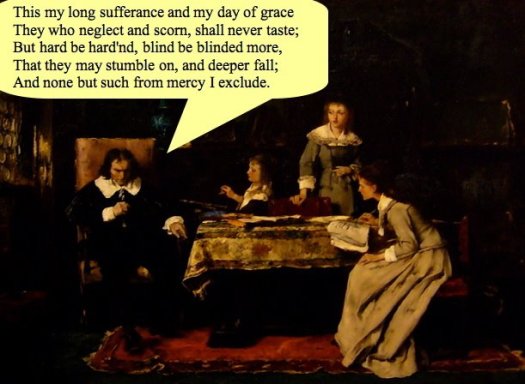
How welcome a sight was “The Blind Milton Dictating ‘Paradise Lost’ to His Daughters.” Yes, that face was familiar, as was the composition, even though I had never troubled myself to note, let alone pronounce, the name of its artist: Mihály Munkácsy. I was surprised to reencounter “Blind Milton” there, knowing it to be on permanent display at New York Public Library on 42nd Street (where it is currently the centerpiece of an exhibition celebrating Milton’s life and works). As it turns out, there are two version of Munkácsy’s painting, the one in New York City being the larger of the two.

This year marks the quatercentenary of Milton’s birth, so we are likely to come across “Blind Milton” in the arts and literature sections of our newspapers or the pages of magazines on history and culture. Even in the 19th-century, the image was frequently reproduced on paper. Indeed, we happened upon such a reproduction at a second-hand bookstore in the Hungarian capital not long after our gallery visit, on the very day it was featured in The New York Times arts section online.

The image became so familiar that, by the twentieth century, the

usual conception of John Milton in the imagination of America’s school children has been a misty mezzotint of a blind man sitting in a dark room dictating Paradise Lost to his bored but dutiful daughters.  That Milton was one of the most fearless and most revolutionary thinkers of his century few youngsters have ever been permitted to know.

.This is how, in 1939, Max Wylie prefaced “The Story of John Milton,” a script from the radio series Adventure in Reading (NBC; 1938-40). The play (by Helen Walpole and Margaret Leaf) tells of blindness, vision, and the specter of persecution as the monumental struggle of the beleaguered poet is being recalled by the voices he called forth in his art.

For twelve years, Milton’s ideas had been in the service of the Commonwealth, until the Restoration threatened to obliterate his words and legacy. Awaiting news from his friend Sir Harry Vane, Milton tries to dictate Paradise Lost to his daughter Mary:

Milton.  You aren’t writing, Mary, you aren’t writing!

Mary.  How can I father? How can I do anything … while we’re waiting for the coming of Sir Harry!

Milton.  Write.  Take down what I say.  “Wolves shall succeed for teachers, grievous Wolves, / Who all the sacred mysteries of Heav’n / To their own vile advantage shall turn. . . .”

Mary.  I cannot.  I cannot.  Paradise Lost may never be finished.

Milton.  Paradise Lost shall be finished.  I’m not a human being any longer, Mary.  I’m an instrument … a vessel … you don’t understand that … but no matter … I may seem hard to you and your sister … but that’s not important either. . . .

Mary.  I shall try to write.  Dictate it again, father.

Milton.  “Wolves shall succeed for teachers, …”

The war of ideas and the fight for their expression—a challenge as urgent in 1660 and 1939 as it is today—is a fitting subject for the so-called blind medium, a medium capable of conjuring images before the mind’s eye not grown dim from lack of exercise.

Milton is accused of treason. The burning of his books, to be executed by “a common hangman,” have been ordered. “Blind among my enemies…. How can I fight?” the poet cries in near despair, until, roused by his visions, he declares:

If, by my own toil, I have fanned the flame that burned out my eyes … then from that darkness will be born new eyes. All natural objects shut away … I can see clearer into life itself….  My vision will not be blurred or turned aside! And so, O, Highest Wisdom, I submit.  I am John Milton, whose sight was taken away that he might be given new eyes.

It is in the opening lines of the third book of Paradise Lost that Milton comments on his condition:

I sung of chaos and eternal night,
Taught by the heav’nly muse to venture down
The dark descent, and up to re-ascend,
Though hard and rare: thee I revisit safe,
And feel thy sovran vital lamp; but thou
Revisit’st not these eyes, that roll in vain
To find thy piercing ray, and find no dawn;
So thick a drop serene hath quenched their orbs,
Or dim suffusion veiled […].
Seasons return, but not to me returns
Day, or the sweet approach of ev’n or morn,
Or sight of vernal bloom, or summer’s rose,
Or flocks, or herds, or human face divine;
But cloud instead, and ever-during dark
Surrounds me, from the cheerful ways of men
Cut off, and for the book of knowledge fair
Presented with a universal blank
Of nature’s works to me expunged and razed,
And wisdom at one entrance quite shut out.
So much the rather thou celestial light
Shine inward, and the mind through all her powers
Irradiate, there plant eyes, all mist from thence
Purge and disperse, that I may see and tell
Of things invisible to mortal sight.

It seems that, in the scene depicted by Munkácsy, Milton is dictating these very lines, at the moment dramatized for Adventure in Reading. His three dutiful daughters look anything but bored. Entrusted with a solemn responsibility and not altogether ignorant of their father’s perilous position, they are rapt and apprehensive as they listen to the dictation, encoded in which is the speaker’s intimate story, a few telling lines in an epic on the fallibility of humankind.

If It Can Cheer Up Karloff . . .

. . . it ought to be working wonders on a soul decidedly less gloomy than your average Karloffian antihero. A trip to Budapest, that is. It has been eleven months since last we took in the sites of the Hungarian capital. Granted, highlights included visits to awe-inspiring Statue Park and the downright dispiriting Terror House, outings for which my catchings-up with pop-acculturated Hungarians like glamorous Zsa Zsa Gabor and dashing Cornel Wilde or the radio experiments of Val Gielgud in said locale had left me thoroughly unprepared. Unexpected, too, were our encounters with FDR, Scarlett O’Hara, and assorted automata (Kempelen’s famed Turk among them).

William Henry Pratt (or Karloff, to call him by the assumed name that would become a typecasting trap) may not be a widely trusted authority on mirth, merriment or gender orientation; nor is old Hollywood with its backlot scenes and cultural insensitivities necessarily a reliable travel agent. Still, his character’s insistence that “It’s gay there,” which I heard again a few weeks ago in The Black Room (1935), is sure getting me in the mood for another Danubian interlude.

Of all the European city tours I have taken since my relocation from the United States to Wales—Madrid, Istanbul, and Prague among them—our week in Budapest has remained a delight as yet unsurpassed (the well-chosen dark spots on the schedule notwithstanding). Our nights at the opera alone were worth the inconveniences of budget air travel. My recent computer crashes have erased many of my holiday snapshots; so I am all the more eager to retrace my steps. Not that I expect to be walking around town in shorts and shirtsleeves this time around (apparently, a mere four weeks, from mid-March to mid-April, make all the difference). I won’t blame either Buda or Pest if it turns out that, to reverse an adage, you can’t go abroad again.

Not prepared to keep up with the out-of-date while abroad, the ‘castellan shuts up the keep, which will reopen upon his return.

"You Boig?"

“I don’t have much respect for biographers,” I once told John N. Hall, noted author of Trollope: A Biography and Max Beerbohm: A Kind of Life. I was being mischievous, knowing my professor to have a sense of humor that makes him just the man to examine the lives and fictions of the humorists who attract him. Indeed, I have rarely met an academic whose mentality was better suited to his subjects. I was not merely being facetious, though. I was also being honest. I don’t read biographies; not cover to cover, at least. I am too impatient to go through a series of incidents designed to trace the traits and career of a famous so-and-so to great-grandparents who were semi-literate peasants from Eastern Europe, to illustrate what impact the childhood agony of losing a balloon during a rainstorm had on an artist’s psyche, or explain what it really means to be a supposed nobody before becoming an alleged somebody.

You might say that I am not easily impressed by facts and downright doubtful of them; that I am unconvinced a life can be told by means of sundry scraps of evidence culled from contemporary sources or the recollections of contemporaries whose lost marbles are dutifully dredged from the gully of memory lane. It’s all that; but I would like to think that respect has something to do with it as well—respect for a creative mind expressing itself in a work of art by someone who might not be willing or able to open up otherwise. In other words, I take what an artist is willing to give, even if the limited supply of such works are dictated, to some extent, by market demands.

Nor do I believe that being told about traumas and toothaches ought to compel me to regard an artist’s works as the product of such ordeals. Nothing is more tedious than arguing that a character who slips on a banana peel was destined to break his neck because his creator was terrified of the tropical fruit a health-conscious aunt was trying to shove down his three-year-old throat. If I want a story or a picture to be a mirror, the reflection I find therein should be my own.

Autobiographies are a different kettle of fishiness altogether. They are the storied self, the persona an artist has decided to display in a public performance. (Hall, by the way, has since written his own memoir titled Belief [2007].) I accept them as such, which does not mean I am any more patient as I am being subjected to the courtship of an artist’s maternal grandparents, to Ellis Island flashbacks or dim impressions from the cradle. There is some of that in the aforementioned Molly and Me (1961), the autobiography of Gertrude Berg (pictured here in a photograph freely adapted from the March 1943 issue of Tune In).

Berg was the creator of the radio serial and subsequent television sitcom The Goldbergs, as well as the lesser known House of Glass, about which I got to read in Radio and the Jews by Siegel and Siegel, a volume I picked up at the Jewish Museum in New York during my last visit to my old Upper East Side neighborhood. Molly and Me may be short on the drama of radio, for which I initially picked it up, and lack the to researchers indispensable index, for which omission I immediately put it down again. I need not have been quite so prickly, though. Berg’s memoir, like her writings for the air, is alive with Dickensian characters, a conversational style, and challenges to literary theory that tickle the wayward scholar. Let me give you a for instance:

Well, I saw [New Orleans].  There were hot, wide streets, charming Old World houses—all hot—wonderful hot restaurants, and lovely, well-decorated, hot hotels. In the evening, when the sun goes down, the heat goes down also but the humidity goes up. It’s no wonder that Tennessee Williams and William Faulkner write such good tragedies.  With air conditioning maybe there’ll be a change in our Southern literature.

This passage, my favorite in the entire book, makes me wish Berg had been the ghost writer of Roland Barthes’s Mythologies:

The Lyceum [a New York restaurant her father managed] was a huge place that could take care of fifteen hundred people [. . .].  It was not only big, it was gemütlich, it was where people came to laugh, and it was before publicity men talked about atmosphere.  The ceilings were high and absolutely guaranteed not soundproofed. The whole idea was to have fun and not to be quiet. In those days silence was for funeral parlors, not restaurants.  There were chandeliers that were chandeliers—all cut glass with teardrops and draped strings of little glass balls, not straight pipes with blisters on the end or holes in the ceilings that drop light on you. I’m not saying that those were the good old days.  It’s just that there was something about bigness that was friendly.  Today if it’s big, it’s a bank or Grand Central or a cafeteria where you go in fast and come out fast.  There’s no place to relax any more except at home—and with the foam rubber they put into everything today, who can relax?

“You Boig?” an agent once addressed the writer at the beginning of her career. I can just see him there, facing her. I can hear him, too, thanks to Berg’s writerly gifts and a long exposure to actors like Allen Jenkins. She’s “Boig” all right. I feel that I got to know her as she wanted to be known, a woman who tells her audience not to expect the story of someone who “divorced three husbands, became a drug addict, and finally, after years of searching, found the real meaning of Life in a spoonful of mescalin.”

So what if there’s more Molly than “Me” in this production. I’m not going to tear up the cushions Berg arranged for me in hopes of finding a needle in what is too comfortable to be foam rubber . . .