Well, “it won’t be like that in town.” That is a remark you would have heard frequently, had you been eavesdropping in on us talking about our anticipated move out of the country later this month. As it turns out, we will have to wait far longer to prove or confute our hypotheses about the differences between urban and rural dwelling. Our plans to relocate to Aberystwyth, the Welsh seaside town romanticized in the quirky murder mysteries of Malcolm Pryce, have been thwarted. The potential buyer of our present abode has nixed the deal, making it impossible for us to buy the house currently owned by the person desirous to take possession of our buyer’s home. There’s a neat little triangle gone Bermuda.
Meanwhile, our cottage is once again cut off from the world, due to an ongoing problem with the telephone lines. I am in town now to file this report, sitting, in fact, not far from the Edwardian house (pictured) we were hoping to occupy. After the welcome interlude set aside for this lament, I am once again singing the blues where no one can hear me sigh . . .
Well, I am not one to multitask. I can only manage one thing at a time, which, if desirous to veil my ineptitude, I would turn into a virtue by declaring myself to be merely anxious to give everything my all. In fact, undivided attention is not easily achieved when keeping on track means struggling not to drown in the crosscurrents of concurrency. I find it hard to read in public places, cannot tie my laces without keeping my eyes on them, and have trouble talking on the phone while being in a state of motion. I may very well be incapable of growing what is commonly referred to as “up.” Going about life with such deliberation, it would take me too long to take all the requisite steps.
It also explains the latest gap in my online journal, as unnoticed as it or its bridging might have gone. Simply put, either I live or I write, the experience being well in advance of its expression. The past few days were spent experiencing: sipping tea (or Margaritas) with visiting novelist Lynda Waterhouse and spouse, taking Montague to the beach on an afternoon almost passing for summer, and attending the opening of Hervé and the Wolf: Saints and Their Beasts, an exciting series of new paintings by our friend Clive Hicks-Jenkins. To avoid becoming rather too refined in my tastes—cultural elitism being as outmoded as modernism, the movement that gave it birth by issuing a privately printed death warrant to the popular—I agreed to take in last weekend’s international box office chart-topper, The Simpsons Movie.
Now, I haven’t watched The Simpsons with any regularity since they got their own show after graduating from the Tracy Ullman Show back in the late 1980s, when Bart and his mischief were still the focal point of this dysfunctional family portrait. Turning the pages of old diaries and photo albums, I did not come across any reference to the show and the impression it made on me (pictured above, in still earlier days, gleefully ignorant of the cultural indoctrination then deemed suitable for children).
Revisiting Springfield after taking scarcely a peek at it in fifteen years, I had little difficulty catching up. The Simpsons do not seem to change. Theirs is a constancy impossible in non-animated TV fare (its inanimate sameness notwithstanding), but common for radio characters of the pre-TV age, whose “Perennial Adolescence” caused one contemporary listener to warn that
only a miracle can save America from debacle. Such people [as those of radio’s Aldrich Family] are unequipped to create or manage an effective nation, as unable to do that as they are to run their individual lives and face the challenges of home and neighborhood [. . .].
They will help to explain why it was that, back in the middle nineteen-hundreds, the most powerful nation on earth was also the most fumbling and ineffective. They will make compassionate the understanding that Americans of our time had lived so long in adolescent terms that when they were called upon for leadership in a world of crisis which demanded mature and wise decisions, they proved incompetent to make those decisions.
The Simpsons differ from the juvenile characters of old radio comedies, which largely avoided socio-political commentary. Marge, Homer, and their perennially prepubescent offspring are outwardly ageless; yet their daily lives reflect the concerns of our times. Without losing their vigor or changing their looks, a sameness at once satisfying and comforting to us mortals, The Simpsons continue to be relevant because they exploit what is most talked of so as to remain talked about. As survival artists who escape time itself, they are permitted to get away with much, especially when it comes to expressing what we dare not face because it requires us to change.
Perhaps, this feature-length episode is rather too literally topical in that it tries hard not to get under our skin. Too careful not to offend too many too much, The Simpsons Movie takes no side in the current international debate from which it culls its material as from so many recycle bins. It sanitizes the fears about which we cannot quite come clean. The “Irritating Truth” is that we are more apt to laugh at than question ourselves, to accept our failures rather than to change our ways.
Well, I’ve never been to Hollywood, tempting offers involving a cat, Elizabeth Taylor’s granddaughter, and a place to stay in LA notwithstanding. You don’t need to be going way out west, though, to be in the presence of Tinseltown’s past, to sense the influence of its players and witness their follies. Now, I am not referring to the likes of Ms. Catherine Zeta-Jones, who was born here in Wales. I mean stars, not celebrities. To be sure, I am somewhat of an Occidental Tourist. Where others, traveling in the Welsh countryside, will find traces of ancient history or sights that quicken the pulse of the most seasoned horticulturalist, I see signs of old Hollywoodland. Take the castle of St. Donats, for instance.
These days, St. Donats is a sort of Hogwarts for assorted Muggles, which is to say that it is an exclusive college for international students, many of whom, if my ears did not deceive me as we walked across the campus last week, come here from the United States. The castle has a centuries-spanning past, as is customary in the case of such fortifications; but in my case, the history lesson exhausted itself in reflections about its state anno 1925, when it got into the ink and blood-stained hands of media tycoon William Randolph Hearst and the far daintier ones of his lovely companion, screen actress Marion Davies (shown in an autographed picture of unverified authenticity from my collection).
Though better known as a silent screen actress, Davies transitioned successfully to sound film and was no stranger to radio. On the air, she starred in the Lux Radio Theater productions of “The Brat” (13 July 1936) and “Peg ‘o My Heart” (29 Nov. 1937), in which she recreated of one of her sentimental talkie roles. Despite her stardom in the 1920s and ‘30s, Davies has long suffered ridicule and neglect, an unwarranted disrepute largely owing to Orson Welles’s Citizen Kane. A caricature of Hearst, it leaves audiences with the impression that Davies was the delusional mistress of an influential mogul who humored her whims by purchasing her fame and foisting her lack of talent on an unimpressed multitude. Anyone who has seen Davies in films like The Patsy or Show People knows this to be slanderous. The Brooklynite with the Welsh surname was a brilliant comedienne, far more accomplished than neo-Hollywood A-lister Kirsten Dunst, who impersonated her in the speculative yet tedious Cat’s Meow (2001).
A 1927 volume titled Alice in Movieland (previously raided for a picture of silent screen star Rod La Rocque), attests to Davies’s fondness for Britain: “Well, yes, I d-do admire the Prince of Wales,” she confessed, “and I d-did try to look like him when I played the boy in the lovely uniform in my picture Graustark.” The picture was the delightful yet rarely screened Beverly of Graustark, which, along with a dozen other Davies features, I had the good fortune of catching at New York’s Film Forum some years back. “I love to do boys parts,” Davies added; and as Beverly (listed high among the films I got around to rating on the Internet Movie Database) she is at her most charmingly androgynous.
Unlike her relationship with Hearst, the star’s Hollywood bungalow was no modern affair. It featured a “pure” Tudor door leading to a Tudor hall. “Nothing Pullman about this!” the author of Alice in Movieland marveled. Yet it wasn’t “nearly Tudor enough,” Davies told her. She was determined to move house “some day”—or have her house moved: “It’s got to be the most Tudor thing in the world. I shall have it t-taken away somewhere else, and another one, m-much more beautiful b-built in its place [. . .].”
“[S]ome day,” she knew, was not too far off. Apparently, the Xanadoozy of an imported castle that is San Simeon was not enough for Hearst; perhaps, it was rather too much, too grand and imposing, even for him. Hearst was getting on in years and wanted a quiet retreat for himself and Ms. Davies. A 14th-century castle overlooking the strait known as the Bristol Channel was his idea of quaint, I gather. According to Davies biographer Lawrence Guiles, getting it ready involved the installation of an additional forty-seven bathrooms. And I find the idea of renovating our newly purchased three-bathroom, semi-detached Edwardian house in town daunting!
Unlike San Simeon, which I visited on an August so foggy it suggested Autumn in Wales rather than sunny California, St. Donats is open to the public only for a few days each year, after its current residents are flown out and the school shuts down in mid-Summer. I am determined to go back for another look. To me, it’ll be like Going Hollywood.
The show must go on, as they say. They, obviously, have not been on British soil this summer, most of which appears to be under water. “Fair Albion”? It’s Altantis, I tell you. While all those braving the deluge are keeping their stiff upper lips well moisturised, I am staying put and dry, steeped in theater and a flood of memories. This evening, I was being treated to radio adaptations of Priestley’s An Inspector Calls (previously discussed here) and Stoppard’s Rosencrantz & Guildenstern Are Dead. Never mind that such adaptations may be mean substitutes for the real thing. You’d have to be out of your mind to keep out of the theater-of-the-mind on a day like this. Besides, sometimes ersatz is all you can sit down to.
Who for instance, has ever seen or is likely to attend a production of Don Marquis’s comedy The Master of the Revels (1934), a condensed version of which was soundstaged on this day, 20 July, back in 1935 over at Al Jolson’s Shell Chateau? The star was Henry Hull, who, as the star of the sensationally long-running Tobacco Road, packed them in that summer at what is now the Eugene O’Neill Theater (where a couple of cloud-covered moons ago I had the dubious fortune of taking in this year’s Tony Awards darling Spring Awakening).
One year later to the day, Walter Huston and Claudette Colbert (pictured) stepped behind the microphone to recreate their roles in the Kenyon Nicholson’s comedy The Barker. The two Broadway-trained leads were substituting for no-shows Wallace Beery and Stuart Erwin, who were scheduled to go on that night in another play. Now, Clara Bow proved a lovely substitute for Colbert when the play was adapted for the talkies; but this is as close to Biltmore Theater anno 1927 as modern media will get you.
Also on this day, in 1942, radio played The Philadelphia Story, a star-studded event that raised the curtain on a new Government-sponsored venture, the Victory Theater. I’ve seen The Philadelphia Story some time ago at London’s Old Vic; but that show, starring Jennifer Ehle and Kevin Spacey (whom I didn’t like much tottering under A Moon for the Misbegotten, either), truly felt like a substitute for the movie version. At the Victory, at least, you get to hear the original cast of that cinema classic.
Yes, when summer pulls a Wallace Beery, you appreciate radio’s importance of being ersatz.
Well, I suppose we have all taken trips that have changed our lives. After all, why else go anywhere! If it had not been for a New York City subway ride and a brisk walk to Rockefeller Center on an afternoon in December, I would never have ended up here in Wales (a virtual tour of which is being attempted in this 1930s radio broadcast). Indeed, I would not have been able to spot Wales on a map, even though I, a student of English literature, believed myself to be familiar with one of the most famous poems to have been inspired by the Welsh countryside: Wordsworth’s “Lines composed a few miles above Tintern Abbey.”
It was on this day, 13 July, back in 1798, that Wordsworth revisited the Wye valley in Monmouthshire, Wales, where Tintern Abbey stands in its Romanticism-inspiring ruins (as shown left, in a more prosaic picture from my first visit there).
Wordsworth had been at the same spot some five summers earlier, together with his sister, Dorothy. He felt himself aged and believed himself matured. It had been a memorable journey; indeed, as he remarked in his notes on the poem, no work of his was “composed under circumstances more pleasant for me to remember.” The memory of the trip and of his “boyish days” were very much on his mind on his return to the scene, a landscape revisited not simply per pedes, but, in a less pedestrian sense, in recollection.
“[H]ow oft,” he recalled in his famous poem, in lines that would change the course of literary history,
In darkness and amid the many shapes Of joyless daylight; when the fretful stir Unprofitable, and the fever of the world, Have hung upon the beatings of my heart— How oft, in spirit, have I turned to thee, O sylvan Wye! thou wanderer through the woods, How often has my spirit turned to thee!
It was a vision of a landscape that recurred to Wordsworth, “in lonely rooms” and “‘mid the din / Of towns and cities.” A “worshipper of nature,” he had little to say about the Abbey itself, a ruin that inspired many an artist, most notably Turner, Wordsworth’s contemporary. This Sunday, I am going to travel down to Monmouthshire in the knowledge that my days in the Welsh countryside are numbered.
It seems I am moving back into town this fall, after nearly three years in the Welsh countryside. A small town, mind you, but a town nonetheless. It was peaceful here, and pleasant in the sunshine. Yet there has hardly been any sunshine this summer, nor warmth; and the loneliness of our house has at times been a burden to me, and to those having to suffer my presence.
Without this intensely felt isolation I would perhaps not have commenced the broadcastellan journal. Before moving to Wales, I was not aware of how much our surroundings enter our being, of how much a landscape can inhabit or possess, rather than merely surround us. Now, would the Romantic movement have come into being had Wordsworth’s second summer in Wales been as much of a washout as the present season?
Holy Mackerel and Blistering Barnacles! Intrepid boy reporter Tintin is under attack. Recently honored in Belgium and soon to become a Spielberg franchise, the byliner turned video and radio star is now being held accountable for his exploits in the Congo. Tintin in the Congo has been denounced by Britain’s independent but government sponsored Commission for Racial Equality as “racist claptrap.” Some booksellers have responded to such claims by moving the comic to the adult graphic novel section.
Tintin, it should be recalled, forged an interracial friendship during his adventures in Tibet (which I hope to be experiencing in the Old Vic stage production later this year) and fought against ethnic stereotyping while retrieving the Castafiore Emerald. Still, the much revised Tintin in the Congo—which dates back to the time when Amos ‘n’ Andy were on the American wireless, Josephine Baker wore bananas, and Al Jolson cried for his “Mammy”—might tell a different story altogether.
I revisited Hergé’s depiction of what Nigger of the “Narcissus” author Joseph Conrad called the Heart of Darkness to debate with myself whether the book’s read-at-your-own-risk label (“an interpretation that some of today’s readers may find offensive”) should suffice or whether Tintin ought to be canned.
Tintin in the Congo is an imperialist, colonial adventure story; but its hero does not come to conquer a continent. He is merely there to see and capture it in his reports. Along the way, he gets into some terrible scrapes, kills a few wild animals, and saves a few natives (or is saved by them). Sure, the Africa visited by Tintin is a caricature, its inhabitants grotesque. So, for that matter, are the white villains, American gangsters with ties to Al Capone.
Is Tintin in the Congo a story likely to turn its readers into Lynx and Lamb (you know, the white supremacist teen-duo known as Prussian Blue)? Should it be going the way of Enid Blyton’s Three Golliwogs (Golly, Woggie, and Nigger), an un(re)publishable book by a bestselling author? I don’t know what is worse: xenophobia or revisionism, yesterday’s blackface or the whitewashings of the present.
She might have been auditioning for Sunset Blvd. or hoping for some such comeback; then again, she sounded as if acting lay in a distant, silent past. Screen legend Gloria Swanson, I mean, who, on this day, 10 July, in 1947, stepped behind the microphone to make her only appearance on CBS radio’s Suspense series in a thriller titled ”Murder by the Book (a clip of which I appropriated for one of my old-time radio podcasts).
Swanson (pictured above in a scene from Music in the Air [1934]) plays a mystery writer suffering from dizzy spells, memory loss, and nervous tension, ever since her husband’s death by drowning. She’d been seeing a doctor about it; but he died as well. “You see, he has been murdered,” she declares, narrating her story. Still, she is determined to continue her latest book, a thriller “about a woman who kills her husband”; but, she admits, she’s been having “all kinds of trouble with the end. Everything was all right up until the explanation.”
For the sake of publicity, and to get her mind off her troubled new volume, she agrees to her publisher’s suggestion to turn reporter and cover her doctor’s murder, much to the distress of her stepdaughter. “She’d always been a little strange,” Swanson’s character remarks. Then again, she’s the one with the dizzy spells.
Swanson, you will agree, was not very assured in her reading of her lines, and at times scans the script downright carelessly. Then again, her best years had been silent ones. Nevertheless, she succeeds in turning the character of Emily into one cooky dame. Since we sense from the start that she cannot be trusted, the pleasure of listening to Robert L. Richard’s “Murder by the Book” lies in hearing her fall apart. It’s a fine premise for the kind of movie thriller many an aging Hollywood diva would take on in the 1950. Ready or not, Swanson had one glorious last close-up in her future . . .
I have been frequently miscast in the story of my life. And matters weren’t always helped by my being in charge of the casting. I was never more out of my element, which is neither quite earth nor air, as during those twenty months of civil service that I spent vaguely resembling a nurse’s aide. The stethoscope dangling around my neck may have fooled some of the patients some of the time; but my half-hearted attempts at hospital corners soon ruined whatever impression such a prop could have made upon them. Not that Hollywood fares any better in its imitations of strife, even though more harm comes to the reputation of the nursing profession than to the sick and injured by giving the so-called White Angel a tint of the Blue. Unless cast in minor roles, Hollywood nurses are as glamorous and rhinestonian as showgirls.
How much more realistic might the portrayal of those bed-pans carrying pulse-takers be once the pressure of making them look pretty—rather than the part—is removed? I asked myself that while listening to “White Angel,” broadcast on this day, 9 July, in 1946. Adapted for radio’s Encore Theater from the 1936 melodrama of the same title, the play stars Virginia Bruce (pictured) in the role of Florence Nightingale (impersonated on the screen by Kay Francis).
Even with the lights switched off, it was difficult for me to get the image of Ms. Bruce out of my head, to picture a nurse among the suffering and picture her suffering among them. As the title, “White Angel,” suggests, the portrait is altogether too clean to be genuine. At best, it is a eulogy, as idealized as Longfellow’s “Santa Filomena”:
A lady with a lamp shall stand In the great history of the land, A noble type of good, Heroic womanhood.
Hollywood stars never truly disappeared when they stepped behind the microphone; not only did their names conjure up their faces, but their voices bespoke their presence. If sponsors paid for the services of a Ms. Bruce, they insisted on her sounding like Ms. Bruce. The audience, likewise, expected no less. Ms. Bruce does not disappoint; which means, of course, that she is altogether unconvincing as Ms. Nightingale. There is not a bead of sweat, not a drop of blood in her performance. Hers is the dignity of a socialite, of a lady serving cocktails rather than mankind in the Crimean.
“Why have women passion, intellect, moral activity—these three—and a place in society where no one of the three can be exercised?” Ms. Nightingale once asked. Hollywood could take you places, but it got you there in high heals and concealed the calluses. Reality, in the case of the Encore Theater, entered the stage only for a curtain call, during which Ms. Bruce spoke on behalf of the sponsor, the drug company Schenley Laboratories. Not to push penicillin, whose healing powers were extolled during the commercial break, but to urge the “Women of America” to do something more worthwhile than to dream of being Virginia Bruce:
“Today the need for nurses is desperate. If you are a high school graduate between the ages of 17 and 35, in good health, apply at the hospital nearest your home. Remember, nursing is one of the highest vocations a woman can follow.” After which bit of practical pathos the actress exited the broadcasting studio with a check for services rendered. Did any young woman walk into a hospital that week, saying “Virginia Bruce” sent me? And how many stuck it out not cursing the “White Angel” thereafter? I wonder.
When I read that Lamont Cranston is being resurrected for another big screen adventure scheduled to begin in 2010, I decided to catch up with one of the earlier Shadow plays. The Shadow, of course, always played well on the radio. On this day, 26 June, in 1938, he was again called into action when a “Blind Beggar Dies” after refusing to share his pittance with a gang of racketeers. The blind beggars alive to such melodrama and asking for more were millions of American radio listeners tuning in to follow the exploits of that “wealthy man about town” who was able to “cloud men’s minds” while opening them to the wonders of non-visual storytelling.
On the screen, the Shadow never quite managed to immaterialize; a previous attempt at delineating The Shadow on the screen, in the form and figure of Alex Baldwin, failed to attract audiences large enough to warrant a franchise.
Considerably less accomplished than the 1994 adaptation was the 1937 feature The Shadow Strikes, which bears little resemblance to the myth conceived for radio (initially as a mere sales gimmick for Street and Smith story magazines, publications popular during the first half of the 20th century).
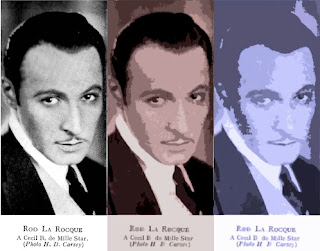
At just about the time when Orson Welles made his debut in the role on radio (as mentioned here), the mysterious crime fighter was impersonated on the screen by silent screen star Rod La Rocque, whose image I came across today while leafing through the recently acquired rarity Alice in Movieland, a gossipy little volume written back in 1927, when La Rocque was still remembered as a major Cecil B. DeMille player by, well, almost everyone:
You would have thought Rod La Rocque and Vilma Banky [the silent screen star with whom La Rocque was about to tie the knot] sure to be recognized at sight anywhere short of the South Pole. But not so!
At a preview of a DeMille picture at a Hollywood theater, seats had been roped off for the stars, as one among whom La Rocque was not being recognized by the usher.
Rod and Vilma crept away. Slow fade-out! I think, however, they did contrive later to annex the two worst seats in the theatre, behind a pillar of something. But all the easier to hold hands.
One of La Rocque’s last movies, The Shadow Strikes, is strictly of the ‘slow fade’ variety, even though the character La Rocque portrayed was so in the 1930s that a follow-up was released half a year later, featuring the same leading man.
Never mind that La Rocque does not get to utter that menacing laugh and is not equipped with mental powers superior to those of other popular crimefighting acts just outside the law, the Falcon, say, or the Saint. The producers of the movie did not even bother to check the spelling of the name of his alter ego when it appeared on the cover of a newspaper.
So, what fate awaits this great figure of 20th-century popular culture? Will he return only to receive a final blow, like a beggar too impoverished to pay up? Will those who watch him on the screen follow him back to the airwaves, into the shadows where he truly belongs?
This one seemed strangely familiar. It felt as if I had seen and heard it all before—which is not to say that the déjà vu was an unpleasant sensation. I am referring to Curtains, the final Kander and Ebb collaboration now playing at the Al Hirschfeld Theatre (pictured). Time Out New York called it ”your grandmother’s musical,” which bit of sexist ageism suggests dentures rather than bite. It so happens, I’m with grandma when it comes to a grand night out. At the theatre, that is. I take in musicals to be charmed rather than provoked, to be tickled or wowed rather than indoctrinated. Give me showtunes I can recall and perhaps even attempt to hum (at Marie’s Crisis, say, the Village piano bar where we spent a few hours of merry sing-along on Tony’s night). Besides, I’ve got a mirror for warts ‘n all.
So, Curtains is really my kind of show, if only it weren’t so obviously and deliberately steeped in Broadway musical history as to evoke other and unquestionably superior ones. A backstage murder mystery, Curtains is set in the late 1950s, which is a fine excuse for pastiche, as is its show within a show construction.
Most of its songs are echoes of the period (“Show People” is something you’d expect to be belted out by Ethel Merman), even though the show being rehearsed seems to date back to the 1930s and the sentimental “I Miss the Music” recalls the to me well-nigh intolerable Andrew Lloyd Webber, especially in the earnest interpretation by the to my ears miscast-for-comedy Jason Danieley. That the show is being tinkered with as its cast is being knocked off seems an excuse for the repetition of an inferior number like “In the Same Boat.”
Curtains, of course, offers its own response to captious reviewers “What Kind of Man?”:
What kind of putz Would squeeze your nuts like that?
Musicals aside, what the show brought to my mind was The Lady of Burlesque (1943) starring Barbara Stanwyck, which I saw earlier this year (for an itemized list of my movie diet, turn right). In that comedy-thriller, a show must go on while a killer is on the loose and an investigation underway. In the case of Curtains, though, it is not the leading lady but the detective who takes center stage and—despite the obvious handicaps of lacking a leading man’s looks or voice, not to mention a convincing Boston accent—takes it in strides at that.
I happen to have been at the Hirschfeld on the day that the show’s male lead, Tony-winning David Hyde Pierce, lifted the curtain on his private life and came out of the closet at last; on stage, he was busy turning a double life into a single one (negotiating his love for musicals with the business of solving crime), and being single into a happy double (by teaming up romantically with one of the suspects). It might be “your grandmother’s musical”; but its leading man is finally breaking with conventions that seemed out-of-date two decades ago.

 Well, “it won’t be like that in town.” That is a remark you would have heard frequently, had you been eavesdropping in on us talking about our anticipated move out of the country later this month. As it turns out, we will have to wait far longer to prove or confute our hypotheses about the differences between urban and rural dwelling. Our plans to relocate to Aberystwyth, the Welsh seaside town romanticized in the quirky murder mysteries of Malcolm Pryce, have been thwarted. The potential buyer of our present abode has nixed the deal, making it impossible for us to buy the house currently owned by the person desirous to take possession of our buyer’s home. There’s a neat little triangle gone Bermuda.
 Well, I am not one to multitask. I can only manage one thing at a time, which, if desirous to veil my ineptitude, I would turn into a virtue by declaring myself to be merely anxious to give everything my all. In fact, undivided attention is not easily achieved when keeping on track means struggling not to drown in the crosscurrents of concurrency. I find it hard to read in public places, cannot tie my laces without keeping my eyes on them, and have trouble talking on the phone while being in a state of motion. I may very well be incapable of growing what is commonly referred to as “up.” Going about life with such deliberation, it would take me too long to take all the requisite steps.

 The show must go on, as they say. They, obviously, have not been on British soil this summer,
  Well, I suppose we have all taken trips that have changed our lives. After all, why else go anywhere! If it had not been for a New York City subway ride and a brisk walk to Rockefeller Center on an afternoon in December, I would never have ended up here in Wales (a virtual tour of which is being attempted in
 She might have been auditioning for Sunset Blvd. or hoping for some such comeback; then again, she sounded as if acting lay in a distant, silent past. Screen legend Gloria Swanson, I mean, who, on this day, 10 July, in 1947, stepped behind the microphone to make her only appearance on CBS radio’s Suspense series in a thriller titled ”Murder by the Book (a clip of which I appropriated for
  I have been frequently miscast in the story of my life. And matters weren’t always helped by my being in charge of the casting. I was never more out of my element, which is neither quite earth nor air, as during those twenty months of civil service that I spent vaguely resembling a nurse’s aide. The stethoscope dangling around my neck may have fooled some of the patients some of the time; but my half-hearted attempts at hospital corners soon ruined whatever impression such a prop could have made upon them. Not that Hollywood fares any better in its imitations of strife, even though more harm comes to the reputation of the nursing profession than to the sick and injured by giving the so-called White Angel a tint of the Blue. Unless cast in minor roles, Hollywood nurses are as glamorous and rhinestonian as showgirls.
 When I read that Lamont Cranston is being resurrected for another big screen adventure scheduled to begin in 2010, I decided to catch up with one of the earlier Shadow plays. The Shadow, of course, always played well on the radio. On this day, 26 June, in 1938, he was again called into action when a “Blind Beggar Dies” after refusing to share his pittance with a gang of racketeers. The blind beggars alive to such melodrama and asking for more were millions of American radio listeners tuning in to follow the exploits of that “wealthy man about town” who was able to “cloud men’s minds” while opening them to the wonders of non-visual storytelling.
 Harry Heuser