History Listens: “The Fall of [No Other] City”

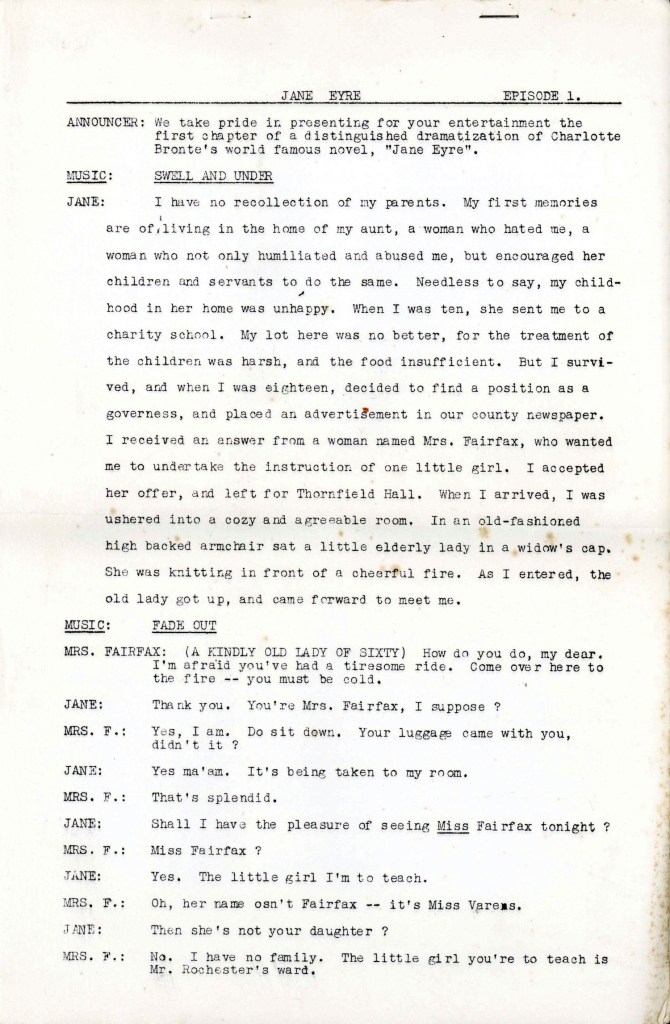
Page from the published script of Archibald MacLeish’s “The Fall of the City” (1937)

As the world awaits news from Ukraine and its people awake daily to the sounds of shelling, many of us, having survived the pandemic that at once isolated and united us, become alive anew to our connectedness to world events and to the urgency, the necessity, of connecting dots in plain sight, and of listening out for tell-tale signs, be it the rumble of tanks or the roar of tyrants.  We should have seen this one coming, we might suspect; but such hindsight provides no relief in the face of local destruction and global upheaval.  

I am reminded of the events that came to be known as 9/11 – an attack that did not, as some claimed and many felt, hit us ‘out of the blue’ on that bright September morning – and of feeling both helpless and useless in the wake of the terror that would shape history.  I was teaching writing in the Bronx, and I was researching radio drama of the 1930s.  None of that seemed to matter at a moment when digging in and digging up – literally and figuratively – was felt to be needed to uncover lives lost and recover the history that had gotten us to that point.  I kept on teaching writing, and I kept on researching radio – and I strove to find the usefulness and relevance of both.  That is, I did not carry on “regardless.”  

Instead of retreating into the past of broadcasts decades old, I tried to retrieve messages pertinent to the present.  And while we might think that messages are merely repeated rather than being heeded, we may also find that we did receive them and that we are capable of learning from history even as a world leader insists on repeating it.  

Take, for instance, Archibald MacLeish’s “The Fall of the City.”  First produced and broadcast in the US on 11 April 1937 – with a cast including Orson Welles and Burgess Meredith, and a score by Bernard Herrmann – it was a response to the rise of a dictator who, unchecked and unresisted, conquers a city despite warning voices from the past – the ancient and the dead.  In MacLeish’s allegory, the ‘conquerer’ is not a person: it is fear.  It is fatalism.  It is the surrender of freedom to fascism.

In “The Fall of the City,” a radio announcer (played by Welles in the 1937 production) serves as our eyes, an observer by proxy reporting from the scene of an unnamed city.  MacLeish’s plays – from “Air Raid” to “The Trojan Horse” – are never simply plays for the medium of radio but also plays about that medium – about tuning in from a distance, about mediation and reception, and about misinformation and deception.  The listeners are implicated, their role in the event of listening reflected upon in the shared act of telling stories and hearing histories in the making.

“The sun is yellow with smoke,” the announcer informs the audience, “the town’s burning….  The war’s at the broken bridge.”  It is impossible to listen to those lines now without seeing the cities under siege in Ukraine; and yet, “The Fall of the City” – which was broadcast just two weeks prior to the arial bombing of Guernica in April 1937 but written some months earlier, in 1936 – not about the reality of any particular invasion but about the real threat posed by evasiveness.  It caution against giving in to ideas and being enslaved by ideologies, for which it was criticised during the Second World War: “In these last years,” Randall Jarrell, himself a poet, wrote in 1943:

many millions of these people, over the entire world, have died fighting their oppressors.  Say to them that they invented their oppressors, wished to believe in them, wished to be free of their freedom; that they lie there.

Jarrell wrote this in the aftermath of air raids, and the war of ideas were not uppermost on his mind.

I do not know whether I am writing at a moment that future records might document to be days or weeks before the start of a Third World War.  I know I am writing it in wartime.  Unlike in the scenario envisioned by MacLeish, the world is not only watching the atrocities perpetrated by Russians in the towns and cities of Ukraine; it is responding, both to aid Ukrainian civilians (my sister in Germany has welcomed Ukrainian refugees into her home) and to avoid an escalation of military conflict.  Unlike the abstract “citizens” of MacLeish’s play, men and women are resisting.  Cities do not fall.  They are attacked.  They are defended. They are fought over.  And it is citizens – civilians – that are doing the fighting.

How different this fight is from the defeat as MacLeish conceived it.  “The city is doomed,” the Voices of Citizens in his play declare,

The age is his! It’s his century!

Our institutions are obsolete.

He marches a mile while we sit in a meeting.

Opinions and talk!

Deliberative walks beneath the ivy and the creepers!

His doubt comes after the deed or never.

He knows what he wants for his want’s what he he knows.

He’s gone before they say he’s going.

He’s come before you’ve barred your house.

He’s one man: we are but thousands!

Who can defend us from one man?

Bury your arms! Break your standards!

Give him the town while the town stands!

We know the price of such surrender.  Putin might have believed that his invasion would meet with little or no resistance, and that the global community, understood as a community, is powerless in the face of his aggression.  Putin’s methods date from the past; his mind, however made up it may be, was made up last century.  It is no match for what humanity can achieve if we – and that includes the people of Russia – put our minds and methods to it.  Right now, his thinking and his tanks, his misfiring strategies and his unwillingness to listen, are being answered by the rallying cries of the present that will help us secure a future.

“There [still] ain’t no sense to nothin’”: A Wayward Text Comes Home

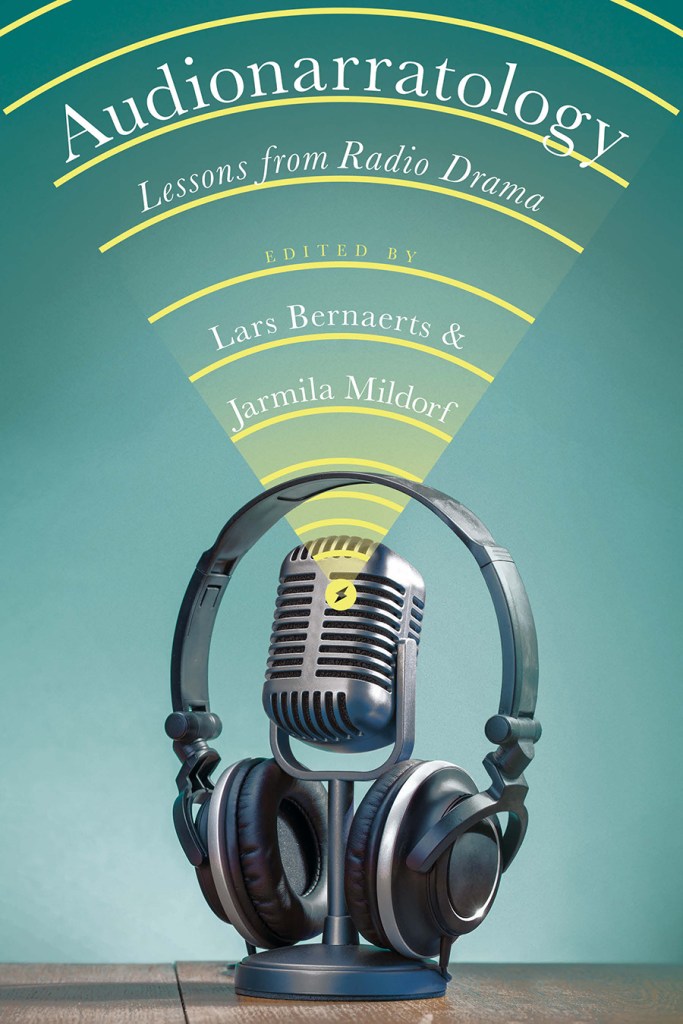
“Home at last,” I could almost hear myself sigh as, out of the narrow slit in our front door, I yanked the packet arriving today.  Bearing my name, as few pieces of mail of any consequence or sustenance do nowadays, it contained the volume Audionarratology: Lessons from Radio Drama, to which I had been invited a few years ago to contribute a chapter.  The book was published in July 2021 by Ohio State University, a press renowned for its contribution to the evolving discourse on narratology.  

The titular neologism suggests that an engagement with aural storytelling is proposed as one way of broadening a field that has enriched the interpretation not only of literature but also of visual culture.  Whether such aural storytelling should be subsumed under the rubric ‘radio drama’ is something I debated in my study Immaterial Culture, for which I settled on the term ‘radio play,’ as, I argued, the fictions written for radio production and transmission are hybrids whose potentialities remained underexplored and whose contribution to the arts underappreciated in part due to the alignment of such plays with works for stage and screen.  Nor am I sure that, by adding the prefix, “audionarratology” will be regarded as a subgroup of narratology – which would defeat the purpose of broadening said field.

To the question what “Lessons” may be learned from plays for radio, or from our playing with them, the quotation that serves as title of my essay provides a serviceable response: “There ain’t no sense to nothin.”  The line is uttered by one of the characters in I Love a Mystery, the thriller serial I discuss – and it is expressive of the bewilderment I felt when first I entered the world created in the 1930s and 1940s by the US American playwright-producer Carlton E. Morse.  My cumbersome subtitle is meant to suggest how I responded to the task of making sense not only of the play but also of the field in which I was asked to position it: “Serial Storytelling, Radio-Consciousness and the Gothic of Audition.”

By labelling ‘gothic’ not simply the play but my experience of it, I aim to bring to academic discourse my feeling of unease, a sense of misgivings about explaining away what drew me in to begin with, the lack of vocabulary with which adequately to describe my experience of listening, the anxiety of having to theorise within the uncertain boundaries of a discourse that I sought to broaden instead of delimiting.

Throughout my experience with radio plays of the so-called golden age, I felt that, playing recording or streaming play, I had to audition belatedly for a position of listener but that I could never hear the plays as they were intended to be taken in – serially, via radio – during those days before the supremacy of television, the medium that shaped my childhood.

In the essay, I try to communicate what it feels like not knowing – not knowing the solution to a mystery, not quite knowing my place vis-à-vis the culture in which the play was produced or the research culture in which thriller programs such as I Love a Mystery are subjected to some theory and much neglect.  Instead of analysing a play, I ended up examining myself as a queer, English-as-second-language listener estranged from radio and alien to the everyday of my grandparent’s generation – never mind that my German grandfather fought on the Axis side while the US home front stayed tuned to news from the frontlines as much as it tuned in to thrillers and comedies that were hardly considered worthy of being paraded as the so-called forefront of modernism.  So, a measure of guilt enters into the mix of emotions with which I struggle to approach or sell such cultural products academically.

The resulting chapter is proposed as a muddle, not as a model – although its self-consciousness may be an encouragement to some who are struggling to straddle the line between their searching, uncertain selves and the construct of a scholarly identity.  Its failings and idiosyncrasies are no strategic efforts to fit in by playing the misfit or refitting the scene – they are proposed as candid reflection of my mystification.  

They also bespeak the fact that the essay, unfinished or not fully realised though it may seem, was a quarter century in the making.  It started out by twisting the dial of my stereo receiver and happening on Max Schmid’s ear-opening program The Golden Age of Radio on WBAI, New York, agonising whether to turn my newly discovered hobby into the subject of academic study, enrolling in David H. Richter’s course “The Rise of the Gothic” at CUNY, and by responding to the essay brief by exploring gothic radio plays and radio adaptations of Gothic literature.

Once I had decided to abandon my Victorian studies in favor of old-time radio, the essay was revised to become a chapter of my PhD study Etherized Victorians.  It was revisited but removed from Immaterial Culture as an outlier – the only longer reading of a play not based on a published script – during the process of negotiating the space allotted by the publisher.  It had a lingering if non-too-visible presence on my online journal broadcastellan as an experiment in interactive blogging, and it now appears in a volume devoted to a subject of which I had no concept when I started out all those years ago.

The draft, too, has gone through a long process of negotiation — of editing, cutting and rewriting – at some point of which the frankness of declaring myself to be among the “outsiders” of the discourse did not make the editors’ cut.

So, home the essay has come; but the home has changed, as has its dweller, a student of literature who transmogrified into an art historian with a sideline of aurality, and who now has to contend with tinnitus and hearing loss when listening out for clues to non-visual mysteries and, ever self-conscious, waits for his cue to account for the latest of his botches, or, worse still, to be met with silence.  Estrangement, uncertainty, and the misery of having to account for the state of being mesmerised by mysteries unsolved – such is the gothic of audition.

Eyre Apparent: Adoption, Adaptation and the ‘orphan child of accepted literature’

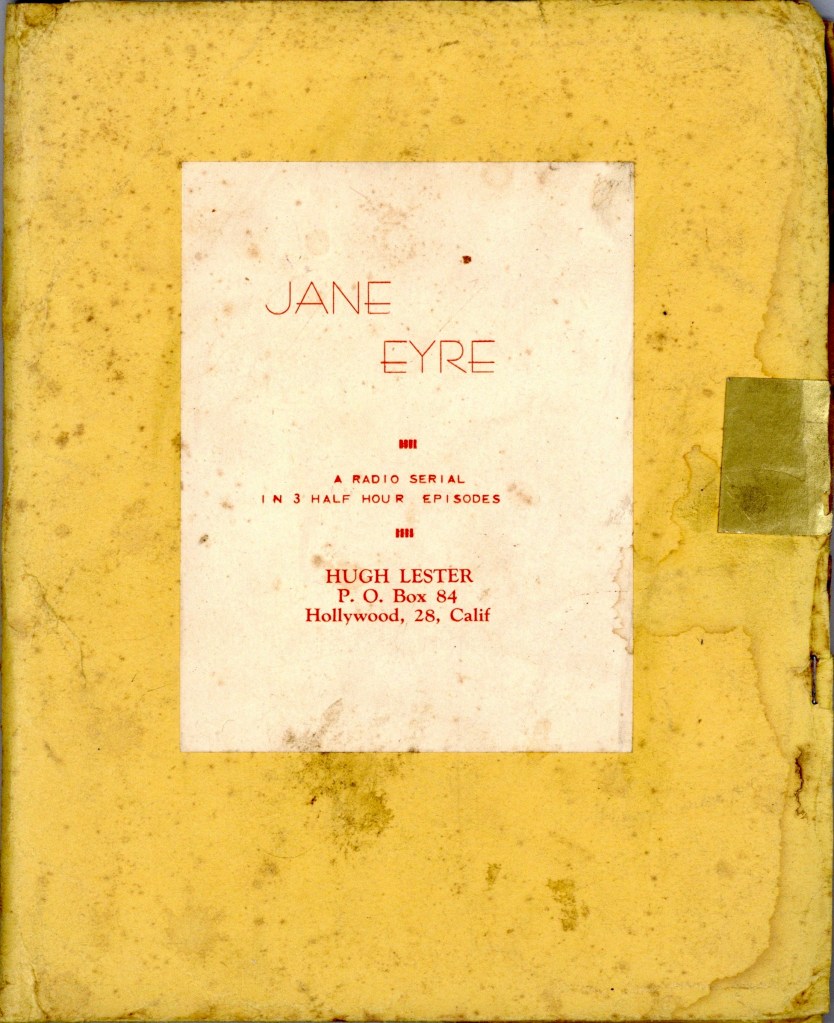
The most recent item to enter my collection of ephemera is a somewhat tattered, unpublished radio script (pictured above).  It is held together by rusty staples that attest to the authenticity to which, as a cultural product, it cannot justly lay claim. I still do not know the first thing about it. When was it written? To whom was it sold? Was it ever produced?

Initial research online revealed at least that Hugh Lester, the writer claiming responsibility – or demanding credit – for the script, was by the late 1930s a known entity in the business of radio writing, with one of his adaptations (a fifteen-minute dramatisation of Guy de Maupassant’s story “The Necklace”) appearing in a volume titled Short Plays for Stage and Radio (1939).   Rather than wait to ascertain its parentage, I decided to adopt Lester’s brainchild after spotting it lingering in the virtual orphanage known as eBay, where the unwanted are put on display for those of us who might be enticed to give them a new home.

Getting it home – my present residence – proved a challenge.  After being dispatched from The Bronx, the script spent a few months in foster care – or a gap behind a sofa in my erstwhile abode in Manhattan – before my ex could finally be coaxed into shipping it to Wales.  I occasionally have eBay purchases from the US mailed to my former New York address to avoid added international postage; but the current pandemic is making it impractical to collect those items in person, given that I am obliged to forgo my visits to the old neighborhood this year.  I was itching to get my hands on those stapled sheets of paper, especially since I am once again teaching my undergraduate class (or module, in British parlance) in Adaptation, in which the particular story reworked by Lester features as a case study.

As its title declares, the item in question is a “Radio Serial in Three Half Hour Episodes” of Charlotte Brontë’s 1848 novel Jane Eyre.  It is easy for us to call Jane Eyre that now – a novel.  When it was first published, of course, it came before the public as an autobiography, the identity of its creator disguised (‘Edited by Currer Bell,’ the original title page read), leading to wild speculations as to its parentage.  An adaptation, on the other hand, proudly discloses its origins, and it builds a case for its right to exist by drawing attention to its illustrious ancestry, as Lester’s undated serialisation does:

Announcer: We take pride in presenting for your entertainment at the first chapter of a distinguished dramatisation of Charlotte Brontë’s world famous novel, Jane Eyre.

An interesting choice of phrasing, that: while the source is pronounced to be ‘world-famous,’ meaning popular, this further popularisation by radio is argued to be ‘distinguished,’ meaning, presumably, first-rate – unless ‘distinguished’ is meant to suggest that the child (the adaptation) can readily be told apart from the parent (source).  Is not Jane Eyre ‘distinguished,’ whereas the aim of radio serials, plays for a mass medium, is to be popular, if only temporarily? Clearly, Lester aimed in that announcement to elevate to an art the run-of-the-mill business of adaptation that was his line; and run-of-the-mill it certainly was, most or the time.

One expert on radio scripts, commenting in 1939, went so far as to protest that radio had ‘developed almost no writers,’ that it had ‘appropriated almost all of them, at least all of those who could tell a good story.’  The same commentator, Max Wylie – himself a former radio director of scripts and continuity at CBS – also called ‘radio writing’ the ‘orphan child of accepted literature.’ To him, most radio writing was no ‘radio’ writing at all, at least not ‘in the artistic and creative sense,’ but ‘an effort in translation’ – ‘a work of appropriation whose legitimacy depends upon the skill of its treatment but whose real existence depends upon the work of some able craftsman who quite likely never anticipated the electrical accident of the microphone.’

Instead of approaching adaptation in terms of fidelity – how close it is to its source – what should concern those of us who write about radio as a form is how far an adaptation (or translation, or dramatisation) needs to distance itself from its source so it can be adopted by the medium to which it is introduced.  However rare they may be, radio broadcasts such as “The War of the Worlds” have demonstrated that an adaptation can well be ‘radio writing’ – as long as it is suited to the medium in such a way that it becomes dependent on it for its effective delivery.  It needs to enter a new home where it can be felt to belong instead of being made to pay a visit, let alone be exploited for being of service.

Jane Eyre was adapted for US radio numerous times during the 1930s, ‘40s and early ‘50s.  The history of its publication echoing the story of its heroine and their fate in the twentieth century – Jane Eyre was apparently parentless.  Brontë concealed her identity so that Jane could have a life in print, or at least a better chance of having a happy and healthy one.  In the story, Jane must learn to be independent before the man who loves her can regain her trust – a man who, in turn, has to depend on her strength.  Similarly, Jane Eyre had to be separated from her mother, Charlotte Brontë, because she could not trust the male critics to accept her true parentage.

On the air, that parent, Charlotte Brontë, needs to be acknowledged so that an adaptation of Jane Eyre does not become an impostor; at the same time, the birth mother must be disowned so that Jane can become a child of the medium of which the parent had no notion – but which is nonetheless anticipated in the telepathic connection that, in the end, leads an adult and independent Jane back to Mr. Rochester, the lover who betrayed her and must earn her trust anew.

Lester’s three-part adaptation retains that psychic episode in Brontë’s story:

Rochester: (In agony.  Whispering through a long tube) Jane! Jane! I need you.  Come to me – come to me!

In radio broadcasting, ‘[w]hispering through a long tube’ can be made to suggest telephony and telepathy – and indeed the medium has the magic of equating both; the prosaic soundstage instruction revealing the trick makes clear, however, that the romance of radio is in the production, that, unlike a novel, a radio play cannot be equated with a script meant for performance.

Being three times as long as most radio adaptations, Lester’s script can give Jane some air to find herself and a home for herself.  And yet, like many other radio versions of the period, it depends so heavily on dramatisation as to deny Jane the chance of shaping her own story.  One scholar, Sylvère Monod has identified thirty passages in which the narrator of Jane Eyre Jane Eyre directly addresses the audience.  And yet, the most famous line of Brontë’s novel is missing from Lester’s script, just as it is absent in most adaptations: ‘Reader, I married him.’ How easily this could be translated into ‘listener’ – to resonate profoundly that most intimate of all mass media: the radio.

Lester, according to whose script plain Jane is ‘pretty,’ is not among the ‘distinguished’ plays of – or for – radio.  Exploiting its source, by then a copyright orphan, it fosters an attitude that persists to this day, despite my persistent efforts to suggest that it can be otherwise: that radio writing is the ‘orphan child of accepted literature.’

Sweetness and The Eternal Light

My bookshelf, like my corporeal shell, has gotten heavier over the years.  The display, like my waist, betrays a diet of nutritionally questionable comfort food—of sugar and spice and everything nice.   Now, I won’t take this as an opportunity to ponder just what it is that I am made of; but those books sure speak volumes about the quality of my food for thought.  There is All About Amos ‘n’ Andy (1929), The Story of Cheerio (1937), and Tony Wons’s Scrap Book (1930).   There is Tune in Tomorrow (1968), the reminiscences of a daytime serial actress.  There’s Laughter in the Air (1945) and Death at Broadcasting House (1934).  There are a dozen or so anthologies of scripts for radio programs ranging from The Lone Ranger to Ma Perkins, from Duffy’s Tavern to The Shadow.

My excuse for my preoccupation with such post-popular culture, if justification were needed, has always been that there is nothing so light not to warrant reflection or reverie, that dismissing flavors and decrying a lack of taste is the routine operation of the insipid mind.  That said, I am glad to have added—thanks to my better half, who also looks after my dietary needs—a book that makes my shelf figuratively weightier rather than merely literally so.

The book in question is The Eternal Light (1947), an anthology of twenty-six plays aired on that long-running program.  It is a significant addition, indeed—historically, culturally, and radio dramatically speaking.

In the words of Louis Finkelstein, President of the Jewish Theological Seminary of America, under whose auspices the series was produced, The Eternal Light was a synthesis of scholarship and artistry, designed to “translate ancient, abstract ideas into effective modern dramatics.”

In his introductory essay “Radio as a Medium of Drama,” Morton Wishengrad, the playwright of the series, defended broadcasting as a valuable if often misused “tool.” He did so at a time when, in the disconcerting newness of postwar opportunity and responsibility, radio was increasingly—and indiscriminately—dismissed as the playground of Hucksters, to name a bestselling novel of 1946 whose subject, like Herman Wouk’s Aurora Dawn (1947), was the prosperity and self-importance of the broadcasting industry in light of the perceived vacuity of its product. 

“An automobile does not manufacture bank-robbers,” Wishengrad reasoned, “it transports them.  It also transports clergymen.  It is neither blameworthy because it does the first nor is it an instrument of piety because it does the latter.  It is merely an automobile, a tool.

 What the medium needed—and what the times required—were writers who had “something to say about the culture.”

According to Wishengrad, there was “nothing wrong” with the techniques of radio writing.  He noted that serial drama, derided and reviled by “demonstrably incompetent” reviewers, had great storytelling potential: “Here are quarter-hour segments in the lives of people which could transfigure a part of each day with dramatic truth and an intimation of humanity instead of presenting as they now do a lolly-pop on the instalment plan.”

A  “lolly-pop on the instalment plan”! To paraphrase Huckster author Frederic Wakeman’s parody of radio commercials: love that phrase. Wishengrad is one of a small number of American radio dramatists whose scripts remain memorable and compelling even in the absence of the actors and sound effects artist who interpreted them.  Of the latter’s métier Wishengrad wrote: “Sound is like salt.  A very little suffices.”  He cautioned writers, in their “infatuation with its possibilities,” not to “drown” their scripts in aural effects.

Wishengrad’s advice to radio dramatists is as sound as his prose.  “Good radio dialogue,” he held, should come across “like a pair of boxers trading blows, short, swift, muscular, monosyllabic.”  Speeches, he cautioned, ought not to “be long because the ear does not remember.  There is quick forgetfulness of everything except the last phrase or the last word spoken.”

While Wishengrad made no use of serialization in The Eternal Light—as much as the title suggests the continuation and open-endedness of the form—his scripts bear out what he imparts about style and live up to his insistence on substance. 

Take “The Day of the Shadow,” for instance.  Produced and broadcast over NBC stations on 18 November 1945, the play opens: “Listen.  Listen to the silence.  I have come from the land of the day of the shadow.  I have seen the naked cities and the dead lips.  Someone must speak of this.  Someone must speak of the memory of things destroyed.”

The abstract gives way to the concrete, as the speaker introduces himself as the “Chaplain who stood before the crematorium of Belsen.”

I have buried 23,000 Jews.  I have a right to speak.   I stood the last month in Cracow when “Liberated” Jews were murdered.  I have no pretty things to tell you.  But I must tell you.

The “plain, and written down, and true” figures—appropriated from the “adding machines of the statisticians”—tell of the silenced.  But, the Chaplain protests, “[l]et the adding machines be still,” and let the survivors—the yet dying—speak; not of the past but of the continuum of their plight, of the aftermath that comes after math has accounted for the eighty percent of Europe’s Jewish population who were denied outright the chance to make their lives count.

At the time The Eternal Light was published, radio drama, too, was dying; at least the drama with a purpose and a faith in the medium.  To this date, it is a body unresuscitated; and what is remembered of it most is what is comforting rather than demanding, common rather than extraordinary.  Shelving the candy, resisting the impulse to reach for the sweet and the obvious—the lolly-popular—I realize anew just what has been lost to us, what we have given up, what we have forgotten to demand or even to long for . . .

Come On Up, Eileen; or, Wonderful Yorkville

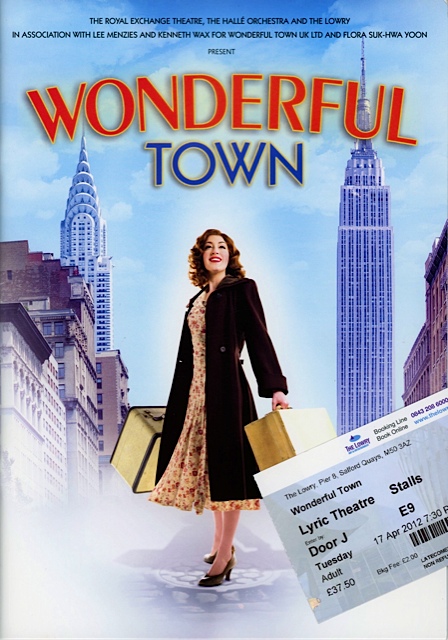
A few weeks ago, my better half and I were up in Manchester, England, to do research for an upcoming exhibition.  While there, we had the good fortune of catching a production of Leonard Bernstein’s Wonderful Town starring Welsh girl gone West End Connie Fisher as Ruth.  Though not quite the real thing, this revival of a Broadway musical version of a play (turned movie, turned sitcom) based on a series of magazine stories inspired by the personal recollections of an Ohioan in Gotham did manage to evoke some of the magic and the madness of life in the titular burg.  And now that I’m back, the residential misadventures of Eileen and her sister come to mind each time I walk down Second Avenue in my old Upper East Side neighborhood.  Like the McKenney siblings, whose Greenwich Village basement flat was shaken by blasts heralding a subway line then under construction, folks up here in Yorkville have been dealing for years with the pre-math of just such a subterranean project: the noise, the dirt, the traffic jams, the shut down stores, the narrowed sidewalks, the fenced in pedestrian passageways that make you feel like a laboratory rat . . . and the rats themselves.


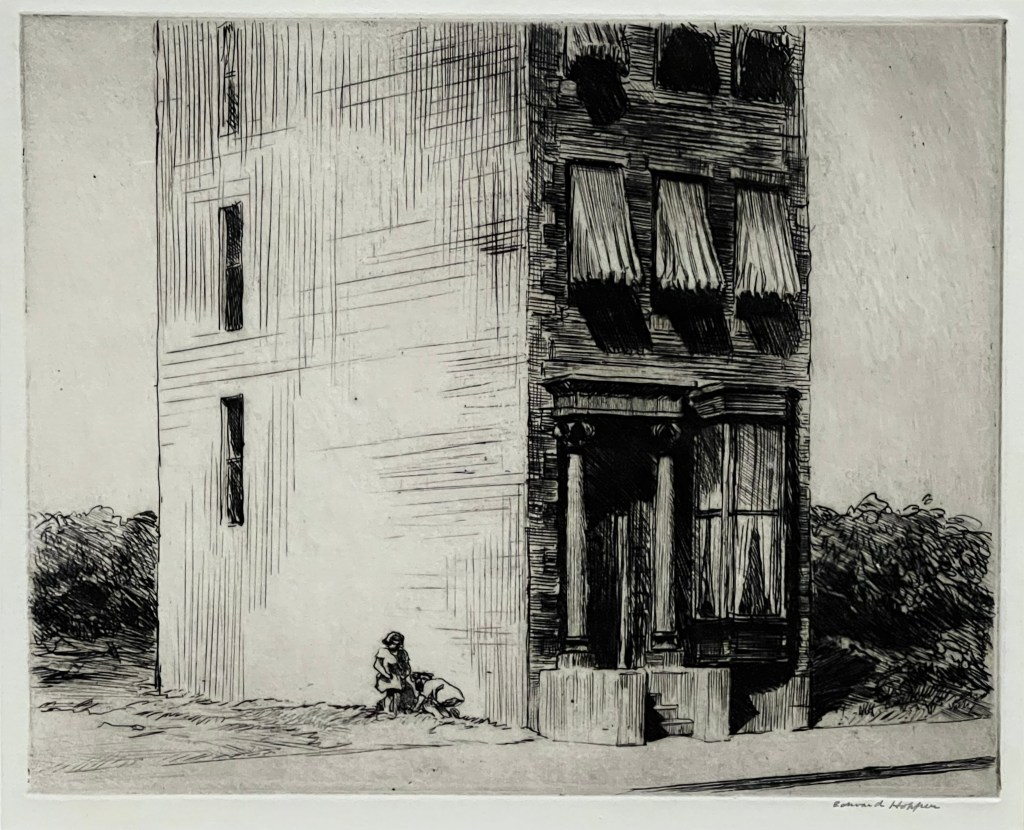
Yes, Second Avenue (pictured) is looking rather worse—and far less flashy—than it did when the street was lined not with gold, but with gals who may or may not have a ticker made of that precious metal; you know, ladies whose line, like the subway’s, is well below.  Wonderful Town is not without hints of darkness, but, as in many musicals of the 1940 and ’50s, the shadier urbanites are colorful caricatures rather than delicately shaded characters.  And if Wonderful is now not as well liked as it was when it premiered, this may be owing to the fact that, even though the characters are based on real people, the assembled Christopher Street portraits are cleaned up so thoroughly as to make them look like stock figures in a formulaic pastiche.  That said, the musical still offers a glimpse at life during the Great Depression and remains translatable—and relatable—to anyone who can read between all those half erased lines of none-of-your-business.

Not that I need to step out of my old apartment to get that sinking Ruth and Eileen feeling.  The two women struggled to find work and put up with a lot while waiting for a break, a wait that, in Eileen’s case, ended at the age of 26 in a fatal car crash.  Journalist Ruth McKenney immortalized her sister and saw—or made us see—the bright side of their hardship and the squalor down in their dingy, downstairs domicile.  Indeed, when I first caught up with My Sister Eileen, sitting in an Upper East Side park listening to a 1948 radio production starring Shirley Booth, I assumed it to be a comment in the post-Second World War housing crisis.  And it is this crisis that hits home today.

If ever I write another autobiography—the one I penned somewhat prematurely at age 14 was discarded once it had served its purpose of communicating my pubescent angst to the girls in my class, whom I knew it was pointless for me to pursue—I might take a lesson from Ruth and look on the proverbial if sometimes elusive silver lining when I reflect on this morning’s knock on the door.  An eviction notice was posted on it and my old apartment is once again contested territory.  I am writing this—while culture beckons unheeded—sitting at the shaky dinner table that, for many years, was stacked with books, student essays, and the drafts of my MA thesis and PhD dissertation.  No, this town would not feel half as wonderful to me if it weren’t for that table, this apartment, and for the friendship that made it possible—and indeed desirable—to come back for a visit, year after year . . .

Of Myrt and Marge-inal “interest”; or, Getting It in the “hinterland”

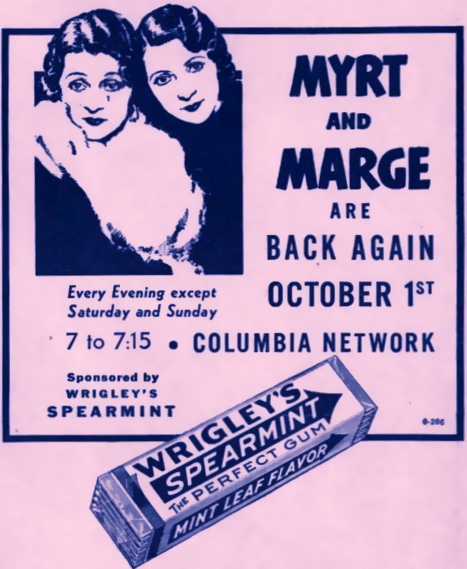
Amos ‘n’ Andy is old-fashioned,” radio critic Darwin L. Teilhet complained as early as 1932. “Its dramatic machinery creaks.”  He much preferred Myrt and Marge, a 42nd Street-smart if way-off-Broadway Melody then in its inaugural season.  To Teilhet, Myrt and Marge was not only “very good serialized melodrama,” it was the “most advanced program of its type now on the air.” 

For all its popularity—and its groundbreaking granddaddy-of-them-all status—Amos ‘n’ Andy sure was “old-fashioned.”  Indeed, its success depended on that comforting, reassuring recognizability—comforting and reassuring, that is, to folks who thought a black face routine less troubling than the effectuation of racial equality.  The early 1930s were highly competitive times of economic hardship, and to hear potential competitors bumbling and make fools of themselves must have been comic relief to the paler faces in the crowd, the faces that mattered most to sponsors.

So, how fresh-faced were Myrt and Marge by comparison? And why was it that, by January 1933, their serialized adventures came pretty close to rivaling Amos ‘n’ Andy in the ratings? Never having been enthusiastic about the latter, I was eager to find out.

As next to nothing is left of the program’s initial run, I had to take the critics’ ear and word for the “it” of listening.  Teilhet, for one, was wowed by the “swift lines,” which he found to be “very different from Amos’ and Andy’s ponderous exchanges.”

Indeed, those “swift lines” translated into swell curves in the critic’s mind.  “Miss [Donna] Damerel [as Marge] provides a sweet and pure sex interest,” Teilhet opined, “which can be safely gulped down by the hinterland without making the children go to bed before their proper hour.”  It took an adult’s imagination of adulterated purity to figure that not all that occurred in the lives of chorines Myrt and Marge was altogether “sweet and pure,” least of all by the puritan standards commercial radio was obliged to uphold.

According to Teilhet, the “tempo” set by the two leads was “hard and glittering.”  Myrt and Marge was quick to respond to the public’s fascination with Al Capone and Little Caesar by turning the backstage drama into an “exciting gangster story.”  It brought a touch of Dillinger to the dilly-dalliance of romantic serials, then still a genre in search of a formula.  By doing so, and by implicating its leads, Myrt and Marge came as close to pre-code Hollywood as network radio could get.

What’s more, Teilhet remarked, that “tempo” was “directly traceable to the vaudeville antecedents” of Myrtle Vail, who created the serial, wrote and starred in it.  “The things she has seen—and experienced,” winked Radio Guide’s Arthur Kent in 1934.  Kent attributed the program’s success to the fact that the title characters were played by actresses who were mother and daughter in real life and that Myrtle Vail had “lived in three great epochs of show business: epochs dominated, respectively, by stage, movies and radio.”  Having “been though it all,” Vail now wrote “the life of the theater as well as her own life into her script.”   Like a true trouper, she carried on even after the death of her co-starring daughter in 1941.

At least on one occasion, the realism was inspired by actual events.  “That tearful episode of Myrt and Marge last week was not the result of an emotionally successful script, m’dears,” readers of Radio Guide’s issue for the week ending 1 February 1936 were told.  “No, it was because the cast almost was overcome by tear gas fumes released when the bank adjoining the CBS studios tested out its automatic vault system.” 

I am surprised that listeners, if not overcome by the vapors, weren’t positively fuming at some of the backstage goings-on.  Perhaps they were overcome, which may account for the lack of documented complaints, radio’s chief tool of self-censoring.  Could they have been oblivious of the program’s other or third “sex interest”—that flaming figure in the dressing room?

What Myrt and Marge brought into American homes, if they didn’t already have one in the closet—and what contributed to renewed interest in the serial, albeit as a mere pop-cultural footnote—was Clarence Tiffingtuffer, the queer sidekick responsible for the gowns worn by the show-busy leads, and for considerable gossip besides.

If listeners were clueless, the hoofers sure weren’t.  When teenager Marge, the newest member of Hayfield Pleasures celebrated precision chorus, feels uncomfortable about being fitted by a man, one of her fellow chorines hisses “Don’t worry, he’ll never harm a hair o’ your head, dearie.”  Rather than being the brunt of it, Clarence dishes out some “swift lines” of his own. “Those gams of yours are practically parenthetical,” he remarks upon the alleged assets in his sartorial care.

Now, belated followers of Myrt and Marge have to make do with a mid-to-late 1940s revival of the serial (although a 1933 film version featuring the radio cast is extant).  Gone are the true-to-life leads; gone, too, is much of what had seemed “different” or “advanced” about the serial back in 1932.  Yet even though we now have to settle for Myrt and Marge-arine, the substitute still retains a flavor of the first outing, as the actor originating the part of Clarence, Ray Hedge, reprises the role he made his own.

I can imagine that, had I been growing up in the early 1930s, Myrt and Marge would have made me feel a little less marginal by moving someone recognizably like me—yet way out there, enjoying a career and a life of make-believe—into the center of the action.  How thrilling it would have been to hear Myrt and Marge take to the soundstage set by their better-known seniors, Gosden and Correll, and listen to them tear down that old minstrel show-on-taxi cab wheels.  With Clarence in their midst, and on my mind, it sure would have sounded like the “most advanced program of its type.”

To be continued, as they say in soap opera land.

Ascent to the Gods: The Odyssey of Norman Corwin (1910-2011)

Obituaries often begin like this: The world (the art world, the theater world, the world of miniature golf, or what have you) has lost one of its leading, brightest, most prominent so-and-so’s. But that won’t do. Not if the so-and-so is Norman Corwin. The formula would not be worthy of him, for one. Stylistically alone, it would be un-Corwinian; it would be Hummertsian. Nor would it fit the occasion of commemorating his life’s work since the formula cannot contain it. The application would lead instead to inaccurate, misleading statements such as this one: The world of radio drama lost one of its greatest writers.

True, Norman Corwin, who died on 18 October 2011 at the age of 101, was a leading light in that dark theater of the mind. But he was also a journalist, a teacher, a screenwriter, a director, a producer, and, what has yet to get into the heads of those who assemble the anthologies of American Literature, a poet. He inhabited and enriched many worlds—and yet, for the past sixty years or so, Corwin has not been known the world over. You might say that we, most or millions of us, lost Norman Corwin decades ago because we, or some somebodies we permitted to act in our stead—though not on our behalf—decided that the world Corwin helped create and never forgot should be written off, abandoned, and depopulated of its talent like the ghost of a mine whose ore is no longer deemed worth our digging . . .

In the United States, the world of radio drama is such a lost world—and those, like cretaceous me, who keep on living in this world even if we can no longer live by it, might as well be dwelling on some dark star in a parallel universe. Unlike today’s listeners, radio writers did not have that choice back in the late 1940s, unless they were content, as Corwin put it in retrospect, to be “apolitical except for strong support of home and motherhood,” “inoffensive to the world in all its parts (although in radio practice, exceptions are often made in the case of minority-opinion groups which cannot possibly reply)” and prepared to “keep within the pale of clichés of character and situation so traditional there is a mellow patina on them.”

“I believe that artistic radio, whether commercial or otherwise, will not develop without a willing and interested leadership on the part of those who control programming, budget and time,” Corwin exclaimed in 1947. “That is all.”

That was all. One year later, Corwin felt compelled to remind those in control that he was still there, waiting and willing to take on another creative assignment—another Twenty-Six by Corwin, perhaps, another One World Flight. “I Can Be Had,” he announced; but those in “control” would not have him back.

“The artists are around, and there is nothing occult about the process of dialing their telephone numbers and talking it over.” Apparently, no one bothered to touch that dial. After years of restraint, commercial radio was eager to get richer even it that meant becoming culturally less enriching. It was a short-lived strategy of cashing in before television would take over and pretty much close the theater of the mind for good. Never again would a single play written for the ear reach and move an audience of sixty million in no more than two performances—as Corwin’s “On a Note of Triumph” did in 1945.

Forced to exit network radio because executives no longer commissioned verse plays, dramatic documentaries or travelogues in sound—three genres that are quintessentially Corwinian—Norman Corwin began travelling between worlds, the worlds of film, journalism, and the academia. Television, at least initially, was too small, too restrictive a realm to attract, let alone accommodate an imagination as vast as his. To Corwin, the audiovisual upstart was but a “poor bastard among the arts, having the benefit of neither the full scope and mobility of cinema, the immediacy of the legitimate theatre, nor the powerful suggestibility of radio’s unillustrated spoken word.”

The American theater of the mind may have been shut up, but Corwin’s mind stayed open. For over sixty years, he kept on journeying, searching and yearning. That’s the spirit that sustains you until you’re 101. Lucky are those who encountered him along the way. I prize the words of encouragement he wrote to me when, a few years ago, I dusted off my obscure dissertation on the American play to share my chapter on Corwin with the very man. I think of those words whenever I feel that, not being quite as eager as he to venture elsewhere, I lost my way; that I am lost to most of the image-minded world, untravelled, unraveling, yet all the while revelling in the “unillustrated spoken word.” I got the words, all right; Corwin had the wisdom as well.

I shall leave this entry in my otherwise image-filled journal “unillustrated.” I imagine Mr. Corwin appreciates the gesture . . .

(For those ready to catch up or on, the entire run of Twenty-Six by Corwin is currently being rebroadcast by John and Larry Gassman of Same Time, Same Station.)

Better the DeMille You Know

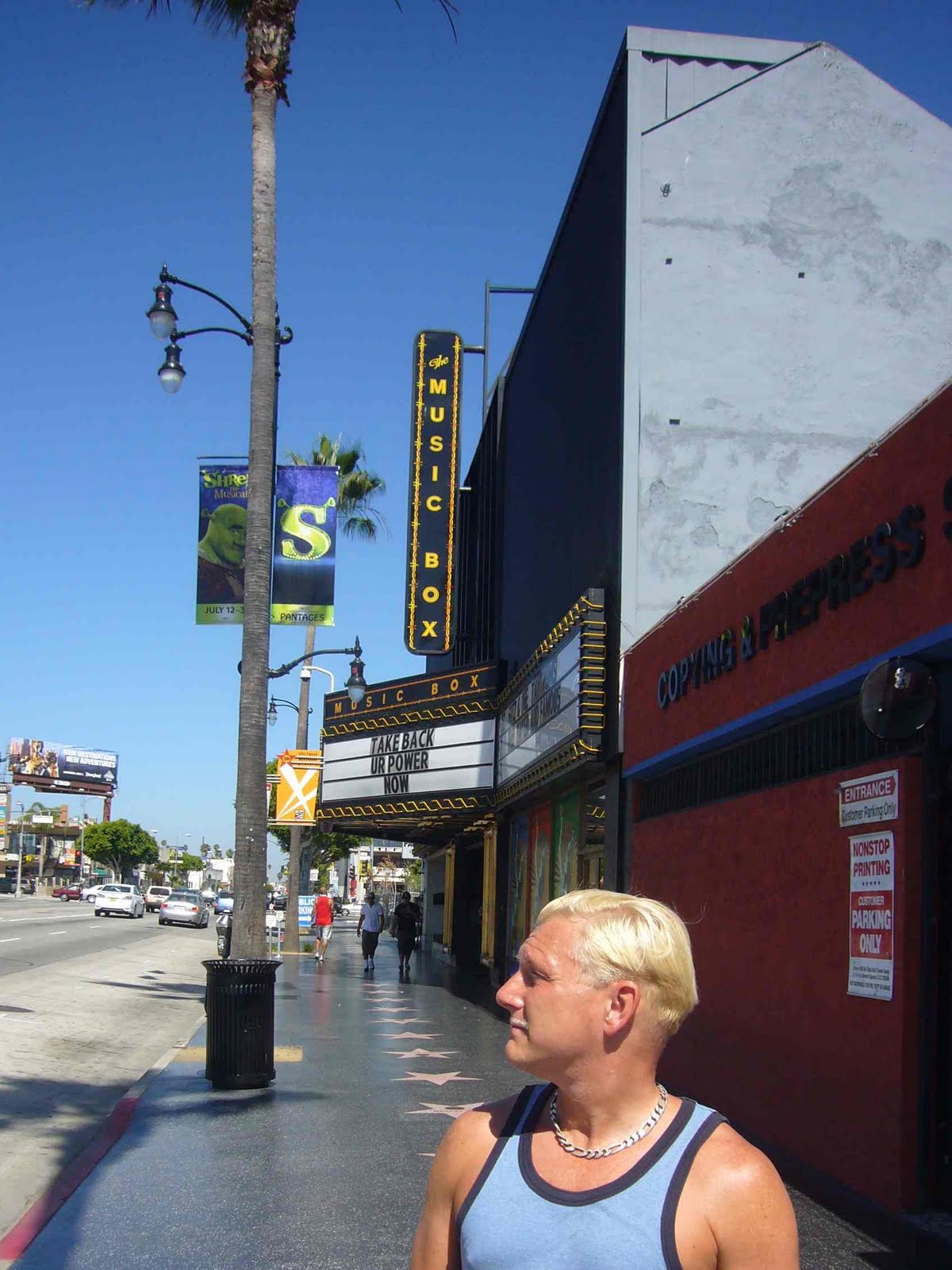
“Take Back UR Power Now,” the letters on the marquee read. I am standing in front of the Music Box Theater on Hollywood Boulevard. Whose power? I wonder. Who took it? Who lost it? And just who is telling me—or anyone else reading—to seize it? Take it from me, perhaps? Do I have it? Did I ever have it? Am I supposed to have it? If so, to do what with? Storm the box office? Take to the stage? Tear down the building and plant a tree? A windmill? Hold it. Is this one of those tiresomely postmodern Barbara Krugerisms? As my friend Clifton once put it, “I could look [it] up . . . but it’s more fun to speculate.”

The imperative “Now” intrigues me. It strikes me as incongruous, anachronistic. And, yes, antagonistic. It does not seem to denote the “Now” of 2011, my “Now” on this bright, sunny afternoon spent in one of the most frivolous locales in the western hemisphere. The look of the venue, the somewhat run-down surroundings, the slogan and its lettering transport me back to the early, bleak, violent, recession-shaken 1990s. Why am I thinking race relations? Could this not just as well be some hackneyed Tea Party catchphrase? Or else, a sign of things to come . . .

The time is ripe for warping. I’ve just been to Grauman’s Chinese, placing my palms into the imprints left by stars long gone out. I’ve been taking in all those names on the Walk of Fame, and it felt like treading on gravestones. And I arrived here, at the Music Box, transported by a longing, by the kind of nostalgia I am so wary of.

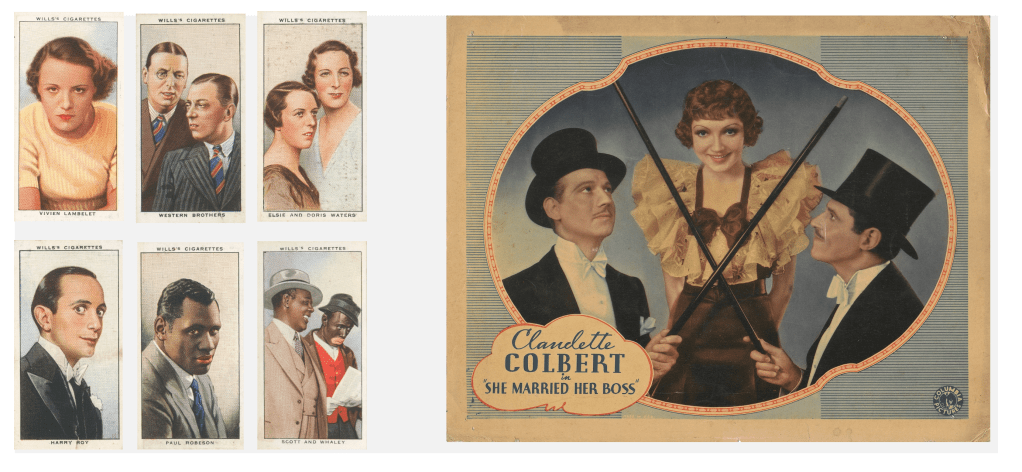
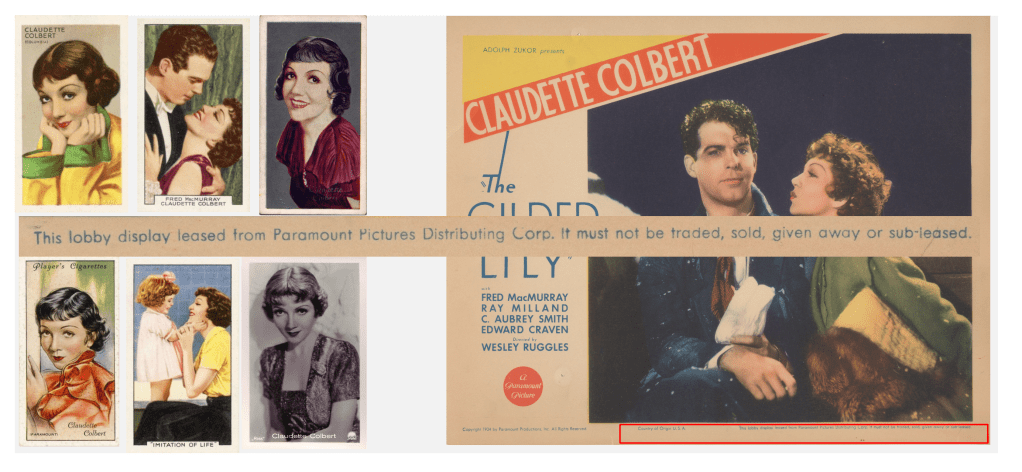
I did not expect to be reminded of the 1990s, to be taken aback instead of simply being taken back, if that were ever achieved ‘simply.’ Sure, I was prepared to be late. Seventy-five years late, to be exact. If it were in my power, I would be standing here, back in line with hundreds of other enthusiasts, to take a gander at Marlene Dietrich, Myrna Loy, Ruby Keeler, or Claudette Colbert. Not on the screen, mind, but live and in person. The Music Box, after all, was once the venue for the Lux Radio Theater, a Monday afternoon extravaganza hosted by showman-director Cecil B. DeMille. Merle Oberon, Marion Davies, Joan Crawford. Back in the summer of 1936, they were all here. I am in awe.

That is why I have come to this spot—on a Monday afternoon, no less, as I would later realize. I was dreaming. Now I feel tired out, and a little bit stupid, having caught myself chasing after ghosts. It is as if I had been hoping to get hold of the breeze stirred up by some wispy number long since mothballed. The spirit of the place does not “send me,” as swooning teenagers used to call it (the state of swooning, I mean). If anything, it sends me back to where I started this reverie. It takes me back into the ether, the mythical non-space I can fill, at will, with the voices of Marlene Dietrich, Myrna Loy, Ruby Keeler . . . as they were performing for millions of listeners, broadcasting live from the Music Box stage. It takes me back.

Wait. When was it again that I discovered these recordings for myself? The early 1990s. Well, what do you know! I guess, looking at that marquee, I have been forced to catch up with myself, and I find that self wanting, historically lost to the world. Years spent circling in representations of a past not alive to my being. Is it time to take back whatever I squandered? Is there still time? Do I have the energy to matter, the power to mean? I wonder . . .

A Voice in the Wave: Carl Brisson at the Golden Oriole

Carl Brisson

“42 Men Killed Every Week,” the headline read. Those who had already heard as much on the radio would likely have felt the impact of this crime wave; but, unless they were pining for the likes of Rudy Vallee, they would have relished it as well. Religious leaders, child psychologists, and a few popular entertainers aside, hardly anyone would have been the least bit alarmed. After all, the headline appeared in the 27 July 1946 issue of Billboard and the tally of fatalities was not meant to reflect the hebdomadal wrongdoings in one of America’s urban jungles. Instead, it referred to the “[l]opsided preponderance” of crime dramas that, after the killings at the front had come to an end, hit the airwaves so hard as to wipe out much of the competition.

Perhaps, “swallow up” might be a better way of putting it, as the zingers and songs previously heard elsewhere were subsumed by thriller programs that, in a desperate attempt not to sound cookie-cutter, were becoming increasingly kooky. Take Voice in the Night, for instance. Mentioned in the Billboard report as a contributor to the body count—yet rarely ever mentioned elsewhere or thereafter—it was one of the most baffling mysteries ever devised for the sightless medium, all the more so for having been green-lighted to begin with.

Folks tuning in to Mutual on Friday nights back in the summer of 1946 were told that Voice in the Night was something new under the moon—“a musical mystery story starring the internationally famous stage, screen and supper-club star Carl Brisson.” Never mind the hyperboles, the fact that Brisson had not appeared on the screen in well over a decade. At the time, he was indeed a successful act on the hotel circuit, although even favorable reviews would point out that “his pipes [were] no longer the same” and that he suffered from “a lapse of memory” (Billboard 30 March 1946). Indeed, such setbacks may have made crooning behind a mike with sheet music in his hand sound like an attractive alternative to the middle-aged baritone.

Not that Brisson would have appreciated being called an “Engaging Grandfather”—as a less than subtle Newsweek review had done two years earlier; but, if his voice or appearance did not suggest as much already, there was that prominent son of his (Rosalind Russell’s husband), then in his early thirties. Such telltale signs could be airbrushed away with the aid of a microphone. On the radio, by which even seasoned voices in the night penetrated many a chambre séparée, Brisson could yet be Carl Brisson, a detective who sang for his private suppers.

True, Brisson had experience playing romantic leads, having starred in two melodramas helmed by Alfred Hitchcock; but that was in the silent era, when his Danish accent posed no obstacle to a career in British or American film. In 1934, he had even mixed music and mayhem and “Cocktails for Two” in Murder at the Vanities (pictured above); but a duet with Kitty Carlisle could not have prepared him for the challenge of carrying anything other than a tune, least of all a dramatic radio series of his own. For, no matter how many times he would perform his signature song “Little White Gardenia” (“You may wear it if you care / Or toss it away”), a crime had to be related and solved within each half-hour allotted to Voice in the Night. And on this night, 14 June, in 1946, it was a case involving the theft of a necklace that “once cost two men their lives.”

We meet Carl Brisson at the Golden Oriole, a nightclub where he takes requests and performs standards like “All of a Sudden My Heart Sings” to an appreciative proxy audience, sit-ins for the listeners at home, some of whom would have seen Brisson in person and may well have resented being drawn in by the performer only to be short-changed as he, having invited the diegetic (or built-in) crowd to stand up and dance, walks over to one of the tables for a tête-à-tête with a female and no doubt attractive newspaper columnist whom he feeds his stories of crime and romance.

Old-time radio encyclopedists John Dunning and Jim Cox, who merely quotes and paraphrases the former without giving him proper credit, would have you believe that Brisson dashes off to solve a crime before resuming his nightclub act. Don’t take their word for it, though. In the only two extant episodes, at least, he merely takes a break to relate one of his adventures.

“You’re never more beautiful than when you’re angry to me,” Brisson tells his private listener. Now, I am not sure whether the script or the interpreter is responsible for the way this comes out, whether, as the linguists put it, the problem is structural (“beautiful . . . to me”), or lexical (“angry at me”); but the performance is riddled with such incidents, which become rather distracting. Indeed, forget the largely frisson-free mystery of the stolen “neggless.” It is Brisson’s delivery that will puzzle you. Perhaps, Mutual had hoped for a second Jean Hersholt; but Brisson, though closer in age to his fellow countryman than he would admit, was not called upon to play another Dr. Christian here. Nor would he have been content to be a kindly old Mr. Keen with a trace of a hard-to-lose accent. The romance-filled mysteries were meant to be fast-paced—but the “Great Dane” kept tripping over his tongue.

Having performed “Bells of St. Mary” for a lovely young “corple” at the club, Brisson admits that he “may have lost Mary Morgan”—but the one he was supposed to pursue was a guy named Larry. Perhaps, it was that “lump on [his] head like the size of an egg” that caused Brisson to fluff his lines or else to render them all but unintelligible.

A few weeks later, an episode titled the “Case of the Worried Detective” self-consciously worked what was problematic about the program into a rather more light-hearted script. “I placed you by your accent immediately,” Brisson is told by a hotel clerk. “You are that new long distance runner from Sweden, aren’t you?” A “long distance singer from Denmark,” Brisson corrects. Neither fame nor ready money could get him a room, though, what with the post-war housing crisis going on. “Not even if I promise not to sing?” the performer inquires. If only he had promised not to speak.

While the tongue-in-cheek approach somewhat improved on the tedious double-cross romance contrived for the earlier episode, Brisson was less convincing as a wit than he was as a womanizer. He simply could not get his tongue around certain English words, at least not quickly enough to deliver snappy one-liners.

Besides, anyone alerting the “Voice in the Night” to his glossal obstacle may have received a response similar to the one Murder at the Vanities director Mitchell Leisen got when he tried to correct Brisson’s diction. The singer-actor “was supposed to say ‘She’ll’ and kept pronouncing it ‘Seel,’” Leisen told David Chierichetti.

I thought he was having language problems, so I enunciated it very carefully for him. He said, “Oh, I know how to say it, but don’t you think it’s cuter the other way?”

Rather than being called upon to talk sense or crack wise, Brisson should have been permitted to give his target audience—“the fair, fat and 40 trade,” as Billboard (5 April 1947) called them—what they really wanted, which is just what he did when he returned to his successful club routines. His Voice in the Night was an early casualty of radio’s post-war crime wave, the riding of which tempted and drowned many a hapless performer.

Hush, Hush, Charlotte Greenwood

You’re sorry?” That was the rather pitiful catchphrase devised for a certain “lovable lady of stage, screen, and radio”—Miss Charlotte Greenwood, who, having done well for herself on stage and screen, added “radio” to her resume in June 1944, when the Charlotte Greenwood Program was first broadcast over NBC’s Blue network as a summer replacement for Bob Hope. Actually, Greenwood had been Mrs. to Mr. Martin Broones for nearly two decades; but whenever another character in her serialized situation comedy addressed her as Mrs.—an assumption based, no doubt, on her far from youthful appearance—and apologized after being duly corrected, Greenwood replied in the fashion of a frustrated spinster by letting off the above retort.

Sorry, indeed. In the fall of 1944, when Hope returned to the airwaves, Greenwood was presented with a vehicle that—after the disappointment of not starring in Oklahoma!, in a part written expressly for her, no less—must have been as thrilling to her as walking off with the unclaimed favors from a cancelled party. It sure wasn’t a surrey with a fringe on top. There’s no way you could confuse that fabulous Broadway hit with the miss that was The Charlotte Greenwood Show (1944-1946), even though the compiler of one Encyclopedia of American Radio did just that, claiming the lovable one was starred “as eccentric Aunty Ellen [sic] from Oklahoma.”

Instead, Charlotte Greenwood was playing Charlotte Greenwood—an actress preparing for her next movie role as a reporter by womanning the desk in the local room of a small-town newspaper. So, for about two and a half months, Greenwood talked long-distance to her manager in Hollywood or had some confrontation or other with the city editor.

Greenwood should have spent more time talking to the show’s head writers—Jack Hasty, who, as stated in the April 22-28 issue of Radio Life (from which the above picture was taken) had previously fed lines to Al Pearce and Dr. Christian, and Don Johnson, who had been one of Fred Allen’s gagmen. Else, she might have had a heart-to-heart with her real-life manager, who also doubled as her real-life spouse. And they all should have had a word with the sponsor, or, rather, the advertising agency handling the Halls Brothers account, since their executives insisted on having a card like Greenwood dispense sentiments as hackneyed as anything printed on cardboard bearing the Hallmark label:

“Friends,” she addressed the listening public in November 1944, a couple of weeks before Thanksgiving,

for most of us, these busy days are filled with big jobs to be done, big problems to be solved.  There’s so little time for the tiny, little everyday things.  The neighborly chat, the letter to an old friend.  And yet, in this swiftly moving world, friendship need not be forgotten.  A few words that say “I hadn’t forgotten” may mean more than you know to someone, somewhere.  There’s an old saying I think all of us should remember: The way to have friends is to be one.

More offensive than such platitudes is the opportunism apparent in advertising copy urging home front folks to drop a line to those on the frontlines, like this reminder from October 1944:

Friends, there has never been a time when so many families were disunited, separated by thousands of miles from those they love.  Our top-ranking officers have told us again and again, there’s nothing so important to our boys and girls as mail from home.  So, look around you today.  Think of some boy or girl out there who would like to hear from you—and do something.  Send something [. . .]

It was left to announcer Wendell Niles to suggest that the “something” in question ought not to be just anything, at least not if listeners truly “cared to send the very best.”

Quite early on in the program’s run, there must have been some debate about its appeal and prospects. As the year 1944 drew to a close, Charlotte Greenwood’s fictional film career came to an abrupt end—as did her musical interludes that had enlivened proceedings—when her character claimed an inheritance that convinced her to retire. The enticement? The Barton estate, replete with a trio of orphans now in her charge.

“You mean, to have three children, all I have to do is just read and write?” Greenwood exclaimed on 31 December 1944. “Oh, judge, isn’t education wonderful!” Perhaps, producers counted rather too much on the lack of education among the viewers. The advent of the minors sure wasn’t a belated Christmas miracle—and the retooled Greenwood vehicle was no immaculate contraption.

Softening the quirky Greenwood persona by placing three orphans in Aunt Charlotte’s lap, the sponsors may well have hoped to win the ratings war by riding the wave of popular sentiment as the all but certain victory in Europe had public attention shift from defeating the enemy and supporting the troops to dealing with the underage casualties of war.

For the remainder of the program’s run—another year, to be exact—Greenwood had do deal with the problems of two teenagers (played by Edward Ryan and Betty Moran) and their prepubescent sibling (Bobby Larson), who, on this day, 3 June, in 1945, gave his Aunt Charlotte some slight grief by being late from school.

Actually, the kid’s temporary waywardness was little more than an occasion for the writers to string together a few cracks about spanked bottoms (“[H]ow can you get anything into a child’s head by pounding the other end?”) and double entendres involving the meaning of “play.”

Not sure whether to punish young Robert for having stayed out “with some boy,” as his sister suggests, Aunt Charlotte remarks: “I know a girl who’s spend her whole life trying to find some boy to play with. Mr. Anthony [the Dr. Phil of his day] called her ‘The Case of Miss C. G.’ It was very touching.” To which she adds for our but not her niece’s amusement: “And what’s more, thirty thousand privates picked her as the girl they’d most like to see marooned on a desert island with their top sergeant.”

Without a consistent tone, let alone situations consistent with the talents of the beloved comedienne, the program’s legs were far shorter than Greenwood’s interminable gams. Apparently, the figures added up as the laughs per episode, which is to say, not. “Well, I’m no expert on arithmetic either,” Charlotte’s on-air alter ego told the nephew she could not bring herself to spank. “If I knew anything about figures, would I keep the one I’ve got?”

Those who did the accounts decided not to keep what they got—and that despite the fact that the series earned Greenwood a star on the Hollywood Walk of Fame. Instead, as Billboard correctly predicted on 22 December 1945, the Charlotte Greenwood Show would “fold as soon as cancellation [could] take effect”—well before the end of the second season—after the sponsor had decided to take over the Reader’s Digest program from Campbell’s.

Charlotte Greenwood left radio, returned to the screen—and, in 1955, she did get to play Aunt Eller after all. You’re sorry?