"Much is published": A Silence Surrounding Henry David Thoreau

Sure, his life near Concord, Massachusetts, as he describes it in Walden, was a quiet one. Thoreau “kept neither dog, cat, cow, pig, nor hens, so that you would have said there was a deficiency of domestic sounds; neither the chum, nor the spinning-wheel, nor even the singing of the kettle, nor the hissing of the urn, nor children crying, to comfort one. An old-fashioned man would have lost his senses or died of ennui before this.”

There is violence in the phrase. And for once I can sense it. Silence being “broken,” I mean. For the next two months or so, my life will be less quiet than I have come to live and like it of late. There will be old friends visiting in July and September, there will be travels in good company, and there will be reunions in New York and in New England this August. I shall endeavor to keep my journal all the while; but journals like this are so much easier to keep in the monotone and silence of a retiring life, a life which need not be tired or tiresome as long as there are thoughts to be spun from whatever impulses and impressions there are to be got and gathered in the everyday. Such contemplative quiet, which to some might spell disquietude, was experienced by Henry David Thoreau, who was born on this day, 12 July, in 1817.
Yet even in its remoteness, his life was still filled with the “Sounds” to which Thoreau dedicated a chapter of Walden. In it, he argues that, while “confined to books,” we are “in danger of forgetting the language which all things and events speak without metaphor, which alone is copious and standard. Much is published, but little printed.” What he found being made public were the sounds that not only surrounded but defined his everyday. During that first summer at Walden, Thoreau did not read. Instead, he looked, listened, and took in:

I had this advantage, at least, in my mode of life, over those who were obliged to look abroad for amusement, to society and the theatre, that my life itself was become my amusement and never ceased to be novel. It was a drama of many scenes and without an end.

Even then, the drama of the scheduled, orderly life of the city was penetrating the quiet woods, sounds that told of a life governed by the ticking of clocks rather than the time told by the elements and the stirrings of nature:

The whistle of the locomotive penetrates my woods summer and winter, sounding like the scream of a hawk sailing over some farmer’s yard, informing me that many restless city merchants are arriving within the circle of the town, or adventurous country traders from the other side. As they come under one horizon, they shout their warning to get off the track to the other, heard sometimes through the circles of two towns. Here come your groceries, country; your rations, countrymen! Nor is there any man so independent on his farm that he can say them nay. And here’s your pay for them! screams the countryman’s whistle; timber like long battering-rams going twenty miles an hour against the city’s walls, and chairs enough to seat all the weary and heavy-laden that dwell within them. With such huge and lumbering civility the country hands a chair to the city. All the Indian huckleberry hills are stripped, all the cranberry meadows are raked into the city. Up comes the cotton, down goes the woven cloth; up comes the silk, down goes the woollen; up come the books, but down goes the wit that writes them.

The wits writing plays for , who often lent Walt Whitman their ear, very rarely listened to Thoreau, even though a sound effects artist might have appreciated the noise that lent rhythm to Thoreau’s seemingly disorderly existence. Perhaps, his civil disobedience went against the grain of those laboring in a mass medium whose commercial sponsors counted on conformity.

An impersonation of Thoreau was heard, however briefly, in “The Heart and the Fountain,” a radio play about his contemporary, Margaret Fuller. Produced by the Cavalcade of America it was presented on 28 April 1941—at a time when it suited American broadcasters to be quiet about the war in Europe, a time when life on a commune like Brook Farm sounded like escapism,” a Blithedale Romance to blot out thoughts of Blighty.

Getting away from modernity need not be an escape; it can be a chance to come to your senses by subjecting yourself to silence and simplicity—a challenge that, in an age of over-stimulation, may very well drive us out of our narrow minds.

A Letter to Make a Day

Well, he deserved better than being barked at. For once, he had something of interest in his inky, pamphlet-sorting hands. The mailman, I mean. Among the bills and flyers I tossed aside, there was that rare specimen of posted correspondences: a personal letter. A missive that did not include the dismissive “sorry” or “unfortunately,” words frequently uttered by the publishers I approach regarding Etherized, my dissertation on American radio drama. Instead, it contained words like “remarkable” and “wonderful”—both, “remarkable” indeed, referring to just that study, of which this webjournal is an unacademic extension. And none now living is more qualified to make such an assessment (or pronounce such flattery) than the greatest of all American radio playwrights: the Old-time Radio Primer inspiring subject of a 2006 Academy Award winning documentary, Norman Corwin.

Researching about so-called , I never contacted any of the people whose performances are discussed in my work. As I expressed it to Mr. Corwin, I was “desirous to let the words they had intended for publication and broadcasting—words so rarely heard—speak for themselves at last. It was a listener’s respect” for such words, I declared, “not a critic’s arrogance.” I treat radio plays as art, not artifacts. I approach them as such, rather than as occasions to wax nostalgic or opportunities to get at a factual past, however important it is to keep their historical context in mind.

When I write about listening to radio plays, I avoid phrases like “the author believed” or “the writer was trying to…..” I am not a biographer; I don’t presume to know what anyone believes. Instead, I pay attention to an artist’s public utterances to discover what they can make me believe, what they convince me of—to express how their works stimulate my emotional or intellectual responses.

Recently, someone perusing this journal disagreed with my reading of a radio play by modernist poet Archibald MacLeish, arguing that I “misunderstood” the author’s “intent.” I appreciate any alternate interpretation of the works I discuss; indeed, I encourage and long for such dialogue, debates I generally have with myself. I just don’t believe that an author is the ultimate authority, that the creator of any work, once that work has been released to the public, can lay claim to any single, definitive interpretation. The brainchild has been given up for adoption, set free to dwell and flourish in the mind of foster parents the existence of which the one giving birth cannot conceive. Writing about literature and art means to adopt a reading, rather than return the presumably lost child to its cradle.

When a parent like Norman Corwin, curious to find out whatever happened to his child and how it fared in the world, finds traces of it in the adoptee’s home, there can occur a get-together of sorts, a reunion by proxy. I am pleased Mr. Corwin recognized his child and did not find me wanting in my care or amiss in my rearing of it. How elated I am to be commended for having produced, in turn, a response to radio that Mr. Corwin argues to be “leagues ahead of anything ever written on the subject in this country” (meaning, the USA). Perhaps, I ought not to have repeated it here; but, as in any such reunion, there is that moment in which pride, like the hot air in a much-damaged balloon, inflates the ego of the one privileged to have given rise to such a joyful occasion.

It is a moment to celebrate the life of a piece of writing, a life continual as long as there are eyes to read, ears to hear, and minds to create it anew. It is the hope I hear in this opening of “Daybreak,” one of Corwin’s many remarkable performances, which was brought to life again in a CBS production broadcast on this day, 10 July, in 1945:

A day grows older only when you stand and watch it coming at you. Otherwise it is continuous. If you could keep a half degree ahead of sunup on the world’s horizons, you’d see new light always breaking on some slope of ocean or some patch of land. A morning can be paced by trailing night. This we shall do, where we begin we shall return to, circling the earth meanwhile.

My mind has been going in circles today; and, for once, it still feels like morning.

Old-time Radio Primer: J Stands for Juvenile

It’s pretty much a four-letter word. It is twice as long because it does double duty. It either suggests trouble or triviality, lack of sophistication or abject recklessness. It spells “no good” or bespeaks those who are up to no less than that. The word “juvenile,” I mean. And yet, most of our everyday diversions and the mass-marketing of such—the distinctions between which efforts are less clear now than ever—are being suited to those who supposedly suit the description. To be sure, it is the label “mature audience” or “adult content” that nowadays dangles from what is truly “juvenile” in popular culture: the brash, the unabashed, the verbal or visual provocation that substitutes for stimulating thought—anything, in short, that caters to our desire for instant self-gratification.

Much of what is still being remembered or perpetuated about the aureate days of wireless aurality in America (the 1930s to mid-1950s) is being thought of as “juvenile.” Indeed, it was widely regarded—and frequently denounced—as such even then. “What have you gentlemen done with my child?” protested Lee De Forest, the inventor whose Audion tube brought radio into being. “You have debased this child,” he railed against broadcasters back in those days after the end of the Second World War, when attacks against commercial radio were as common as the entertainment it presented.

“You have made him a laughingstock to intelligence, surely a stench in the nostrils of the gods of the ionosphere.” Instead of reaching maturity, radio had been “resolutely kept to the average intelligence of thirteen years,” as though those assuming charge of broadcasting believed that the “majority of listeners” had “only moron minds.” However sweeping and simplistic in his attack, De Forest realized at least that “juvenile” was nothing more—and nothing less—than a construct, an assumed average created for the sake of commerce and mass-marketing; it was not truly representative of American life in any of its stages.

It is no wonder that one of the words most often associated with “juvenile” is “delinquency.” After all, those who attempt to deprive us of our childhood because they believe it pays to have us yearn for adult life are closely allied with those who punish us when we find ourselves unable to buy or refuse to buy into the concept of buying whatever is being pushed our way. I, for one, am highly suspicious of those who wax nostalgic about the imaginary age of innocence—the years during which we are prey to commerce and corruption without yet sensing the state of our vulnerability, the days that are deemed precious by virtue of being irretrievable.

Today, serials like The Lone Ranger and episodic thrillers like The Shadow are being recalled either fondly or disdainfully, but by and large patronizingly. Future generations tend to trivialize the past by cherishing samples of bygone follies that are contrasted with or judged in light of present—and allegedly less primitive—diversions. The realization that we haven’t learned much from history or that we are altogether incapable of learning is perhaps too difficult to endure without the laughter of ridicule, unless such suspicions are being foiled by the benevolent smile of nostalgia.

Very little is gained by such approaches to popular culture, other than putting a performance in what is argued to be its proper place by putting it down as artistically inconsequential, or by elevating it to something incomparable and thereby rendering it historically nil. Such pretensions are of no assistance in our appreciation of history or art; nor do they make for insightful and engaging criticism. To call something “juvenile” means to render it either immune to criticism or unworthy of it.

Granted, I am getting too old to be playing the juvenile in the melodrama of life; but it is not out of a sense of envy or regret that I resent the term. Playing with what was once playing on the radio, I detest being reduced to a statistical average only because much of what was staged in the theater of the mind was conceived with such a construct in mind. I won’t turn a mythical thirteen whenever I take in an old radio program. And if I can’t manage to listen intelligently to such “juvenile” entertainment, I’d much rather be properly childish about it.

Maureen O’Hara Sounds Matter-of-fact about Murder

I can’t seem to get through this romance. It is tempestuous, steeped in mystery, and features a fierce heroine who bears a vague resemblance to Jane Eyre. Daphne du Maurier’s Jamaica Inn, I mean, one of the novels I picked up to set the mood for my trip to Cornwall. That was in April—and I am still not done with Mary’s adventure among the smugglers. I do like Mary, though. She is not the fainting kind, despite the danger she’s in:

A girl of three-and-twenty, in a petticoat and a shawl, with no weapons but her own brain to oppose a fellow twice her age and eight times her strength, who, if he realised she had watched the scene tonight from her window, would encircle her neck with his a hand, and, pressing lightly with finger and thumb, put an end to her questioning.

Now, the woman who portrayed her Hitchcock’s film version of Jamaica Inn, Maureen O’Hara (pictured above, during the production of the 1938 film), was a few weeks from turning twenty-three when she played another character of that mettle. On this day, 6 July, in 1943, she was heard on the US radio series Suspense in a thriller titled “The White Rose Murders.” An adaptation of a story by Cornell Woolrich, it is the sort of yarn Suspense came to be famous for.

“You’ve been reading too many of those romantic stories,” Virginia tells her fiancé, a police officer with so little self-esteem that he thinks he needs a promotion to deserve a well-to-do debutante like the young woman who’s so devoted to him, she sets out to get what he thinks is in the way of their connubial bliss. This woman is serious about marriage. You might say that she’s dying to get hitched. To achieve just that, she sets out to catch the White Rose murderer, a serial killer who strangles young women, apparently incited or inspired by the “Beer Barrel Polka” (also known as “Rosamunde”). As a token of his perverse affection, he leaves behind the bud of a white rose, the symbol, Virginia explains, of “purity, loyality, devotion.”

Virginia carefully dresses to resemble the victims and “tours the low dives,” searching in each “dingy bar” where “Rosamunde” plays, hoping to attract the man the police has been looking for in vain. As it turns out, the tune is practically everyone’s favorite, just as roses prove popular with the men she encounters. She has to smell a lot of red herrings before she meets the one who is eager to offer her that certain rose. It’s the one she least expected, of course, who is out to do her in.

Despite the names attached to this project—O’Hara, Woolrich, and composer Bernard Herrmann—”The White Rose Murders” is less lurid than it is ludicrous. The situation is suitably creepy—the kind of tale of entrapment and prolonged peril fully deserving of the label Suspense. Even the cheerful “Rosamunde” begins to sound ominous as, in the mind of the listener, it becomes associated with impending horror. Yet instead of relying on a suspenseful mood, the producers of the series insisted on adding an element of surprise—a last minute twist meant to startle the audience. It is a surprise, all right, but one that is psychologically so unconvincing as to reduce the play to mere melodramatic claptrap.

Nor does O’Hara fit her voice to the performance. Perfunctory in her reading of the script, she sounds very much like a sophisticated businesswoman out to get a job done. Perhaps, Virginia’s only adventure was to put an end to all thrills by going through the mill of matrimony. Perhaps, O’Hara had “been reading too many of those romantic stories” not to know which ones were played strictly for the money.

Ship Surgeon Opens His "Cabin" to Spill Some Blood

There is an air of mystery about the house. The atmosphere is charged with criminal endangerment, and the sounds are clews to the nature of the offence that threatens harm. The rustle of leaves, distant rumblings, the shiver of the umbrella under which I had sought shelter from the sun. I am sentenced to retreat indoors; and before I lose the wireless connection that allows me to communicate with the outside world, I am going to report a murder. Dr. Fabian told me about it. He is a ship surgeon of a luxury liner docked at Southampton. Alone on the ghostly vessel, he has opened his cabin—Cabin B-13—to air his memories of bygone crimes.

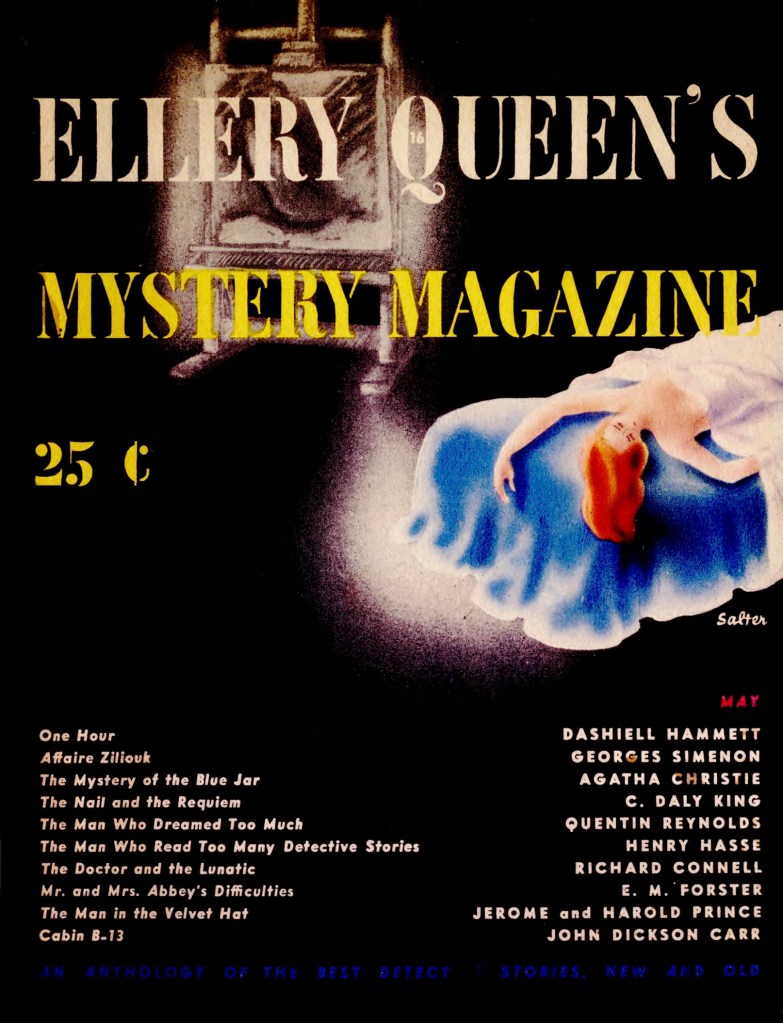
Carr’s radio play “Cabin B-13” was published in the May 1944 issue of Ellery Queen’s Mystery Magazine

Cabin B-13 was the creation of noted mystery writer John Dickson Carr. An anthology of radio thrillers produced by CBS, the series had its premiere on this day, 5 July, in 1948. Carr had been writing plays for the wireless since the beginning of the Second World War, first in England, where he had moved from the US in 1931, and then in America, to which he returned after the attack on Pearl Harbor. Like many storytellers, Carr was called upon to contribute to the war effort by writing propaganda plays for radio; most of the thrillers he wrote or adapted for Suspense in late 1942 and early 1943 tempered escapism with indoctrination.

Cabin B-13 borrows its title from one of the plays heard on Suspense; it might very well have been an extension of the latter series. Like many of Carr’s wartime stories for Suspense, which emphasized the alliance between the two nations, “A Razor in Fleet Street” features a team of American and British characters. An American married to an Englishwoman, Carr frequently explored the relationship of the two cultures—the supposedly old world and the new. The thriller that opened Cabin B-23, was no exception, even though the story is set prior to the war and was produced thereafter. You might say that it stages the revenge of nostalgia.

Bill, an American diplomat, visits London with his British wife, Brenda. He is fascinated by this aged metropolis, which, to him, conjures up memories of Sherlock Holmes and Fu Manchu, of “Hansom cabs rattling through the fog”—”It’s put a spell on my imagination ever since I was a boy so high.” There is even an old barrel organ under the window of their hotel room, which doesn’t seem to have been refurbished since the 1860s. Brenda is amused by this attitude toward her native country. “[O]f all the Americans I have ever met, you have the most absurd and fantastic ideas about England. You don’t really expect to find Scotland Yard men in bowler hats trailing you every step—now, do you?”

Yet Brenda, too, is looking at her birthplace with the eyes of a romantic. “When you think about it, just remember the barrel organ: safe, stodgy, comfortable—that’s London,” she insists. Such romantic notions soon turn into some very real for the young couple, who become caught up in a murder plot right out of Sweeney Todd, that Victorian thriller about the Demon Barber of Fleet Street. Bill is not too keen on facing “one of those bowler hats in real life”—but that is precisely what happens when Scotland Yard informs him that he is the spitting image of a “ripper” (a killer who “uses a razor . . . and likes it”) now on the loose in that “safe, stodgy, comfortable” town.

It is a solid opener for the series, even though, like most of Carr’s work for the aural medium, it is not altogether radiogenic. Generally, Carr was rather too ambitious in his dramatic works for radio, most of which were mysteries that not only asked “whodunit,” but “how was it done.” The results are often confusing or disappointingly simplistic. The ear is not attuned to complex puzzles; unlike the reader, the listener back then could not turn back the pages or close the book to consider the clews at leisure. Nor does the scope of a 20-minute play match that of a mystery novel with its assortment of suspects and red herrings.

After Carr left Suspense in 1943, the series fared very well with plays more deserving of the term; cat-and-mouse thrillers like the aforementioned “Sorry, Wrong Number,” which prolonged their thrills by building tension rather than counting on last-minute surprises.

“A Razor in Fleet Street” improves on those puzzles by casting Bill in the role of the wrong man, an innocent if imprudent adventurer in pursuit of his doppelganger, the criminal he will be accused of murdering. Granted, the idea of the doppelganger is rather wasted on radio; and the case is solved by an onlooker who, unlike the listener, can describe in detail how the crime was committed. How promising, by comparison, is the title of the subsequent thriller: “The Man Who Couldn’t Be Photographed.” That fellow has not be captured on recordings, either; so, like most of the tales told on Cabin B-13, his story remains locked in the memory of Dr. Fabian . . . or some archive yet untapped.

“Long Distance” Caller Sounds “Sorry”

My students never knew it, but I can be a right pushover when it comes to sentiment. I weep, publicly and almost unabashedly, at the sight of a Landseer painting like “His Only Friend.” I enjoy being manipulated that way and am pleased to find my senses receptive to the melodramatic, the dubious arts some denounce as kitsch and others approach only as camp. Nor do I mind being aware of being taken in—unless the trick doesn’t quite come off and I am left disappointed, unmoved, or get downright cross. Disappointed because I was promised a chance to exercise my passions in the relative safety of the controlled environment that is an aesthetic experience. Cold because the passions could not be provoked, despite appreciable effort; and hostile because my intellect rebukes me for having been put on hold for something clearly not worth the shutting down of reason.

To be sure, there’s much to be done with art even if an emotional engagement is lacking; but I am generally distrustful of critics who deny themselves such personal responses or who, worse still, are entirely incapable of experiencing them; commentators who are eager to speak before having listened to the work they subject to the mental appropriation that is critical study.

A long time ago, I told myself never to write anything I don’t feel; and I don’t enjoy writing about matters that do not matter to me emotionally. Granted, that list of subjects is quite short, since I cannot but feel angry at not feeling anything else. Here, then, is what I feel about “Long Distance,” a radio thriller that premiered on this day, 3 July, in 1948.

To begin with, “Long Distance” sounds an awful lot like “Sorry, Wrong Number” (previously mentioned here) It invited the comparison, considering that it aired on and inaugurated NBC’s Radio City Playhouse within weeks of the film premiere of Sorry, Wrong Number, the vastly inferior adaptation of Lucille Fletcher’s famous radio thriller. Vastly inferior because the film resorted to flashbacks and thus diminished the sensation of experiencing a crime in progress, a crime whose victim will die within the time allotted for the play—the sensation of being alone with this person as she sits by the telephone, fighting for her life.

What makes “Sorry” such a guilty pleasure is that we don’t feel altogether sorry that the number’s up for the ostensibly innocent victim, who reveals herself to be a mean and selfish individual. The distraught woman trying to call “Long Distance” (portrayed by future Palmolive spokesperson Jan Miner) is fighting for survival as well; but it is not her own existence she cares about; it is the survival of her husband. Convicted of murder, he is schedule to be executed within the next twenty minutes. Mrs. Jacks, the desperate woman on the telephone, claims to have found the missing piece of evidence that would prove her husband’s innocence. For the duration of the play, she is heard trying to get hold of the judge who can stay the execution.

Like Mrs. Stevenson, the anti-heroine of “Sorry, Wrong Number,” Mrs. Jacks is frustrated by a maze of wires; the telephone, her only means of taking action, is acting against her. It is only when the clock strikes the hour of death that she finally manages to talk to the only person who can keep her husband alive. She is urged to hang up and await his return call. The deadline passed, dramatic time stands still. A brief musical bridge rips apart the real time unity of the play—perhaps shredding its realism altogether to pieces. Then, the telephone rings once more. Reluctantly, the despairing woman picks up the receiver. She begins to laugh hysterically, shouting her husband’s name.

Unlike the conclusion of “Sorry, Wrong Number,” which leaves no doubt as to the deadly failure of its central character, the epilogue of “Long Distance” permits alternate readings. The voice to which the woman on the phone responds so euphorically is the only one in the play not rendered audible. It is for the audience to determine whether her husband has been saved or whether she lost both him and her mind during the ordeal of this long distance rescue mission.

It is only in this moment of doubt that I can find merit in Harry W. Junkin’s overwrought and derivative melodrama that, were it not for this little breach of trust, leaves me disappointed, cold, and nearly as hostile as Agnes Moorehead must have felt being passed over for Barbara Stanwyck in the film version of the play that had earned Moorehead the title “First Lady of Suspense.”

The Home Folks Are Moving In

Well, sir, it’s a few minutes or so past six o’clock in the evening as our scene opens now, and here in the garden of the small house halfway up in the Welsh hills we discover Dr. Harry Heuser setting the table for a barbecue dinner. Sorting the flatware, he still keeps an eye on Montague, his Jack Russell terrier. Meanwhile, the side dishes are being prepared in the kitchen and the telephone is ringing. Listen.

That is how my evening dinner preparations might have sounded if they had been fictionalized by Paul Rhymer, creator of radio’s Vic and Sade, a series of sketches (previously mentioned here) that had its debut on this day, 29 June, in 1932. Some sixty years before Seinfeld renovated the television sitcom, Rhymer constructed a fictive world whose four main characters could truly go on about nothing like nobody else—without as much as a situation. Like this, for instance:

UNCLE FLETCHER. [. . .] Don’t s’pose you ever knew Arnie Gupples, Vic? 

VIC. Name’s not familiar. 

UNCLE FLETCHER. Sadie? 

SADE. Uh-uh. 

UNCLE FLETCHER. Arnie Gupples worked in a shoe store there in Belvidere years ago. I’ve bought shoes off’n Arnie. Far as that goes, I could name you off a dozen parties that bought shoes off’n Arnie. Hey, Sadie, your cousin Albert Feeber bought shoes off’n Arnie Gupples. 

SADE. Really? 

UNCLE FLETCHER. (Stoutly) Your cousin Albert Feeber bought shoes off’n Arnie Gupples. 

SADE. Um.

Don’t expect the other shoe to drop any time soon. This is as much a rumination about birthday presents as it is an occasion for one of Uncle Fletcher’s stories, yarns that became tangled as soon as he set out to spin them. For all their lazy folksiness, Rhymer’s wireless tappings of the small house have been likened to the Theater of the Absurd. In the estimation of noted storyteller Ray Bradbury, these “conversations” are “more brilliant in their pointlessness, circling around nothing, than anything written since by Pinter or Beckett.” Radio raconteur Jean Shepherd followed up this assessment by calling Rhymer’s series an “authentic picture of American life” while arguing them to be “far closer to Ionesco in spirit than [. . .] to Thornton Wilder.”

That Rhymer inspires such name dropping is due in part to his radiogenic use of the unseen and non-speaking character—the “phantom” of Mrs. Harris. In Dickens’s Martin Chuzzlewit, Mrs. Gamp appeared to be in “constant communication” with a woman whose existence remained a “fearful mystery” and stirred “conflicting rumours,” since none had “ever seen her.”

Giving voices to only four of his creations, Rhymer managed to introduce hundreds of such talked-about “phantoms” into the small house—an imaginary dwelling fit for anyone dwelling on and dwelling in imaginings. Its architecture never changed, despite undergoing countless extensions. Like our memories, it became cluttered and crowded, familiar and bewildering, age-worn yet ever new. Here, conjured up again for our amusement, is the aforementioned Arnie Gupples.

UNCLE FLETCHER. Arnie Gupples give Gwendolyn Yowtch this fancy shoe scraper for her birthday. They were engaged to be married at the time. Well, sir, first shot outa the box Gwendolyn went to scrape some mud off her shoes with that shoe scraper, twisted her ankle, had to have the doctor, got mad, an’ give Arnie the mitten. Two months afterwards she married Art Hungle an’ moved to North Dakota. Arnie felt so bad he quit is job at the shoe store. I heard afterwards he finally married a rich woman that made him learn to play on the cornet. 

VIC, SADE, and RUSH. Uh. 

UNCLE FLETCHER (thoughtfully) Way the world goes, I guess. 

VIC, SADE, and RUSH. Um.

Which concludes another missive from the small house halfway up in the Welsh hills.

On This Day in 1949: At Quip’s End, Wireless Wit Calls It Quits

Well, I’ll probably laugh about it—eventually. Not a day in my life passes without mishaps, some major, some trivial, all vexing. Sure, I could blame it now on Montague, our new canine companion. After all, dogs are expected to be inept, to be indifferent to our technological comforts and headaches; but a few remaining bristles on that scouring brush called conscience go against the grain of my indolence and continue to tickle until I make a clean breast of it. The “it,” this time around, is a cordless phone plunged into the watery grave of a bathtub. The rest, as they say (in Hamlet) is silence.

I won’t be silent about the quietus of one of the great American radio comedians whose program left the air on this day, 26 June, in 1949. The comedian in question is Fred Allen, a mediocre juggler who discovered that playing with words attracted a larger audience. That is, until the quiz and giveaway craze of the late 1940s revealed the greed and idiocy of a public that was eager to leave radio behind for the promises of a few bucks, some gifts, and a little flickering picture in a box of tubes and wires.

Fred Allen was a satirist. Whereas Jack Benny relied on situational humor, Allen relished in timely wit. Benny got people to laugh by making a fool of himself on our behalf. His age, his musical shortcomings, his vanity and tightfistedness—they were as hilarious as they were endearing. Rival Allen, on the other hand, made fun of all and sundry. He was the court jester in the living room, sending up what got listeners down: New Deal bureaucracy, wartime rationing, postwar housing shortage—anything fit for banter in Allen’s Alley.

That Alley was Allen’s finest piece of airwaves architecture. It was just the airway to vent anger and open up debate. How unfortunate that, in his final months on the air, Allen stooped to driving around that lane—a broader and less angular Alley called Main Street—in a Ford vehicle, in keeping with the demands of his new sponsor and the greed rampant after years of sacrifice. It wasn’t television that ended Allen’s career, even though, as critics insisted, he had no face for it. That he had no voice for radio did not prevent him from excelling in that medium. It was commerce, plain and simple.

The sponsors kept giving him a tough time, demanding cuts or cutting him off. The giveaway programs cut him to the quick; he was smarting from the audience’s lack of loyalty. It was just a phase; but Allen, plagued by poor health, did not wait for it to end. On the final program, Portland Hoffa started things off “with a laugh” by telling a few intentionally corny jokes and supplying the laughter herself. “If I can keep up this pace, I’ll end up with my own program,” Hoffa declared. “The way radio is going, that is quite possible,” her husband retorted. It was Allen having the last laugh at the age of canned cheer. It was the gallows humor of a man at wit’s end.

There were jokes, too, about Milton Berle, the epitome of television humor, comedy that translated sharp lines into slips and gaffes, allusions into grimaces, and travesty into cross dressing. True, television could deliver verbal jokes—but it had to justify the image, however grainy or ghostly at first. An old vaudevillian who learned to tell jokes when his juggling hands failed to do the trick, Allen was not a lad of Berlesque. He made some attempts, as Alan Havig noted, but none succeeded, just as his film career had flopped while Benny and Hope stayed afloat.

On his last program, Allen confronted wit and humor by pairing fellow satirist Henry Morgan with humor triumphant—none other than Benny, the fall guy who would be back in the fall. Having overspent by buying into the installment plan scheme, Morgan, “flatter than something that has been stepped on,” is forced to go to a pawnshop. There, he is greeted by Benny, the broker, proudly showing off his cool, green vault and counting whatever money was coming his way. As it turns out, Benny was also the shyster whose loan got Morgan still deeper into his financial fix.

It paid to adjust, this final sketch suggested; and pinning your hopes on a medium that was being abandoned, as Allen put it in Treadmill to Oblivion, like the “bones at a barbecue” was no picnic. It’s no good to be good at something if it’s something the many no longer cares about. It’s the death sentence under the law of supply and demand. I know. I’ve been staring at that noose for years.

Old-time Radio Primer: H Stands for Hiatus

Well, how are you feeling today? According to one British study, 23 June is the happiest day of the year. Montague and I were perfectly content, playing and dozing in the garden and going for walks along the lane. Perhaps, the folks down in the nearby town of Aberystwyth were even happier last Tuesday, when they had several thousand pounds thrown at them on the street by a stranger who just wanted to “spread a little sunshine.”  Apparently, this local story had already travelled around the world (both my sister and my best friend in Germany had heard of it) before it came to my ears, which, no doubt, were too busy picking up the sounds of .

As grateful as I am for ready access and instant replay, recording technology can render our present-day listening quite unlike the experience of tuning in back then. It is difficult to get a sense of a weekly broadcasting schedule, of certain parts of the day being associated with particular programs, of the anticipation of their airing and the space such periodically scheduled events occupied in the minds of the audience in the interim.

To be sure, the middle of June would have been meant a rather prolonged wait for the next tune-in opportunity. It was during this month (rather than May, as on US television nowadays) that most of the crowd-pleasing drama series and comedy-variety shows went on their summer hiatus. Hiatus, from the Latin hiare, meaning “to yawn.”

As I suggested a while ago, the off-season in radio had initially been a response to technical difficulties of broadcasting during the long, bright days of the year. Now, a hiatus can be a precarious wait, which is why I’d never attempt one for broadcastellan. The question is: will the audience greet the news of your return with excitement, or a resounding yawn? That is, will your show go on even in its absence, circulating in the minds of the multitude? Not, perhaps, if your season finale is as disastrous as the second one of Desperate Housewives.

To be sure, broadcasters did not shut down the microphones and close the studios for the duration. Before resorting to reruns, which became customary in the 1950s, they scheduled replacement programs, some of which, like the Forecast series, were designed to test the potential of untried fare. It wasn’t all filler during those summer months. The Mercury Theater, for instance, was first heard in July 1938. Besides, a prestigious timeslot, one occupied by the Lux Radio Theatre demanded high-profile or at least adequate replacements. One of the most highly regarded programs to have its premiere during the summer was the thriller anthology Escape.

On this day, 23 June, in 1950, Escape offered the western melodrama “Sundown,” the “story of a boy who never owned anything . . . but a gun.” The cast was headed by Barton Yarborough, best remembered today for his portrayal of Texan daredevil Doc Long in Carlton E. Morse’s I Love a Mystery serial. Doc and his pals did not break for the summer; they kept audiences suspended, from one cliffhanger to the next. On the very day Yarborough was heard in “Sundown,” another Doc Long (played by Jim Boles) set out for a new adventure in “The Snake with the Diamond Eyes.”

There was time as well for summer schooling. On this day in 1957, Edward R. Murrow introduced the listeners of the CBS Radio Workshop to a word far more ominous than “hiatus,” precisely because it denotes a lingering presence:

A new word has been added to our ever increasing vocabulary.  It’s a small word, dressed in fear.  To pronounce, not very difficult.  To envision, staggering.  This scientific word may well become the most important in all languages and to all peoples. It is pronounced “fallout.” “Fallout.”  Rather a simple word to describe so much.  “Fallout.”  Radiation withheld by quantities of atmosphere that may eventually descend to pillage, burn, kill not only you and me, but the scores of generations unborn.  Quite a word, “fallout.”

Countering the politics of terror, Murrow suggested that this lexical novelty could also denote the harvest of knowledge, as “words, thoughts, ideas,” withheld in an “atmosphere of ignorance,” eventually descend on future generations. Perhaps, this intellectual fallout is rather too gradual and the radiation too slight. With atomic energy once again on the political agenda in Britain, and threats of nuclear warfare not quite a thing of the past, little seems to have been learned from past horrors.

I wish political leaders could be forced to go on hiatus to make room for summer replacements—especially since some of them seem as perverse as that ill-treated teenager in Escape, seeking retribution beyond reason in an atmosphere of fear and its inevitable fallout. To the restless mind, “hiatus” can mean “pause for thought.”

More Milestone Reflections; or, Quo Vadis, broadcastellan?

Well, I have been away taking pictures. Taking pictures away, to be precise. It was an entirely manual engagement with the arts, involving nothing more than hauling some large canvasses—paintings by the late British artist David Tinker—for an upcoming exhibition. The things we do for a meal and a daytrip to a place where sheep are outnumbered by people (in this case, Cardiff). It so happens that the artist’s widow is Tracy Spottiswoode, who writes for television and radio. She is currently working on a radio play for the BBC, based on a story related to her by her father. It is an incident in the life of Hollywood actor Robert Vaughn, who found himself caught up in the turmoil of the Prague Spring while filming on location in Czechoslovakia, anno 1968. Considering that another successful radio writer, silent film music composer Neil Brand (last seen on UK television in Paul Merton’s Silent Clowns series, which concludes today with a portrait of Harold Lloyd) is coming to visit this weekend, I decided to give writing for the medium another try and return to my own audiodramatic tinkerings (first and last hinted at here).

I have written much about radio, but never for it. And since this 200th entry into my journal marks another milestone (the last one having been contemplated here) it is a convenient moment to reflect on my writings, their uses and purposes. “Quo Vadis” is meant here as a way of mapping out a way, of asking myself what to do next with and within this forum, another opportunity of looking back, listening ahead, and saying thanks to all those who have been reading and commenting over the past five months. Writing in such a marginalized field—and writing in such a marginalizing style about it—can be a rather lonely pursuit.

Perhaps I am craving a larger audience than I am enjoying here; but writing an audio play (for the first time since high school) is merely another creative response to my ongoing engagement with radio. And, if the lacking response to Larry Gelbart’s recent radio satire “Abrogate” (as discussed here) is any indication, there may not be a large audience—or a large vocal one—for such writing either.

That said, there will be less of me, here, in the next few weeks, weeks that will involve gathering new impressions elsewhere, in London and New York City. As you may recall, when last I was in New York, I very nearly went out of my mind going in search of a wireless network to post my writings—not the kind of part in the theater of the mind I had in mine.

The recent acquisitions you will find on my bookshelf (including Arch Oboler’s Fourteen Radio Plays, Abbot’s Handbook of Broadcasting, and Wylie’s 1938/39 and 1939/40 Best Broadcasts, all pictured above) provide models and instructions for the wireless tyro. Today’s writers can learn a lot from the old practitioners, restraint as they were by commercial ties. Radio plays can be talky and tiresome, so intellectual as to become insipid. A healthy dose of melodrama and a helping of sound effects sure liven things up. At least, I hope they will in my efforts at soundstaging. I might exhibit some of my experiments in radio writing on my podcast site.

So, if you enjoy plays for the ear—or derive pleasure hearing about someone struggling to give prospective listeners an earful—you might find my forthcoming discussions about aural storytelling and sound effects of some interest. Please stay tuned . . .