An X-ray Visionary for the Atomic Age

Magic is the fishiest of arts; so, it seems quite appropriate that, over at New York City’s Lincoln Center for the Performing Arts, illusionist David Blaine attempts to wow onlookers by stepping into a tank of water and staying submerged for a week. I’m not sure whether such aquatics qualify as superheroics, but Gotham Citizen seem more likely to embrace Blaine’s antics than cynical Londoner, who may have cheered Tom Cruise at the Mission Impossible 3 premiere today, but who were less-than-impressed by Blaine’s 2004 out-of-lunch box stunt. After all, the USA are the birthplace of latter-day superheroes such as the 20th-century graphic arts creations whose cinematic offspring keep populating (or perhaps quelling) our imagination, an army of X-Men among whom, the charm of Tobey Mcguire notwithstanding, Superman still reigns supreme.

Although rather fond of comic books as a child—and still partial to the exploits of Tintin and Snowy—I have never been much intrigued by those super-powered, larger-than-life action figures. Indeed, I have always been suspicious of such secular saviors, avenging angels whose awe-inspiring wrath seems to demand the belief that worthy ends—ends worthwhile for you and your kin—justify violent deeds, that trust in some higher power will take care of the alien, the evil, or the merely inconvenient and, for that matter, of everything else amiss in the western-centric universe.

On this day, 25 April, in 1941, the Superman of the airwaves—the faster-than-a-speeding-bullet original having been cloned nearly as often as Santa Claus—was still dealing with comparatively trifling substances like nitrate; four-and-a-half years later, he was facing far more dangerous and destructive forces, personified by the insidious Atom Man. Let’s make that Atom Mann. Shortly after the bombing of Hiroshima, there was nothing more daunting than a nuclear weapon—unless, of course, that weapon was wielded by a runaway Nazi.

Until the Communists could be trusted to take over, after an appropriate period of vilification, the Nazis remained very much alive in American culture as mythical figures of evil incarnate. That they had considerably less political prowess after VJ-Day only made them all the more suitable for seemingly innocuous, a-political thrills, for which purpose they were transformed into characters akin to the wicked stepmother in Grimms’s fairytales.

Outage by nuclear power is what threatened the man of steel in the fall of 1945. As the announcer of the radio serial Superman vs. the Atom Man summed up (in a script published by Watson-Guptill),

Henry Miller, the Nazi Atom Man [ah, that Henry Miller], threatened to destroy every man, woman, and child in Metropolis by drowning! While all police authorities, aided by the army, guard every inch of the city’s waterways, and Superman hover high in the heavens, searching for the deadly foe who has twice brought him close to death, Miller, unseen by anyone, is slipping through the dark woods in the hills above Metropolis, bent on shattering the dam holding back the water in the city’s gigantic billion-gallon reservoir, and engulfing Metropolis!

That atomic power was capable of doing far more lasting harm, such as the fallout still studied and debated in Chernobyl, was apparently deemed too frightening for the listener—and too inconvenient for the serial writer.

In his radio dis-incarnation, Superman may have enjoyed the endorsement of psychologists (as claimed by the contemporary magazine article above); but his presence was nonetheless contaminating the air by spreading the notion that there is always someone out there to put things right—right for the good citizens of a certain nation that believes itself vulnerable enough to be in need of long-range missiles and short-order mythologies.

Trivializing History Is a Dangerous Assignment

Well, I have always been somewhat of a ham, even though my own life has remained the only long-running drama in which I have had the good fortune to play a sizable part. Yesterday, the cured meat was of the smoked variety. I spent the weekend, it having been a sufficiently dry one, at last, watching our gargantuan compost heap go up in flames (or smolder, at any rate). As the plumes wafted over the fields, I was reminded of the invisible cloud that, back in April 1986, made its way westward across Europe.  

Brian Donlevy in the television version of Dangerous Assignment

I am referring, of course, to the nuclear disaster at the Chernobyl power station, the fallout and immediate aftermath of which I well remember as I saw polluted playgrounds being closed in Germany, pharmacists profit from outbreaks of hysteria, and toxic milk vanish from supermarket shelves (to be shipped, in powered form, to apparently immune consumers in the Middle East). It was a disconcerting experience worth recalling today, as oil prices in the West are rising nearly as fast as concerns about emerging nuclear powers in the East.

Is there any drama equal to the times in which we live? Is it in need of fictionalization? Can—and should—our fears—as far as they are felt by those who prefer to numb their pain or ignore its sources—be melodramatized and acted out for us in order to bring distant terror home and to render vague anxieties concrete?

During World War II, the mass media of radio and film tried to do just that—letting the home front see and vicariously experience what was at stake overseas. Such blatant propaganda would hardly be Hollywood-endorsed or swallowed whole today, be the objective ever so unobjectionable to the many.

I thought about this again last night, when I caught the Basil Rathbone/Nigel Bruce thriller Sherlock Holmes and the Voice of Terror (1942), which was shown on the British cable channel UK Drama. In it, the wireless becomes a tool used by the enemy—my ancestors from Germany—to instill fear and doubt in the British people. The air is contaminated by the less than subtle influences of a demoralizing force not unlike that exerted by the infamous Lord Haw Haw.

The thriller sought to counter this terrifying voice by giving the speaker a face, by turning fascism into a concrete figure—and a single one at that. As ideas become flesh, they not only seem more readily conquerable, they very nearly vanish altogether behind the mask created for the purpose of propaganda.

Melodrama operates by processing the abstract—the tangled roots of a problem—into a visible, tangible entity. What makes melodrama unlike life is not that it offers a happy ending—not all melodramas end happily, no matter how strongly our viewpoint might be enforced—but that it embodies and thereby obscures what is most potent and problematic in its disembodiment: the war of ideas.

Melodrama does not encourage its audience to perceive the ideological bases of any problem. It deals in specifics, thereby encouraging us to believe a problem to be solvable if only its manifestations can be overcome. Instead of making us question the sources of our fears—which may well be our own ignorance—melodrama provides more or less ready answers, for which reason it is the idiom of propaganda, used by politicians the world over with considerable success.

What has this to do with Chernobyl, you might ask. Well, the atomic age got under way by creating the illusion that nuclear power is safe as long as it is in the right hands—which means, of course, our own. It was a belief instilled in western minds ever since the dropping of the bomb that ended World War II. Popular storytelling, whether overtly propagandist or not, has assisted in selling atomic power as a safe source of energy and in justifying the nuclear arms race of the cold war.

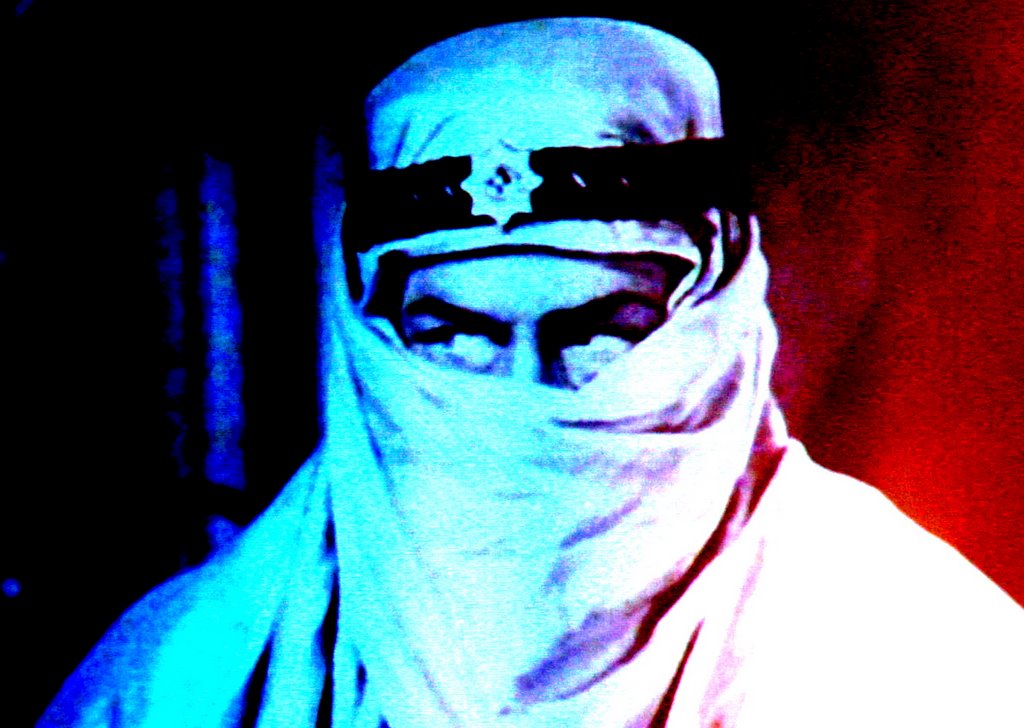
On this day, 24 April, in 1950, for instance, Steve Mitchell (portrayed by Brian Donlevy) went on another Dangerous Assignment (in a US series of episodic radio thrillers so titled), this time in search of a missing nuclear physicist. A few weeks earlier, Mitchell (pictured above, in one of his TV adventures) had been sent to the Middle East to prevent a uranium-enriched sheik from creating an atomic bomb. The peril, such fictions insisted, lay not in the substance, but in its possessor.

As I shall explore in subsequent essays, the airwaves carried a great deal of such propagandist fiction into US homes during decade following the end of the Second World War; some of these stories trivialized uranium in everyday American life while most others demonized foreigners with a hankering after atomic might.

On This Day in 1943: Peter Lorre Gives Voice to "A Moment of Darkness"

Well, I am generally slow to catch up. As the broadcastellan maxim—”Keeping up with the out-of-date”—suggests, I am forever belated in my response to the news of the world, food for thought I tend to chew more slowly than the dinner on my plate. Having just learned from a fellow web-journalist that the mind of ousted American Idol finalist Mandisa might be considerably less broad than her frame, I thought of other occasions on which the message of a voice seems out of tune with the messenger, moments in which timbre and text, sound and image, appear to be at odds. One such occasion was “A Moment of Darkness,” a radio play by noted mystery writer John Dickson Carr that aired on this day, 20 April, in 1943.

“A Moment of Darkness” is one of Carr’s ambitious but far from satisfying attempts to make up for the inadequacies of the medium by complicating the kind of plots that radio is least successful in rendering: the “whodunit.” The murder mystery is a genre best suited to novels, page-turners that permit the confounded to do just that: turn the pages, forward and back. On the air, such puzzles are often marred by a lack of pieces, or red herrings, due to the limited number of suspects and clues a listener can be expected to tell apart and pick up within the short time allotted for the drama.

In the fall of 1942, when Carr became the head writer for a fledgling US radio program titled Suspense, he devised alternate ways of mystifying his audience, of casting doubt about the outcome of his thrillers.

As I discuss it in Etherized Victorians, my study on so-called old-time radio, Carr not only asked listeners “whodunit,” but “how done,” by presenting posers involving locked rooms, less-than-obvious weapons, as well ingenious acts of committing and concealing crime. Unlike the reader, the listening audience is rarely equal to this double challenge of guessing the “who” and “how,” considering that there is no chance to recap or retreat in order to evaluate the (mis)information provided. The likely response is that of utter dumbfoundedness, a puzzlement of the least intellectual sort that, in turn, may trigger feelings of exasperation or indifference.

Later Suspense dramatists well understood and expertly solved this problem by emphasizing the “most dangerous game” of the manhunt or exploring the mental state of criminal and victim. Determined to trick his audience with surprises rather than tease them with suspense, Carr decided to heighten the element of doubt and suspicion, to exploit the prejudices of the listener in ways that sounded entirely radiogenic: foreign accents suggesting fiendish acts. In “The Moment of Darkness,” as in Carr’s “Till Death Do Us Part,” such a foreign-tongue twist was delivered by the enigmatic Peter Lorre.

During World War II—and for many years thereafter—harsh Germanic tones often sufficed to taint or undermine a speaker’s message, to make listeners question the sincerity of the utterance or the motives behind it. His Teutonic tongue made Lorre a formidable wartime villain; and his voice, which could be disconcertingly oleaginous, sly, or sinister, inflected with hysteria and madness, only fueled the imagination of Americans prejudiced against foreign influences.

Given the diversity of US culture, however, the networks did not altogether endorse the exploitation of accents—particularly European accents—as reliable signposts of a certain, unmistakable nationality, a mother tongue bespeaking the fatherland of the enemy. Radio writers like Carr were advised not to use voices as a means of identifying—and disqualifying—a speaker as un-American. According to the logic of pre-Political Correctness, Lorre’s character, a sham shaman, is not at all what he sounds, a vocality/locality mismatch that not so much teaches the audience to question their prejudices but to distrust their ears altogether.

There is no such thing as accent-free speech, of course; but those, like me, whose first language is not the one in which they primarily speak are often self-conscious about the sound of their voice, or at least keenly aware of the doubt and derision it might provoke.

On This Day in 1943: Arthur Miller Asks Americans to "Listen for the Sound of Wings"

As I sat at my desk on this cool, gray April afternoon, looking out onto the Welsh hills, I found myself transported back to—or at least forcefully reminded of—my childhood in Germany. It wasn’t the view of my present surroundings that brought on these not altogether pleasant recollections. It was a recording of Arthur Miller’s “Listen for the Sound of Wings,” a radio play first broadcast on this day, 19 April, in 1943. While not a great dramatic achievement, it serves as a reminder to me just why I have not set foot on German soil in nearly sixteen years.

It is not any single event that made me vow never to return in anything other than a wooden box. It is the sense of being tainted, of being part of a violent and terrifying past which isn’t past at all but still very much present in the minds and attitudes of the German people. That one side of my family was somehow connected with one of the characters in the play—Joachim von Ribbentrop, for whose family my grandmother worked as a seamstress—only makes such reflections about my native country more dreadful to me.

Miller’s play dramatizes the life of Martin Niemöller, a German pastor who dared to speak up against the Nazi regime, and act of treason for which he was imprisoned and for which he nearly lost his life. Miller’s portrayal and the performance of the avuncular, gentle-voiced Paul Lukas, make Niemöller sound like a naïve believer who, concerned about the decline of faith in Germany, agrees to side with the emerging Nazi party when promised that, once in power, the fascists would assist in restoring the erstwhile prominent role of the church.

Eventually, the pastor realizes his grave mistake—an error in judgment that not only endangered his own life but led to the persecution and slaughter of millions. Resisting attempts at cajoling or coercing him into cooperation, he yet remains hopeful as, from his prison cell, he looks westward to “Listen for the Sound of Wings”—the wings of allied planes that to him are angelic messengers who signal that the “word is born again.”

Niemöller’s past, his initial acceptance—and indeed support—of anti-Semitism is being glossed over in this propaganda play to emphasize the message that one of the great American freedoms—the freedom of religion—was under attack elsewhere and that it was a mission of the US military to protect such rights at home and restore or establish them wherever threatened. What Miller’s play does not represent is captured in Niemöller’s own words, uttered some thirty years after the end of World War II. Here is one version of the original (which was initially spoken and not written down), followed by my own translation:

Als die Nazis die Kommunisten holten, habe ich geschwiegen, ich war ja kein Kommunist.

Als sie die Sozialdemokraten einsperrten, habe ich geschwiegen, ich war ja kein Sozialdemokrat.

Als sie die Gewerkschafter holten, habe ich geschwiegen, ich war ja kein Gewerkschafter.

Als sie die Juden holten, habe ich geschwiegen, ich war ja kein Jude.
Als sie mich holten, gab es keinen mehr, der protestieren konnte.

When the Nazis came for the Communists, I kept quiet.  After all, I was not a Communist.

When they locked up the Social Democrats, I kept quiet.  After all, I was not a Social Democrat.

When they came for the Labor Unionists, I kept quiet.  After all, I was not a Labor Unionist.

When they came for the Jews, I kept quiet.  After all, I was not a Jew.
When they came for me, there was no one left to protest.

The Germans were fortunate in having had a rescuer in the United States; but enough remains of the spirit of fascism and of professed realizations or belated admissions of its dangers, as exemplified by Niemöller’s story, to make me uneasy about the Teutonic nature. And then there was the time, decades after the end of the Third Reich, when I, too, was introduced to the von Ribbentrop family, my grandmother having remained loyal to them long after Nuremberg. Perhaps that is why, when I am looking eastward, I still listen for the sound of the right wing.

On This Day in 1944: A Dead Soldier Speaks Up to Stir the Living

I have often found comfort in the notion that the dead may survive in the minds of those who recall them. It is no mere vanity to desire such afterlives. Indeed, the concept of lingering in each other’s thoughts by virtue of some worthy deed or memorable word can be a significant motivational force in our lives. I am not sure, however, whether the self-images we try to instill in the minds of others as potential extensions of our corporeal existence are to be considered a noble attempt at rescuing our finite lives from triviality or whether these transferable or continuing selves are a construct that trivializes the finality of death. After all, does not the realization that we are perishable render each hour we have left so much more significant?

During times of war such as these, the possibility that those lost are never truly gone or might yet return has particular resonance. Radio, in the pre-television years, was often thought of or exploited as a spiritual medium. Gathering around the receiver to hear voices from the unreachable beyond—or the far away, at any rate—could assume all the magic of a conjuring act: a high-tech séance. As I have argued in Etherized Victorians, my doctoral study on so-called old-time radio in the US, broadcast propaganda often availed itself to addresses from the hereafter, words akin to the cries of “Remember me,” uttered by the Ghost in Hamlet, to stir and motivate the listener.

On this day, 18 April, in 1944, such a ghost voice was cast into the living rooms of America by radio playwright Norman Corwin (whose works I have frequently discussed in this journal). It is the voice of a soldier killed in action. “As for his life,” explains the narrator of “Untitled” (a recording of which you may find here),

there is no straightforward account available, but there are several people who could piece it together, although they cannot always be relied on to give you a true interpretation of the facts.

Through the various recollections of others, including those who thought little of him, the soldier’s unwritten biography comes to life. It is a conventional one, all told, if giving your life for an ideal may be justly labeled “conventional.”

Corwin’s soldier is not an action hero, but a man of doubts, a thinking fighter—or fighting thinker—who, in today’s parlance, chose to engage in a war on terror—and that terror, still very much alive today, was fascism. Rather than relying on others to give an account of his beliefs, the dead man picks up on and tears apart their words—some shallow, some insincere—like a radio commentator taking issue with so-called facts. The memories of those lined up to speak for him are proven to be too distorting or inadequate to capture the true self of the deceased who, according to the justice of the radio poet, is now given the opportunity to speak up for himself.

These lines, uttered toward the end of the play, are some of the finest written for radio—or any medium, for that matter. They are worthy of Shakespeare, and certainly worth quoting here and remembering thereafter: “I am dead of the mistakes of old men, / And I lie fermenting in the wisdom of the earth.”

It is not enough to live on in the minds of others from whose sundry impressions our existence might be retraced. Instead of becoming the mental playthings of our contemporaries or former associates, we must seize the chance to communicate our own minds while living. This journal may serve as a record of my thoughts.

On This Day in 1939: Pearl S. Buck Gets Into the “Patriot” Act

I had intended to spend much of today al fresco, our long-neglected garden being in serious need of attention. Dragging the old lawnmower out of hibernal retirement a while ago, I had managed to knock over a can of paint and, the spilled contents being blue, very nearly ended up looking like a Smurf in the process. No sooner had we unleashed the noisy monstrosity, engulfed in a cloud of smoke, than one of its wheels broke off, which immediately put a stop to my horticultural endeavors. It is to the latter mishap on this Not-So-Good Friday and the fact that I am all thumbs (none of which green) that you owe the questionable pleasure of this entry in the broadcastellan journal.

An afternoon’s dilly-dallying among the daffodils may be just as escapist an act as tuning in an old radio program. In either case, however, it is difficult to get very far away from the news of the day, headlines so maddening and haunting that there is little relief even in irreverence, in mocking those among our political leaders who turn a blind eye to the signs of the times or who succeed in nothing more than in making enemies and alienating their allies.

Are we to believe, are we to accept that a nuclear attack from Iran is to be expected and that a pre-emptive raid is therefore necessary? Is it impossible to win a war—on terror, no less—without waging one? Is it possible to win (in) any violent conflict? On this day, 14 April, in 1939, Nobel Prize winning author Pearl S. Buck (pictured above) appeared on the Campbell Playhouse to address this very question.

Orson Welles, the official producer of this weekly radio series featuring adaptations of stories, plays, and motion pictures, had chosen Buck’s latest novel, The Patriot, as the “best new book for April” and presented a dramatization of the narrative starring Anna May Wong. Shaking hands with Welles and Wong during the curtain call, Buck was invited to comment on the “situation in the east,” the Chinese-American war that may have seemed even more remote, incomprehensible, or irrelevant to Americans than the crises in Europe. Welles inquired whether it was possible to sympathize with China and Japan alike in this conflict. To this, Buck responded:

When one has had experience of many wars, one comes to see that the pattern is always the same. No matter who is the aggressor and who is attacked, both are victim and both lose in the end.

To be sure, such a remark would not have been welcomed some two and a half years later, when the US felt compelled to enter the Second World War after the bombing of Pearl Harbor. Yet patriotism might find expression other than jingoist speech and the complexities of war called for responses other than simple slogans. Realizing the significance of radio as a means of connecting (with) the world and addressing far-reaching political and humanitarian crises, Buck decided to become a radio dramatist herself.

As Erik Barnouw relates in his Media Marathon, Buck enrolled incognito in his class (Radio Writing U2) at Columbia University to prepare for a proposed series of plays titled America Speaks to China. During the Second World War, she went on to write a number of propaganda plays about Asian-Americans and the relationship between East and West.

Today, perhaps, more people are beginning to discern the pattern Buck pointed out. And, once again, the definition, the concept of the patriot is changing: the action hero, the go-getter of few words now seems infinitely less desirable and rare than the thinker who not only knows how to use each word effectively but can be trusted to keep it.

On This Day in 1938: Jefferson Tribute Turns Infomercial . . . "through chemistry"

Well, I’ve only been back some forty-eight hours, but the sunny interlude in Cornwall, so poorly captured by my camera, already seems a distant memory. It was Thomas Jefferson—born on this day, 13 April, in 1743—who argued that travelling makes “men wiser, but less happy.” Is this true? “When men of sober age travel,” Jefferson claimed, they may gather useful knowledge, but “are subject ever after to recollections mixed with regret; their affections are weakened by being extended over more objects; and they learn new habits which cannot be gratified when they return home.” Should we limit our exposure to the world by concentrating on what is closest or by selecting a specific if narrow field of inquiry whose soil we continue to till skilfully to reap a rich harvest?

My field, of course, is so-called old-time radio, and I seem to take the fruits of my research along with me or take soil samples wherever I travel. Jefferson would not have approved of my preoccupation with American radio drama and with western popular culture in general, since he held storytelling in rather low esteem:

A great obstacle to good education is the inordinate passion prevalent for novels, and the time lost in that reading which should be instructively employed. When this poison infects the mind, it destroys its tone and revolts it against wholesome reading. Reason and fact, plain an unadorned, are rejected. Nothing can engage attention unless dressed in all the figments of fancy, and nothing so bedecked comes amiss. The result is a bloated imagination, sickly judgment, and disgust towards all the real businesses of life.

Now, in the 20th century, it was beginning to become clear that the “real businesses of life,” as interpreted by Americans, was big business: producing goods, advertising them, generating sales and making profits. So, when Jefferson was being celebrated some 195 years after his birth, his life, too, was turned into a promotional opportunity. The opportunist, in this case, was the du Pont company, who, in order to improve their image as a wartime profiteer, came up with the slogan “Better living through chemistry” and sponsored a series of historical radio dramas called Cavalcade of America. It is a fascinating merger of history, entertainment, and advertising I’ve explored in my dissertation and previously discussed here on several occasions.

On this day in 1938, Jefferson’s connections to the du Pont family were thoroughly exploited to suggest that, like Jefferson—the founder of the University of Virginia—the du Pont Company was chiefly interested in educating America, rather than amassing riches from the manufacture of gunpowder.

In “Thomas Jefferson, Pioneer in Education,” the future US President meets Pierre Samuel du Pont de Nemours (1739-1817), a French economist whose son, Eleuthère Irénée turned to gunpower manufacture during the volatile and dangerous days of the French Revolution. No mention is made of the source of the du Pont fortune, leaving listeners with the impression that the du Pont clan were a group of benevolent scholars who admired the United States chiefly for its advancements in education.

Children in the United States, the old Monsieur du Pont told Jefferson in the Cavalcade‘s version of history, “are encouraged to read and comment. Controversy has developed argumentation and given room for the exercise of logic. This country has a large proportion of moderately well-informed men. But that does not mean that the general education cannot be improved. And if improvement is a possibility, it is a duty.”

To underscore this message, a great-great grandson of papa du Pont seizes the microphone for a curtain call, in which it is suggested that his family played a substantial role in American education. Cited for “good taste in advertising,” the Cavalcade program, much reviled by erstwhile contributors like the aforementioned Arthur Miller, seems to have counted on the “moderately well-informed” and done its share to remove all traces of “controversy” and “argumentation” from the cleverly crafted infomercials it passed off as history lessons. Was this “better re-living through chemistry”?

Radio Rambles: Cornwall, Marconi, and the "Devil’s Foot"

St. Michael's Mount
St. Michael’s Mount

Well, I am back from my weeklong tour of the south-western most extremity of England. As it turns out, even in a place as remote and ancient as Cornwall—where I was deprived of a wireless network that might have permitted me to continue the broadcastellan journal on location—it is impossible not to be reminded of broadcasting. Especially not Cornwall, I should say. I had forgotten just how intimately the Cornish coast is connected with the efforts of wireless pioneer Guglielmo Marconi. It was on Mount’s Bay (pictured, left, in my snapshot of St. Michael’s Mount) that the first successful transatlantic transmission of a wireless signal took place on 12 December 1901. Having set up his station near Poldhu in Cornwall—away from the prying eyes of his competitors—Marconi received a signal from there all the way across the Atlantic at his post on Signal Hill, St. John’s, in Newfoundland, Canada. And it was near Poldhu, also, that the great Sherlock Holmes—who went on the air some three decades after this momentous event in wireless technology—solved one of his most puzzling cases: “The Devil’s Foot” or “The Cornish Horror.”

Having been prescribed “complete rest” by his Harley Street physician after his iron consitution was beginning to show signs of wear, Holmes travelled to Cornwall in March 1897 to recuperate and, as American radio listeners were left unaware, to engage in some philological studies. Surrounded by “weird ruins” and “strange monuments of stone” suggesting ancient pagan rituals and devil worship, the little whitewashed cottage Holmes and Watson shared on Mount’s Bay was hardly the right spot to ensure quiet study or relaxation. The scene was “grim” and “foreboding,” as Dr. Watson recalled in 1910 (and several radio broadcasts); the “old death trap” of Mount’s Bay looked positively menacing—a “sinister semicircle” with a “fringe of black cliffs and surge-swept reefs.”

“Bleak is putting it mildly,” Dr. Watson responded to radio announcer Joseph Bell on both 30 May 1936 and 11 January 1947, albeit in different voices (Harry West’s in the former broadcast, Nigel Bruce’s in the latter). Now, this is not the Cornwall I encountered on my first visit; instead, the scenery was invitingly fresh, bright—and, notwithstanding a late frost that had done some harm to the Camellias and Magnolia blossoms in the celebrated Cornish gardens—colorful and downright subtropically lush. Still, having seen the cliffs at Land’s End, the hidden villages along the Helford, the narrow streets of Mousehole and St. Ives, and the view of St. Michael’s Mount from Marazion, I can picture Holmes and Watson in their “Adventure of the Devil’s Foot,” of which I first partook thanks to the legacy of Marconi.

Radio plays, especially traditional American radio plays, often dispense with longer exposition; short on descriptive narration, they unfold mostly in dialogue, verbal exchanges supported by sound effects to establish background or enhance atmosphere. This gives listeners the opportunity to paint their own pictures of the surroundings in which characters are dwelling, moving and thinking. With this freedom, as with all freedoms, come responsibilities and challenges. Do we paint indiscriminately, according to our own fancy? Do we leave the brush alone or turn, perhaps, to other sources to assist us in creating a fit impression of costumes and scenery.

Working on the imagination, radio drama is not always the most reliable educator. It invites us to fill in the blanks—a task not readily accomplished with a clean slate, let alone in an obnubilated state of “Cornish Horror” as experienced by the impressionable, intoxicated Dr. Watson.

On This Day in 1952: “An Ideal Husband” Must Face Charges of Infidelity

Tomorrow, I am once again crossing the border for a weekend up north in Manchester, England. “Crossing the border” may seem a rather bombastic phrase, considering that I won’t have to show my passport, get fingerprinted or have my luggage inspected at customs. Yet, as I learned after moving from New York City to Wales, the border to England is much more than a mere line on the map, very much guarded by those whose thoughts are kept within that most rigid and impenetrable of confinements—the narrow mind. Urbanites can be most provincial. Thoroughly walled-in, they are often ignorant of a fact stated by Oscar Wilde in An Ideal Husband (1895): “Families are so mixed nowadays. Indeed, as a rule, everybody turns out to be somebody else.”

That the proud and prejudiced lack discernment is rather what I’m counting on when next I walk over to the Royal Exchange Theatre, which is currently promising seats at Separate Tables. During my previous visit to Manchester, I was fortunate to catch a splendid production of What Every Woman Knows (as mentioned here).

Indeed, Jenny Ogilvie portrayed Barrie’s heroine, the knowing Maggie Wylie, so brilliantly that I was quite disappointed when, sauntering over to the theater of the mind, I took in a Theatre Guild on the Air adaptation of the play only to find it wanting, notwithstanding the valiant efforts of Ms. Helen Hayes to act against the clock.

It was on this day, 30 March, in 1952, that the Theatre Guild presented An Ideal Husband, with Rex Harrison as Lord Goring and Lilli Palmer as the scheming Mrs. Cheveley. Now, An Ideal Husband, not unlike the plays of George Bernard Shaw, is scripted with such novelistic attention to stage business that it is nearly impossible to perform as the text attempts to dictate.

I mean, who, beyond the second row, would be able to discern that Mrs. Cheveley has “gray-green eyes” or that Sir Robert Chilterns’s “romantic expression” contrasted with a “nervousness in his nostrils”? That “Vandyck would have liked to have painted his head” is an interpretative aside reserved for the reader and unlikely to become legible to the theater audience, however attentive.

Plays like An Ideal Husband were designed to counter the crudeness of Victorian melodrama, which was appreciated for its staging rather than its writing, lines borrowed, bowdlerized, or anonymously penned. The late-Victorian playwrights insisted on being authors— and accordingly approached drama as a composition to be published as well as performed.

Radio theater can—and must—do without such minutiae. It must permit audiences some liberties in designing the set, in staging and casting a play. The voices of the actors will curtail that freedom, suggesting the age, gender, origin, and cultural background of the speaker. Harrison is not altogether suited for the part of Lord Goring, whom I picture as suave, rather than gruff; but perhaps my mind’s eye, long conditioned visually, simply could not see beyond Harrison’s memorable impersonation of Professor Henry Higgins. I have become too accustomed to his face to allow his voice to suggest another.

It is Lord Goring who takes center stage in Arthur Arent’s adaptation, whereas the “ideal” husband being put to the test in Wilde’s play is Sir Robert, a man who comes to regret having made his fortune by dubious means. The moral dilemma of a powerful politician who becomes the prisoner of his secret, both the telling or keeping of which may cost him not only his social standing, but his marriage to a morally upright woman, is sacrificed to telescope the intricacies of the plot, which are played strictly for laughs in the radio version.

I’m not sure whether this is altogether a loss, since Wilde’s paradoxical bon mots seem at odds with his less than convincing exploration of morality. The last time I saw a production of An Ideal Husband was in April 1996, at the Ethel Barrymore Theater in New York City. As I noted in my diary (still written in German at that time), the hideously chintzy production, starring Martin Shaw, was very much a disappointment. The staging was too Ibsenesque, I thought, and wit was its casualty. I would have been only too glad to do away with the moral ideals to savor the play’s beyond-good-and-evil twists. Arent’s adaptation made these cuts for me—but was the play being acted out for me still An Ideal Husband or an act of unprincipled imposture instead?

As I put it forward in the current broadcastellan survey, American radio of the 1930s, ‘40s, and 1950s often stood in as an everyman’s theater. Dating back to the early 1920s (as evidenced by the above picture, from a 1923 magazine), it is a concept and a function of broadcasting culture I explore at some length in my dissertation. The drama of the air is potentially boundless—and it often falters when it tries to recreate the stage or dwell in its precincts.

On This Day in 1943: The Man Behind the Gun Fires Into American Living Rooms

Well, if my “Do Not View” list over at blogexplosion may be drawn on as ocular proof, the blogosphere is the stomping ground for today’s self-styled propagandists. Operating in the relative anonymity of the internet, webjournalists have seized the new medium as their Hyde Park Corner, a space where they can whine and opine vociferously while hiding behind the latter-day scarves of generic skins and colorful pseudonyms. How effective is such ranting, however relevant or worthwhile the cause? Is debate, so rarely encouraged by loudmouthed badmouthing, still possible among the media-blitzing nobodies of feuding weblocs and those permitting themselves to be caught in between? That I don’t have any ready answers only makes such questions all the more worth raising.

Radio, the mass medium Gerald Nachman labelled “yesterday’s Internet,” was the first such means to penetrate the domestic stronghold and stranglehold the mind. Prior to World War II, the propagandistic uses of broadcasting were curtailed by the FCC, which apparently had fewer qualms about the sister art of sly manipulation known as advertising. The act of selling ideas was deemed more dubious or sinister than the peddling of wares, no matter how harmful.

During the war, however, the US government did much to exploit wireless omnipresence, radio’s firm and welcome entrenchment in the American home. Wartime movies, like the clever To Be Or Not to Be I watched last night, took far longer to make and were decidedly more costly to produce than broadcast dramas; and while magazines cajoled the public with bold-printed memoranda (such as the less-than-subtle war bonds appeal shown above), the airwaves carried jingles and jingoist speech that could penetrate the recesses of the mind more deeply and with greater frequency than film and print, shaking the complaisant or calling the recalcitrant to arms. And while Esther Williams was still poised on her swing, ready to leap into some technicolored Lethe, radio recruited everyone from Amos ‘n’ Andy to Young Widder Brown for war duty.

Even the commercials began to don camouflage. On this day, 28 March, in 1943, for instance, the Elgin National Watch Company reminded its former customers that it, too, had “gone to war,” turning out “tools of victory.” Being “completely devoted to the production of precision instruments for war,” it now manufactured compasses, tachometers, and time fuses.

And whether they were on civilian wrists or in the gun turret, Elgin watches, across whose faces the second hand swept “towards the zero hour,” were steadily measuring that “priceless ingredient of victory: time.” Few listening to such con-fusings of corporate greed and patriotism would have thought that the campaigners for Elgin had lost their marbles. It was all part of the war game no American could afford to lose.

The aforementioned war-time piece maker sponsored a program called The Man Behind the Gun (previously discussed here), which declared itself “dedicated to the fighting forces of the United States and the United Nations.” It was “presented in the hope” that its ostensibly “authentic accounts of men at war” might give civilians a “better understanding and deeper appreciation” of American and allied “fighting forces everywhere in the world.”

The noisy, in your face plays written for the series by Ranald MacDougall achieve a remarkable verisimilitude, despite the fact that sound recordings of wartime machinery were either unavailable or off-limits to civilians, as Jim Widner’s Adventures in Radio Podcast reveals in an introduction to another episode of the series. And since the radio, unlike the internet, gave home audiences little opportunity to talk back or speak up, MacDougall decided on second-person narration forcefully to transport listeners into the action. Quite literally, listeners were being shipped off to battle in a war fought in the air, on the waves, and on the airwaves.

To those who think that so-called old-time radio in America was all “Hi-Yo Silver” and “Jell-O everybody,” such less frequently circulated frontline dramatics might be an eye-opening earful indeed. I hope I am not being too blatantly manipulative when I suggest you keep that in mind should you care to respond to the current broadcastellan survey.