Brown Study

I am often too lost in whatever thoughts go through that absent mind of mine to take note of what goes on in the world or who among the worldโ€™s notables have departed it of late. Else I am too slow to gather those thoughts in time for anything approaching timely. Enter fellow web journalists Ivan Shreve, on whom you can depend for the latest in great names to have joined the parade of late lamented.

Himan Brown, Raymond Edward Johnson and Claude Rains

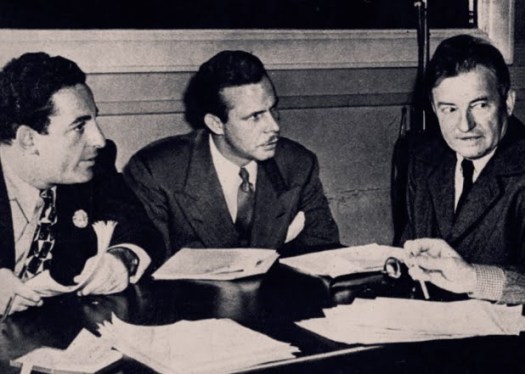
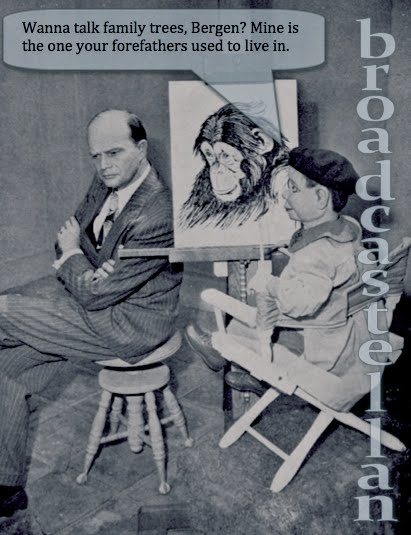
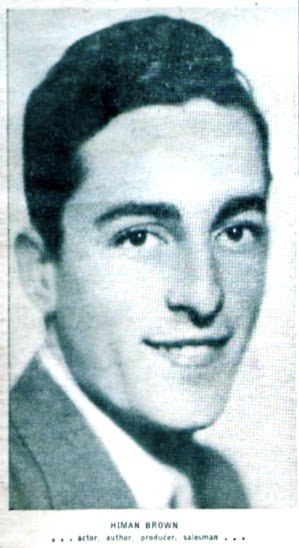
As I learned catching up with The Thrilling Days of Yesteryear this morning, one of the most prolific producers of radio drama in the United States passed away last Friday at the age of ninety-nine: Himan Brown (pictured here, to the left of Raymond Edward Johnson and Claude Rains, during a no doubt brief script conference for Inner Sanctum Mysteries).

Why โ€œno doubt briefโ€? Well, Brown was not only one of the busiest men in radio, he was also one of the thriftiestโ€”which, his skills and personality aside, is how he got so far so fast in a business that valued performers over producers. According to an article published in the July 1943 issue of Tune In magazine, Brown, then thirty-three, already had some fifteen thousand radio programs to his credit, and, at one time, โ€œhad thirty-five of them going each week.โ€

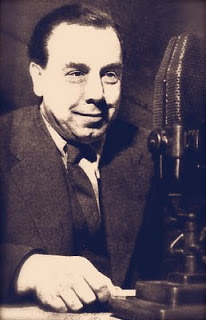
If he โ€œalmost ha[d] a corner on radio horror programs,โ€ it was due largely to his reputation as the mediumโ€™s โ€œchampion corner cutter,โ€ which is how radio actor Joseph Julian describes the โ€œfabulous Himan Brownโ€ in his memoirs.

For starters, Brown was a โ€œone-man operation.โ€ As Julian points out, the โ€œfabulousโ€ one

produced, cast, and directed of all his shows himself. ย He never even had an office. Heโ€™d make his phone calls from home, or use a phone at one of the studios. ย He had shrewd understanding of script values and an outsize charm that seduced performers to work for him for less than they would for anyone else.

Brown was involved in all aspects of radio production, and understood them in both dramatic and economic terms. โ€œWe must write our scripts with the constant vision of a dollar sign before our eyes,โ€ he told the editors of The Microphone. Interviewed for the magazineโ€™s 14 July 1934 issue, he deplored the industryโ€™s insistence on

employing only the most microphone-experienced actors, who, as Julian points out, โ€œcould deliver quickly, thus saving on rehearsal pay and studio costs,โ€ Brown was able to โ€œsell a program at a lower price than his competitors.โ€ ย Those who assisted him to beat the competition by reading their lines without much instruction appreciated that Brown provided them with steady work, made fewer โ€œdemands on their time,โ€ which, in turn, created a โ€œpleasant working atmosphere.”

Julian claims that Brown had made โ€œa million dollars by the time he was twenty-four.โ€ In later life, Brown made a donation in excess of that amount to Brooklyn College, where he taught radio drama. Even on his way up, the enterprising producer opened doors, creaking or otherwise, for young New York writers like Irwin Shaw, who, as Michael Shnayerson recounts in his biography of the noted playwright-novelist, owed his career in radio to Brown, however much Shaw came to resent the experience.

โ€œStill another newspaper cartoon strip comes to the air,โ€ Radio Guide for the week ending 16 February 1935 announced. The program in question was Dick Tracy. โ€œThe scripts are to be written by Erwin Shaw [sic] and produced by Himan Brown, who produces The Gumps and Marie, the Little French Princess.โ€

Clearly, the 1943 article in Tune In, which portrays Brown as a โ€œlone wolfโ€ who was โ€œsomething of a mystery even within the industry,โ€ is rather overstating it when asserting that the producer had remained โ€œpractically unknown to the listening public.โ€ To avid dial twistersโ€”those choosy enough to pick up periodicals like Tune In and its predecessorsโ€”the noted producer was already a household name in the mid-1930. How else could readers of the February 1935 issue of Radio Stars be presumed to care that, in November 1934, the โ€œstork left a brand new young man at the home of Mr. and Mrs. Himan Brownโ€?

It was a rarity, though, for producers to be hailed as โ€œRadio Stars,โ€ among whom those reading the commercial were far more prominent than those preparing the scripts. Perhaps, it was Brownโ€™s past that aided him here, as surely it did in his handling of his numerous programs. As the 1934 article in Microphone reminded me, the producer of series like Little Italy and Jack Dempseyโ€™s Gymnasium was then still referred to as writer, director and โ€œactor [. . .] of his plays.โ€

Brown himself played Papa Marino in Little Italy, and, if an article in the January 14-20 issue of Radio Guide is to be believed, studied the Italian accent of his Brooklyn neighbors so carefully that he was being mistaken for a paisan.

Given his full schedule and reliable troupe of performers, that ambition (his โ€œgreatest,โ€ according to Tune In) remained largely unfulfilled. After all, even a โ€œone-man operationโ€ cannot be expected to be quite this self-sufficient . . .

Related recording

Himan Brown recalling the origins of Inner Sanctum Mysteries in a 1998 interview

Time and the Airwaves: Notes on a Priestley Season

Both BBC Radio 4 and 7 are in the thick of a J. B. Priestley festival, a spate of programs ranging from serial dramatizations of early novels (The Good Companions and Bright Day) and adaptations of key plays (Time and the Conways and An Inspector Calls), to readings from his travelogue English Journey and a documentary about the writerโ€™s troubled radio days. Now, I donโ€™t know just what might be the occasion for such a retrospective, since nothing on the calendar coincides with the dates of Priestleyโ€™s birth or death. Perhaps, it is the connection with the 70th anniversary of the evacuation of Dunkirk, an event on which Priestley embroidered in June 1941 for one of his Postscript broadcasts, that recalled him to the minds of those in charge of BBC radio programming.

Never mind the wherefores and whys. Any chance of catching up with Priestley is welcome, especially when the invitation is extended by way of the wireless, the means and medium by which his voice and words reached vast audiences during the 1930s and early 1940s, both in the United Kingdom and the United States.

For all his experience as a broadcaster, though, Priestley, who was not so highbrow as to high-hat the mass market of motion pictures, never explored radio as a playwrightโ€™s medium, as a potential everymanโ€™s theater on whose boards to try his combined radiogenic skills of novelist, dramatist, and essayist for the purpose of constructing the kind of aural plays that are radioโ€™s most significant contribution to twentieth-century literatureโ€”the plays of ideas.

Priestley prominently installed a wireless set in Dangerous Corner, a stage thriller whose characters gather to listen to a thriller broadcast. Later, he read his controversial wartime commentaries (titled Postscripts) to a vast radio audience. He even went on one of Rudy Valleeโ€™s variety programs to discuss the fourth dimension. Yet the medium that relied entirely on that dimension, to the contemplation of which he devoted many of his stage playsโ€”Time and the Conways and I Have Been Here Before among themโ€”did not intrigue Priestley to make time and create plays especially for the air.

To be sure, his falling out with the BBC in 1941 (as outlined in Martin Wainwrightโ€™s radio documentary about the Postscript broadcasts) did little to foster Priestleyโ€™s appreciation of the radiodramatic arts. Yet the indifference is apparent long before his relationship with Auntie soured. When interviewed for the 1 September 1939 issue of the Radio Times about his novel Let the People Sing, which was to be read serially on the BBC before it appeared in print, Priestley dismissed the idea that he had written it with broadcasting in mind:

“I realised, of course, that the theme must appeal to the big majority. But apart from that, I thought it better to let myself go and leave the BBC to make it into twelve radio episodes. It would otherwise have cramped my style.”

To Priestley, the โ€œexperimentโ€ of broadcasting his novel lay in the marketing โ€œgambleโ€ of making it publicly available prior to publication, a challenge of turning publishing conventions upside down by effectively turning the printed book into a sort of postscript. Clearly, he looked upon radio a means of distribution rather than a medium of artistic expression.

Reading I Have Been Here Before and listening to the radio adaptation of Time and the Conways, I realized now little either is suited to the time art of aural play. Whereas the Hรถrspiel or audio play invites the utter disregard for the dramatic unities of time and space, Priestley relied on the latter to make time visible or apparent for us on the stage.

The Conways, like the characters of Dangerous Corner before them, are brought before us in two temporal versions, a contrast designed to explore how destinies depend on single moments in timeโ€”moments in which an utterance or an action brings about changeโ€”and how such moments might be recaptured or rewritten to prevent time from being, in Hamletโ€™s words, โ€œout of joint.โ€

โ€œTimeโ€™s only a dream,โ€ Alan Conway insists. โ€œTime doesnโ€™t destroy anything. It merely moves us onโ€”in this lifeโ€”from one peep-hole to the next.โ€ Our past selves are โ€œreal and existing. Weโ€™re seeing another bit of the viewโ€”a bad bit, if you likeโ€”but the whole landscapeโ€™s still there.โ€

In Priestleyโ€™s plays, it is the scenery, the landscape of stagecraft, that remains there, โ€œwholeโ€ and virtually unchanged. The unity of space is adhered to so as to show up changes in attitudes and relationships and to maintain cohesion in the absence or disruption of continuity.

In radioโ€™s lyrical time plays, by comparison, neither time nor place need be of any moment. It is the moment alone that matters on the air, an urgency that Priestley, the essayist and wartime commentator, must surely have sensed.  Priestley, the novelist and playwright did or could not.  Too few ever did.  To this day, a whole aural landscape is biding its time . . .

“You Were Wonderful,” Lena Horne

When I heard of the passing of Lena Horne, the words โ€œYou Were Wonderfulโ€ came immediately to mind. Expressive of enthusiasm and regret, they sound fit for a tribute. However, by placing the emphasis on the first word, we may temper our applauseโ€”or the patronising cheers of othersโ€”with a note of reproach, implying that while Horneโ€™s performances were marvellous, indeed, the system in which she was stuck and by which her career was stunted during the 1940s was decidedly less so. No simple cheer of mine, โ€œYou Were Wonderfulโ€ is also the title of a radio thriller that not only gave Horne an opportunity to bring her enchanting voice to the far from color-blind medium of radio but to voice what many disenchanted black listeners were wondering about: Why fight for a victory that, of all Americans, will benefit us least? As title, play, and cheer, โ€œYou Were Wonderfulโ€โ€”captures all that is discouraging in those seemingly uncomplicated words of encouragement.

Written by Robert L. Richards, โ€œYou Were Wonderfulโ€ aired over CBS on 9 November 1944 as part of the Suspense series, many of whose wartime offerings were meant to serve as something other than escapist fare. As I argued in Etherized Victorians, stories about irresponsible Americans redeeming themselves for the cause were broadcast nearly as frequently as plays designed to illustrate the insidiousness of the enemy. Despite victories on all fronts, listeners needed to be convinced that the war was far from over and that the publicโ€™s indifference and hubris could endanger the war effort, that both vigilance and dedication were required of even the most war-weary citizen. โ€œYou Were Wonderfulโ€ played such a role.

When a performer in a third-rate nightclub in Buenos Aires suddenly collapses on stage and dies, a famous American entertainer (Horne) is rather too eager replace her. โ€œIโ€™m a singer, not a sob sister,โ€ she declares icily, thawing for a tantalizing rendition of โ€œEmbraceable You.โ€

The very name of the mysterious substitute, Lorna Dean, encourages listeners to conceive of โ€œYou Were Wonderfulโ€ in relation to the perennially popular heroine Lorna Doone, or the Victorian melodramatic heritage in general, and to consider the potential affinities between the fictional singer and her impersonatrix, Lena Horne, suggesting the story to be that of an outcast struggling to redeem herself against all odds.

One of the regulars at the nightclub is Johnny (Wally Maher), an seemingly disillusioned American who declares that his country did not do much for him that was worth getting โ€œknocked off for.โ€ Still, he seems patriotic enough to become suspicious of the singerโ€™s motivations, especially after the club falls into the hands of a new manager, an Austrian who requests that his star performer deliver specific tunes at specified times. The absence of a narrator signalling perspective promotes audience detachment, a skeptical listening-in on the two central characters as they question each other while all along compromising themselves.

When questioned about her unquestioning compliance, Lorna Dean replies:

Iโ€™m an entertainer because I like it. ย And because itโ€™s the only way I can make enough money to live halfway like a human being. ย With money I can do what I want toโ€”more or less. I can live where I want to, go where I want to, be like other peopleโ€”more or less. ย Do you know what even that much freedom means to somebody like me, Johnny?

However restrained, such a critique of the civil rights accorded to and realized by African-Americans, uttered by a Negro star of Horneโ€™s magnitude, was uncommonly bold for 1940s radio entertainment, especially considering that Suspense was at that time a commercially sponsored program.

โ€œ[W]e are not normally a part of radio drama, except as comedy relief,โ€ Langston Hughes once remarked, reflecting on his own experience in 1940s broadcasting. A comment on this situation, Richardsโ€™s writingโ€”as interpreted by Horneโ€”raises the question whether Horneโ€™s outspoken character could truly be the heroine of โ€œYou Were Wonderful.โ€

Talking in the see-if-I-care twang of a 1930s gang moll, Lorna is becoming increasingly suspect, so that the questionable defense of her apparently selfish behavior serves to render her positively un-American. When told that her command performances are shortwaved to a German submarine and contain a hidden code to ready Nazis for an attack on American ships, she claims to have known this all along.

The conclusion of the play discloses the singerโ€™s selfishness to have been an act. Risking her life, Lorna Dean defies instructions and, deliberately switching tunes, proudly performs โ€œAmerica (My Country โ€˜Tis of Thee)โ€ instead.

About to be shot for her insubordination, Lorna is rescued by the patron who questioned her integrity, a man who now reveals himself to be a US undercover agent. When asked why she embarked upon this perilous one-woman mission, the singer declares: โ€œJust to get in my licks at the master race.โ€

โ€œYou Were Wonderful,โ€ which, like many wartime programs was shortwaved to the troops overseas, could thus be read as a vindication of the entertainment industry, an assurance to the GIs that their efforts had the unwavering support of all Americans, and a reminder to minorities, soldiers and civilians alike, that even a democracy marred by inequality and intolerance was preferable to Aryan rule.

Ever since the Detroit race riots of June 1943, during which police shot and killed seventeen African-Americans, it had become apparent that unconditional servitude from citizens too long disenfranchised could not be taken for granted. With โ€œYou Were Wonderful,โ€ Horne was assigned the task of assuring her fellow Negro Americans of a freedom she herself had to waitโ€”and struggleโ€”decades rightfully to enjoy.

Had it not been for this assignment, Lena Horne may never have been given the chance to act in a leading role in one of radioโ€™s most prominent cycles of plays. Yes, โ€œYou Were Wonderful,โ€ Lena Horneโ€”and any tribute worthy of you must also be an indictment.

โ€œ. . . there must come a special understandingโ€: To Corwin at 100

Today, American journalist and radio playwright Norman Corwin turns 100. Whether that makes him the oldest living writer to have had a career in radio I leave it to fact-checkers and record book keepers to determine. I do know that, seventy years ago, he was already the best. Oldest. Best. Why not dispense with superlatives? Corwin has been set apart for too long. Instead, an appreciation of his work calls for the positive and the comparative, as his plays deserve to be regarded at last alongside the prose and poetry of his better-known literary contemporaries.

No survey of 20th-century American literature can be deemed representative, let alone definitive, without the inclusion of some of Corwinโ€™s Whitmanesque performances. What has kept him from being ranked among the relevant and influential writers of the 1940s, and of the war years in particular, is the fact that, during those years, Corwin wrote chiefly for a medium that, however relevant and influential, wasโ€”and continues to beโ€”treated like a ghetto of the arts in America.

You might argue that the metaphor is not altogether apt, especially if you bear in mind the distinguished authors and playwrights who did turn toโ€”or agreed to be pulled intoโ€”broadcasting during the Second World War; among them poets Archibald MacLeish, Edna St. Vincent Millay, and Stephen Vincent Benรฉt, as well as dramatists like Maxwell Anderson, Marc Connelly, and Sherwood Anderson. And yet, even their scripts are rarely acknowledged to be contributions to literature, the American airwaves being thought of as a cultural site quite beyond that field.

At best, dramatic writings for radio are handled as historical documents that, by virtue of being propagandist or populist, could hardly be regarded as having artistic merit or integrity. As something otherโ€”and lessโ€”than literature, they were as quickly obliterated as they were produced, stricken from the records so as not to tarnish the reputation of erstwhile writer-recruits most of whom exited the radio camp well before V-J Day.

Norman Corwin never deserted that camp. Rather, the camp was shut down, raided by McCarthy, all but razed to make way for television. Sporadic returns to the old playing field notwithstanding, he was forced to move on. Yes, the air wasโ€”and isโ€”Corwinโ€™s playground. For all their wartimeliness, his 1940s plays were never mere means to an end, even if end is understood to mean an end to the war that gave them a reason for being.

To gain an understanding of that past is not the only good reason for being in the presence of Corwin today. Rather than promoting uniformity, which is a chief aim of propaganda, Corwinโ€™s plays challenge the commonplace, encourage independent thinking and the voicing of ideas thus arrived at. Take โ€œTo Tim at Twenty,โ€ for instance. It is hardly one of Corwinโ€™s most complex, ambitious or experimental works for radio; in a note to a fellow writer, published in Norman Corwinโ€™s Letters (1994), the playwright himself described it as โ€œthe lowest common denominator of simplicity.โ€ Simplicity, in this case, is an achievement. Quietly startling, โ€œTo Tim at Twentyโ€ bespeaks the humanity, intellect, and dignity of its author.

Written for the CBS Forecast series, a string of pilot broadcasts designed to test audience responses to potential new programs, the play first aired on 19 August 1940, when it starred Charles Laughton, for whom โ€œTo Timโ€ was expressly written, and Elsa Lanchester. Newly arrived in California, Corwin was staying at the coupleโ€™s Brentwood home at the time.

As he shared in a letter to his sister-in-law, he felt โ€œkind of lonelyโ€ in Hollywood, and was โ€œgetting tired of singlehood.โ€ In times of warโ€”and to Laughton and Lanchester August 1940 was wartimeโ€”the thought of growing up and raising a family is compounded by the realization that the future is darkly uncertain instead of rich in potentialities. So, Mr. Corwin wrote a letter.

To Tim at Twenty is an epistolary play, a radiodramatic genre of partially dramatized speeches addressed to an implied audience. The proxy listener, in this case the unheard Tim, suited Corwin since indirection made whatever was conveyed come across as something other than an act of overt indoctrination. The addressee also provided him with a veil behind which to enact his personal conflicts as he contemplated his maturity, mortality, and legacy.

The letter writer is Timโ€™s father, a British gunner spending a sleepless night in the โ€œbarracks of an RAF squadron on the northeast coast of Englandโ€; as the narrator-announcer informs us, he is โ€œleaving at dawn on a mission from which there can be no return.โ€

Once the United States entered the war, lesser writers, melodramatist Arch Oboler among them, would use this kind of set-up to remind American civilians of the sacrifices made for them overseas, of the bravery that must be honored and matched at the home front. Tim, we expect, is asked to honor his fatherโ€™s memory. Instead, the letter he is to receive tells him that the men of his fatherโ€™s generation โ€œhavenโ€™t made out any too wellโ€ in the business of โ€œthe running of the earth.โ€

At the time the letter is composed, Tim is just five years old. His father made a โ€œspecial pointโ€ of asking his wife โ€œnot to deliverโ€ it until 1955, at which time he might have had the โ€œman to manโ€ talk with his son that war denied him.

Sentimental, seemingly pacifist messages were not unheard of at the time. They were welcomed by isolationists who counted on big business as usualโ€”and commercial radio, which shunned the controversial, was very big business indeed; but โ€œTo Tim at Twentyโ€ suggests something alien to those determined to preserve the status quo. Instead, the belated address of the Englishmen, who knows better than to have faith in things as they are, is meant to instill his sonโ€”and Corwinโ€™s listenersโ€”with a โ€œfuller appreciation of women.โ€ To Marshall, they are authorities of humanity superior to men because โ€œthere must come a special understanding of the dignity of life to those who grow it in their vitals.โ€

As the dramatic flashbacks reveal, the lessons he shares with his son were taught Marshall by his wife, who suggested that the voices of the many might have drowned the shrill cries of the few, the โ€œwanton willsโ€ that were not countered by โ€œmanโ€™s vast raw materials of love and tenderness and courageโ€ in time to avoid deadly conflict. โ€œThere are several kinds of valor,โ€ Tim is to learn from his dead father, โ€œand the least is the kind that comes out of the hysteria of battle.โ€

I suspect that it was easier to write this message in 1940 than it was to understand it in 1955, when Americaโ€™s leader was a five-star general, when superpowered dominance was the manly objective of the day and the โ€œappreciation of womenโ€ was more a matter of the male gaze than of political influence or workforce equality. By then, there was no place for Corwin in network radio.

Since his climactic โ€œNote of Triumphโ€ in 1945, to which nearly half of the US population was estimated to have tuned in, his voice has been heard by a comparatively fewโ€”the fortunate few who, by lending him an ear, are gaining a “special understanding.”

โ€œBecause there is always someone left outโ€: Bennett, Biography, and the Habit [of Framing] Art

I might as well come right out with it, dissentient, fractious and uncharitable as it may sound. I donโ€™t like Alan Bennettโ€”popular British playwright, memoirist, and frequent reciter of his own wordsโ€”whose latest work for the stage, The Habit of Art, was beamed from Londonโ€™s National Theatre into movie houses around the world this month. He irritates me. Why, then, did I number among the sizeable crowd this satellite event drew at our local cinema? Truth is, I kind of like that he irritatesโ€”unless he does it with the sound of his voice, a querulous whine the exposure to which theater audiences, unlike radio listeners, are generally spared. In The Habit of Art, Bennett does itโ€”that is, doesnโ€™t do it for meโ€”in the way he packages or frames what I think he is trying to capture.

At this stage in his career, Bennett is about as stuffy as an old whoopee cushion. Once in a while, he stands up to lecture, letting his charactersโ€”all stand-ins for himselfโ€”disseminate lines that stand out not merely by virtue of their brilliance but by the less-than-virtue of being borrowed for the occasion as if they were quotations taken from what could have been the draft of an unpublished essay. Then, sitting down again, he, in his frightfully British way of rendering himself human and opening up to usโ€”and of confusing secrets with secretionsโ€”carries on about bodily functions as if he were out to revive the Carry On series. The habit? O, fart!

โ€œThatโ€™s Auden farting, not me,โ€ one of Bennettโ€™s characters, Fitz, insists after doing so audibly. Whether caught breaking wind or urinating in the kitchen sink, thatโ€™s still W. H. Auden, the distinguished poet, with whose short yet (since?) intimate friendship to composer Benjamin Britten the play is ostensibly concerned. Ostensibly, because Bennett is not about to humor those curious about the private lives of two fellow gay artists, reunited in 1972 to discuss a collaboration that does not come off, by delivering some kind of Sunshine Boys routine. In its roundabout way, The Habit of Art refuses to be about any one thing. It isnโ€™t Auden letting go. Itโ€™s an actor portraying him in a rehearsal of a play whose Author, also on the scene, seems unsure about just what it is all aboutโ€”or at least unable to convince his players.

To say what he needs to say, Bennettโ€™s Author feels compelled to move a biographer into the frame of what he is anxious to preserve as his composition; Bennett does the same in order to explore that frame and explode it. In other words, Bennett is rehearsing his failureโ€”or inability or unwillingnessโ€”to restrain himself for the sake of art by acting out passages from his decidedly golden notebook.

A kind of Greek Chorus, the biographer is the Authorโ€™s device, just as the sensitive, defensive Author is Bennettโ€™s. That is, the device is similar, but the purpose is different. In Bennettโ€™s play, the unassuming actor assuming the part of the interviewing, interjecting biographer is aware of being a device and resents it. Since his character is based on a real person (radio broadcaster Humphrey Carpenter), the actor wants his role to come across as real even as he is made to walk in and out of Audenโ€™s quarters like the Stage Manager in Our Town. Nothing seems real here aside from Bennettโ€™s artistic struggle.

Although the actor does not have to emit gas to prove his characterโ€™s humanity, heโ€”that is, the biographer in spite of his extra-autobiographical selfโ€”is confronted with Audenโ€™s request for a sex act the performance of which was the job of the callboy for whom the biographer is briefly mistaken. Enter the callboy proper. He, not Auden or Britten, is the character referred to, albeit obliquely, in the Authorโ€™s play Calibanโ€™s Day, the troubled rehearsal into the midst of which we are plonked.

Meanwhile, Fitz, the less than letter-perfect actor set to play Auden, is not amused by this Caliban, nor by Calibanโ€™s Day, a dramatic monstrosity that also features talking furniture (โ€œI am a chair and in New York / I seated his guests and took in their talkโ€) and an exchange between Audenโ€™s Words and Brittenโ€™s Music, performed, in the absence of the two unfortunate thespians assigned those parts, by the jovial Stage Manager and her hapless assistant.

It is through Fitz that Bennett responds to the frustrations of theatergoers eagerโ€”if increasingly less soโ€”to get closer to a poet whom, after witnessing this closed-door run-through of what is about to go on public display, it would be nigh on impossible to romanticize as bohemian: โ€œThereโ€™s no nobility to him,โ€ Fitz protests, โ€œWhereโ€”this is what the audience will be thinkingโ€”where is the poetry?โ€

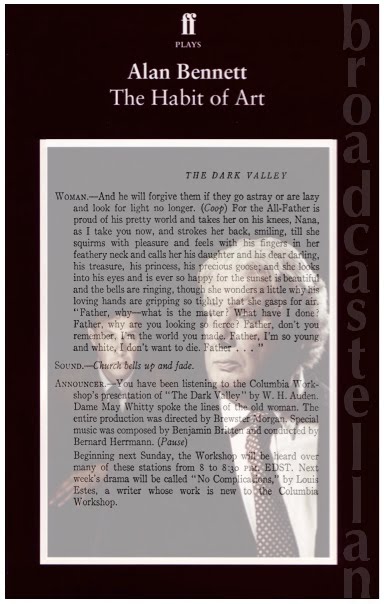
Not that I was expecting, even from an audiophile like Bennett, any reference to โ€œThe Dark Valley,โ€ Audenโ€™s 1940 contribution to The Columbia Workshop. Dramatically underscored by Brittenโ€™s music, Audenโ€™s monologue for radio is a collaborative effort that speaks, more directly and poignantly than Bennett, of love, death, and the secrecy that is the death of love:

Under the midnight stone
Love was buried by thieves.
The robbed hearts weep alone.
The damned rustle like leaves.

Taking center stage instead is a professional sex worker. Bennettโ€™s Author does his utmost to justify the callboyโ€™s presence, insisting that his request performance is neither uncalled for nor gratuitous. As the only surviving witness of that fictionalized meeting between Auden and Britten, the young man is recalled from obscurity to tell us what he would want to get out of the exchange if he, a Caliban among Prosperos, were to have his day:

I want to figure. He goes on about stuff being cosy, England and that. But itโ€™s not England thatโ€™s cosy. Itโ€™s art, literature, him, you, the lot of you. Because thereโ€™s always someone left out. You all have a map. I donโ€™t have a map. I donโ€™t even know what I donโ€™t know. I want to get in. I want to join. I want to know.

Neither the Author, whom we are not encouraged to take seriously, nor Bennett, in all his tongue-in-cheekiness, convinces me that the boy truly wants to be in the know; above all, he wants to be known. And, for some reasonโ€”a touch of Death in Venice, Habit with its built-in commentary suggestsโ€”Bennett lets the youth voice his demands on behalf of all the faceless boys that Britten and Auden may have privately enjoyed while enjoying critical success.

But the boyโ€”played by a self-conscious twenty-nine-year oldโ€”does not figure. If anything, he disfigures. He, like anyone who ever catered to Audenโ€™s bodily needs, cleaned his kitchen sink or inspected his carcass, is generally โ€œleft outโ€ for a reason. After all, is it really such a revelation that an artist may be rankly human, that, stripped of the artistry for which he is known, he stands before us as homo mephiticus?

Bennett, to borrow a line from myself, is โ€œlike a boar chasing Adonis for the sweat on his thighs.โ€ That we are unknowable to each other is old hat. To add that, if we do get to know what others did not mean to share, we might end up with moreโ€”or lessโ€”than we need to know is hat decomposing.

Bennett means to share, though. He means to share what it means to create, to critique, and collaborate, what it means to be old, what it means to be gay, what it means to be public, to be private, to be popular, to be British, to be human. Now artsy, now fartsy, he means to let it all out, and say, too, how difficult it is to say anything, let alone everything and the kitchen sink. Yet, as Scream 3 drove home back in 2000, postmodern self-reflexivity is as dead as a nail in a mortuaryโ€™s door, a door that, if left open, releases nothing but the ptomaine wafting our way when storytelling is permitted to keep turning and feasting on itself.

However breezy this exercise in framing and dismantling may be, nothing quite this undisciplined and self-indulgent can be any longer mistaken for fresh air. Itโ€™s just a hard-to-kick habit of art, and a rather bad one at that.

โ€œMarching backwardsโ€: โ€œThe Great Tennessee Monkey Trialโ€ Is Back on the Air

The Darwin bicentenary is drawing to a close. Throughout the year, exhibitions were staged all over Britain to commemorate the achievements of the scientist and the controversy his theories wrought; numerous plays and documentaries were presented on stage, screen and radio, including a new production of Inherit the Wind (1955), currently on at the Old Vic. I was hoping to catch up with it when next I am in London; but, just like last month, I my hopes went the way of all dodos as only those survive the box office onslaught who see it fit to book early.

Not that setting foot on the stage of the Darwin debate requires any great effort or investment once you are in the great metropolis. During my last visit to the kingdomโ€™s capital, I found myselfโ€”that is to say, I was caught unawares as I walked through the halls of the Royal Academy of Artsโ€”in the very spot where, back in 1858, the papers that evolved into The Origin of Species were first presented.

This week, BBC Radio 4 is transporting us back to a rather less dignified scene down in Dayton, Tennessee, where, in the summer of 1925, the theory of evolution was being put on trial, with Clarence Darrow taking the floor for the defense. Peter Goodchild, a writer-producer who served as researcher for and became editor of the British television series on which the American broadcast institution Nova was modeled, adapted court transcripts to recreate the media event billed, somewhat prematurely, as the “trial of the century.”

Like the LA Theatre Works production before it, this new Radio Wales/Cymru presentation boasts a pedigree cast including tyro octogenarians Jerry Hardin as Judge John Raulston and Ed Asner as William Jennings Bryan, John de Lancie as Clarence Darrow, Stacy Keach as Dudley Field Malone, and Neil Patrick Harris as young biology teacher John Scopes, the knowing if rather naive lawbreaker at the nominal center of the proceedings who gets to tell us about it all.

โ€œI was enjoying myself,โ€ the defendant nostalgically recalls his life and times, anno 1925, as he ushers us into the courtroom, for the ensuing drama in which he was little more than a supporting player. โ€œIt was the year of the Charleston,โ€ of Louis Armstrongโ€™s first recordings, โ€œthe year The Great Gatsby was written.โ€ Not that marching backwards to the so-called โ€œMonkey trialโ€ isโ€”or should ever becomeโ€”the stuff of wistful reminiscences. โ€œBut, in the same year, Hitler wrote Mein Kampf, Scopes adds, โ€œand in Tennessee, they passed the Butler Act.โ€

Darrow called the ban on evolution as a high school subjectโ€”and any subsequent criminalization of intellectual discourse and expressed beliefsโ€”the โ€œsetting of man against man and creed against creedโ€ that, if unchallenged, would go on โ€œuntil with flying banners and beating drums, we are marching backwards to the 16th century.”

He was not, of course, referring to the Renaissance; rather, he was dreading a rebirth of the age of witch-hunts, superstitions and religious persecution. โ€œWe have the purpose of preventing bigots and ignoramuses from controlling the education of the United States, and you know it, and that is all,โ€ Darrow declared.

It is a line you wonโ€™t hear in the play; yet, however condensed it might be, the radio dramatization is as close as we get nowadays to the experience of listening to the trial back in 1925, when it was remote broadcast over WGN, Chicago, at the considerable cost of $1000 per day for wire charges. According to Slate and Cookโ€™s It Sounds Impossible, the courtroom was โ€œrearranged to accommodate the microphones,โ€ which only heightened the theatricality of the event.

I have never thought of radio drama as ersatz; in this case, certainly, getting an earful of the Darrow-Bryan exchange does not sound like a booby prize for having missed out on the staging and fictionalization of the trial as Inherit the Wind.


Related post
โ€œInherit the . . . Air: Dialing for Darwin on His 200th Birthdayโ€

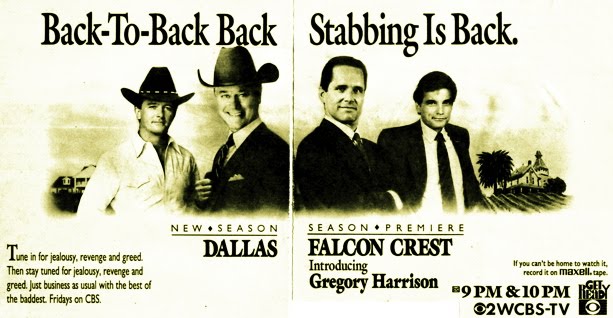
Back to Back-to-Back; or, Serialization of Schemes

A long time (well, okay, make that โ€˜about four and a half yearsโ€™) ago I came to the realization that the key to keeping an online journalโ€”and oneโ€™s fingers regularly on the keyboard in its serviceโ€”is serialization: some kind of evolving plot that, like life and Stella Dallas on a diet, keeps thickening and thinning from Monday till Doomsday until the inevitable sundown that not even Guiding Light could outshine.

Despite this realization, though, I have never managed to make a success of stringing together the latest on my follies and failures, mainly because I did not set out to make my person the axis around which this less than celestial body of essays spins. That, in recent months, the revolutions have ground to a near halt and affairs have become all but devolutionary is largely owing to the series of friction that is my one life to live beyond these virtual pages. These days, writing in installments begins and ends in โ€˜stall,โ€™ which is the least I tend to do best.

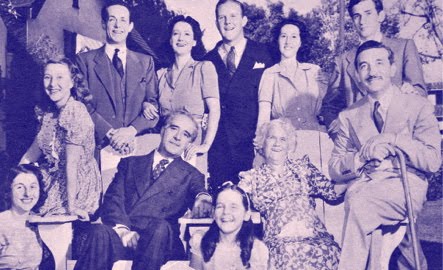
The cast of One Man’s Family

Not that the contemplation of the presumably out-of-date lends itself to frequent updates. I mean, whatโ€™s the point of being current when your harvest is raisins? For the love of ribbon mikes, how many times can you run away with the A & P Gypsies and still expect anyone to follow the run-down caravan in which you survey the bygone scene? Good for how many yarns are the bewildering progeny of the Happiness Boys, that old โ€œInterwoven Pair,โ€ until any attempt at catching up with the catโ€™s whiskers and its litter unravels like knitting gone kittyโ€™s corner? Why go on circulating gossip from the Make Believe Ballroom as the world turns the radio off?

Clearly, there is room for a chorus line of doubt when I now announce the beginning of a new chapter in the cancellation dodging saga of broadcastellan. Anyone hoping for a weekly quintuplet of All My Mindโ€™s Children should be advised that this is going to be more a case of One Manโ€™s Family Planning . . .

"2X2L calling CQ. . .": The Night They Made Up Our Minds About Realism

Radio Guide (19 November 1938)

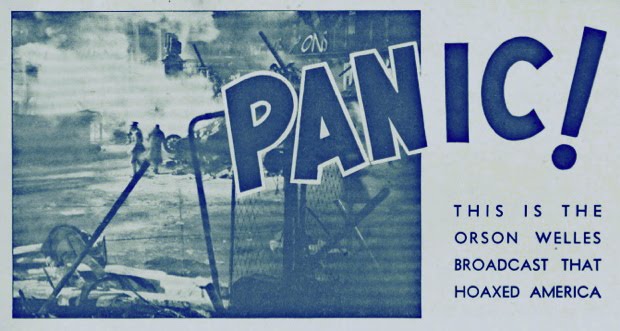
This is just the night for a returnโ€”a return to that old, beloved yet woefully neglected hobbyhorse of mine. You know, the Pegasus of hobbyhorses: the radio. After all, it is the anniversary of the Mercury Theatreโ€™s 1938 โ€œWar of the Worldsโ€ broadcast, a date that lives in infamy for giving those who say that โ€œseeing is believingโ€ an ear-opening poke in the eye. These days, the old Pegasus doesnโ€™t get much of an airing. It may have sprung from the blood of Medusaโ€”but that old Gorgon, television, still has a petrifying grip on our imagination.

What made โ€œThe War of the Worldsโ€ so convincing was that it treated fantasy to the trickery of realism, by turning an old sci-fi yarn into what, too many, sounded like a documentary. As the programโ€™s general editor, John Housemanโ€”who gave up the ghost on Halloween in 1988โ€”recalled about the Mercuryโ€™s holiday offering, not even the script girl had much faith in the material: โ€œItโ€™s all too silly! Weโ€™re going to make fools of ourselves. Absolute idiots.โ€ Instead, the broadcast made fools of thousands by exploiting their pre-war invasion anxieties.

As I put it in Etherized Victorians, broadcast fictions could

tap into what McLuhan argued to be โ€œinherent in the very natureโ€ of radioโ€”the power to turn โ€œpsyche and society into a single echo chamber.โ€

The more urgent concern for broadcasters had always been whether it was proper for radio dramatists to exploit this power at all, especially after the codes of radioโ€™s surface realism had been so forcefully violated by Howard Kochโ€™s dramatization [. . .]. In one of the most disturbing scenes of the play, a speaker identified as a CBS announcer addresses the public to document the end of civilizationโ€”โ€œThis may be the last broadcastโ€โ€”until succumbing to the noxious fumes that spread across Manhattan and extinguish all human life below. ย His body having collapsed at the microphone, a lone voiceโ€”rendered distant and faint by a filterโ€”attempts to establish communication.ย 

It is the voice of a radio operator: โ€œ2X2L calling CQ. . . . 2X2L calling CQ . . . . 2X2L calling CQ . . . New York. Isnโ€™t there anyone on the air? [Isnโ€™t there anyone on the air?] Isnโ€™t there anyone. . . .โ€ ย The Mercury Playersโ€™ โ€œholiday offeringโ€ had not only โ€œdestroyed the Columbia Broadcasting System,โ€ as Welles jested at the conclusion of his infamous Halloween prank, but had pronounced the death of its receiversโ€”the listening public. ย Considering the near panic that ensued, was it advisable to open the realm Esslin called a โ€œregion akin to the world of the dreamโ€ without clearly demarcating it as fantasy by resorting to the spells of Trilby, Chandu, or The Shadow?

After that night, the aural medium as governed by those in charge of the realties of commerce and convenience seemed destined to perpetuate what Trilling referred to as the โ€œchronic American beliefโ€ in the โ€œincompatibility of mind and reality.โ€

Related writings
โ€œโ€˜War of the Worldsโ€™: A Report from the Sensorial Battlefieldโ€
โ€œโ€˜War of the Worldsโ€™: The Election Editionโ€
โ€œThousands Panic When Nelson Eddy Begins to Singโ€

They Also Sell Books: W-WOW! at Partners & Crime

Legend has it that, when asked what Cecil B. DeMille was doing for a living, his five-year-old grand-daughter replied: โ€œHe sells soap.โ€ Back then, in 1944, the famous Hollywood director-producer was known to million of Americans as host and nominal producer of the Lux Radio Theater, from the squeaky clean boards of which venue he was heard slipping (or forcefully squeezing) many a none-too-subtle reference to the sponsorโ€™s products into the behind-the-scenes addresses and rehearsed chats with Tinseltownโ€™s luminaries, lines scripted for him by unsung writers selling out in the business of making radio sell.

No doubt, the program generated sizeable business for Lever Brothers; otherwise, the theatrical spin cycle conceived to bang the drum for those Lads of the Lather would not have stayed afloat for two decades, much to the delight of the great (and only proverbially) unwashed. For all its entertainment value, commercial radio was designed to hawk, peddle and tout; and although the spiel heard between the acts of wireless theatricals like Lux has long been superseded by the show and sell of television and the Internet, old radio programs still pay off, no matter how freely they are now shared on the web. In a manner of speaking, they still sell, albeit on a far smaller and downright intimate scale.

Take W-WOW! Radio. Now in its fourteenth season, the opening of which I attended last month, the W-WOW! Mystery Hour can be spentโ€”heard and seenโ€”on the first Saturday of every month (July and August excepting) from a glorified store room at the back of one of the few remaining independent and specialty booksellers in Manhattan: Partners & Crime down on Greenwich Avenue in the West Village. The commercials recited by the cast are by now the stuff of nostalgia, hilarity, and contention (“In a coast-to-coast test of hundreds of people who smoked only Camels for thirty days, noted throat specialists noted not one single case of throat irritation due to smoking Camels“); but the readings continue to draw prospective customers like myself.

Whenever I am in town, I make a point of making a tour of those stores, even though said tour is getting shorter and more sentimental every year. There are rewards, nonetheless. Two of my latest acquisitions, Susan Wareโ€™s 2005 โ€œradio biographyโ€ of the shrewdly if winningly commercial Mary Margaret McBride and John Housemanโ€™s 1972 autobiography Run-through (signed by the author, no less) were sitting on the shelves of Mercer Street Books (pictured) and brought home for about $8 apiece. The latter volume is likely to be of interest to anyone attending the W-WOW! production scheduled for this Saturday, 3 October, when the W-WOW! players are presenting the Mercury Theatre on the Air version of Dracula as adapted by none other than John Houseman.

As Houseman puts it, the Mercuryโ€™s โ€œDraculaโ€โ€”the seriesโ€™s inaugural broadcastโ€”is โ€œnot the corrupt movie version but the original Bram Stoker novel in its full Gothic horror.โ€ Indeed, Housemanโ€™s outstanding adaptation is a challenge worthy of W-WOW!โ€™s voice talent and just the kind of material special effects artist DeLisa White (pictured above, on the right and to the back of those she so ably backs) will sink her teeth into, or whatever sharp and blunt instruments she has at her disposal to make your hair stand on end.

Rather more run-of-the-mill were the scripts chosen for W-WOW!โ€™s September production, which, regrettably, was devoid of vamps. You know, those double-crossing, tough-talking dames that enliven tongue-in-cheek thrillers like The Saint (โ€œLadies Never Lie . . . Muchโ€ or โ€œThe Alive Dead Husband,โ€ 7 January 1951) and Richard Diamond (โ€œThe Butcher Shop Case,โ€ 7 March 1951 and 9 March 1952), a story penned by Blake “Pink Panther” Edwards and involving a protection racket. The former opened encouragingly, with a wife pretending to have killed a husband who turned out to be yet living, if not for long; but, as it turned out, the dame had less lines than any of the ladies currently in prime time, or any other time for that matter. Sure, crime paid on the air; but sex, or any vague promise of same, sells even better.

That said, I still walked out of Partners & Crime with a book in my hand. As I passed through the store on my way out, an out-of-print copy of A Shot in the Arm caught my eye and refused to let go. Subtitled โ€œDeath at the BBC,โ€ John Sherwoodโ€™s 1982 mystery novel, set in Broadcasting House anno 1937 and featuring Lord Reith, the dictatorial Baron who ran the place, is just the kind of stuff I am so readily sold on, as I am on browsing in whatever bookstores are still standing offlineโ€”if only to give those who are still in the business of vending rare volumes a much-deserved shot in the open and outstretched arm.

Related recordings
“Ladies Never Lie . . . Much,” The Saint (7 January 1951)
“The Butcher Case,” Richard Diamond (7 January 1950)
“The Butcher Case,” Richard Diamond (9 March 1951)

Yoo-hoo! Isn’t anybody anymore?

Remembering Gertrude Berg, that is. Having been to Fleischmanns last year (without spotting her tombstone there), I was thrilled to be catching Aviva Kempnerโ€™s much reviewed if ultimately unsatisfying documentary Yoo-Hoo, Mrs. Goldberg at the Quad Cinema in Manhattan last week. After all, it is not a film you are likely to see in Europe (or, for that matter, in any US multiplex); and I doubt whether it will ever be released in Wales, my present home. Who, after all, remembers (or ever had the opportunity of) tuning in to The Goldbergs, or The Rise of the Goldbergs, as Bergโ€™s program was initially called in the days before television?

Kempnerโ€™s filmic memorial to Berg and her creationโ€”heard on radio and seen on stage, television and the moviesโ€”aims at countering the oblivion to which the writer-producer-actress and her signature character have long been consigned; but, judging from the elderly, Jewish audience among which I found myself, aside from my good friend, Brian, Mrs. Goldberg is not likely to find new admirers through Kempnerโ€™s polite and downright reverent re-introduction, however deserving she may be of praise.

โ€œWhy, for all her popularity and apparent influence, is Gertrude Berg so little remembered today?โ€ Paul Farhi of the Washington Post asked back in July 2009. It is a question Kempner does not trouble herself to answer, other than with a resounding โ€œWhy indeed?โ€ Predating but overshadowed by I Love Lucy, The Goldbergs come across as little more than a noteworthy, ethnic curiosity, a historical footnote, the stuff of nostalgia. At least, Kempnerโ€™s documentary, which New York Post critic V. A. Musetto called โ€œfawning and formulaic,โ€ did little to convince me otherwiseโ€”and I donโ€™t need convincing.

โ€œUlleright, ulleright!โ€ For all its shortcomings, Yoo-Hoo, Mrs. Goldberg is still a welcome and overdue tribute to of a long overlooked icon of American popular cultureโ€”and an enterprising, emancipated woman at that; but it is also a rather perfunctory and historically questionable piece of bio-cinematography, replete with a poorly reenacted scene from Bergโ€™s earliest radio script.

Except for a few tantalizing clips of Edward R. Murrow’s interview with Berg on Person to Person and those seemingly random excerpts from The Goldbergs kinescopes, the documentary, like most pieces of ocular proof, is at a loss to fill the screen, resorting to images only remotely related to the subject; or, else, to talking heads like Ed Asnerโ€™s and Ruth Bader Ginsburg (who recalls being addressed as Mrs. Goldberg). Meanwhile, the snippets from Bergโ€™s radio and television broadcasts are often unintelligible, if it werenโ€™t for the subtitles. The result is about as funny as a translated jokeโ€”and certainly not remotely as amusing or charming as Bergโ€™s glossy autobiography Molly and Me (1961).

Here, for instance, is how autobiographer Berg made the connection between her parentage and her wireless offspring. Those watching Kempnerโ€™s documentary never get to hear about it. To them, Molly is a kindly woman leaning out of a window, chatting to her neighborsโ€”and an audience long since dispersedโ€”or praising the miracle of Sanka Coffee, instead of yelling โ€œYoo-hoo, is anybody?โ€ into a telephonic darkness just beyond her Bronx apartment:

My father was a special fan of the dumbwaiter and when radio was invented, he gave up the shaftway only because of the better coverage. But until that time it was through the dumbwaiter that he got to know everybody, not by their names, but by their locations. He predicted divorce for Mr. and Mrs. 5-D because of their nightly arguments; he knew that Mrs. 3-Aโ€™s son was going to leave home before even Mrs. 3-A. It didnโ€™t take second sight; all it took was a good ear and a comfortable chair near the dumbwaiter door.

Kempnerโ€™s film is so reverent and nostalgic, it sentimentalizes the already saccharine confection of Mother Goldberg, whose Jewish Amos โ€˜nโ€™ Andyisms enliven the early scripts for her radio serial, extant only in print, before the series-turned-daytime serial settled for at times โ€œsoap-operaishโ€ melodrama.

โ€œ[E]verything about The Goldbergs changed but the theme song, โ€˜Toselliโ€™s Serenade,โ€™โ€ Berg explains in Molly and Me. Those encountering Molly in Kempnerโ€™s documentary are unlikely to see Molly as an early Lucy, or, come to think of it, as a prototype for linguistically challenged immigrant Ricky Ricardo.

โ€œSo come down a liddle after,โ€ Mrs. Goldberg once yoo-hooed to her neighbor, Mrs. Bloom, โ€œmaybe veโ€™ll go to a mofieโ€”is playing de Four Horsemen in de Apoplexies.โ€ Well, you almost got it, Molly. Apoplexies are the kind of movie theaters that leave you angry at your lack of choices. Too bad that even the exceedingly rare art house simplexes are not likely to rescue you from the fate of being trampled to death by the pale horse of apathy.


Related writings
The House of [Broken] Glass
Wireless Women, Clueless Men: Gertrude Berg, Everybody’s Mama
On This Day in 1941: Molly Goldberg Nearly Chickens Out