Another “Wrong Number,” a False Start for Marilyn, and the Right Answer at Last

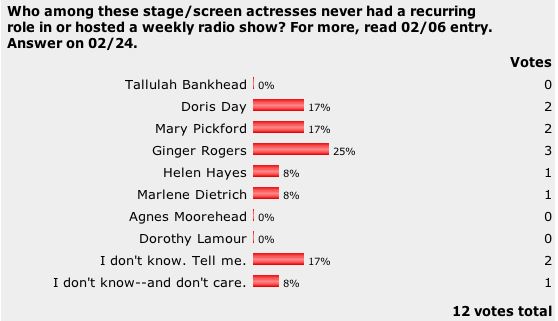
For the past three weeks I have been commemorating the dames, gals, and ladies of the airwaves; but now, the correct answer to the question posed in first broadcastellan quiz can finally be revealed. Thanks to all those who guessed or knew or couldn’t care less—and told me so. Tallulah Bankhead, Doris Day, Mary Pickford, Helen Hayes, Marlene Dietrich, Agnes Moorehead, and Dorothy Lamour—they were all radio regulars at some point in their careers, whereas others, including Ginger Rogers, the lady in question (as guessed by three readers), limited their air time to occasional guest appearances on dramatic programs like the Lux Radio Theatre. And others still, Marilyn Monroe among them, started out in commercials.

On this day, 24 February, in 1947, more than five years before she became a major star, a noticeably nervous Monroe, having waited months for her first movie role while already under contract at Fox, was pushed before the microphone to appear in a commercial break for the Lux production of “Kitty.” Within the few seconds allotted for her radio debut, Monroe was faced with the task of initiating her career (by mentioning her first Technicolor screen test), plugging Betty Grable’s The Shocking Miss Pilgrim (whose costume she got to wear during the test shoot), and peddling Lux “flakes” (which ostensibly kept those costumes fresh and colourful). However alluring her timbre, Monroe fumbled. She could not even get the name of the announcer straight; her voice was rarely broadcast thereafter, even as her film roles remained scarce and undistinguished.

A pleasant voice, while an asset, was not a radio requisite. As I mentioned previously, Louella Parsons did quite well without one, notwithstanding her consternation when being told she had to do without the larynx of Ms. Rogers, who allegedly insisted on getting paid to be interviewed. The giggles and high-pitched screechings of comedy actresses aside, the most celebrated woman’s voice on American radio was the less than pleasing one emanating from Agnes Moorehead. Her virago vocals, by which Joseph Cotton’s character in Since You Went Away claims to have been haunted across the Atlantic, was ideally suited to the role of irate Mrs. Stevenson in that most famous of original old-time radio plays, Lucille Fletcher’s “Sorry, Wrong Number.”

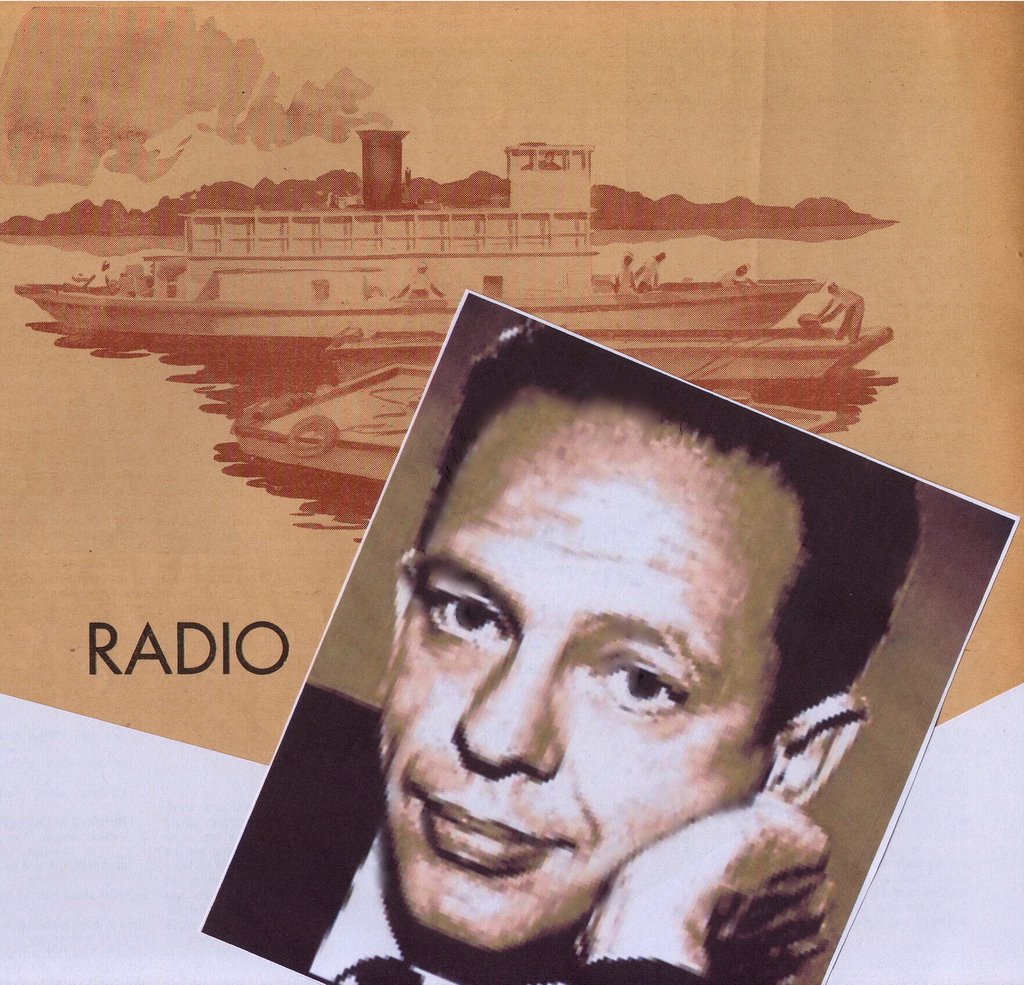
On this day in 1944, Moorehead, shown left during a performance of “Sorry,” once again starred in the role she had originated on the radio thriller anthology Suspense in May 1943. The part was subsequently translated for motion picture audiences and television viewers (by Barbara Stanwyck, Mildred Natwick, Ida Lupino, and Shelley Winters); but, however bitter Moorehead might have been losing the role to Stanwyck on the big screen, no actress would snatch the original from the “First Lady of Suspense.”

It was not until long after Moorehead’s death that Claire Bloom (recently seen on UK television in the last of the second season of Marple), made an attempt at superseding the “First Lady,” not only by recreating the role for radio in 1999, but by starring in a sequel of sorts.

While she had nothing to do with that sequel, radio dramatist Lucille Fletcher was responsible for the 1948 film adaptation. Her involvement did not, however, assure the aesthetic success of the latter, which, for all its high melodrama, has little of the tension generated by the original play. With its numerous flashbacks, the film destroys the intensity of a drama unfolding in real time. Like Allan Ullman’s novelization of Fletcher’s screenplay, it fails to approximate, let alone recreate, the excitement of eavesdropping on someone in mortal danger, someone whose life, like the live broadcast during which it plays out—runs on a decidedly tight schedule beyond our control and influence.

“I wanted to write a show that was ‘pure medium,'” Fletcher remarked about “Sorry, Wrong Number.” She succeeded so well that any adaptation would amount to nothing short of mediocre impurity.

Wireless Women, Clueless Men: Bernadine Flynn, "Small House" Keeper

ANNOUNCER: Well, sir, it is the middle of the afternoon as we enter the small house half-way up in the Welsh hills. In the conservatory we find our friend Dr. Harry Heuser in less than scholarly pursuits as he stares out of the windows to witness the birth of the first lamb of the season. He has taken a few pictures and now picks up the phone to relate the news to his pal in the old country. Listen!

Okay, you won’t get to listen. As you may have gathered from the above imitation, I was determined to keep the old-time radio comedy Vic and Sade—but especially Sade—in my ear and on my mind this afternoon when I got distracted by the opening of an outdoors birthing center just beyond the hedge.

Being an old urbanite, the opportunity of witnessing the spectacle of a lamb being born in full view is something too fascinating to pass up. I seem to be averting my eyes too often as it is, you might think, as I rarely mention the headlines of the day, be it the rise of cartoon riots or the spread of avian flu, Holocaust denier trials or Winter Olympics scandals. Indeed, I generally have such strong opinions that it is not always easy to refrain from speaking up. Ish!

The privilege of this online journal, as I see it, is not so much to go on indiscriminately about anything, but to show the restraint that is the requisite of all artistic expression. Rather than the illusion of being altogether ungoverned, art is the reality of adhering chiefly to our own rules. So, let’s go visit Mrs. Victor Gook, shall we?

As imagined by radio writer Paul Rhymer and brought to life by former stage actress Bernadine Flynn (pictured), Sade Gook was neither a desperate housewife nor a dainty one. She was her husband’s equal, and sometimes his superior. She got along well with her adopted son, Rush, but did not always find it easy to keep her cool when confronted with the antics and outrageous anecdotes of her visiting Uncle Fletcher.

Rhymer’s imaginary small house was only occupied by those four characters; and sometimes Sade was left all to herself (something she relished, rather than dreaded). Through their exchanges and their one-sided telephone chats with others, however, listeners got to hear about a lot of different folks. Indeed, these talked-about or talked-to personages are so frequently mentioned and vividly described by Sade, Vic, Rush, and Uncle Fletcher that you might sense having heard them after all.

When the men of the menage are gone, Sade Gook enjoys settling down at last to one of her telephonic exchanges with confidante Ruthie Stembottom; never heard, always there. Unlike Uncle Fletcher’s outlandish acquaintances, recalled from the past or made up for the sole purpose of yarnspinning, Mrs. Stembottom is decidedly real.

Rhymer’s writing and Flynn’s well-timed monologue make it so. Yet, by not being imaged forth through voice, she becomes, by extension, our imaginary friend. We know her because we are her genetrix, giving birth to her in our minds.

The noisy men in Sade’s life are about to leave now. Once again we are being teased with a bit of intimacy; but, as in this conclusion to one of Rhymer’s scripts, little more than Sade’s satisfaction is conveyed. Let’s listen in as she cherishes the momentary stillness—by talking, of course:

VIC and RUSH. Telephone is ringing, telephone is ringing. 

SADE. I’ll get it. 

FLETCHER. (off a ways) Good-bye. 

SADE. Good-bye, Uncle Fletcher. So long, fellas. 

VIC. (moving off) So long, kiddo. 

RUSH. (moving off) So long, Mom. 

SADE. [into the imaginary telephone receiver] Hello? (warmly) Oh, yes, lady. Why, bless your old sweet heart, you did call back. (giggles affectionately) Gee, lady, I still haven’t got anything to say. It was just such a still quiet lonesome afternoon I felt like I had to talk to somebody. Isn’t it quiet though. Person runs into quiet afternoons like this every so often. Yes. (giggles) Well . . . quietness is nice sometimes. Gollies . . . I don’t think I’ve spoken to a soul all day. No. (and then briskly) Who had an operation, Ruthie? Mis’ McFreemer? Which Mis’ McFreemer? The one on South Morris Avenue or the one on West Monroe Street?

ANNOUNCER. Which concludes another interlude . . . at the small house half-way up in the Welsh hills.

Wireless Women, Clueless Men: Gertrude Berg, Everybody’s Mama

Well, I am back from my three-day getaway to Manchester, my makeshift Manhattan. And what a poor substitute it has proven once again. The only bright spot of an otherwise less than scintillating weekend was the production of James M. Barrie’s comedy What Every Woman Knows at the Royal Exchange Theatre. While I prefer the traditional proscenium arch over an arena that to me suggests circus acrobatics or boxing matches rather than verbal sparring, I eventually got past the irritation of being dazzled by confronting stage lights, of having to watch the action through a fireplace or other obstructing props, and of looking into the faces of audience members opposite while the players turned their backs to me.
I was won over, tickled then touched by the excellent performances in this smart and sentimental piece, particularly by Jenny Ogilvie’s knowing portrayal of Maggie, whose “every woman” charm eludes the very man for whom she so devotedly works her magic: her clueless husband, that is. I will have more to say about Barrie’s play—and the hazards of adaptation—in a journal entry coinciding with its 2 March 1947 soundstaging by the Theatre Guild on the Air, on which occasion Helen Hayes was heard as Maggie.

Hayes is one of the leading ladies mentioned in the first broadcastellan quiz; and whether or not she ever had her own radio program is something for you to ponder should you choose to join in before the answer is revealed on 24 February. Until then, I could not possibly let Ms. Hayes or her interpretation of Maggie take center stage. That spot is reserved today for “every woman” Mollie (or Molly) Goldberg and her creator Gertrude Berg, who also portrayed the role for decades on radio, stage, big screen and small.

As vaudevillian-turned radio personality Eddie Cantor once remarked, Berg “captured the charm” of New York’s East Side, and “through her sketches runs the entire gamut of human emotions, from laughter to tears.” It was no charmed life on Pike Street those days, but surely one with whom many radio listeners could readily identify.

Jewish immigrants Mollie, her husband Jake, and her two children, Sam and Rosie, came to NBC radio on 20 November 1929, just a few weeks after Wall Street laid that proverbial egg. Recordings of those first broadcasts are not known to have survived, but the early struggle of the Goldberg family has been preserved in print, in a 1931 novelization of the scripts to accompany the popular series.

Mollie is introduced as a woman whose worries are largely domestic and sometimes imaginary. Anxious because her son, Sammy, is late from school, Mollie speculates that he might have gotten himself “runned over by a cabsitac”; after all, “[d]ey run around so fast like cackroachers.” Mollie, you see, lacked a formal education in American English—unlike her children, who were quick to correct her. “De chicks is loining de rooster!” Mollie exclaimed in exasperation.

Husband Jake, meanwhile, was clueless about Mollie’s desire to improve herself; he was too busy with his struggling business. “Oy, vat beezness!” Mollie sighed, “Saturday, Sonday, holledays. Plain talking all de time! Vy don’t you buy a bed and slip dere and finished! And dat’s beezness? It’s a slavery—jost like in Oncle Tom’s Cabinet!”

Sure, Mollie loved going to the pictures watching movies like “Oy, vot a fool I am,” by “Ruddy Kipland” or “de Four Horsemen in de Apoplexies.” She also marvelled at technological advances such as the newly installed telephone in her home (“Mr. Telephon Company, vhere do you put de nickels?”). Yet, like Barrie’s Maggie, Mollie was eager to learn even that which not every immigrant homemaker was expected to know. For that purpose, she enrolled in a reading and writing course at a neighboring night school. So, as much as listeners were invited to laugh at Mollie’s malapropisms, they were also taught to admire her courage and perseverance:

Ay, ay, Amerike, Amerike! Everybody vhat only vants, can become here a somebody. An education is like in de fairy story, “Open see-saw open.”  Vhen you got an education den everyting; all de doors from de vorld stands open far you.  You could even understand yourself, and vhat’s more important dan dat, ha? You’ll vouldn’t be ashamed from your mama, ha, Rosiely?

Years later, Berg commented on the significant contribution of the serial to American democracy. The “daytime serial,” she said, “can be a very effective force in bringing to the American people a deeper understanding of the democratic way of life” since it was capable of “revealing the meaning of democracy in people’s lives,” and of doing so far more effectively “than any speech.”

During the war, however, Berg agreed to address the radio audience in her own educated, if not nearly as charming, voice, imploring those listening to the Treasury Star Parade to be mindful of the fight for democracy, rather than wasteful of the material benefits deriving from it.

“Women like us fight with the bonds we buy, the rubber we save, the food prepare and the fat we save.” It’s what every woman needed to know back then. And who was more ideally suited to tell them than Gertrude Berg, the mother of radio’s surrogate mom?

Wireless Women, Clueless Men: Eve Arden, Class(room) Act

I am up north for a weekend in Manchester, England, which, for the past twelve months or so, has been some kind of ersatz New York City, a Manhattan in miniature.  Not that the three-and-a-half hour journey from here in Mid-Wales is exactly a subway ride downtown. Before spending an evening among strangers, I am going to listen now to another familiar voice as I continue my tribute to female performers in radio drama. It’s a feature coinciding with the first broadcastellan quiz, which you are herewith encouraged to take. Now, the wireless woman I am commemorating today knew all about quizzes—and smart answers. For about a decade she was America’s schoolteacher: Eve Arden, the mistress of the well-timed one-liners.

Before hitting it big in radio and finding the role with which she became so closely identified thereafter, Arden had been a supporting player in a great many Hollywood films. Nominated for an Academy Award (a small but memorable part in Mildred Pierce), she invested even the sparsest and weakest of lines with caustic wit. On Our Miss Brooks (previously discussed here), Arden got ample opportunities to demonstrate her infallible comedy timing.

With Our Miss Brooks, the situation comedy reached maturity, a sophistication only excelled by the smart, sentimental, and at times socially profound Halls of Ivy. Replacing the rather tired and generic he said/she said routines of vaudeville, the sitcom placed a small group of regular and roughly outlined characters (or caricatures) in more or less outrageous scenes designed to test their clearly defined strengths and weaknesses. Now, Connie Brooks had one prominent weakness: Mr. Boynton, the clueless biology teacher.

Much of the humor in Our Miss Brooks derived from the central character’s attempt to balance her responsibilities as an educator with her not so secret passion and her desire to escape the academic hierarchy, to be as giddy and goofy as a teenager. Mingling with her charge rather than ruling over it, Miss Brooks formed a close bond with one of the students at Madison High, the similarly lovelorn Walter Denton.

However ardent a teacher, Miss Brooks was also Eve; and the apple of her eye was always tantalisingly close. According to sitcom logic, however, she never got very far in her pursuit of Boynton, which, much to our amusement, was destined to go pear-shaped.

Perhaps, Arden identified so closely with her role that she was drawn to a man whose first name matched her on-air persona: fellow actor Brooks West. No need to put Eve on the psychiatrists couch, though. I’m just happy to sit in the back of her class, and listen.

Wireless Women, Clueless Men: Lurene Tuttle, Disembodied Somebody

Have you taken the broadcastellan quiz yet? I’ve got a few more laudable larynxes lined up to commemorate women in American radio dramatics. There is certainly a renaissance of old-time radio underway, an iPod regeneration infinitely more satisfying than my phrasing here; after all, just how long can a birthing or rebirthing process take? It’s the nurturing that matters now. And while some of those names on my list of leading ladies no longer ring the proverbial bell, they sure spelled “stardom” when radio took center stage in American living rooms. Perhaps, “star” isn’t the word for being it on the radio. Stardom requires visibility, screen close-ups and paparazzi snapshots that define an individual’s status as being removed enough from the crowd to demand admiration and near enough to encourage our approach. A broadcast voice can make an actor; but it is the circulated image that makes a star.

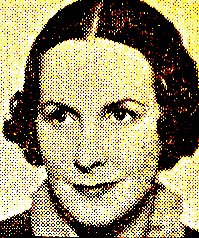
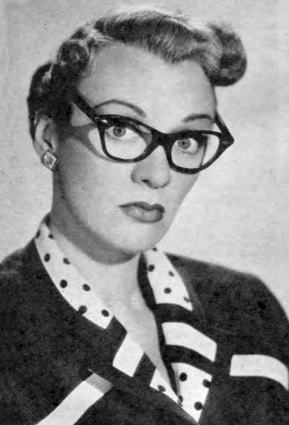
Unlike print and film, radio merely creates a desire to see. Spread long and often enough in magazines or on the screen, the image turns the disembodied speaker, the nobody, into a certified somebody. Quite clearly, the above picture has not remained in wide enough circulation over the past five decades or so to keep alive the memory of the sitter. Her name is Lurene Tuttle; and, however obscure today, she once was the First Lady of American radio drama.

How prominent was Ms. Tuttle in her day? According to the records kept at the RadioGOLDINdex, she was downright ubiquitous. An impressive 722 entries document the broadcasting career of this once highly regarded, stage-trained performer. Her resume includes roles, starring and supporting, on notable drama anthologies like Columbia Workshop, Lux Radio Theatre, and Suspense. She was a regular cast member of comedies like The Great Gildersleeve, Mayor of the Town, and Blondie, as well as episodic melodramas like Dr. Christian.

As an article in the August 1949 issue of Radio and Television Mirror sums it up, “there’s scarcely a radio program on which Lurene hasn’t been heard.” She was much sought-after by radio drama producers like William Spier for her “ability to play almost any kind of feminine role. Whenever the script call[ed] for a gun moll, a slinky confidence woman, a grandmother, an adventuress, [or] a Main Line debutante,” Tuttle could be relied upon to fit the role.

On this day, 9 February, in 1951, for instance, she was heard as Effie Perrine, Sam Spade’s trusted secretary. While generally not part of the action, she did more than just type Spade’s reports, as listeners are reminded in “The Sure Thing Caper.” Her occasional malapropisms notwithstanding, she fleshes out each story and reinvests them with the language of crooks and thugs—and probably with greater zing or realism than the censors-wary writers of the program ever dared. She also ends up in Spade’s arms and gets to caress his hair, kept so healthy and shiny by the Wildroot Cream Oil people who footed the bill for the Sam Spade series. It sure adds double meaning to Spade’s “Goodnight, Sweetheart,” the words and serenade that ended each show.

Speaking of meaningful doubles, many radio actors had to double as small casts in cost-cutting productions crowded around studio microphones; but Tuttle could make you believe that she was a double without resorting to vocal trickery or voice-altering filters. As radio historian John Dunning points out, Tuttle was once called upon to portray identical twins—with identical voices—who fight over the same man and confront each other in a deadly struggle (in “Death Sees Double,” a Whistler thriller broadcast on 20 November 1944). The evil twin had even her clueless lover fooled as she assumed her sister’s place.

And just how unwell remembered is Ms. Tuttle today, even by those who ought to know (her) better? A book by a noted radio historian, for instance, refers to the actress as one “Earline Tuttle”—further proof that, no matter how often your voice is heard and your name is pronounced on the air, you’re expected to stay in print to make a proper name for yourself. Yet, whatever the state or nature of her fame, Tuttle’s a great gal to come home to . . .

Wireless Women, Clueless Men: Mercedes McCambridge, Airwaves Advocate

Last night, I watched The Damned Don’t Cry (1950), a seedy but glamorous rags-to-riches-to-rags melodrama starring Joan Crawford. Crawford was a perfectionist on screen, even though producers like Jerry Wald determined that, by the mid-1940s, her physiognomy was less than ideal and called for that extra layer of gauze in front of the lens to soften her mature looks (because most leading roles in Hollywood are, to this date, a little too young for anyone over forty). No doubt, Crawford’s need for control contributed to what those in the radio business called mike fright.  When Crawford went on the air, starring in dramatic programs like Suspense, she insisted on being recorded for later broadcast rather than going on the air live. Apparently, to someone as protective of her persona as Crawford, any screw-up in radio insinuated something tantamount to crow’s feet on screen. Not to Crawford’s Johnny Guitar (1954) co-star and rival, though, the radio-trained and true Mercedes McCambridge.

Her career in film and on stage notwithstanding, McCambridge was a genuine radio actress; and unlike many aspiring thespians, she would not have objected to the term. Sure, her voice was so distinct that even the hearing impaired could not fail to spot her in any of her many notable radio roles; but, however obvious her vocal disguises, McCambridge, whether performing in night-time thrillers, daytime soap operas, or wartime propaganda plays, rarely did less than throwing herself, larynx and soul, into each and every part she accepted to play.

On this day, 8 February, in 1950, for instance, McCambridge was “Jack Dempsey,” the rambunctious teenage daughter of a prize-fighting crazed rancher. Determined to get married to a man of whom her father does not approve, she convinces a trio of adventurers to defend her rights in what was billed as “The Battle of the Century.” That was just one of the adventures in which McCambridge played a part in 1939—and again a decade later—in a thriller serial called I Love a Mystery. The program, and McCambridge’s role as the maniacal Charity in “The Thing That Cries in the Night,” has been discussed at some length previously in this journal.

She was also heard in many other Chicago-originating drama broadcasts, including episodes of the legendary horror program Lights Out!. My favorite among those is an episode in which McCambridge plays a spoiled teenager on a school trip to Paris. Abducted by a man who claims to know her family, she is dragged into the sewers, where she is forced to make necklaces out of the bones of those killed by her capturer. It’s Grand Guignol, all right—ghastly melodramatics that don’t require images to conjure up unimaginable horrors.

To moviegoers, McCambridge is best known as the demon voice in the The Exorcist, a performance she attributed to a fortuitous bout with childhood bronchitis. McCambridge thought of this role, in which she is never seen, as a radio performance. Until the 1970s, when radio enjoyed a renaissance, she returned to the airwaves with former colleagues, enjoying the freedom that radio afforded the performer, notwithstanding the limitations imposed by producers and sponsors.

“In radio you had to be a tiger or you didn’t last,” McCambridge wrote in her autobiography, The Quality of Mercy, “If you didn’t keep your toes curled under, you would fall of the edge of that marvelous world. For me, nothing in films, or theater, or certainly TV as ever touched the magical kaleidoscope of radio.” Most television and film producers may have been clueless about radio; but you sure got us, tiger! I consider myself mauled.

Wireless Women, Clueless Men: Gracie Allen, Presidential Candidate

Well, are you ready to tap your toes to the “The Cabinet Shuffle,” sing “The Tory Blues” or stand up for the “Thatcher Anthem”? That’s right, the Iron Lady is back in business. Show business, that is. Thatcher: The Musical is going on tour. Now, as someone who enjoys representing the past (albeit a past I have never experienced as present until its “now” turned to “then”), I don’t seem to be in a position to throw mossy stones. No, I’m not going to argue, as you well might, that the producers of this show are about two decades too late.

Dwelling in the half-forgotten and digging up the misremembered, I am not among those who opine that there is nothing older than yesterday’s news. A musical review of such faded headlines strikes me as being decidedly more quaint and questionable. The only contemporary touch appears to be the politically correct or overly cautious disclaimer attached to the announcement: the show’s producers aim at being “entertaining and provocative,” yet insist that the “politician’s lasting legacy” is being neither “glorified nor denigrated.” Too recent for revisionism, too tired for satire?

I’d much rather join a chorus of “Vote for Gracie.” Now there was a woman ahead of her time—and her man. As early as 1940, Gracie Allen decided to stop knitting sweaters and run for President instead. To the comic relief of millions of New Deal weary Americans, she ran so fast and so wild that her husband and comedy partner, straight man George Burns, could not possibly keep up with her, let alone keep her down.

“I admit that the election of the first woman would let the country in for a flood of corny jokes,” Gracie remarked (in a slim volume you may read online in its entirety). That does not have to be a deterrent, to be sure. Besides, many of those very jokes were told on the Burns and Allen Program, on which Gracie’s campaign started in February 1940.

The vaudeville routine of Burns and Allen was beginning to sound rather creaky; ratings were crumbling, sponsors grumbled. Soon the husband and wife banter would make way for a novel concept in radio comedy—the sitcom. Before their program was thus reinvented in 1942, Burns and Allen were trying to reinvigorate the old formula by heightening Gracie’s nuttiness, by adding currency and topicality to their gags, and by developing a running joke that would encourage repeat listening. The “Vote for Gracie” campaign was such an attempt to salvage their act.

“You’re, you’re running for President?” an incredulous George Burns burst out when he first learned about his wife’s political ambitions on the 28 February 1940 broadcast. “Gracie, how long has this been going on?” “For a hundred and fifty years,” Gracie retorted, “George Washington started it.” To George the whole idea was “preposterous.” “Not only that,” Gracie added, “it pays good money.”

A clever idea it turned out to be—or a quick fix for the ailing show, at any rate. Soon, Gracie was where she’d always been: all over the place. Spreading her outlandish ideas about democracy, the ditzy candidate got to promote the Burns and Allen act on a number of other high-rated radio programs, including those hosted or headlined by fellow vaudevillians Edgar Bergen, Rudy Vallee, and Jack Benny.

At least Roosevelt’s opponents, candidates like Republican Thomas F. Dewey and Democrat John Nance Garner had “political affiliations,” George cautioned. “Well,” replied Gracie undeterred, “maybe that’s because they weren’t vaccinated.” “Have you got a Republican or Democratic machine in back of you?” George cautioned. “No,” Gracie replied nonchalantly, “that’s a bustle.”

Today’s critics, listeners like Leah Lowe, label Gracie’s antics “transgressive,” which is the academy’s validation of playfulness (and of our engagement with it). “One of the greatest problems today is about the people who would rather be right than be President,” Gracie explained in her startling and disarmingly frank simplicity (as it expresses itself in the aforementioned book outlining her campaign). “I have a solution for that. You can be Left and President: that way you can eat your cake and halve it too. Or you can stay in the middle of the road and get run over.”

“Mr. Roosevelt has been President for eight years,” Gracie went on reasoning in her signature non sequitur and pun-driven unreasonableness,

I’m sure he wouldn’t mind getting up and giving his seat to a lady. That old saying about not changing horses in the middle of the stream is ridiculous, when you remember that people have been changing babies in the middle of the afternoon for years and everybody takes it for granted.

Being oracular, the oratrix declared that

women are getting very tired of running a poor second to the Forgotten Man, and with all the practice we’ve had around the house the time is ripe for a woman to sweep the country. I’ll make a prediction with my eyes open: that a woman can and will be elected if she is qualified and gets enough votes.

It sure worked for a lot of clueless men, even those who, unlike Gracie, didn’t have a “Surprise Party Platform” to stand on.

Last Poll, First Quiz

Well, I said as much yesterday: I am neither a poet nor a psychoanalyst. Such self-awareness does not deter me, however, from getting myself into some metaphorical tangle while going on about old-time radio or from trying my interpretative skills at my last and, as always, altogether unscientific poll. Now, last things first.

In my fifth poll I had invited readers to close their eyes and wander off—an invitation perhaps too readily accepted. “What image,” I had asked, “appears foremost in your mind when you read the term ‘old-time radio’?” The replies were pretty much divided between two responses, just as had I expected.

There are those more likely to picture a radio set and those who imagine a microphone. To borrow some Brechtian terminology, the former look at radio as a “distribution apparatus, as a receiver that spouts out information and entertainment to be appreciated, taken in, disdained, derided, or ignored. Those who imagine a microphone seem to conceive of radio as a site of creation, consider the processes involved in the act of broadcasting.

In McLuhan’s terms, the former seem to look at the message, whereas the latter image forth the medium as a generator of that message. To imagine radio as a microphone suggests to me a willingness to participate and create, to look beyond the contraption (the “furniture that talks”) and toward conception instead; to investigate, question, or challenge the source of what is being received. In short, to imagine the wireless and see a box of wires seems to bespeak the triumph of eye over the ear, the sort of short-sighted literal-mindedness that is the product of visual culture and that ultimately contributed to the demise of radio as a creative force.

I’m not sure what to make of the reply “Nothing at all.” It may signal an indifference or a want of imagination. Yet it also suggests quite the opposite: a thoroughly radiogenic mind—one that does not resort to translating thoughts into pictures, one that conceives of ideas as being non-material, one to whom imagination is not imaged.

Now, onto the first quiz. Over the next few weeks, I am going to pay tribute to some of the dames, gals, and ladies of the airwaves, from the Lux beauties to the “First Lady of Suspense,” from the stars of the American stage to the girls-next-door who went over big on the small screen.

Radio was a stopover for many movie, stage, and television actresses; during the 1930s and ‘40s, it was a welcome source of supplemental income. In the early 1950s, with the emergence of syndication and magnetic transcription, it became a lucrative sideline for actors who appeared in dramatic series or hosted variety programs in order to promote a specific film or remain generally heard and spoken of by potential moviegoers.

Whenever I hear the voice of an actress like Sandra Bullock or Neve Campbell or Scarlett Johansson, I am disappointed at their lack of diction. Their mumbling is not realism; it is a want of craft. Screen actresses are no longer required to hold a tune while parading in glamorous gowns, dancing with Astaire, or leaping into a technicolored pool. Instead, they are expected to have their expressiveness botoxically erased and appear before us in unchanging sameness. Radio, which carried the threat of invisibility and disembodiment, forced actresses to explore the power and pull of their voices, to distinguish themselves in speech and song.

So, if you would like to participate and take the quiz, you may also want to leave your answer in the comments section, along with the name of your favorite actress of the 1930s, ’40s, or ’50s. Whether your answer is correct or not, I will feature your performer of choice—or her voice—in a future installment of this journal. Now, pardon me while I go in search of that lovely larynx, those thespians whose vocal chords ensnared and whose timbres did wonders for the voice box office.

On This Day in 1948: Quiet Please, There’s a Computer Getting Personal!

Well, t’ain’t funny, McGee! There simply isn’t enough room in that stuffed broom closet I call my brain for all the things I care (or even don’t care) to remember. I just missed a small-screening one of my favorite melodramas, George Cukor’s A Double Life, which aired on BBC 2 this afternoon, perhaps as a belated tribute to Shelley Winters. When I taught Shakespeare, A Double Life was the first pop cultural reference I’d toss into the room to liven up discussions about Othello. Quiet Please, while I compose myself and put what’s left of my grey cells back to work.

Quiet Please! Now there’s a literate radio program you’d expect to throw in the occasional reference to Shakespeare, or Shelley, or Ruskin. I once dug up a 1949 Master’s thesis on radio drama that asserted the program was simply too highbrow to be appreciated by the average thriller audience. Now, Mrs. J. H. G. from New York, NY, wasn’t troubled by that; she thought Quiet Please was the “best” show on the air and told as much to the editors of Radio and Television Mirror (see evidence above). Perhaps she hid her identity behind that acronym because she felt ashamed of her longhair tastes—but she could rely on me to defend them.

Written and directed by Wyllis (or Willis) Cooper, Quiet Please is not your average fare of claptrap. It is somber, brainy, deliberate–with an emphasis on moods and a healthy respect not only for the English language, but for the intelligence of the American listening public. On this day, 2 February, in 1948, for instance, Cooper introduced his audience to a by now familiar theme—the possibility that mankind might be outsmarted by machines. Do computers have a life of their own—a double life, perhaps?

In Cooper’s light-hearted “Pathetic Fallacy,” a newly developed computer (or “differential integrator”) is being introduced to the world as a “mechanical, electronic brain capable of performing mathematical tasks far beyond the comprehension of the human brain.” The sceptics of the press question the use of the word “brain,” doubtful that such a machine is capable of independent thought.

The somewhat irritated scientist (played with a hint of Gale Gordon fussiness by versatile Ernest Chappell) shrugs off the remark by declaring that he was “merely indulging in the Pathetic Fallacy.” It’s a “Philosophical concept of John Ruskin,” he explains, “which derives from the imputation of human qualities or emotions to an inanimate thing. Uh, a figure of speech, let us say.”

Now what intelligent being—artificial or otherwise—could tolerate such a label? “Pathetic Fallacy,” indeed. What follows is a mild-mannered revenge comedy (it isn’t a tragedy, at least). Who knew computers could be this mischievous and possessive? Mine will be left behind this weekend, since I’m going to be away until Sunday.

On a Note of “Relevance”; or, What I Learn from Fellow Bloggers

Well, I had this particular spot reserved for two; but, as you will see, it got considerably more crowded here. Watching the Joan Crawford melodrama Possessed (1947) last night, I noticed in the opening credits that the screenplay was an adaptation written by playwrights once well known for their work in radio: Ranald McDougall and Silvia Richards.  I had come across McDougall’s name only yesterday, when his propaganda piece “The Boise” reached me by mail (between the covers of Erik Barnouw’s 1945 radio play anthology Radio Drama in Action).

McDougall’s plays for the series The Man Behind the Gun are notable for their effective use of second-person narration, an addressing of the listener as a character in the drama to follow:

You’re a chief bosun’s mate aboard the “Boise”—a gun pointer—the guy that points and fires the fifteen big guns of the cruiser.  Right now you’re standing by for action [. . .].  You’ve sighted the enemy, and your eye is jammed into the telescopic gun sight, searching for a target.  [And] now, very dimly, you see a light-gray spot on the lens . . . then another . . . and another—five of them. It’s them! You can see them plainly.

As those listening to old-time radio shows know, the technique was later used to announce each upcoming episode of Escape). McDougall’s collaborator writing the screenplay for Possessed was Silvia Richards. I assume that is the Sylvia Richards who wrote scripts for the thriller anthology Suspense. At any rate, I was going to discuss the influence of radio writing and technique on the structure of Possessed, a film noir that also makes use of radio’s voice-altering Sonovox, readers interested in which Google occasionally refers to broadcastellan.

The second topic on my mind was the narrative genre of soap opera, which occurred to me after misreading the date marking the demise of four long-running radio serials back in 1959, the anniversary of their silencing having been 2 January, not 1 February. I occasionally contribute a definition to Waking Ambrose and was interested in redefining “soap opera” for myself. It is a word that has become rather too loosely used, but might actually fit certain commercial blogs.

So, this is what I had planned to write about today; but technorati made me reconsider all that. After posting my essays here, I often go in search of other online journals discussing subjects similar to mine. Not infrequently, this leads to some follow up on my part. The other day, for instance, having written about the radio promotion for Cecil B. DeMille’s Four Frightened People, I searched for recent mentions of that title elsewhere. And what did I learn? That the film is going to be released as part of a DeMille DVD anthology. Both the Alternative Film Guide and Trouble in Paradise will tell you as much. That’s another product of popular culture recalled from obscurity. Unfortunately, my similarly obscure journal had little to do with it; but bloggers are doing their share by spreading the word and signalling interest in or demand for such films.

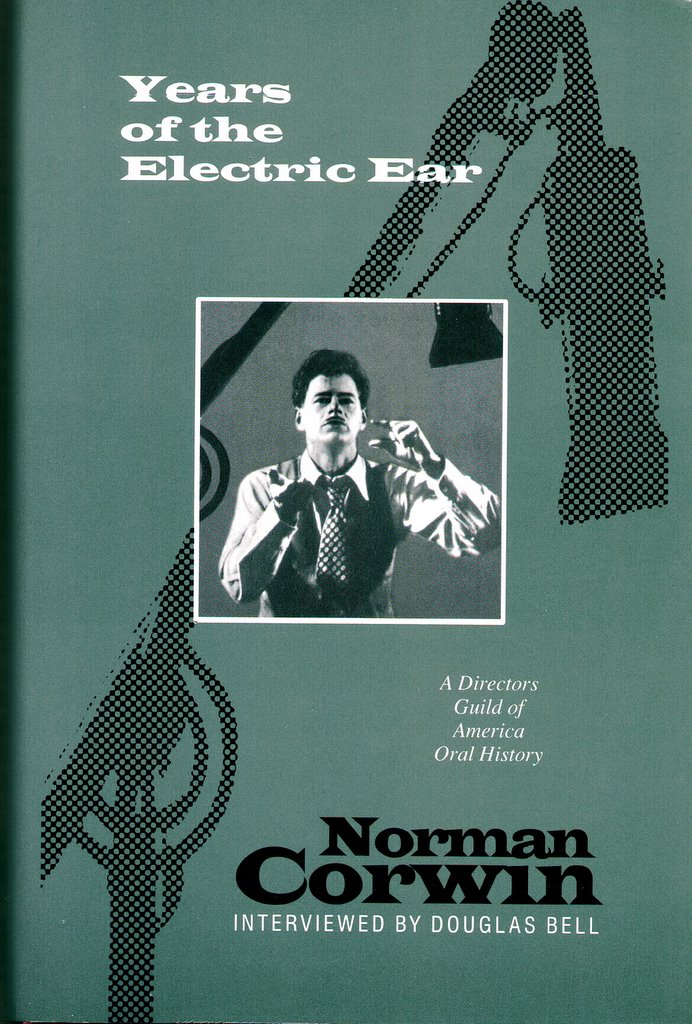
Yesterday, having just mocked the “relevance” of the Academy Awards, I came across an entry in the Popsurfing blog, shared by someone who, unlike me, took time to look at the entire list of nominees. And what is nominated in the documentary (short subject) category? A Note of Triumph: The Golden Age of Norman Corwin, a film honoring the foremost exponent of American radio dramatics. How relevant (to me, the broadcastellan blog, and readers in popular culture) can an Oscar nomination get? The next question on my mind was not a rhetorical one: how can I get my hands on a copy of this film?

By sharing all this I meant to comment on the enriching interactivity of the blogosphere, on the flow of information (correct, false, relevant or not) that can sweep past, engulf, or uplift you, if only you bother to keep surfing. “There will be time later” (to quote a line from Corwin) to retreat into that world between my ears. Right now, I’m eager to look around and partake . . .