Spotting “The Mole on Lincoln’s Cheek”; or, The Free Company We Didn’t Keep

My headphones have been buried so deeply in the sands of time that I have only recently begun to pay attention to the mission of Cindy Sheehan, to the anti-war movement she seems to have reinvigorated, and to the controversy she is stirring by insisting on talking to the US president at his ranch down in Texas. The American home front is showing signs of battle fatigue. Well, perhaps the phrase “home front,” so commonly used during World War II, is inappropriate these days, considering the lack of universal support the Iraq-centered war on terror has been receiving.

Expressions of frustration, confusion, and anger seem to become more forceful and frequent as, after years of fighting, both the end of the war and the ends of it remain uncertain. Is it illusory or perhaps even misguided to hope for a voice of reason to unite the masses, a voice not strident yet unequivocal, not irate but assertive, not jingoistic but inspirational? Radio once seemed to have given nations such a voice, but was often in danger of becoming the medium of fascism.

Unlike those who go indifferently about their business while being mute beneficiaries of democratic freedoms, few protesters would deny that American ideals are worth fighting for in words and actions; indeed, people like Sheehan, a mother who lost her son in combat, are fighting for the realization of such ideals by insisting on publicly voicing their concerns, concerns that by now are shared even by many of those responsible for the reelection of the US president in 2004.

The question on the minds of many Americans and their allies today is, of course, whether the war in Iraq has in any constructive way contribute to the defense of their freedoms or whether it might not have further endangered them either directly (through increasing acts of global terrorism) or indirectly (through anti-terrorist measures curtailing civil liberties).

It is a mistake to assume, however, that, in 1942, US citizens were any more united about going to war then they are now, or that they had a clearer understanding of the stakes and aims of such an enterprise. As I learned from Gerd Horten’s book Radio Goes to War, a government survey revealed that half of those questioned just months after the attack on Pearl Harbor were not even sure what the war was about. Many had been convinced to embrace an isolationist position. Media tycoon Randolph Hearst was one of the most influential figures to warn Americans that war was bad because it was not good for business. And radio was big business.

Back then, noted American playwrights, journalists, and novelists spoke up against isolationist—that is anti-war—propaganda, reminding citizens that inertia could mean surrender to fascism, that there are nearly as many wrong reasons for not going to war than they are for engaging in it.

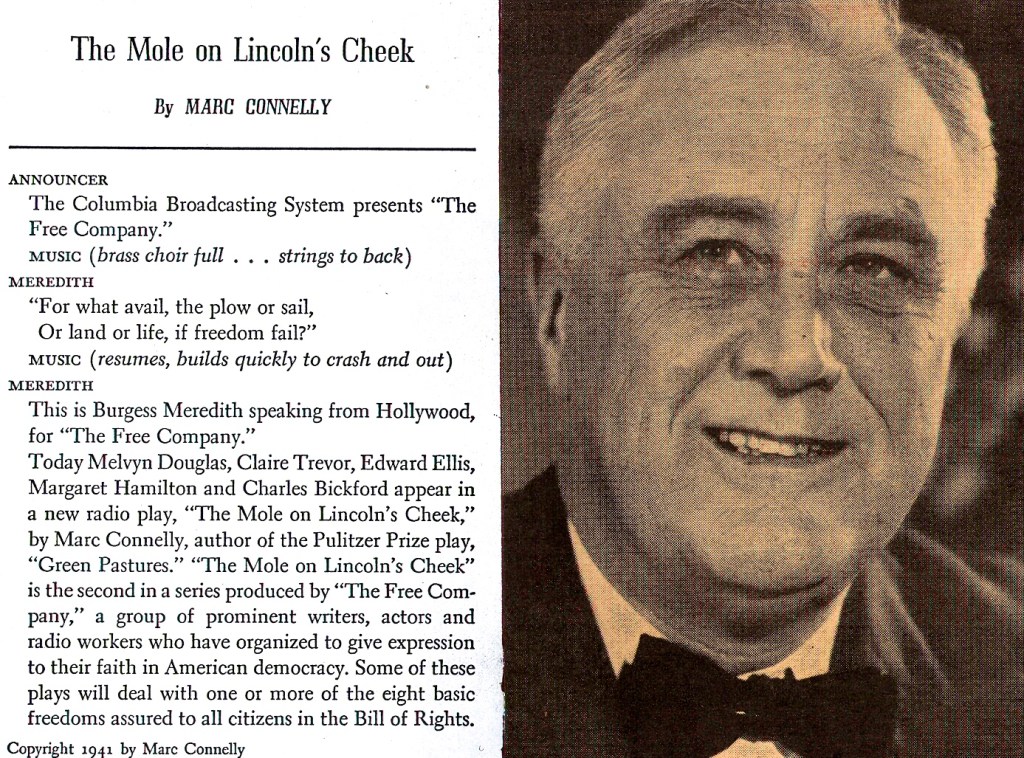
One such group of artists who set out to inspire the American public in the months prior to Pearl Harbor was the Free Company, a “group of leading writers, actors and radio workers who had “come together voluntarily to express their faith in American democracy.” They were “unpaid, unsponsored and uncontrolled. Just a group of Americans saying what they [thought] about [America] and about freedom.” And they chose a commerce-driven medium like radio to bring their point across.

As Burgess Meredith told the radio audience of Marc Connelly’s play “The Mole on Lincoln’s Cheek”: “Our freedom [ . . . ] has this meaning . . . that here, in our land, the truth may be taught, always.” He urged Americans to “resist all attempt to suppress truth or to distort it. Let us consider again,” he continued,

the most powerful words ever spoken against the enemies of man—the lightning-charged words of Lincoln at Gettysburg. And let us renew, in this threatening hour, his high resolve that the government of the people, by the people and for the people shall not perish from the earth.

Could a group like the Free Company—which consisted of Pulitzer Prize winners including Maxwell Anderson, Archibald MacLeish, Stephen Vincent Benét, Marc Connelly, and Paul Green—unite for a series of radio (or television) broadcasts today to unite a largely disillusioned people divided by confusion and cynicism, a people more eager to expose the mole on Lincoln’s cheek than to conceal it?

Would they deem a continuation of the present war unjustifiable or argue a withdrawal from Iraq to be a surrender to terrorism? And just how open would a skeptical public be to any effort to “resist all attempts to suppress truth or to distort it,” how willing to accept any attempts to achieve a consensus?

“God and Uranium”: Corwin, VJ Day, and the Disorientation of American Culture

Today, August 14, marks the 60th anniversary of VJ Day—the supposedly glorious day ending the second World War, a day of triumph in the wake of terror and devastation in Hiroshima and Nagasaki. On US radio, poet-journalist Norman Corwin commemorated the event with this hastily composed script:

Congratulations for being alive and listening. 

Millions didn’t make it. They died before their time, and they are gone and gone, for the Fascists got them. . . .  

Fire a cannon to their memory!

[Cannon.] 

God and uranium were on our side.

And the wrath of the atom fell like a commandment, 

And the very planet quivered with implications. 

Tokyo Rose was hung over from the news next day 

And the Emperor, he of the august stupid face, prayed to himself for succor. 

Sound the gun for Achilles the Atom and the war workers: Newton and Galileo, Curie and Einstein, the Archangel Gabriel, and the community of Oak Ridge, Tennessee.

Jubilantly joining the concept of God and the reality of uranium as if blessing the killing of thousands of civilians by the US and their allies, the celebratory broadcast titled “14 August”—expanded and rebroadcast five days later as “God and Uranium”—is one of Corwin’s few artistic misfires; insensitive, smug, and crudely patriotic in its derision of the “stupid”-looking emperor and his nuked subjects.

Did Americans really need to commemorate the dead by “[s]ound[ing] the gun,” by firing yet another cannon? After all, it was US weaponry, not “the Fascist,” that “got them” over in Japan. Unlike the subdued “On a Note of Triumph,” “God and Uranium” is an unquestioning sanction of total warfare, of nuclear means justifying the end—the end of a culture: “The Jap who never lost a war has lost a world: learning, / This too is worth a cheer.”

The “very planet quivered with implications,” all right, but the broadcast does not acknowledge the potentially terrible consequences of nuclear armament. These days, the implications continue to make themselves felt as more and more nations join the “community of Oak Ridge, Tennessee” and aspire to becoming atomic superpowers.

Instead, rather too sure about a peaceful future, Corwin’s salute to the victors asserts that the “peoples have come a long way since the time of Cain.” He claims that, “[e]ffective 15 August, peace, its care and handling, becomes our ward.” It appears that the US still fancies itself to be such a “ward,” imposing its views onto the world, jeopardizing the lives of thousands of civilians in a quest for a Western-centric conception of peace.

“14 August” was “written overnight, alas,” Corwin remarked somewhat apologetically shortly after the war; it was a project he did not want to accept at the time. A mere two and a half months later, on October 29, 1945, he offered far more sobering reflections of atomic power with “Set Your Clock at U235,” a broadcast that contributed to the appearance of his name in Red Channels:

Now we are in it together:

The rich with their automatic comforts, and the family bunkering seven in a room. 

The highly trained, who understand the poems and the engines; and those whose culture measures five hundred words 

across the middle: Old people tired of wars and winters, and children who do not yet know they are made of matter: 

The famous face in four colors, nationalized on the cover of the magazine; and the crowd face, the background face, gray, nameless, out of focus: 

Now we are in it, in it together.

The secrets of the earth have been peeled, one by one, until the core is bare:

The latest recipe is private, in a guarded book, but the stink of death is public on the wind from Nagasaki: 

The nations have heard of the fission of the atom and have seen the photographs: skies aboil with interlocking fury, mushrooms of uranium smoke ascending to where angels patrol uneasily.

As if coming to his senses after having toasted victory rather too shrilly, Corwin encouraged listeners to “reset the clock.” No longer was 15 August proposed as a ringing in of peace, but as the beginning of a new age of terror. As such it now behooves us to consider the legacy of VJ Day—the ticking of the atomic clock, the spiral of retaliatory actions, and the fallacy that a war well waged could end all wars. 

After all, we are still “in it together. . . .”

The Caterpillar and the Butterfly: Fantasy Metamorphosed, from Corwin’s “Curley” to Burton’s “Charlie”

When I dipped my toe into the cool Irish Sea yesterday afternoon, I thought to myself “How detached I am from the enveloping present, how remote from the surrounding world.” Sure, I dip into the currents of culture now and again, but little of what is current seems to have any grip on me. I just shake my mind like that wet toe and retreat. Not that the beach was any more comforting for being terra firma. I was chilled by a feeling of rootlessness, intensified, no doubt, by my relatively recent transplantation to the west of Britain. And yet, here I am, nowhere and anywhere, tending to my journal. Well, according to Technorati, there is one born every second.

Not permitting myself to become wistful, I slipped into the darkness of a movie theater to take on the latter-day mongrel that is Charlie and the Chocolate Factory.  What a reassuring experience it turned out to be. Once again, I know where I am—and why I am there and loving it. The “there,” of course, is nothing but the sanctuary of my confirmed biases.

Tim Burton’s re-adaptation of Roald Dahl’s 1964 story is a mongrel indeed. It is a cautionary tale for children playing itself out as a computer game. Curb your greed, your arrogance, and your precociousness, it tells children, or you will suffer the fate of obnoxious brats like Augustus, Violet, Veruca and Mike. Obey your elders, even a deranged manchild like Willy Wonka, and your humility will be amply rewarded. The eponymous kid is too much of a goody-two-shoes to make a compelling hero (and, given the lesson learned by Wonka himself, retaining the title of the 1971 adaptation would have made more sense).

The trouble with Charlie is not its muddled message about innocence and purity, however; it is that, in its now treacly, now quirky delivery, in its very conception, there is too much of Augustus Gloop and Mike Teavee to render it sincere.  Charlie is a self-conscious if diverting botch. It is eye candy with a cavity built in; it is at once a celebration and a negation of fantasy. Does not Dahl’s description of Augustus Gloop sound like a critique of Hollywood blockbusters, of the spirit of Disneyfication? Listen:

How long could we allow this beast

To gorge and guzzle, feed and feast

On everything he wanted to?

Great Scott! It simply wouldn’t do!

However long this pig might live,

We’re positive he’d never give

Even the smallest bit of fun

Or happiness to anyone.

So what we do in cases such

As this, we use the gentle touch,

And carefully we take the brat

And turn him into something that

Will give great pleasure to us all . . .

It is telling that Burton’s movie very nearly drowns out these words in its lavish production numbers. In time it will metamorphose into DVDs and computer games, into the videodorous playthings of Mike Teavee. Conveying the warning about being a guy like Burton’s movie once again drowns the message by dreamcoating it in Technicolor:

The most important thing we’ve learned,


So far as children are concerned,


Is never, NEVER, NEVER let


Them near your television set—


Or better still, just don’t install


The idiotic thing at all.

In almost every house we’ve been,


We’ve watched them gaping at the screen.


They loll and slop and lounge about,


And stare until their eyes pop out.


(Last week in someone’s place we saw


A dozen eyeballs on the floor.)


They sit and stare and stare and sit


Until they’re hypnotised by it,


Until they’re absolutely drunk


With all the shocking ghastly junk. . . .


IT ROTS THE SENSES IN THE HEAD!


IT KILLS IMAGINATION DEAD!


IT CLOGS AND CLUTTERS UP THE MIND!


IT MAKES A CHILD SO DULL AND BLIND


HE CAN NO LONGER UNDERSTAND


A FANTASY, A FAIRYLAND!


HIS BRAIN BECOMES AS SOFT AS CHEESE!


HIS POWERS OF THINKING RUST AND FREEZE!


HE CANNOT THINK–HE ONLY SEES!

And what else, other than reading, “used the darling ones to do?” in the days “[b]efore this monster was invented?” Well (you may have guessed it, coming from me), they listened to the radio, that forgotten generator and amplifier of fantasy. Long before colorful butterflies like Charlie and the Chocolate Factory dazzled kids with a flutter of images, there was “My Client Curley,” Norman Corwin’s madcap adventures of a boy, Stinky, and his dancing caterpillar.

Stinky has to learn what Charlie seems to know and Burton doesn’t quite remember: money talks so loudly at times, it threatens to mute happiness and muffle the imagination. Unlike Burton, who clutters his film with pointless references to popular culture (Busby Berkeley, Psycho, the Beatles), Corwin offers a poignant mass media satire, of a world of commerce, sensationalism, and mediocracy.

Throughout it all, the dancing caterpillar comes vividly alive without uttering nary a syllable. There he is, in all his terpsichorean splendor. I’m there, too, knowing why I love old-time radio. Not because it is past, but precisely because it is present whenever I put my mind to it. So, to appropriate Dahl’s words for a plea for the theater of the mind, “please, oh please, we beg, we pray, / Go throw your TV set away, / And in its place you can install /A lovely [radio] on the wall.” Well, okay, keep the TV—but do give Corwin’s “My Client Curley” a try.

In Bed With Orson; or, How I Got the Wandering Ear

Elsa Maxwell, Claudette Colbert and Orson Welles

What I didn’t get to tell in Etherized Victorians, my doctoral dissertation, is how I love to cuddle up with a good voice. Aside from being rather too intimate an aspect of my passion for old-time radio to be shared in an academic paper, the sensuality and sway of the human voice, regardless of the words it conveys—seemed to be decidedly beyond the boundaries of my vocabulary.

I am hardly one to shy away from lexical experimentation; but I felt that I could not approach the subject—the mystique—of the vocal with the clarity and precision I aim for in all my linguistic playfulness. How, for example, could I describe the lush, seductive performances of Ann Sothern (as Maisie) and Natalie Masters (as Candy Matson), the sinister melancholy and paroxysmal fury of Peter Lorre (on Mystery in the Air, for instance), or the tender, tattered quavering of Gertrude Berg (matriarch of The Goldbergs) as I listen to them burble, groan, hiss and whimper, as I hear them snarling at or whispering to me?

How could I intellectualize the suave and mannered cadences of Vincent Price as the Saint or the hammy bluster of Orson Welles as Harry Lime? Some passions are not to be explained, to be argued out of existence. They are to be reveled in, secretly, in the shelter of darkness.

There are many such pleasures to be had listening to recordings of US radio broadcasts of the 1930s, ‘40s and ‘50s, a period during which voices were trained for and attuned to the special demands of the microphone. For me, they can be found and felt when encountering a friendly and well-groomed speaking voice of an announcer like Harry Bartell; a distinguished, eloquent recital like Ronald Colman’s (as in his D-Day reading of Edna St. Vincent Millay’s “Poem and Prayer for an Invading Army”); a tough, noirish delivery like Joseph Cotton’s (on Suspense); an unsentimental everymanliness like Joe Julian’s (on Corwin’s An American in England); a glamorous, sultry purring like Marlene Dietrich’s (as the peripatetic adventuress of Time for Love), Ilona Massey’s (as a spy-catching baroness in Top Secret) or Tallulah Bankhead’s (in her memorable role as hostess of the Big Show); a warm, avuncular drone like Nigel Bruce’s (as Sherlock Holmes sidekick and narrator Doctor Watson), a smart and charming lilt like Claudette Colbert’s (frequently heard on the Lux Radio Theater; above, in bed with Welles and etiquette maven Elsa Maxwell) or a queer pomposity like Monty Woolley’s (in his role as the Magnificent Montague).

Quite often, these voices had to convey lines better left unspoken, words unworthy of the actor’s talent. Yet through the magic of timbre and intonation, gifted performers could imbue almost any line with feeling, subtlety, or sly innuendo. And I’m not even talking about the suggestive reading Mae West lent to her characterization of Eve that got her banned from the airwaves. Last night I went to bed with Dane Clark. I didn’t quite get through his performance of John Andrews in a NBC University Theater production of John Dos Passos’s “Three Soldiers,” but his voice still lingers in my mind’s ear this morning.

Ever since I got my first radio, as a child, I have gone in search of voices, soothing, thrilling, enticing. I was eavesdropping on a hidden realm the passage to which was the canal of an eager ear pressed close against the speaker. It was my keyhole to the world about which I knew yet little, a world to which I did not yet belong. It was a levitating grown-up table, an off-limits chamber made of air and furnished by my imagination. Today, these disembodied voices come to me mainly by invitation. Whom, I wonder, am I going to take upstairs with me tonight?

Anodyne Thrills, Abject Thraldom: Broadcasting “fear itself”

“The only thing we have to fear is fear itself,” US president Franklin Delano Roosevelt insisted in his 1933 inaugural speech. These days, as bombs are going off again in London (and, for that matter, in many other places east and west) and as people are being victimized both by terrorism and the measures taken to control it, this famous aphorism seems particularly poignant. What is to be feared, certainly, is the abject thraldom of fear, the suspicion it breeds, and the potential it has to quell the spirit of humanity, to diminish our ability to act within reason and with understanding. As is the case with all epigrams, however, FDR’s becomes shorter on wisdom the longer it is pondered.

What might this be, “fear itself”? Is fear not always a reaction, whether reasonable or not? As a response to stimuli or surroundings, it is neither to be feared in “itself” nor as part of our being. The avoidance of conditions potentially harmful to us is an instinct it would hardly behoove us to conquer in our efforts to become more civilized, less primal. I lived in New York City when the World Trade Center towers crumbled in a cloud of asbestos-filled dust. What impressed me most during the immediate aftermath was that those living in fear and trembling were reminded of their mortality, encouraged to examine their everyday lives in order to find ways of making themselves useful to others. Even heroes were publicly shedding tears.

While often admired, warriors who prefer fight over flight are often less civilized than the worriers who respond to threats by trying to avoid them or void them with circumspection. In any case, fear is hardly the “only thing” to be dreaded, no matter how dire the situation. Recklessness and heedless indifference of dangerous consequences beget more horrors than caution, awe, or diffidence. What is to be feared most, perhaps, is fearmongering—the deliberate provocation of fear, the manufacturing of fear for profit or political gain. The media are open, the masses vulnerable to such designs. Yet when the fears are real and not sensed keenly enough, imagined terror may assist in making true horrors apparent.

The 7 December 1941 broadcast of Inner Sanctum Mysteries‘s “Island of Death” suggests just slow the radio industry was to react to the terror that had finally hit home. The show, however inappropriate, had to go on, for the sake of the sponsors. The titular island is not, of course, Hawaii; but it is doubtful that either this “strange and terrible tale” of black magic or the sponsor’s product, “Carter’s Little Liver Pills” (the “best friend to your sunny disposition”) could do much to get people’s minds off the topic of the day or alleviate the anxieties the news—or lack thereof—must have produced.

The government could not afford radio drama to remain escapist. Within a few weeks after the attack on Pearl Harbor, fear became a weapon aimed at mobilizing the homefront. In Arch Oboler’s “Chicago, Germany,” for instance, listeners were confronted with the dystopia of an America annexed and governed by the Nazis. With nightmarish fantasies like these, the Treasury hoped to raise millions for defense.

It is too simplistic to argue that audiences then were more gullible or less sophisticated than today’s consumers of popular culture. Certainly, the 1940s, when millions of civilians perished or faced irreparable losses as the result of global warfare, were not “innocent” times, as those pining for nostalgia might opine. They were times of uncertainty like any “now” any time, times of suffering, hardship, and frustration—times during which those tired of threats or numbed by pain needed to be reminded that a present free from fear might bring about a future without freedom, that to stop fearing might well mean to stop living.

The weekly blood-and-thunder anthologies were deemed particularly suitable to the awakening of real terror through imaginary thrills. Underlying the tension of such melodramas, wrapped up neatly within less than 30 minutes, were the anxieties of war, which were often driven home with a final curtain call appeal. Even shortly before the end of the war in Europe, when those listening to the tales of The Mysterious Traveler were invited to rejoice as ”Death Comes for Adolf Hitler” (24 March 1945), a mere month prematurely, they were cautioned that the dangers of Nazism were still very much alive. So, rather than being purely escapist, the terror of the airwaves provided anodyne thrills to impede abject thraldom.

Today, the uses of fear are well understood by the terrorists, that new breed of indiscriminals holding the world hostage; but the weapon that once was the thriller is too rarely being honed to prepare us for them.

“War of the Worlds”: A Report from the Sensorial Battlefield

We know that in the early years of the twentieth century this world was being watched closely by intelligences greater than man’s and yet as mortal as his own.  We know now that as human beings busied themselves about their various concerns they were scrutinized and studied, perhaps almost as narrowly as a man with a microscope might scrutinize the transient creatures that swarm and multiply in a drop of water.  With infinite complacence people went to and fro over the earth about there little affairs, serene in the assurance of their dominion over this small spinning fragment of solar driftwood which by chance or design man has inherited out of the dark mystery of Time and Space.  Yet across an immense ethereal gulf, minds that are to our minds as ours to the beasts in the jungle, intellects vast, cool and unsympathetic, regarded this earth with envious eyes and slowly and surely drew their plans against us.  In the thirty-eighth year of the twentieth century came the great disillusionment. . . .

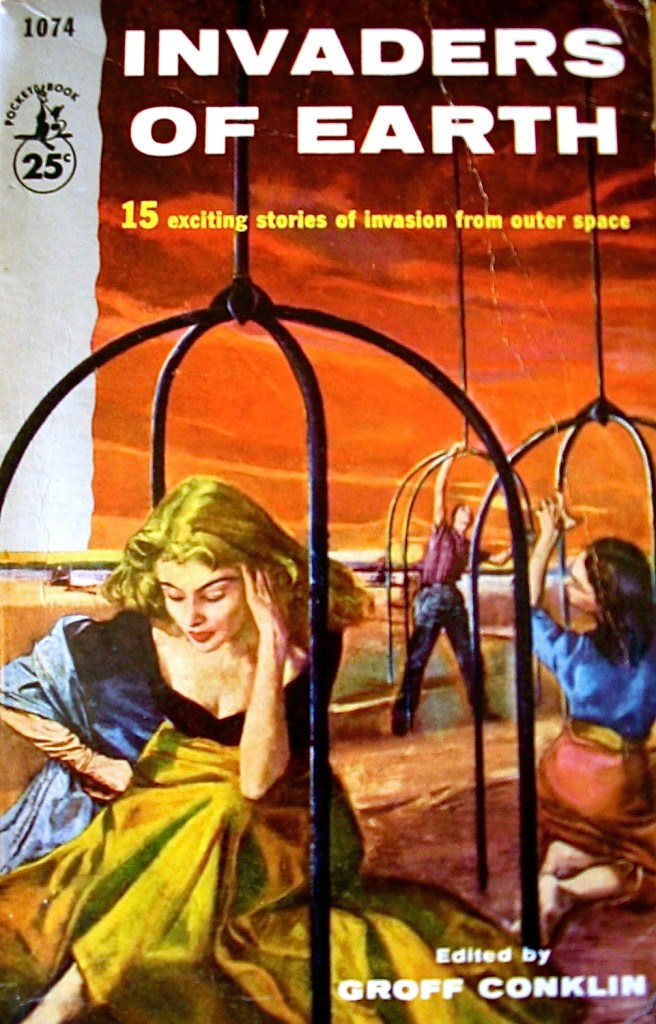
This 1950s paperback from my collection includes the script of the 1938 “War of the Worlds” broadcast.

With these ominous lines, read by Renaissance ham Orson Welles, opened what is now the best-remembered and most widely discussed of all US radio plays—Howard Koch’s adaptation of H. G. Wells’s “War of the Worlds” (30 October 1938).  Apart from this introduction, a slightly tweaked passage of Wells’s original narrative, the infamous Mercury Theater production took great liberties with its source.  It was an infidelity that proved most felicitous; for rarely has any story been transferred from one medium to another with greater ingenuity and with such sensational results.

Steven Spielberg’s cinematic update, which I experienced yesterday, pays homage to both Wells and Welles by quoting these words, by delivering them in a sonorous, Wellesian voice (Morgan Freeman’s), and by employing them as a literary bookend for an episodic melodrama that unfold as a series of more or less stupendous set pieces.  Freeman’s voice-over narration notwithstanding, Spielberg’s conventional sci-fi thriller—some kind of intergalactic Jurassic Park—has none of the qualities that made the radio play such an engaging and provocative experiment in adaptation.

Like all filmic reworkings, Spielberg’s spectacle struggles with and falters under the pressure of making terror visible, of equating the evocative with manifest dread.  The opening montage sums up the war to be fought by zooming in on the sources of threat and salvation, cosmos and microcosm.  Neither infinite outer space nor infinitesimal innerspace remains hidden from view.

The camera soon assumes the role of the terrorizing invader alluded to in Wells’s introductory remarks, as the menaced protagonists are being “watched closely,” “scrutinized and studied, perhaps almost as narrowly as a man with a microscope might scrutinize the transient creatures that swarm and multiply in a drop of water.”  As in our daily lives, captured by infiltrating webcams and ubiquitous close-circuit security equipment, vigilance and violence coincide; the act of surveillance has become the art of assailants.  And still, the demand for ocular proof has to be satisfied at all costs.

Throughout the movie, the hero’s daughter is cautioned not to look as camera and special effects expose the audience to the horrors of alien warfare and the consequences of human frailty.  In one scene, she is being blindfolded by her father in an attempt to shelter her from the murder he feels compelled to commit.  For one brief moment, the audience is spared a graphic scene.  As the crime is being perpetrated behind closed doors, a close-up of the girl’s face reveals that her mind’s eye creates an image no less terrifying than the atrocities she had witnessed before.  The father, like most western adults, has become too dependent on visuals to recall the power of suggestion and the thrills produced by the insinuating ear.  The movie thus manages to disclose his failings—and our sensorial loss—but cannot combat the empire of the eye to which it is beholden.

However futile, the radio artists of the 1930s and ‘40s were among the last dramatists to wage war against the dominion of the visual world.  Howard Koch’s adaptation proved to be one of the last victorious battles, dealing such a blow as to put censors on guard against the forgotten force of non-visual stimulation.  Then, “in the thirty-eighth year of the twentieth century came the great disillusionment. . . .”

Related writings

“Thousands Panic When Nelson Eddy Begins to Sing”
“‘War of the Worlds’: The Election Edition”