Soaps to Dial For: My Nights with That Noble Woman

I’ve been having sleepless nights recently, what with this cold and all the rest I am getting throughout the day. It is a testament to my restraint that you still don’t know the half of it. Since I’m not one to crochet or get crotchety, I generally substitute sound sleep for a generous if gentle dose of sound. There’s nothing like canned melodrama to fill the dark hours with images just mute enough not to clash with your pajamas. No thrillers like Inner Sanctum or Suspense, if you please. Too jarring by far! No Fred Allen or Vic and Sade to induce chuckles when it’s snores I’m after. No plays I’d be itching to follow, no tunes I’d be eager to hum. So, I kept my ears peeled for some pop-cultural flotsam that could send me adrift, and presto. The other sleepless night, I finally turned to the kind of fare I rarely try, particularly not when I am in fine fettle. My fettle being decidedly not fit to be in, I contrived to make a late night date with Mary Noble, Backstage Wife.

Backstage Wife belongs to that genre known as “soap opera,” defined by James Thurber as a

kind of sandwich, whose recipe is simple enough, although it took years to compound. Between thick slices of advertising, spread twelve minutes of dialogue, add predicament, villainy, and female suffering in equal measure, throw in a dash of nobility, sprinkle with tears, season with organ music, cover with a rich announcer sauce, and serve five times a week.

If you serve that platter past midnight, rather than at lunchtime, the sandwich appears to become more spicy than soggy. After all, what Thurber left out of that list of ingredients is the listener’s imagination, which tends to get saucier once you hit the sheets.

Fodder for radio satirists Bob and Ray’s “Mary Backstage, Noble Wife,” the “story of Mary Noble and what it means to be the wife of a famous star” was on the air for a quarter of a century. A small but sizeable helping of that run is readily available online, namely a storyline involving the scheming Claudia Vincent, a woman who fires shots at man to gain the confidence of another. That the other man is Mary Noble’s husband, Larry, makes Claudia Vincent’s obvious maneuverings all the more delicious.

Not that my taste buds can be trusted in times likes these, but the last thing I wanted was my mouth to start watering. Now my nights are spent wondering about Mary, Larry, Claudia and Rupert, knowing that I shall never hear the end of it, for want of extant chapters. Of course, serial dramas are not about endings. They, like all melodramas, are about the protracted middle, the main courses and the side dishes, about the precariousness of the status quo and all our attempts to stay as we are or get what is presumably owed us. For all its sensational scenes and rhetorical bombast, melodrama is truest to life, far more real, to be sure, than tragedy and comedy. In those aged and unadulterated models of drama, all endings are final; in melodrama, there is plenty of room for doubt, for turns and returns, for the “what ifs” that, I should have known, are keeping me asking for seconds and up for hours.

The current season of Desperate Housewives being so listless you cannot even claim it to have mustered energy enough to jump the shark, I am only too grateful for a bit of cheddar and ham as only those horrid Hummerts could slice it. Now pardon me while I dim the lights. It’s time for my sandwich.

Mikes in the Sticks: A Visit with Radio’s Real Folks

“You will want to know what are my qualifications,” Ring Lardner introduced himself to the readers of his new radio column in the New Yorker back in June 1932. “Well,” the renowned humorist-turned-broadcast critic remarked, “for the last two months I have been a faithful listen-inner, leaving the thing run day and night [ . . .].” Lardner was hospitalized at the time, but he sure knew how to make the most of his misfortune by twisting the dial long enough to squeeze a few bucks out of it, and that at a time when, like today, there were hardly any competitors on the scene but, unlike today, there were millions eager to listen to and read about the radio, its programs and personalities.
Believe me, there is nothing like a sickbed to turn you on to radio and into an avid listener, especially when all you want to do is close your eyes and have stories told to you. No other qualifications are needed to become a critic of the medium. No wirelessons required, if I may be Walter Winchell about it.

Sometimes, though, listening does not seem to be an option. Hundreds of the programs available to Lardner back then are no longer extant; earlier programs are still more difficult to uncover. This is particularly frustrating when you have heard of a show without ever getting a chance to hear it. One such forgotten program is Real Folks, the first dramatic series to air on NBC’s Blue network. It premiered on 6 August 1928 and ran for the relatively short period of three years.

Years ago, I came across a brief description of the series in Radio Writing (1931), a contemporary book on broadcast drama penned by radio dramatist Peter Dixon, who recommended Real Folks for being “excellent characterization and an example of the attractiveness of simple, homely humor.” As a radio critic, you do not want to take anyone’s word for the “it” of listening. Was I ever going to hear for myself?

Recovering from a seemingly interminable cold, I am fortunate in having much time to go in search of lost voices. You might say that I excite easily, but today I was thrilled to meet those Real Folks for the first time. On this day, 17 November, in 1940, writer George Frame Brown was joined by members of the original cast to bring back the series for a special broadcast. By then, the pioneering drama had been off the air for nearly a decade.

After a short and not altogether factual introduction by announcer Graham McNamee, the Real Folks sketch heard on Behind the Mike opens with a train whistle, a sound that, like no other, is capable of transporting you swiftly into town and country—and to any Whistle Stop along the tracks. Thompkins Corner was one of those places. Its mayor was Matt Thompkins, who was also the owner of the town’s general store. He was played by the man who knew him best: George Frame Brown.

Apart from its writer, the cast of Real Folks included Irene Hubbard, Ed Whitney, and Elsie Mae Gordon (pictured), all of whom were reunited for the Behind the Mike broadcast which, in its sentiment and politics, returned 1940s listeners straight back to the Depression, with a story involving lost jewelry, a stolen banana, and a destitute yokel. The sketch concludes with the sounds of the whip-poor-will and the Capraesque words of the Mayor who, having faced and avoided the end of his career, pensively remarks:

I guess there’s a lot of folks way up in politics tonight that wishes they was back living beside the country road listening to a whip-poor-will.

Perhaps, that rarely seen yet distinctive sounding bird was a metaphor for the radio, the preferred medium of the not-so-way up who enjoyed to find themselves represented by “home folks” like Vic and Sade, Lum and Abner of Pine Ridge, and Real Folks like those in Thompkins Corner; and it was voice talents like Elsie Mae Gordon who made it all sound authentic.

During the original run of Real Folks, Theatre Magazine‘s Howard Rockey pointed out Elsie Mae Gordon as a “veteran trouper” who came to radio “from the concert and vaudeville stages.” A sought-after player in those early days of radio drama, Gordon took on as many as

six to eight separate roles in the course of a single broadcast. To each of these “doubles” she imparts a distinct individuality, so natural that it is difficult to believe oneself listening to a “one-girl show.” In some sketches her lines are from her own pen, so that the complete interpretation is of her own devising. Miss Gordon’s differing voices are familiar to all who tune in on Real Folks, the Kukus, Detective Story thrillers and other weekly features.

Some of that versatility is also apparent in the Behind the Mike broadcast, the gender-bent casting being disclosed at the conclusion of the sketch. At the time of her reunion with her Real Folks co-stars, Gordon was still active in radio, notably in the distinguished anthology Columbia Workshop.

Her portrayal as Matt Thompkins’s wife, however, would have fallen out of earshot had it not been for the producers of Behind the Mike, who, as early as 1940, promoted the medium by featuring voices we would otherwise only read about. Indeed, Behind the Mike brought back Gordon a few weeks later to talk about her role as a voice coach.

Without voices like Gordon’s, and without all the real folks who make them heard on the web, I would have very little to go on about in this journal … except, perhaps, that my own voice has all but vanished as a result of the cold that has me listening, somewhat enviously, to the speech sounds of a bygone era.

Nostalgia and the Common Cold

If you were to ask me right now “what’s shaking,” I’d have to say “my laptop.” The lap in which it sits is an uneasy resting place right now. I am being seized by violent coughing fits, the kind that sets off such explosions in your skull, it shatters your equilibrium. Ever since that Halloween party—the first and probably last I condescended to attend—I have been suffering from the kind of cold that may be known as “common,” but that, to our relief, remains a disruptive exception to our everyday. Apart from all the pretty much useless over-the-counter medication I swallow, inhale or wrap my tongue around, I resort to any number of treats I know to be soothing in times like these. A return to Allen’s Alley, a helping of Chanograms, any combination of folds in the weathered phizog of Margaret Rutherford—whatever it takes.

I tend to return to established remedies, the kind of stuff I know to comfort and cheer me. In a way, I am warding off two sicknesses, all the while being in danger of contracting one. For whenever I am as miserable as I am these far from good old days, I am in danger of getting nostalgic.

Despite my appreciation of and frequent exposure to films, books and radio programs predating the 1960s, I am wary of this feeling. More than a sensation, nostalgia is a disease—a dis-ease—I am anxious not to catch; nor do I believe that am I generally prone to it. In a review of a friend’s book of short stories I once referred to nostalgia as the “fruitful reverie of a past whose text is a history of longing.” Now, even I don’t quite know what that means anymore, however smart it sounded at the time. The rotten apple in it is “fruitful”; although, in defense of the prose I have never managed to outgrow, I hasten to add that the sentence began with “If,” signalling that I merely offer for debate rather than wholeheartedly endorse the sentiment expressed. I vowed, years ago, never to write anything in which I do not believe. It is a proven prophylactic against much, though hardly all, pointless drivel.

True, nostalgia can and does bear fruit; but unless that fruit is intoxicatingly fermented it might be downright unfit to eat. It sure can give you an ache. Indeed, it is an ache. Literally, it is the ache to go home or the ache produced by the awareness of not being able to get there. It is a longing to belong, to return not simply to a place we once knew and loved, but to reach or build such a place from whatever scraps in the book of memory we can assemble with the paste that prevents us all from becoming unglued.

However rewarding such an imaginary retreat, it is a sense of the futility that makes the journey painful—the very moment along the way in which “what if” and “if only” turn to a bitter “as if!” An iffy a performance, in short. After all, how can you expect to find an effective home remedy for homesickness?

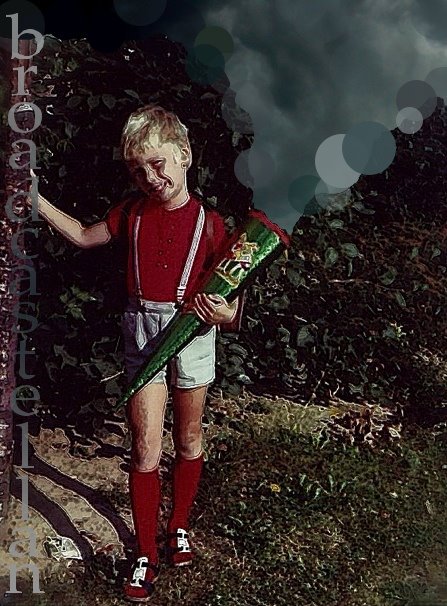
I wonder whether I tend to get childlike when ill because I (pictured above, with the horn of plenty that German children are handed upon entering school) was more ill than well as a child. As if anxious to stand out in a crowd of sick kids, I went out of my way to get scarlet fever twice. Not that “childlike” is used here to connote “innocent” or “carefree.” In my early days, I was subject to many more fears, doubts and ailments than the adult into which I somehow evolved—which is why I keep relying on those tried remedies, knowing them to have worked once and finding them working still.

Could it be that I love the movies, books, and radio plays of the past—a past predating mine by far—because I am stricken with the present, rather than just being presently sick? Good gosh, this might be a worse case of nostalgia than I thought.

“Von Ribbentrop’s Watch”: Thoughts on Kristallnacht

Perhaps I should call her. We have not talked in over a year. Could I have telephoned tonight, though? Not simply to exchange a few kind words, mind. From her, I would like to learn about the past that shaped our world; and who would not seize the opportunity to grasp that past firsthand? That said, I have never quizzed my German grandmother about life in the Third Reich, never attempted anything amounting to probing inquiry. I am more distressed by my failure to ask than by any responses I might get. Not that any number of answers could make me stop wondering.

Another watch, another (lost) wartime story

Tonight marks the 70th anniversary of Kristallnacht, and I am more keenly aware than usual that the past is not done with, that many of those who threw stones into shop windows or looked on as Jews were hauled off to the concentration camps are still among us. Their ideologies, their hypocrisies, and their indifference are alive as well.

My grandparents were not among those who resisted the Reich and its reign of terror. “Of course, we knew they were being shipped to the camps,” my paternal grandmother once told me. Frank about knowing, she was open rather than open-minded. Third Reich propaganda remained at work throughout her life, even some forty, fifty years after the defeat of the Nazi regime. Once she heard I was schwul (German for gay), she ceased to acknowledge me; not as much as a reply to my Christmas cards. My maternal grandmother, now in her nineties, continued to correspond, though, sending greetings and wishes to me and mine. Is she more open? Or is she, like so many of us, merely permitting her personal feelings for her own kind to gainsay thoughts that would otherwise dominate her mind?

My maternal grandmother worked for one of the leading Nazi families and remained loyal to them decades after the war, introducing me to the heirs when I was a child. My memories are vague. I remember being told about the guilt that made outcasts of the obviously well-to-do family for which grandmother worked as a seamstress. There was a boy, roughly my age, with whom I played while grandmother worked. As much as I would like to fill in the blanks, I cannot bring myself to ask about the past, about grandmother’s connection to the Von Ribbentrops.

On this Remembrance Sunday, as Britain commemorates the 90th anniversary of the 1918 armistice and those killed in war, I drift in and out of consciousness, sick with the commonest of colds. Swirling in the thick of my head are thoughts that just the right word cannot put into any conclusive or satisfying order. I continue to question myself rather than demanding answers from those who might help me to resolve matters.

Instead of proving that actions speak louder than words, Kristallnacht demonstrated that actions are louder than the silence of unvoiced dissent. A stone, in this respect, is like a resounding “no” to the potentialities of change latent in the troubled mind. Words can set nothing aright if they merely create the illusion of control, if they obscure the chaos within us rather than dispel it. I let my words bespeak confusion rather than answer conclusively, thus falsely. I let them run riot rather than underwrite what amounts to the hollow triumph of paper solutions.

A quandary is at the heart of “Von Ribbentrop’s Watch,” a radio play by Laurence Marks and Maurice Gran, which premiered 8 November 2008 on BBC Radio 4. It is the story of a Jewish shop owner in contemporary Britain who learns that the less-than-reliable watch he inherited from his father once belonged to Nazi Germany’s Foreign Minister Joachim Von Ribbentrop. What to do? Keep the watch and ignore the Swastikas to which a watchmaker alerted him? Sell it to collectors of Nazi memorabilia in order to keep alive his own struggling business? Would that be retribution or profiteering?

The fascinating premise is undermined by the language in which the conflict is couched. It seems that the playwrights are rather too enamored of their at times desperate wordplay, too eager to elicit awkward chuckles from assorted squabbles at a Passover table when restraint might have served them better. Perhaps, the broadcast date for this dreadful piece of imitation Goldbergs was as unfortunate a choice as the playwrights’ mockery—a Jewish defense of Nazi crimes, the sounds of broken glass after a family quarrel, followed by an otherworldly visit from Von Ribbentrop—as it gave me reason to believe that “Von Ribbentrop’s Watch” was meant to coincide with and somehow commemorate the horrors of Kristallnacht. Armistice Day, by comparison, is given a solemn treatment on BBC Radio 3, with an adaptation of All Quiet on the Western Front.

At least, the titular chronometer of “Von Ribbentrop’s Watch” seems to suggest that even belated justice is preferable to terminal ignorance; time catches up with timepiece in question, however exasperating and offensive the ninety minutes that it takes us to hear about it. Not that the conclusion is rewarding: in its tacky irony, the play insists that the Jews end up confessing their guilt by association.

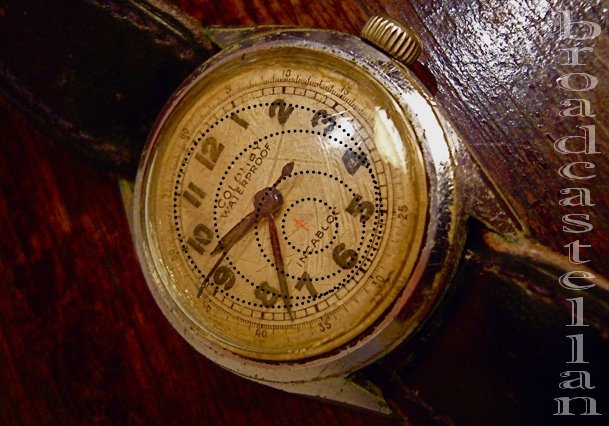
In response to this appalling piece of misjudged comedy, which is supposedly based on a true story, I retrieved the watch shown above. Like so many stories of so many objects around me, the story of this watch cannot be recovered, the one who could have helped to pieced it together having died many years ago. It was given to my partner, whose father brought it back from the Second World War. My camera failed to capture it, but the face bears the Cross of Lorraine, the symbol of the Resistance.

What we need to resist, always, is the convenient answer, the conclusive remark, the word to extinguish the doubt that is the life of thought, the hope for change; and the doubt we should all permit ourselves to voice on this day is whether the past is truly over or whether we are still victims of the same prejudices, susceptible to the same talk, capable of the same actions. Those are the questions we cannot expect anyone to answer on our behalf.

Feeling Strangely Animated

I had never been to a Halloween party; and the days of dressing up in more or less fancy costumes lay well behind me. It was with some reluctance and considerable misgivings that I accepted the invitation. Back where and when I grew up, there was no such blood red letter day as Halloween. Your parents might take you to the cemetery to see the candles lit for All Hallows’; but you could not expect to have a ghoulish old time. Such levity was unheard of even among those not attending church services (yet still paying their automatically deduced church tax in fear of social stigma or unemployment).

When first I saw the title character of Steven Spielberg’s E.T. being both concealed and paraded around with a sheet over his head, I had no idea how clever this disguise was; nor did I what “trick or treat” meant. And what about all those carved pumpkins! To me, dressing up was reserved for Carnival, the late winter revels preceding Ash Wednesday, while going from door to door, lantern in hand, caroling and asking for candy was a treat reserved for the feast of St. Martin’s. Who knew you could combine both festivities, have your candy and dress up to boot!

Your costume tells people what you really want to be, one of my school teachers told us. That may very well be true; but, as a pre-adolescent boy, you get uneasy when you look at yourself and others looking at you while dressed in skirt your sister , having raided the closets and not found anything resembling a costume, insisted you wear instead. It was my sister’s choice, not mine, I pointed out; but my teacher’s argument seemed more compelling to those around you (and, you secretly admit, even to yourself). It was this moment of public shaming that took the carefree joy out of fancy dress parties.

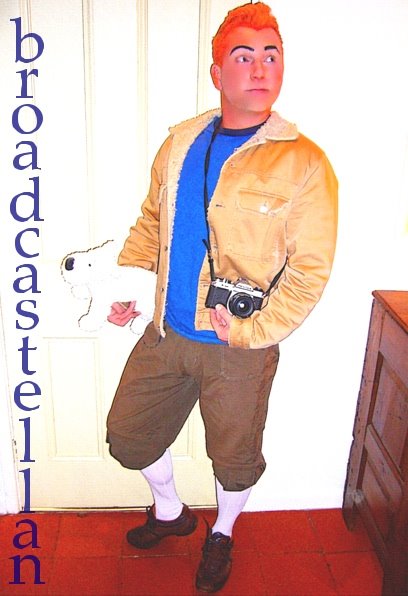
Fast forward to Halloween 2008. I am once again in costume. No wigs or dresses, if you please. There are plenty of ill-fitting garments; but little befitting the occasion. What to do? I certainly did not want to go to any great expense; being a good sport could come dear enough. To appear as my favorite comic strip character was a last minute decision, one for which my none-too-sharp pencil mustache had to be sacrificed.

And for what? Only very few people at the party guessed whom I was trying to impersonate, even though the by now nearly eighty year old boy reporter proved highly popular again when, last year, he toured Britain in a colorful stage production. It might have been the lack of preparation or my abject failure to capture this much traveled hero of my youth; and yet, I suspect that such a general shrugging of shoulders is just the kind of response that made it difficult for Spielberg to convince Paramount to green-light his latest project.

“War of the Worlds”: The Election Edition

View from a London bus, 2005

Teaching undergraduate English in the Bronx while researching my dissertation on old-time radio, I found it difficult if necessary to relate nightly study to daytime work in the classroom.  I did not want to be one of those educators who think of their ‘job’ as an educator as being at odds with—or in the way of—an academic careers, success in which is largely dependent on self-promotional efforts rather than years of service.

Reluctant instructors tend to become resentful of their charge, a feeling that is hardly conducive to the far from mutually exclusive activities of teaching and learning.  Writing this journal has been a way of vindicating my approach, of coming to terms with my inability to squeeze the most out of the degree I earned.  broadcastellan is not a series of unheard lectures, but a record of my enthusiasms.

Now, where was I going with this? Ah, yes.  “The War of the Worlds,” the infamous “Panic Broadcast” that was first heard on this day, 30 October, in 1938. The Mercury Theater’s iconic dramatization of Wells’s futuristic parable and the resulting Hullabaloo (also the title of a 1940 musical comedy inspired by the event) provided me with a rare opportunity to forge a connection between classroom and study.  “The War” was the first recording of a radio play I shared with my students, whose listening experience was followed by the inevitable question whether such a performance could still hornswoggle us today.

Being that one of my enthusiasm is American radio drama, I have already discussed the Mercury Theater production and its rival broadcast on previous occasions. Tonight, though, “The War of the Worlds” comes to a mind that is about as uneasy as the minds of those tuning in back then.

Not surprisingly, most of my students argued that we are too sophisticated nowadays to fall for such claptrap.  There is more access to alternative media, more awareness of what is going on around the world.  However comforting it might be to think so, I have never permitted myself to share this view.  I do not conceive of the past as being inferior to the present by virtue of some supposedly natural progression.

Sure, you might snicker at preposterous styles and passing fads.  You might say, in hindsight, that certain political decisions were wrong and that those living in the past should have seen things coming. In short, there are any number of ways to demonstrate your ostensible superiority to folks back then.  Doing so, however, you should have the honesty to admit that your argument is designed to make yourself feel better about the uncertainties and anxieties of the present.

I do not hold with those who look at past generations as an older, hence inferior, model of themselves.  I reject the notion that there has ever been what is frequently referred to as “innocent” times.  Retrospection breeds contempt.  Too often, it is an act of distancing yourself from events that the present, if properly inspected, proves to be not altogether beyond the possibility of recurrence.

So, could something akin to the headlines-making broadcast be restaged tonight and elicit a similar response, a response frequently attributed to the threat of war that was about to shatter hopes of stability, peace, and prosperity? Are we not on edge enough now to have reached the point of sustainable gullibility? Or are cynicism and apathy an adequate shield against deception?

Have not many of us lived a myth constructed by those who benefit from our desire to believe in something, be it a falsehood about terror and the war on it, be it the promise of economic progress to which every aspect of our existence is made subordinate? The times, it seems, are ripe for a shake-up.

One reader of the so-called panic broadcast, Peter Lowentrout, suggests that listener belief in an attack from Mars was rooted in a “loss of spirit,” the 1920s and 1930s having been “decades in which the influence of secularization peaked in our general and elite cultures.” Are we more eager to believe in a hoax if we are incapable of or reluctant to believe in anything else? Or is a return to faith a prerequisite for a susceptibility to apocalyptic visions?

In a way, the “panic” is itself an historical construct; its extent has been exaggerated to permit us that look of superiority we tend to cast on the past.  Yet what about the present fear change and its mongers, those who look upon of the presidential candidates as a false Messiah and claim him to be alien to the economic needs of an ailing nation, if not downright hostile to those intent on clinging to a status quo that hardly seems worth maintaining?

What about those who think of ecological crises as a matter of fate or charlatanry rather than challenge and opportunity; and who, by claiming it to be either inevitable or false, go on living as if their individual conduct had no influence on the future of this planet? What about those who are disillusioned by the stock market, yet feel threatened by concepts of alternative living that involve something other than the amassing of greenbacks?

Orson Welles’s introductory remarks, at least, are readily applied to our present condition:

With infinite complacence people went to and fro over the earth about there little affairs, serene in the assurance of their dominion over this small spinning fragment of solar driftwood which by chance or design man has inherited out of the dark mystery of Time and Space.

At present, I find it difficult to think of anything other than the US election, which is what reminded me of the challenge I faced in the classroom, the challenge I am facing when keeping a journal that attempts to keep up with the out-of-date? To find relevance in the past and to relate it to the uncertainties that constitute my present, that is the challenge.  

While I have no official say in the matter, I shall have certainty next Wednesday.  On that day, I may even have renewed confidence in the democratic West; but certain and confident is not who I am tonight . . .

The Transplanted Mind: A Caligari for Radio?

“Poor print.” That was all I had to say after attending a screening of Das Kabinett des Dr. Caligari (1920) at the Museum of Modern Art in New York City. I was dreadfully disappointed. It felt like walking through an exhibition of Expressionist art in which all the paintings were covered in plastic, the lights dimmed, and the space brightened only by an occasional flash of a camera. I pretty much had the same impression when, preparing for a trip to Prague, I tried to take in Der Golem by exposing myself to the horrors of a cheap copy I had dug out of a bargain bin at a third-rate department store. You might as well experience these films on the radio, where the visuals are as clear and bold as you can make them, provided your mental camera is both creative and focused enough to take pictures that are worth keeping.

Tonight, BBC Radio 3 attempted no less with “Caligari,” a radio adaptation of Robert Wiene’s seminal horror film, one of the few classics of the cinema to rank among the top 250 films on the Internet Movie Database. In the exposition, poet/playwright Amanda Dalton slyly comments on the challenges of such a project. “Caligari” opens with the sound of a board (an advertisement for the fair, a title card for the film, a piece of scenery) being painted and hammered into position. The question this gesture begs is whether the brush and the hammer are being passed on to us. Are we the artist, the audience, or the subject? Can we choose? Must we?

A “strangely arresting” film that succeeds in giving “pictorial interpretation to a madman’s vision,” one early commentator (Carlyle Ellis) said of Caligari. Such a statement drives home that Caligari is itself an exercise in translation: a bringing to light and darkness the workings of a crooked, crazy mind in crooked, crazy images. Rather than a translation, then, Dalton’s “Caligari” (available online until 2 November 2008) should be performing nothing more—and nothing less—than a transplant, a projection of a madman’s vision onto the screen of our own mental theater, sound or otherwise.

By installing a narrator at the changing scene, “Caligari” insists on translating and interpreting, at times so facetiously as to undermine any sense of terror. Irritation, perhaps, but not anxiety. More clamorous and voluble than radio needs to be, Dalton’s frantic, play, whose light-heartedness is weighed down by anachronistic cliches like “over my dead body,” is, for all its irreverence, an unsatisfactorily literal transliteration. Too many voices shouting down our imagination, “Caligari” reviews familiar images it does not permit our mind’s eye to see, let alone re-envision or remake. A running commentary on the original on a familiarity with which it depends, “Caligari” plays itself out as a series of aural footnotes.

Last Friday, during an ostensible lecture on German film prior to a screening of Germany’s latest cinematic export, Die Welle (2008), I once again caught glimpses of Wiene’s seminal work; but its images were taken out of a context that the dull, rambling talk could not create. I had a similar attitude toward Dalton’s adaptations.

A few bars of the German national anthem, as it was once sung (that is, including the first stanza, “Deutschland, Deutschland über alles”), can hardly suffice in assisting us to adopt a Weimar Republican mindset; nor can mentions of an “intricate design” recreate an expressionistic set. And while a babble of tongues may make a failed democratic system audible, “Caligari” is little more than a poor substitute for the experience of either art or history.

Meanwhile, I am sure that the jack-o’-lantern I carved today (and display above) would look better on the air or in anyone’s mind, especially now that Montague, our terrier, has already begun to disfigure it. Is he adopting traits you may have decided to attribute to me?

“Madagascar Madness”; or, It Takes a Houdini to Get Out of That One

Tickled by Canary Feather’s account of being an accompanist for silent movies, I was in the mood for another non-talkie. The term may be unhappy in its connotation of lack, yet seems preferable to “silent movie,” considering that, prior to the late 1920, the sound for motion pictures was supplied by those playing the piano or the organ; even sound effects artists and entire orchestras were not unheard.

Having had my fill of non-talkie comedy of late, I chose a melodrama likely to wear out the most resourceful and nimble-fingered of pianists: The Master Mystery a 1919 thriller underscored by Stuart Oderman, whom I have often heard and seen playing the piano to movies screened at the Museum of Modern Art in New York. Intolerance, Grandma’s Boy, and Caligari—Lillian Gish biographer Oderman has articulated them all.

In the case of The Master Mystery, the pianist must have been relieved that his accompaniment was being recorded, rather than performed live. However fragmentary, the film still runs an epic 238 minutes. With an attention span shortened by broadband and a clock ticking down the last minutes of the day, I was resolved to take in this thriller as it was conceived; that is, as a weekly chapter play.

From the first instalment, I expected little more than an exposition, an introduction of the main characters, and the obligatory cliffhanger. After all, The Master Mystery stars the famed escape artist Harry Houdini (previously encountered on a boat about to go over Niagara Falls).

Now, I pride myself in not readily throwing in the remote control; but The Master Mystery, with its secret identities, its corridors and hidden caves stalked by an pre-RUR automaton, and its cases of Madagascar Madness—proved too complex to master at that late hour. The opening title card should have been ample warning. The “Foreword” reads:

International Patents, Inc., is a firm whose vast fortune has been made by inducing inventors to trust the marketing of inventions to their care and after obtaining sole rights—they suppress the manufacture of these inventions—much to the financial gain of the owners of already existing patents.

However intriguing, this is hardly the most effective way of opening a chapter play. We have not yet been introduced to any of the characters, but are confronted instead with a corporation and with legalities not quite the stuff of melodramatic action. Equally frustrating is the introduction of characters by indirection, that is, as a name on a title card not referring to the character shown. The secretary of businessman Peter Brent, for instance, is identified as being “secretly in the service of Balcom,” before we are shown the latter.

My own shortcomings aside, was it writerly ineptitude that caused me to get lost in the muddle? Was it owing to the fragmentary state of the surviving print, segments of which have been “rearranged” to create the “illusion of completeness”? Or was it, perhaps, all part of a shrewd design? I was determined to fill in the blanks with whatever notes I could find. Notes? How about an entire book!

In May 1919, Masters of Mystery was published as a novelization co-written by Arthur B. Reeve, one of the scenarists credited as the “authors” of the serial. Yes, viewers lost in the maze from which only Houdini could extricate himself were promised a key to it all in the form of a tie-in book, replete with stills from the film. I wonder just how many moviegoers resorted to a purchase in hopes of mastering this Mystery?

Here is how the opening title card is translated into some semblance of a narrative:

“I will see Mr. Brent,” insisted the new-comer, as he pushed past the butler. “Mr. Brent!” he cried, advancing with a wild light in his eyes. “I’m tired of excuses. I want justice regarding that water-motor of mine.” He paused, then added, shaking his finger threateningly, “Put it on the market—or I will call in the Department of Justice!”

Brent scowled again. For years he had been amassing a fortune by a process that was scarcely within the law. For, when inventions threaten to render useless already existing patents, necessitating the scrapping of millions of dollars’ worth of machinery, vested interests must be protected.

Thus, Brent and his partner, Herbert Balcom, had evolved a simple method of protecting corporations against troublesome inventors and inventions. They had formed their own corporation, International Patents, Incorporated.

Their method was effective—though desperate. It was to suppress the inventor and his labor. They bought the sole rights from the inventor, promising him glittering royalties. The joker was that the invention was suppressed. None were ever manufactured. Hence there were no royalties and the corporations went on undisturbed while Brent and Balcom collected huge retainers for the protection they afforded them.

Thus Brent Rock had come to be hated by scores of inventors defrauded in this unequal conflict with big business.

While the perfunctory prose suggests that the book is not always better than the movie, I was at least caught up with the story and prepared to follow Houdini as he gets in and out of scrapes to a score by Stuart Oderman . . . next week.

A Mind for Biography: Norman Corwin, “Ann Rutledge,” and Joan Fontaine

Yesterday, Joan Fontaine celebrated her 91st birthday. Now, I have no idea how the Academy Award winner marked the occasion; but I’ve got a suspicion that, on the twenty-seventh return of the day, Ms. Fontaine was perusing a script. Not such a startling surmise, I suppose, given that the star was particularly busy back in 1944, what with the release of Frenchman’s Creek (directed by the aforementioned Mitchell Leisen and last remarked upon in connection to my trip to Cornwall) and the work on her upcoming picture The Affairs of Susan (1945).

The script that would have been foremost on her mind, though, was not a scenario. It was what used to be called a radario: a dramatic script for radio. Not just any old script, mind you, but one written by the best in the business—the indefatigable Norman Corwin (now 98).

On this day, 23 October, in 1944, Joan Fontaine was heard on the Cavalcade of America program in Corwin’s “Ann Rutledge,” a gentle love story that historians tend to dismiss in a footnote. There is some doubt whether Ann Rutledge was indeed “The Girl Lincoln Loved,” which is the alternative title of Corwin’s biographical play. In his notes on the published script, the playwright remarked that, when commissioned to dramatize the romance between Rutledge and the man who would be President, he

decided to make it as simple as the story of the girl herself.  [His] decision was influenced by the fact that not enough is known about Ann to get a writer into complications anyway.

What is known is that she was the daughter of a tavern-keeper in New Salem, that she had several brothers and sisters, and that she was in love with one John McNeil before she took notice of Abe Lincoln.

Unable to rely on Carl Sandburg, who does not furnish his readers with further insights, Corwin needed to approach history with the open mind of the poet. He rejected the adaptation of Abe Lincoln in Illinois, since it insisted that Rutledge never loved anyone but McNeil.

Acknowledging this lack of ocular proof and inspired by the gaps it leaves for us to fill with meaning, Corwin’s biography of Ann Rutledge does not so much reconstruct the young woman’s story as it conjures continuations and alternate endings in the listener’s mind. The scripted and the spoken are merely the skeleton key that gives us access to a maze of passageways.

According to Corwin, the cast of the original production, which gathered exactly four years earlier, on 23 October 1940, was very much moved during the reading of the script, so much so that the great radio wit wondered whether we “was a tragedian and didn’t know it.”

Death is not tragic, of course, unless one ponders the opportunities that are lost along with the life. What might have become of Rutledge with Lincoln at her side? What might have become of Lincoln with Rutledge at his? And how might Lincoln’s character have been influenced by this loving companionship? It is a play that invites speculations about First Ladies, lasting impressions . . . and Joan Fontaine.

“Ann is no easy role,” Corwin commented, giving much credit to Jeanette Nolan for reviving her during the first production. Joan Fontaine certainly achieves nothing less. Hers is a spirited performance, rather than the once-over lightly attitude with which many a star deigned to lower herself to the microphone.

So, if I were a biographer with nothing else but “Ann Rutledge” to go on, I would guess that Joan Fontaine spent her twenty-seventh birthday with a woman in mind who did not live to see twenty-three.

A Nose for Business; or, This Woman Has Issues

You know you’ve got money to spare when you can afford to hire someone to do the sneezing for you. Save your nostrils, keep the tissue! Just call Hildegarde Halliday. That is what NBC did back in the 1930s and ‘40s, when Halliday was the Durante of sound effect artists. Radio actors were fortunate to have their proboscis blown by proxy whenever the script demanded the feigning of a common cold or an attack of hay fever. On this day, 20 October, in 1940, stage actress Halliday demonstrated her skill on Behind the Mike, a weekly half-hour that promised to take listeners inside the studio to reveal some of the tricks of the radio dramatic trade. Billed as “radio’s own show,” the aforementioned Behind the Mike dramatized and promoted the business by telling audiences what was involved in putting together a national broadcast, in selling it to a sponsor, or in prepping a studio audience.

“We’ve had many people on this program who make their living from radio in strange ways” announcer Graham McNamee opened the 20 October 1940 broadcast, referring to assorted animal imitators and baby criers (like my fictional Aunt Ilse). “But our next guest makes her living in radio in a way that tops all of them.” Halliday claimed to have “done all kinds of sneezes,” making herself heard on the variety programs headed by Rudy Vallee and Robert Benchley, as well as on daytime serials like Aunt Jenny.

“Oh, I can sneeze like all get-out if I just imagine very hard that I have a cold and chill,” the jovial Halliday tells the host (pictured above). To illustrate the afflatus the afflicted are to her, Halliday enacts in monologue a scene at a cocktail party she attended. Listeners are treated to a severe allergy attack, the sounds of which I know only too well. The sufferer lets out a few terrifying atchoos (a rather feeble onomatopoeic substitute, as it turns out), along with some choice words of political wisdom.

“I hope he doesn’t get besmirched,” the none-too-ladylike sneezer tells her friend, the wife of a congressman. “I always say politics are so common, what with letting everybody vote. No, I don’t know a thing about politics, but I do know what I like.”

Such sentiments are uttered more frequently than “Gesundheit,” no doubt, which is why elected governments are rarely as healthy and sound as they ought to be. And however poorly we are represented due to our lack of care at the sickbed of our democracies, we cannot rely on someone like Hildegarde Halliday to perform the suffering on our behalf . . .