Alternative (F)acts: Curating as Creative Response

Our Japanese ‘Merman’ made for a suitable poster boy.
Poster design by Neil Holland, based on an idea by Sarah Selzer
Once a year, with the help of the head curator of the School of Art, Aberystwyth University, I stage an exhibition with a group of students who are enrolled in my undergraduate module “Curating an Exhibition.” The shows draw on the University’s vast collection of art and artefacts. The student curators are given a theme and set out to create a narrative by selecting objects in response to it. That is quite a challenge, considering that the exhibition is put together in just over three months from initial planning to display.
 
Past exhibitions include Untitled by UnknownQueer Tastes, and Matter of Life and Death.  This year, I was all set to use the colour red and its connotations as a theme . . . until the inauguration of Donald Trump and the ensuing dispute about the size of the audience made me see red in a different way.  This gave me the idea for a more urgent, topical show.
 
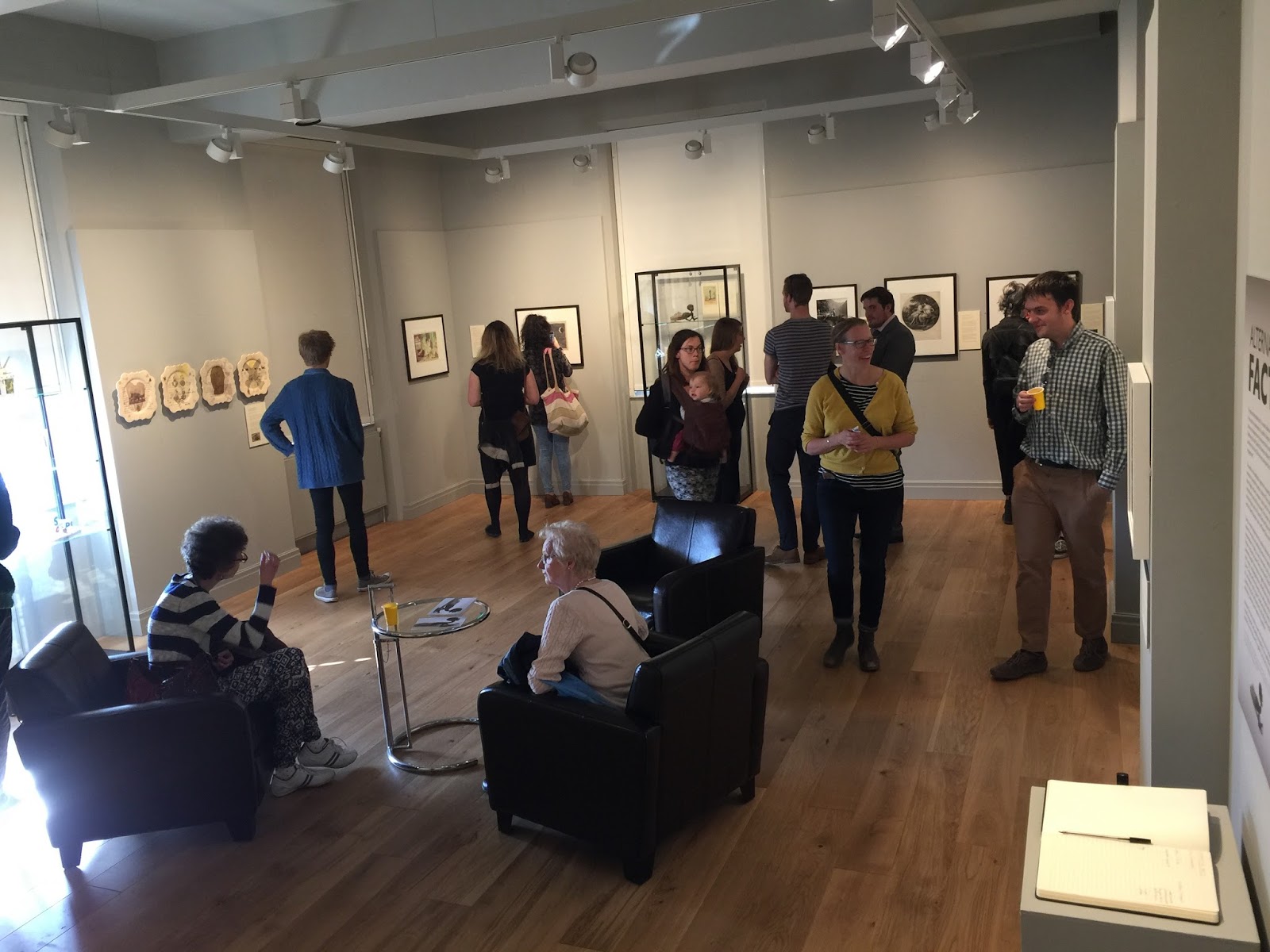
That show is Alternative Facts: Interpreting Works from the School of Art Collection. It opens on 22 May and will be on display until 29 September in one of the School of Art’s galleries in Aberystwyth, Wales.
 
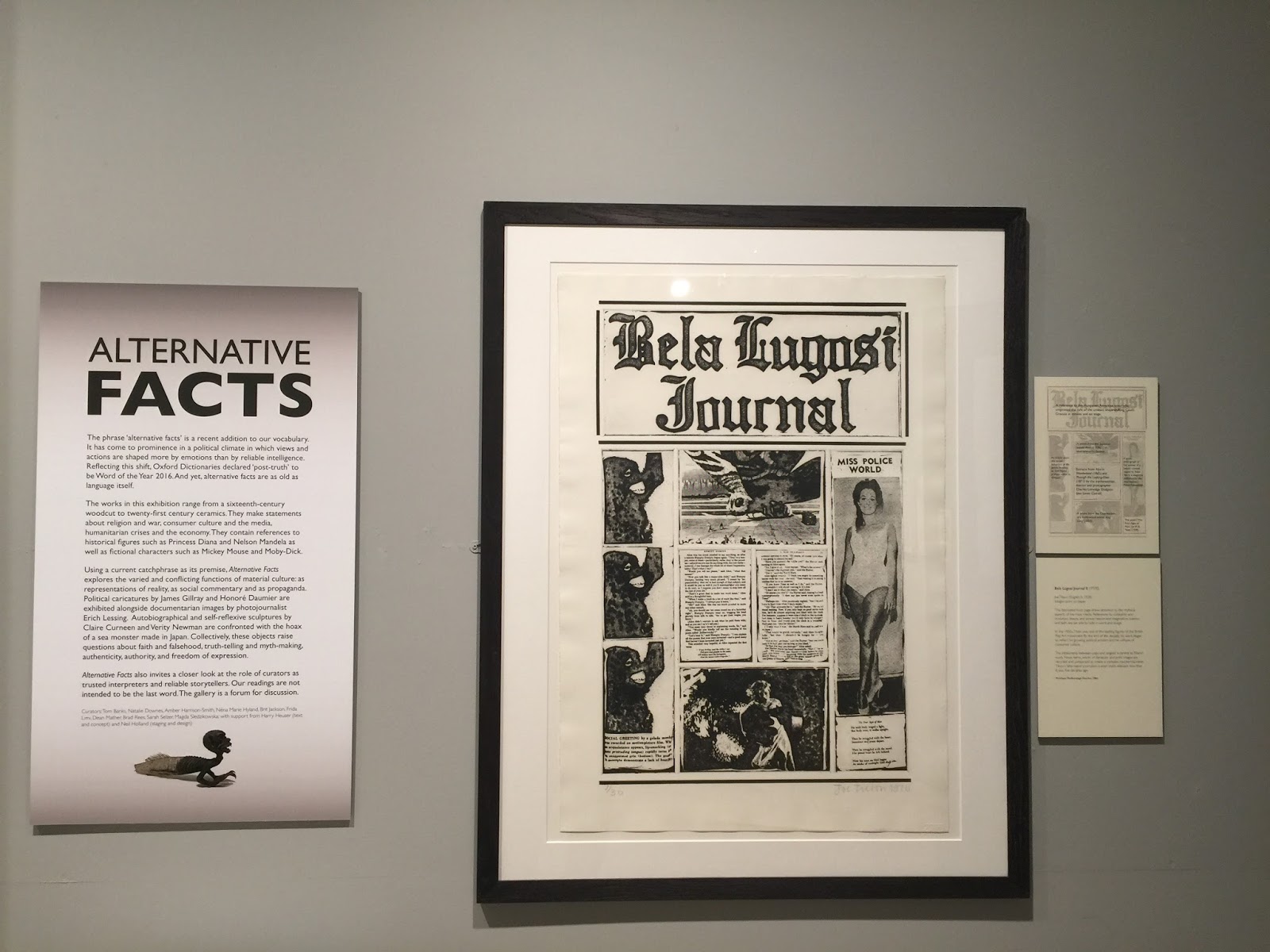
The introductory panel explains the theme as follows:
 
The phrase ‘alternative facts’ is a recent addition to our vocabulary.  It has come to prominence in a political climate in which views and actions are shaped more by emotions than by reliable intelligence.  Reflecting this shift, Oxford Dictionaries declared ‘post-truth’ to be Word of the Year 2016.  And yet, alternative facts are as old as language itself.
 
The works in this exhibition range from a sixteenth-century woodcut to twenty-first century ceramics.   They make statements about religion and war, consumer culture and the media, humanitarian crises and the economy.  They contain references to historical figures such as Princess Diana and Nelson Mandela as well as fictional characters such as Mickey Mouse and Moby-Dick.
 

Using a current catchphrase as its premise, Alternative Facts explores the varied and conflicting functions of material culture: as representations of reality, as social commentary and as propaganda.  Political caricatures by James Gillray and Honoré Daumier are exhibited alongside documentarian images by photojournalist Erich Lessing.  Autobiographical and self-reflexive sculptures by Claire Curneen and Verity Newman are confronted with the hoax of a sea monster made in Japan.  Collectively, these objects raise questions about faith and falsehood, truth-telling and myth-making, authenticity, authority, and freedom of expression.

 
Alternative Facts also invites a closer look at the role of curators as trusted interpreters and reliable storytellers.  Our readings are not intended to be the last word. The gallery is a forum for discussion.
 
Curators: Tom Banks, Natalie Downes, Amber Harrison-Smith, Néna Marie Hyland, Brit Jackson, Frida Limi, Dean Mather, Brad Rees, Sarah Selzer, Magda Sledzikowska; with support from Harry Heuser (text and concept) and Neil Holland (staging and design)

Recycling Questions: Just What Is or Ain’t an Adaptation?

As a product of postmodern culture, I lay no claim to originality.  Indeed, I have always been thoroughly unoriginal, and, occasional anxieties of influence notwithstanding, often gleefully so.  As a child, I ripped off comics, tore apart magazines and took whatever images were available to create collages and parodies.  Using an audio tape recorder, I appropriated television programs by inserting my voice into mass-marketed narratives, transforming a saccharine anime like Heidi (1974) into a subversive adolescent fantasy.

My postmodern past (note my de Chirico take on a mass-produced vase)

No evidence of my early experiments is extant today; but adaptation became an enduring fascination and a field of study.  As a student, I wrote essays on adaptations of Frankenstein and on Brecht’s revisitations of Galileo Galilei – Leben des Galilei (1938/39 and 1955), as well as Galileo (1947).  I produced an MA thesis on translation (“Meister Remastered”) and a PhD dissertation on the relationship between stage, screen, print and radio (“Etherized Victorians”).  The latter I recycled as Immaterial Culture, published in 2013.

Now a lecturer in art history, I have repurposed some of the above and pieced together a Frankenstein’s creature of an undergraduate module I call Adaptation: Versions, Revisions and Cultural Renewal.  In a series of lectures and seminars, the course (at Aberystwyth University) investigates the processes involved in translative practices that range from the reworking of a literary classic into a graphic novel to drawing a moustache on a copy of the Mona Lisa.  It explores relationships between form and content, genre and mode, integrity and hybridity, durability and transience, culture and commerce, as well as art and the environment.

As I state in the syllabus, many products of culture endure by shifting shape: stories are turned into sculptures, plays are reimagined as dramatic canvases and mass-produced ephemera are recycled for art. What survives such transformations? What is lost or gained in translation? What are the connections between – and interdependencies of – so-called originals and the works that keep coming after them?

Given the monstrous scope of the course, another question emerges: Just what is not an adaptation? It is a question that becomes more complex if tackled by anyone who, like me, regards originality as a myth.

Much of what is published on the subject is limited to matters of narrative, of what happens when telling becomes showing, or vice versa.  Linda Hutcheon’s study A Theory of Adaptation opens promisingly – if somewhat patronizingly – with the following statement: “If you think adaptation can be understood by using novels and films alone, you’re wrong.  The Victorians had a habit of adapting just about everything…. We postmoderns have clearly inherited this same habit….”

Hutcheon does not quite deliver on her promise of inclusivity.  Unable or unwilling to break the “habit” of adaptation scholars who came before her, Hutcheon’s study also concentrates on “novels and films,” the word “film” appearing on 229 pages, compared to, say, “painting” on 17 pages, including index and bibliography.   There is no mention at all of collage or assemblage.  Left out are the projects of Dada, Neo-Dada and Pop, as well as the debates about Kitsch, Camp and Pastiche that were central to Postmodernism.

Hutcheon’s definition of “adaptation” is at once too broad and too narrow.  Her brief statements on “What Is Not an Adaptation?” are welcome yet imprecise and contradictory.  What is worse, her definition is at times arbitrary.   She states, for instance, that “fan fiction” is not a form of adaptation, offering no explanation for its exclusion.

I agree with Hutcheon that adaptations need to be readable as a version, an acknowledged take on or taking of something we perceive as same yet different.  Adaptations are not copies, and, as spurious as they may sometimes strike us, they are not fakes, either.

Hutcheon distinguishes between parody and adaptation, claiming that the former does not need to be acknowledged.  If unacknowledged, parodies – or any other form of adaptation – cannot operate qua adaptation.  They are like irony in that respect.  You just can’t be ironic all by yourself.  Any dance of the index fingers needs an audience.

As I see it, adaptations, be they parodies or pastiche, anarchic or reverent, have to exist as concrete products – rather than ideas or themes – that are distinct from yet related to other products with which they engage or from which they openly borrow in more or less creative acts of transformation.

Am I an adaptation?

Hutcheon, who does not insist on a change in medium as a criterion for adaptation, cites a source that identifies as a “new entertainment norm” the “process where integral elements of a fiction get dispersed systematically across multiple delivery channels for the purpose of creating a unified and coordinated entertainment experience.”  The resulting products are not meant to exist independently but serve as a deliberate fragmentation for the sake of maximizing market potential and profits by increasing the potential audience.  Is this still adaptation? Perhaps, if the audience rejects to buy the lot.

Buying the lot is something I rarely do.  I pick and choose, take apart and transform according to my own desires and limitations.  And pick apart I must when I read Hutcheon’s comments on radio drama as a form of “showing” like “all performance media,” at which point her study recommends itself for recycling as pulp.  Anyone who appreciates the hybridity of radio plays would balk at such simplifications.

Trying to make a case for elevating their cultural status, Hutcheon asks: “If adaptations are … such inferior and secondary creations why then are they so omnipresent in our culture and, indeed increasing steadily in number?” Well, junk food is “omnipresent” – and so are feebly argued studies – which does not make either any less “inferior.”  Besides, the question is not whether adaptations are good, bad or indifferent.  The question is: what are and what ain’t they?

Teaching by Numbers That Don’t Add Up; or, Not in the Mood to Celebrate an Anniversary

On the eve of the tenth anniversary of broadcastellan, I look back at what this blog once was and what it has been reduced to over the years.  The neglect is due in part to the fact that I struggled to engage an audience or generate interest in my study on radio, which, under the title Immaterial Culture, was eventually published as an academic book in 2013.  I think a copy of it still lies in some corner of the Theatre and Television department of Aberystwyth University, the institution that is my current employer.  It attests to the lack of imagination, ingenuity and respect of said institution that my offer to deliver a lecture on the subject has never come to fruition.  But that is only one of my grievances.

Why there is so little going on here at broadcastellan has mainly to do with my being too busy to devote time to what is essentially a hobbyhorse I can no longer ride at leisure.  My life has changed considerably since that first tentative entry in May 2005; in terms of my academic career, it has not changed for the better.

As a zero hour contract employee at Aberystwyth University, I work virtually daily for little or no pay.  No pay, you ask? How can that be? Well, I spent months creating two courses in art history that I delivered at a university in China in October 2014 and March 2015.  I received no compensation for this preparation; the work was simply not time-tabled, nor thought of as deserving of pay.  There is no shortage of examples; so I consider the most recent one.  Today, I was denied pay for work that was expected of me.

Showing my support for the university, I agreed to teach a course that apparently no full-time member of staff would touch.  For this dubious privilege I was to be remunerated on an hourly basis.  On that iffy foundation, I was to prepare a series of lectures and seminars.  No, let me revise that: I received no money for the preparation.  If the hourly lecture rate is meant to reflect preparation, the rate is below minimum wage.  

I am accustomed to this practice, having worked under such conditions for years.  In this case, there was quite a bit of research, the subject being The Language of German Politics.  I have not lived in Germany in about a quarter of a century and have not voted since before the wall came down (which is just about the time I left).  I was told that the instructor who had taught the course previously did not leave behind any notes on which to draw.  If it was a part-time instructor, I can sympathise.

Why leave behind your intellectual property, even though such rights are violated routinely at institutions of higher learning that take everything from you and take credit for anything you do (such as publishing a book or staging an exhibition that happens despite one’s work for the university, not as a result of it).  Anyway, I enjoy a challenge; a member of staff recently referred to my sense of enjoyment as masochism.

Agony it certainly turned out to be, at times.  I did not receive a contract for signing until three weeks into teaching, at which point it was impossible to withdraw.  There is no mention of pay for grading assignments in the contract, and there were to be 63 individual written papers and 21 final exams to grade.

On average, I spent over 40 minutes reading and marking each essay or translation submitted, sometimes considerably longer.  For each piece of writing up to 1000 words I was permitted to claim the staggering amount of £2.53.  This meant that I worked below the minimum wage, and in many cases quite significantly so.

This is so demonstrably unreasonable that I expressed my incredulity to the Human Resource department of Aberystwyth University.  After all, the task of evaluating the effectiveness of a translation is not simply a matter of right or wrong. As someone who has studied translation theories, I regard translation as an interpretative act that is – or should be – to some degree open to debate.  It is a debate I could hardly afford to have with my students, at least not at the rate of £2.53 per 1000-word manuscript.

I was familiar with these appalling pay rates from other teaching assignments at Aberystwyth University and have tolerated them heretofore without comment.  Though assessing a translation is not equivalent to reading a manuscript mainly for its content, the pay rate is the same.

This by-the-numbers approach to remuneration – and education – is detrimental to the quality of teaching that an institution like Aberystwyth University can deliver when it is relying on part-time staff.  I tried not to short-change students by providing fewer comments, as records will bear out.  I read each submission literally word for word in order to assess responsibly and provide detailed and constructive criticism on matters such as word choice and sentence structure.  This, I believe, is as it should be, and I expect neither praise nor gratitude for my conscientiousness.

As a zero contract hour employee at another department of the same university I routinely meet with students for tutorials.  It is an important aspect my teaching.  Anyone’s teaching.  Due to the decision of the European Languages department to pay me only for the hours I spent conducting lectures and seminars, I was unable hold individual meetings with my students there.  This contributed to student dissatisfaction, instances of which were brought to my attention just as I was about to depart for China.

Yes, I had another teaching commitment, on behalf of Aberystwyth University, while three of my courses were going on here in Wales.  I took off for Beijing with a sense of failure in the face of adversity; and, despite the module coordinator’s assurance that she had ‘heard a lot of praise for [my] teaching,’ the message left me disheartened.  Had I been permitted to conduct tutorials, I would have been able not only to address student concerns but also considerably to bridge the gap created by my China assignment.

It had been suggested to me to mark more leniently to ease tension.  However, I reject the notion that the lowering of standards should be considered as a measure to assure or boost student satisfaction.  Instead, I followed the departmental marking guidelines from which my standards were derived.

Being unable to meet with students resulted in spending more time assessing performances so as clearly to explain how each mark was derived.   This effectively lowered my pay for each assignment.  As I told the head of department, I do not think it fair to our students to provide fewer comments as a result of staff members’ time constraints.

Not being able to hold tutorials, I was also forced to spend more time responding to student inquires via email.  This time is not remunerated, either.  That I had to spend time in class detailing marking criteria, for instance, also limited the time allotted to delivering the material (almost all of which I created myself, as no lecture notes or presentations were available from previous years on which to model my own performance).

The department’s decision to cut corners further by denying me payment for a meeting with – and requested by – the module coordinator to finalise work that requires double marking is, apart from being unjust and insulting to me, a shortsighted decision that impacts negatively on the marking and compromises its fairness.  I had assumed it to be a matter of course that I should be paid for such time; I stated in an email to the module coordinator that I would bill the department at the ‘meeting’ rate, upon which the meeting was called off.  I have informed the department that I am unwilling to conduct a discussion about marks via email, thus without pay.

I told the department that I would not accept any further employment under the same conditions.  To do so would mean to accept Aberystwyth University’s exploitative practices.  The contract is phrased in a way that only underscores its inadequacies.  There is mention of time and a half pay and double pay, for instance.  Such a contract can never be honoured when the work in question is teaching.  I routinely work weekends and late into the night.  There is no mention anywhere of remuneration for any time spent designing or preparing for courses or responding to student email.

There is also no mention of marking.  As a long-time zero hour contract employee I might be expected to be familiar and perhaps even reconciled to such terms; but teaching languages is, as I said, vastly different from teaching other subject matter, as language comes – or should come – under closer scrutiny than in other disciplines.  Responsible teaching of languages will therefore almost inevitably result in a pay below the minimum wage for part-time staff.

All the while, my dedication to teaching has made it difficult for me to pursue my career as a writer, from which I derive as yet no income.  For a year’s worth of teaching, I get paid under £10,000.

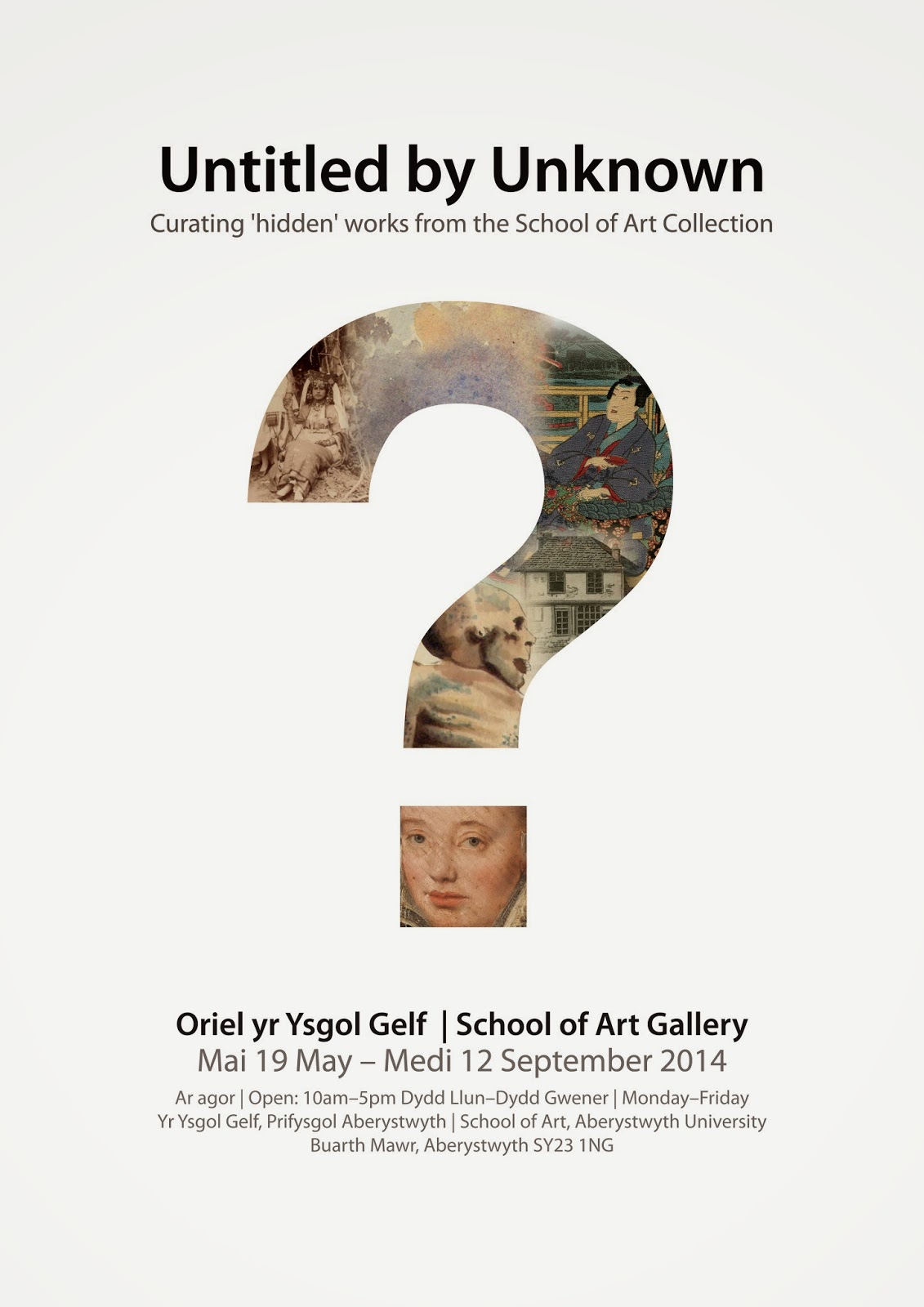
"Untitled by Unknown"

Every spring, the students of my “Staging an Exhibition” class are doing just what the title suggests: they curate a show at Aberystwyth University’s School of Art galleries. And every summer, I have to come up with another idea for another spring. This year’s exhibition, on show now until 12 September, poses a particular challenge. As stated on introductory panel, most of the works on displayed “have no official title. The identity of their creators remains unconfirmed.” This opens the debate as to their value and relevance: “Do their uncertain origins mean that these objects are unworthy of our time and attention?”

Untitled by Unknown: Curating ‘Hidden’ works from the School of Art Collection investigates the effects of doubt and mystery on our estimation of visual culture. The thirteen curators not only researched the objects but also needed to think of ways to interpret in the absence of verifiable facts.

Viewers are “encouraged to reflect on the ‘hidden’ lives” of the objects chosen by students: they include photographs, watercolours, prints and miniature paintings. Each work is identified only by the number by which it is filed and can be accessed in the School of Art collection’s online database.

The idea was to let visitors of our exhibition in on the curatorial task, to suggest that while a “lack of facts can be an obstacle,” it “can also be an opportunity for personal engagement.” Visitors may well question our interpretations and uncover alternative stories. Perhaps, they know more than we do about some of the mystery objects in our collection.

Untitled art works by unknown or anonymous artists often have no chance of being displayed—at least not until their mysteries are solved. Still, public museum and galleries have a responsibility of sharing the works in their collection.

Untitled by Unknown is not intended to show astounding works from exceptional artists. It is here to open a debate about what should be on display and how it may be shared.

My thanks to the students involved in making the show – and my class – possible: Jessie Davis, Karolina Hyży, Justyna Jurzyk, Kate Largan, Charlotte Raftery, Laura Roll, Elizabeth Salmon, Melissa Sarson, Belinda Smith, Julia Steiner, Stephanie Troye, Veera Vienola, and Eleri Wood.

Our thanks also to curator Neil Holland for all his help and expertise.