A photograph published in the April 1926 issue of Radio Broadcast showing a young John Huston (left) and fellow members of the Provincetown Players
Here I go again. Another broadcasting centenary, another radio “first.” This “First,” mind, is wrapped in quotation marks, as the claim is not mine. I am not going to dispute it, either, or challenge someone else to have the last word in the old “Who’s on First?” routine. I have been there before.
The claim served as a hook. It was designed to underscore the international significance of the event. At the same time, I tried to justify its happening in Wales by drawing attention to the play’s Welsh setting and the playwright’s affinity with the country. More important to me than arriving at a definitive answer to the vexed question of whether Comedy of Danger should be regarded as the “first” of its kind are the shifting definitions of the term “radio play” on which, to my mind, hinges the answer to that question—or rather, its unanswerability and ultimate pointlessness.
After all, it is difficult to say what is “first” in any field if the field itself is not clearly delimited first, or if the field is so limitless that it defies delineation in the first place. In the case of “radio play,” Hörspiel (play for listening) or radio drama—relatively arcane though this field of study may be—definitions not only vary greatly but are often not even attempted.
When is a play a radio play? That is a question I have been asking for a long time in my musings on the wireless, and it is a question I keep asking myself. “When is a play a radio play” strikes me as a more useful way of framing the debate than the more obvious question “What is a radio play?” because the former encourages us to avoid the most perfunctory of answers: A radio play is a play written for and/or heard on the radio.
Sure, on the surface it barely scratches, that statement sounds reasonable enough. But are all plays written and produced for radio broadcasting radio plays by default? Is it the medium, then, that makes a play—any play—a radio play?
Not that “radio” as we understand or know it these days bears a close resemblance to “radio”—as a receiver set, a system, and a phenomenon—anno 1925, the year when Sue ‘Em, proclaimed by its publisher to be the “first radio play printed” in the USA, successfully made a play for first place in a radio playwrighting contest.
Cover of the theater program for the Theatre Royal Haymarket production of Farm Hall (2024)
No horses—wild, domesticated or strictly metaphorical—would have dragged this fool (meaning, yours truly) to see Only Fools and Horses, a musical adaptation of a 1980s Britcom that made hay of nostalgia at the Theatre Royal Haymarket, where it enjoyed a record run before the stable doors closed, at last, in April 2023. How relieved was I then, returning to London after an eighteen-month-long hiatus, to find that what I assumed to be legitimate drama or, at any rate, a show beyond the dog-and-pony variety had returned to a venerable venue where, over the years, I had taken in plays as varied as William Wycherley’s The Country Wife (1675), Edward Albee’s The Goat, or Who Is Sylvia? (2000), and James Goldman’s The Lion in Winter (1966).
Granted, none of those theatrical evenings—certainly not the heavy-handed 2015 revival of the delightfully immaterial Harvey—were more memorably dramatic than The Rivals, during the 23 December 2010 performance of which I witnessed a member of the cast gallantly jumping off the stage to assist a fellow theatregoer suffering a stroke.
Nothing approaching such drama, scripted or otherwise, materializes in the course of the ninety minutes or so that historian Katherine Moar sets aside for the development of her episodic “snapshot,” as she calls it, of Farm Hall, the titular setting of a play about what happened in the summer of 1945 when a group of German nuclear scientists—members of the Uranium Club—were being kept under surveillance at a house in Cambridgeshire, only to learn, listening to news broadcast by BBC radio, that the United States had dropped the atomic bomb on Hiroshima.
Taking the radio play to the library has long been an ambition of mine, given that dramatic and literary works written for the medium of sound broadcasting occupy comparatively little space on the bookshelves. Taking the first of its kind to a national library—the National Library of Wales, no less—is a chance of a lifetime amounting to poetic justice. Allow me to shed a modicum of light on that, and on my benightedness besides.
So that meaningful conclusions may be drawn from my peculiar challenge of commemorating one hundred years of radio dramatics in just a few minutes, it strikes me as essential that the centenary first be quartered, a fate I hope to escape on 22 February 2024, the date set for the event.
Souvenirs of my London theater experience, March 2023
The London theater season in early spring 2023 was as droughty as the weather was damp. Rarely was so little being offered to so many, and with such few discounts. Being in town to attend the opening of the London International Print Fair at Somerset House, I managed to catch up with what I thought was worth my while and then worked myself down to what I would generally consider bottom drawer best kept shut. No, not Only Fools and Horses: The Musical. After all, you can lead European fools like me to water, but you cannot make them splash out on bottled nostalgia for supposedly true Britishness.
After belatedly taking in The Lehman Trilogy – hoping in vain to find some reference to my alma mater, named in honor of one of the title characters, or to connect meaningfully in any other way to what is basically a semi-dramatized performance of a PowerPoint – I quickly ran out of theatrical options.
I did go see – and was intrigued – by the twenty-first century update of Oklahoma!, which almost works, pretty much right up to the heretofore feel-good finale that it very nearly nixes in bloodshed and yet awkwardly depends on, thus proving the old adage that you can’t have your ammo and spend it.
I also appreciated the philosophical and weighty if already slightly past its sell-by dystopia Marjorie Prime at the Menier Chocolate Factory, even though I could never quite tell Anne Reid’s AI character from either Anne Reid, the actress, or from the character’s fleshly alter ego. There being nothing else to see for someone on my budget – and I draw the line well before subjecting myself to the firing squad of a musical experience such as Bonnie and Clyde – the last resort was a matinee of The Unfriend. And no discount.
Turns out, I enjoyed the least ambitious of those four shows the most, however low the bar. Essentially a Britcom mounted in the West End, The Unfriend is as thin as the decorated shell of an Easter egg that someone – television-trained playwright Steven Moffat, assisted by his Dracula collaborator, director Mark Gatiss, a renowned darkside devotee – blew, as is customary, out of all substance and traces of nutrition while managing to keep it intact for our amusement. I mean, Edward Albee it ain’t. More like Are You Being Stiffed? or Mrs. Brown’s Bodies.
Reflecting on the impotence of being English, The Unfriend taps into the self-consciousness of the British regarding their apparently cultural or just plain apparent politeness – I mean, ask any European how that civility manifests on the continent – and their love-hate relationship with their overbearing American cousin, or whatever the family ties of post-Brexit Britain to the US.
In The Unfriend, the American cousin by any other name is the brash and manipulative Elsa Jean Krakowski. Elka Ostrovsky, Betty White’s similarly clad character in Hot in Cleveland came to my readily distracted mind at the mention of that name; then again, The Unfriend is so derivative a farce that it affords any number of associations.
In the 30 March 2023 matinee of The Unfriend at the Criterion Theatre, which, the program informs me, opened about 150 years earlier with a production of An American Lady, Elsa, who is more of a dame, was played con molto brio by Olivier Award-nominated – and Remain-voting – English actress Frances Barber, even though the role would perhaps be more fully and faithfully inhabited by Kathleen Turner – a former Serial Mom, no less.
A denizen of the Colorado capital made famous the world over by Dynasty, Elsa is a widow – possibly a black one – of what with some lexical flexibility and generosity of spirit might still go for midlife. Her velour tracksuit – underneath which she admits to be “chins all the way down” – is as plush as the veneer of British politesse is demonstrated to be ripe for the abrasing.
Well, in this game of rock-paper-scissors, Elsa has the upper hand, especially since the other hands are either flailing or shaking. From the start – we first encounter garrulous Elsa onboard a cruise ship, a premise based on a true story told to Moffatt, where she meets the certifiably middle aged, and all around middling British couple Debbie and Peter (also based on real people and deftly impersonated by Amanda Abbington and Reece Shearsmith) – I felt encouraged to warm, however reluctantly, to the anti-mystique of Elsa, a hot mess concocted of shrewdness and forth-far-rightness. She is too obvious to be deceitful, too in-your-face to be masking her true self … or so we are led to believe. Who is Elsa? What is she, that all the swains croak on her?
Then again, Elsa is drawn that way: a flat character devoid of the very dimensions or nuances that are also lacking in today’s political discourse, references to which pop up to give the farcical proceedings a tinge of relevance. “I’d do him,” Elsa declares in the opening scene when confronted with the likeness of a similarly garish former US president. Her stated reason for voting for him, a second time around, is that “he’s funny.” Apparently constructed under the influence of conspiracy theories, her ramshackle alternative to logic may be summed up by her claim that “[h]e only lost because of fraud and people voting against him.”
Elsa, as her British hosts discover before she even drops in, as threatened on the high seas, is a celebrity of sorts, and of one of the worst sorts at that, the ex-President excepting: she is suspected to be a serial killer. Only Fools and Corpses, anyone?
The English characters, confronted with the possibility of their demise, are hamstringed in their attempt to get shot of her – legally, that is – by their sense of obligation toward their unwelcome guest. “You English, you’re so polite,” Elsa gushes. It is a courtesy Debbie and Peter do not extend to their neighbor (Michael Simkins) who, despite having lived next door for ten years, is not known to them – or any of us – by name. Peter is too easily distracted by calls and text messages to pay attention to a man whose presence is less keenly felt as that of priggish Mrs. Grundy, to mention a long-established convention of British comedy.
The Unfriend, to be sure, does not belabor or foreground its dramatic heritage. It goes all out for nowness. And yet, as refreshing as it is to see a comedy that responds to and mirrors our present, the play is already beginning to feel dated in its efforts to keep up the appearance of keeping up. It is as contemporary as last year’s smartphone technology, especially in its references to the pandemic that delayed its arrival. Not surprisingly, Elsa has her own take on Covid-19. Peculiarly but all the same representative of an all too familiar type, she reminds her hosts that the people she was supposed to have poisoned “were all vaccinated.”
Speaking of silent killers, real or imaginary, The Unfriend is ripe with all the crudeness of British toilet humor – a recurring threat in act one is the breaking of wind and a stool sample takes center stage in number two. A farce invested in farts and feces, The Unfriend is not about British politeness, in a bad manner of speaking, or about the relationship between cultures who don’t see eye to eye on the distinction (“Tomayto-tomahto”?) between toilet and bathroom as much as it about human interaction – friendship, family and neighborliness – in the age of social media.
Elsa tracks down her unwitting – and very nearly witless – victims-in-waiting via Facebook, and what Debbie and Peter learn about her, via the legacy media of tabloid television, they find posted on YouTube. Meanwhile, Elsa connects with the couple’s son, Alex (Gabriel Howell), by playing violent computer games off which she also manages to ween him.
“Isn’t technology wonderful!” Elsa chirps. Not that she remains convinced that such dubious advancements – or her new British acquaintances, for that matter – are quite so “wonderful” when she is confronted with her past. “Why did you google me?” she protests. “Why would anyone google a person like that? It’s so rude!” According to Elsa, online research for the sake of self-preservation is more insensitive than bumping off your other half.
“Facebook got it right,” Peter moans. What “the real world needs” is an “unfriend button.” If The Unfriend were a college composition, that might be its thesis, as signposted by the title. Luckily, it ain’t. As a comedy, it invites us, especially those among us who remember a world before virtuality, collectively to roll our eyes and laugh out loud at the precarious state of what we once understood to mean “social.”
The illusion of the stage. The magic of the movies. The glamour of fashion. In a career spanning half a century, Angus McBean (1904–1990) turned instances of make-believe and masquerade into enduring records of enchantment.
Poster design by Neil Holland, from a photograph of Angus McBean by Robert Greetham
McBean was born and raised in South Wales. His father had worked in the collieries. Encouraged by his mother to make art his life, McBean moved to London. After working in banking and retail, he became a theatrical mask-maker and designer before achieving international fame as a photographer.
This year’s exhibition at the School of Art, Aberystwyth University, showcases McBean’s work in advertising, his commissioned portraits, and his annual Christmas cards. It offers rare glimpses of McBean’s private life, holidaying on the continent, as captured in two unique photo albums. Also featured in the exhibition are portraits of McBean at home, in later life, by the contemporary photographer Robert Greetham.
Make/Believe installation view
Not all the personalities on view in this exhibition – Marlene Dietrich, Ruth Draper, Audrey Hepburn, Vivien Leigh, Claire Luce, Laurence Olivier, Maggie Smith, and Welsh icon Ivor Novello among them – are as familiar today as they once were, even though some of them, including Rosemary Harris and Maggie Smith are acting to this day. All of them, like McBean, lived by their passions, whether performing on stage and screen or playing on the tennis court, as Wimbledon champion Helen Wills Moody did.
Make/Believe installation view
McBean’s photographs were made in the pre-digital age of the medium. Using scissors and paste, montage and collage, as well as elaborate sets and props, McBean employed every trick of the trade to bring out the beauty, vitality and personality of his subjects. His photographs were staged, not taken.
Drawing inspiration from Salvador Dalí, whose exact birthday he (incorrectly) claimed to share, McBean ‘surrealized’ many of them. ‘This thing of truth doesn’t really come into it,’ MacBean said in late life of his portraits.
Make/Believe installation view
The theater, to McBean, was ‘fantasy.’ It was ‘what you wished it to be.’ It was also the refuge McBean needed at a time when being queer was a crime. During the Second World War, he endured a two-and-a-half-year sentence of imprisonment and hard labour. His work is a testament to the imperatives of making, believing, and make-believe.
Make/Believe, which draws almost entirely on the School’s collection, opened to the public on 16 May 2022 and runs until 30 September 2022.
Curators: Hannah Beach, David Eccles, Helen Flower, Ellie Hodnett, Mayu Maruyama, Ekene Okoliachu, Lucija Perinic, Joanna Reed, Katerina Vranova, Portia Sastawnyuk, Anna Slater, and Helena Zielinska. with support from Senior Lecturer Harry Heuser (text and concept) and Senior Curator Neil Holland (staging and design).
Nothing is innately trifling. As I put it once, when I had the nerve to make a public display – in a museum gallery, no less – of the mass-produced ephemera I collect, ‘Trivia is knowledge we refuse the potential to matter.’ Now, some products of culture are more resistant than others to our realization of them as worth more than a fleeting glance, if that. Exerting the effort to make them matter may feel downright perverse when there are claimed to be so many more deserving candidates for appreciation around.
When looking out for something to look into, I invariably draw on my own sense of otherness, of queerness. It is not altogether by choice that I am drawn to the presumed irrelevant. My perceived marginality is both the effect and the cause of my attraction to the margins. What matters – and according to whom – is always worth questioning. That is why I created Gothic Imagination, an alternative art history course I teach at Aberystwyth University.
To augment the weekly lectures and seminars, I created a series of film screenings for my students further to explore the territories of the visual ‘gothic’ beyond literary genre Gothic and the Gothic as an architectural style. The second film in the chronologically arranged series, The Cat and the Canary (1927), is, for all its technical and cinematographic achievements, a rather undemanding old chestnut. In part, such a view of it is owing to our belatedness of catching up with it, now that much of it strikes us as a grab bag of narrative clichés.
Well, those clichés were up for grabs even back in 1927, as the film draws on its audience’s familiarity with murder mysteries and stage melodramas. Like Seven Keys to Baldpate before it, The Cat and the Canary is parodic and self-reflexive. It play with conventions and our awareness, even our weariness, of them. The Cat got our tongue firmly in cheek; and as much as we may feel sticking it out at the derivative claptrap to which we are subjected, we are encouraged to appreciate that the film anticipates our response, that it is one step ahead, dangling our tongue cheekily in front of us like a carrot intended to keep us playing along.
Is it only a single step ahead? Ahead of what? Is it ahead, retro or perhaps even reactionary? The Cat and the Canary is postmodern before there was a word for it. Like any adaptation of a text I have not caught up with, it also makes me wonder just how what we get to see has evolved and how the film, in addition to interpreting its source material cinematically, questions, edits and revises that material as well.
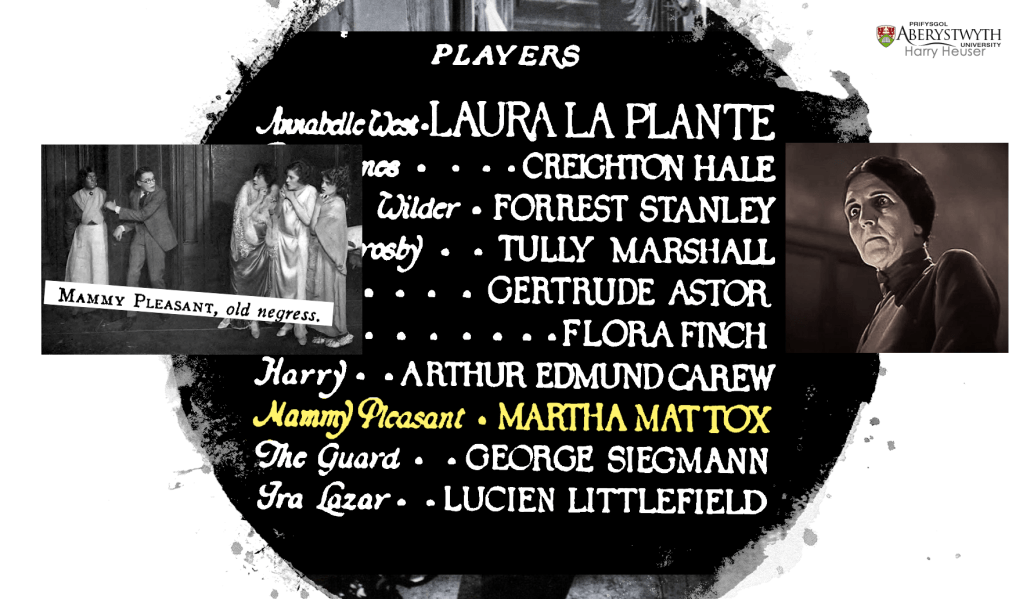
One revision draws attention to itself in the credits – and it made me aware of the consequences the seemingly inconsequential can have. I am referring to the character Mammy Pleasant, a housekeeper played in the film by the scene-stealing Martha Mattox. Given that The Cat and the Canary was released in the same year that The Jazz Singer stridently hammered a sonic nail in the coffin of silent film – at times simply by dragging said nail screechingly across the surface of an eloquent body of work shaped over a quarter of a century – the reference to the ‘Mammy’ legend stood out like a discordant note.
A slide from my introduction to the screening
What is ‘Mammy’ about Mammy Pleasant, particularly when the role is performed by a white female actor? The 1922 stage melodrama by John Willard, who also acted in the play on which the film is based, describes the character as an ‘old negress.’ Not that Blanche Friderici, who originated the part on the stage, was black. She performed it in blackface.
As The Jazz Singer and other early sound films such as the ‘Amos ‘n’ Andy’ vehicle Check and Double Check (1930), blackface and minstrel shows were very much part of Western popular culture at the time, and they were not effectively challenged – that is, were not permitted effectively to challenge – until decades later.
And yet, the film does not partake of that tradition, retaining the character’s name only. In the play, Mammy Pleasant is a servant who has gained enough independence to choose whether or not to serve the future heir to the fortune of her deceased employer, as is clear from this exchange with the family lawyer, Roger Crosby, prior to the reading of the will:
Crosby. Six! All the surviving relatives. By the way—Mammy—your job as guardian of this house is up to-night. What are you going to do?
Mammy. It all depends. If I like the new heirs—I stay here. If I don’t—I goes back to the West Indies.
There is no such exchange in the film, and the ethnicity of Mammy Pleasant is not made central to the characterisation, which in the play is rooted in stereotypes surrounding superstitions to be rooted out in the act of ratiocination. The Cat and the Canary is, after all, not a Gothic romance but a whodunit in which weird goings-on are shown to have a logical, albeit preposterous, explanation.
The name Mammy Pleasant, in Willard’s play at least, carries with it a reference to an actual person – the businesswoman and abolitionist Mary Ellen Pleasant, who, by passing as white, managed to become the first African American millionaire.
In the stage play, produced nearly two decades after Pleasant’s death in 1904, the reference is facetious and derogatory. Mary Ellen Pleasant, who lost the fortune she had made and shared as an activist, and whose character was destroyed when her passing as a white cook and landlady was exposed, is misremembered in the film as a not altogether trustworthy and slightly threatening outsider operating on the inside of a dead white millionaire’s mansion.
Why did the reference remain? How many viewers back in 1927 would have recognised it as a reference to Mary Ellen Pleasant? And how many would have found comic relief in what might have been some sort of white revenge fantasy that renders Pleasant odious while keeping her in her supposed place?
It is a gothic reading, as opposed to a reading of the gothic, that refuses to privilege the center and, imagining alternatives, lets the canary chase the cat for a change. An unlikely scenario, to be sure; but to expose what is cultural it is useful to conjure what is unnatural.
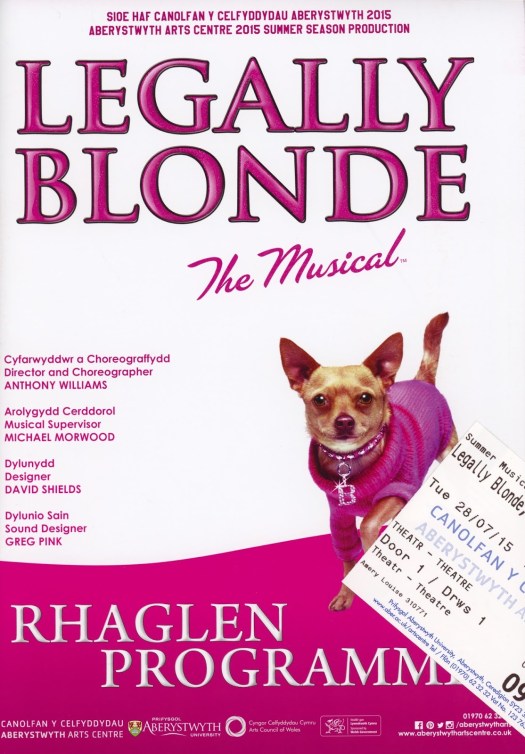
Okay, I am blond, gay and European. So it isn’t all that difficult for me to relate to this year’s summer season offering at the Arts Centre here in Aberystwyth. “Positive” and “Omigod You Guys,” it’s Legally Blonde: The Musical. Ever since I relocated, for love and legal reasons, to this little Welsh town – from an island, no less, that has Broadway running through it – I have not missed a single one of these seasonal spectaculars. After all, they are often the only indication that summer actually takes place here. And since that very first show – which was Oliver! back in 2005 – I have been coming back to the scene it would be a crime to miss.
I’ve also seen the summer season grow up over the years, and the characters along with it, from a criminally mistreated but dutifully hoofing and oh-so-adorable Victorian orphan to a stylish, twenty-first-century Harvard Law graduate who seems to be fighting a lost cause but ends up winning her first case and her true love besides.
In Legally Blonde, justice is served as in Dickensian days, except that what you deserve is no longer dished out as a helping of destiny. I won’t say that either way is “So Much Better” than the other – for entertainment purposes, at least – but it sure is about time to have, at the heart of it all, three persevering females who don’t have to suffer Nancy’s fate so that the Olivers of this world can enjoy the twist of their own.
Legally Blonde does its part to “Bend” if not quite “Snap” the long string of boy-meets-girl plots of theatrical yesteryear; at the same time, it cheekily pays tribute to the ancient laws of Western drama, right down to its cheerleading Greek Chorus. The conventions are not discarded here but effectively “Whipped Into Shape.” And what it all shapes up to be is an updated fairytale of boy meets girl in which girl ditches boy since boy doesn’t meet the standards girl learns to set for herself.
The lads, meanwhile, perform parts traditionally forced upon the ladies: they are the chosen or discarded partners of the women taking charge. Unless they are objectionable representatives of their sex, like the opportunistic Warner Huntington III (convincingly played by Barnaby Hughes), the men of Legally Blonde are mainly paraded as sex objects, flesh or fantasy. Exhibit A: stuff-strutting Kyle (inhabited by a delivering Wade Lewin). Exhibit B: gaydar-testing Nikos (gleefully typecast Ricardo Castro, returning to Aberystwyth after last year’s turn as Pablo in the divine Sister Act). Come to think of it, even the two dogs in the show are male – and how well behaved these pets are in the hands, or handbags, of the women who keep them.
Not that it looks at first like the women have a clue or a fighting chance. I mean, how can a gal be oblivious for so long to the connubially desirable qualities of gentle, reliable if fashion-unconscious Emmett Forrest (played by David Barrett, who was unmissable as Mr. Cellophane in the Aberystwyth production of Chicago)? That Elle Woods ultimately finds her way and gets to sings about it is the so not gender-blind justice of Legally Blonde.
And that we side with the spoiled, seemingly besotted sorority sister is to a considerable degree owing to Rebecca Stenhouse’s ability to make Elle mature in front of our eyes, from bouncily naïve and misguided to fiercely determined yet morally upright. And, as her character gets to prove, a valedictorian is not just Malibu Ken’s girlfriend in a different outfit. Legally Blonde demonstrates beyond the shadow of a doubt that you can be pretty and “Serious” in pink, even though I, personally, have failed on both accounts.
Depending on Elle’s success in getting her act together is the life and career of Brooke Wyndham (energetically played by endorphin-level raising Helena Petrovna), a celebrity on trial whose fitness empire is endangered by a dirty secret of a potential alibi. And if you are a cynic out for a hanging, just wait and see what Brooke (and Petrovna) can do with a piece of rope.
As it turns out, Brooke does not have to make a case for orange being the new pink, which of course was the old black. Ultimately, not wardrobe but a serious case of TTP saves the day, for which the production hairdresser can take some credit. Follicles play nearly as big a part in Legally Blonde as in Hairspray, to name another property Aberystwyth Arts Centre has laid its skilled hands on in recent years. And if that production had a showstopper in “big, blonde and beautiful” Motormouth Maybelle, Legally Blonde has down-but-not-out stylist Paulette Bonafonte, a role Kiara Jay makes her own with warmth, knowing and extensions in her voice that reach from here to “Ireland.”
Legally Blonde is not without its share of injustices. It takes a seasoned professional like Peter Karrie to accept a plea bargain of a part that allows him to be the villain of the piece but denies him the moment his Phantom-adoring followers may have been hoping for. It was Karrie I saw in that memorable Oliver! production, and he is back here as Professor Callahan, a suave shark with a nose for “Blood in the Water.” Like Fagin, he is a law unto himself; but unlike Fagan, the professor is ill served by a book that bars him from tunefully “Reviewing the Situation” once he gets his just deserts. Not that you won’t be gasping at the scene that constitutes his downfall.
Now, had I a Manhattan-sized “Chip on My Shoulder,” I could object that, if “What You Want” to produce is a musical, you might consider putting a few instruments back into the pit. I mean, with sets as swanky as Acapulco, why should the singing be practically a cappella? The overture out of the way, any such objections are largely overruled, given the plain evidence that these troupers hardly depend on orchestral crutches. “Break a leg” to all of them – dancing, skipping and rollerskating – for keeping the pace brisk and making Legally Blonde such an infectiously high-spirited show.
This was the first season I attended as a legally married blond, gay European – and I think it is no overstatement to say that, for all their heterosexual pairings, shows like Legally Blonde have helped to take on patriarchal bullies, to rethink masculinity and what means to “Take It Like a Man.” It’s not the American flag alone that is prominently on display here. Whatever your angle, I can bear witness to the fact that, by any standard – gold, platinum blonde, or otherwise – the Aberystwyth Summer Season is in the pink.
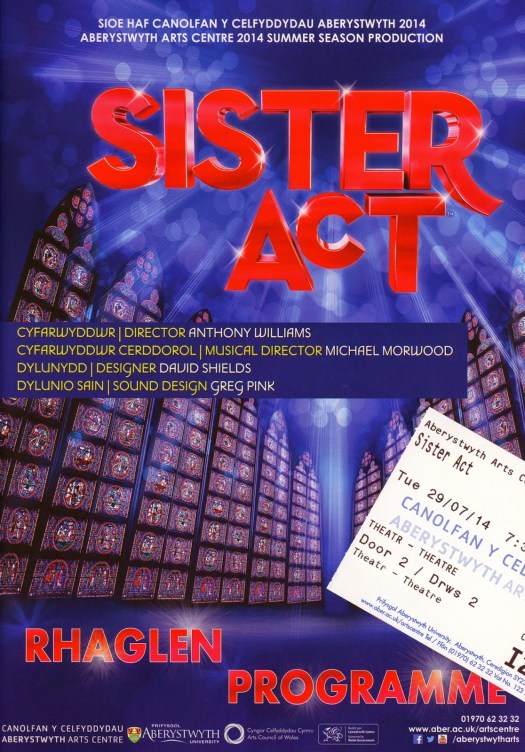
“Farrah Fawcett as thou art in heaven!” This is a good time to dust off your “F. M. boots” and shake your groove thing right on down to our local Arts Centre here in Aberystwyth. You know, F as in Funky and M as in, well, Mary, Mother of Grace. Or, FM as in radio, tuned to the station that gives you Diana, Donna and … Deloris. Deloris Van Cartier, honey, the diva that dreamed of a wearing white fur and ended up in a nun’s habit. Yes, it’s Sister Act, the musical. The one about the convent where the mother’s Superior and the sisters Supreme.
In this production, Mother Superior is played by Lori Haley Fox, whom I previously saw perform here in Chess and Hairspray. There is a bit of Velma Von Tussle in Mother Superior—but her Sister Act character has some depth, which comes across in Fox’s rendition of “Here Within These Walls.” You don’t just get to hiss and laugh at her, but get to understand her struggle to restore the order that wasn’t meant to be a reformed one. It’s a fight against the trivialization and exploitation of her beliefs. To be sure, it’s a tall order to deliver such conviction in a play so invested in that very trivialization. But if there are false notes in this musical, they are not coming out of Fox’s mouth. Nor out of Jenny Fitzpatrick’s, for that matter, who is great in the wear-your-Jackal-and-hide part of Deloris “Sister Mary Clarence” Van Cartier, a diamonds craving tramp with the proverbial heart of gold. Or a golden larynx, anyway. And Fitzpatrick sure got that, and soul besides. Make that Philly soul. After all, the scene is set in Philadelphia, the town to which the bastard of Disco can trace some of its heritage.
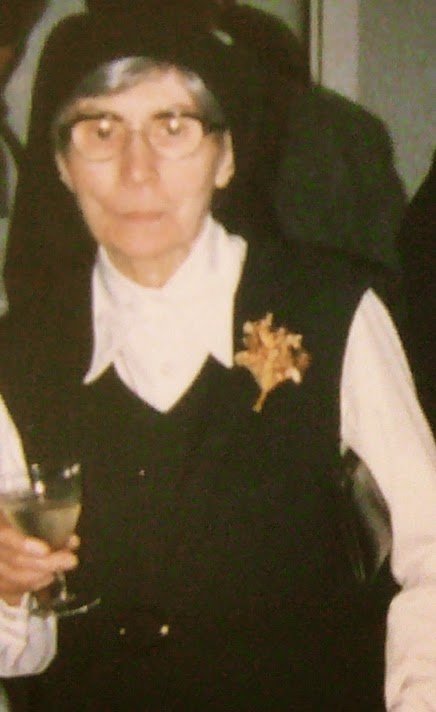
My great aunt was a nun, so I fancy myself an authority
[Image caption: My great aunt was a nun, so I fancy myself an authority.]
I’ve been attending the Aberystwyth Arts Centre productions ever since I arrived in this town after fifteen years of life in Manhattan. I had a bad attitude in my suitcase and thought that nothing could match Broadway, that this was just the sticks. Well, shows like Chicago and Hairspray proved me wrong. Actually, the very first show I saw here, Oliver!, did that. And it was great to see Mr. Bumble again, right there in that convent. Gary Davis, I mean, who plays Monsignor O’Hara. Indeed, there were a number of familiar faces in the cast, among them David Barrett and Robert O’Malley.
Brother, it must be tough for any man to assert himself in a place where all those rapping and von Trapping sisters are doing it pretty much for themselves (and the Almighty); but Robert Grose as Curtis Jackson and Aaron Lee Lambert as Eddie Souther are giving it their best shot—and I’m using the metaphor advisedly. Grose is at his smarmiest best singing “When I Find My Baby,” a creepy number worthy of Sweeney Todd and likely to give you the heebie-Bee Gees.
Meanwhile, in “I Could Be That Guy,” Lambert makes a transition that rivals the costume change endured by Deloris – albeit from plain to fabulous, so that the twain can meet somewhere in between—and he doesn’t get a phone booth or even a Hong Kong Phooey filing cabinet to do it in. So, props to him! Then again, why call props when Velcro and virtuosity will do?
There are echoes of Kiss Me, Kate in the trio of thugs—The Three Degrees of separation from the baboon—who are making apes of themselves for our amusement in “Lady in the Long Black Dress.” Never mind Earth and Fire; these guys are pretty much all Wind. That said, Andrew Gallo as Joey has more moves in his eyebrows than most wannabe Travoltas have in their polyester-clad hips. George Ray as TJ does four-eyed cute as well as Rick “Suddenly Seymour” Moranis ever did. And Ricardo Castro is just bueno as Pablo in a Brüno kind of way.
Meanwhile, for those who prefer their eye candy unwrapped, there are a couple of highly distracting boy dancers, competing though they were, temporarily, with an audience member in front of me who insisted on noisily unpacking her own treats. Sure, Toffifee is retro, but a flask is more discreet.
Dancing boys and their legs apart, this is still a play in which the sisters have the upper hand; and glorious Jodie Jacobs as Sister Mary Robert and fierce Andrea Miller as Sister Mary Lazarus prove that “It’s Good to Be a Nun.” So what if Sister Act’s pastiche. Why reinvent the Disco Ball? I, for one, am glad to be having the sisters “Here Within These Walls” of Aberystwyth Arts Centre to “Spread the Love.” I’ll be back for another audience with them—and that adorable Pope—just as soon as I get the platforms redone on the F. M. boots I wore out tapping along. “Fabulous[,] Baby”!
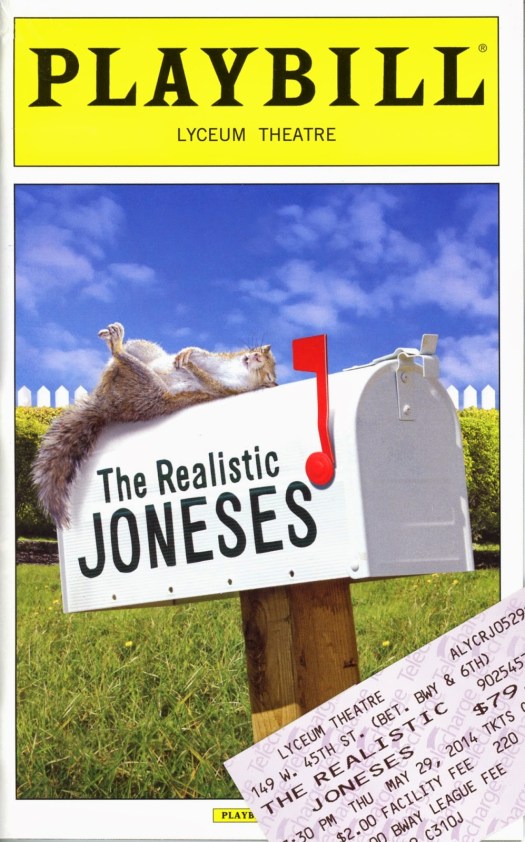
I don’t get it. No, I take that back. I didn’t get anything from it. No, that’s not it, either. I didn’t really like it is more like it, really. Will Eno’s The Realistic Joneses, I mean. It’s one of those plays that are nothing more than wordplay. The Joneses aren’t really Realistic. That much I got, and not much else.
The characters are just worders, if that’s the word for it. If it were a word. They are not word made flesh. I’m not sure whether they are mouthpieces because I’m not sure what they were meant to mouth, other than that we are mostly words to one another. Words that are no reliable access to thought or feeling, that are no substitute for flesh, for sensations and experiences.
A playwright who says as much as that – or as little – has got a real challenge. But that may be too charitable a word for a playwright’s “I’ve got nothing, really.”
The Realistic Joneses, to me, is a bad play. Even the wordplay isn’t that good. It is of a sitcom caliber, and the characters are a bunch of near flatlining oneliners. I mean, ‘Ice cream is a dish best served cold’? Seriously, is that bit of lame rhetoric – a cliché made obvious as a commonplace – a substitute for a plot twist? I didn’t feel the play was a moving comment on the increasingly disembodied state of twenty-first century humanity, much less a sensitive portrait of toxic malaise. I didn’t feel. That’s just it.
The Realistic Joneses is a play on the hollowness of words, and I don’t feel that that is a valid point to make in a play. Not any more. Not even for the middle-aged with a nostalgic yearning for some old-fashioned post-modern self-reflexivity. Well, post-modernism isn’t what it used to be because it just isn’t anymore. Or oughtn’t to be. The tongue has to come out of the cheek eventually, and it has to learn to speak again and say something other than, say, “What’s there to say?” Not just some piffle passing for the absurd. To me, surrealism isn’t anything goes nothing, at least not in the theater.
I walked out of the Lyceum Theatre thinking that I had just spent what amounts to a buck a minute on a rotten piece of ephemera – like that dead squirrel Tracy Letts picks up and throws into a trash bag, or the spoilt food Michael C. Hall takes out of the refrigerator – with little else but these few words of mine to show for it. If only that food had been served hot.
If only the squirrel had lived. If only. Or maybe not.
Theater ought to make for good theater. Noises Off. A Chorus of Disapproval. Stuff like that. Sometimes, though, it doesn’t. And it doesn’t because it doesn’t quite become stuff. And when it ain’t stuff, it fails to matter. The Lincoln Center production of Act One drives that home. And what a slow drive it is. You just sit there, or I did, thinking: when will it stop? Incredulous, I kept checking my watch to see whether time had stood still and I was stuck in the mind of a playwright who hadn’t quite stopped revising, who hadn’t quite figured out just where to go and how to end. And the end, when it came at last, couldn’t have been less of one. You could have spelled it out in six letters. THE END. It’d be quicker that way. But that doesn’t make an ending feel like any conclusion to draw from.
Granted, the question of how and where to finish is always a tough one when it comes to autobiography, a life unfolding and not wrapped up retrospectively. If only Moss Hart had done the adapting of his 1959 autobiography, the play might have had, if not necessarily a structure but at least an urgency, a currency that this nostalgic exercise in pointlessness woefully lacks. Instead, we end up with an adaptation that, in its second act, is mostly about the act of adapting.
That’s just the problem with the second half of James Lapine’s reworking of Hart’s book. It tells – rather than compellingly dramatizes – the story of how Hart and Kaufman collaborated on Once in a Lifetime (1930). Watching two guys sitting around drafting a play isn’t nearly as riveting as experiencing that play or the evolution of it. And, to me, at least, it didn’t help matters that, several years ago, I saw a lifeless National Theatre production of Once in a Lifetime, starring David Suchet. What should have been sheer madcap felt drowsily close to one nightcap too many.
“The theatre is not so much a profession as a disease, and my first look at Broadway was the beginning of a lifelong infection,” Hart wrote. It’s a line from Act One, the book, that makes it into Act One, the play, and it makes you aware how little blood there is in the latter. It is altogether too glossy to make us believe in the curative potency of make-believe, felt by someone brought up in “unrelieved poverty,” as Hart put it. Such urgency could turn theater-crazy Aunt Kate, charmingly though she is played by Andrea Martin, into someone akin to Blanche DuBois.
If the play, in this production, at least, isn’t quite a cure for drama dependency, that may be because it isn’t sufficiently catching to be an antidote to theater madness. It has a cuteness about it that is merely subcutaneous. It doesn’t prick you, or hook you, or infuse you with the passion of which it can only speak in borrowed words.








 Harry Heuser