
They [Got] What They Wanted: or, We Postpone This Wedding

Starting next week, I shall once again take in a few shows on and off Broadway. In the meantime, I do what millions of small-townspeople used to do during the 1930s, ‘40s, and early ‘50s—I listen to theater. Since the 1920, such makeshift-believe had been coming straight from the New York stage, whether as on-air promotion or educational features. Aside from installing an announcer in the wings to translate the goings-on and comings-in, it took the producers of broadcast theatricals some time to figure out what could work for an audience unable to follow the action with their own eyes. When that was accomplished, in came the censors to determine what could come to their ears. The censors were in the business of anticipating what could possibly offend a small minority of self-righteous and sententious tuners-in who would wield their mighty pen to complain, causing radio stations to dread having risked their license for the sake of the arts.

Few established playwrights attempted to re-write for radio. One who dared was Kenyon Nicholson, whose Barker, starring Walter Huston and Claudette Colbert delighted Broadway audiences back in 1927 (and radio audiences nearly a decade later). On this day, 19 May, in 1946, the Theatre Guild on the Air presented his version of Sidney Howard’s They Knew What They Wanted, with John Garfield as Joe, Leo Carillo as Tony, and June Havoc (pictured) as Amy.

Now, I have never seen a stage production of the Pulitzer Prize-winning They Knew; nor have I read it. Like most tuning in that evening, I would not have known about the tinkering that went on so that the story involving a doomed mail-order May-December romance could be delivered into American living rooms—were it not for Nicholson’s own account of what it entailed to get They Knew past the censors.

Nicholson got to share his experience adapting They Knew, one of his “favorite plays,” in a foreword to his script, which was published in an anthology of plays produced by the Theatre Guild on the Air. According to the inexperienced adapter, his “enthusiasm for the job lessened somewhat” as soon as he began to undertake the revision:

“Radio is understandably squeamish when it comes to matters of illicit love, cuckolded husbands, illegitimate babies, and such; and, as these taboo subjects are the very core of Mr. Howard’s plot, I realized what a ticklish job I had undertaken.”

After all, Messrs. Chase and Landry remind us, as the result of a single listener complaint about this adaptation of Eugene O’Neill’s Beyond the Horizon, which retained expressions like “hell” and “for god’s sake,” several NBC Blue affiliates were cited by the FCC and ordered to defend their decision to air such an offensive program. Nicholson was nonetheless determined “that there could be no compromise. Distortion of motivation as a concession to Mr. and Mrs. Grundy of the listening public would be a desecration of Mr. Howard’s fine play.”

It was with “fear and trembling” that Nicholson submitted his script. Recalling its reception, he expressed himself “surprised to find the only alteration suggested by the Censor was that Joe seduce Amy before her marriage to old Tony.”

The “only alteration”? Is not the “before” in the remark of the pregnant Amy—”I must have been crazy, that night before the wedding”—precisely the kind of “compromise” and “[d]istortion” the playwright determined not to accept? Nicholson dismisses this change altogether too nonchalantly as a “brave effort to whitewash the guilty pair!” Rather, it is the playwright’s whitewashing of his own guilt in this half-hearted confession about his none too “brave” deed.

The censors sure knew what they did not want those to hear who never knew what they did not get.

The "universal language of mankind"; or, Do You Verstehen Surtitles?

According to Henry Wadsworth Longfellow, our “universal language” is music. This might account for the international crowd at Budapest’s splendid opera and operetta houses; or perhaps it is ticket prices, which the locals are less likely to tolerate than the visitors in town for a good time. It is like that the world over, I suspect. New Yorkers are hardly the main audience for Broadway shows. What is on offer in any cultural center is largely owing to centrifugal forces. Is it the music that is universally understood? Or is it just that money talks without an accent?

Longfellow—who made above remark while on the subject of “Ancient Spanish Ballads”—is often quoted out of context. The “universal” is not meant to imply the absence or insignificance of regional or national idioms. We might all share a love of song without necessarily trilling the same tune:

The muleteer of Spain carols with the early lark, amid the stormy mountains of his native land. The vintager of Sicily has his evening hymn; the fisherman of Naples his boat-song; the gondolier of Venice his midnight serenade. The goatherd of Switzerland and they Tyrol, the Carpathian boor, the Scotch Highlander, the English ploughboy, singing as he drives his team afield—peasant, serf, slave, all, all have their ballads and traditional songs.

It is not local color you are likely to discover when stepping inside the larger venues, painted as they are in the color of money. What, I asked myself as I walked past a Finn in the foyer, is the intended audience for productions mounted by the National Hungarian Opera, where last year we took in the bewildering spectacle of Gone With the Wind, staged as a ballet to the music of Czech composer Dvořák, a pop-cultural miscalculation meant to foster good relations between Hungary and the United States. On offer this time around was Leoš Janáček’s Jenůfa, in Czech, with Magyar surtitles. Is it any wonder I am getting Prague and Pest confused as I try to recall our adventures in theatregoing?

In such moments of cultural confusion the Pontevedrian embassy can generally be relied upon as a refuge for the historically challenged. Yes, the Pontevedrian embassy is always open for business. Said Graustarkian edifice was set up for our convenience at the Budapesti Operettszínház, where the ever popular Lustige Witwe (heard here in a 23 January 1950 broadcast of Railroad Hour starring Gordon MacRae) once more saved her make-believe nation (or was it Montenegro?) from bankruptcy and waltzed off with the less-than-patriotic Danilo (portrayed with brio by Dániel Gábor) into the bargain—all in Hungarian with German supertitles, which, much to my irritation, I caught myself editing.

Finally, we went to the ballet, where “universal” meant lissome girl dancing with scrawny boy . . . to canned music. “Can real friendship exist between a man and a woman, and if so, why not? Happiness and pain follows each other again and again until death comes,” choreographer Antal Fodor comments in his note on “A nö hétszer” (“Women Times Seven”). Sometimes, you just have to provide your own translation . . .

A String of Pearls? Sweeney Todd on Stage, Screen, and Radio

As much as I have enjoyed our Gracie Fields trip—which continued last night with Look Up and Laugh (1935), featuring Vivien Leigh in her film debut—an excursion into the make-believe of contemporary cinema seemed long overdue. And if “contemporary” means Victorian melodrama set to music by Stephen Sondheim, such a break is hardly a violent disruption. Still, I was reluctant to return to Fleet Street. I’m familiar with the Demon Barber’s establishment; and unlike those to whom Burton’s slasher with songs serves as an introduction to this well worn piece of penny dreadfulness—Sweeney Toddlers, I call them—I cannot help but be reminded of past encounters with the not-so-gay blade. Would the razor, as swung by Burton, be sharp, dull, or just too ornate to be effective?

According to my diaries, whose racier passages I skipped to extract the data I required from it, I got my first look at Sweeney in September 1989, when Sondheim’s 1979 musical was revived by the York Theater Company and moved to the Circle in the Square Theatre on Broadway, with Bob Gunton as Sweeney and Beth Fowler in the role of Mrs. Lovett (see Playbill above). Referred to as “Sweeney Todd, Up Close and Personal” by its director, it was a scaled down production that depended far more on the talents of its performers than on an elaborate set design. What besides rage, a razor, and that ingenious chair does Sweeney really need to get the job done?

A little more than three years later, Mrs. Lovett was Judy Kaye and Fleet Street was a set at the Papermill Playhouse in New Jersey. As I remarked in an undergraduate essay, venturing out to New Jersey “meant not only the reluctant departure from the cultural center, but also from personal stereotypes about Manhattan’s periphery.” Ms. Kaye, whom I would meet on a few occasions thereafter, truly brought the amoral pie maker back to life for anyone who might have thought she had died after the spirit of Angela Lansbury departed from a body so easily collapsed into a single dimension.

A decade later, the melodrama The String of Pearls by George Dibdin Pitt had made it onto my reading list as I sauntered toward my doctorate. The barber’s chair and the revolving trap were already in place when the play premiered in 1847; but in this version, borrowed from French sources, the motive Todd’s scheme to “polish off” his customers was a hankering after the titular pearls rather than suffering and revenge:

When a boy, the thirst of avarice was fist awakened by the fair gift of a farthing; that farthing soon became a pound; the pound a hundred—so to a thousand, till I said to myself, I will possess a hundred thousand. This string of pearls will complete the sum.

Since my studies were chiefly concerned with US radio drama, it had also come to my ears that, back in 1896, Sherlock Holmes had attended, “with obvious delight,” a revival of the shocker. In one of Doctor Watson’s accounts of his life with the famed detective (broadcast on 28 January 1946), Holmes is invited backstage, where the actor in the title role shares his horrible suspicion:

I know it sounds fantastic, but it’s true. I’ve often heard of actors beginning to live their parts off the stage that they play on it. Well, it’s happening to me. I am turning into another Sweeney Todd, the character I am portraying on the stage.

A reference to this oft sliced chestnut, heard here in a CBC production from 1947, can also be found in John Dickson Carr’s this episode of Cabin B-13 (5 July 1948), in which an American visitor to London learns that he resembles a killer who lives above a barber shop in Fleet Street, has got a razor and “is ready to use it.”

While not quite as dreadful as I had anticipated, Burton’s Sweeney is joyless and drab, rendered in computer generated imagery that, by now, has become more tiresome than the traditional hokum on display in this black-and-white version from 1936 starring Tod Slaughter. Being forced to fly rather than slowly make our way through the labyrinthine passages of the dingy, darksome metropolis, one gets no sense of entrapment or secrecy.

Our minds do not get the workout that make our bones ache in the keen awareness of having travelled on foot rather than some multi-purpose not-so-magic carpet from the CGI warehouse. Whatever happened to a sound brick wall like the one we want to bang our head against after having been taken for a ride that?

Removed from its narrative frame (“Attend the tale of Sweeney Todd”), the epic theater convention of encouraging detachment to achieve a demonstration of social problems, what remains of Sondheim’s Sweeney is old-fashioned melodrama for the pathos of which Burton used to have a flair. And yet, more so even than Charlie (discussed here), Sweeney is largely devoid of wit and vision. With the exception of the Pirelli-Barker shaving contest, in which Sacha Baron Cohen steals the show as the Todd’s spurious rival, most of the numbers are listlessly assembled.

It would have been intriguing to see this melodrama turned into a pop-up book in which cardboard characters struggle to emerge as three-dimensional individuals; but the characters, as presented by Burton, would not stand a chance to distinguish themselves. They are utterly forgettable—a rare feat, given such material.

Burton might do well to look beyond his ensemble once in a while. Depp, who is being given a virtual Botox treatment that renders his phizog expressionless, and Bonham-Carter, who is buxom yet bloodless, are not suited for every costume he throws at them. Their voices are thin, their singing flat and, what is worse, the enunciation frustratingly poor. Bonham-Carter, if you’ll permit the pun, has probably the worst pipes in London. The orchestra is meant to give the musically challenged actors a boost; but here it ends up given them the boot instead. Casting, after all, is not as easy as “popping pussies into pies.”

In short, this latest Sweeney is as tired as a Victorian scullery maid who has lost the ability to dream up ways of disposing of her employers. With all those pearls of ruby blood spilled onto screen, some ought to have been set aside for an emergency transfusion.

“With hey, ho, the wind and the rain”: Thoughts on Twelfth Night

Well, this is it. Twelfth Night. In Elizabethan England, Epiphany (6 January) marked the culmination of the winter revels, that topsy-turvy escape to the kingdom of Upsidedownia. For me, it is an apt time to return to this journal in earnest by looking back at my own follies, being that the first daft act of the year has me lying in bed with a cold. I am feeling—to borrow and immediately discard what unaccountably has been declared word of the year—decidedly subprime (wouldn’t below par or having peaked do just fine? Then again, it is a banking or business term and should therefore be ugly and subliterary). I had meant well, braving the wind and the rain, walking our dog after a three-week separation. Just a few days earlier I observed that 2007 has really been a wonderful year; in case yours has proven otherwise, I apologize for rubbing it in like so much VapoRub.

It was a year of traveling and theater-going that, a fall from a ladder notwithstanding (as a result of which my right pinky is now more likely to remain extended during high tea) was free of strife, hardship, and disappointment. Sure, there were those seemingly endless weeks without phone or wireless internet, there was a move into town that fell through, and there were a few minor upsets in my now sidelined teaching career. And then there was that summer that wasn’t. “For the rain it raineth every day.” Yes, it has been a wet year at that. It began in stormy Glasgow and ended in a drizzle on Waterloo Bridge in London, where the annual firework spectacular disappeared behind a thick curtain of sulphurous mist.

Perhaps my greatest folly was the attempt at maintaining this journal while away from home (as I was for about one fifth of the year). Much of what I did manage to convey, pressed for time or bereft of a reliable wireless signal, was—watch me resist neologian inanities—substandard. As I have proved conclusively, I am not cut out to be a post-postmodern Tintin, to mention the titular hero of one of the most engaging theatrical entertainments of 2007, a year filled with delights and sprinkled with duds. Among the duds, aforementioned, were a ballet version of Gone With the Wind, which we caught in Budapest, the Angela Lansbury vehicle Deuce, and the death sentence to musical theater, an art form done away with, rather than revived, in the guise of a cheap concert version of itself that is Spring Awakening.

Among the recent theatrical highlights numbered the New World Stages production of Charles Busch’s Die Mommie Die, with the 2003 film adaptation I have caught up since. It had been seven years, almost to the day, since I saw Busch’s rather more conservative Tale of the Allergist’s Wife, starring (opposite Linda Lavin and Tony Roberts) the wonderful Michele Lee. The star of Die Mommie Die, of course, is the playwright himself. Some unnecessary crudity aside, it is a brilliant evocation of the 1960s and the end of the Hollywood era. It is also a darn good mystery—a rather better mystery than Christie’s nonetheless charming Mousetrap.

I am not a lover of camp, which, according to my own definition, is a wilful act of misreading. Die is a careful reading of the state of the women’s picture in the 1960s, the schlock that reduced a number of silver screen A-listers to sideshow freaks.

The heroine of Die Mommie Die is washed up, all right; but Busch does not derive most of his laughs from strapping her into a ducking stool. His play is as much an homage as it is a send-up (catering to those familiar with the histrionics of Crawford, Davis, and Susan Hayward); and it is this careful balance that, despite some vulgar touches, makes his play succeed both as thriller and farce.

Yes, I am rather traditional when it comes to film and theater, but that is not why I did not care much for Matthew Bourne’s Nutcracker (now playing at Sadler’s Wells)—having enjoyed his Car Man earlier this year—and sought refuge at the Prince Edward Theater to take in one of the final performances of Mary Poppins on New Year’s Day. I am not opposed to trying out something new; but I find more pleasure in finding the new in the supposedly out-of-date.

A great while ago the world begun,
With hey, ho, the wind and the rain,
But that’s all one, our play is done,
And we’ll strive to please you everyday.

Yes, I am back, Monday through Friday. And not going on about the weather—until something well nigh catastrophic or at any rate sensational compels me to break this rule . . .

Felicitous Tintinkering; or, Take Note, Mr. Spielberg

Considering that he inspired the adventures of Indiana Jones, Tintin should do well under Steven Spielberg’s direction. Little is known as yet about the project; and I wonder whether Spielberg, preparing the boy reporter for his first Hollywood outing, is paying attention to the Young Vic production of Hergé’s Adventures of Tintin, which I caught at the Wales Millennium Centre in Cardiff prior to its return to London, where the production will soon reopen in the West End. What an inspired piece of pop culture this dramatization of Tintin in Tibet (1958-59) turned out to be.

I was not prepared to be charmed. I expected something along the lines of the previously reviewed Thirty-Nine Steps (which will soon open on Broadway); but, despite its wit, David Greig and Rufus Norris’s stage version was not so much tongue-in-cheek as it was true to and respectful toward its source without being slavish in its fidelity.

The psychedelic opening sequence had me worried a bit. Although entirely in keeping with Tintin in Tibet, which draws on surrealism to explore the dreams and visions of its central characters, the parading of famous Hergé figures who have no part in the story had something of a routinely choreographed theme park performance. From this costume ball, however, a number of strong characters soon emerged.

Matthew Parish was ideally cast in the title role, conveying both the vigor and vulnerability of our hero, who is driven to the point of madness and despair in his selfless yet lives-endangering quest to find and rescue a friend whom everyone assumes to have perished in a plane crash. Particularly haunting is a scene in which Tintin investigates the crash site and is faced with the ghosts of the dead passengers.

Miltos Yerolemou (previously hidden in the costume of the giant Yeti) was entirely believable as Snowy, the reporter’s four-legged companion. Their friendship, and indeed the very concept of friendship, is at the heart of Tintin in Tibet, a story with whose gentle lesson the creative team behind Hergé’s Adventures of Tintin did not try to tinker. Heartwarming and pulse-quickening, the result is energetic, charming, and altogether absorbing.

Unlike most of today’s Hollywood blockbusters, the stage play suggests as much as it shows, leaving the audience, assisted by ingenious props, to imagine themselves high in the Himalayas, a hidden lamasery, or the cave of a legendary monster. The props, in this case, are not a substitute for the imagination. They are a stimulant. Let’s hope that big screen, big budget special effects won’t do away with this give and take of make-believe . . .

Kaboom! Kerplunk! Ka-ching!

Well, being that I am off to Cardiff on Thursday to see the touring Young Vic production of Hergé’s Adventures of Tintin, I thought I’d make this serial and comic strip week here on broadcastellan. “Blistering barnacles” and “Cushion footed quadrupeds”! I am smack in the middle of the “Funny Book War” as staged by Michael Chabon in The Amazing Adventures of Kavalier & Clay; and even though my comic treats were generally of not of the superheroic kind (to which this recent portrait attests), comics are very much on my mind.

It so happens that the aforementioned (and by now controversial) boy reporter and his creator are also the subject of the BBC Radio 4 documentary “Tintin’s Guide to Journalism” (available online here until 23 November). In this broadcast, which also features the voice of Tintin creator Hergé, journalist Mark Lawson investigates cases of real-life reporters who were inspired to enter their profession by books like King Ottokar’s Sceptre. In my case, comics simply inspired imitation.

The Germans are said to have papered the way to the comics with the picture books of Wilhelm Busch (Max und Moritz), which is where I started out as well. After graduating from the Katzenjammer Kids inspiring Max und Moritz, I became an avid comic collector, spending virtually all of my Taschengeld (distributed as it was back then in Deutsch Marks) on weeklies like Fix und Foxi.

Sigh! My family could not afford to have me shod there; but I still sneaked into the Salamander shoe stores to browse just long enough to grab my copy of Lurchi, another treat being the stories of Mecki the hedgehog I clipped from the pages of the German radio and television magazine Hörzu. More inclined toward the buzz of Maya the Bee than to the “THWIP!” of Spiderman, my comic book phase ended as I entered my teenage years. Make that my “comic reading phase,” since I kept drawing them. My own creations often mocked those among my pubescent schoolmates who kept up with the exploits of guys like Superman or The Phantom.

It was only after I graduated from the comics that I discovered a connection between cartoon bubbles and comic speech, the kind of connection to which the Americans owe the serial adventures of Amos ‘n’ Andy, the kind of affinity that made it possible for New York City Mayor La Guardia to read Little Orphan Annie on the air during the 1945 newspaper strike.

Even though I had very little exposure to radio drama, being the walking TV Guide in my family, I created in the character of Inspektor Bullauge (Inspector Bull’s Eye) a comic for the ear. I made up the story as I played the parts, more interested in the sound effects I could use and record to bring my cardboard creation to life.

Zowie! Despite dedicating an estimated 300,000 words of this journal to popular culture (and radio dramatics in particular), I have never explored here the relationship between onomatopoeia and the equally imaginative world of sound effects . . .

“. . . till the fat lady sings”

It seems that the proverbial one who’s got more curves than the skeletons on the catwalks has not warbled her last.  No, it ain’t over yet.  According to my students, at least, whose rallying cries generated enough interest to keep my rather esoterically titled course “Writing for the Ear” alive, death warrants and prematurely issued certificates notwithstanding. The “fat lady,” of course, is the diva who gets to have the last word in opera. I don’t know where the expression originates; but it seems to be true for much of the operatic canon.  Tonight, I am going to see Mimi expire in a production of La Bohème, performed by the Mid-Wales Opera Company.
Now, I have been going to the opera since I was a teenager, even though prohibitively high prices made for long gaps in my exposure to this kind of melo-drama.  And even though a tenor numbered among my close friends in New York, Opera-going still mostly meant finding an empty space to spread my blanket on the Great Lawn whenever the New York Opera toured the parks, taking the sandwiches out of the basket, and hoping that no cellular device would go off to mar the performance as I lost myself in the night skies in search of that rare star darting its long-delayed light through the smog and light pollution of Gotham.

My tenor friend tried to convince me that opera is the highest form of dramatic storytelling; but, for the most part, I struggled to follow the plot and keep straight just who is who and doing it with whom. Last night, watching the pre-code melodrama Secrets of a Secretary, starring Claudette Colbert and Herbert Marshall, I thought what a great plot for an opera it might have made.  A woman repentant of her follies, a sinister husband, a pining lover (a nobleman, no less), and bloodstained dress.  Perhaps, I’d rather lose track of the plot than the ability to lose myself in the drama of a moment; but I still find it strange to be confronted with a narrative only to ignore it, along with the translations flashing above the stage.

There are few plays I have seen as often as La Bohème, sat through the gloom of Rent and the glamour of Baz Luhrman; but, the music aside, I still recall little else beyond an extinguished candle and a distinct cough.  Not that I believe comedian Ed Wynn to be a reliable translator in matters operatic. Wynn, whom I previously consulted on Carmen, once tried to tell the story of La Boheme (or “La Bum,” as he called it) to tenor James Melton (pictured above), on whose radio program he was featured in the mid-1940s.

It was on the 10 March 1946 broadcast of The James Melton Show that Wynn introduced listeners to Mimi, who, preparing for a ball, had just put on her bustle and was “rearing to go.” In Wynn’s version, Mimi had been named “Miss Soft Drink of the Year” because she was “interested in any guy from seven up.” He had nothing to say about flirtatious Musetta, who had such terrible puns coming.

Now, Mimi lives in the same boarding house as Rodolfo, you see.  One day, she hears the pot, the poet [. . .] reciting.  He says: “There is an old lady who lives in a shoe.”  And Mimi says, “Well, she’s pretty lucky, the way that the room situation is.”

Not Rent-controlled, apparently. Such references to the housing crisis of the mid-1940s pop up frequently in radio entertainment, from Fred Allen to Hercule Poirot (who, as I discussed here, inexplicably relocated to the US and found himself without a flat).

The synopsis is mercifully interrupted by a few notes from the opera, sung by Annamary Dickey.  It is the kind of highhatting of the uplift that was so common an approach to the so-called high arts in the middlebrow medium of 1930s and 1940s radio. It is the working-class re-vision and consequent rejection of culture as imposition, of art as irrelevance, a way of looking without seeing to which I was conditioned as I grew up, my father being hostile toward anything that smacked of the “high classical,” a self-imposed exclusion from the beautiful, transporting and inspiring that expressed itself in crude mockery.

Fortunately, I don’t need to draw on the jovial if misfiring old Fire Chief to enlighten me. The Mid-Wales Opera’s La Bohème is “cenir mewn Saesneg,” which is to say, sung in English. For once I can just face the music, rather than being confronted with my own ignorance . . .

Twenty Men Singing—But Why?

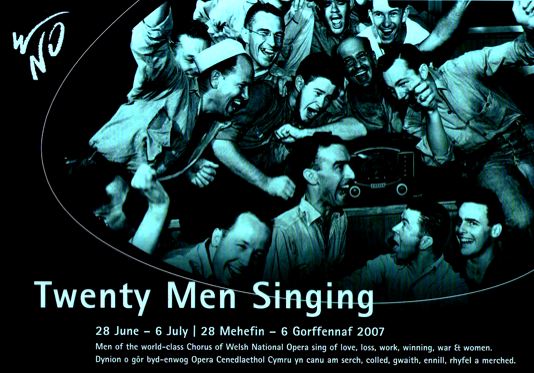
There they stood last night, singing a cappella, performing songs from Schubert to South Pacific, from the 13th-century Middle-English “Sumer Is Icumen In” to Alfred Schnittke’s “Adam Sat Weeping at the Gates of Paradise,” which premiered in 1988. Twenty they were; men of the Welsh National Opera, touring Wales with their aptly titled program Twenty Men Singing. Some of their sonic offerings were tonic, many (and for my taste rather too many) of them somber, reverent, and brooding.

Why were they singing? To amuse themselves, to entertain others, to earn a few quid or to enjoy the applause of an appreciative crowd? Why sing in unison when what you want is to stand out? If, indeed, that is what you want.

According to the program notes, those Twenty Men Singing explore just that: why men raise their voice together in song, whether to celebrate life, to protest or lament. In song, a hoped for unity is being realised in sonic unison. A chorus of disapproval is formed in resistance to voices and actions that may threaten community. Leoš Janáček’s “Sedmdesát tisíc” (1909), for instance (as translated by John Binias), many-voices the pressures inflicted on the national identity of a Czech bordertown by neighboring but less than neighborly Germans and Poles:

70,000 graves they dig for us
Outside Tesin
Beg for help from heaven
Herded like cattle
Like cattle we gaze about
Our own slaughter [ . . .]. 

Let our voices thunder out: [. . .].
Before we are finished [. . .].

This Saturday, performers around the world are singing to bring awareness to what may well be the greatest threat to humanity, regardless how much religion and nationalism, how much faith and terror (and the terror of faith) are being exploited by those who make a fortune keeping us at war with one another.

On this day of Live Earth, festivities that coincide with the anniversary of the London suicide bombings of 2005, we are asked to consider the terra we share, not the terror that divides us, to let “our voices thunder out” before we are “finished.” I cannot think of a better reason for joining a chorus.

The Bourne Imperative

Well, I’m not sure whether I could stomach Lorna Luft and Dallas alumnus Ken Kercheval in a touring production of White Christmas; but Matthew Bourne’s Bizet ballet The Car Man was certainly worth a trip to the splendid Canolfan Mileniwm Cymru (Wales Millennium Centre) in Cardiff Bay. Inspired by James M. Cain’s oft-adapted 1934 novel The Postman Always Rings Twice (revived on 24 January 1952 on Hollywood Sound Stage, starring radio stalwart Richard Widmark), The Car Man is set in mid-20th century small town America (the fictional Harmony, pop. 375), The Car Man tells the story of the titular drifter who falls for the accommodating wife of his new boss (a vixen named Lana, after the actress who played her in the 1946 film version). Though easily duped, the cuckold is bound to find out, eventually, and to be less than accepting of the triangular situation.

Unlike his whimsical if choreographically frivolous Edward Scissorhands (my impressions of which I shared previously), Bourne’s earlier Car Man is proper dance theater, with an exceptional performance by Michela Meazza as Lana.

While firmly within the tradition of 19th-century melodrama without resorting to camp, The Car Man bears no resemblance to Carmen. Indeed, the story as told in movement, light, and a generous amount of stage blood is far easier to follow than that of Bizet’s opera or the Prosper Mérimée novella upon which it is based, a plot comedian Ed Wynn insisted on translating for the listening audience of Tallulah Bankhead’s radio variety program The Big Show on 26 November 1950, as opera star Lauritz Melchior struggled to perform Pagliacci: “And as the curtain rises, we see Carmen walking out of the cigarette factory. We know it’s a cigarette factory because there are doctors walking in and out of the building.”

Those medical practitioners, of course, were meant to endorse tobacco rather than treat the workers or assess the risks of smoking.

“Carmen has many admirers,” Wynn continued, “and to each one of them she has given a lock of her hair. Isn’t that beautiful? So, Carmen, or as she is now called by her friends, Baldy, [. . .].”

Not that Mr. Wynn could have possibly prepared me for the theatrical experience of The Car Man. In keeping with his celebrated all-male revision of Swan Lake, the old love triangle has been colored pink; or, rather, it is getting another—an outré—angle, as Bourne tosses a male admirer of Lana’s lover into the bloody mix of lust, jealousy, and murder. Being granted views of a communal shower, a private bedroom, and life behind bars—or wherever else you might expect intimate encounters of the same and opposite sex on a sultry evening, Bourne’s audiences can and should expect the full bodyworks.

Crude Awakening; or, This Ain’t Show Boat

Unlike the previously discussed play Deuce, this one came highly recommended: Tonys darling Spring Awakening (music by Duncan Sheik; book and lyrics by Steven Sater), with which I caught up during the week leading up to Broadway’s annual awards ceremony. It has been touted as the new Show Boat, the spectacle with a story that revolutionized musical theater back in 1927 (and revived on radio as a musical, a straight play, a musical serial, and a number of burlesques). “Old Man River,” take me now! I realize that I am filing a minority report here; but if this is the new face of Broadway, I just got to slap it.

For starters, that new face is partially obscured by hand-held microphones, props that, along with an audience seated onstage and a blackboard listing the tunes, are meant to suggest, in the by now tiresome postmodern mode of self-reflexivity, that what you see and get is only “Make Believe”—an Epic theatrical in the Brechtian vein designed to be stimulating rather than absorbing. Verfremdung, Broadway style, means to play out whatever is left of a story like a rock concert; that is, by playing to the audience rather than interacting with one’s fellow players.

Spring Awakening is not so much an adaptation of Franz Wedekind’s drama of youth, longing, and disillusionment as it is an assortment of clichés about hormonally-induced teenage Sturm and Drang. This high-Rent production (which won’t break even at the box office any time soon) may well appeal to youngsters who don’t know any better or refuse to listen, and to their parents who assume this noisy spectacle to be happening since it has an energetic and gifted cast that emotes in foul language and jumps up and down a lot, as if out to bring in ‘da punk. In its treatment of sexuality beyond the old boy-impregnates-girl-and-both-pay-for-it formula, however, the show betrays its conservative agenda, acknowledging the reality of alternative stirrings only in the form of comic relief.

Choreographed like an old Britney Spears number and outfitted in costumes left over from a touring production of Ah, Wilderness!, Spring Awakening revels in an identity crisis equal to that suffered by an acne-troubled, media-beleaguered high schooler set to pass out at a Goth concert—and it is just about as cheerful and endearing. “Mis’ry’s Comin’ Aroun’,” showtune lovers.