
Manhattan Transcript: Why The Drowsy Chaperone Might Have Done Well on the Air

Well, there I was this afternoon, walking Montague, our terrier, and picking sloes along the lane near our house halfway up in the Welsh hills. I was walking him in order to get to the sloes, truth be told. Unlike Montague, though, the sloes won’t be seen again until Christmas, as I learned, much to my dismay, after having spent half an hour pricking them. I had heard of a Sloe Gin some time ago; but I always assumed it to be spelled “slow” and work as fast as the regular kind. Now I know that my ear hadn’t led me altogether astray, considering that it will take so long to appreciate this potent concoction. At any rate, a predilection for booze is something I share with that celebrated Broadway dame known as The Drowsy Chaperone, who may currently be seen failing her charge in the Tony Award-winning “Musical Within a Comedy” of the same name, a show that reminded me of my love not only for stiff drinks but old-fashioned radio drama.

I might not have learned about The Drowsy Chaperone had it not been for some of my New York City pals, some of whom work in the theater. Now, Broadway isn’t exactly “My Beat.” As much as I enjoy “How Do You Solve a Problem Like Maria?” (a West End Sound of Music audition-turned-TV reality show starring Andrew Lloyd Webber presently unfolding on BBC television), I am rather selective in my choice of musical treats. I would not be caught dead watching Cats, to be sure, and have refused to attend a performance of Phantom even when a close friend of mine was one of its featured actors on Broadway.

A few years ago, I enjoyed Drowsy Chaperone‘s leading lady Sutton Foster in a revival of Thoroughly Modern Millie, and her presence, as long as it does not remind me of Leslie Caron (as indeed it sometimes does), suffices to make me shell out some $75, the highest price I have yet paid for a TKTS ticket, to see a show that is an amusing trifle rather than a certified classic.

Now, on that particular night (the date of which you may glean from the ticket displayed above), Ms. Foster was rather subdued and lackluster. Too bad, considering that her “Show Off” routine is the smartest number in the whole production, which opens with Mary Tyler Moore alumna Gloria Engel going on about her “Fancy Dress,” a tune that is insipid rather than comically inspired. Worse still, the eponymous character (the Drowsy one) was played by an understudy, as that dreaded white slip in my Playbill informed me. Understudy, in this case, meant second best. Luckily, the same was not true for the whole production.

There is a self-reflexivity about The Drowsy Chaperone that is so subtle and commercially slick as to render this musical comedy charming rather than clever. In fact, the play struck me as decidedly dumb—in a manner that ingratiates instead of irritates. The smartest thing about it all is the opening of the play and its concept. After all, The Drowsy Chaperone begins in utter darkness, with the voice of a middle-aged Broadway aficionado (who, traditionally, does not speak in a booming baritone) telling you about the costly experience of going to the theater these days before sharing a record (vinyl, no less) from his collection of show tunes.

One of those forgotten gems is The Drowsy Chaperone, the forgotten (and entirely fictional) 1929 musical our host (the “Man in a Chair”) has never seen but imagined often enough sitting in front of his outmoded home entertainment system and listening to an old and not altogether groove-proof record in his rundown New York City apartment. As he tells the audience about the show, the impressions made by the recording come to life and The Drowsy Chaperone materializes before us as it presumably might come alive in our MC’s mind. Of course, for seventy-five bucks or more, we demand to see our theater. Most of us go to a Broadway show for sheer dazzle, not dialectics. We rely on Off-off Broadway for the subversive and provocative—and the clear demarcation makes it easy for most to avoid such intellectual challenges.

And yet, nothing I saw onstage quite matched the excitement or warranted the enthusiasm of that middle-aged man (wonderfully portrayed by Bob Martin), an unassuming cardigan-clad homebody whose visions, no doubt, were more potent than anything devised by the set designers of this show. I wonder how theatregoers might have reacted had the scene been cast in darkness for the entire eighty-odd minutes (a short enough time for a Broadway play). They might have concurred with the guy.

Aside from “Show Off,” “Accident Waiting to Happen” and the surprising “Message from a Nightingale,” The Drowsy Chaperone wasn’t all that much to look at. Then again, who would pay this much for a single radio play? The eyes had it, as usual—but they did not quite have their fill . . .

Fiddle/Sticks; or, When Broadway Comes to Town

Well, there’s milk in the old cow yet. The cash cow that is Fiddler on the Roof, I mean, which started giving in 1964 and ran for a record-breaking 3,242 performances. Forced to abandon the town of Anatevka, Tevye and his neighbors have travelled the world to inhabit the small but rich territory that is the theatrical stage. One of those theaters giving a temporary home to the Fiddler is the Arts Center in Aberystwyth, Wales, where the plight of the Russian Jews and their threatened “Tradition” are now being re-enacted by a mostly Welsh cast, headed by Welsh-born Peter Karrie in the role of Tevye.
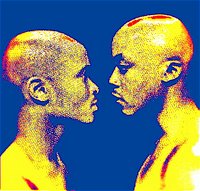
Karrie (“The World’s Most Popular Phantom”) performed in the same venue last summer, when he impressed me with his sensitive portrayal of Fagin in Lionel Bart’s Oliver! (as discussed here). This time around, the show truly revolves around him, which is somewhat of a problem for his fellow actors, who can’t hold a candlestick to him. Karrie is a musical actor; he does not merely saunter or dance across the stage to belt out tunes like the familiar “If I Were a Rich Man.” Even with a microphone coming unglued and protruding from his cheek like a handle on a paper bag, he is thoroughly convincing and engrossing.

Holding up well enough opposite him as his wife is Andrea Miller, who takes on Golde with a long-faced, comical severity that reminds me of Edna May Oliver. Her sentimental duet with Tevye, “Do You Love Me?” is one of the highlights of a show whose greatest shortcoming is that it is rather devoid of darkness. After all, the pogroms, the razing of entire villages and the exodus of the Jews from their Russian homes, are not to be treated like an occasion for so many routinely staged showstoppers. This Fiddler came across like a Jewish version of Pride and Prejudice, with hard-up Golde, like Jane Austen’s Mrs. Bennett, trying to get her five daughters married to well-to-do suitors while her permissive husband caves in to the youngsters’ concept of matrimony as a union of loving partners.

Central to this plot is the matchmaker Yente, a role originated by Golden Girl Bea Arthur (whom I last spotted autographing DVDs at a Manhattan bookstore). In this production, a shtick-figure of a Yente slips in and out of her Yiddish accent. Less fitting still were most of the wigs and beards, rendering the Rabbi, as performed by a juvenile, so laughable as to compromise the sincerity of the entire production. Now, Aberystwyth is a summer resort for Hassidic Jews, who take over one of its beaches during the month of August. Should any of them venture out to see this production, as directed by BAFTA-award winning Michael Bogdanov, they might very well hiss this unfortunate miscast off the stage.

Studying the playbill, I came across one intriguing radio dramatic connection–a wireless connection I invariably seek and find without fail. Apart from Andrea Martin, who is an award-winning writer of radio plays, the playbill names Arnold Perl as the man by whose “special permission” the Tevye stories of Sholem Aleichem were adapted for Fiddler.

I am not sure how Perl got to acquire the rights to these late 19th/eary 20th-century tales; but, as a writer whose old-time radio play “The Empty Noose” commented on the inconclusiveness of the Nuremberg Trials (as mentioned here), he was undoubtedly drawn to them due to their special cultural and political significance, a heritage of horrors now playing itself out in the uneasy compromise that is Israel, a heritage that Bogdanov, himself a descendant of Ukranian Jews, merely fiddles with his amiable roof hoofers for the sticks.

Carrion Antigone: The Island Beyond Guantanamo Bay

Chicken pox. That’s what had kept the Johannesburg Market Theatre players from coming down to Cardigan Bay to perform in Athol Fugard’s The Island. Last night, the two (Mpho Osei-Tutu as Winston and Thami Mngqolo as John) made up for it, even though their audience (students at the local university) had taken off by then for some holiday destination. It was worthwhile hanging on to the ticket, though. And since I enjoy debating myself, I dug up an old college paper I had written on The Island for a graduate course in drama back in the mid-1990s. Aside from its title “Carrion Antigone,” that essay, while not outright dismissed by its academic audience, is rather too slight a performance to warrant reproduction here. It told me more about myself than the play, which I argued to be less concerned with historical facts than with cultural universals.

That statement is in serious need of revision. In its stead, I will only raise the questions that came to mind when I watched the play last night. While staging Sophocles’s Antigone—or re-staging the famous staging of it—on Robben Island, the notorious prison where Nelson Mandela once took on the role of Creon, Fugard does not so much follow than confront the Aristotelean maxim that poetry is a “more philosophical and higher thing than history: for poetry tends to express the universal, history the particular.”

Winston and John, like Mandela, are the prisoners of an oppressive state. They are doing time as a direct consequence of the times in which they live. Indeed, Winston is doing more than time—he is in it for life. Yet even though he, like the defiant Antigone, has been robbed of a chance to count his days—to plan for and look forward to a tomorrow of his own shaping), he resents being asked to play the title role in Sophocles’s drama, which John wants to perform for fellow inmates and prison staff.

Aside from being uncomfortable playing a female character inside the homosocial confines of a prison, Winston dismisses the very idea of staging Sophocles as “child’s play.” Make-believe like Antigone seems remote and irrelevant to him: “I live my life. I’m here, and it’s history, not legends.” John tries to remind him that “child’s play” is what their warden calls their “convictions” and “ideals”—the beliefs for which they, like Antigone, were condemned.

Ideals are not removed from history—they are born of and beget it. To think of “history” and “ideals,” of “reality” and “play” as opposites may mean surrendering life to the system of binaries according to which Winston and John were cast as criminals.

When Winston learns that John’s sentence has been shortened and that his cellmate is to be released in a few months, his attitude toward performing changes. He is, after all, living quite outside what he thought of as history, on Robben Island, where even time in its relativity has lost its meaning: “My life? How do I count it, John? One . . . one . . . another day comes . . . one.”

Now “lost between life and death,” he has to meet the challenge of making his days matter. Playing Antigone—and playing it for those like him, right before the guards—may be just the thing. The latter may shrug off the trial and death sentence of Antigone as harmless “legend”; but to the former it will be the living history of their convictions.

The Island confronted me with my own remoteness from what I often thought of as the world before I entered the blogosphere—a world of ideas presented on the stage that is a journal such as this. Is this stage as much a new world as it is an old prison? Is that sphere a Robben Island on which inmates circulate, exchange, and recycle thought, as the guards watch on and let it pass, for now? How do you meet the challenge of making life matter when it does not seem to count or add up to much?

Gormenghast (Dis)played; or, How to Mount a Frame of Mind

The beleaguered sun appeared to have triumphed at last in a narrow victory over the long-reigning clouds, and I, a much deprived heliolater, ventured out with laptop and deckchair to luxuriate in the vernal cool of a brightly colored afternoon, absorbed in thoughts of . . . death, dread, and desolation. It was not the long shadows cast upon the weeds-corrupted lawn, nor the shrieking of the crows nesting in our chimney that evoked such gloomy visions; nor was it the realization that the skies were darkening once more as another curtain of mist was lowering itself upon the formerly glorious outdoors.

No, my mood was not brought on by any one thing I happened to be perceiving at that moment; it was something instead that I took away with me last night as the crowds poured out of the theater on the hill, sending them into the inky, rain-swept night with images of Gormenghast.

Appearing before me, on the stage of my mind, are scenes of last night’s production of Mervyn Peake’s Titus trilogy, a dark evocation of a world more forbidding, more rotten and miasmic than Hamlet’s Elsinore—a world of stifling traditions, soul-crushing dread, and futile ambitions. To say that John Constable’s adaptation of this world was a recreation in sound and images would be an injustice to this thoroughly engrossing spectacle—a theatrical event that struck me at times as a staging of Jacobean revenge tragedies by Cirque du Soleil.

Matthew Bourne, who whipped Edward Scissorhands into such a frothy confection of over-hyped ballet-hoo should take note; as should anyone endeavouring to bring a fantasy like Tolkien’s alive in the “wooden O” of the theater. Under the direction of David Glass, Gormenghast is conceived as an imaginatively choreographed piece of melodramatic shadowcasting, a labyrinthine dreamscape whose grotesque denizens scurry about like frustrated rodents.

As Quentin Crisp suggests in an essay on Peake as author and artist, visualizations often fail in the attempt to capture the imagined. When illustrating or showing, when portraying and rendering concrete the world an imaginative storyteller creates in words, “a certain ludicrous quality is always liable to creep in; the eye begins to vomit sooner than the ear—far sooner than the mind.”

So, the prospect of ghastly gormandizing, on seeing novelistic food for fancy being processed into rancid eye candy was not something I looked forward to without serious misgivings. I had not expected anything quite as bold as this inspired translation, which relied neither on the spoken word nor elaborate props to assist the audience in seeing the castle of Gormenghast rise not so much before their eyes as before their mind’s eye.

There was silent screen horror in the movement of Phillip Pellew (above, as Flay) and in the long corridors suggested by panels and shafts of light; in fact, the production seemed to owe more to silent movies than to western stage melodrama; this Grand Guignol was at times Kafkaesque, at others reminiscent of Brecht’s epic theater, as meek and inconsequential Steerpike (played by Adam Sunderland) attempts to lift himself from squalor to political prominence—a ruthless revolutionary in a stagnant, corroding society insisting on “no change.”

David Glass’s Gormenghast is too bleak to be called brilliant; but it certainly is a memorable achievement in translation, which is the realization that being faithful is not being literal, the radical art of doing away with “no change.”

On This Day in 1944: Montgomery Clift Gets Lost in Radio’s “Wilderness”

Before heading out on this appropriately wild and gloomy evening to see a touring production of Gormenghast at our local theater, I am going to listen to one the lesser known drama programs of American old-time radio: Arthur Hopkins Presents (1944-45), which took its name from the noted Broadway producer-director who hosted the series. On this day, 24 May, in 1944, Mr. Hopkins presented an adaptation of Eugene O’Neill’s popular comedy Ah, Wilderness! starring Broadway legend Dudley Digges and featuring a young if experienced stage actor who would become one of the most sought-after actors of 1950s Hollywood—Montgomery Clift.

In the spring of 1944, Arthur Hopkins took to the airwaves in hopes of introducing to radio a “people’s theatre and a repertory theatre.” Hopkins held that radio offered a temporary “solution to the unavoidable extravagance of the commercial theater in shelving a play when the immediate audience has been served,” and to the “economic encumbrances” that made repertory “impractical” in a Broadway venue. By reprocessing recent stage successes, Hopkins sought to “create adult theatre audiences for them and eventually for Broadway.”

The series premiered promisingly that April with Thornton Wilder’s Our Town, whose use of a narrator makes it one of the most radiogenic of stage dramas. Subsequent plays were not nearly as ideally suited to the airwaves; at least, they were not suited to the demands of the one-dimensional (that is, sound only) medium. Hopkins was vehemently opposed to making changes to the original scripts. He insisted that the “two pillars on which dramatic productions stand are identical in theater and radio. They are text and cast.”

Rejecting the addition of a narrator and keeping both music and sound effects to a minimum, Hopkins deemed the challenge of adaptation to be no more than a matter of sagacious cutting. As a result of such ill-advised fidelity, “Ah, Wilderness!” begins in medias res and ends in somewhat of a muddle. 

The mind receiving no assistance in setting the scene—help provided by a guiding narrator like the one installed in Arthur Arent’s Theater Guild version of the same play—what is left of O’Neill’s nostalgic recreation of small town Connecticut in the year 1906 is a Babel of voices, a sonic jungle that at times suggests a forest of microphones behind which performers, whose scripts you can hear rustling, rush to and fro in a frantic attempt to recite as much of the original text as possible within the allotted fifty-five minutes.

For all their shortcomings, such transcribed theatricals are living records of a tradition we can otherwise only glimpse at in a couple of still photographs. Digges (as Nat Miller) and Clift (as his young son Dick) turn in fine performances, Clift being most convincing in the scene at the notorious Pleasant Beach House, where he is easy prey for one of the “swift” dames who prefer cash over matrimony.

The young man, we readily believe, doesn’t understand what is going on; nor is he corrupted by it. His father is pleased to forgive a son who has been naïve rather than wayward. “I don’t believe in kissing between fathers and sons after a certain age,” Nat remarks, having just received such a token of filial love; “seems mushy and silly—but that meant something.” To Nat, it meant that his son was “safe—from himself.” In Cliff’s case, it might have meant something else altogether.

Surprisingly, the man responsible for this Arthur Hopkins adaptation was none other than Wyllis Cooper (pictured above), whose thriller programs were the finest and most literary ever to be soundstaged for American radio. Now, there was a man who’d done well bringing a Gothic nightmare like Gormenghast to the public’s ear. I wonder how the visualization of Mervyn Peake’s 1950 novel will succeed tonight. But more about that tomorrow . . .

Rattigan’s “Tables” (Up)set at the Royal Exchange, Manchester

Well, I couldn’t get away from it after all, even at the theater. Not the protests-provoking Condoleezza Rice visit to Britain, from which, to my relief, business-as-usual Manchester is being spared during my stay there this weekend. The stereotyping, I mean. As I remarked in my previous entry, the English up north are tiresomely prejudicial in their approach to the Welsh. Now, I am not from Wales; but I happen to have moved there. And it is beginning to irk me that I am being subjected to scoffs, sneers, or petty remarks whenever my present residence, which is not readable in my Germanic features, becomes known.

Asked for my zip code at the box office of the Royal Exchange Theatre—a compliant response to which one ought to resist rather than giving it readily—I was treated to some mild sarcasm, partly encouraged by my generally self-deprecating sense of humor. Perhaps I am too sensitive, but I think a line is being crossed when a salesperson calls you “confused” for having relocated from New York City to Wales.

At any rate (and perhaps at a rather too high one, considering this low moment of high-hatting), I got myself a ticket for a production of Terence Rattigan’s Separate Tables (1954), which is on at the aforementioned Royal Exchange Theatre until 13 May 2006. The two plays so called are set at a hotel by the sea, just respectable enough to be tolerated by those who have seen better days and affordable enough to shelter them with a modicum of comfort in their waning ones.

The predominantly elderly clientele of the Beauregard Private Hotel, Bournemouth, exchange pleasantries—and unpleasantries—while seated apart from one another at their meals. Among them, the impoverished but stately Lady Matheson, the myopic, horse-betting Miss Meacham, the lonely ex-schoolmaster Mr. Fowler, and the formidable Mrs. Railton-Bell and her mousy daughter (excellently portrayed by Janet Henfrey and Clare Holman, respectively).

Now, the fastidious Mr. Rattigan, who insisted on writing plays of ideas—rather than character and narrative—had the seating arrangements all figured out, providing drawings of the stage with descriptions of each, reading, for instance,

Table (down L): white cloth, cruet, menu, napkin in ring, bottle of Vichy water, tumbler, sauce, table lamp, flowers, soup spoon, large knife and fork, small knife, dessert spoon and fork, side plate, roll, plate of soup, ashtray.

The Royal Exchange production does serve the food—which, if the staff is to be believed, is rather awful (“I shouldn’t have that, if I were you”); but does so with admirable swiftness and little clutter. While the tables are less personal than Rattigan prescribes, the isolation and forlornness of the characters and the tensions between them become more expressive, more tangible in an austere setting.

As it turns out, Rattigan’s play is far better suited to a theater in the round like the Royal Exchange than a more traditionally narrative drama like What Every Woman Knows, which I previously saw at the same venue. I felt like sitting at dinner (not at a dinner theater, mind you), at a table way in the back, observing fellow guests. Sure, I only saw the back of Mrs. Meacham for most of the time and did not catch her every word as a result; but I could appreciate the play’s ideas, its commentary on modernity, all the more for it.

Not having found a radio adaptation of this highly successful play, which was exported to America at a moment in theater history when radio was no longer seriously considered as a potential medium for drama, I am trying to imagine how a soundstaging of it could work, with varying levels of volume indicating the distance between the tables. Would the microphone sit in middle of the room? Would it move from table to table, along with the dishes being served? Would it favor any one character or would it eliminate differences in class and fortunes by having the neutrality of volume control?

Now, that’s what I call a play giving me ideas as I continue to think about my own attempts at radio playwrighting.

On This Day in 1952: “An Ideal Husband” Must Face Charges of Infidelity

Tomorrow, I am once again crossing the border for a weekend up north in Manchester, England. “Crossing the border” may seem a rather bombastic phrase, considering that I won’t have to show my passport, get fingerprinted or have my luggage inspected at customs. Yet, as I learned after moving from New York City to Wales, the border to England is much more than a mere line on the map, very much guarded by those whose thoughts are kept within that most rigid and impenetrable of confinements—the narrow mind. Urbanites can be most provincial. Thoroughly walled-in, they are often ignorant of a fact stated by Oscar Wilde in An Ideal Husband (1895): “Families are so mixed nowadays. Indeed, as a rule, everybody turns out to be somebody else.”

That the proud and prejudiced lack discernment is rather what I’m counting on when next I walk over to the Royal Exchange Theatre, which is currently promising seats at Separate Tables. During my previous visit to Manchester, I was fortunate to catch a splendid production of What Every Woman Knows (as mentioned here).

Indeed, Jenny Ogilvie portrayed Barrie’s heroine, the knowing Maggie Wylie, so brilliantly that I was quite disappointed when, sauntering over to the theater of the mind, I took in a Theatre Guild on the Air adaptation of the play only to find it wanting, notwithstanding the valiant efforts of Ms. Helen Hayes to act against the clock.

It was on this day, 30 March, in 1952, that the Theatre Guild presented An Ideal Husband, with Rex Harrison as Lord Goring and Lilli Palmer as the scheming Mrs. Cheveley. Now, An Ideal Husband, not unlike the plays of George Bernard Shaw, is scripted with such novelistic attention to stage business that it is nearly impossible to perform as the text attempts to dictate.

I mean, who, beyond the second row, would be able to discern that Mrs. Cheveley has “gray-green eyes” or that Sir Robert Chilterns’s “romantic expression” contrasted with a “nervousness in his nostrils”? That “Vandyck would have liked to have painted his head” is an interpretative aside reserved for the reader and unlikely to become legible to the theater audience, however attentive.

Plays like An Ideal Husband were designed to counter the crudeness of Victorian melodrama, which was appreciated for its staging rather than its writing, lines borrowed, bowdlerized, or anonymously penned. The late-Victorian playwrights insisted on being authors— and accordingly approached drama as a composition to be published as well as performed.

Radio theater can—and must—do without such minutiae. It must permit audiences some liberties in designing the set, in staging and casting a play. The voices of the actors will curtail that freedom, suggesting the age, gender, origin, and cultural background of the speaker. Harrison is not altogether suited for the part of Lord Goring, whom I picture as suave, rather than gruff; but perhaps my mind’s eye, long conditioned visually, simply could not see beyond Harrison’s memorable impersonation of Professor Henry Higgins. I have become too accustomed to his face to allow his voice to suggest another.

It is Lord Goring who takes center stage in Arthur Arent’s adaptation, whereas the “ideal” husband being put to the test in Wilde’s play is Sir Robert, a man who comes to regret having made his fortune by dubious means. The moral dilemma of a powerful politician who becomes the prisoner of his secret, both the telling or keeping of which may cost him not only his social standing, but his marriage to a morally upright woman, is sacrificed to telescope the intricacies of the plot, which are played strictly for laughs in the radio version.

I’m not sure whether this is altogether a loss, since Wilde’s paradoxical bon mots seem at odds with his less than convincing exploration of morality. The last time I saw a production of An Ideal Husband was in April 1996, at the Ethel Barrymore Theater in New York City. As I noted in my diary (still written in German at that time), the hideously chintzy production, starring Martin Shaw, was very much a disappointment. The staging was too Ibsenesque, I thought, and wit was its casualty. I would have been only too glad to do away with the moral ideals to savor the play’s beyond-good-and-evil twists. Arent’s adaptation made these cuts for me—but was the play being acted out for me still An Ideal Husband or an act of unprincipled imposture instead?

As I put it forward in the current broadcastellan survey, American radio of the 1930s, ‘40s, and 1950s often stood in as an everyman’s theater. Dating back to the early 1920s (as evidenced by the above picture, from a 1923 magazine), it is a concept and a function of broadcasting culture I explore at some length in my dissertation. The drama of the air is potentially boundless—and it often falters when it tries to recreate the stage or dwell in its precincts.

"This . . . is London": Florence Foster Jenkins, Again

Well, it doesn’t always take “practice, practice, practice” to get to Carnegie Hall. Sometimes, delusions of grandeur—and a few thousand gawkers in search of the proverbial train wreck—will do. If you are among those who still marvel at the American public’s decision to include Kevin Covais among this year’s American Idol finalists, consider the career of a tone-deaf diva who brought the William Hung-factor to classical music: Florence Foster Jenkins, a coloratura-blind soprano so astonishingly awful that audiences are still pricking up their ears in disbelief some sixty years after her silencing. Call it “Schadenfreude schöner Götterfunken.”

When last I was in New York City, I went to see Souvenir, a “fantasia on the life of Florence Foster Jenkins” starring Judy Kaye (and reviewed it here). A few weeks later, I was surprised to discover that another not-so-musical portrait of the miss-most-notes notable was on display in London, where it can be taken in at the Duchess Theatre until the end of April. Of course, I had to see and hear for myself how La-la-la Jenkins was being treated overseas, so far from the famed hall she brought down in the fall of 1944, within weeks of her exit at age 76.

As conceived by Peter Quilter, patched-together from what little he could find about the performer in print, Glorious is the sort of guilty theatrical pleasure few people permit themselves these days, given the exorbitant ticket prices that make the legitimate stage a recycle bin for acknowledged classics and crowd-pleasing musicals. Glorious doesn’t quite live up to its title. It is unambitious, trivial, and decidedly silly. Maureen Lipman, whom I had previously seen opposite Sir Ian McKellen in a rather chintzy reproduction of the pantomime Aladdin, delivers the broad jokes and broader slapstick with pitch-perfection. Only too rarely, when addressing us as Jenkins’s audience, does she become as captivating or “glorious” as the original herself must have been to 1940s concert-goers.

Unlike Souvenir‘s Judy Kaye, Lipman does not go far beyond shtick, not being required or encouraged to do so by Quilter’s cartoonish script, which at times seems little more than an assortment of rather ho-hum puns, few of which you would get away with even in intoxicated company.

Unlike Ms. Kaye—who was just and judiciously supported by a pianist-narrator based on Jenkins’s own accompanist, Cosme McMoon—Lipman is being surrounded by a host of sitcom characters: an irascible Hispanic maid, a womanising admirer, a ditzy confidante, and a society lady appalled at her caterwauling. The situations derived from these fictional foes and associates are far less inspired than the close-up of Jenkins at her self-delusional best.

And, unlike Ms. Kaye, Lipman is unable to end on the moving high note both Quilter and Stephen Temperley (the writer of Souvenir) chose for their flourish. Both playwrights attempt to bring home Ms. Jenkins’s blissful ignorance of her tone-deafness by letting us hear the dulcet tones the performers assumes to be producing. Musical star Judy Kaye gets an opportunity to sing “Ave Maria,” while Lipman merely lip-synchs to a recording. The audiences of Souvenir are offered a glimpse, at least, of the diva’s doubts and fears, while those seeing Glorious will encounter a consummate mis-performer sheltered by a stupefying lack of self-awareness.

“[I]t was certainly rather wonderful living in the head of this unique woman,” Quilter remarks in his notes on the play. Unfortunately, we get to enter neither his mind nor hers. Instead, we are being treated to two hours of Will and Disgrace.

Wireless Women, Clueless Men: Gertrude Berg, Everybody’s Mama

Well, I am back from my three-day getaway to Manchester, my makeshift Manhattan. And what a poor substitute it has proven once again. The only bright spot of an otherwise less than scintillating weekend was the production of James M. Barrie’s comedy What Every Woman Knows at the Royal Exchange Theatre. While I prefer the traditional proscenium arch over an arena that to me suggests circus acrobatics or boxing matches rather than verbal sparring, I eventually got past the irritation of being dazzled by confronting stage lights, of having to watch the action through a fireplace or other obstructing props, and of looking into the faces of audience members opposite while the players turned their backs to me.
I was won over, tickled then touched by the excellent performances in this smart and sentimental piece, particularly by Jenny Ogilvie’s knowing portrayal of Maggie, whose “every woman” charm eludes the very man for whom she so devotedly works her magic: her clueless husband, that is. I will have more to say about Barrie’s play—and the hazards of adaptation—in a journal entry coinciding with its 2 March 1947 soundstaging by the Theatre Guild on the Air, on which occasion Helen Hayes was heard as Maggie.

Hayes is one of the leading ladies mentioned in the first broadcastellan quiz; and whether or not she ever had her own radio program is something for you to ponder should you choose to join in before the answer is revealed on 24 February. Until then, I could not possibly let Ms. Hayes or her interpretation of Maggie take center stage. That spot is reserved today for “every woman” Mollie (or Molly) Goldberg and her creator Gertrude Berg, who also portrayed the role for decades on radio, stage, big screen and small.

As vaudevillian-turned radio personality Eddie Cantor once remarked, Berg “captured the charm” of New York’s East Side, and “through her sketches runs the entire gamut of human emotions, from laughter to tears.” It was no charmed life on Pike Street those days, but surely one with whom many radio listeners could readily identify.

Jewish immigrants Mollie, her husband Jake, and her two children, Sam and Rosie, came to NBC radio on 20 November 1929, just a few weeks after Wall Street laid that proverbial egg. Recordings of those first broadcasts are not known to have survived, but the early struggle of the Goldberg family has been preserved in print, in a 1931 novelization of the scripts to accompany the popular series.

Mollie is introduced as a woman whose worries are largely domestic and sometimes imaginary. Anxious because her son, Sammy, is late from school, Mollie speculates that he might have gotten himself “runned over by a cabsitac”; after all, “[d]ey run around so fast like cackroachers.” Mollie, you see, lacked a formal education in American English—unlike her children, who were quick to correct her. “De chicks is loining de rooster!” Mollie exclaimed in exasperation.

Husband Jake, meanwhile, was clueless about Mollie’s desire to improve herself; he was too busy with his struggling business. “Oy, vat beezness!” Mollie sighed, “Saturday, Sonday, holledays. Plain talking all de time! Vy don’t you buy a bed and slip dere and finished! And dat’s beezness? It’s a slavery—jost like in Oncle Tom’s Cabinet!”

Sure, Mollie loved going to the pictures watching movies like “Oy, vot a fool I am,” by “Ruddy Kipland” or “de Four Horsemen in de Apoplexies.” She also marvelled at technological advances such as the newly installed telephone in her home (“Mr. Telephon Company, vhere do you put de nickels?”). Yet, like Barrie’s Maggie, Mollie was eager to learn even that which not every immigrant homemaker was expected to know. For that purpose, she enrolled in a reading and writing course at a neighboring night school. So, as much as listeners were invited to laugh at Mollie’s malapropisms, they were also taught to admire her courage and perseverance:

Ay, ay, Amerike, Amerike! Everybody vhat only vants, can become here a somebody. An education is like in de fairy story, “Open see-saw open.”  Vhen you got an education den everyting; all de doors from de vorld stands open far you.  You could even understand yourself, and vhat’s more important dan dat, ha? You’ll vouldn’t be ashamed from your mama, ha, Rosiely?

Years later, Berg commented on the significant contribution of the serial to American democracy. The “daytime serial,” she said, “can be a very effective force in bringing to the American people a deeper understanding of the democratic way of life” since it was capable of “revealing the meaning of democracy in people’s lives,” and of doing so far more effectively “than any speech.”

During the war, however, Berg agreed to address the radio audience in her own educated, if not nearly as charming, voice, imploring those listening to the Treasury Star Parade to be mindful of the fight for democracy, rather than wasteful of the material benefits deriving from it.

“Women like us fight with the bonds we buy, the rubber we save, the food prepare and the fat we save.” It’s what every woman needed to know back then. And who was more ideally suited to tell them than Gertrude Berg, the mother of radio’s surrogate mom?

Original? Sin!: Romancing the Reproducers (Part Two)

Well, I did say “romancing,” didn’t I? It may have sounded more like “pooping on” in the entry I balderdashed off yesterday. The accompanying image, by the way, referred to the new television series Balderdash and Piffle (on BBC2 in the UK), which invites the public to challenge, edit and amend the Oxford English Dictionary. More about that in a few days, perhaps. So, why “romancing”?

For one thing, I am very much attracted to and fascinated by remakes and adaptations. I am not one of those clamoring for so-called original material in favor of a smart revision or charming homage. Let’s face it: “originality” is a downright prelapsarian concept. There are only so many juicy stories to tell. We should not expect to be handed another forbidden fruit from the tree of knowledge; which does not mean that we should settle for any old lemon.

Reworking a so-called classic can be a questioning of its definitiveness, its very status. It can also mean a translation of a great idea or worthwhile thought into a context and language more accessible to present-day audiences, thus a way of keeping the original alive in spirit, rather than slaughtering it.

As diverting as both King Kong and The Producers might have been, I feel they have failed on both accounts. Yet even though I am not infrequently disappointed with remakes and sequels (which are often remakes in disguise), I seek them out again and again, embracing them—in concept, at least—as an alternative form of criticism.

Last night, for instance, I watched The Saint in London (1939), which aired during the first week of January 2006 on BBC 2 in a series of four Saint adventures. The movie is a reworking of Leslie Charteris’s mystery “The Million Pound Day.” So, I could not refrain from digging up that story from my library and will probably report my comparison in the near future, drawing on the 1940s Saint radio series as well.

I felt compelled to do the same after watching King Kong, of which I found an undated radio adaptation, with Captain Englehorn as narrator. And I might take the same multimedia approach to the Charlie Chan mystery, The Black Camel, having recently come across a first edition of the 1933 omnibus The Celebrated Cases of Charlie Chan at a local second-hand bookstore.

Tracing an adaptation to its source—not necessarily an original itself—often enhances my appreciation or understanding of a work and its workings. It does not follow that the older version is superior by virtue of its antecedents, even though our fondness for it may make us sceptical of any attempts at revision.

While in London, I saw two 1930s plays. One was the Kaufman and Hart comedy Once in a Lifetime, the other And Then There Were None. The latter is based on the 1939 Agatha Christie novel in which ten strangers find themselves on a remote island, murdered, one by one, by an unknown adversary among them. Rene Clair’s 1945 film adaptation is a marvel of both atmosphere and fidelity—right until the very end. One reviewer having his say on the internet movie database (IMDb) remarks that the novel’s ending “would never *ever* work in a dramatized setting, film or stage”—but Kevin Elyot’s new stage adaptation proved him wrong. I couldn’t wait for the play to be over. Not because it was so awful, not because I wanted to know the identity of the murderer (familiar to me from book and film)—but because I needed to see what was being done to the ending. A very satisfying counting down of corpses it turned out to be.

Once in a Lifetime—staged by the National Theatre, no less—was dead on arrival. Even the spirit of nostalgia, if I were possessed by it, could not assist in animating this propped up carcass. Period costumes, smart sets, and fidelity to the script—itself much in need of tightening and deserving of fresher jokes—are no substitute for a director’s knowing and assured handling of material that was still relevant and topical in 1930 (the advent of cinema’s sound era), but that now comes across as a quaint and pointless revisitation of Singin’ in the Rain—without the Singin’. A soggy muddle indeed.

The program for the show supplied a “Once in a Lifetime Glossary” to an audience confronted with a slew of 75-year-old in-jokes. What’s left is a dim farce of decidedly low wattage. Very few directors can work up and sustain the energy to prevent the potentially zany from being plain dull.

In short, rummaging through remakes and revivals can be a disenchanting exercise; but there are rewards in romancing the reproducers, especially if they take you to the occasional gem you might have otherwise overlooked.