Gone South . . . and Very Pacific: Broadway on an Off Day

I suppose I am back in my element (earth, mingled with dust), being that I can reminisce at last about my recent trip to New York City from the comfort of my own patch of terra firma across the pond. Okay, so I never managed to turn writing into a living; but I sure can turn life into writingโ€”provided I can go on about past experiences once I am good and ready, once that which has been going on and gone through my mind is bona fide bygone. Not one to multitask, I somehow cannot both be living and writing simultaneously, which is why Twitter is not for me. I am not cut out to be an on-the-spot correspondent. You wonโ€™t catch me with my finger on the pulse of anything yet living other than in my thoughts where, quickened by imagination, anything presumably dead and gone is readily revived.

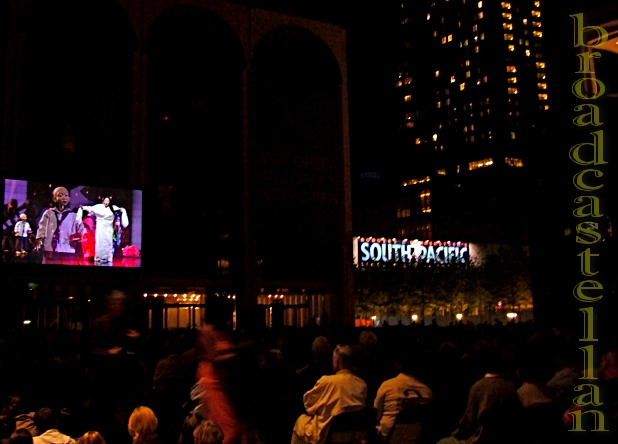
Perhaps, going live is not the same as being in the moment; at least, performances need not be, by virtue of being live, worth a moment of my time. For the record (and this is a new record to me, for I am about to change my tune): canned performances are not necessarily inferior to live ones. At least I thought so a few weeks ago while watching a recorded broadcast of a dazzling Metropolitan Opera production of Madama Butterfly, screened on the plaza in front of the building housing that venerable institution.

There I was (leaning against a trash can, no less), joined by hundreds of strangers, to take in, free of charge, the musical equivalent of cured meat, a pickled delicacy shared out to lure those partaking into the venue to shell out serious money for the supposedly real thing. Maybe Iโ€™ll think differently tomorrow at the local cinema, where I will be catching a high definition broadcast of the current National Theatre production of Shakespeareโ€™s Allโ€™s Well That Ends Well, live from London; but I sure realized that live is not to be confused with lively when I went to see South Pacific at New Yorkโ€™s Lincoln Center Theater, just a few feet from the screen where Madama Butterfly had flickered before my teary eyes.

South Pacific left my peepers dry, even though I was on the brink of welling up when I reminded myself that I had let go of more than $90 for a discount ticket to for the dubious privilege of beholding said spectacle. What I witnessed was Broadway on an off night, some less than โ€œEnchanted Eveningโ€ during which the cast went through the motions like Zombies on sabbatical. I knew as much when I opened my playbill to discover one of those white slips that, on the Great White Way, are equivalent to a pink one: Paulo Szot, the celebrated lead, had been replaced for the evening (and several weeks to come) by one William Michals.

Turns out, Mr. Michals had all the charm and thespian animation of a Bela Lugosi. Not that Laura Osnes (as Nellie Forbush) was out-Mitziying Ms. Gaynor. She did not as much try to wash that man right outa her hair as dispose of him with a purple rinse. As I remarked to my fellow onlooker, the pair had less going on between them as might be generated by a preschoolerโ€™s chemistry set.

Almost everything about this potentially engrossing play seemed to have been rehashed on a desperately reduced flame. I, for one, was boiling; it wasnโ€™t โ€œHappy Talkโ€ youโ€™d have overheard had you been eavesdropping on us as we left the theater. Sure, the production had been running for a year and a half and wasnโ€™t exactly โ€œYounger Than Springtimeโ€; but the Pacific, never more deserving of the name, has rarely felt quite this tepid. A rousing rendition of โ€œThere Is Nothinโ€™ Like a Dameโ€ and the still-spirited performance of Danny Burstein (as Billis) aside, the promise of Bali Haโ€™i never left anyone feeling quite this low . . .
“Chew that bacon good and slow”: Our Town Like You’ve Never Seen It

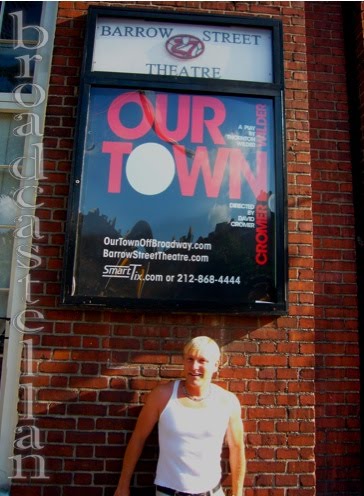
Okay, so Iโ€™ve been cutting a few corners during my present, month-long stay in New York City; but I wasnโ€™t about to cut Groverโ€™s Corners. Our Town, that is, a new production of which is playing at the Barrow Street Theatre in Greenwich Village. These days, there isnโ€™t much on Broadway to tempt me into letting go of whatever is left in my wallet. I mean, Shrek the Musical? Whatโ€™s next, Pac-Man of the Opera? A concert version of Saved by the Bell? Secret Squirrel on Ice? I am all for revisiting the familiarโ€”a tendency to which this journal attestsโ€”as long as I feel that such recyclings are worth my impecunious (hence increasingly persnickety) whileโ€”and theatrical retreads of The Addams Family, 9 to 5 or Spider-Man are not. Come to think of it, I had never seen a performance of Thornton Wilderโ€™s Pulitzer Prize-winning Our Town, which I always thought of as the ideal radio play. Well, let me tell you, David Cromer sure made me see it differently.

Our Town was produced on the air at least three times, even though the Lux Radio Theatre version (6 May 1940) is a reworking of the screenplay, replete with a tacky, tagged-on Hollywood ending and ample space for commercial copy between the acts. Wilderโ€™s 1938 play is decidedly radiogenic in its installation of a narrator (or Stage Manager) and its insistence of doing away with props or scenery. The Barrow Street Theater production seemed to be in keeping with the playwrightโ€™s instructions; and I was all prepared to watch it with my eyes closed.

There are two tables on the small stage; and the props do not amount to more than a hill of string beans. The Stage Manager points into the audience, inviting us to envision a small town in New Hampshire, anno 1901:

Along here’s a row of stores. ย Hitching posts and horse blocks in front of them. First automobile’s going to come along in about five years belonged to Banker Cartwright, our richest citizen . . . lives in the big white house up on the hill.

Here’s the grocery store and here’s Mr. Morgan’s drugstore. ย Most everybody in town manages to look into those two stores once a day.

Public School’s over yonder. ย High School’s still farther over. ย Quarter of nine mornings, noontimes, and three o’clock afternoons, the hull town can hear the yelling and screaming from those schoolyards.

Some eyes followed the pointed finger in my direction, faces in the crowd briefly looking past me in hopes of making out the Methodist and Unitarian churches just behind my back. Now, Iโ€™m not saying that the actors were not worth looking at, Jennifer Grace as Emily Webb being particularly charming. Still, at the end of the first act, I could not figure out what Frank Scheck of the New York Post referred to as โ€œrevolutionary staging.โ€ Two tables, eight chairs, string beans?

By act three, I understood. David Cromer defies Wilderโ€™s instructions (โ€œNo curtain. No sceneryโ€)โ€”and to startling effect. I never thought that the smell of bacon could be so overwhelming, so urgent and direct. Sure, it has often made my mouth waterโ€”but my eyes? Whether or not you are a staunch vegetarian, there is reality in the scent, just as there is a revelation behind that curtain. Our Town may be a wonderful piece of pantomime; but Cromer deserves some props.

โ€œOh, Mama, just look me one minute though you really saw me,โ€ the dead Emily implores the unseeing childhood vision of her mother. โ€œMama, just for a moment we’re happy. Let’s look at one another.โ€ Seeing this fragrant scene acted out made me realize anew the importance of coming to all of oneโ€™s senses, of partaking by taking in, of grabbing hold of the moment (which we Germans call an Augenblick, a glance) by beholding what could be gone at the blink of an eye.


Related recordings
“Our Town,” Campbell Playhouse (12 May 1939)
“Our Town,” Lux Radio Theatre (6 May 1940)

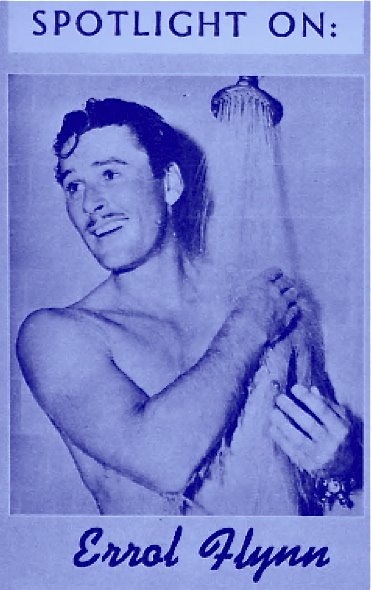
His Words, Her Voice: Errol Flynn, Olivia de Havilland, and the Resonance of โ€œEnoughโ€

“Oh, I have seen enough and done enough and been places enough and livened my senses enough and dulled my senses enough and probed enough and laughed enough and wept more than most people would suspect.” This line, as long and plodding as a life gone wearisome, was recently uttered by screen legend Olivia de Havilland, now in her 90s. You may well think that, at her age, she had reason enough for saying as much; but Ms. de Havilland was not reminiscing about her own experiences in and beyond Hollywood. She was reciting the words of one of her most virile, dashing, and troubled contemporaries: Errol Flynn, who was born one hundred years ago, on 20 June 1909, and apparently had โ€œenoughโ€ of it all before he turned fifty, a milestone he did not live to enjoy.

In her brief talk with BBC Radio 3โ€™s Night Waves host Matthew Sweet, de Havilland talks candidly, yet ever so decorously, about her swash-buckled, devil-may-careworn co-star, about his temperament, his aspirations, his fears. Hers is an aged voice that has a tone of knowing in it. A mellow, benevolent voice that bespeaks understanding. A voice that comforts in its conveyance not of weariness but of awareness, a life well lived and not yet spent.

I could listen for hours to such a voice. I might not care for, learn from or morally improve by hearing what is saidโ€”but the timbre gives a meaning to โ€œenoughโ€ that the forty-something Flynn never lived to express or have impressed upon him. It is the โ€œenoughโ€ of serenity, the โ€œenoughโ€ of gratitude, the โ€œenoughโ€ of not asking for more and yet not asking less . . . or stop asking at all.

My own life is marked and marred by a certain lack of inquisitiveness, it sometimes strikes me. Being blasรฉ is one of the first masks we don not to let on that we donโ€™t know enough, that we know as much, but donโ€™t know enough simply to ask. I wore such a mask of vainglory when I set out in life, the dullest of lives it seemed to me. My fellow employees had a nickname for me then.

It was my moustache that inspired it. Errol Flynn they called me. Little did they know that, even at age 20, I felt that I had โ€œenoughโ€ even though I so keenly felt that I had not had much of anything at all. I simply had enough of not even coming close to the glass of which I might one day have had my fill; but, for three long years, I did not have sense enough to leave that dulling life behind. No voice could talk me out of that barren existence but my own.

It was not easy for me to regain a sense of curiosity; it was as if the pores beneath the mask had been clogged after being concealed so long, my skin no longer alive to the breeze and its promises. I had brushed off more than I dared to absorb. One morning, I took a walk around Central Park with one of Errol Flynnโ€™s leading ladies, Viveca Lindfors, and was neither startled nor thrilled; nor did I not seize the opportunity to inquire about her past or permit her to draw me into her presence as she offered me advice and assistance.

Instead, I preserved the sound of her voice on the tape of my answering machineโ€”like a butterfly beyond the magic of flightโ€”her words saying that she had enough of me was dispensing of my humble services as her dog walker. I am left with canned breath, quite beyond the chance of living what might have been a great story.

Enough of my regrets. I can only hope that, when next I feel that I had โ€œenough,โ€ the word will sound as if it were uttered in what I shall henceforth refer to as a de Havilland sense, with dignity, insight and calmโ€”and an acceptance that is not resignation.

A Half-Dollar and a Dream: Arthur Miller, Scrooge, and a โ€œbig pile of French copperโ€

The currency market has been giving me a headache. The British pound is anything but sterling these days, which, along with our impending move and the renovation project it entails, is making a visit to the old neighborhood seem more like a pipe dream to me. The old neighborhood, after all, is some three thousand miles away, on the Upper East Side of Manhattan; and even though I have come to like life here in Wales, New York is often on my mind. You donโ€™t have to be an inveterate penny-pincher to be feeling the pressure of the economic squeeze. I wonder just how many dreams are being deferred for lack of funding, dreams far greater than the wants and desires that preoccupy those who, like me, are hardly in dire straits.
Back in March 1885, Joseph Pulitzer was doing his part to make such a larger-than-life dream a reality when he tried to raise funds for the erection of the Statue of Liberty. In one of his most sentimental plays for radio, Arthur Miller told the story through the eyes of a soldier and his miserly grandfatherโ€”Millerโ€™s Scrooge.

Broadcast on 26 March 1945, โ€œGrandpa and the Statueโ€ is announced as a โ€œwarm, human story of the most famous pinup girl in the world.โ€ Miller claimed that he โ€œcould not bearโ€ to write just โ€œanother Statue of Liberty showโ€ designed to โ€œillustrate how friendly we are with France and how the Statue of Liberty will stand forever as a symbol of a symbol and so on.โ€ As I put it in my dissertation, the Dickensian comedy he wrote instead โ€œis a nostalgic response to the publicโ€™s growing World War-weariness and the prospects of international unity and concord after Yalta.โ€

As the play opens, a wounded American soldier, recovering in a hospital room with a view of New York Harbor, recalls how his grandfatherโ€”โ€œMerciless Monaghan,โ€ the โ€œstingiest man in Brooklynโ€ got โ€œall twisted up with the Statue of Liberty.โ€ Old Monaghan (played by Charles Laughton) refused to make a contribution to the Statue Fund and, for decades to come, stubbornly defended his position until, one day, his grandson entreats him to take a ferry to Bedloeโ€™s Island:

GRANDPA. What I canโ€™t understand is what all these people see in that statue that theyโ€™ll keep a boat like this full makinโ€™ the trip, year in year out. ย To hear the newspapers talk, if the statue was gone weโ€™d be at war with the nation that stole her the followinโ€™ morninโ€™ early. ย All it is is a big pile of French copper.

YOUNG MONAGHAN. The teacher says it shows us that we got liberty.

GRANDPA. Bah! If youโ€™ve got liberty you donโ€™t need a statue to tell you you got it; and if you havenโ€™t got liberty no statueโ€™s going to do you any good tellinโ€™ you you got it. It was a criminal waste of the peopleโ€™s money.ย 

Among the visitors to Bedloe Island is a veteran of the Spanish-American War. Celebrating the birthday of his fallen brother by visiting the โ€œonly stone heโ€™s got,โ€ the veteran convinces the old man that the โ€œstatue kinda looks like what we believe.โ€

Profoundly moved, Monaghan asks to be left alone while inspecting the inscription at the base of the statue: 

GRANDPA (to himself). โ€œGive me your tired, your poor, your huddled
masses . . .โ€

(Music: Swells from a sneak to full, then under to background.)

YOUNG MONAGHAN. I ran over and got my peanuts and stood there cracking them open, looking around. And I happened to glance over to grampa. He had his nose right up to that bronze tablet, reading it. And then he reached into his pocket and kinda spied around over his eyeglasses to see if anybody was looking, and then he took out a coin and stuck it in a crack of cement over the tablet.

(Biz: Coin falling onto concrete.)

YOUNG MONAGHAN. It fell out and before he could pick it up I got a look at it. It was a half a buck. He picked it up and pressed it into the crack so it stuck. And then he came over to me and we went home.

(Music: Changes to stronger, more forceful theme.)

Thatโ€™s why, when I look at her now through this window, I remember that time and that poem [. . .].

Unlike the published script (as it appeared in the 1948 anthology Plays from Radio), the broadcast play concludes with the last lines of Emma Lazarusโ€™s famous if oft misquoted sonnet โ€œThe New Colossus.โ€

I am highly critical of Arthur Miller in Etherized Victorians; but, for all its sentimental propagandizing, โ€œGrandpa and the Statueโ€ is one of Millerโ€™s most affecting plays for the medium. As I read and listen to it now, so far away from New York City, I get a little wistful; and yet, the message is not lost on me, either, as I think of the larger picture, the ideals worth our investment, and the funds unreplenished, that makes my pouting for a few weeks in the Big Apple seem downright petty. Besides, I’ve got the airwaves to carry me through and keep me buoyant when I go “Oh, boy.”


Related recordings
โ€Grandpa and the Statue 26 March 1945

Related writings
“Politics and Plumbing” (Arthur Millerโ€™s โ€œPussycatโ€)
โ€œArthur Miller Asks Americans to โ€˜Listen for the Sound of Wingsโ€™”
โ€œArthur Miller Unleashes a Pussycatโ€

Abiding Faith; or, Where’s the Caterer?

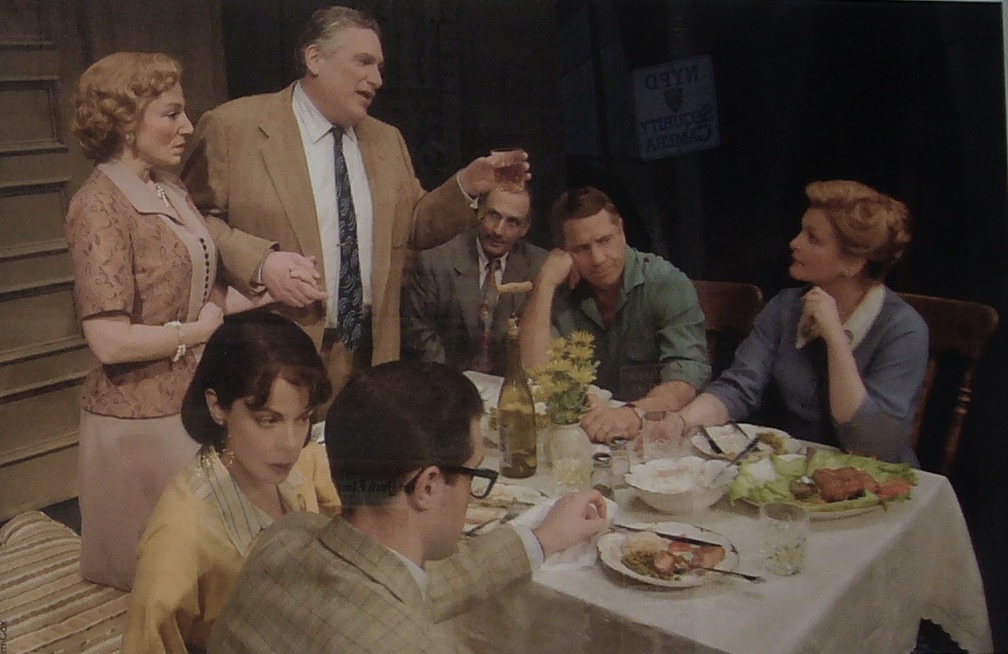
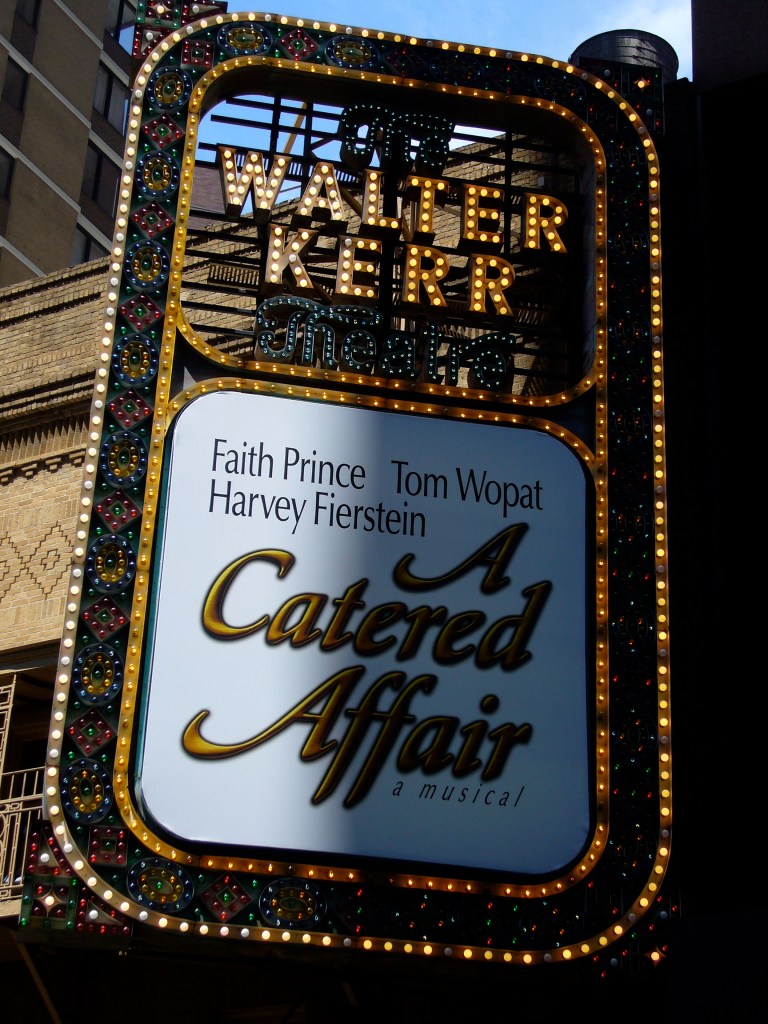
There was a sheet of paper pinned to each seat at the aforementioned Walter Kerr Theatre, asking patrons whether or not they had liked the current production and whether they would recommend the show. Now, I did not hand in my questionnaire. Who am I to caution theatergoers about a musical with such a wonderfully gifted group of players: Harvey Fierstein, who also wrote the libretto, Tom Wopat, whom I had previously seen, defenses way down, in Annie Get Your Gun, and the glorious Faith Prince (last featured here on the cover of the playbill for Bells Are Ringing)? Obviously, enough people had come to the Walter Kerr on that Tuesday evening in early June to relegate me, chancing it by getting a last-minute ticket at TKTS, to a seat way in the back.

Now, this might be all right when the stage is filled with a line of chorus girls making their way down a giant staircase, a set boasting an enormous showboat or an oil painting coming to life (as in the revival of Sunday in the Park with George I would see a few weeks later); but A Catered Affair is not that kind of a razzle-dazzler. It is a modest, earnest musical play; it examines characters rather than providing an opportunity for a series of show tunes. Modesty is its quiet strength, but, sitting in the back row, it still feels an awful lot like weakness.

I regret to report, however belatedly, that I did not warm to A Catered Affair, and not because its thin story felt somewhat warmed up. Sure, it is based on a 1955 television play by Paddy Chayefsky, himself not exactly a hot property these days; but then, most of today’s Broadway offerings are recycled.

A promotional close-up supplied by the theater to passers-by with a view no audience member would enjoy

No, it wasnโ€™t that. I was simply too far removed from the hearthโ€”even further than Uncle Winston, the sidekick Fierstein insisted on turning what, back in the 1950s, could only be an outsider. I appreciated him being there, as a reminder that homosexuals where always in the picture, even when they were kept well outside the frame of the camera. Unfortunately, Winstonโ€™s moment in the limelight is โ€œConey Island,โ€ a dreadfully clichรฉ-laden number in which he advises us to keep our eyes open as we ride the rollercoaster of life.

I had been told about the old stove, and that Ms. Prince actually prepared scrambled eggs during the scene. And that is a recommendation? Well, hand me a frying pan and start selling tickets! It rather reminded me of Gertrude Berg, who insisted on realism, and real eggs, even though The Goldbergs was a radio program. Yes, eggs were being prepared on the stage of the Walter Kerr that night, but, unable to smell the, that did nothing to whet my appetite. An intimate play deserves an intimate theater, especially a play that depends on character far more than on plot, of which there is little, and that anticlimactic.

Indeed, A Catered Affair would have made a fine radio musical, if something like that were ever to be reintroduced into American culture. This is not to say that it is cheap or second-rate. It just means that it does not require visuals for its staging of a family in crisis, a particular brand of problem play you might call Miller Light, even though Rheingold or Schlitz were more likely to be found in the family icebox.

The Walter Kerr was once a radio studio; back in the late 1930s, the playbill informed me, Alexander Woollcott broadcast from here. I would have enjoyed closing my eyes and listening to Ms. Prince, who wowed me many years ago as Adelaide and who keeps delighting me whenever I play selections from the Guys and Dolls cast album. Having kept my eyes peeled on a faraway stage with little to see (not even the event promised in the title), I did not recall a single tune upon exiting the theater shortly before 9 PM, after 90 minutes of intermission-free drabness.

Broadway does Family Tuesdays now, for the discerning “family,” however defined, that can afford to spend money on the less-than-spectacular.

Audiophile, My Eye!

Has my ear been giving me the evil eye? For weeks now, I have been sightseeing and snapping pictures. I have seen a few shows (to be reviewed here in whatever the fullness of time might be), caught up with old friends I hadn’t laid eyes on in years, or simply watched the world coming to New York go byโ€”all the while ignoring what I set out to do in this journal; that is, to insist on equal opportunity for the ear as channel through which to take in dramatic performances so often thought of requiring visuals. When. in passing, I came across this message on the facade of the Whitney Museum, my mindโ€™s eye kept rereading what seems to be such a common phrase” โ€œAs far as the eye can see.โ€

It is the article that began to overshadow the empty nest below the dead eye of the cyclopean window in the austere faรงade, features that might well be to some what Roland Barthes referred to as the punctumโ€”the point(s) to which the eye is drawn, the dot(s) that end up in the question marks we make of art that engages us.

What might that be, โ€œthe eyeโ€? Are we to assume that one eye looks out into the world as any other, that the act of seeing is objective, divorced from outlook, range and perspective? Does โ€œthe eyeโ€โ€”untrained or jaundiced or unfocusedโ€”invariably begin to see things as it seeks what lies beyond perceiving, such as an imaginary bird returning to the nest of our senses?

A few days ago, I suffered an eye infection (come to think of it, the second one since my arrival here in late May), which brought the above picture back to mind. I am not sure just how it happened, but my right eye became alarmingly inflamed, my lid swelled up and my cornea buckled. It is still pounding now, even though there no longer exists any ocular proof of my discomfort. Perhaps, my eyes are aching for a break upon which they now begin to insist.

A day after the incident I ran into a former neighbor of mine. I had seen him only a few days earlier. This time around, he was wearing an eye patch. As I later learned, he had just lost his sight in one eye, yet too distressed to explain or share his grief. What would I do without my vision, imperfect as it has become over the years? I could not help pondering. Suddenly, my insistence on rooting for the ear as a sensory underdog began to sound rather hollow. I want to keep going out in public and see the world before I allow myself to be dragged away by the ear into the privacy of my inner visions . . .

“With hey, ho, the wind and the rain”: Thoughts on Twelfth Night

Well, this is it. Twelfth Night. In Elizabethan England, Epiphany (6 January) marked the culmination of the winter revels, that topsy-turvy escape to the kingdom of Upsidedownia. For me, it is an apt time to return to this journal in earnest by looking back at my own follies, being that the first daft act of the year has me lying in bed with a cold. I am feelingโ€”to borrow and immediately discard what unaccountably has been declared word of the yearโ€”decidedly subprime (wouldnโ€™t below par or having peaked do just fine? Then again, it is a banking or business term and should therefore be ugly and subliterary). I had meant well, braving the wind and the rain, walking our dog after a three-week separation. Just a few days earlier I observed that 2007 has really been a wonderful year; in case yours has proven otherwise, I apologize for rubbing it in like so much VapoRub.

It was a year of traveling and theater-going that, a fall from a ladder notwithstanding (as a result of which my right pinky is now more likely to remain extended during high tea) was free of strife, hardship, and disappointment. Sure, there were those seemingly endless weeks without phone or wireless internet, there was a move into town that fell through, and there were a few minor upsets in my now sidelined teaching career. And then there was that summer that wasn’t. “For the rain it raineth every day.” Yes, it has been a wet year at that. It began in stormy Glasgow and ended in a drizzle on Waterloo Bridge in London, where the annual firework spectacular disappeared behind a thick curtain of sulphurous mist.

Perhaps my greatest folly was the attempt at maintaining this journal while away from home (as I was for about one fifth of the year). Much of what I did manage to convey, pressed for time or bereft of a reliable wireless signal, wasโ€”watch me resist neologian inanitiesโ€”substandard. As I have proved conclusively, I am not cut out to be a post-postmodern Tintin, to mention the titular hero of one of the most engaging theatrical entertainments of 2007, a year filled with delights and sprinkled with duds. Among the duds, aforementioned, were a ballet version of Gone With the Wind, which we caught in Budapest, the Angela Lansbury vehicle Deuce, and the death sentence to musical theater, an art form done away with, rather than revived, in the guise of a cheap concert version of itself that is Spring Awakening.

Among the recent theatrical highlights numbered the New World Stages production of Charles Buschโ€™s Die Mommie Die, with the 2003 film adaptation I have caught up since. It had been seven years, almost to the day, since I saw Buschโ€™s rather more conservative Tale of the Allergistโ€™s Wife, starring (opposite Linda Lavin and Tony Roberts) the wonderful Michele Lee. The star of Die Mommie Die, of course, is the playwright himself. Some unnecessary crudity aside, it is a brilliant evocation of the 1960s and the end of the Hollywood era. It is also a darn good mysteryโ€”a rather better mystery than Christieโ€™s nonetheless charming Mousetrap.

I am not a lover of camp, which, according to my own definition, is a wilful act of misreading. Die is a careful reading of the state of the womenโ€™s picture in the 1960s, the schlock that reduced a number of silver screen A-listers to sideshow freaks.

The heroine of Die Mommie Die is washed up, all right; but Busch does not derive most of his laughs from strapping her into a ducking stool. His play is as much an homage as it is a send-up (catering to those familiar with the histrionics of Crawford, Davis, and Susan Hayward); and it is this careful balance that, despite some vulgar touches, makes his play succeed both as thriller and farce.

Yes, I am rather traditional when it comes to film and theater, but that is not why I did not care much for Matthew Bourneโ€™s Nutcracker (now playing at Sadlerโ€™s Wells)โ€”having enjoyed his Car Man earlier this yearโ€”and sought refuge at the Prince Edward Theater to take in one of the final performances of Mary Poppins on New Yearโ€™s Day. I am not opposed to trying out something new; but I find more pleasure in finding the new in the supposedly out-of-date.

A great while ago the world begun,
With hey, ho, the wind and the rain,
But that’s all one, our play is done,
And we’ll strive to please you everyday.

Yes, I am back, Monday through Friday. And not going on about the weatherโ€”until something well nigh catastrophic or at any rate sensational compels me to break this rule . . .

The Hirst Noel

Well, New York City is looking more festive than ever, “ever” starting from the first Christmas I spent here back in 1989. There are outdoor markets on Union Square and Bryant Park, and a holiday fair at Grant Central Station. A departure from the city’s traditional Christmas windows, to say the least, was the above installation at the Lever House on Park Avenue in midtown Manhattan. I recall a Christmas carousel in the window; but this year, there was something else on display that is sure to make your head (and possibly your stomach) turn.

Damien Hirst’s “School: The Archaeology of Lost Desires, Comprehending Infinity, and the Search for Knowledge” (12 November 2007 to 9 February 2008) is billed as a “complex and thought provoking presentation that makes numerous references to art, science, art history, authority, knowledge, culture, religion, and beliefs,” as the curator of the $10 “School,” which took about $1 to assemble, describes it in the handout you may pick up as you walk in from the street.

Lever House, designated an official landmark in 1992, is one of those buildings you walk past without looking up; it takes an installation like Hirst to make you stop and wonder. We had just come from SYMS to pick up a few ties (where else would you buy ties in New York!) when we spotted the glass tanks filled with animal carcasses. Discomfortingly well-ordered and awfully beautiful, Hirst’s “School” is even more disturbing than the rate at which our money is going . . .

Crude Awakening; or, This Ain’t Show Boat

Unlike the previously discussed playย Deuce, this one came highly recommended: Tonys darling Spring Awakening (music by Duncan Sheik; book and lyrics by Steven Sater), with which I caught up during the week leading up to Broadway’s annual awards ceremony. It has been touted as the new Show Boat, the spectacle with a story that revolutionized musical theater back in 1927 (and revived on radio as a musical, a straight play, a musical serial, and a number of burlesques). “Old Man River,” take me now! I realize that I am filing a minority report here; but if this is the new face of Broadway, I just got to slap it.

For starters, that new face is partially obscured by hand-held microphones, props that, along with an audience seated onstage and a blackboard listing the tunes, are meant to suggest, in the by now tiresome postmodern mode of self-reflexivity, that what you see and get is only “Make Believe”โ€”an Epic theatrical in the Brechtian vein designed to be stimulating rather than absorbing. Verfremdung, Broadway style, means to play out whatever is left of a story like a rock concert; that is, by playing to the audience rather than interacting with one’s fellow players.

Spring Awakening is not so much an adaptation of Franz Wedekind’s drama of youth, longing, and disillusionment as it is an assortment of clichรฉs about hormonally-induced teenage Sturm and Drang. This high-Rent production (which won’t break even at the box office any time soon) may well appeal to youngsters who don’t know any better or refuse to listen, and to their parents who assume this noisy spectacle to be happening since it has an energetic and gifted cast that emotes in foul language and jumps up and down a lot, as if out to bring in ‘da punk. In its treatment of sexuality beyond the old boy-impregnates-girl-and-both-pay-for-it formula, however, the show betrays its conservative agenda, acknowledging the reality of alternative stirrings only in the form of comic relief.

Choreographed like an old Britney Spears number and outfitted in costumes left over from a touring production of Ah, Wilderness!, Spring Awakening revels in an identity crisis equal to that suffered by an acne-troubled, media-beleaguered high schooler set to pass out at a Goth concertโ€”and it is just about as cheerful and endearing. “Mis’ry’s Comin’ Aroun’,” showtune lovers.

Great Match, Ill Served: Angela Lansbury and Marian Seldes in Deuce

Well, I had been given ample warning. About Deuce, I mean, the Terrence McNally play starring American Theater Hall of Famers Angela Lansbury and Marian Seldes. Reviewers and friends uniformly panned it. Not content to take their word for it, I set out to see for myself, only to confirm that Deuce truly is an insipid trifle of a play, a plotless, actionless one-acter whose greatest offense is its squandering of talent: two captivating leads let down by a leaden script and reduced to longshots by an extravagant set on the large stage of Broadway’s Music Box theater.

That setโ€”the impersonal space of a tennis stadium filled with electronically simulated spectators (or spectres)โ€”echoes and amplifies the hollowness of the production, but appears to have been designed (by Peter J. Davison) to give audiences certain to tire something to look at or look out forโ€”as if Lansbury and her accomplished co-star werenโ€™t reason enough to head out for the theater. They arenโ€™t, if onlookers cannot zoom in on and get close to these two, as is warranted and promised by the potentially intriguing premise, the opportunity to eavesdrop on a private exchange between two celebrities dragged out of retirement and forcefully reunited for a belated tribute.

Their talk, however ably delivered, is devoid of anything amounting to revelations. They are long-ignored and finally acknowledged tennis legends who (surprise!) happen to be real women with long personal histories and strong opinionsโ€”opinions shared in lines so insipid that the playwright felt obliged to spice them up with profanities in hopes of getting spectators to stir, gasp and guffaw at expressions supposedly too vulgar to escape the mouths of our venerable elders.

You know you are faced with a dramatic dud when you open the Playbill to discover that even leading lady Lansbury struggles to give it to you in a nutshell too rotten to contain much good: โ€œThe play is about ageโ€”about becoming old and not being in the mainstream in the world of tennis today.โ€ Who is the target audience? Martina Navratilova? Then again, it is also a “metaphor for age and the problem that women have with old age.” Like finding good parts, I suppose.

The gimmick of the play (and it is little more than that) is the juxtaposition of the real women behind the legend with the shallowness and vanity of the television sportscasters prattling overhead like a pair of false gods, a vapid chat (reminiscent of the characters created, to far better effect, by Christopher Guest in mockumentaries like Best in Show and For Your Consideration) in contrast to which the play offers next to nothing.

Deuce might be better served on radio, which is the ideal medium for intimate talk and character studies. Radio plays do not suffer from a lack of action or circular construction, from being anecdotal and fragmentary. Radio theater, which does not lose sight of its actors on enormous sets, is well suited to the conveying of an impression (a sense of dread, say) or the imparting of an idea. On the stage that sort of thing or nothingness is a deucedly bad one.

Now, I donโ€™t care whether Iโ€™ll ever get to see another play by Mr. McNally (who’s rather more amusing, if similarly trifling Love! Valour! Compassion!, starring Nathan Lane, I saw back in 1995). I do mind, however, that this might have been my last chance to see Ms. Lansbury on the stage. As a swansong, Deuce is tantamount to Trog.

Some fifty years prior to her nonetheless Tony award nominated performance in Deuce, Lansbury played a retired stage actress on radio’s “outstanding theater of thrills,” Suspense,” in a melodrama titled “A Thing of Beauty” (29 May 1947). A woman willing to kill for a good part or to forge an alliance with someone she does not respect, she ends up having, quite literally, lost face. Now, there’s a metaphor!