Cinegram No. 14 (Because You Canโ€™t Rely on Air Mail These Days)

I am taking the passing ash cloud as an occasion to dust off my collection of Cinegrams, a late-1930s to early 1940s series of British movie programs I recently set out to acquire. Immemorabilia, you might call them. Not quite first-rate souvenirs of, for the most part, less-than-classic films like The Return of the Scarlet Pimpernel, or worse. These cheaply printed ephemera were designedโ€”quite pointlessly, it seemsโ€”to encourage folks to keep alive their memories of something that may well have been forgettable to begin with. Sure, why not pay a little extra for a few stills of a picture that wasnโ€™t much to look at while in motion? And why not pay still more to keep your โ€œFilm Memoriesโ€ in a self-binding case, with your name on itโ€” in gilt-lettering, no less? That was the offer made to British moviegoers anno 1937, who purchased Cinegram No. 14 to prevent Non-Stop New York from seeming all too fleeting.

Perhaps, I am confusing โ€œforgettableโ€ with โ€œforgotten.โ€ Non-Stop New York which is readily available online, has a lot going for it, quite apart from being a fast-paced romantic vehicle for John Loder and Anna Lee, helmed by Leeโ€™s husband, Robert Stevenson, who would go on to make Flubber and Mary Poppins soar at the box office.

Efficiently if somewhat routinely lensed, this Gaumont-British production might have served as a project for the companyโ€™s most notable director, Alfred Hitchcock. Substituting airlanes for tracks, itโ€™s the The Lady Vanishes in the realm of the birds. Except that, in this case, the ladyโ€”the young and innocent girl who knew too muchโ€”refuses to vanish, which makes the man whose secret she knows all the more eager to see to her disappearance.
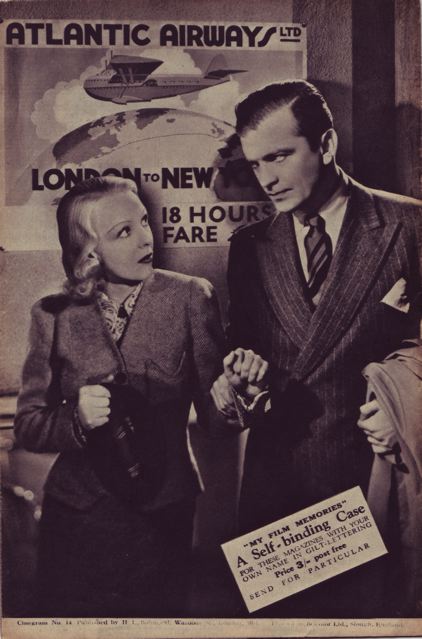
The main attraction of Non-Stop New York is not its contrived plot, its charming leads or its rich assortment of goons and ganefs. Rather, it is the filmโ€™s setting, the futuristic plane aboard which this pursuit reaches its thrilling climax. It is a large, multi-story aircraft resembling a luxury linerโ€”right down to the outdoor deck on which windblown lovers kiss by moonlight and villains go for the kill. Thereโ€™s plenty of room for some old-fashioned hide and seek, as passengers are not crowded together but retreat into the privacy of their own cabins. Quite an extravagance, this, considering that the imagined travel time of eighteen hours hardly warrants accommodations fit for on a sea voyage, which mode of transatlantic crossing yet served as a point of reference to the production designers who conceived the vessel.

It took Christopher Columbus ten weeks to cross the Atlantic Ocean, Cinegram No. 14 educated its readers. โ€œToday, ten hours seem to be sufficient to complete the same journey.โ€ Set in the seemingly foreseeable future of 1939, Non-Stop New York

anticipates the regular air service which before long [that is, after the end of the wartime air raids that, even in the age of Guernica, purveyors of escapist entertainment did not trouble themselves to predict] will be flying regularly across the North Atlantic and carrying passengers overnight between London and New York. Already survey flights are being carried out by Imperial Airways and Pan American Airways and these flights have shown that such a service is not longer a dream of the fiction writer, but something which to-morrow will be as commonplace as the many daily services of to-day between London and Paris.

The first experimental flights were made in the Summer of 1937. The British company made a series of flights with two of the Empire class flying boats, the โ€œCaledoniaโ€ and the โ€œCambria.โ€ The terminal points of these flights were Southampton and New York and the route followed was by way of Foynes, on the west coast of Ireland across the Atlantic, 1992 miles, to Botwood, Newfoundland. From there the flying boats went to New York by way of Montreal.

In all, 5 two-way crossings were made and these were carried out without incident and with such certainty that they reached the other side of the Atlantic within a few minutes of schedule.

On the last eastward journey the โ€œCambriaโ€ set up an all time record, making the 1992 miles in 10 hrs. 33 min. or at an average speed of nearly 190 m.p.h.

These flying boats will not be used for the Atlantic service when passengers are carried but it is probably that flying boats of the same type, but with greater power and greater ranger will be used. These flying boats may have a cruising speed of 250 m.p.h., and carry 20-30 passengers in a degree of comfort equal to that of the present luxury liner.

With its promise of a jet-setting tomorrow, a title like Non-Stop New York must have sounded thrilling to picture-goers anno 1937, albeit not nearly as thrilling as such a promise is to any present-day passenger awaiting the all-clear for departure at one of Britainโ€™s dormant airportsโ€”among them a friend of ours whose plans for a birthday celebration in Gotham are being pulverized by the largest export of a cash-strapped nation to whom volcanic activity appears to be a natural substitute for banking.

Movies like Non-Stop New York and collectibles such as Cinegram No. 14 remind me that, in living memory, long distance air travel was rare and special indeed. They remind me as well of one momentous April morning in 1985โ€”some quarter century agoโ€”when my younger self first boarded a transatlantic flight to the exhilarating and treacherous metropolis that was New York City. Back then, we still applauded the captain who returned us safely to earth; nowadays, we merely moan when we are grounded for whatever strikes us non-stoppers as too long . . .
A โ€œkind of monsterโ€: Me[, Fascism] and Orson Welles

It doesnโ€™t happen often that, after watching a 21-century movie based on a 21-century novel, I walk straight into the nearest bookstore to get my hands on a shiny paperback copy of the original, the initial publication of which escaped me as a matter of course. Come to think of it, this never happened before; and that it did happen in the case of Me and Orson Welles has a lot to do with the fact that the film is concerned with the 1930s, with New York City, and with that wunderkind from Wisconsin, the most lionized exponent of American radio drama, into which by now dried up wellspring of entertainment, commerce and propaganda it permits us a rare peek. You might say that I was the target audience for Richard Linklaterโ€™s comedy, which goes a long way in explaining its lack of success at the box office.

And yet, despite the filmโ€™s considerable enticementsโ€”among them its scrupulous attention to verisimilitudinous detail and a nonchalant disregard for those moviegoers who, having been drawn in by Zac Efron, draw a blank whenever references to, say, Les Tremayne or The Columbia Workshop are being tossed into their popcorn littered lapsโ€”it wasnโ€™t my fondness for the subject matter, much less the richness of the material, that convinced me to pick up Robert Kaplowโ€™s novel, first published in 2003. Indeed, it was the glossiness of the treatment that left me with the impression that something had gotten lost or left behind in the process of adaptationโ€”and I was curious to discover what that might be.

On the face of it, the movie is as faithful to the novel as the book is to the history and culture on which it draws.  Much of the dialogue is lifted verbatim from the page, even though the decision not to let the protagonist remain the teller of his own tale constitutes a significant shift in perspective as we now get to experience the events alongside the young man rather than through his mind’s eye.  In one trailer for the film, the voice-over narration is retained, suggesting how much more intimate and intricate this story could have beenโ€”and indeed is in printโ€”and how emotionally uninvolving the adaptation has turned out to be.

Without Samuelsโ€™s narration and with a scene-stealing performance by Christian McKay as Welles, the screen version gives the unguarded protรฉgรฉ, portrayed by the comparatively bland Efron, rather less of a chance to have the final word and to claim center stage, as the sly title suggests, by putting himself first.

The question at the heart of the story, on page and screen alike, is whether successes and failures are born or made.  Prominence or obscurity, life or death, are not so much determined by individual talent, the story drives home, but by the circumstances and relationships in which that talent can or cannot manifest itself.  We know Welles is a phony when he goes around giving the same spiel to each member of the cast who is about to crack up and endanger the opening of the show, insisting that they are โ€œGod-created.โ€  They are, if anything, Welles-created or Welles-undone.

Finding this out the hard wayโ€”however easy it may have looked initiallyโ€”is high school student Richard Samuels who, stumbling onto the scene quite by accicent, becomes a minor player in a major theatrical production of a Shakespearean drama directed by a very young, and very determined, Orson Welles.  Samuelsโ€™s fortunes are made and lost within a single week, at the end of which his name is stricken from the playbill and his life reconsigned to inconspicuity, all on account of that towering ego of the Mercury.

The premise is an intriguing one: a forgotten man who lives to tell how and why he did matter, after allโ€”a handsome stand-in for all of us who blew it at some crucial stage in our lives and careers.  Shrewdly concealing that it was he who nearly ruined the Mercury during dress rehearsal by setting off the sprinklers, Samuels can luxuriate in the belief that he may have inadvertently saved the production by reassuring a superstitious Welles that opening night would run smoothly.

Speculating about the personalities and motives of historical figures, dramas based on true events often insert an imaginary proxy or guide into the scene of the action, a marginal figure through or with whom the audience experiences a past it is invited to assume otherwise real.  And given that Me and Orson Welles goes to considerable length capturing the goings-on at the Mercury Theater, anno 1937, I was quite willing to make that assumption.  Hey, even Joe Cotten looks remarkably like Joseph Cotten (without the charisma, mind).

It was not until I read the novel that I realized that Kaplow and the screenwriters, while ostensibly drawing their figures from life, attributed individual traits and behaviors to different real-life personages.  Whereas actor George Coulouris is having opening night jitters on screen, it was the lesser-known Joseph Holland who experienced same in the novel.

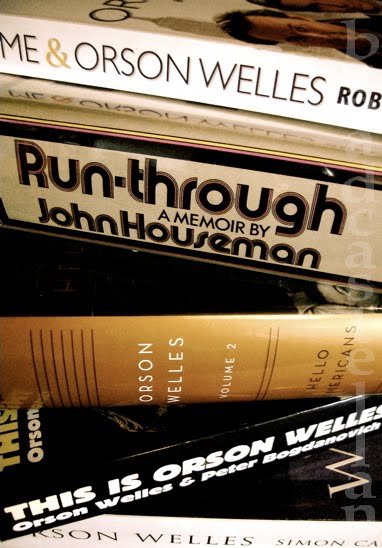
Although quite willing to let bygones be fiction, I consulted Mercury producer John Housemanโ€™s memoir Run-through, which suggests that the apprehensive one was indeed Coulouris.  Housemanโ€™s recollections also reveal that the fictional character of Samuels was based in part on young Arthur Anderson, a regular on radioโ€™s Letโ€™s Pretend program who, like Samuels, played the role of Lucius in the Mercury production.  According to Houseman, it was Anderson who flooded the theater by conducting experiments with the sprinkler valves.

Never mind irrigation; I was trying to arrive at the source of my irritation, which, plainly put, is this: Why research so thoroughly to so little avail? Why be content to present a slight drama peopled with folks whose names, though no longer on the tip of everyoneโ€™s tongue, can be found in the annals of film and theater? The missed opportunityโ€”an opportunity that Welles certainly seizedโ€”of becoming culturally and politically relevant makes itself felt in the character of Sam Leve, the Mercuryโ€™s set designerโ€”a forgotten character reconsidered in the novel but neglected anew in the screenplay.

Andersonโ€™s contributions aside, it is to Leveโ€™s account of the Mercuryโ€™s Julius Caesar that Kaplow was indebted, a debt he acknowledges in the โ€œSpecial thanksโ€ preceding the narrative he fashioned from it.

โ€œ[P]oor downtrodden Sam Leveโ€โ€”as Simon Callow calls him rather patronizingly in his biography of Orson Wellesโ€”was very nearly denied credit for his work on the set.  Featuring prominently in the novel, he is partially vindicated by being given one of the novelโ€™s most poignant speeches, a speech that turns Me and Orson Welles into something larger and grander than an intriguing if inconsequential speculation about a brilliant, egomaniacal boy wonder.

Confiding in Leve, with whom he has no such exchange in the movie, Samuels calls Welles a โ€œkind of monster,โ€ to which Leve replies: โ€œWe live in a world where monsters get their faces on the covers of the magazines.โ€  In this exchange is expressed what mightโ€”and, I believe, shouldโ€”have been the crux of the screen version: the story of a โ€œkind of monster,โ€ a man who professes to turn Julius Caesar into an indictment of fascism, however conceptually flawed (as Callow points out), but who, in his dictatorial stance, refuses to acknowledge Leveโ€™s contributions in the credits of the playbill and shows no qualms in replacing Samuels when the latter begins to assert himself.

โ€œAs in the synagogue we sing the praises of God,โ€ Leve philosophizes in the speech that did not make it into the screenplay, โ€œso in the theatre we sing the dignity of man.โ€  Without becoming overly didactic or metaphorical, Me and Orson Welles, the motion picture, could have put its authenticity to greater, more dignified purpose by not obscuring or trivializing history, by reminding us that Jews like Leve and Samuels were fighting for recognition as the Jewish people of Europe were facing annihilation.

To some degree, the glossy, rather more Gentile film version is complicit in the effacement of Jewish culture by homogenizing the story, by removing the Jewish references and Yiddish expressions that distinguish Kaplowโ€™s novel.  Instead of erasing the historical subtext, the film might have encouraged us to see the Mercuryโ€™s troubled production of Julius Caesar as an ambitious if somewhat ambiguous and perhaps disingenuous reading of the signs of the times, thereby making us consider the role and responsibility of the performing artsโ€”including films like Me and Orson Wellesโ€”in the shaping of history and of our understanding of it.


Related writings
โ€œOn This Day in 1938: The Mercury Players โ€˜dismember Caesarโ€™โ€
โ€œOn This Day in 1937: The Shadow Gets a Voice-overโ€

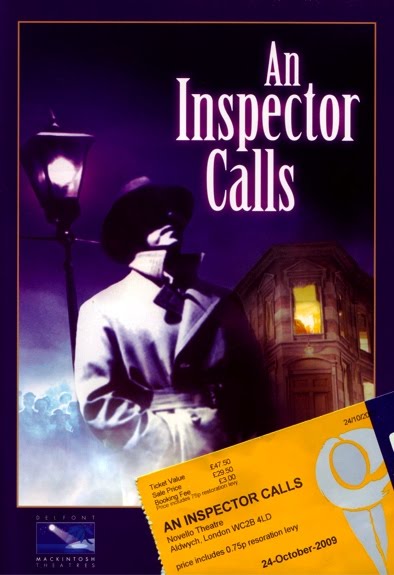
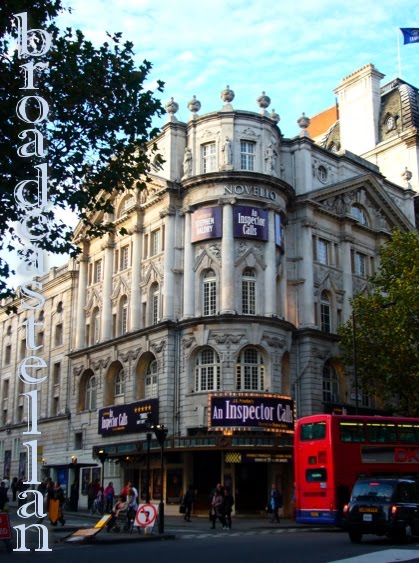
“. . . in fire and blood and anguishโ€: An Inspector Calls Repeatedly

As I was saying: what is wanting here is continuity, some sort of story on the go, a sense of goings-on ongoing, of the so on and so on and so on. It would be laziest to claim, as I have done, that what prevents me from turning a seemingly random clipbook into the attraction that is the yet-to-come is largely owing to the kind of clippings for which this (mis)nominal journal is reserved.

Instead of looking ahead, I keep on hearkening back. As I recall, which is what my kind of introspective retrospection calls for, my life always seemed to unfold in hindsight, not so much enveloped as developing. I know better than to regard history as a series of acts perpetrated rather than ideas perpetuatedโ€”but that knowledge does not prevent me from living ahistorically. According to J. B. Priestley, I am bound to regret this.

For the most part, mine has been a life apart; many are the instances, momentous events even, in which I just was not in the moment. What was I feeling when the Berlin Wall fell? My diary wonโ€™t tell you. It only refers to the event in passingโ€”and with detachmentโ€”as something that would have been โ€œnoch vor kurzem undenkbarโ€ (unthinkable even a short time ago). โ€œUndenkbar,โ€ perhaps, since I had never given it much Gedanke.

I recall being revolted by David Hasselhoffโ€™s โ€œLooking for Freedom,โ€ a 1989 chart topper all over Europe, but was not aware that the songโ€™s popularity was owing to political events then in the making, let alone that Hasselhoff was part of the revolution (as claimed, with tongue firmly in cheek, in a current BBC Radio 2 retrospective). I never made the connection. Nothing seemed to connect, least of all with me. My existence, as I saw it, was coincidental and inconsequential.

It is not for nothing that my generation was known as the โ€œno futureโ€ generation. Life in the Western middle of Europe was, to many, solely dependent on the whim or disposition of two world leaders, on a red telephone, and a scientistโ€™s finger on a long-range missile switch.

I came briefly into contact with my past self when, on a recent weekend in London, I looked into the fresh faces of my nieces, whom I had not seen in over twelve years since I steadfastly refuse to set foot again on German soil. I never did make peace with my native country, and, as much as I enjoy a good Schlachtplatte (literally, a battle or slaughter platter, which is a dish of assorted meats), Iโ€™d much rather rely on German exports than return to the scene of inner turmoil.

The belated realization that, growing up in the Rhineland, I had never witnessed a celebration of Armistice Day, seen a World War I memorial (of which there is one in nearly every village here in Britain) or witnessed the annual spectacle of lapels sprouting poppies, only deepened my suspicion that it was the shame of defeat that rendered causality ineffective in a post-1918 German construct of history, and that what was being commemorated elsewhere was victory rather than the failure to insure it.

As the fatalism expressed in the grating conclusion of the most recent installment in The Final Destination series of disaster horror suggested to me, causality without social or moral responsibility is a mere exercise in predictability. “We are responsible for each other. And I tell you that the time will soon come when, if men will not learn that lesson, then they will be taught it in fire and glood and anguish.โ€ J. B. Priestley keeps saying as much in An Inspector Calls, the previously maligned 1990s production of which I caught again on said trip to London a few weeks ago.

โ€œYouโ€™ve a lot to learn yet,โ€ pragmatic and presumably self-made Mr. Birling advises the younger generation, anno 1912.

And Iโ€™m talking as a hard-headed, practical man of business. ย And I say there isnโ€™t a chance of war. ย The worldโ€™s developing so fast that itโ€™ll make war impossible. Look at the progress weโ€™re making [. . .]. ย Why, a friend of mine went over this new liner last weekโ€”the Titanicโ€”she sails next weekโ€”forty-six thousand eight hundred tonsโ€”and every luxuryโ€”and unsinkable, absolutely unsinkable. ย That what youโ€™ve got to keep your eye on, facts like that, progress like thatโ€”and not a few German officers talking nonsense and a few scaremongers here making a fuss about nothing. ย Now you three young people, just listen to thisโ€”and remember what Iโ€™m telling you now. ย In twenty or thirty yearsโ€™ timeโ€”letโ€™s say in 1940, you mighty be giving a little party like thisโ€”your son or daughter might be getting engagedโ€”and I tell you by that time youโ€™ll be living in a world thatโ€™ll have forgotten all these Capital versus Labour agitations and all these silly little war scares. ย Thereโ€™ll be peace and prosperity and rapid progress everywhereโ€”except of course in Russia, which will always be behindhand, naturally.

Mr. Birling is blind not only to the signs of the time but also to his responsibilities in designing the future while consigning the present to waste and ruin. Even when given the chance in Priestleyโ€™s fantastic setup, he is incapable of turning hindsight into insight. Knowledge, after all, is not synonymous with understanding. As much as I keep rejoicing in Mr. Birlingโ€™s fallโ€”a delight dimmed by the knowledge that his is our downfall by proxyโ€”logic dictates that I fall well short of understanding the consequences of my own ahistorical ways.

Gone South . . . and Very Pacific: Broadway on an Off Day

I suppose I am back in my element (earth, mingled with dust), being that I can reminisce at last about my recent trip to New York City from the comfort of my own patch of terra firma across the pond. Okay, so I never managed to turn writing into a living; but I sure can turn life into writingโ€”provided I can go on about past experiences once I am good and ready, once that which has been going on and gone through my mind is bona fide bygone. Not one to multitask, I somehow cannot both be living and writing simultaneously, which is why Twitter is not for me. I am not cut out to be an on-the-spot correspondent. You wonโ€™t catch me with my finger on the pulse of anything yet living other than in my thoughts where, quickened by imagination, anything presumably dead and gone is readily revived.

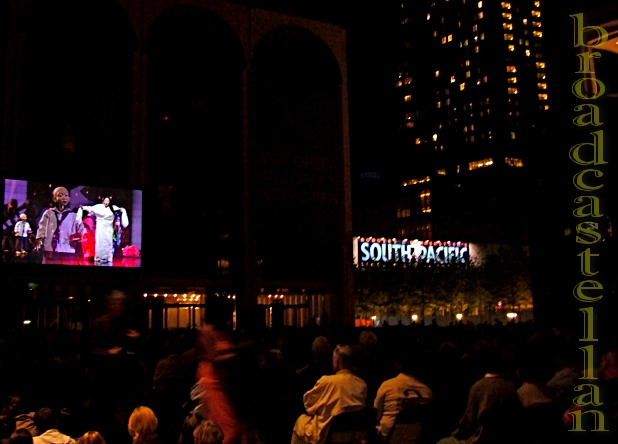
Perhaps, going live is not the same as being in the moment; at least, performances need not be, by virtue of being live, worth a moment of my time. For the record (and this is a new record to me, for I am about to change my tune): canned performances are not necessarily inferior to live ones. At least I thought so a few weeks ago while watching a recorded broadcast of a dazzling Metropolitan Opera production of Madama Butterfly, screened on the plaza in front of the building housing that venerable institution.

There I was (leaning against a trash can, no less), joined by hundreds of strangers, to take in, free of charge, the musical equivalent of cured meat, a pickled delicacy shared out to lure those partaking into the venue to shell out serious money for the supposedly real thing. Maybe Iโ€™ll think differently tomorrow at the local cinema, where I will be catching a high definition broadcast of the current National Theatre production of Shakespeareโ€™s Allโ€™s Well That Ends Well, live from London; but I sure realized that live is not to be confused with lively when I went to see South Pacific at New Yorkโ€™s Lincoln Center Theater, just a few feet from the screen where Madama Butterfly had flickered before my teary eyes.

South Pacific left my peepers dry, even though I was on the brink of welling up when I reminded myself that I had let go of more than $90 for a discount ticket to for the dubious privilege of beholding said spectacle. What I witnessed was Broadway on an off night, some less than โ€œEnchanted Eveningโ€ during which the cast went through the motions like Zombies on sabbatical. I knew as much when I opened my playbill to discover one of those white slips that, on the Great White Way, are equivalent to a pink one: Paulo Szot, the celebrated lead, had been replaced for the evening (and several weeks to come) by one William Michals.

Turns out, Mr. Michals had all the charm and thespian animation of a Bela Lugosi. Not that Laura Osnes (as Nellie Forbush) was out-Mitziying Ms. Gaynor. She did not as much try to wash that man right outa her hair as dispose of him with a purple rinse. As I remarked to my fellow onlooker, the pair had less going on between them as might be generated by a preschoolerโ€™s chemistry set.

Almost everything about this potentially engrossing play seemed to have been rehashed on a desperately reduced flame. I, for one, was boiling; it wasnโ€™t โ€œHappy Talkโ€ youโ€™d have overheard had you been eavesdropping on us as we left the theater. Sure, the production had been running for a year and a half and wasnโ€™t exactly โ€œYounger Than Springtimeโ€; but the Pacific, never more deserving of the name, has rarely felt quite this tepid. A rousing rendition of โ€œThere Is Nothinโ€™ Like a Dameโ€ and the still-spirited performance of Danny Burstein (as Billis) aside, the promise of Bali Haโ€™i never left anyone feeling quite this low . . .

“Chew that bacon good and slow”: Our Town Like You’ve Never Seen It

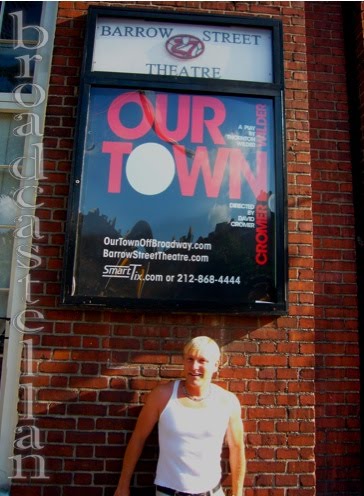
Okay, so Iโ€™ve been cutting a few corners during my present, month-long stay in New York City; but I wasnโ€™t about to cut Groverโ€™s Corners. Our Town, that is, a new production of which is playing at the Barrow Street Theatre in Greenwich Village. These days, there isnโ€™t much on Broadway to tempt me into letting go of whatever is left in my wallet. I mean, Shrek the Musical? Whatโ€™s next, Pac-Man of the Opera? A concert version of Saved by the Bell? Secret Squirrel on Ice? I am all for revisiting the familiarโ€”a tendency to which this journal attestsโ€”as long as I feel that such recyclings are worth my impecunious (hence increasingly persnickety) whileโ€”and theatrical retreads of The Addams Family, 9 to 5 or Spider-Man are not. Come to think of it, I had never seen a performance of Thornton Wilderโ€™s Pulitzer Prize-winning Our Town, which I always thought of as the ideal radio play. Well, let me tell you, David Cromer sure made me see it differently.

Our Town was produced on the air at least three times, even though the Lux Radio Theatre version (6 May 1940) is a reworking of the screenplay, replete with a tacky, tagged-on Hollywood ending and ample space for commercial copy between the acts. Wilderโ€™s 1938 play is decidedly radiogenic in its installation of a narrator (or Stage Manager) and its insistence of doing away with props or scenery. The Barrow Street Theater production seemed to be in keeping with the playwrightโ€™s instructions; and I was all prepared to watch it with my eyes closed.

There are two tables on the small stage; and the props do not amount to more than a hill of string beans. The Stage Manager points into the audience, inviting us to envision a small town in New Hampshire, anno 1901:

Along here’s a row of stores. ย Hitching posts and horse blocks in front of them. First automobile’s going to come along in about five years belonged to Banker Cartwright, our richest citizen . . . lives in the big white house up on the hill.

Here’s the grocery store and here’s Mr. Morgan’s drugstore. ย Most everybody in town manages to look into those two stores once a day.

Public School’s over yonder. ย High School’s still farther over. ย Quarter of nine mornings, noontimes, and three o’clock afternoons, the hull town can hear the yelling and screaming from those schoolyards.

Some eyes followed the pointed finger in my direction, faces in the crowd briefly looking past me in hopes of making out the Methodist and Unitarian churches just behind my back. Now, Iโ€™m not saying that the actors were not worth looking at, Jennifer Grace as Emily Webb being particularly charming. Still, at the end of the first act, I could not figure out what Frank Scheck of the New York Post referred to as โ€œrevolutionary staging.โ€ Two tables, eight chairs, string beans?

By act three, I understood. David Cromer defies Wilderโ€™s instructions (โ€œNo curtain. No sceneryโ€)โ€”and to startling effect. I never thought that the smell of bacon could be so overwhelming, so urgent and direct. Sure, it has often made my mouth waterโ€”but my eyes? Whether or not you are a staunch vegetarian, there is reality in the scent, just as there is a revelation behind that curtain. Our Town may be a wonderful piece of pantomime; but Cromer deserves some props.

โ€œOh, Mama, just look me one minute though you really saw me,โ€ the dead Emily implores the unseeing childhood vision of her mother. โ€œMama, just for a moment we’re happy. Let’s look at one another.โ€ Seeing this fragrant scene acted out made me realize anew the importance of coming to all of oneโ€™s senses, of partaking by taking in, of grabbing hold of the moment (which we Germans call an Augenblick, a glance) by beholding what could be gone at the blink of an eye.


Related recordings
“Our Town,” Campbell Playhouse (12 May 1939)
“Our Town,” Lux Radio Theatre (6 May 1940)

His Words, Her Voice: Errol Flynn, Olivia de Havilland, and the Resonance of โ€œEnoughโ€

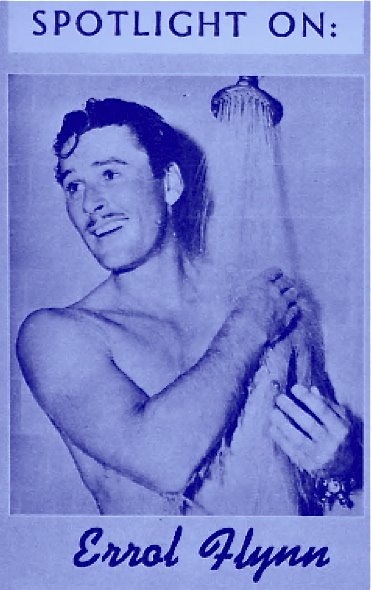
“Oh, I have seen enough and done enough and been places enough and livened my senses enough and dulled my senses enough and probed enough and laughed enough and wept more than most people would suspect.” This line, as long and plodding as a life gone wearisome, was recently uttered by screen legend Olivia de Havilland, now in her 90s. You may well think that, at her age, she had reason enough for saying as much; but Ms. de Havilland was not reminiscing about her own experiences in and beyond Hollywood. She was reciting the words of one of her most virile, dashing, and troubled contemporaries: Errol Flynn, who was born one hundred years ago, on 20 June 1909, and apparently had โ€œenoughโ€ of it all before he turned fifty, a milestone he did not live to enjoy.

In her brief talk with BBC Radio 3โ€™s Night Waves host Matthew Sweet, de Havilland talks candidly, yet ever so decorously, about her swash-buckled, devil-may-careworn co-star, about his temperament, his aspirations, his fears. Hers is an aged voice that has a tone of knowing in it. A mellow, benevolent voice that bespeaks understanding. A voice that comforts in its conveyance not of weariness but of awareness, a life well lived and not yet spent.

I could listen for hours to such a voice. I might not care for, learn from or morally improve by hearing what is saidโ€”but the timbre gives a meaning to โ€œenoughโ€ that the forty-something Flynn never lived to express or have impressed upon him. It is the โ€œenoughโ€ of serenity, the โ€œenoughโ€ of gratitude, the โ€œenoughโ€ of not asking for more and yet not asking less . . . or stop asking at all.

My own life is marked and marred by a certain lack of inquisitiveness, it sometimes strikes me. Being blasรฉ is one of the first masks we don not to let on that we donโ€™t know enough, that we know as much, but donโ€™t know enough simply to ask. I wore such a mask of vainglory when I set out in life, the dullest of lives it seemed to me. My fellow employees had a nickname for me then.

It was my moustache that inspired it. Errol Flynn they called me. Little did they know that, even at age 20, I felt that I had โ€œenoughโ€ even though I so keenly felt that I had not had much of anything at all. I simply had enough of not even coming close to the glass of which I might one day have had my fill; but, for three long years, I did not have sense enough to leave that dulling life behind. No voice could talk me out of that barren existence but my own.

It was not easy for me to regain a sense of curiosity; it was as if the pores beneath the mask had been clogged after being concealed so long, my skin no longer alive to the breeze and its promises. I had brushed off more than I dared to absorb. One morning, I took a walk around Central Park with one of Errol Flynnโ€™s leading ladies, Viveca Lindfors, and was neither startled nor thrilled; nor did I not seize the opportunity to inquire about her past or permit her to draw me into her presence as she offered me advice and assistance.

Instead, I preserved the sound of her voice on the tape of my answering machineโ€”like a butterfly beyond the magic of flightโ€”her words saying that she had enough of me was dispensing of my humble services as her dog walker. I am left with canned breath, quite beyond the chance of living what might have been a great story.

Enough of my regrets. I can only hope that, when next I feel that I had โ€œenough,โ€ the word will sound as if it were uttered in what I shall henceforth refer to as a de Havilland sense, with dignity, insight and calmโ€”and an acceptance that is not resignation.

Another Manโ€™s Ptomaine: Was โ€œThe Undertakerโ€™s Taleโ€ Worth Exhuming?

Bury this. Apparently, it was with words not much kinder that the aspiring but already middle-aged storyteller Samuel Clemens was told what to do with โ€œThe Undertakerโ€™s Tale.โ€ Written in 1877, it was not published until this year, nearly a century after the authorโ€™s death. The case of the premature burial has not only been brought to light but, thanks to BBC Radio 4, the disinterred matter has also been exposed to the air (and the breath of reader Hector Elizondo). So, you may ask after being duly impressed by the discovery, does it stink?

To be sure, even the most minor work of a major literary figure is deserving of our attention; and โ€œThe Undertakerโ€™s Taleโ€ is decidedly minor. It derives whatever mild titters it might induce from the premise that one manโ€™s meat is another manโ€™s poison or, to put it another way, one manโ€™s dead body is anotherโ€™s livelihood.

โ€œWe did not drop suddenly upon the subject,โ€ the narrator ushers us into the story told to him by his โ€œpleasant new acquaintance,โ€ the undertaker, โ€œbut wandered into it, in a natural way.โ€ We should expect slow decay, then, rather than a dramatic exitโ€”and, sure enough, there is little to startle or surprise us here.

There isnโ€™t much of a plot eitherโ€”but a lot of them. The eponymous characterโ€”one Mr. Cadaverโ€”is a kind-hearted chap who cheers at the prospect of an epidemic and who fears for his family business whenever the community is thriving. To him and his lovely, lively tribe there can be no joy greater than the timely demise of an unscrupulous vulture (some simulacrum of a Scrooge), whichโ€”death ex machina and Abracacaver!โ€”is just what happens in the end.

In its time, “The Undertaker’s Tale” may have been dismissed as being in poor taste; what is worse, though, is that it is insipid. To bury it was no doubt the right decision as it might have ended Clemens’s literary career before it got underway by poisoning the public’s mind against him. A death sentence of sorts.

It may sound morbid, but, listening to this unengaging trifle, I drifted off in thoughts of home. My future home, that is. No, I am not about to check out; but within a few days now I am going to move to a town known, albeit by very few, as Undertakerโ€™s Paradise.

Back in 2000, the Welsh seaside resort of Aberystwyth served as the setting for a dark comedy thriller with that title. Starring Ben Gazzara, it concerns an undertaker rather more enterprising than Mr. Cadaver in the procuring of bodies. Like Twainโ€™s story before it, the forgotten film is waiting to be dug up and appreciated anew. Unlike Twainโ€™s story, it has no literary pedigree to induce anyone to pick up a shovel. Shame, really. Itโ€™s the better yarn of the two.


Related writings
“Mark Twain, Six Feet Underโ€
“What Those Who Remembered Forgot: Don Knotts (1924-2006) on the Airโ€

So to Speke

When not at work on our new old houseโ€”where the floorboards are up in anticipation of central heatingโ€”we are on the road and down narrow country lanes to get our calloused hands on the pieces of antique furniture that we acquired, in 21st-century style, by way of online auction. In order to create the illusion that we are getting out of the house, rather than just something into it, and to put our own restoration project into a perspective from which it looks more dollhouse than madhouse, we make stopovers at nearby National Trust properties like Chirk Castle or Speke Hall.

The latter (pictured here) is a Tudor mansion that, like some superannuated craft, sits sidelined along Liverpoolโ€™s John Lennon Airport, formerly known as RAF Speke. The architecture of the Hall, from the openings under the eaves that allowed those within to spy on the potentially hostile droppers-in without to the hole into which a Catholic priest could be lowered to escape Protestant persecution, bespeaks a history of keeping mum.

Situated though it is far from Speke, and being fictional besides, what came to mind was Audley Court, a mystery house with a Tudor past and Victorian interior that served as the setting of Mary Elizabeth Braddonโ€™s sensational crime novel Lady Audleyโ€™s Secret. The hugely popular thriller was first serialized beginning in 1861 and subsequently adapted for the stage. Resuscitated for a ten-part serial currently aired on BBC Radio 4, the eponymous โ€œladyโ€โ€”a gold digger, bigamist, and arsonist whose ambitions are famously diagnosed as the mark of โ€œlatent insanityโ€โ€”can now be eavesdropped on as she, sounding rather more demure than she appeared to my mindโ€™s ear when reading the novel, attempts to keep up appearances, even if it means having to make her first husband, a gold digger in his own right, disappear down a well.

As if the house, Audley Court, did not have a checkered past of its ownโ€”

a house in which you incontinently lost yourself if ever you were so rash as to attempt to penetrate its mysteries alone; a house in which no one room had any sympathy with another, every chamber running off at a tangent into an inner chamber, and through that down some narrow staircase leading to a door which, in its turn, led back into that very part of the house from which you thought yourself the furthest; a house that could never have been planned by any mortal architect, but must have been the handiwork of that good old builder, Time, who, adding a room one year, and knocking down a room another year, [ … ] had contrived, in some eleven centuries, to run up such a mansion as was not elsewhere to be met with throughout the county […].

โ€œOf course,โ€ the narrator insists,

in such a house there were secret chambers; the little daughter of the present owner, Sir Michael Audley, had fallen by accident upon the discovery of one. ย A board had rattled under her feet in the great nursery where she played, and on attention being drawn to it, it was found to be loose, and so removed, revealed a ladder, leading to a hiding-place between the floor of the nursery and the ceiling of the room belowโ€”a hiding-place so small that he who had hid there must have crouched on his hands and knees or lain at full length, and yet large enough to contain a quaint old carved oak chest, half filled with priests’ vestments, which had been hidden away, no doubt, in those cruel days when the life of a man was in danger if he was discovered to have harbored a Roman Catholic priest, or to have mass said in his house.

Loose floorboards weโ€™ve got plenty in our own domicile, and room enough for a holy manhole below. It being a late-Victorian townhouse, though, the hidden story we laid bare is that of the upstairs-downstairs variety. At the back, in the part of the house where the servants labored and lived, there once was a separate staircase, long since dismantled. It was by way of those steep steps that the maid, having performed her chores out of the familyโ€™s sight and earshot, withdrew, latently insane or otherwise, into the modest quarters allotted to her.

I wonder whether she read Lady Audleyโ€™s Secret, if indeed she found time to read at all, and whether she read it as a cautionary tale or an inspirational oneโ€”as the story of a woman who dared to rewrite her own destiny:

No more dependency, no more drudgery, no more humiliations,โ€ Lucy exclaimed secretly, โ€œevery trace of the old life melted awayโ€”every clue to identity buried and forgottenโ€”except […]

… that wedding ring, wrapped in paper.  Itโ€™s enough to make a priest turn in his hole.

A Half-Dollar and a Dream: Arthur Miller, Scrooge, and a โ€œbig pile of French copperโ€

The currency market has been giving me a headache. The British pound is anything but sterling these days, which, along with our impending move and the renovation project it entails, is making a visit to the old neighborhood seem more like a pipe dream to me. The old neighborhood, after all, is some three thousand miles away, on the Upper East Side of Manhattan; and even though I have come to like life here in Wales, New York is often on my mind. You donโ€™t have to be an inveterate penny-pincher to be feeling the pressure of the economic squeeze. I wonder just how many dreams are being deferred for lack of funding, dreams far greater than the wants and desires that preoccupy those who, like me, are hardly in dire straits.
Back in March 1885, Joseph Pulitzer was doing his part to make such a larger-than-life dream a reality when he tried to raise funds for the erection of the Statue of Liberty. In one of his most sentimental plays for radio, Arthur Miller told the story through the eyes of a soldier and his miserly grandfatherโ€”Millerโ€™s Scrooge.

Broadcast on 26 March 1945, โ€œGrandpa and the Statueโ€ is announced as a โ€œwarm, human story of the most famous pinup girl in the world.โ€ Miller claimed that he โ€œcould not bearโ€ to write just โ€œanother Statue of Liberty showโ€ designed to โ€œillustrate how friendly we are with France and how the Statue of Liberty will stand forever as a symbol of a symbol and so on.โ€ As I put it in my dissertation, the Dickensian comedy he wrote instead โ€œis a nostalgic response to the publicโ€™s growing World War-weariness and the prospects of international unity and concord after Yalta.โ€

As the play opens, a wounded American soldier, recovering in a hospital room with a view of New York Harbor, recalls how his grandfatherโ€”โ€œMerciless Monaghan,โ€ the โ€œstingiest man in Brooklynโ€ got โ€œall twisted up with the Statue of Liberty.โ€ Old Monaghan (played by Charles Laughton) refused to make a contribution to the Statue Fund and, for decades to come, stubbornly defended his position until, one day, his grandson entreats him to take a ferry to Bedloeโ€™s Island:

GRANDPA. What I canโ€™t understand is what all these people see in that statue that theyโ€™ll keep a boat like this full makinโ€™ the trip, year in year out. ย To hear the newspapers talk, if the statue was gone weโ€™d be at war with the nation that stole her the followinโ€™ morninโ€™ early. ย All it is is a big pile of French copper.

YOUNG MONAGHAN. The teacher says it shows us that we got liberty.

GRANDPA. Bah! If youโ€™ve got liberty you donโ€™t need a statue to tell you you got it; and if you havenโ€™t got liberty no statueโ€™s going to do you any good tellinโ€™ you you got it. It was a criminal waste of the peopleโ€™s money.ย 

Among the visitors to Bedloe Island is a veteran of the Spanish-American War. Celebrating the birthday of his fallen brother by visiting the โ€œonly stone heโ€™s got,โ€ the veteran convinces the old man that the โ€œstatue kinda looks like what we believe.โ€

Profoundly moved, Monaghan asks to be left alone while inspecting the inscription at the base of the statue: 

GRANDPA (to himself). โ€œGive me your tired, your poor, your huddled
masses . . .โ€

(Music: Swells from a sneak to full, then under to background.)

YOUNG MONAGHAN. I ran over and got my peanuts and stood there cracking them open, looking around. And I happened to glance over to grampa. He had his nose right up to that bronze tablet, reading it. And then he reached into his pocket and kinda spied around over his eyeglasses to see if anybody was looking, and then he took out a coin and stuck it in a crack of cement over the tablet.

(Biz: Coin falling onto concrete.)

YOUNG MONAGHAN. It fell out and before he could pick it up I got a look at it. It was a half a buck. He picked it up and pressed it into the crack so it stuck. And then he came over to me and we went home.

(Music: Changes to stronger, more forceful theme.)

Thatโ€™s why, when I look at her now through this window, I remember that time and that poem [. . .].

Unlike the published script (as it appeared in the 1948 anthology Plays from Radio), the broadcast play concludes with the last lines of Emma Lazarusโ€™s famous if oft misquoted sonnet โ€œThe New Colossus.โ€

I am highly critical of Arthur Miller in Etherized Victorians; but, for all its sentimental propagandizing, โ€œGrandpa and the Statueโ€ is one of Millerโ€™s most affecting plays for the medium. As I read and listen to it now, so far away from New York City, I get a little wistful; and yet, the message is not lost on me, either, as I think of the larger picture, the ideals worth our investment, and the funds unreplenished, that makes my pouting for a few weeks in the Big Apple seem downright petty. Besides, I’ve got the airwaves to carry me through and keep me buoyant when I go “Oh, boy.”


Related recordings
โ€Grandpa and the Statue 26 March 1945

Related writings
“Politics and Plumbing” (Arthur Millerโ€™s โ€œPussycatโ€)
โ€œArthur Miller Asks Americans to โ€˜Listen for the Sound of Wingsโ€™”
โ€œArthur Miller Unleashes a Pussycatโ€

Thatโ€™s a Sound All Right, but It Ainโ€™t Music

As much as I enjoy Hollywood musicals, Iโ€™ve never sat through The Sound of Music. In fact, before I moved to the US, I had never even heard of the film, let alone anything of the true story behind it. Being born and raised in Germany does have its advantages, you might say; but I am not inclined to be flippant about censorship. Fact is, depictions of Nazism in popular culture were carefully filtered in (West) Germany, even decades after the end of the Third Reich. The reminders of past atrocities and the shared culpability for them were apparently deemed too humiliating or distressing to audiences out to enjoy a bit of cinematic escapism. Perhaps, the decision not to exhibit certain films or to edit and dub them so as to render them inoffensive was based on the notion that the horrors hinted at or exploited for their melodramatic value were too severe to serve as mere diversions. In any case, I was not exposed to the Von Trapps. And when I had my first glimpse of them, I did not feel particularly sorry to have missed out on the acquaintance.

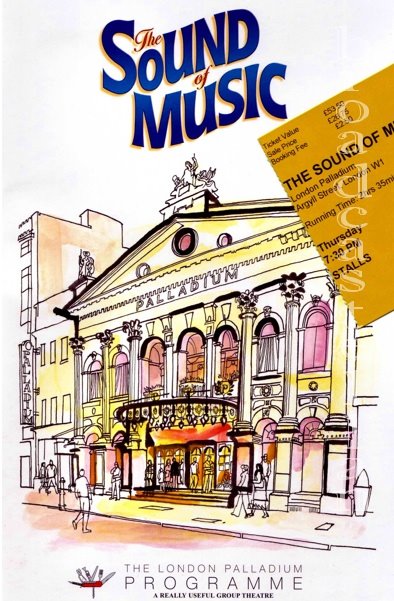
I was as much turned off by the 1960s look of what was meant to have been the late 1930s as I was by those cloying sounds and images. This picture needed to be altogether darker, the music more haunting, more angry and sorrowful than โ€œMy Favorite Things.โ€ For years, I avoided what to many remains a sing-a-long occasion. A few weeks ago, the stubborn Teuton in me surrendered at last and got a discount ticket to Andrew Lloyd Webberโ€™s production of the Rodgers and Hammerstein classic at the London Palladium, a production launched and shrewdly promoted back in 2006 by an American Idol-style singing contest in which the British public, along with Sir Andrew, went in search of the perfect Maria.

I canโ€™t say that the West End changed my mind about The Sound of Music. Sure, there are bright and eminently hummable numbers in it, but what is left of the story has less weight than the average supermodel. What is at stake for Maria is not life or liberty, but a chance to trill a few more tunes. No moral dilemma, no sense of danger, no signs of turmoil as Maria grapples with the difficulties of choosing between the convent and the conventional. I donโ€™t expect a treatise on the relationship between fascism and the church; but I sure am tired of those insipid scenes of Sister Activity to which nuns are reduced in popular culture.

In the production’s single instance of dramatically effective set design, the auditorium is transformed into a fascist venue, as brown shirted guards appear in the isles and swastika banners are imposed onto the walls of the Palladium; but the machinery, the show tune factory that is The Sound of Music, does not permit any forebodings to build, any doubt or dread to work on the spectatorโ€™s mind. The pageant must go on, dispassionate and smooth as clockwork.

Not everything was quite so well oiled that evening. I knew that what had been mounted here would not amount to anything resembling absorbing melodrama the moment I saw Maria atop a circular platform that was slowly and laboriously tilted in an obvious but feeble imitation of Ted McCord’s Oscar-nominated cinematography. The hills were alive all right; you could hear them aching so loudly that Mariaโ€”not the one chosen on the reality program but a paler substitute (the chirpily unengaging Summer Strallen)โ€”couldn’t climb any high note piercing enough to deaden them, spread out as she was on that giant pizza like a slice of parma ham, extra lean.

Less dulcet than the tones produced by those tectonic shifts was whatever emanated from the gaping jaws of the Captain, impersonated that night by Simon MacCorkindale, whose credentials as an actor include, need I say more, featured roles in Falcon Crest and Jaws III. โ€œIf you know the notes to sing,โ€ Maria instructs the children in โ€œDo-Re-Mi.โ€ Well, you still canโ€™t “sing most anything” if restricted by the vocal chords of a MacCorkindale, whose rendition of โ€œEdelweissโ€ should have resulted in his immediate seizure by Nazi officials. The Sound of Music was the croaking Mac’s firstโ€”and, let the nuns of the world pray, his lastโ€”venture into musical theater.

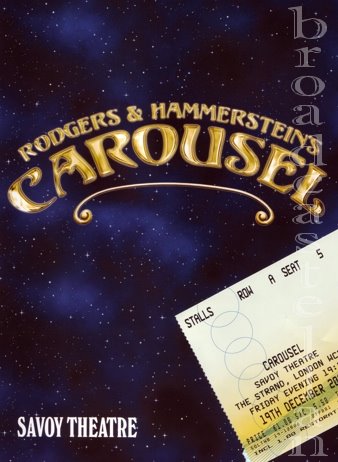
Decidedly more rewarding both tunefully and dramatically is the current West End production of Carousel at the Savoy, which I saw the following day. Starring Jeremiah James as the troubled Billy Bigelow and an earthy, buxom Lesley Garrett as Nettie, it proved a nutritious alternative to pizza with the Von Trapps.