Transatlantic Call: From Radio Reportage to Video Conferencing

Now, I am not going to get all sentimental and give you the old “tempus fugit” spiel; but I’d like to mention, in passing, that this post (the 355th entry into the journal) marks the beginning of a third year for broadcastellan. Meanwhile, I am resting with a bad back—in the city that never sleeps, of all places. This afternoon, during an inaugural transatlantic video conference with my two faithful companions back home in Wales, my mind excused itself from my heart and took off in reflections about the ways in which technology has assisted in forging a bond between the US and its close ally across the pond, and the degree to which such tele-communal forgings may come across as mere forgeries when compared to the real thing of an actual encounter.

I was reminded of this again when, a few hours after my chat, I sat, as of old, on a bench by the East River, in a park named after Carl Schurz, a fellow German gone west who likened our ideals to the stars that, however far beyond our touch, yet assist those guided by them to “reach their goal.” In my hand was a signed copy of a newly purchased biography of Edward R. Murrow (by Bob Edwards). It opens with Murrow’s report from the blitz on London, Murrow’s residence during the war.

The broadcasts from London (as featured and discussed here by Jim Widner) did much to enhance the American public’s understanding of the plight of a people, who, due to Hollywood’s portrayal of the British, seemed stuck-up, remote, and about as real as the fog in which Basil Rathbone and Nigel Bruce waded through some of their adventures. Reports from Britain not only brought home a Kingdom but a concept—the notion of brotherhood untainted by the nationalism whose fervor was responsible for the war.

If not as emotional as Herbert Morrison’s report from Lakehurst during the explosion of the Hindenburg, Murrow’s updates from London were delivered by a compassionate journalist who not only listened in but was a part of what he related while on location. On this day, 21 May, in 1950, British novelist Elizabeth Bowen connected wirelessly with her American audience by speaking via transcription on NBC radio’s University Theater. Bowen referred to her novel The House in Paris (1935) as “New York’s child,” the “fruit of the stimulus, the release, the excitement [she] had received here.” Would she have been able to enter into the feelings of a child lost in a strange house, she wondered, if she “had not just returned from another city, equally new and significant to me?”

There are limits to the connections achieved by the wireless, a controlled remoteness that brings home ideas without ever feeling quite like it. Rather than seeing or hearing, being there is believing. I felt far away during my transatlantic call; but I know I will know what home is now once I get back there . . .

“Yankee Doodle went to town” . . . and That Is Where You’ll Find Him

Well, call me a “dirty rat,” but I’ve never paid much attention to this memorial on East 91 Street (or “James Cagney Place,” to be precise), a mere two blocks from where I used to live. The everyday renders much what surrounds us invisible; so, I’m going to make some noise for the old “Yankee Doodle Dandy,” the tribute to whom I now see with eyes accustomed to the green hills of Wales. Say, just how Welsh is the old New Yorker? Taking advantage of the wireless network I am gleefully tapping, I reencountered the aforementioned Cagney in an adaptation of Night Must Fall by Welsh playwright Emlyn Williams (previously discussed here). On American radio, the role of Danny, the charming psychopath, was most frequently played by Robert Montgomery, who also starred in the 1937 screen version. As it turns out, Cagney does not sound unlike Montgomery, which is to say, rather Irish than, as Williams prescribed it, “more Welsh than anything else.”

Among the other radio-related finds of the day were fine copies of Earle McGill’s Radio Directing (1940) and Harrison B. Summer’s Thirty-Year History of Radio Programs, 1926-1956 (1971), the latter of which I consulted so frequently while writing my doctoral study on old-time radio. Both volumes sat on the shelves of the Strand bookstore on 828 Broadway, which is well worth a visit for anyone who enjoys browsing for unusual books. A few blocks away, I found a copy of Once Upon a Time (for a mere $4.99); I have long wanted to catch up with this comedy. After all, it is based on Norman Corwin’s radio fantasy (“My Client, Curley” (previously discussed here).
Meanwhile, night is falling on Manhattan. Time to leave the old wireless alone and go out for a drink . . .

Earwitness for the Prosecution

Being that this is the anniversary of the birth of Guglielmo Marconi, a scientist widely, however mistakenly, regarded as the inventor of the wireless, I am once again lending an ear to the medium with whose plays and personalities this journal was meant to be chiefly concerned. Not that I ever abandoned the subject of audio drama or so-called old-time radio; but efforts to reflect more closely my life and experiences at home or abroad have induced me of late to turn a prominent role into what amounts at times to little more than mere cameos. Besides, “Writing for the Ear” is a course I am offering this fall at the local university; so I had better prick ’em up (my auditory organs, I mean) and come at last to that certain one of my senses.

The English lexicon amply documents the western bias against listening, generally “seen” as being secondary to sight. Compared to the commonly used “eyewitness,” for instance, the expression “earwitness” sounds rather unusual. What’s more, it is rejected by my electronic dictionary and, when typed in defiance, promptly marked as a spelling error. That is perhaps the victorious eye thumping its nose at the once superior ear, which, prior to the invention of the printing press, played a greater or at any rate more respected role in the sharing and absorption of information than it does in this our age of gossip and hearsay. If the always favored ocular proof cannot be discovered, it is the eyewitness report that carries more weight than the overheard.

I am going to refrain from channeling McLuhan, however, and concentrate instead on a notable fictional witness whose testimony was brought before an audience in the strictest sense of the word. I am referring to Agatha Christie’s Witness for the Prosecution, a courtroom melodrama initially conceived as a short story and subsequently adapted, albeit not by Dame Agatha herself, for US radio, whose early experiments in courtroom dramatics have been previously discussed here.

According to the Wikipedia, the “very first performance of Witness for the Prosecution was in the form of a live telecast which aired on CBS’s Lux Video Theatre on 17 September 1953. Now, this is accurate only if Witness is meant to denote Christie’s stage play, rather than her story. The latter had already been dramatized nearly four and a half years earlier. Produced by NBC’s Radio City Playhouse, it was broadcast on this day, 25 April, in 1949.

Such a hold has visual storytelling on our imagination today that it is difficult to approach this audio performance of Witness without seeing before one’s mind’s eyes the features and the legs of the legendary Marlene Dietrich (of whom I have seen quite a bit this year [see my movie lineup on the right] and to whose voice I intend to devote my next podcast). Then there is that prominent scar in the face of the titular character, more prominent still than Ms. Dietrich’s invaluable German accent. Can a sound-only adaptation without access to Dietrich’s features or voice succeed in rendering Christie’s cheeky deception?

Unlike the character of Leonard Vole, the accused, whose innocence is laid on rather too thickly by David Gothard in the Radio City Playhouse production to escape the listener’s suspicion, the mysterious woman who comes to his aid (ably portrayed by theater actress Lotte Stavisky) might just manage to pull the wool over your ears. The radio dramatization handles the challenges of duping the audience, both the listeners at home and in the fictional courtroom, remarkably well, the scar being made audible in the gasp of its beholder. Like the members of a jury, when called upon to examine accusations and protestations of innocence, the listener deals with interpretations of reality, on someone’s word taken for an otherwise unknowable “it.”

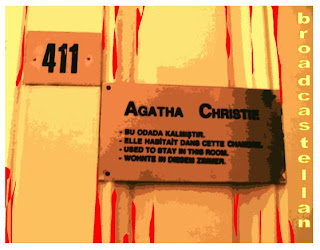
I confess, though, that, as much as I value my hearing, I frequently feel compelled to see for myself; which is why, on the anniversary of Dame Agatha’s birthday, I went up to her room at the Pera Palas Hotel in Istanbul last fall and had a look. There wasn’t much to see, really; not so much as an air of her presence. And, after paying the concierge who escorted us up to room 411, which the enterprising management has shrouded in a mystery of its own, I felt as if I were getting a box on the ear for not having had more sense.

From the House of Terror

This report from the Terror Háza (or House of Terror) concludes my Budapest diary. Not that Hungary is quite done with me yet, considering that this week’s drama on BBC Radio 3 is The Radetzky March, an adaptation of the 1932 novel, which chronicles the fall of the Austro-Hungarian Empire, as well as a portrait of its author, Joseph Roth, an Austrian Jew. Roth died in 1939, some five years before the Nazis took over Hungary (or Nazi Hungary allied itself with Germany), resulting in the deportation and death of thousands of Jews in the concentration camp in Auschwitz. My visit to the House of Terror, in which these and other stories from Hungary’s none-too-distant past are documented, was one of the most fascinating and disturbing history lessons I have ever received.

Once called the House of Loyalty, the building was the headquarters of the Hungarian Nazi Party. In its basement, members of the Arrow Cross interrogated, tortured and silenced hundreds, smothering the voices of the opposition. Like Hungary itself, the premises were soon taken over by the Communists, who, beginning in 1945, continued to use them for such purposes until 1956, the year of the brutally crushed revolution.

The House of Terror is a museum now, an exhibition space at once horrific and beautiful. In its corridors of former power, the art of intimidation survives as art installations. The awful turns awesome, the oppressive impressive. David Lynch might have served as its interior decorator. It is glamorous, you might say. How perverse it was to admire what decency compels us to abhor. The house, it seemed, was designed to corrupt.

It was only when I descended into the cellar, rooms into which visitors are lowered with cruel deliberation on a black and slow-moving elevator, that the oohs and ahhs were choked right out of me. Never before have I experienced such an approach to what must be never again, at least not on this heart-shrinking and spirit sinking scale. This place of dread and despair does not simply document the uses of awe—it provokes and regenerates it.

My throat muscles tightened, my eyes filled with tears, as I solemnly made my way through this desolate underground maze of “detention cells”, “wet cells,” of “foxholes” and “treatment rooms,” of “guard rooms” and “condemned cells”—and the “place of execution.”

“There were no executions” in Terror Háza, the guidebook took pains to inform me, “‘only’ fatal bashings and suicides.” Echoing the distinctions of the extinguishers at work here, the clear and cruel terminology of extermination still reverberates in this orderly house of silencing, a house in which there was no room for grace . . .

Replications of Life: Kempelen and the Art of "Turking" It

I appreciate a good hoax; and no hoax is any good unless it wrings from you the admission that you have been had. My common sense yields to the artistry of the con, the handiwork of cheeky tricksters who can cheat you out of your trousers by presenting you a with a hook from which to suspend your disbelief. And however desperately I might try to cover up and recover my composure by juggling an assortment of polysyllables, I am just the kind of fall guy you’d love to be around on April Fools’ Day—or any other day, if you are among those who practice their legerdemain without a license.

To cry foul at the art of faking, as Oscar Wilde put it, to “confuse an ethical with an aesthetical problem.” Not that such a defense would have done for Orson Welles and his Mercury Players, whose aforementioned Halloween make-believe gave broadcasters cause for alarm after some radio listeners panicked at the announcement of a Martian invasion back in 1938. In the case of the famous Turk, the fakery was comparatively inoffensive and harmless, excepting perhaps for the wretch squeezed into the apparatus, a replica of which (by illusionist supplier John Gaughan) I encountered at the Műcsarnok in Budapest. It is on display there until 28 May 2007, after which time it may be seen in Karlsruhe, Germany, from 15 June until 19 August 2007, over two hundred years after its first appearance in that town.

The chess-playing automaton was the creation of Austro-Hungarian baron Wolfgang von Kempelen (1734-1804), who, according to Edgar Allan Poe, “had no scruple in declaring it to be a ‘very ordinary piece of mechanism—a bagatelle whose effects appeared so marvellous only from the boldness of the conception, and the fortunate choice of the methods adopted for promoting the illusion.'”

The marvel of the Turk was that it kept audiences guessing, not so much what his next move might be, but how he moved and whether he actually contemplated the movements of the pieces in the game. What was the ghost in this machine? Was it some precursor of “The Automaton” that, on 27 July 1953, stalked radio’s Hall of Fantasy? Might the Turk have a mind of his own (a thought to cause suspicious westerners unease)?

Poe became intrigued by the mystery of the Turk when this player of mind games toured America after having been acquired by a German inventor-showman who shrouded the creation in further mystery by refusing to say whether it was “a pure machine or not.” As Poe speculated in “Maelzel’s Chess-Player,” the “notoriety” and “great curiosity” of the Turk were “owing more especially to the prevalent opinion that it is a pure machine, than to any other circumstance.” It was, therefore,

in the interest of the proprietor to represent it as a pure machine. And what more obvious, and more effectual method could there be of impressing the spectators with this desired idea, than a positive and explicit declaration to that effect? On the other hand, what more obvious and effectual method could there be of exciting a disbelief in the Automaton’s being a pure machine, than by withholding such explicit declaration?

Being in the know without having had the courage of falling for it or the virtue of rising to the occasion by exercising one’s imagination is a profligate waste of curiosity. It means to reduce a philosophical problem to a mechanical one. More compelling than the matter of its nuts and bolts was how the Turk worked on the minds of those surrounding him. “For, people will naturally reason,” Poe argued, that it is

Maelzel’s interest to represent this thing a pure machine—he refuses to do so, directly, in words, although he does not scruple, and is evidently anxious to do so, indirectly by actions—were it actually what he wishes to represent it by actions, he would gladly avail himself of the more direct testimony of words—the inference is, that a consciousness of its not being a pure machine, is the reason of his silence—his actions cannot implicate him in a falsehood—his words may.

To this day, Germans refer to what they deem forged, false or fake as being “turked” (“getürkt”), which, I am pleased to say, explains nothing.

Monumental (S)care: A Walk in Statue Park

No matter how hard I tried to make light of them, by pulling their fingers or sitting on their boots, the colossal statues gathered in the ideological leper colony that is Szoborpark made me feel (and, as you can see, seem) rather small. They were intended to awe, of course, to impress those looking up with a sense of being overmastered rather than represented, of being conquered and compelled to surrender their personal aspirations along with their cultural identity. Removed from the public squares in which they towered over the multitude, the statues of the communist regime imposed on the Hungarian people have been relegated by them to the outskirts of Budapest, to a forlorn place called Memento or Statue Park.

Never completed as conceived on paper in the early 1990s, the park has already fallen into disrepair. Weeds now triumph over concepts, mocking at once the old order of terror and this new method of detaining it, of quarantining a body of unsettling memories by setting it apart from the everyday. The past needs tending to; but, as the grounds of Statue Park suggest, we balk at beautifying what amounts to pathology, at manicuring a disease known to have corrupted intellects, choked incentives, and smothered lives.

As those monuments went up in 1940s Hungary, the US took monumental care in tearing down communist and socialist ideals, many of which had been shared and endorsed by thousands of upright, patriotic Americans during the 1930s. After years of economic hardship, of rationing and sacrifice, Americans seized the chance of raising picket fences, those monuments to sovereignty, which they were encouraged to set up as individual tributes to American virtues, to the pursuit of personal happiness and the proper boundaries of its expression.

Yet the straight and clean domains of the home frontier were argued to be under attack, compromised by wayward doubters and their doubtful ways; and it was on the air that the infiltrations and contaminations of the social fabric by the newly branded un-Americans—who were argued to have their designs on the dream they questioned as fabrication—were mass-circulated as cautionary tales of anti-communist propaganda.

Aside from the common weed of crime, once rooted out with precision and glee by superheroes like The Shadow (reportedly slated to be recast for the screen that could never contain him), the fungus of homegrown communism at home threat of mushroom clouds over America demanded a new breed of secret and sanitary agents, men like Matt Cvetic, who infiltrated the infiltrators and spread his cleansing mission statement by boldly declaring I Was Communist for the FBI in a series of espionage thrillers that premiered on US radio back in April 1952.

Throughout the 1930s, ‘40s and ‘50s, US radio assisted in setting up new statues and dismantling old, in forging idols and fostering ideals while pronouncing others fallen or rotten. It created images in the mind more persuasive, invasive and pervasive than prominently displayed sculptures in stone or steel. The United States did not require monuments to steer and stir, to guide, goad and guard its citizenry. It had microphones.

Tara on the Danube; or, The Ambassador Wore Ballet Shoes

Well, that didn’t last long, did it? The wireless connection in our hotel room in Budapest, I mean. It pretty much collapsed after about 48 hours, even though we had paid a small bundle to be online for the week. Not that I find it easy to keep this journal, to keep up with the out-of-date while being out and about on my travels. Our days were filled with taking in the sights; our evenings (and bellies) with goulash, goose liver, and Hungarian wines—from which culinary excesses arose the most curious and vivid dreams. I was paying my respects at the bedside of the by me previously pooh-poohed Zsa Zsa Gabor, shared a moldy piece of decades-old cake with Madonna, who told me my gray roots needed a fresh coating of dye, and was set to teach “My Fair Lady” (whatever that might entail) at a soberingly conservative village school. Those subconscious night flights of fancy were not nearly as strange, though, as the experience of going to the Budapest Opera House to see Gone With the Wind transformed into a Hungarian ballet.

“I bet you, if it was handled right, that picture would make a great book.” That is what the aforementioned Fibber McGee told his wife Molly after watching the premiere of Gone With the Wind at their local theater in early 1940. And there I was, 67 years later, hundreds of miles from my local theater, asking myself whether it could make a great ballet. I had never considered the question; but when we walked into the magnificent Operaház to find out what was playing, we could not resist snatching up what might have been the last as well as the best tickets to the pop-cultural and historical confrontation that was the world premier of Elfújta a Szél.

In her introduction to the piece, US ambassador April H. Foley made a somewhat desperate effort to stress the connections between Gone With the Wind and Hungarian culture, reminding readers of the playbill that the novel was awarded a prize named after Hungarian-born newspaper mogul Joseph Pulitzer; that the production of the movie had involved Hungarian-born director George Cukor; and that it starred a leading lady once “under contract to Hungarian filmmaker Alexander Korda.” Such connecting-the-dottiness rather reminds me of the treatment I am giving American radio drama, which I am wont to work into just about any conversation; especially into this one, given that a scene from Margaret Mitchell’s 1936 bestseller had been dramatized for radio more than three years before it hit the big screen in December 1939.

But, back to the ballet. The last time I exposed myself to the spectacle of cinema gone tiptoeing, my response was less than rapturous. Matthew Bourne’s Edward Scissorhands seemed to rely overmuch on fanciful costumes and fantastic sets than on the footwork that had made Bourne’s earlier Swan Lake such breathtaking theater. Choreographed by Lilla Pártay (to the music of Anton Dvorak, whose “New World” was not the bygone one romanticized by Gone), Elfújta was decidedly more traditional in its approach to ballet, even though its retelling of the contrived melodrama that is Gone often felt like a danced synopsis—a series of tiptoe tableaux. However charming or thrilling the moves, it was the tiptoeing around American history that had me wriggling in my seat.

Commenting on Gone’s depiction of the American Civil War, Foley remarked that the “attitudes toward slavery and stereotypes of African Americans are consistent with the historical era” and that “[a]lthough we certainly do not share these views today, we appreciate Gone With the Wind for what it is: an icon of American historical fiction that is still enjoyed by millions the world over.” Now, aside from feeling that Scarlett’s struggles are so much less interesting than the period in which they are set, I was disconcerted to see that there was next to nothing “historical” about Elfújta, that its love story might as well have taken place on the banks of the Danube—had it not been for those three white actors grinning and swaying in unconvincing dark makeup that was nearly as cartoonish as blackface.

I am not sure in which way Elfújta could “enrich an already close and thriving bilateral relationship” between Hungary and America, other than celebrating a mutual dumbing down of the social sciences. Having long been oppressed and subjected to foreign terrors under the communist regime, Hungarians might be better equipped to identify with the suppressed stories of the slaves than with tales involving Scarlett, Melanie, and Rhett. Now, I don’t know what the role of ballet should or could be in today’s culture; but, for all its splendor, the frivolous Elfújta struck me as an ambassadorial misstep.

Square New Deal?

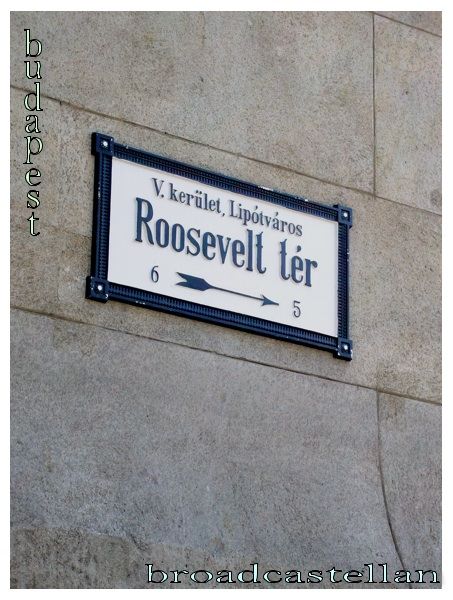
At one point it was prosaically called Uploading Square. Roosevelt tér in Budapest, that is. I decided to start our visit to the Hungarian capital by walking across the old Chain Bridge to pay my respects to the thirty-second US President who died in office on this day, 12 April, in 1945. As previously mentioned here, FDR owed much to the radio; his voice and views were known to millions of Americans who tuned in to hear his Fireside Chats. Three days after his death, his life was recalled by two special and very different broadcast, one headed by Ronald Colman and featuring an uncommonly yet appropriately somber Fibber McGee and Molly, the other featuring Canada Lee, reciting FDR’s D-Day prayer.

Roosevelt did not get a square deal, I thought, as I approached the spot named after him in 1947. These days, it is little more than a roundabout, a traffic island with a few statues in the middle—and none of them of FDR. Seen from the top of the hill in Buda, however, its prominence in the cityscape becomes apparent. Besides, as Fibber expressed it: “You know, a man is entitled to a lot of credit when people can say his family, and his community, and his country are better off for his having lived; but when a man dies and the whole world was a better place for his living, well, nobody needs much more of a monument than that.”

Meanwhile, the statues of Soviet heroes and leaders from whose rule Hungary struggled to free itself (after having lost the war siding with Nazi Germany) have been relegated to a park of their own . . .

Hungary to Hollywood; or, "seven maids with seven mops"

Well, this is it. My last entry into the broadcastellan journal before I’m off to Budapest, from which spot I hope to be reporting back on 12 April with a snapshot of Roosevelt Square, in commemoration of FDR’s death in 1945. Supposedly, our hotel room has wireless access; so I might not have to share my impressions retrospectively (as I have done on almost every previous occasion, after trips to London and Madrid, Istanbul and Scotland, Cornwall and New York City). This time, perhaps, I won’t have to catch up with myself as well as our pop cultural past.

Preparing for my trip, in an experiment you might call method blogging, I devoted the last few posts to connections between broadcasting and Budapest, between Hollywood and Hungary. Today’s association was not so much forged but found; and it is rather more remarkable for that. You’ve probably experienced it too from time to time: the feeling that, once you begin to engage with something you haven’t much thought of before, everything seems to point or relate to it. Suddenly, life is just a bowl of goulash.

Let me give you a for instance. Last night I watched a Hollywood non-classic I assumed to be entirely unrelated to our Hungarian adventure: the Ginger Rogers-starring fantasy romance It Had to Be You (1947), one of the fifty-odd movies I’ve been taking in so far this year (all listed on the right). It is a daft romance about a gal who can’t say “yes” (leaving three guys at the altar) because she cannot get her dream lover out of her head—until said dream enters her life to tell her how to lead it. Her dream lover, whose waking double eventually turns into her true love, is played by Cornel Wilde, who spends much of the picture walking around dressed like a Hollywood Indian. Anyway . . .

I generally follow up my viewings by checking out the filmographies compiled on the Internet Movie Database, which is how I came to speculate about Mr. Wilde (pictured above). Is he, or ain’t he? Hungarian, I mean. It would never have occurred to me, considering that, unlike Paul Lukas or Peter Lorre, Wilde does not have a readily distinguishable accent. Whereas most other online sources will tell you that the actor was born in New York City to Czech-Hungarian immigrants, the Database claims that he not only studied in Budapest and spoke Hungarian, but was indeed Hungarian by birth. Apparently, there are census reports confirming the former.

Wilde’s early screen name was Clark Wales. That alias does not make him Welsh, of course, but might have been chosen to suggest the foreign and rebellious. What would make him Hungarian, though? What is left of your national identity after Hollywood, like an Ellis Island checkpoint for Tinseltown hopefuls, changes your name or compels you do so? Hungarian, of course, was not a highly valued heritage in 1940s Hollywood, given the country’s suspicious proximity to the volatile Balkans, and, as the 1944 propaganda play “Headquarters Budapest” drove home, its alliance with Nazi Germany (“Admiral Horthy of Hungary, or people like him, will help to start World War III in the Balkans”).

I have long tried to get away from such a past (and, after seventeen years, am running still); but I could not hide my national origins, as much as I resent being defined by them. In stubborn grains of truth, the fatherland keeps sticking to my tongue (as you might have gathered from my podcasts). No matter how loudly I declare my past to be water under the proverbial bridge, it won’t wash. It is too prominent to be swept away or brushed aside:

“If seven maids with seven mops
Swept it for half a year.
Do you suppose,” the Walrus said,
“That they could get it clear?”
“I doubt it,” said the Carpenter,
And shed a bitter tear.”

Those lines, from Lewis Carroll’s “The Walrus and the Carpenter,” were recited by Mr. Wilde—in a broad Southern accent, no less—as he played an innocent American falling through the looking-glass in “Allen in Wonderland” (27 October 1952), a Suspense thriller involving an assassination plot, a crisis in the Balkans, and a case of mistaken identity. Earlier, in the same series, Wilde attempted an Eastern European accent playing the villain in “A Ring for Marya” (28 December 1950). It must be wonderful to have a tongue that can be twisted as readily as a broom handle.

Cleaning up the inconvenient pasts of their most valued players, Hollywood swung a lot of mops back then. It was left to the journalists to inspect the buckets. I envy those who get to sweep for themselves or learn to live with the sand.

Things Eve Peabody Taught Me

Well, it is the “Little Paris of Middle Europe.” At least that’s how our newly arrived Eyewitness Travel Guide introduced me to the city of Budapest. Since I am about to visit the Hungarian capital, I’ve been flicking the pages to get acquainted with the place, its people, and its language; but whenever I find myself in need of cultural initiation I go about it in a roundabout way, with a stopover in Hollywood. Or Paris. You know, the really big Paris to the West of Middle Europe.

You can really learn a lot from old Hollywood movies, as long as you don’t get taken in or turned off by fake sets and phony accents. Take Mitchell Leisen’s 1939 screwball romp Midnight, for instance, and profit from the experience of American adventuress Eve Peabody (as portrayed by Claudette Colbert, whose career was the recent topic of an Alternative Film Guide discussion). Eve’s story, the gist of which you can follow in this recording of a Lux Radio Theater adaptation broadcast on 20 May 1940, will teach you a thing or two about traveling on a budget of little more than a centime with a hole in it, about crashing a society party with a pawn ticket, and about the perils of unwittingly impersonating a Hungarian baroness—practical stuff not generally covered by Baedekers.

Now, as the previous entry into this journal will tell you, I have just been in the company of a true Hungarian baroness last night, one with an accent to prove at least the Hungarian part of her past. The misleading lady Eve, on the other hand, has to work somewhat harder to hoodwink her way out of the hood (in her case, the Bronx). After suffering a “nasty accident” in Monte Carlo (“The roulette system I was playing collapsed under me”), down-and-out Eve is forced to depend on little more than her wits, her sex appeal having gotten her into too much trouble already.

She takes the name of the first person she met in Paris, one Tibor Czerny (Don Ameche), a Hungarian cabbie who’s been rather too eager to chauffeur her around town in her futile attempt to land a gig as a nightclub singer. “I guess, mine is strictly a bathtub voice,” she concludes, and makes a swift exit before Tibor can make good on his offer of taking her home. “No woman ever found peace in a taxi. I’m looking for a limousine.” However much she really likes the guy, it’s dough, not romance, that this dame is after.

At the swanky soiree onto which she happens when dodging those driving forces (the Hungarian, the rain, and the subconscious), the Czerny handle proves somewhat of a liability. The assembled high society assumes Eve to be one of the Czernys—a baroness, no less. And while it proves a breeze for Eve to slide around the foreign angle by alleging to be a Czerny by marriage, not birth, she slips on a treacherous bit of trivia and soon blows her cover.

When asked about that “most enchanting” city of Budapest, where she claims to have left her ailing husband, the baron, she is dealt a trick question about the town’s famous subway. “Did they ever finish that?” a guest at the dull get-together she’s managed to infiltrate inquires. “The streets are still a little torn up,” she responds, rather flustered. Her inquisitor did not need to hear any more to know this Eve from Adam. The Budapest metro, after all, is one of the oldest subways in the world, and Miss Peabody is little more than an impersonatrix eager to get away from a past that involved being squeezed each day into the Bronx local.

According to Hollywood justice, Eve gets away with it all . . . and walks away on the arm of Czerny to boot. In fact, having gotten it wrong works out all right for her. History, geography, facts and figures—none of that matters, Midnight suggests, as long as you’ve got beauty, charm and moxie. Considering that I still know so little about my destination, and a gold lamé gown like Eve’s does so little to enhance whatever charm I might have, I’d better cram plenty of moxie into that duffle bag of mine.