Manhattan Transcript: Why Oliver Stone Left Me Cold

Well, I am back in town. Getting here (from Wales) was a considerably less sentimental journey than Oliver Stone’s journeyman tribute to the city and its indomitable spirit—and a far more telling reminder of the changes resulting not just from the terrorist attack on the World Trade Center but the subsequent efforts in the so-called war on terror. At our airports, unlike a court of law, we all are presumed guilty unless proven innocent. After a sleepless night in Manchester, England, I was being questioned regarding my passport, asked to provide evidence of my stay in the United Kingdom—the country where I now live and from which was about to leave.

Although issued in London and stating my residence as being Wales, my German passport marks me as a visitor, a cosmopolitan spirit, or some such suspicious subject. Airport (in)security has made international traveling considerably more challenging of late, given the current security alerts and precautionary measures at UK and US airports. Far more than a series of inconveniences, air travel has become an endurance test for a free world locked in a system of terror and liberties impounding counter-terrors.

It seemed right for me to go see World Trade Center on its opening night here in New York City, especially since some of the proceeds will go to charity. I lived in Manhattan on the day of the attack and the anguish of its aftermath. Reminders and memorials far more eloquent and than Stone’s film lined the city’s crowded if quiet streets—candles on the doorsteps, “missing persons” photographs on the walls, and distress signals in the faces of those lingering among strangers whose presence offers some reassurance that the world had not yet come to an end. Today, the World Trade Center site (pictured above, in a photograph I took last Tuesday), is a gash in the cityscape bespeaking the pathology of terror.

Telling the events of that day from the perspective of first responders and their families, Stone’s World Trade Center struck me not merely as sentimental but spurious. Denying the politics of terror and offering instead something akin to Backdraft with a “based on a true story” tag, the film plays a game of “Good cop, bad Capra” with those who are most anxious to attack it. It refuses to be sensationalistic, but falls far short of making much sense of matters so staggering to most of us. It has nothing to share beyond the uplifting message that the human body can endure great pain if sustained by a will to live.

We all are living and fighting for the basics, for the love of someone or the passion for something—including those in our midst who love to hate us and are willing to be consumed by and give their lives for that love. It is the realization of the potential destructiveness of fierce attachments that makes terrorism such a frightening presence in our lives. It is this disconcerting realization that World Trade Center leaves out of the picture, thereby falsifying an historical event that gave rise to the passion-stirring and hate-begetting war on terror.

Unlike the riveting United 93, Stone personalizes the event, embedding the extraordinary in ordinary stories of everyday middle-class and endorsed-as-traditional family living. With a narrative structure fit for a Lifetime television movie of the week and performances so perfunctory as to collapse under the burden of sentiment they are supposed to carry, World Trade Center is an abject failure in Hollywood storytelling.

Turning a landmark event into a Hallmark card, it even manages to reduce the eponymous structure and the smoke rising from its rubble look to a poorly executed CGI effect. Given the footage we have all seen and shed tears over, this faking was most distressing to me. Then again, even the homeless and the streetwalkers—stock figures meant to suggest urban grittiness in films set in the metropolis—came across like so many Hollywood extras dressed up for the occasion.

It was distressing that I could not be made to feel anything but dissatisfaction, having suffered so greatly on that day and being generally so receptive. Other around me even burst into uneasy laughter at the sight of Jesus holding a water bottle, an image of astonishing tackiness. It is telling that the most poignant moments in the film flickered before me in news footage of the world’s response to the attack, images of people who did just what I did when the towers came down: watch in horror.

These snippets also carry the political message that Stone’s dramatizations obscure: that the world’s love for America, so evident on the day of the attack, has been squandered and that neither our homes nor the world beyond are any safer in the age of counter-terrorism.

We Now Resume Our Regularly Scheduled Life

It has been a week of local excursions here in Wales, days spent sunbathing and splashing in the radioactive sea, bookhunting in Hay-on-Wye (the world-renowned “Town of Books”), dining al fresco, stargazing outdoors and on screen, playing with Montague, our unruly terrier, and being among friends (even after having been critiqued with the candor I reserve for those who matter to me). The occasion of it all was a weeklong visit by my closest if mostly long distance friend, the fatherland I haven’t set foot on for seventeen years. It is to him that I owe the wonderful book pictured above, a splendid addition to my collection of Claudette Colbert memorabilia.

Whenever I venture out to Hay, I return home with a few treasures. This time, I added a book on Harold Lloyd (my favorite silent screen comedian, whose films The Kid Brother, The Cat’s Paw and Girl Shy we screened during the past few days), as well as a coffee-table topper on screwball comedies (a book which I had previously gifted to abovementioned best pal, but with which I was pleased to get reacquainted). However convenient and economic it might be to browse and shop online, the thrill of the hunt (as previously described here), is something a carnivore of a booklover like me does not like to go without.

Now, the people of Film Pictorial, a British publication, are full of it. Legend, I mean, which is a term I much prefer to trivia when it comes to describing pieces of nothing from which to weave whatever your mind is up to at the moment. Trivia is for the mercenary; legend for the mercurial. I shall raid said volume from time to time here on these virtual pages. Where else might you learn whether or not you have a “Film Hand” from a writer who examines the “long little finger on the hand of Katharine Hepburn” or the “thickish fingers” of John Boles and Warren William to tell their temperament and acting skills?

The book also contains longer articles on “The Gallant Life of Norma Shearer” and takes readers to the homes of stars like Harold Lloyd, Bette Davis, and . . . Gordon Harker? Robert Montgomery, meanwhile, debates, along with Jeanette MacDonald, “At What Age Are Women Most Charming” and Myrna Loy reveals her “Own Ideas.” It’s all glossy but telling gossip, which I am looking forward to sharing, along with old news from , over the next few days.

Of course, my week was not without pain and what there is of sorrow in my life, among which my tumble down the slippery steps to my room and the breaking down of our car are the most dramatic examples. My lower back and my left toe still ache; the car might not be salvageable at all. In a matter of weeks, I reckon, such woes—which led to dipped feet in cooling springs and a ride through Wales in an Auto Club truck—will be nothing but cheerful anecdotes to be shared among chums. For now, they are inconveniences, at most.

As I have mentioned before, the weeks to come will be somewhat less than regular. On 7 August, I shall return, however briefly, to my old home in New York City. In the meantime, I resume my journal, hoping it will be appreciated by those who make it a habit to keep up with someone as gleefully out-of-date as yours truly, broadcastellan.

Up Frenchman’s Creek; or, How (Not) to Prepare for a Vacation

Well, I’ve been home barely twenty-four hours and already I am packing my suitcase again. After a weekend up north in Manchester, I’ll be off tomorrow on a weeklong trip down south to Cornwall. Instead of flicking through my travel guides this morning, I started reading Daphne du Maurier’s Jamaica Inn. Now, there’s a description of scenery you wouldn’t get from your travel agent:

[There] was a lashing, pitiless rain that stung the windows of the coach, and it soaked into a hard and barren soil. No trees here, save one or two that stretched bare branches to the four winds, bent and twisted from centuries of storm, and so black were they by time and tempest that, even if spring did breathe on such a place, no buds would dare to come to leaf for fear the late frost should kill them. It was a scrubby land, without hedgerow or meadow; a country of stones, black heather, and stunted broom. 

There would never be a gentle season here. [. . .] 

Not much more hospitable is the seascape depicted in the opening chapter of du Maurier’s Frenchman’s Creek:

When the east wind blows up Helford river the shining waters become troubled and disturbed and the little waves beat angrily upon the sandy shores [. . .].

The long rollers of the Channel, travelling from beyond Lizard point, follow hard upon the steep seas at the river mouth, and mingling with the surge and wash of deep sea water comes the brown tide, swollen with the last rains and brackish from the mud, bearing upon its face dead twigs and straws, and strange forgotten things, leaves too early fallen, young birds, and the buds of flowers.

Perhaps reading du Maurier’s Cornish romances is not such an ideal way to get into the spirit of things, especially not when one is hoping for spring and renewal. At least their author was familiar with the locations described. Listening to the 10 February 1947 Lux Radio Theatre version of Frenchman’s Creek, I got no sense of the locale at all; nor, for that matter, much sense of the story. There was too little of it left to suggest the illicit passion of a married woman for a dashing pirate.

The radio version is not so much an adaptation of the novel, but of radio dramatist Talbot Jennings’s screenplay for Paramount’s 1944 technicolor production, which cleaned up du Maurier’s act in accordance with Hollywood’s production code. Mitchell Leisen’s film, of course, was not shot in Cornwall either, but in Jenner, California, which also stood in as Devon in The Uninvited, an old-fashioned ghost story featuring the novelty of a sun rising in the west.

I don’t suppose Alfred Hitchcock’s reworking of Jamaica Inn is any more useful as an introduction to Cornwall; I’ve always confused it with Under Capricorn, another one of Hitchcock’s misguided forays into period piece froufrou (although I confess having enjoyed his Waltzes from Vienna). And since there is little time to dip into the poetry of John Betjeman, I think I’d better get back to my travel guide after all—and finish packing. I will try to relate my impressions upon my return next Wednesday—provided I can find a radio drama angle.

On This Day in 1952: “An Ideal Husband” Must Face Charges of Infidelity

Tomorrow, I am once again crossing the border for a weekend up north in Manchester, England. “Crossing the border” may seem a rather bombastic phrase, considering that I won’t have to show my passport, get fingerprinted or have my luggage inspected at customs. Yet, as I learned after moving from New York City to Wales, the border to England is much more than a mere line on the map, very much guarded by those whose thoughts are kept within that most rigid and impenetrable of confinements—the narrow mind. Urbanites can be most provincial. Thoroughly walled-in, they are often ignorant of a fact stated by Oscar Wilde in An Ideal Husband (1895): “Families are so mixed nowadays. Indeed, as a rule, everybody turns out to be somebody else.”

That the proud and prejudiced lack discernment is rather what I’m counting on when next I walk over to the Royal Exchange Theatre, which is currently promising seats at Separate Tables. During my previous visit to Manchester, I was fortunate to catch a splendid production of What Every Woman Knows (as mentioned here).

Indeed, Jenny Ogilvie portrayed Barrie’s heroine, the knowing Maggie Wylie, so brilliantly that I was quite disappointed when, sauntering over to the theater of the mind, I took in a Theatre Guild on the Air adaptation of the play only to find it wanting, notwithstanding the valiant efforts of Ms. Helen Hayes to act against the clock.

It was on this day, 30 March, in 1952, that the Theatre Guild presented An Ideal Husband, with Rex Harrison as Lord Goring and Lilli Palmer as the scheming Mrs. Cheveley. Now, An Ideal Husband, not unlike the plays of George Bernard Shaw, is scripted with such novelistic attention to stage business that it is nearly impossible to perform as the text attempts to dictate.

I mean, who, beyond the second row, would be able to discern that Mrs. Cheveley has “gray-green eyes” or that Sir Robert Chilterns’s “romantic expression” contrasted with a “nervousness in his nostrils”? That “Vandyck would have liked to have painted his head” is an interpretative aside reserved for the reader and unlikely to become legible to the theater audience, however attentive.

Plays like An Ideal Husband were designed to counter the crudeness of Victorian melodrama, which was appreciated for its staging rather than its writing, lines borrowed, bowdlerized, or anonymously penned. The late-Victorian playwrights insisted on being authors— and accordingly approached drama as a composition to be published as well as performed.

Radio theater can—and must—do without such minutiae. It must permit audiences some liberties in designing the set, in staging and casting a play. The voices of the actors will curtail that freedom, suggesting the age, gender, origin, and cultural background of the speaker. Harrison is not altogether suited for the part of Lord Goring, whom I picture as suave, rather than gruff; but perhaps my mind’s eye, long conditioned visually, simply could not see beyond Harrison’s memorable impersonation of Professor Henry Higgins. I have become too accustomed to his face to allow his voice to suggest another.

It is Lord Goring who takes center stage in Arthur Arent’s adaptation, whereas the “ideal” husband being put to the test in Wilde’s play is Sir Robert, a man who comes to regret having made his fortune by dubious means. The moral dilemma of a powerful politician who becomes the prisoner of his secret, both the telling or keeping of which may cost him not only his social standing, but his marriage to a morally upright woman, is sacrificed to telescope the intricacies of the plot, which are played strictly for laughs in the radio version.

I’m not sure whether this is altogether a loss, since Wilde’s paradoxical bon mots seem at odds with his less than convincing exploration of morality. The last time I saw a production of An Ideal Husband was in April 1996, at the Ethel Barrymore Theater in New York City. As I noted in my diary (still written in German at that time), the hideously chintzy production, starring Martin Shaw, was very much a disappointment. The staging was too Ibsenesque, I thought, and wit was its casualty. I would have been only too glad to do away with the moral ideals to savor the play’s beyond-good-and-evil twists. Arent’s adaptation made these cuts for me—but was the play being acted out for me still An Ideal Husband or an act of unprincipled imposture instead?

As I put it forward in the current broadcastellan survey, American radio of the 1930s, ‘40s, and 1950s often stood in as an everyman’s theater. Dating back to the early 1920s (as evidenced by the above picture, from a 1923 magazine), it is a concept and a function of broadcasting culture I explore at some length in my dissertation. The drama of the air is potentially boundless—and it often falters when it tries to recreate the stage or dwell in its precincts.

"This . . . is London": Florence Foster Jenkins, Again

Well, it doesn’t always take “practice, practice, practice” to get to Carnegie Hall. Sometimes, delusions of grandeur—and a few thousand gawkers in search of the proverbial train wreck—will do. If you are among those who still marvel at the American public’s decision to include Kevin Covais among this year’s American Idol finalists, consider the career of a tone-deaf diva who brought the William Hung-factor to classical music: Florence Foster Jenkins, a coloratura-blind soprano so astonishingly awful that audiences are still pricking up their ears in disbelief some sixty years after her silencing. Call it “Schadenfreude schöner Götterfunken.”
When last I was in New York City, I went to see Souvenir, a “fantasia on the life of Florence Foster Jenkins” starring Judy Kaye (and reviewed it here). A few weeks later, I was surprised to discover that another not-so-musical portrait of the miss-most-notes notable was on display in London, where it can be taken in at the Duchess Theatre until the end of April. Of course, I had to see and hear for myself how La-la-la Jenkins was being treated overseas, so far from the famed hall she brought down in the fall of 1944, within weeks of her exit at age 76.

As conceived by Peter Quilter, patched-together from what little he could find about the performer in print, Glorious is the sort of guilty theatrical pleasure few people permit themselves these days, given the exorbitant ticket prices that make the legitimate stage a recycle bin for acknowledged classics and crowd-pleasing musicals. Glorious doesn’t quite live up to its title. It is unambitious, trivial, and decidedly silly. Maureen Lipman, whom I had previously seen opposite Sir Ian McKellen in a rather chintzy reproduction of the pantomime Aladdin, delivers the broad jokes and broader slapstick with pitch-perfection. Only too rarely, when addressing us as Jenkins’s audience, does she become as captivating or “glorious” as the original herself must have been to 1940s concert-goers.

Unlike Souvenir‘s Judy Kaye, Lipman does not go far beyond shtick, not being required or encouraged to do so by Quilter’s cartoonish script, which at times seems little more than an assortment of rather ho-hum puns, few of which you would get away with even in intoxicated company.

Unlike Ms. Kaye—who was just and judiciously supported by a pianist-narrator based on Jenkins’s own accompanist, Cosme McMoon—Lipman is being surrounded by a host of sitcom characters: an irascible Hispanic maid, a womanising admirer, a ditzy confidante, and a society lady appalled at her caterwauling. The situations derived from these fictional foes and associates are far less inspired than the close-up of Jenkins at her self-delusional best.

And, unlike Ms. Kaye, Lipman is unable to end on the moving high note both Quilter and Stephen Temperley (the writer of Souvenir) chose for their flourish. Both playwrights attempt to bring home Ms. Jenkins’s blissful ignorance of her tone-deafness by letting us hear the dulcet tones the performers assumes to be producing. Musical star Judy Kaye gets an opportunity to sing “Ave Maria,” while Lipman merely lip-synchs to a recording. The audiences of Souvenir are offered a glimpse, at least, of the diva’s doubts and fears, while those seeing Glorious will encounter a consummate mis-performer sheltered by a stupefying lack of self-awareness.

“[I]t was certainly rather wonderful living in the head of this unique woman,” Quilter remarks in his notes on the play. Unfortunately, we get to enter neither his mind nor hers. Instead, we are being treated to two hours of Will and Disgrace.

"This . . . is London": Approaching Edward R. Murrow

I have returned from my latest London trip; my stimulated mind is filled with assorted impressions that I now ready for recollection in relative tranquility. Rather than pouring out those impressions like the content of an overstuffed suitcase, I shall meet the challenge of assembling them into a sequence of composite portraits, portraits not so much of myself but of the experience of gathering ideas and collecting thoughts. You might call this manipulation of the everyday a form of “method living”: a mental aligning and creative channelling of life’s vast, fleeting, and potentially overwhelming influences into something resembling a design of my own making.

There is to me nothing more thrilling than the tracing of a pattern in the patched-up fabric of the everyday. Granted, I often impose such a design by snipping off too many of the loose ends and by choosing that to which I expose myself with rather too thorough discrimination, by excluding the ill-fitting piece or neglecting the odd thread. Yet the satisfaction of finding sameness where others might only detect difference is not necessarily the program of a narrow mind. I try to do as much stitching together as I do selecting or cutting away. Atropos, Clotho, and Lachesis—I intend to do the handiwork of all three fates.

One of the threads I chose to follow during my wanderings through the maze that—compared to the comforting simplicity of New York City’s map—is sprawling London was the career of American journalist Edward R. Murrow. In his late 1930s broadcasts from London, Murrow had encouraged Americans to connect with world affairs by bringing the hardship of those under Fascist attack home to radio listeners who, in the confines of their living rooms, might have imagined themselves immune to such devastating influences. Later, he exposed fascism of another kind in his commentaries on misguided patriotism and undemocratic perversions of unity.

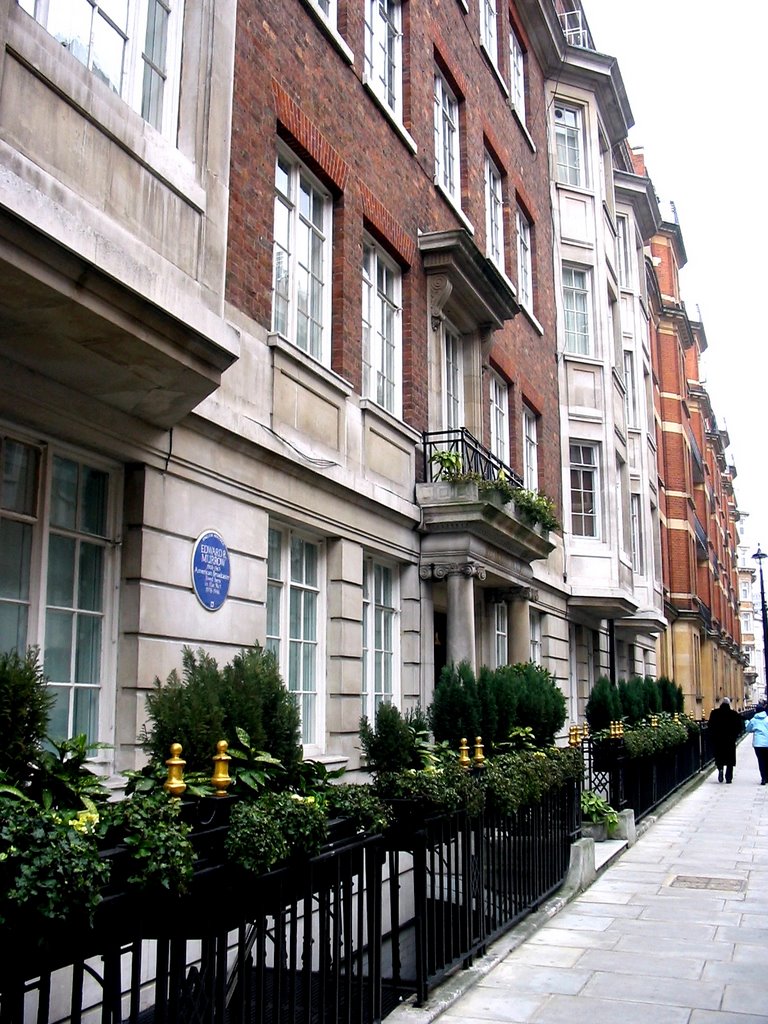
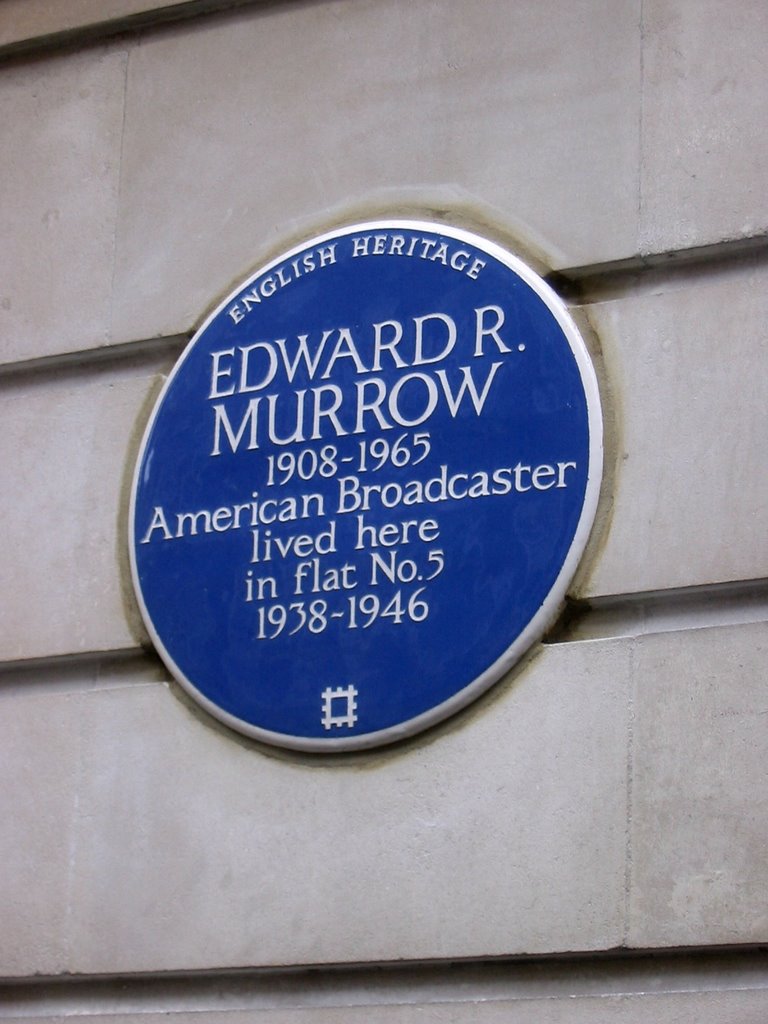
After a brisk two-hour walk from South Kensington, across Hyde Park, I arrived at Murrow’s former residence in Marylebone, not far from the British Telecom tower. I took a few photographs and walked on. I experienced no great stirring of emotions, let alone a spiritual connection. Yet the site itself, along with the act of finding, approaching and appropriating it pictorially became part of a design, enforced by the screening of Good Night, and Good Luck. my mate and I attended a day later. It had not been altogether planned that way; indeed, I was surprised to find the film to be still in such wide circulation.

The quietly impressive motion picture and my altogether unremarkable photographs do not so much amount to a biographical composite sketch of Murrow, a man who shaped history by recording it. Rather than capturing his past they suggest his presence—or our need for it.

Much of what Murray reflected upon in his broadcasts—even in reminiscences such as this one from 3 December 1944—is anything but dated, if only you permit yourself to look beyond the names of places and persons and weave his expressions of hope and fear into the fabric of our current wars and crises:

You remember those mean streets in London where so many died; the men stretching canvas over holes in roofs and walls, trying to patch things up before the winter comes, anything to keep out the rain and cold.  At the airfield you remember that it was just here you watched Mr. Chamberlain descend from his plane when he came back from Munich, waving his written agreement with Hitler and talking about peace in our time.  That was such a long time ago. And you wonder when there will be peace again and what it will be like. . . .

You recall all the talk of a better world, a new social order, a revolution by consent, that marked the desperate days, and you realize that talk of equality of opportunity, of equality of sacrifice, of a peace based on something other than force, comes more readily to the lips when disaster threatens.  There isn’t so much of it now [. . .]. 

Europe for a long time will be concerned with the urgent problems of day-to-day existence. The fundamental economic and social conflicts will not have been settled by this war. [. . .] 

For years after this war Europe will be in torment and [ . . . ] you wonder what part America will play in it all.  In battle and in production we have been magnificent.  We have delivered the planes, tanks, guns and ships and the men to fight with them.  The evidence of our strength can be found all around the world.  We’re not as tired as the others.  Our industrial plant is undamaged.  Our homes have not been blasted.  We enjoy security and relative comfort and our responsibility is frightening, for Europe will look to us—not for charity, advice or admonition, but for an example.  Democracy hasn’t been very fashionable over there in recent years and there are many who doubt that it can survive the strains and stresses of peace. . . .

Is democracy still “fashionable” anywhere? Is it the gear of choice or an imposed uniform that ceases to be fashion by resembling fascism? Has the current war on terror (or the terror of war) done much to preserve it? Are we still talking about a “peace based on something other than force”? The patterns we discover when engaging with the so-called past are often disturbing rather than reassuring. And yet, to ignore them, to refuse recalling them into our everyday, might be more disturbing still—a wilful refusal to connect that, far worse than passivity, is a violent act of tearing apart the fabric along with its flawed design.

“This . . . is London”: Departures for, of, and at the Theater

Well, I’m afraid this journal entry is going to be all over the place—like my luggage, as I am preparing for tomorrow’s trip to London. I would have enjoyed sharing one of my “What Those Who Remembered Forgot” obituary footnotes to commemorate the radio career of Oscar and Tony winner Maureen Stapleton (1925-2006); but I could not find any recordings of her performances heard on Best Plays, a US drama anthology that premiered on 8 June 1952 with a production of Winterset. Nor have I come across Stapleton’s guest appearances on radio’s Quiz Kids program. So, after some searching, I had to give up on the tribute and continued to plan my theatrical entertainments for the days ahead.

I have yet to see a truly great stage production in London, most of the plays I attended during my previous visits having been less than scintillating. Let’s see, there were the lackluster revivals of The Philadelphia Story and Once in a Lifetime, starring Kevin Spacey and David Suchet, respectively. While colorful and quirky, Matthew Bourne’s adaptation of Edward Scissorhands (discussed here) was choreographically far less impressive than his Swan Lake.

Rather more to my liking was the staging of Agatha Christie’s And Then There Were None, which, as discussed here, offered few surprises (being faithful to the novel), but a genuinely creepy finale.

Then again, I’ve always been fond of unabashed melodrama, even though, at today’s prices, theatrical thrillers are a decidedly rare and guilty pleasure. Gone are the days when everyday people flocked to the theater for some choric hissing of villains in plays with titles like The Worst Woman in London or The Ugliest Woman on Earth. I’d settle for a production of William Archer’s The Green Goddess, but doubt whether our politically correct climate—in which even a cast member of South Park balks after discovering his scientologically reconstituted conscience—still allows for the blossoming of such vulgar delights, now relegated to that slowly deteriorating hot house of popular culture, the movie theater.

Imagine a scene like this—as described by Charles Dickens—at one of today’s West End temples of drama:

We were a motley assemblage of people [. . .] . Besides prowlers and idlers, we were mechanics, dock-labourers, costermongers, petty tradesmen, small clerks, milliners, stay-makers, shoe-binders, slop-workers, poor workers in a hundred highways and byways. Many of us—on the whole, the majority—were not at all clean, and not at all choice in our lives of conversation. But we had all come together in a place where our convenience was well consulted, and where we were well looked after, to enjoy an evening’s entertainment in common. [. . .]
Between the pieces [a pantomime and a melodrama], we almost all of us went out and refreshed [. . .]. The sandwich—as substantial as was consistent with portability, and as cheap as possible—we hailed as one of our greatest institutions. It forced its way among us at all stages of the entertainment, and we were always delighted to see it; its adaptability to the varying moods of our nature was surprising; we could never weep so comfortably as when our tears fell on our sandwich; we could never laugh so heartily as when we choked with sandwich; Virtue never looked so beautiful or Vice so deformed as when we paused, sandwich in hand, to consider what would come of that resolution of Wickedness in boots, to sever Innocence in flowered chintz from Honest Industry in striped stockings. When the curtain fell for the night, we still fell back upon sandwich, to help us through the rain and mire, and home to bed.

Perhaps I could have done without those assorted noises and scents after all; but I sure enjoy an evening of unpretentious theater. Unfortunately, both Jerry Herman’s silent-screen musical Mack and Mabel and Noel Coward’s Hay Fever, starring Judy Dench, won’t open until April.

Instead of such revivals, I might be singing the Resurrection Blues. There is Robert Altman’s production of Arthur Miller’s play of that title, of course; but I have never been particularly fond of Miller, mostly due to his denunciations of radio, the medium that not only sustained him during the lean 1940s, but that influenced the mind-as-stage explorations attempted in plays like Death of a Salesman and After the Fall. I’d much rather see Altman’s latest movie, A Prairie Home Companion, Garrison Keillor’s own adaptation of his popular radio series.

I’ve still got my eye on Glorious!, that other play about the odd career of vocally challenged Florence Foster Jenkins, one version of which, titled Souvenir, I enjoyed when last I was in New York City. Well, we shall see what tickets I can manage to snatch up at the half-price booth. Next week, at any rate, I hope to share some souvenirs from what I trust will amount to a glorious time in the metropolis.

"This . . . is London": Getting Ready to Take in the Sounds Again

Broadcasting House, London

Well, it has been a rather gloomy weekend, a few hours of which were spent finding a publishing house and home for Etherized, my doctoral study on old-time radio. I have been slow to send out proposals but am aware that I cannot rest on my laurels until they begin to smell. The fresh air being too damp, cold, and swiftly circulated, I sought shelter by the fire and found pleasant company in an unflappable adventuress by the name of Eve Peabody. Surely you’ve met Eve Peabody, the blues singer whose voice, by her own admission, is strictly of the “bathtub” variety? You know, the gal who once crashed a ritzy social gathering with a pawn ticket for an invitation. Yes, that Eve Peabody—the gold-lamé garbed, Bronx Local-hardened heroine of Mitchell Leisen’s deucedly clever screwball comedy Midnight (1939).

There’s much to be learned from an urbane charmer like Eve (as portrayed with pitch-perfection by Ms. Claudette Colbert). Lessons in picking yourself up, dusting yourself off, and starting all over again, I mean. Having escaped a Monte Carlo disaster—a failed system that left her practically penniless at the roulette table, with the exception of that one French coin with a hole in it—Eve takes a gamble by hopping on a train to not so gay Paris.

Alighting none too delightedly with damp and dreary prospects before her, she inquires with sarcasm, rather than incredulity: “So this, as they say, is Paris?” Not altogether reassured by the conductor, she wryly remarks: “Well, from here it looks an awful lot like a rainy night in Kokomo, Indiana.” I might find myself saying something not unlike this when I step out of the train in London this Wednesday. The forecast is not promising; but, like Eve, I am determined to make the most of my stay.

Perhaps, my idea of a good time differs from that of most visitors, but, aside from the shops and a West End show or two, Edward R. Murrow’s house in Hallam Street is right up there on my list of must-see attractions. As I reported a few weeks ago, a blue plaque has been placed on the façade of Weymouth House earlier this year, commemorating the contributions of its former resident, Murrow, to bringing the terrors of the London blitz home to American radio listeners, many of whom may have otherwise been indifferent or downright hostile to the British, quite willing even to let my Nazi ancestors have their way with them.

“This . . . is London,” of course, was Murrow’s famous introduction to his blitz broadcasts. His reports made a distant fight for survival seem real and urgent—unlike that picturesque firework display that stood in for the air raids in the recent Judy Dench-starrer Mrs. Henderson Presents. After all, radio can produce terrors far more immediate than video or photography, provided you have mind, heart, and guts enough to translate dreadful sounds into horrible images.

Walking through London again, I might do what I used to do when I first came to New York City, which is, besides taking in the sights, to take in the sounds as well. When the broadcastellan journal was still in its infancy, rather than its present adolescence, I contemplated the soundscape of Britain. For, surely, London has one of the most distinct sonic designs of any Western metropolis, the chiming of Big Ben being its most memorable earmark. So, as an exercise in getting in tune with said town, I will tune in again to “A Portrait of London” (20 July 1956), a CBS Radio Workshop tour conducted by Winston Churchill’s daughter Sarah, who took American listeners right into the bell tower of Big Ben.

“So this, as they say, is London, huh?” I might find myself saying on Wednesday as I step out onto the platform at Euston Station: but, hearing the inimitable sounds of the big city, I am unlikely to add “Well, to me it sounds an awful lot like a rainy night in the Welsh hills.”

Wireless Women, Clueless Men: Gertrude Berg, Everybody’s Mama

Well, I am back from my three-day getaway to Manchester, my makeshift Manhattan. And what a poor substitute it has proven once again. The only bright spot of an otherwise less than scintillating weekend was the production of James M. Barrie’s comedy What Every Woman Knows at the Royal Exchange Theatre. While I prefer the traditional proscenium arch over an arena that to me suggests circus acrobatics or boxing matches rather than verbal sparring, I eventually got past the irritation of being dazzled by confronting stage lights, of having to watch the action through a fireplace or other obstructing props, and of looking into the faces of audience members opposite while the players turned their backs to me.

I was won over, tickled then touched by the excellent performances in this smart and sentimental piece, particularly by Jenny Ogilvie’s knowing portrayal of Maggie, whose “every woman” charm eludes the very man for whom she so devotedly works her magic: her clueless husband, that is. I will have more to say about Barrie’s play—and the hazards of adaptation—in a journal entry coinciding with its 2 March 1947 soundstaging by the Theatre Guild on the Air, on which occasion Helen Hayes was heard as Maggie.

Hayes is one of the leading ladies mentioned in the first broadcastellan quiz; and whether or not she ever had her own radio program is something for you to ponder should you choose to join in before the answer is revealed on 24 February. Until then, I could not possibly let Ms. Hayes or her interpretation of Maggie take center stage. That spot is reserved today for “every woman” Mollie (or Molly) Goldberg and her creator Gertrude Berg, who also portrayed the role for decades on radio, stage, big screen and small.

As vaudevillian-turned radio personality Eddie Cantor once remarked, Berg “captured the charm” of New York’s East Side, and “through her sketches runs the entire gamut of human emotions, from laughter to tears.” It was no charmed life on Pike Street those days, but surely one with whom many radio listeners could readily identify.

Jewish immigrants Mollie, her husband Jake, and her two children, Sam and Rosie, came to NBC radio on 20 November 1929, just a few weeks after Wall Street laid that proverbial egg. Recordings of those first broadcasts are not known to have survived, but the early struggle of the Goldberg family has been preserved in print, in a 1931 novelization of the scripts to accompany the popular series.

Mollie is introduced as a woman whose worries are largely domestic and sometimes imaginary. Anxious because her son, Sammy, is late from school, Mollie speculates that he might have gotten himself “runned over by a cabsitac”; after all, “[d]ey run around so fast like cackroachers.” Mollie, you see, lacked a formal education in American English—unlike her children, who were quick to correct her. “De chicks is loining de rooster!” Mollie exclaimed in exasperation.

Husband Jake, meanwhile, was clueless about Mollie’s desire to improve herself; he was too busy with his struggling business. “Oy, vat beezness!” Mollie sighed, “Saturday, Sonday, holledays. Plain talking all de time! Vy don’t you buy a bed and slip dere and finished! And dat’s beezness? It’s a slavery—jost like in Oncle Tom’s Cabinet!”

Sure, Mollie loved going to the pictures watching movies like “Oy, vot a fool I am,” by “Ruddy Kipland” or “de Four Horsemen in de Apoplexies.” She also marvelled at technological advances such as the newly installed telephone in her home (“Mr. Telephon Company, vhere do you put de nickels?”). Yet, like Barrie’s Maggie, Mollie was eager to learn even that which not every immigrant homemaker was expected to know. For that purpose, she enrolled in a reading and writing course at a neighboring night school. So, as much as listeners were invited to laugh at Mollie’s malapropisms, they were also taught to admire her courage and perseverance:

Ay, ay, Amerike, Amerike! Everybody vhat only vants, can become here a somebody. An education is like in de fairy story, “Open see-saw open.”  Vhen you got an education den everyting; all de doors from de vorld stands open far you.  You could even understand yourself, and vhat’s more important dan dat, ha? You’ll vouldn’t be ashamed from your mama, ha, Rosiely?

Years later, Berg commented on the significant contribution of the serial to American democracy. The “daytime serial,” she said, “can be a very effective force in bringing to the American people a deeper understanding of the democratic way of life” since it was capable of “revealing the meaning of democracy in people’s lives,” and of doing so far more effectively “than any speech.”

During the war, however, Berg agreed to address the radio audience in her own educated, if not nearly as charming, voice, imploring those listening to the Treasury Star Parade to be mindful of the fight for democracy, rather than wasteful of the material benefits deriving from it.

“Women like us fight with the bonds we buy, the rubber we save, the food prepare and the fat we save.” It’s what every woman needed to know back then. And who was more ideally suited to tell them than Gertrude Berg, the mother of radio’s surrogate mom?

Sailor Duval Did Not Go Out Into That Big Sleep Last Night

Well, I just got back from a weekend up in Lancaster, a town in the north of England not far from that hotbed of Romanticism known as the Lake District. Perhaps I imbibed rather too copiously from the well of romance, which might account for the strange dreams I had while there. Few things are more tiresome, I know, than someone else’s dreams, unless they are recalled by a poet, a painter, or a psychoanalyst. Being none of the above, I ought to know better than to dabble in such recollections; but this tidbit of mental television so closely relates to my general musings as recorded in this journal—and the plans I have for it—that I deem it worth sharing.

Being removed from a wireless network and the up-to-dateness it affords, I had plenty of time to linger in and dwell on the past, a return trip that began at the Ruskin Library. Exhibited there were sketches and daguerrotypes by the noted Victorian art critic (whom I had just mentioned in my discussion of Quiet Please).

At a second-hand bookstore in Carnforth, I happened on a fine copy of One Year of Grace (1950), a small volume of travel impressions by BBC radio drama producer Val Gielgud, composed while he visited the United States in the late 1940s. A brother of noted stage and screen actor John Gielgud, the author frequently commented on American radio acting and production techniques, deploring commercially sponsored broadcast dramatics and their wastefulness. So, I am looking forward to reading and contradicting his remarks, responses I might share in a future instalment of this journal.

While in Carnforth, I also got to look at the town’s train station. It was here that the location shots were taken for my favorite British film melodrama, the previously discussed Brief Encounter. Unfortunately, I did not recognize the scene as such, even though I arrived at it on a suitably bleak and misty day. Nor does the town seem particularly interested in advertising its landmark.

After visiting a gallery in the town of Kendal, where quite a few painting by erstwhile resident George Romney are on display (though few truly outstanding ones), I was on my way to Lake Windermere, picturesquely shrouded in a haze the feeble winter sun was not able to dispel. My camera refused its services; but I did manage to take the photograph featured in the collage above.

Wordsworth found much to dream and write about on this lake:

There, while through half an afternoon we played
On the smooth platform, whether skill prevailed
Or happy blunder triumphed, bursts of glee
Made all the mountains ring. But ere night-fall,
When in our pinnace we returned, at leisure
Over the shadowy Lake, and to the beach
Of some small Island steered our course with one,
The Minstrel of our Troop, and left him there,
And rowed off gently, while he blew his flute
Alone upon the rock,—Oh then the calm
And dead still water lay upon my mind
Even with a weight of pleasure, and the sky,
Never before so beautiful, sank down
Into my heart, and held me like a dream!

I went to bed early that night, set my ears for a while on “Library Book,” a Suspense play starring the none-too-phonogenic Myrna Loy, but soon drifted beyond earshot and reason. I was not beyond gossip, however, and awoke with the feeling—the knowledge—that Hollywood had lost someone far grander than good old Grandpa of The Munsters—and someone rather more formidable at that.

Upon my return home, I opened to my laptop and eagerly checked the Internet Movie Database for facts, only to realize that I had merely imagined it all: imagined that I had read a headline pronouncing the death of Ms. Lauren Bacall. As of today, 5 February 2006, Ms. Bacall is alive and, I trust, well. Exhale in relief, and marvel at my murderous revision. “You know how to whistle, don’t you?”

In the murkier recesses of my mind, I had somehow made up this story of her passing and believed it, too, mainly because I saw it all in print, however fictive. Sad to say, my immediate response was that I saw in this imaginary headline ample material for a new journal entry, as well as occasion for some exciting listening. I was prepared to write about Sailor Duval and the Bold Venture, the boat on which Bacall (as “Sailor”) and her husband, Humphrey Bogart (as Slate Shannon, her guardian), took off for some tropical adventure each week in their 1950s radio series of the same name. . . .

Not that I require an obituary to revisit the ladies, dames, and gals of the air, the heroines of old-time radio whom I had planned all along to feature over the next couple of weeks, and to whom my first quiz is dedicated. For now, I am going to close the creaking door on this day (and that vision) like Raymond shutting up the Inner Sanctum: “Good night. Pleasant dreams, hmmmmmmmmm?”