White trousers may be out of fashion; but there are still a lot of ways to tell that summer is officially over. And I am not even talking about the mist rolling in from the Irish Sea this afternoon. After all, I am reporting from New York City, even though my reports are filed a few weeks late and some three thousand three hundred miles away.
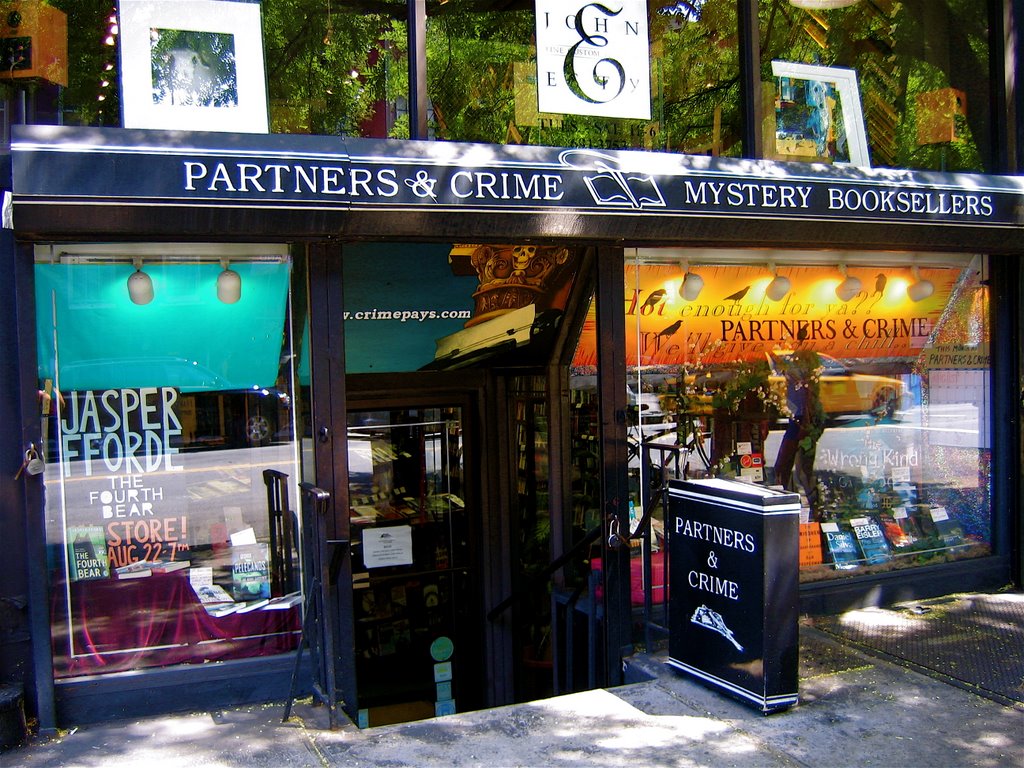
In the United States, the summer season traditionally ends on the first weekend in September, a time when millions of college students abandon beaches for bookstores and a certain band of players reclaims its space behind the shelves. Unlike those students I used to teach during my ten years of adjunct lecturing in the metropolis, the W-WOW! troupe only frequents one exclusive—if academically less than sound—venue: the Partners & Crime bookstore in the West Village.
Ever since the mid-1990s, when the city that presumably never sleeps still bore a slight resemblance to the bawdy and raucous town it had been before naps (and a lot else) became mandatory or derigueur, the W-WOW! players have been gathering on the first Saturday of each month (summer excepting) to re-enact the cases of Sherlock Holmes, Harry Lime, Philip Marlowe, and The Shadow as they were heard on US radio during the 1940s and early 1950s. You know, those days when the city had so much character to spare that a shadier one of it could be knocked off and tossed into the East River without causing more than a RIP-ple. Those days when the city was divided into distinct and clashing neighborhoods rather than being homogenized for the purpose of corporate milking. Those pre-television days during which keeping ones eyes shut to the world to share an imagined one was a national pastime rather than a geo-political hazard.
Anyway. Partners & Crime is a terrific store, one of the few sites that somehow managed to withstand the pressures imposed by chains like Borders or Barnes and Noble. One day, when the millennium was still very young and terrorism something that, from an American perspective, happened mainly to people in Europe and the distant Middle East, I discovered that Partners & Crime had become somewhat of an old-time radio institution—without ever going on the air. In short, it was an intriguing anachronism in a town about to trade in its past for clean facades and the promise of crime-free streets. I’d rather look at the scar above my left eye, dating back to a nightly stroll anno 1989, than walk what now goes for 42nd Street. But, back to fictitious felonies . . .
I was probably browsing for an old copy of Seven Keys to Baldpate or some such chestnut brought to light in my dissertation, when, much to my astonishment and joy, I spotted a microphone at the back of the store. As it turned out, there was an entire studio in the tiny, windowless backroom, a space modelled after station WXYZ in Detroit, as the playbill informed me.
I don’t suppose the goings-on behind the shelves do much for the sales at Partners & Crime. I, for one, immediately forgot all about the volumes around me and inquired about the microphone and its purpose. I was thrilled to learn that it was not set up for a reading of a contemporary crime novel, but for some old-fashioned radio mystery, to be performed for the benefit of a small group of theater-of-the-mind goers who eagerly squeezed into this nook beyond the books. I joined them, of course.
 The W-WOW! players recreate old-time radio thrillers—commercials ‘n all—by placing their audience inside the make-believe Studio B of the equally imaginary W-WOW Broadcast Building. It may not further or elevate the art of radio drama and be done largely for camp (a way of misreading I can do without); but watching the performers as audiences once watched live broadcasts over at Radio City is nonetheless an enjoyable experience, particularly if you happen to eye the sound effects artist eager to elicit a few laughs while playing to the onlookers.
It is unfortunate that the W-WOW! troupe, unlike the Gotham Radio Players, do not go on the air to put their skills to the ultimate test of prominent invisibility. Theatrical training insures that some of the voices are fit for radio; and the actors are passionate even when the scripts are ho-hum. One among them, a certain Darin Dunston, not only appeared in a production of Under Milk Wood, but was the lead in Radioman, an award-winning student film about old-time radio drama.
For a mere five bucks (less than one tenth of the cost of a half-price theater ticket), you may still take in a double feature of thrillers, transcribed from original recordings. Never mind that most of those in attendance at Partners & Crime seem more interested in the corny sales talk than in the plot of the mysteries or in the history of radio dramatics. I, for one, often listen to audio plays to get lost in sound instead of bothering to find much sense in them; and the noise made in the back of that West Village bookstore is quite in keeping with the shots, thuds, and wisecracks heard on US radio during the 1940s.

 Well, I am back in town. Getting here (from Wales) was a considerably less sentimental journey than Oliver Stone’s journeyman tribute to the city and its indomitable spirit—and a far more telling reminder of the changes resulting not just from the terrorist attack on the World Trade Center but the subsequent efforts in the so-called war on terror. At our airports, unlike a court of law, we all are presumed guilty unless proven innocent. After a sleepless night in Manchester, England, I was being questioned regarding my passport, asked to provide evidence of my stay in the United Kingdom—the country where I now live and from which was about to leave.
 It has been a week of local excursions here in Wales, days spent sunbathing and splashing in the radioactive sea, bookhunting in Hay-on-Wye (the world-renowned “Town of Books”), dining al fresco, stargazing outdoors and on screen, playing with Montague, our unruly terrier, and being among friends (even
  Well, I’ve been home barely twenty-four hours and already I am packing my suitcase again. After a weekend up north in Manchester, I’ll be off tomorrow on a weeklong trip down south to Cornwall. Instead of flicking through my travel guides this morning, I started reading Daphne du Maurier’s Jamaica Inn. Now, there’s a description of scenery you wouldn’t get from your travel agent:
 Tomorrow, I am once again crossing the border for a weekend up north in Manchester, England. “Crossing the border” may seem a rather bombastic phrase, considering that I won’t have to show my passport, get fingerprinted or have my luggage inspected at customs. Yet, as I learned after moving from New York City to Wales, the border to England is much more than a mere line on the map, very much guarded by those whose thoughts are kept within that most rigid and impenetrable of confinements—the narrow mind. Urbanites can be most provincial. Thoroughly walled-in, they are often ignorant of a fact stated by Oscar Wilde in An Ideal Husband (1895): “Families are so mixed nowadays. Indeed, as a rule, everybody turns out to be somebody else.”
 Well, it doesn’t always take “practice, practice, practice” to get to Carnegie Hall. Sometimes, delusions of grandeur—and a few thousand gawkers in search of the proverbial train wreck—will do. If you are among those who still marvel at the American public’s decision to include Kevin Covais among this year’s American Idol finalists, consider the career of a tone-deaf diva who brought the William Hung-factor to classical music: Florence Foster Jenkins, a coloratura-blind soprano