Illustration for “The Voice That Killed” (1923) by Leo Bates (1890-1957)
“There is a modern touch about this story that stamps it with the brand of originality.” That is how the editors of Detective Magazine introduced “The Voice That Killed,” a short work of fiction that first—and, as far as I can tell, last—appeared in print on 28 September 1923. The man responsible for this slight but nonetheless noteworthy “touch” of the “modern” was Gwyn Evans (1898-1938), a writer best known for his fanciful contributions to the sprawling Sexton Blake Library.
While I am not prepared to pursue Evans’ trail into the far recesses of that vault of once popular culture, I have read enough of his stories to get the impression that “The Voice That Killed” is representative of Evans’ none-too original fascination with—or, perhaps, his adroit cashing in on the widespread ambiguity of his readers toward—modernity and the rapidity with which, in the years between the two World Wars, technology was transforming every aspect of human life, consuming some lives in the process.
Taking the radio play to the library has long been an ambition of mine, given that dramatic and literary works written for the medium of sound broadcasting occupy comparatively little space on the bookshelves. Taking the first of its kind to a national library—the National Library of Wales, no less—is a chance of a lifetime amounting to poetic justice. Allow me to shed a modicum of light on that, and on my benightedness besides.
So that meaningful conclusions may be drawn from my peculiar challenge of commemorating one hundred years of radio dramatics in just a few minutes, it strikes me as essential that the centenary first be quartered, a fate I hope to escape on 22 February 2024, the date set for the event.
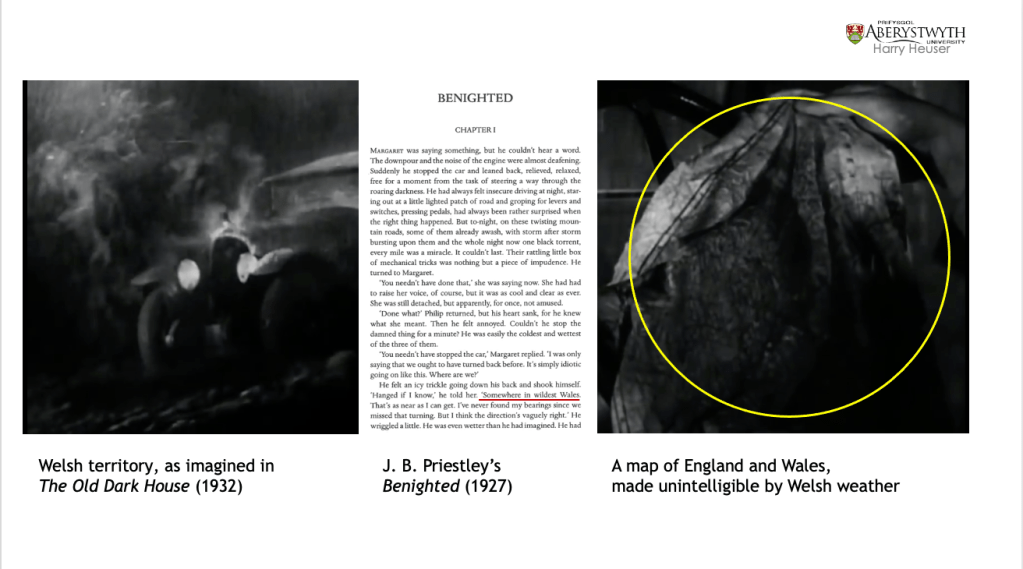
The last time I approached that Old Dark House – the titular edifice of a 1932 Hollywood thriller directed by the queer English filmmaker James Whale and founded on a novel by the English social critic J. B. Priestley—my eyes were not focussed on any particular visual detail. I was remarking generally on the house as a concretization of Priestley’s views on the condition of Britain after the so-called Great War, as the film and its source, Priestley’s Benighted (1927), are often understood: Interwar Britain as an empire haunted by its past and a kingdom lacking a vision as unifying as the largely unchallenged rule of its alleged heyday.
Never mind the map. Now entering gothic territory
Not that British moviegoers, let alone US American audiences, would have considered this perspective, partially obscured by the retitling of the property, as being essential to the experience of the fun house-ghost train atmosphere the film conjures. Sure, the house, with its shadowy corridors, massive oaken doors and branching staircases, is as ill-lit as any old Gothic-fictional castle; but the unenlightened ones at the heart of this picture are its denizens, the backward, dim-witted and intractable Femms in whose midst we, along with a small group of unfortunate travelers, find ourselves.
Just what is ‘gothic’? And how useful is the term when loosely applied to products of visual culture, be it paintings, graphic novels, movies or the posters advertising them? Aside from denoting a literary genre and a style of architecture, in which usages I recommend setting it aside by making the ‘g’ upper case, the term ‘gothic,’ understood as a mode, can be demonstrated to take many shapes, transcend styles, media, cultures and periods. It can also be demonstrated not make sense at all as a grab bag for too many contradictory and spurious notions many academics, to this day, would not want to be caught undead espousing. Those are the views I take on and the potentialities I test out with students of my module Gothic Imagination at the School of Art, Aberystwyth University.
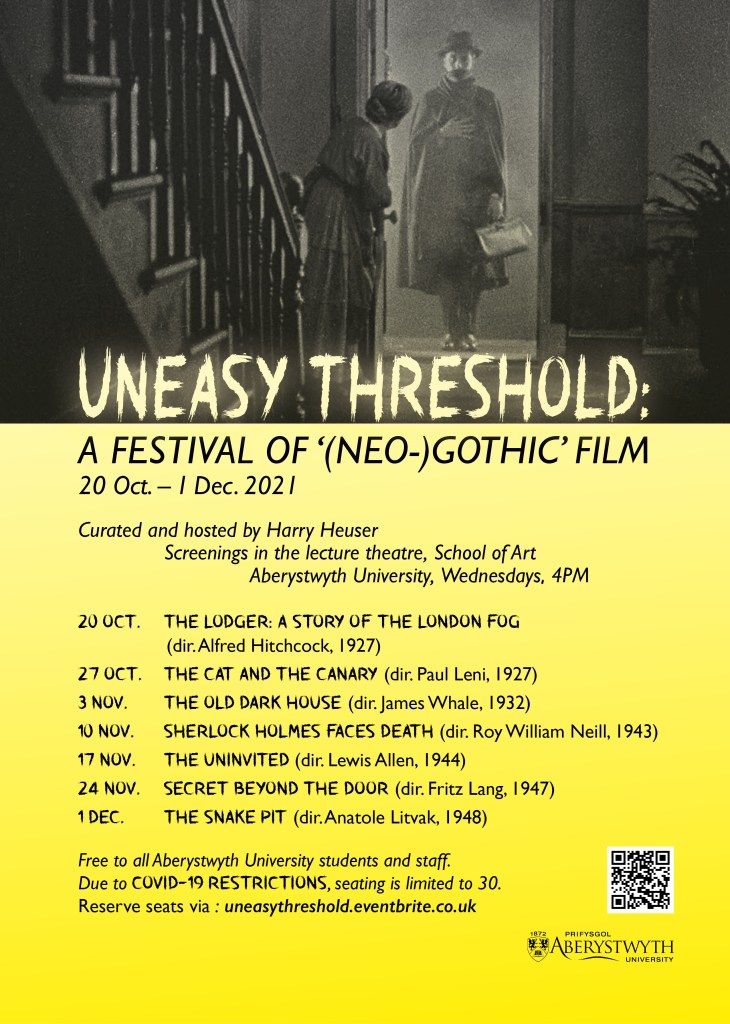
As the gothic cannot thrive being crammed into a series of seminars, let alone been exsanguinated or talked to death in academic lectures, I created an extracurricular festival of film screenings to explore the boundaries of the visual gothic beyond genre and style. The fourth film in the chronologically arranged series, Sherlock Holmes Faces Death (1943), demonstrates that the gothic struggles to thrive as well when its sublime powers are expended in a game of wartime chess.
The fourth entry in a series of Universal B-movies that began in 1939, prior to the end of US isolationism, as feature films, Sherlock Holmes Faces Death is a formulaic whodunit in which the gothic is an accessory to crime fiction, and in which suspects, some more usual than others, are lined up like cardboard grotesques for deployment in a mock-Gothic extravaganza executed on a budget.
Now, as a lover of whodunits and epigrams, I do not object to formula or economics. I can appreciate budget-regard even when I long for that rara avis. For the gothic, however, a cocktail consisting in measures equal or otherwise of solvable mystery and final-solution mastery is a cup of hemlock. Granted, the attempt to serve it and make it palatable to the public creates a tension of intentions that may well give motion picture executives and censors nightmares.
I discuss such messaging mixers in the context of radio plays in a chapter of Immaterial Culture I titled “‘Until I know the thing I want to know’: Puzzles and Propaganda,” in which Holmes and Watson also feature.
After all, at the same time the pair set the world aright in twentieth-century wartime scenarios, Holmes and Watson continued to solve crime in the gaslit alleyways of late-Victorian and Edwardian London, or suitably caliginous settings elsewhere in the British Isles, in pastiches in which Basil Rathbone and Nigel Bruce were heard on the New Adventures of Sherlock Holmes radio program that aired in the US at the same time:
As Sherlock Holmes director Glenhall Taylor recalled, the series was one of several sponsored programs whose “services were requested by the War Department.” The charms of an imagined past were to yield to visible demonstrations of the responsibilities broadcasters and audiences shared in the shaping of the future. To promote the sale of defense bonds during the War Loan Drives, Bruce and co-star Basil Rathbone appeared in “special theatrical performances,” live broadcasts to which “admission was gained solely through the purchase of bonds.” (Heuser, Immaterial Culture 189)
To be sure, Sherlock Holmes Faces Death is less overtly propagandist than the previous three entries in Universal’s film series, all of which are anti-fascist spy thrillers. Adapted, albeit freely, from a story by their creator, Sir Arthur Conan Doyle, the case they took on subsequently recalled the titular detective and his faithful sidekick from Washington, DC, and released them back into their fog-shrouded habitat in and for which they had been conceived.
And yet, whatever the setting, in motion pictures Holmes and Watson continued to face adversaries that were recognisably anti-democratic – stand-ins for the leaders of the Axis. The villain of Sherlock Holmes Faces Death, diagnosed as egomaniacal by Holmes, is no exception.
Much of the action of Sherlock Holmes Faces Death takes place in an ancestral pile that has been temporarily converted into a convalescent home for wounded soldiers. Those inmates may have their idiosyncrasies, as all flat characters do, but, to serve their purpose in a piece of propaganda, they cannot truly be plotting murder, unless there are exposed as phoneys, in which case the reassurances of wartime service honored and government assistance rendered would be called into question.
The unequivocal messages the Sherlock Holmes films were expected to spread in wartime did not allow for such murky developments. A post-war noir thriller might sink its teeth into corruption; but the Sherlock Holmes series did not exhibit such fangs.
Variety thought this entry ‘obvious stuff.’ Less obvious to me, reading Variety, was how much Ella Fitzgerald contributed to the success of the film at the box office.
Nor could the recovering soldiers be shown to be so mentally unstable as to kill without motive; according to the convention of whodunits, even serial killers like Christie’s Mr. ABC follow a certain logic that can be ascertained. The heiress of Musgrave Manor may be momentarily distraught, the butler may be exposed as an unstable drunkard – but the soldiers, whatever horrors and shocks they endured on the battlefield, can only be moderately muddled.
Most of the recovering servicemen – in their fear of unwrapped parcels or their fancy for knitting – are called upon to provide comic relief, bathos being a key strategy of the domesticated gothic. In the Sherlock Holmes series, that is a part generally allotted to Dr. Watson, a role he performs even in this particular installment, in which his expertise as a man of medicine is put to use for the war effort. Inspector Lestrade serves a similar purpose, which is probably what made the ridiculing of military personnel seem less objectionable to sponsors, as it made them look fairly inconsequential to the crime caper unfolding. Aligning those men with Watson and Lestrade assists in eliminating them from the start as potential suspects.
While missing legal documents and cryptic messages are certifiably Gothic tropes, the gothic atmosphere in Sherlock Holmes Faces Death is fairly grafted on the proceedings with the aid of visuals. There are genre Gothic trimmings aplenty in – secret passages, a bolt of lightning striking a hollow suit of armor, and pet raven assuming the role of harbinger of death – but there is no real sense of menace as, guided by the infallibly capable hands of Sherlock Holmes, we negotiate with relative ease the potentially treacherous territory of a mansion as makeshift asylum and contested castle.
The climax, which tries to cast doubt as to Holmes’s perspicacity, plays out in a dimly lit cellar. It is here that the gothic could potentially take hold if the plot had not preemptively diffused the dangerous situation hinted at in the film’s title. The trap for the killer below has already been laid above-ground on the newly polished surface of a giant chessboard, in a display of strategy choreographed by Holmes himself. By the time the game moves underground, it is no longer afoot; rather, it is fairly limping along.
Gothic and propaganda can mix; genre Gothic fiction often served political purposes. Gothic and whodunit are less readily reconciled. Although John Dickson Carr tried hard to make that happen, often in an antiquarian sort of way, the Victorian Sensation novelists and the had-I-but-known school of crime writers come closer to achieving that. But the handling of all three of those form or raisons d’être for writing – Gothic, whodunit and propaganda – by the jugglers employed here, at least, is not a formula designed to make the most of mystery and suspense. As I concluded in my discussion of the “identity crisis” of the wartime radio thriller, “propagandist work was complicated by the challenge of puzzling and prompting the audience, of distracting and instructing at once.”
Sherlock Holmes faces death, all right, but the demise he encounters is that of the gothic spirit.
Much has been said about the titular edifice of Universal Studio’s 1932 melodrama The Old Dark House, the third in the series of films I am screening as part of my Gothic Imagination module at Aberystwyth University. Directed by the queer English Great War veteran James Whale, and adapted from J. B. Priestley’s 1927 novel Benighted, The Old Dark House is often argued to be a commentary on Imperial Britain during the so-called interwar years (that is, the period between the two World Wars, Britain having been involved in plenty of other international conflicts besides): an ancient but crumbling family home – run by aging and morally corrupt imbeciles and cut off from the world by water. It has been called, more than once, a “metaphor for … England.”
And yet, the story is not set England but in Wales, and the novel and film alike exploit and perpetuate the stereotypes of what, presumably, constitutes Wales and sets it apart from neighboring England: the wild, the uncivilised, the superstitious and unenlightened. Wales, according to Priestley and Whale, is gothic territory. It is the stuff of romance – or the English definition of romance – meaning that when the English want to go primitive, they think Wales.
Here is what the dreamer Penderel, himself a war veteran, says about Wales as he is being driven around in his friend’s motorcar one dark and dismal night:
I don’t want to go to Shrewsbury. I don’t particularly want to go anywhere. Something might happen here, and nothing ever happens in Shrewsbury, and nothing much on the other side of Shrewsbury. But here there’s always a chance.
The Hollywood ending aside, the film is remarkably faithful to the novel, retaining much of Priestley’s dialogue. While I am not sure just how many US American viewers back then would have understood the reference to the border that Shrewsbury represents, both Priestley and Whale would have known that, when the name “Shrewsbury” is dropped, the meaning “borderline” is implied. Arriving at Shrewsbury – and this is the party’s intention – means traversing the Welsh Bridge over the Severn and arriving back in England.
The party in question – Penderel and his friends, the married and bickering couple Margaret and Philip – has lost its way in what Priestley lets Philip describe as “wildest Wales.” The colonial attitudes toward Wales as both enchanted and benighted – as a place where there is ‘always a chance’ – the chance of an improvement in infrastructure excepting – are at the heart of this modally gothic narrative.
When the drunkard Welsh butler Morgan opens the door upon their unannounced arrival, he “produce[s] from somewhere at the back of his throat, a queer gurgling sound” that Penderel cannot translate. Priestley tells us that “Penderel knew no Welsh.” And yet, he says with confidence, in the book and film version alike, that “Even Welsh out not to sound like that; it was as if a lump of earth had tried to make a remark.”
Wales, to be sure, was just that to England, or many in England, a mute lump of Earth to be exploited for its resources. It is not Wales that is gothic – or Gothic – but the perspective of the English that, fascinating as they may be with the wildness of Wales – impose their views on the nation they invade like “travellers in a foreign country,” as Priestley has Penderel see it.
Morgan, as we soon learn, cannot communicate in any spoken language. He is a personification of Wales infantilised, gesturing like “some prehistoric monster.” Wales, the source of mined ore – of coal and slate and lead, silver and gold – as well as Water, was often seen as little more than potential to be unearthed and funnelled for the benefit of England. The tradition was deemed to be expendable.
In The Old Dark House, as in Benighted, the nightmare vision makes way for daylight. What we experienced was a Phantasmagoria staged by the visiting English. The travelers depart, whether enlightened by what they experienced or just glad to have survived it. The perspective of the hosts is not considered.
Hollywood would return to a fairy-tale Wales in The Wolf Man a decade later, in which Welsh landscape and culture, rendered unrecognisable, become the other when England was seen as the real, the upholder of values, in its fight against fascism. To this day, visitors prefer to be enchanted by Wales, an old dark house whose perceived darkness is to a large extent a product of an English or Anglo-American imagination.
Nothing is innately trifling. As I put it once, when I had the nerve to make a public display – in a museum gallery, no less – of the mass-produced ephemera I collect, ‘Trivia is knowledge we refuse the potential to matter.’ Now, some products of culture are more resistant than others to our realization of them as worth more than a fleeting glance, if that. Exerting the effort to make them matter may feel downright perverse when there are claimed to be so many more deserving candidates for appreciation around.
When looking out for something to look into, I invariably draw on my own sense of otherness, of queerness. It is not altogether by choice that I am drawn to the presumed irrelevant. My perceived marginality is both the effect and the cause of my attraction to the margins. What matters – and according to whom – is always worth questioning. That is why I created Gothic Imagination, an alternative art history course I teach at Aberystwyth University.
To augment the weekly lectures and seminars, I created a series of film screenings for my students further to explore the territories of the visual ‘gothic’ beyond literary genre Gothic and the Gothic as an architectural style. The second film in the chronologically arranged series, The Cat and the Canary (1927), is, for all its technical and cinematographic achievements, a rather undemanding old chestnut. In part, such a view of it is owing to our belatedness of catching up with it, now that much of it strikes us as a grab bag of narrative clichés.
Well, those clichés were up for grabs even back in 1927, as the film draws on its audience’s familiarity with murder mysteries and stage melodramas. Like Seven Keys to Baldpate before it, The Cat and the Canary is parodic and self-reflexive. It play with conventions and our awareness, even our weariness, of them. The Cat got our tongue firmly in cheek; and as much as we may feel sticking it out at the derivative claptrap to which we are subjected, we are encouraged to appreciate that the film anticipates our response, that it is one step ahead, dangling our tongue cheekily in front of us like a carrot intended to keep us playing along.
Is it only a single step ahead? Ahead of what? Is it ahead, retro or perhaps even reactionary? The Cat and the Canary is postmodern before there was a word for it. Like any adaptation of a text I have not caught up with, it also makes me wonder just how what we get to see has evolved and how the film, in addition to interpreting its source material cinematically, questions, edits and revises that material as well.
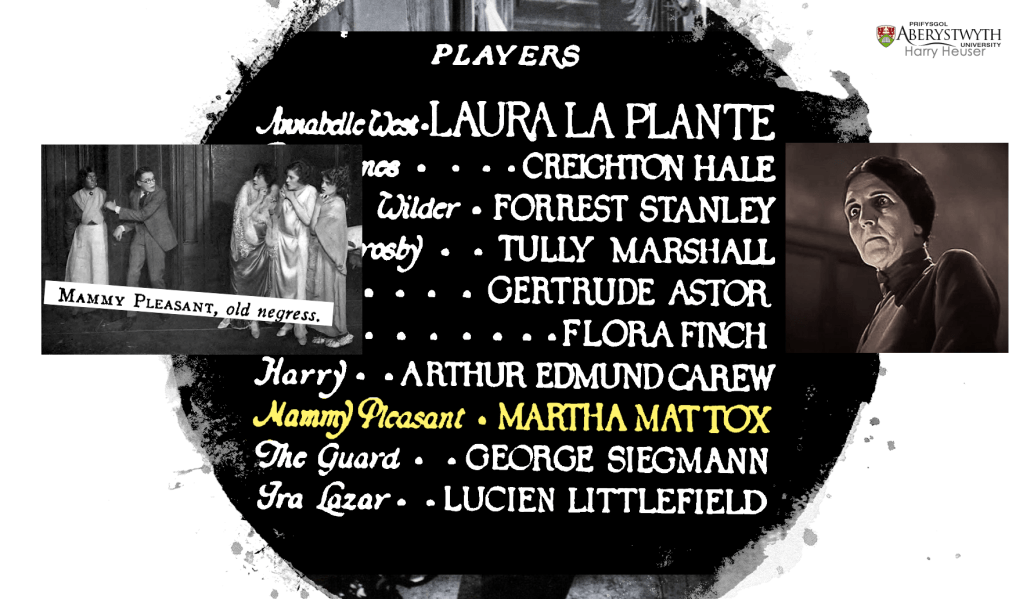
One revision draws attention to itself in the credits – and it made me aware of the consequences the seemingly inconsequential can have. I am referring to the character Mammy Pleasant, a housekeeper played in the film by the scene-stealing Martha Mattox. Given that The Cat and the Canary was released in the same year that The Jazz Singer stridently hammered a sonic nail in the coffin of silent film – at times simply by dragging said nail screechingly across the surface of an eloquent body of work shaped over a quarter of a century – the reference to the ‘Mammy’ legend stood out like a discordant note.
A slide from my introduction to the screening
What is ‘Mammy’ about Mammy Pleasant, particularly when the role is performed by a white female actor? The 1922 stage melodrama by John Willard, who also acted in the play on which the film is based, describes the character as an ‘old negress.’ Not that Blanche Friderici, who originated the part on the stage, was black. She performed it in blackface.
As The Jazz Singer and other early sound films such as the ‘Amos ‘n’ Andy’ vehicle Check and Double Check (1930), blackface and minstrel shows were very much part of Western popular culture at the time, and they were not effectively challenged – that is, were not permitted effectively to challenge – until decades later.
And yet, the film does not partake of that tradition, retaining the character’s name only. In the play, Mammy Pleasant is a servant who has gained enough independence to choose whether or not to serve the future heir to the fortune of her deceased employer, as is clear from this exchange with the family lawyer, Roger Crosby, prior to the reading of the will:
Crosby. Six! All the surviving relatives. By the way—Mammy—your job as guardian of this house is up to-night. What are you going to do?
Mammy. It all depends. If I like the new heirs—I stay here. If I don’t—I goes back to the West Indies.
There is no such exchange in the film, and the ethnicity of Mammy Pleasant is not made central to the characterisation, which in the play is rooted in stereotypes surrounding superstitions to be rooted out in the act of ratiocination. The Cat and the Canary is, after all, not a Gothic romance but a whodunit in which weird goings-on are shown to have a logical, albeit preposterous, explanation.
The name Mammy Pleasant, in Willard’s play at least, carries with it a reference to an actual person – the businesswoman and abolitionist Mary Ellen Pleasant, who, by passing as white, managed to become the first African American millionaire.
In the stage play, produced nearly two decades after Pleasant’s death in 1904, the reference is facetious and derogatory. Mary Ellen Pleasant, who lost the fortune she had made and shared as an activist, and whose character was destroyed when her passing as a white cook and landlady was exposed, is misremembered in the film as a not altogether trustworthy and slightly threatening outsider operating on the inside of a dead white millionaire’s mansion.
Why did the reference remain? How many viewers back in 1927 would have recognised it as a reference to Mary Ellen Pleasant? And how many would have found comic relief in what might have been some sort of white revenge fantasy that renders Pleasant odious while keeping her in her supposed place?
It is a gothic reading, as opposed to a reading of the gothic, that refuses to privilege the center and, imagining alternatives, lets the canary chase the cat for a change. An unlikely scenario, to be sure; but to expose what is cultural it is useful to conjure what is unnatural.
I am not an academic. I am a human being. That’s not just me misquoting The Elephant Man. It is a cri de cœur expressive of what is at the core of my identity as a creative person who happens to have transmogrified into an art history lecturer. To interrogate what that even means, I teach “Gothic Imagination” at the School of Art, Aberystwyth University.
As part of that class, I present an extracurricular series of film screenings exploring the boundaries of the ‘gothic’ beyond the furnishings of the genre ‘Gothic.’ That ‘gothic’ is a term so broadly applied and ill-defined as to render it practically useless is a by now thoroughly predictable way of opening a debate about its practical uses. Then again, the gothic has little to do to with practicalities.
I have no intention to make the term, “salonfähig,” that is, reverting here to my native German, to make it acceptable or viable in an academic setting. Rather, I use the word, which I am applying to visual culture instead of literature, to contest progress or avant-garde narratives traditionally espoused by academies in order to suggest alternative histories and alternatives to the teaching of art history. Attention to the popular, presumably lesser arts is essential to this strategy.
The first series of screenings, coinciding with my previous iteration of “Gothic Imagination,” was titled “Treacherous Territories.” The phrase was meant to capture that challenge of defining and the dangers of inserting a mutable term such as ‘gothic’ into the lecture theaters and seminar rooms that cannot quite accommodate, let alone confine it.
The current series, “Uneasy Threshold,” continues that playful investigation. What, for instance, carries a mystery or a romance over the threshold of ‘gothic’? What is that threshold? And what is the ‘gothic’ interior – the environment in which ‘gothic’ may be contained both as a subject for discussion and as an experience to be had by the viewer of, say, a crime drama, a thriller, a film noir or a horror movie?
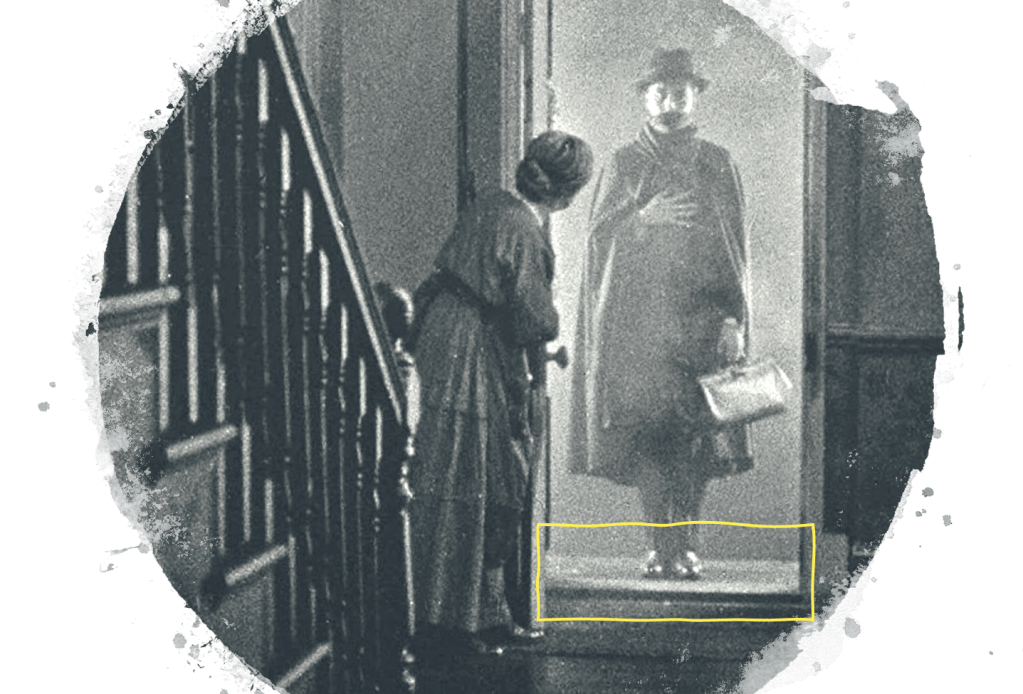
As a literary genre, the Gothic began in and with a house – in Strawberry Hill and with the Castle of Otranto, both conceived by Horace Walpole long before Frankenstein, Jekyll/Hyde and Dracula came onto the scene. Those names are on the letter box of the Gothic mansion of our imagination, and I do not mean to evict their bearers; but might there be room as well – be it a closet, a cellar or a boudoir – for a few hundred other, less usual suspects, such as the title character of The Lodger (1927)?
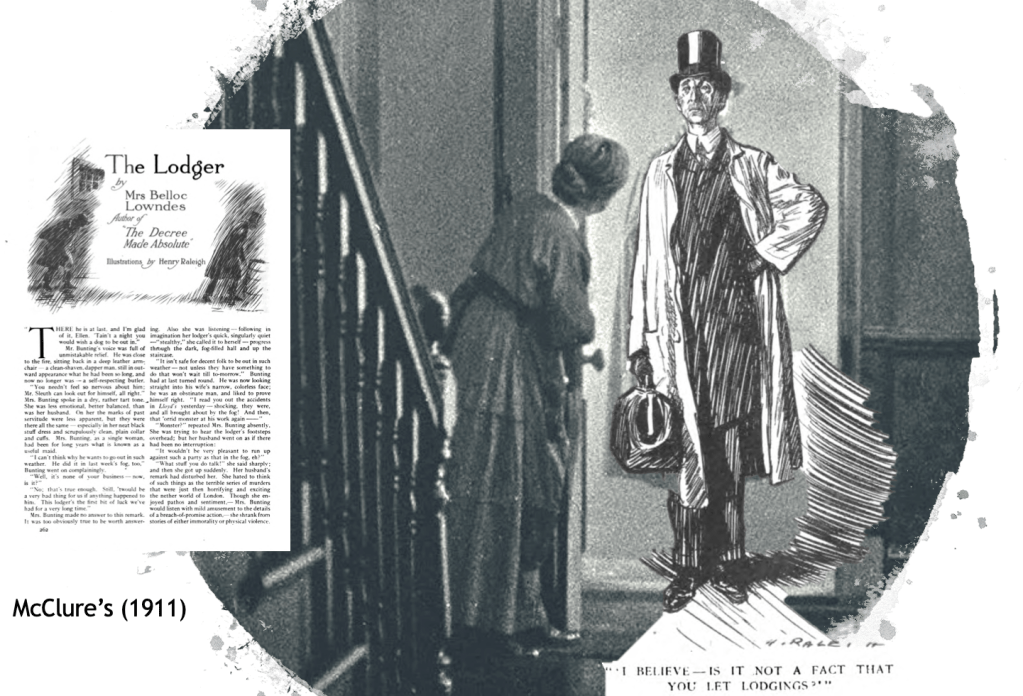
The Lodger insists on moving in on the party assembled at the Gothic castle, just as the Lodger – who may or may not be a serial killer called The Avenger – emerges out of the fog. edges himself into the home of the Buntings, and comes to preoccupy their thoughts and nightmares. Invited, perhaps, but deemed suspect or queer all the same.
When the Lodger first made his appearance, in 1911, in a short story by Marie Belloc Lowndes, the figure was already lodged in the collective consciousness of urban dwellers who, like the author, were old enough to recall the Whitechapel Murders of 1888 or else were raised with the legend of Jack the Ripper, an alternative to a nursery rhyme all the more terrifying for having neither rhyme nor reason.
The Lodger transforms the story, which Belloc Lowndes turned into a novel, by pouring more sex into the mix. That the layered cake did not quite rise to Hitchcock’s satisfaction was, legend has it, due to the casting of Ivor Novello in the title role: a queer Welsh matinee idol who, Hitchcock argued, was not allowed to get away with murder but was to be pronounced blameless by virtue of his status as a star.
Whether or not that is the true reason for the direction the movie adaptation takes, it does not make the story any less intriguing – or gothic.
The Lodger is the story of a home that becomes “unhomely” – German for “uncanny.” The lodger is no architect or bricklayer; rather, he transforms the dynamics of the group of people dwelling in the house he enters. Blameless he may be, but he is an Avenger all the same, as Sanford Schwartz points out in “To-Night ‘Golden Curls’: Murder and Mimesis in Hitchcock’s The Lodger” – not the killer, but the victim of the killer avenging her death, a victim-turned-vigilante who, misunderstood, dreaded and feared, becomes the subject of her other lover’s revenge.
It is the other, ostensibly sane and safe lover, a police officer, who trespasses – who abuses his power – to trap the innocent man who threatens his supremacy as a prospective husband. The handcuffs he suits to his own pursuits prove harmful to his lover’s trust and nearly cause the death of his rival even after that rival is proven innocent of crime.
The Lodger is gothic as James’s Hogg’s The Private Memoirs and Confessions of a Justified Sinner (1824) is Gothic. It is a story of injustice and sanctioned tyranny. Like Frankenstein’s creature, the Lodger is hunted and tormented. Law, reason and morals are being questioned; and the pillars of civilisation are proven to be unsafe as houses.
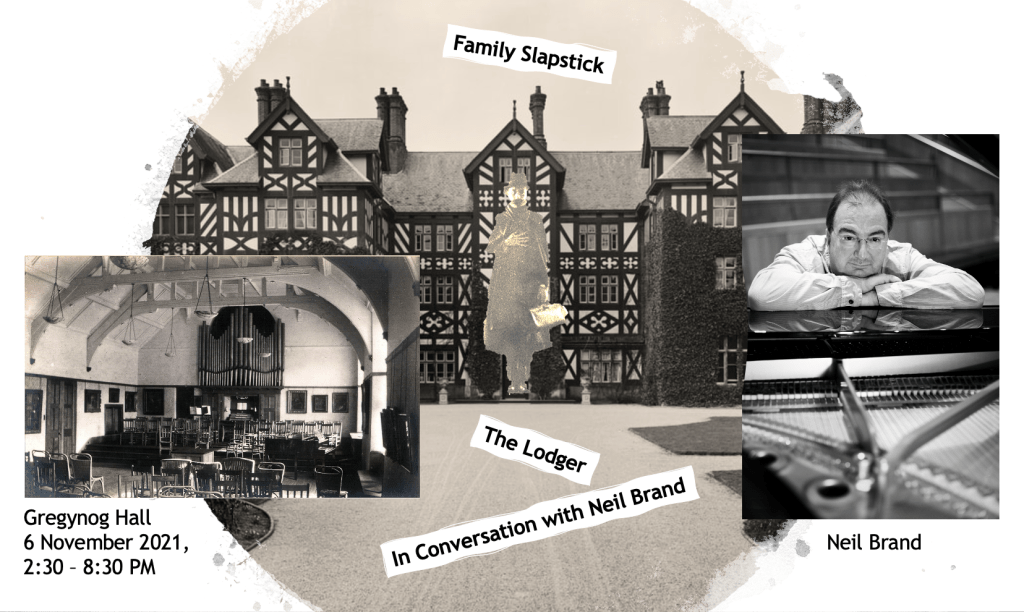
The next time I am (re)viewing The Lodger, the film will be accompanied by Neil Brand at Gregynog Hall, 6 Nov. 2021, when I shall be in conversation with the playwright-composer about silent film music and the language of pre-talkie cinema.
Ceri H. Pritchard at his solo exhibition Paradoxes, MOMA Machynlleth, 18 Sept. 2021
Some creative sparks managed to rekindle themselves during the pandemic; stoked up by a keenly felt sense of do-or-die urgency, they keep generating alternative realities – or alternatives to reality – out of the deepest blue of mind-numbing, soul-crumbling chaos. While I do not quite succeed in numbering among those motivated mortals, visual artist Ceri H. Pritchard certainly does.
In front of Metamorphosis I at MOMA Machynlleth, with a temporarily unmasked Ceri H. Pritchard
His prodigious output, mordant wit and renewed openness to experimentation are on full display in his latest of a slew of solo shows. Ceri H. Pritchard’s Paradoxes opened on 18 September 2021 at MOMA Machynlleth, one of Wales’s most distinguished contemporary art galleries, and is on view there until 13 November 2021. I have been keeping up with Ceri’s work and am excited to see it transmogrify. I said as much, or as little, in the introductory text panel I was glad to contribute to his exhibition:
Ceri first invited me into his studio in 2015. A few years earlier, I had co-authored monographs on his parents, figurative painter Claudia Williams and the late landscape artist Gwilym Prichard. At the time, I was as yet unfamiliar with Ceri’s decades-spanning international career. It was an unexpected, disorientating encounter – in his parents’ house, no less – with what Ceri here terms ‘Paradoxes.’
I was perhaps too quick to label his paintings ‘neo-surrealist’ in an effort to get an art historical handle on the uncanny with which I was confronted: an otherworldly territory strewn with the detritus of modernity, with outcast and less-than-easy chairs, outmoded models of disconnected television sets, and displaced floor lamps shedding no light on matters.
Resisting further temptations to make sense of it all by trying to place the work, I did not initially consider – but subsequently discussed with Ceri – how his conspicuous enthusiasm for colour and his partiality for patterns is prominent as well in his mother’s work, although in subject and mood Ceri’s paintings could not be further removed from Claudia’s figure compositions expressive of the bond between mother and child.
And yet, the patterns in Ceri’s paintings, too, suggest blood bonds – biological ties, be it the universality of our molecular make-up or the common experience of life and death in the strange new age of COVID-19. Those repeated shapes bespeak at once commonality and change, circulation and evolution – and they remind us that what we share can also keep us apart.
Gwilym Prichard, Landscape (1960), detail
The mostly unpopulated landscapes painted by Ceri’s father, Gwilym, meanwhile, showed a preoccupation with home and belonging, with the uncovering of roots in ancient soil rather than the representation of the iconic sites of his native Wales. Ceri’s work, too, is concerned with home – but his approach to the question of belonging to particular cultures and traditions – is entirely different. It is the paradox of being at home with dislocation and familiar with estrangement.
Claudia Williams, The Toy Basket (1989) detail
The paradoxes that Ceri’s work communicate are not the consolidation of a calculated career move, an effort to set himself apart as much as possible from the tradition represented by his artist parents. They are felt, not fabricated. Ceri’s practice is informed by an international outlook, a transnational engagement with diverse cultures, high and low, in France, Mexico and the United States. The unresolved tension of paradox at play in his compositions reflects and responds to decades of being abroad and of returning as an artist whose paintings redefine the tradition of what it means to be living and working here and now – in twenty-first century Wales.
Upon first seeing Ceri’s work, I felt as if I were about to be let in on a secret: canvases that were still underway, waiting – ready or reluctant – to come out into the open. Catching up with his evolving work in his studio years later, in the middle of the pandemic, I sensed a renewed purpose, a conviction of having arrived at something worth the departure and of forging ahead, destination unknowable.
This is a body of work distinguished by something other than its now familiar set of iconography and ready tropes packaged for public exhibition. There is continued experimentation both in subject and technique – not just a recycling of a haunting image repertoire but a repurposing of found materials as well and an increasing openness to change and chance.
Ceri H. Pritchard, The State of Things (2021)
That air of mystery has not dissipated since I opened Ceri’s solo exhibition The Strange Edge of Reality at Tenby Museum and Art Gallery in 2016. And although encounters with art may become less personal in a museum setting, an institutional space can also contribute to our sense of discovery by making us become more aware of alternative approaches and canonical outliers we may not have expected to find there. Surprise, mystification, and a darkly humorous take on what it means to be alive at a time it seems impossible for future generations to get nostalgic about – all that may be experienced here, but also the realisation of being prompted to become part of a compelling narrative in the making.
Rather than look at Ceri’s paradoxes as puzzles to be solved it might be useful to regard them as open invitations to question our assumptions about culture, heritage, and about art produced in Wales today.
‘Mysteries,’ are ‘like the sun,’ the metaphysical poet John Donne wrote, ‘dazzling, yet plain to all eyes.’ And not unlike the metaphysical poets, Ceri’s compositions yoke together opposites to achieve a kind of reconciliation, a discordia concors (harmonious discord), even though, in Ceri’s case, the aim is not harmony: it is to become reconciled to remaining unsettled.
Members of the Mid Wales Opera performing at Gregynog, July 2021
Like much of the heritage of Wales, and indeed the world, the interior of Gregynog Hall was off limits during the pandemic (ongoing at the time of this writing), even though its extensive grounds continued to provide a welcome retreat for local visitors in the days of social distancing. Gregynog – pronounced as you would a portmanteau word for an alcoholic yuletide treat named after a Pope getting chummy, with an “un” wedged between the man and the intoxicant – was known for keeping the two apart for the purported benefit of the former. During its heyday – between the two World Wars – the Hall was owned by the teetotalling and public-spirited Davies sisters, Gwendoline and Margaret, and the recommended stimulant to be taken in there was produced on location during Gregynog’s renowned Festivals of Music and Poetry.
I shan’t rehearse what, in Wales at least, is well-known, as much has been written elsewhere about Gregynog and Davies sisters, who bought the mock-Tudor Hall in 1920 and, even though they did not initially intend doing so, lived there from 1924 until their respective deaths some three to four decades later. Suffice it to say that, during their residence, the Hall was not only a home filled with art or for the arts. It was a place devoted to cultural, spiritual and social uplift through the arts, as the sisters – encouraged by their friend and advisor Dr Thomas Jones (TJ) – understood it.
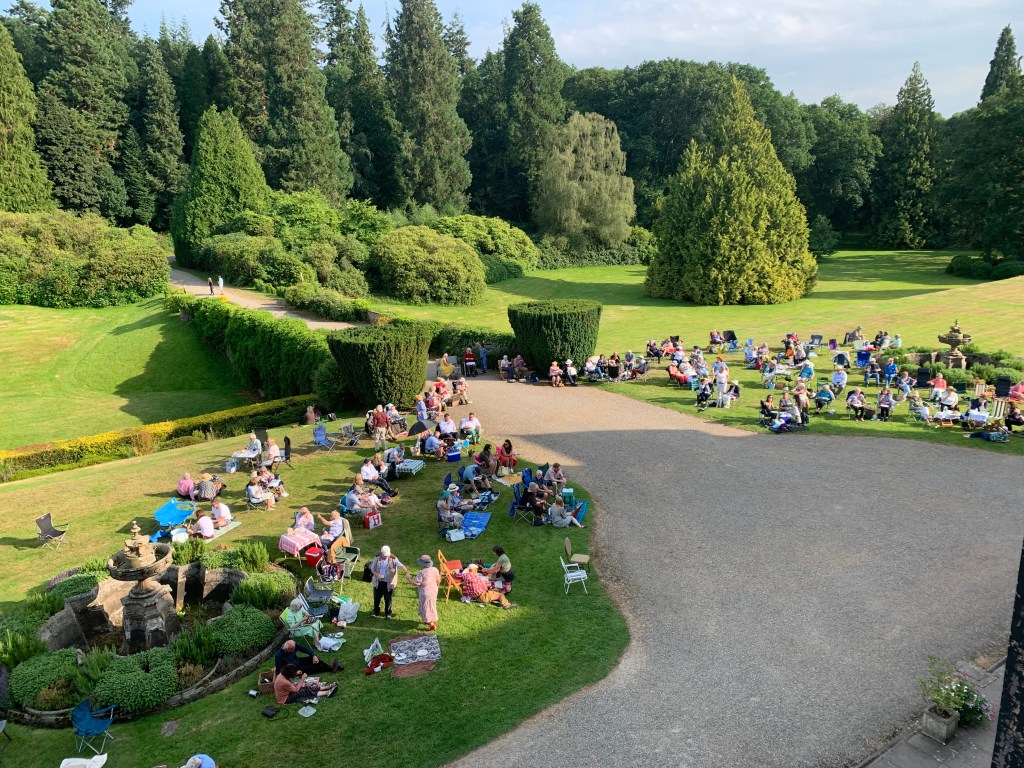
The performing arts are returning, and so are the crowds. On a warm and sunny afternoon in July 2021, the grounds of the estate once again resounded with classical music, as young members of the Mid Wales Opera – sopranos Meinir Wyn Roberts and Llio Evans and tenor Huw Ynyr, accompanied by pianist and Music Director Charlotte Forrest – came to give a crowd-pleasing concert of arias from works as diverse as Mozart’s Die Zauberflöte, Puccini’s La Bohème and Il tabarro, Leonard Bernstein’s Candide (“Glitter and Be Gay”), with Jonathan Dove’s The Enchanted Pig and Disney’s Snow White (Frank Churchill’s “Some Day My Prince Will Come”) thrown into the mix, and appropriately so, considering that, these days, Gregynog is a popular venue for weddings.
Equipped with a lawn chair, a bottle of champagne and a husband, I was glad to attend that charmed picnic concert, having spent some time behind the scenes in the months and weeks prior to the event to volunteer – despite a lack of practical skills but owing to the decidedly practical prince I wed anno 2014 – in getting the Hall ready to welcome back visitors.
When not lugging books or furnishings, I was ensconced in the library at Gregynog Hall, where I had a browse through the Festival programs and other documents still waiting to be drawn upon for a social history of the place.
The program for the first Festival of Music and Poetry in 1933 reminded me of the mission of the sisters to put the family wealth to good use:
In these days of unprecedented difficulty and disillusionment, when the very fabric of our civilisation is rent and torn, we are compelled to return again to the unfailing sources of inspiration and delight. Music and poetry are no longer the luxury of the few but the necessity of the many.
Thousands upon thousands of our fellow beings are dragging out a dark and desolate existence; exhausted and in despair they stand at the corners of the streets, for no man hath need of them. A bewildered Government doles out to them the pittance which keeps them alive, but their minds and spirit are starved, for man doth not live by bread alone. They are bone of our bone and flesh of our flesh, their powers and potentialities are the same as ours, the same unseen beauty is theirs, could we but show it to them.
Held during the depression, that first festival was designed to raise money for Coleg Harlech, a Training Centre for Unemployed, contributions towards which, as the program stated, were “gratefully accepted during the Interval each evening.” Thomas Jones would later become President of the Coleg.
Many who stayed as guests at Gregynog enjoyed the music and appreciated the spirit in which it was offered – but some found the sober atmosphere less than inspiriting. “We all went to Gregynog to stay with the Davies sisters,” actress Joyce Grenfell reminisced in her autobiography. Grenfell, who visited Gregynog as a friend of Thomas Jones, noted how important music was in the lives of the sisters. “[W]hen new staff were needed for the house, garden or farm,” Grenfell was told,
the sisters advertised for a contralto-housemaid, a bass-undergardener or a tenor-cowman to take part in the Gregynog choir. All through the winter months the choir, under a professional master, worked on programmes for the summer festival, when musicians like Sir Adrian Boult and Sir Walford came, with their wives, to lead the music.
According to the visitor book, Grenfell attended the final two of the original Gregynog festivals in 1937 and ’38; she also returned at Easter 1939, when, as she recalled, “Elsie Suddaby, Mary Jarred and Keith Falkner sang Bach’s St Matthew Passion in the big white music-room hung with a series of Monet’s water-lily paintings.” When there was “religious music,” Grenfell noted, a “great EI Greco was put on a stand to conceal the choir and the conductor.” Grenfell was unconvinced; not only did it “do more than hide a few of the performers,” the artful cover-up struck her as “more of a disturbance than an inspiration.”
“Staying at Gregynog was a mixed blessing,” Grenfell summed up. “The music was unalloyed pleasure but the atmosphere in the house was cool, correct and daunting.”
The mood and tone on that July 2021 afternoon was decidedly more relaxed. After months of home front battle and its concomitant fatigue, the small crowd assembled on the lawn facing the entrance to the Hall felt reassured, no doubt, that “beauty” need no longer go “unseen,” or, for that matter, unheard. And while those in attendance, unlike Grenfell, were not subjected to the scrutiny of “two maiden ladies” – owing to whom it was “not possible to forget one’s ps and qs” – there also was nothing of the “missionary zeal” Grenfell observed in Thomas Jones and Gregynog as a project.
I am of two minds about such zeal. It is a worthy cause to make art something other than “the luxury of the few.” All the same, it is worth questioning just what constitutes – and who determines – “the necessity of the many.” That “necessity” needs to be felt like a yearning rather than being imposed, defined and determined by those presumably best equipped to judge what is proper art in the best possible taste.
Instead of demanding the “same unseen beauty,” we need to recognise that much remains “unseen” because it is not yet deemed to be art. Clearly, that is why I am teaching “Gothic Imagination” again this autumn, why I encourage students to engage with “inconvenient objects” in our galleries (more about that in the next post), and why I write about canonically neglected radio plays (more about that in the previous entry). I don’t wait for the prince, thank you. I’ll do the crowning, or tiara-ing, using whatever materials are at hand …
On my only trip requiring an overnight bag during this stay-at-home summer, my husband and I drove from our patch on the west coast of Britain to the thoroughly overcrowded Cotswolds and, upon my urging, made a stop-over at the Welsh town of Hay-on-Wye, an internationally renowned haven for second-hand book lovers. Now, musty old volumes and COVID-19 do not quite go together – or so I thought – considering that retail spaces generally set aside for them are rarely supermarket-sized. However, Hay, which depends on the trade, managed to make it work; and, meeting the moment by donning a mask, I got to enjoy an afternoon of socially distanced and sanitized hands-on browsing.
Not that I walked away with any tomes of consequence. While at the Cinema bookstore – a shop not limited to publications related to motion pictures – I discovered a nook stacked with a curious assortment of ephemera: German movie programs of the 1930s. I am not sure how they ended up in a Welsh bookshop – but that dislocation may well have extended their shelf life … until a German such as I came along and took an Augenblick to sift through them.
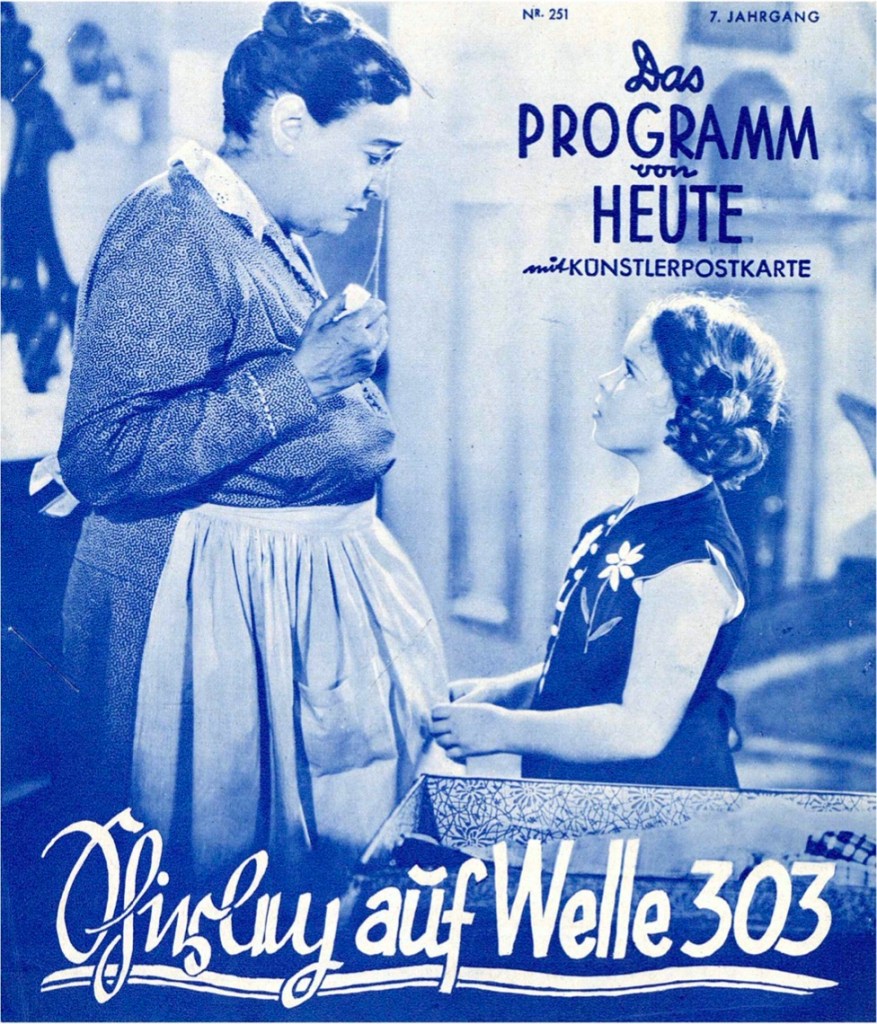
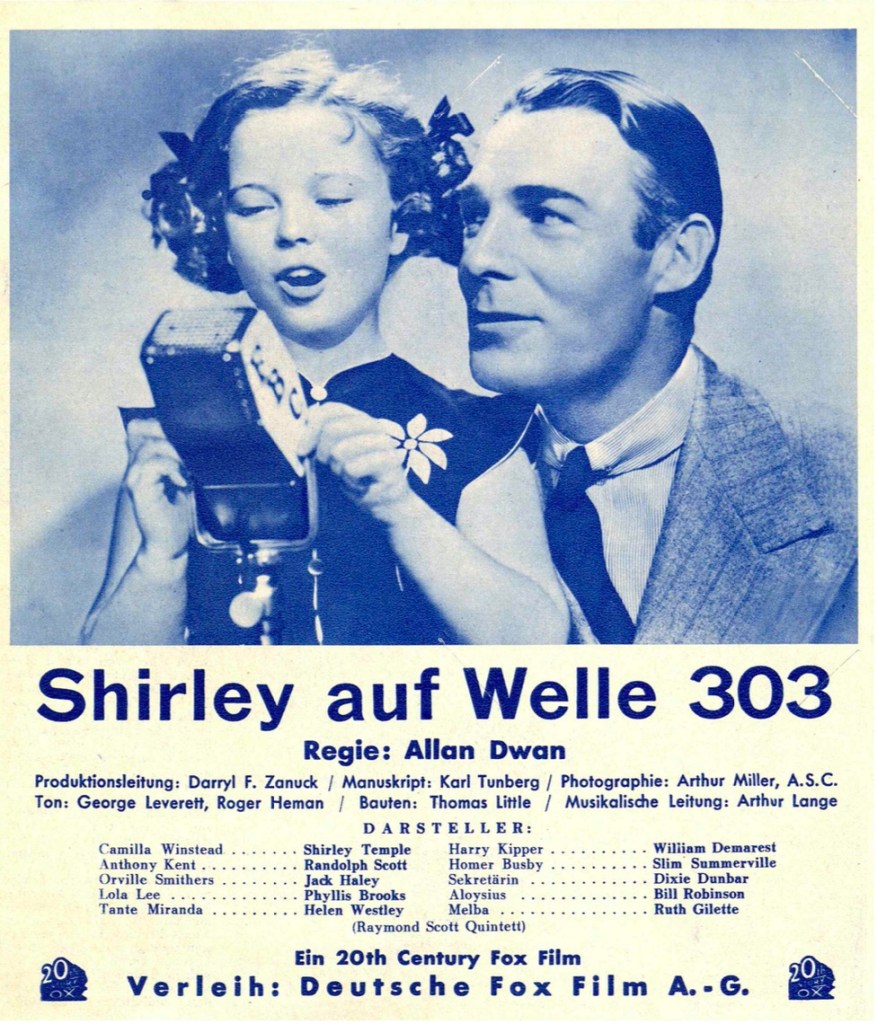
The program pictured above, dating from 1937, left me puzzled for a while. I am familiar with many of Shirley Temple’s features – but I did not recall any among them bearing a title remotely like “Shirley auf Welle 303,” or “Shirley over Station 303.” So, I picked up this fragile brochure, and a few others besides, if mainly to tap their potential as pop cultural conversation pieces.
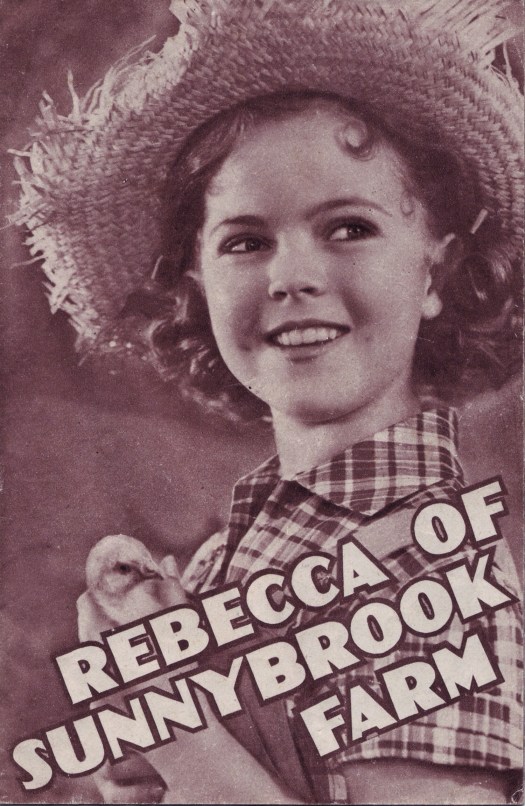
The film being deemed worthy of commemoration is Rebecca of Sunnybrook Farm, a DVD of which is gathering dust in my video library. The title refers to an early twentieth-century children’s literature classic, although the movie version bears so little resemblance to it that it could hardly be considered an adaptation. Not that the title of the novel would have resonated with German audiences. Meeting this challenge, the marketing people at Fox came up with a new one that might sound more relatable.
I suspect that the servants of the Nazi regime would have objected to the name of the titular character as well, being that Rebecca is Hebrew in origin, meaning “servant of God.” Shirley, on the other hand, was a household name, Ms. Temple having charmed audiences around the world since at least 1934. Like the titles of several other Shirley Temple vehicles released in 1930s Germany, the German version of Rebecca of Sunnybrook Farm therefore bears the first name of its star. Only Heidi stayed Heidi, rather than being translated into “Little Swiss Miss Shirley.”
A contemporary British program for the same film, also in my collection.
And yet, the effort to make the film seem more relatable to Nazi Germany’s picture-goers nonetheless resulted in a title that was out of touch with Fascist reality. In 1938, when the film was released in German cinemas, the idea of using radio transmitters for your purposes – or for the purpose of exploiting a child for your own purposes – was inimical to state-controlled broadcasting. On the air, it was always “Germany Calling,” a phrase famously used by the aforementioned Lord Haw-Haw beginning in 1939.
Germans would have struggled in vain to twist the dial and hit on a broadcast like Shirley’s, or they would have paid a price for such twisting. Many of them listened via the Volksempfänger, a mass-produced receiver that was always tuned in to the Führer’s voice. Imagine staying tuned to Fox News all day. Then again, so many who do have the choice not to still do nonetheless, not unlike those who were complaisant during the rise of Fascism in Germany.
The change in title – and the recontextualization it achieves – is peculiar, and only a performer as innocuous as Shirley Temple could have gotten away with what otherwise would have been downright seditious: seizing the microphone and taking to the airwaves in a makeshift studio set up in a remote farmhouse. Perhaps, the titular bandwidth – 303 – was to signal that Shirley’s broadcast had been sanctioned after all, 30 January 1933 being the date Hitler came to power. In the Third Reich, three was heralded as the charm.
For decades, the German film industry did wonders – or, rather, wilful damage – to international films with its dubbing of their soundtracks; voicing over and voiding the content of the source, there were many opportunities to ready a film more substantive than Rebecca for consumption in Nazi Germany. I do not recall seeing this movie in my native language, although I do remember a festival of her films airing on West German television in the late 1970s. Not that watching Rebecca of Sunnybrook Farm in the original is an experience I am eager to repeat, clobbered together a vehicle for an overhyped and overworked child star about to wear out her welcome that it is. Variety dismissed the film at the time as a “weak story,” “indifferently acted and directed,” while claiming its lead to be “at her best.”
The German program does little more than summarize the plot as well as state the principal actors and main players behind the scene of the production; I am sure someone checked whether producer Darryl F. Zanuck was Jewish, which he was not. What struck me about the program was that it mentions the word ‘propaganda’ twice in the first paragraph, where it was used as a substitute for advertising (in German, “Werbung” or “Reklame”). Sending up the excesses of US consumerism while promoting the ostensible virtues of country living, this trifle of a film – distributed in Nazi Germany by the enterprising and accommodating “Deutsche” Fox – could serve as a vehicle for anti-American propaganda at a time when increasingly few US films were granted a release in Germany.
By making such trifles, and by marketing them for distribution in Nazi Germany, the US film industry contributed to the rise of Fascism, which, only after the attack on Pearl Harbor, Hollywood films began to confront with a suitably glossy vengeance. By that time, US films were banned in Germany, and Shirley Temple ceased to be a leading lady – at least in motion pictures.






 Harry Heuser