I Remember, Mama: Complicity, Mendacity, and Other Desert Cities

Once, as I recalled here before, I had the audacity to tell a well-known biographer, whose student I was, that I had no respect for writers of other people’s life stories.  Unless content to be mere chroniclers, recording activities and recounting events, they are fabricators of interiorities that, I was—and am— convinced, are unknowable to anyone other than the single occupant of that interior.  For all our confidences and intimations, we are ultimately unreadable to one another.

In order to turn life into story, biographers must impose a logic beyond chronology, a pattern to make unreason rhyme.  They connect the dots on a timeline to create causal relationships designed to account for people’s behaviors and actions: because she couldn’t face her past, she couldn’t live with herself; because she lost her brother, she lost her trust in family; because he was in truth insecure, he became a make-believe gunslinger.  Without being supplied with at least a hint of what we call “motivation,” we reject stories as lacking in psychological depth and moral complexity.

Back when I gave my professor a piece of my mind—proffered, mind you, with a smile—I thought of the biographer’s determination to make sense of other people’s existences as sheer hubris.  Now, I am more inclined to look at biography as an act of desperation.  Nothing is more disconcerting, more silencing and disabling, than the blank we have to call potentiality in order to face or overwrite and deface it.  We cannot—will not—settle for zilch.

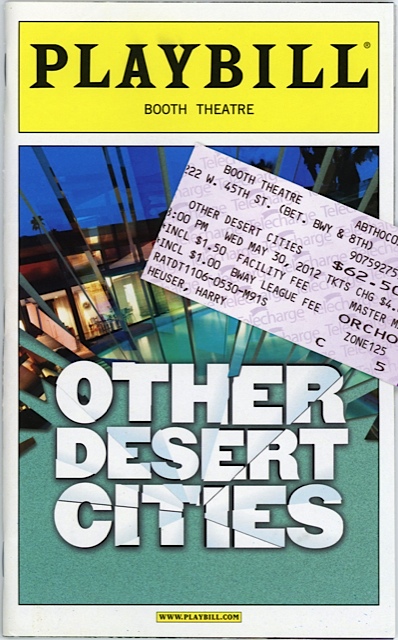
Secrets and duplicities, intimacy and detachment.  Like all family dramas worth relating to, Jon Robin Baitz’s stage play Other Desert Cities measures the distance between folks who are biologically—and often physically—closest to each other: the flesh, the blood and the closeted skeletons of kinfolk.

Approaching Palm Springs (and Other Desert Cities)

Baitz’s American stage family, the Wyeths, could hardly be more traditional: a mother and father, married to one another, a daughter and son, offspring of that union.  Then there is the dramatically expedient extension of that nucleus; in this case an alcoholic, don’t-give-a-damn aunt whom the audience looks at as a go-between, not only between characters but between those characters and ourselves.  It is a well calculated constellation, this, as Other Desert Cities does not just explore relationships but the act of relating, of putting that relationship and all those relations into words, and of questioning the words and the unspoken.

Though most of us couldn’t live with Aunt Silda (Judith Light, in the Booth Theatre production), we love her for what we are encouraged to read as her forthrightness and free spirit.  She, we assume, would be the person most likely to tell the true story of that family, as compromised as her memory and judgment might be after years of swilling the kind of spirits from which she is unable to free herself.

Hello Silda—
The way I remember Palm Springs

After all, we cannot expect to get the inside dirt from her sister Polly (Stockard Channing), a staunch yet tarnished Republican who is terrified that her daughter Brooke (Elizabeth Marvel) has written a tell-all autobiography threatening to tear the façade right off the family’s sunny Californian home.

Yes, Silda tells it like it is.  Criticized by her class-conscious sister of wearing knock-offs, she barks back:

Honey.  News-flash: you’re not a Texan, you’re a Jew! We’re Jewish girls who lost their accents along the way, but for you that wasn’t enough, you had to become a goy, too.  Talk about the real thing? Talk about ‘faking it.’ Honey, this Pucci is a lot more real than your Pat Buckley schtick.

As it turns out, neither Silda nor Polly are what we are led to believe them to be; and this is Brooke’s lesson, too, as she tries to piece together the life story of her lost brother, a left-wing radical whose act of terrorism forced Nancy Reagan pal Polly and her ex-Hollywood star husband Lyman (Stacey Keach) into retirement in the desert.

Desperate to figure out who or what made her brother Henry what the facts don’t quite tell her he was, Brooke turns from writing fiction to biography.  Yet, in her attempt to expose the truth, she ends up with yet another version of the story rather than a definitive one.  “She presents us as ghouls who drove [Henry] to become sort of a murderer,” her anguished, disconsolate father protests to his son (Thomas Sadoski), the “ADD riddled, junk-food-addicted porn surfing Trip Wyeth,” as Brooke calls him to his face.

“Christ, there’s something so vicious about what you’re doing here, Brooke, don’t you know that?” Lyman exclaims.  Vicious and necessary, Other Desert Cities argues.  And futile? As suggested by the closing scene, which may strike some as perfunctory or incongruously sentimental, Brooke’s ordeal—and the ordeal to which she put her family—has served a purpose.

What may seem like a coda or anticlimax I took as the point of the Baitz’s drama.  As a biographer, Brooke has failed.  She has been taken in, taken story for life and secrecy for guilt only to become complicit in her family’s cover-up.  As an autobiographer, though, Brooke is to be envied.  She has learned something about herself that she didn’t know before she came to investigate the lives of those around her.  We may be unknowable to each other—but we can learn to know ourselves.

Of Two Minds: Can The Best Man Win?

Anyone who has as much respect and appreciation for the niceties of the English language as Gore Vidal has will realize, if perhaps only after the final curtain has fallen on The Best Man, that the title is not simply ironic but prognostic: the best man, whoever he may be, cannot be declared if the fight and choice is between just two candidates.  The ostensibly “better” one of them might win, but not, grammatically speaking, the “best.”  Now, the man whom Vidal favors—and expects the audience of his political comedy The Best Man to root for in the play’s fictional contest for Presidential nomination—is not just a man of his word, he is a man who uses each word properly.  The political banter is no mere wordplay: in The Best Man, grammar and morals are one.

Like any wit, Vidal’s central character, William Russell, takes language seriously.  He is not beyond lecturing and flinging the grammar at anyone who doesn’t play by the rules of that book, a volume that the upright man carries in his head.

 
Russell, proper right down to that noun, is proud to have the last name of a noted philosopher; and, as a thinker, it strikes him as morally wrong to allow others to put words in his mouth.  He would rather write his own speeches—“It’s a shameful business, speech by committee,” he declares—but has come to terms with the fact that his busy schedule dictates otherwise.  What he will not brook, though, is ungrammatical speech. “Please tell the writers again that the word ‘alternative’ is always singular.  There is only one alternative per situation.”
 
In the dramatic situation of The Best Man, “alternative” is clearly the wrong word, just as choosing the supposedly lesser evil is the wrong approach to casting votes.  Like the dilemma of the two-party system, the either-or decision to which the unquestioning responder is restricted calls for something better: the rejection of the supposed choice as spurious and misleadingly restrictive.
 
“May the best man win!” is the choice platitude of Russell’s opponent, Joseph Cantwell, whose last name, more than the name of Russell, suggests that the playwright cares less about his characters than about the philosophies for which he makes them stand and fall: they are metaphors for what politics can reduce us to when all we care about is making a name for ourselves.  Both Russell and Cantwell are stand-ins for the figures we imagine—hope and fear—politicians to be; beyond that, they aren’t at all.  “A candidate should not mean but be,” the literary playwright has Russell quip; as a character, Russell is not meant to be anything other than the mouthpiece Vidal means him to be in this verbal play of true versus nominal values.
 
Asked whether he thought that “a president ought to ignore what people want,” Russell replies “If the people want the wrong thing, [. . .] then I think a president should ignore their opinion and try to convince them that his way is the right way.”  How to do right and what is “right” are the questions The Best Man aims at encouraging us to ponder.  Russell answers by taking his opponent by his clichéd expression and extricating himself from the either-or bind that threatens to turn him into a man no better than Cantwell.
 
Vidal, too, attempts a way out here, a synthesis of satire and sentimentality, cynicism and hopefulness, as he demonstrates Russell to be the “best” man, after all, by proving him to be the better one.  The solution is as noble as it is grammatical—but it is rather too neat and ponderous, especially since the alternative “message” Vidal communicates is more tired than the dirty politics from which he derives a modicum of dramatic tension.
 
“And if I may bore you with one of my little sermons,” Russell and Vidal tell reporters and audiences early on:

Life is not a popularity contest; neither is politics.  The important thing for any government is educating the people about issues, not following the ups and downs of popular opinion.

Who, today, would buy that little nugget of shopworn sentiment?

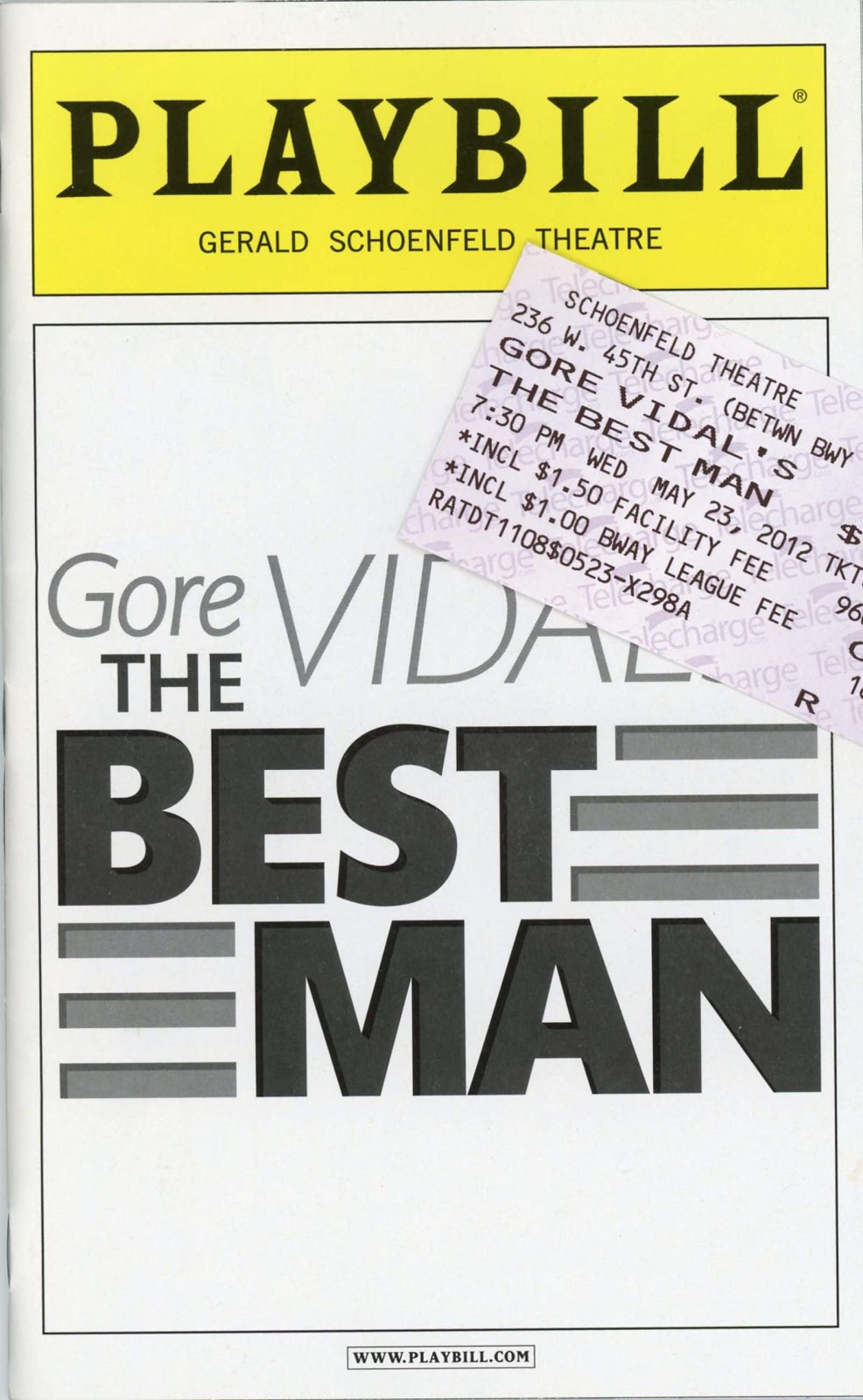
Few, no doubt, even bother, as they are more likely to have come to sample the wares on display in the latest Broadway production at the Gerald Schoenfeld Theatre.  The cast is headed by two sentimental favorites—Angela Lansbury and James Earl Jones—whose presence, however lively, takes some of the bite out of the 1960 play, which now provokes nothing more effectively than nostalgia: a longing for politics that never were.  Like politics, the business of staging a show is too much of a “popularity contest” to rely on a playwright’s words to win us over.  Reading the script now without seeing the assembled personalities—Candice Bergen, John Larroquette, Eric McCormack—before me on that evening in May, I can better appreciate Vidal’s best lines—but, as a play, The Best Man remains ultimately unconvincing.

 
Sizing up his competition, Victorian novelist Anthony Trollope once interrupted one of his narratives by attempting witty remarks about Thomas Carlyle and Charles Dickens, labeling  the latter “Mr. Popular Sentiment” and the former “Dr. Pessimist Anticant.”  With his showdown between “Popular” Cantwell and “Anticant” Russell, Vidal demonstrates that wanting to be both satirical and sentimental means doing justice to neither; the sentiment feels calculated, the wit pointless. In the noble experiment of making dirty politics cleaner, everything comes out rather muddy in the wash.

Come On Up, Eileen; or, Wonderful Yorkville

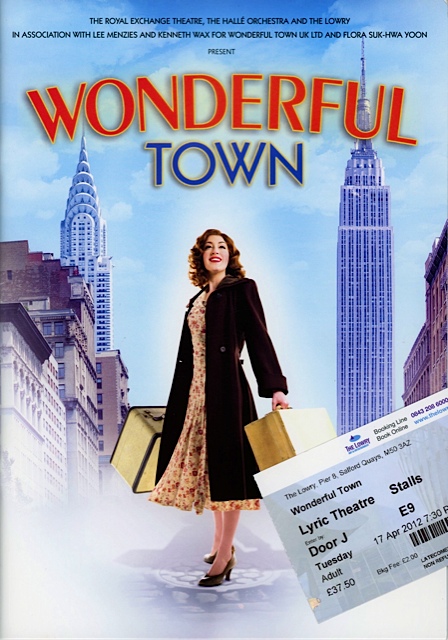
A few weeks ago, my better half and I were up in Manchester, England, to do research for an upcoming exhibition.  While there, we had the good fortune of catching a production of Leonard Bernstein’s Wonderful Town starring Welsh girl gone West End Connie Fisher as Ruth.  Though not quite the real thing, this revival of a Broadway musical version of a play (turned movie, turned sitcom) based on a series of magazine stories inspired by the personal recollections of an Ohioan in Gotham did manage to evoke some of the magic and the madness of life in the titular burg.  And now that I’m back, the residential misadventures of Eileen and her sister come to mind each time I walk down Second Avenue in my old Upper East Side neighborhood.  Like the McKenney siblings, whose Greenwich Village basement flat was shaken by blasts heralding a subway line then under construction, folks up here in Yorkville have been dealing for years with the pre-math of just such a subterranean project: the noise, the dirt, the traffic jams, the shut down stores, the narrowed sidewalks, the fenced in pedestrian passageways that make you feel like a laboratory rat . . . and the rats themselves.


Yes, Second Avenue (pictured) is looking rather worse—and far less flashy—than it did when the street was lined not with gold, but with gals who may or may not have a ticker made of that precious metal; you know, ladies whose line, like the subway’s, is well below.  Wonderful Town is not without hints of darkness, but, as in many musicals of the 1940 and ’50s, the shadier urbanites are colorful caricatures rather than delicately shaded characters.  And if Wonderful is now not as well liked as it was when it premiered, this may be owing to the fact that, even though the characters are based on real people, the assembled Christopher Street portraits are cleaned up so thoroughly as to make them look like stock figures in a formulaic pastiche.  That said, the musical still offers a glimpse at life during the Great Depression and remains translatable—and relatable—to anyone who can read between all those half erased lines of none-of-your-business.

Not that I need to step out of my old apartment to get that sinking Ruth and Eileen feeling.  The two women struggled to find work and put up with a lot while waiting for a break, a wait that, in Eileen’s case, ended at the age of 26 in a fatal car crash.  Journalist Ruth McKenney immortalized her sister and saw—or made us see—the bright side of their hardship and the squalor down in their dingy, downstairs domicile.  Indeed, when I first caught up with My Sister Eileen, sitting in an Upper East Side park listening to a 1948 radio production starring Shirley Booth, I assumed it to be a comment in the post-Second World War housing crisis.  And it is this crisis that hits home today.

If ever I write another autobiography—the one I penned somewhat prematurely at age 14 was discarded once it had served its purpose of communicating my pubescent angst to the girls in my class, whom I knew it was pointless for me to pursue—I might take a lesson from Ruth and look on the proverbial if sometimes elusive silver lining when I reflect on this morning’s knock on the door.  An eviction notice was posted on it and my old apartment is once again contested territory.  I am writing this—while culture beckons unheeded—sitting at the shaky dinner table that, for many years, was stacked with books, student essays, and the drafts of my MA thesis and PhD dissertation.  No, this town would not feel half as wonderful to me if it weren’t for that table, this apartment, and for the friendship that made it possible—and indeed desirable—to come back for a visit, year after year . . .

Of Myrt and Marge-inal “interest”; or, Getting It in the “hinterland”

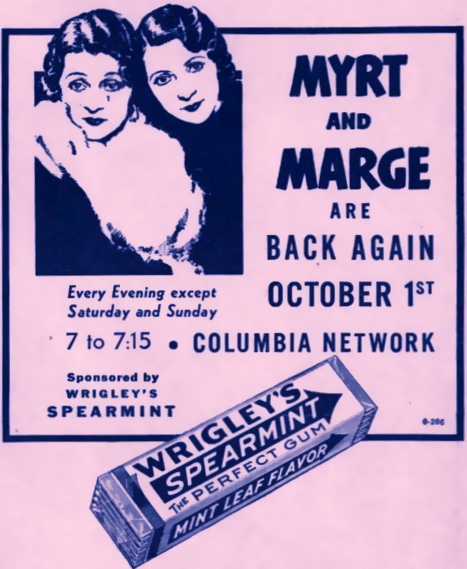
Amos ‘n’ Andy is old-fashioned,” radio critic Darwin L. Teilhet complained as early as 1932. “Its dramatic machinery creaks.”  He much preferred Myrt and Marge, a 42nd Street-smart if way-off-Broadway Melody then in its inaugural season.  To Teilhet, Myrt and Marge was not only “very good serialized melodrama,” it was the “most advanced program of its type now on the air.” 

For all its popularity—and its groundbreaking granddaddy-of-them-all status—Amos ‘n’ Andy sure was “old-fashioned.”  Indeed, its success depended on that comforting, reassuring recognizability—comforting and reassuring, that is, to folks who thought a black face routine less troubling than the effectuation of racial equality.  The early 1930s were highly competitive times of economic hardship, and to hear potential competitors bumbling and make fools of themselves must have been comic relief to the paler faces in the crowd, the faces that mattered most to sponsors.

So, how fresh-faced were Myrt and Marge by comparison? And why was it that, by January 1933, their serialized adventures came pretty close to rivaling Amos ‘n’ Andy in the ratings? Never having been enthusiastic about the latter, I was eager to find out.

As next to nothing is left of the program’s initial run, I had to take the critics’ ear and word for the “it” of listening.  Teilhet, for one, was wowed by the “swift lines,” which he found to be “very different from Amos’ and Andy’s ponderous exchanges.”

Indeed, those “swift lines” translated into swell curves in the critic’s mind.  “Miss [Donna] Damerel [as Marge] provides a sweet and pure sex interest,” Teilhet opined, “which can be safely gulped down by the hinterland without making the children go to bed before their proper hour.”  It took an adult’s imagination of adulterated purity to figure that not all that occurred in the lives of chorines Myrt and Marge was altogether “sweet and pure,” least of all by the puritan standards commercial radio was obliged to uphold.

According to Teilhet, the “tempo” set by the two leads was “hard and glittering.”  Myrt and Marge was quick to respond to the public’s fascination with Al Capone and Little Caesar by turning the backstage drama into an “exciting gangster story.”  It brought a touch of Dillinger to the dilly-dalliance of romantic serials, then still a genre in search of a formula.  By doing so, and by implicating its leads, Myrt and Marge came as close to pre-code Hollywood as network radio could get.

What’s more, Teilhet remarked, that “tempo” was “directly traceable to the vaudeville antecedents” of Myrtle Vail, who created the serial, wrote and starred in it.  “The things she has seen—and experienced,” winked Radio Guide’s Arthur Kent in 1934.  Kent attributed the program’s success to the fact that the title characters were played by actresses who were mother and daughter in real life and that Myrtle Vail had “lived in three great epochs of show business: epochs dominated, respectively, by stage, movies and radio.”  Having “been though it all,” Vail now wrote “the life of the theater as well as her own life into her script.”   Like a true trouper, she carried on even after the death of her co-starring daughter in 1941.

At least on one occasion, the realism was inspired by actual events.  “That tearful episode of Myrt and Marge last week was not the result of an emotionally successful script, m’dears,” readers of Radio Guide’s issue for the week ending 1 February 1936 were told.  “No, it was because the cast almost was overcome by tear gas fumes released when the bank adjoining the CBS studios tested out its automatic vault system.” 

I am surprised that listeners, if not overcome by the vapors, weren’t positively fuming at some of the backstage goings-on.  Perhaps they were overcome, which may account for the lack of documented complaints, radio’s chief tool of self-censoring.  Could they have been oblivious of the program’s other or third “sex interest”—that flaming figure in the dressing room?

What Myrt and Marge brought into American homes, if they didn’t already have one in the closet—and what contributed to renewed interest in the serial, albeit as a mere pop-cultural footnote—was Clarence Tiffingtuffer, the queer sidekick responsible for the gowns worn by the show-busy leads, and for considerable gossip besides.

If listeners were clueless, the hoofers sure weren’t.  When teenager Marge, the newest member of Hayfield Pleasures celebrated precision chorus, feels uncomfortable about being fitted by a man, one of her fellow chorines hisses “Don’t worry, he’ll never harm a hair o’ your head, dearie.”  Rather than being the brunt of it, Clarence dishes out some “swift lines” of his own. “Those gams of yours are practically parenthetical,” he remarks upon the alleged assets in his sartorial care.

Now, belated followers of Myrt and Marge have to make do with a mid-to-late 1940s revival of the serial (although a 1933 film version featuring the radio cast is extant).  Gone are the true-to-life leads; gone, too, is much of what had seemed “different” or “advanced” about the serial back in 1932.  Yet even though we now have to settle for Myrt and Marge-arine, the substitute still retains a flavor of the first outing, as the actor originating the part of Clarence, Ray Hedge, reprises the role he made his own.

I can imagine that, had I been growing up in the early 1930s, Myrt and Marge would have made me feel a little less marginal by moving someone recognizably like me—yet way out there, enjoying a career and a life of make-believe—into the center of the action.  How thrilling it would have been to hear Myrt and Marge take to the soundstage set by their better-known seniors, Gosden and Correll, and listen to them tear down that old minstrel show-on-taxi cab wheels.  With Clarence in their midst, and on my mind, it sure would have sounded like the “most advanced program of its type.”

To be continued, as they say in soap opera land.

Blind Man’s Stuff: Alec Templeton in Time and Space

Last night, I had the good fortune to hear the music of Alec Templeton. Live and by proxy—and right here in town. Templeton’s compositions, among them barrier-obliterating and class-unconscious numbers like “Bach Goes to Town” and “Debussy in Dubuque,” were performed at the National Library of Wales, Aberystwyth. Pianist Simon Crawford-Phillips was ably assisted by Templeton himself, whose voice and ways on the keyboard were heard in a variety of radio recordings from the 1930s, ‘40s, and ‘50s.

Why here? Why now? Well, Templeton was a Welshman by birth, a fact that seems to have eluded most of the Welsh who pride themselves to be a nation of song. So, last night was as good and as high a time as any for his countrymen and women to acknowledge Templeton’s remarkable against-almost-all-odds career, even if the will to embark upon it took the composer-pianist as far West from the West of Britain as Hollywood. The countrywoman who did the acknowledging was Rhian Davies, teller of Templeton’s life in words and images. Davies, who generously acknowledged as well all the support and assistance her project received from broadcasting buffs and music lovers around the inter-networked world, has known about Templeton practically all her life. Eager to share her readily transmitted enthusiasm, she brought home to us, the assembled audience, that it is always Alec Templeton Time.

Templeton’s life is the stuff of legend. Born blind, he developed an ear so keen and a wit so sharp that he was destined to play tunes made for the cutting of rugs. That he was an expert at middlebrow musical culture has a lot to do with the fact that the eyes beneath his brows saw nothing and that his ears saw nothing but potential. Others, left in the dark yet accustomed to light, might have seen an insurmountable impediment.

The mind’s eye of Alec Templeton saw no such manifestations of doubt. He saw, say, Lower Basin Street … and took it. It may be that sightless people, who sense space by feeling their way around and listening intently, are not so much impressed by the walls facing them as their seeing contemporaries, not so much concerned with apparent boundaries, be they cultural or national.

“I understand,” a writer for Radio Guide remarked in 1936, “why his friends, when you start glooming about his sightless eyes, smile superciliously and say: ‘Save your sympathy for someone who needs it.’”

The stuff sighted folks concern themselves with is so much nonsense to a man like Templeton. Sensing a universe where others might imagine chaos, he crossed the waves and made a home for himself on the airwaves, authoring an etherized existence.

“Radio,” Templeton reportedly said, “is to me the greatest miracle of man’s ingenuity. My ears are my eyes, and I tune in at every opportunity, listening to everything from Vic and Sade to Toscanini.”

Hearing Templeton’s music performed live and seeing his career celebrated was a thrill. Yet as pleased as I was that all this happened in the little Welsh town where I now live, I wonder what claim Wales has to her native son. After all, the place of his birth, like his blindness, was not of his choosing. Indeed, he chose to unfurl his pinions, take to the air, and come to live for all willing to be all ears, in a medium whose art is not limited by space but that is instead the stuff—the no-matter—of time.   Make that Alec Templeton Time.

Face Value?

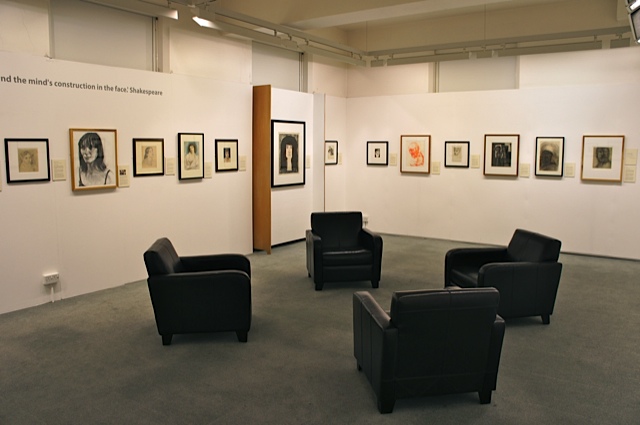
Time to mingle with the visitors, to watch them stand back, take in the artwork—and read those captions. During the past few months, I have been involved in putting together an art exhibition at the local university. It all started last October. I was given the opportunity to teach an undergraduate course in writing informative and interpretive texts for museums: labels, text panels, promotional material. The class was designed as a workshop. So, rather than just theorizing about such matters as readability and legibility or analyzing prose styles and target audiences, my students and I were faced with the challenge of curating a show.

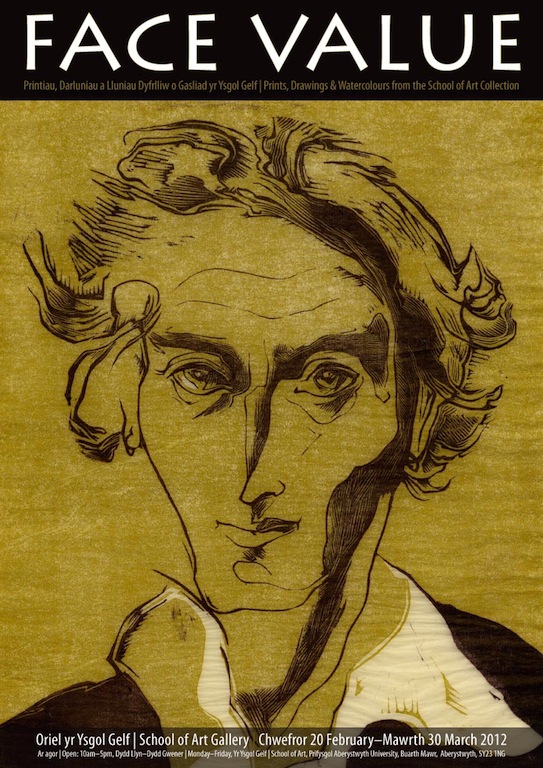
That show, Face Value, is on display and open to the public until 30 March 2012 at the School of Art, Aberystwyth.   It features works on paper (watercolors, etchings, drawings) by artists as diverse as cover girl Gertrude Hermes, Edward Burne-Jones, Fernand Léger, Dante Gabriel Rossetti, Simeon Solomon, William Strang, Stuart Pearson Wright, and Keith Vaughan.  Here is the introductory panel greeting guests at the private view tonight:

‘It is only at the first encounter that a face makes its full impression on us,’ the philosopher Arthur Schopenhauer once remarked. Face Value encourages such chance encounters.  Many of these works on paper from the School of Art collection are presented here for the first time.  Most have never been shown side by side.

This themed exhibition explores various acts of reading: our interpretation of facial features, our attempts to work out the relationships between appearances and mental or emotional states, between character and physical characteristics, as well as between artist, sitter and ourselves.

In 1868, Charles Darwin conducted an experiment to demonstrate that humans have a universal set of facial expressions. An anatomist stimulated a subject’s facial muscles with electrodes to elicit expressions of anxiety, sadness, and joy. He then took a series of photographs with which Darwin presented guests at a dinner party, inviting them to guess the subject’s emotional state. Are our responses predictable? Are faces quite this easy to read?

Face Value is itself the product of an experiment. It was conceived in a classroom, in workshops designed to debate or refute the value of interpretive texts written for museums. Do we look at and judge a self-portrait of a named artist as we do an anonymous, faceless study of a head? Does knowledge about artist or sitter influence our appreciation? What is the curator’s role in aiding or informing our ‘encounter’ with works of art?

‘Who sees the human face correctly,’ Picasso asked, ‘the photographer, the mirror, or the painter?’ Our various guides to interpretation are meant to suggest that there is no ‘correct’ reading and that works of art cannot be taken at face value.

At face value, this is just another art exhibition; but many of the texts on the wall would not read or sound the way they do had I not learned from listening to and reading about radio how to keep sentences simple, short and clear.  It is a lesson I am still learning … and worth learning it is.  Especially for curators.

You Can’t Take It With You; or, I Scan, Therefore I Am

I call them inventory days, those first few weeks of a new calendar year. It is a time when I play secretary to myself, when I organize and catalogue, shelve and throw away, when I look back at the places I’ve been to, the things I have done, the people I have met. Perhaps, I am getting it all wrong: the year is crisp—so, why am I rehashing what has been, obsessively reconstructing the past with the aid of notes in my calendar, correspondences, receipts and ticket stubs? I am not attached to the material evidence of my prior whereabouts and activities, mind. I jot down what I can glean from each scrap of paper and discard it posthaste. The records are gone, but my recordings of them remain. Such nonchalance is the prerogative of a diarist: not to feel obliged to prove—let alone account for—his or her existence to anyone else. I recount events in order to make them count rather than become accountable for them . . .

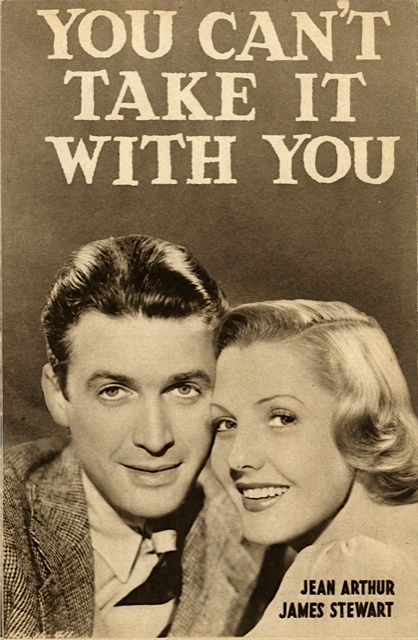
You can’t take it with you—but does that mean I should dispose of whatever I have consumed? I am not quite so indifferent when it comes to artifacts that, unlike my mind and body’s scant body of work, might be of consequence to posterity. I feel free to dispose of a photograph of myself after I scan it; but I am uneasy about doing the same to a piece of ephemera such as this souvenir program (from my collection of motion picture memorabilia). May the copy be a feast for greedy eyes as long as the original is removed from greasy fingers.

Sure, I enjoy surrounding myself with meaningful objects; but, my childhood teddy bear excepting, I am not attached to belongings. To have is utility; to hold, futility.

The chance of having and not holding is what attracted me to the immaterial world of radio dramatics. These days, I mostly collect what goes into one ear and, playing with it, delay the moment at which it comes out of the other. I amass what has no mass: digital recordings, not the physical vehicles on which they used to be stored (shellac, vinyl, magnetic tape).

Everything I have gathered is at my fingertips, nothing is filed away. My world and my vault are one. The files are backed up (this much I have learned from past losses)—but they are ready to go wherever I am. I can take it all with me; and doing so rather than storing things away enriches my life.

That said, I have to learn to cut short my inventory days; last year, they lasted for months. To cut a long time in storage short, I have booked a trip to New York this January. No doubt I will be both gathering new stuff for living and, as my past record tells me, look back and catch up. I know my failings. No saints need apply to preserve me.

The Lion in Winter Wonderland; or, What’s That Fir?

Once a year, in the run-up to Christmas, my better half and I make the seemingly interminable journey from Wales to London for some seasonal splurging on art and theater. Now, I don’t travel all the way east to the West End to waste my time on pap like Dirty Dancing. This isn’t snobbery, mind; I simply can’t thrill to a feast of re-processed cheese and the prospect of paying for it through a nose bigger than Jennifer Grey’s old one. Besides, why raid the bottom shelves of our pop cultural cupboard when I’ve got a heaping plateful of squandered opportunities to chew over? During the days of my graduate studies in English and American literature, I had little money to spare for Broadway theatricals, which is why I now tend to seek out revivals of plays I missed the first, second, or umpteenth time around—drama with some history to it, be that pedigree or baggage. James Goldman’s The Lion in Winter has a bit of both.

As an added attraction, the current Theatre Royal Haymarket production also has the ever Ab-fabulous Joanna Lumley, whom I first saw on stage in the 2010 Broadway revival of La Bête. Lumley plays caged lioness Queen Eleanor opposite Robert Lindsay’s Henry II, the husband who keeps her under lock and key.  Witty and fierce, The Lion is a domestic drama fit for the tryingly festive season. All the same, the darn cat is in a confounded state of seasonal disorder.

What those stepping into the auditorium from the audio-visual onslaught that is Christmas time in the city cannot but gasp at is that even Henry’s halls are decked: his French chateau, anno 1183, features a regal Tannenbaum, no less. It certainly had my eyebrows raised to the alert level of WTF: you might expect a Green Knight, surely, but a bebaubled evergreen?

The proud Lion is prepared to pounce, though, ready to defend itself against “turbulent” critics crying bloody murder in the cathedral of culture. Goldman acknowledged that his “play contains anachronisms” such as the “way . . . Christmas is celebrated.” As he states in the notes duly reprinted in the playbill, the ahistorical trimmings are “deliberate”; “though it deals carefully with history,” The Lion “remains a piece of fiction.”

Towering over the assembled branches of Henry’s living family tree, the familiar, dead one serves as a reminder of the storyteller’s presence.  The needling transplant from our present day tells not only of the author’s intervening re-inventiveness but also of his obligation to make that past relevant: the dramatist does not simply stage history; he fashions it. To withhold evidence of this intervention would mean to falsify, to deny the hand and mind involved in the process of transcribing.

Goldman was nonetheless concerned that this never-evergreen might overshadow his research and cast doubt on his responsible interpretation of verifiable historical events. “This play,” he pointed out to his audience, “is accurately based on the available data.”

The elephant of a dislocated trunk aside, The Lion is refreshingly unself-conscious; it is a deluxe soap free from the by now irritating additives of postmodernist reflexivity. For all its modern day translations—of which only its pre-gay lib treatment of the 19th century construct of homosexuality struck me as dated—it affords a close look at historical figures that rarely seem human to us in the accounts of battles and political maneuverings.

If Goldman reduces the sweep of history to an intimate first-family portrait, he chose a subject that warrants such an approach; as historian John Gillingham argued, what “really mattered” to Henry II “was family politics,” in the belief of the failure of which he died. Far from being a Peyton Placeholder, Goldman’s “Christmas Court that never was” has been assembled to bring historical intrigue home.

Ladykillers Instinct; or, Marcia Warren’s Profession

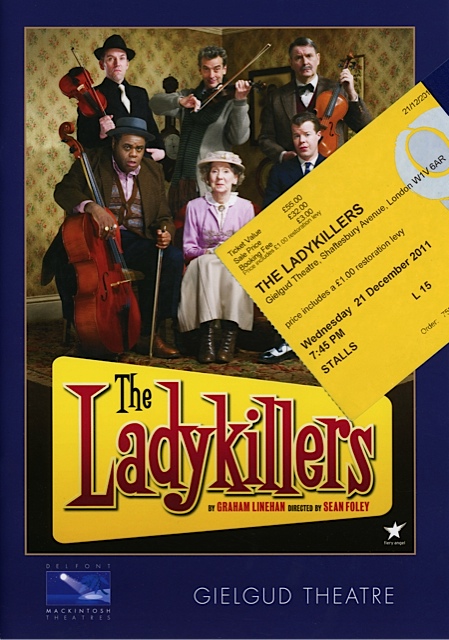
“What’s your great online discovery,” an interviewer asked Marcia Warren, star of the current West End production of Ladykillers.  To this, the veteran of stage, screen and radio replied, “What does online mean?” It is just the kind of answer most of us expect—and want to hear—from someone past middle age, which makes hers such a sly response.  Warren remains in character, as Mrs. Wilberforce, kindly old landlady to the killers, giving us what we find so reassuring and endearing about the senescence we otherwise dread.  She may or may not be joking—but she sure has earned the right neither to know nor to care.  Looked at it that way, being past it becomes a shelter, a retreat beyond trends, updates and upgrades whose seeming simplicity appeals to those who cannot afford to be quite so nonchalant about technology, who feel the pressure of performing in and conforming to the construct of the present as a digital age. 

Not to know or willfully to ignore—what luxury! Young and not-so-young alike find comfort in this deflecting mirror image of our future selves.  It’s a Betty White lie we use to kid ourselves .

We enjoy making light of old age; and those of us who have half a conscience enjoy it even more to be presented with elderly people or characters who are not simply the brunt of yet another ageist joke but are in on it—and cashing in on it as well.  We laugh all the way as they take our laughter to the bank.

We want older folks to be feisty because it comforts us to know that, even in our declining years, there are weapons left with which to fight, however futile the fighting.  The middle aged, by comparison, are past the prime against which the standard their looks and performances are measured; it is their struggle to conceal or deny this obsolescence that makes them the stuff of deflationary humor.  We don’t laugh at Mrs. Wilberforce; we laugh at the bumbling crooks whose willfulness is no match for her force shield of insuperable antiquity.

It is this nod to nostalgia as a weapon against the onslaught of modernity that makes Ladykillers such a charmer of a story.  And what makes it work on the stage just as it works on the screen is that the 1955 original requires no update: the Ladykillers was born nostalgic.  It hit the screens—in fabulous Technicolor, no less—at a time when, after years of postwar austerity, the British were ready to look back in amusement at their wants and desires and all those surreptitious attempts to meet them.  Sneers turned to smiles again as greed was finally being catered to once more.

Eluding those who try to will it by force, fortune winks at those who wait like Mrs. Wilberforce, a senior citizen yet hale, clearheaded and driven enough to enjoy a sudden windfall.  It is a conservative fantasy that appealed then as it appeals now, especially to middleclass, middle-aged theatergoers eager to distract themselves from banking woes and pension fears, from cybercrime and urban riots.

Familiar to me from radio dramatics, Warren’s name was the only one on the marquee I recognized as I decided whether or not take in what I assumed to be another one of those makeshift theatricals that too often take the place of real theater these days—stage adaptations of popular movies, books and cartoons like Shrek, Spider-Man, or Addams Family with which the theater world is trying rather desperately to augment its aging audience base.

Written by Graham Linehan and directed by Sean Foley, this new production of The Ladykillers fully justified its staging.  There is much for the eye to take in; indeed, it owing to an able cast—and the lovely, lively Ms. Warren above all— to prevent the ingenious set and special effects from stealing this caper.

In the real, honest-to-goodness make-believe beyond the online trappings of which she claims to be ignorant, Warren gives us just what we want.  After all, acting for our pleasure and acting out our desires is her business.  It’s the oldest profession in the world.

Of “historical value”: Hitler’s “Best” Straight Talk and Other Continuity Types

As soon as I decided to make radio plays written in the United States in the 1930s, ‘40s and early ‘50s the subject of my doctoral study, I set out to scour New York City University libraries for scripts published during that period. My degree is in English, and I was keen not to approach broadcasting as a purely historical subject. The play texts and my readings of them were to be central to my engagement with the narrative-drama hybridity that is peculiar to radio storytelling. Whenever possible, I tried to match script with recording—but, to justify my study as a literary subject, I was determined to examine as many print sources as possible. One text that promised to provide a valuable sample of 1930s broadcast writing was Radio Continuity Types, a 1938 anthology compiled and edited by Sherman Paxton Lawton.

Back in the late 1990s, when I started my research, I was too focused, too narrow-minded to consider anything that seemed to lie outside the scope of my study as I had defined it for myself, somewhat prematurely. Instead, I copied what I deemed useful and dutifully returned the books I had borrowed, many of which were on interlibrary loan and therefore not in my hands for long. It was only recently that I added Radio Continuity Types to my personal library of radio related volumes—and I was curious to find out what I had overlooked during my initial review of this book . . .

Radio Continuity Types is divided into five main sections: Dramatic Continuities, Talk Continuities, Hybrid Continuities, Novelties and Specialties, and Variety Shows. Clearly, the first section was then most interesting to me. It mainly contains scripts for daytime serials, many of which I had never heard of, let alone listened to: Roses and Drums, Dangerous Paradise, Today’s Children. There are chapters from Ultra-Violet, a thriller serial by Fran Striker, samples of children’s adventures like Jack Armstrong and Bobby Benson, as well as an early script from Gosden and Correll’s Amos ‘n’ Andy taken from the period when the program’s format was what Lawton labels “revolving plot drama.”

Aside from a melodrama written for The Wonder Show and starring Orson Welles, I got little use out of Lawton’s book, mainly because I concentrated on complete 30-minute or hour-long plays rather than on serials I could only consider as fragments. Besides, I was not eager to perpetuate the notion of radio entertainment as being juvenile or strictly commercial.

Anyway. Looking at the book now, I am struck by Lawton’s choices. Never mind the weather report on page 346 or Madam Sylvia’s salad recipe. How about the editor’s selection of “Occasional speeches”? Historically significant among them are Franklin D. Roosevelt’s first inaugural, a “Welcoming” of Roosevelt by Getulio Vargas, President of Brazil, as well as Prince Edward VIII’s announcement of his abdication.

No less significant but rather more curious are Lawton’s “Straight Talk” selections of fascist propaganda by Benito Mussolini, Joseph Goebbels and Adolf Hitler: “Long live the National Socialist German Reich!” and “Now and forever—Germany! Sieg Heil!” Surely, such lines draw attention to themselves in a volume promising readers “some of the most successful work that has been done in broadcasting.” What, besides calling Goebbels’s “Proclamation on Entry into Austria” and Hitler’s “I Return” speech (both dated 12 March 1938) “straight” and “occasional,” had the editor to say about his selections? And what might these selections tell us about the editor who made them?

In a book on broadcasting published in the US in 1938, neutrality may not be altogether unexpected, as US network radio itself was “neutral”; but Lawton—who headed the department of “Radio and Visual Education” at Stephens College in Columbia, Missouri—seems to have gone beyond mere representations of “types.” Introducing a translation of Hitler’s speech, which comments on the reluctance of “international truth-seekers” to regard the new “Pan-Germany” as a choice of its people, Lawton argued it to represent “some of the best work of a man who has proved the power of radio in the formation of public opinion.” There are no further comments either on technique or intention. No explanation of what is “best” and how it was “proved” to be so. No examination of “power,” “public,” and “opinion.” It is this refusal to contextualize that renders the editor’s stamp of approval suspect.

The “continuity” Lawton was concerned with was of the “type” written for broadcasting—not the “continuity” of democracy or the free world. When he spoke of “historical value,” the editor did so as a “justification for a classification” of the kind of “continuity types” he compiled (among them “straight argumentative talks” by Senator Huey Long and Father Coughlin). And when, in his introduction, he speculated about radio in 1951 (“when broadcasting [would] be twice as old” as it was then), he did not consider what consequences the “best” and “most efficient” of “straight talk” might have on the “types” that were still “in common use” back in 1938.

Given its definition of “historical value,” it hardly surprises that Lawton’s anthology was not in “common use” for long. There was no second edition.