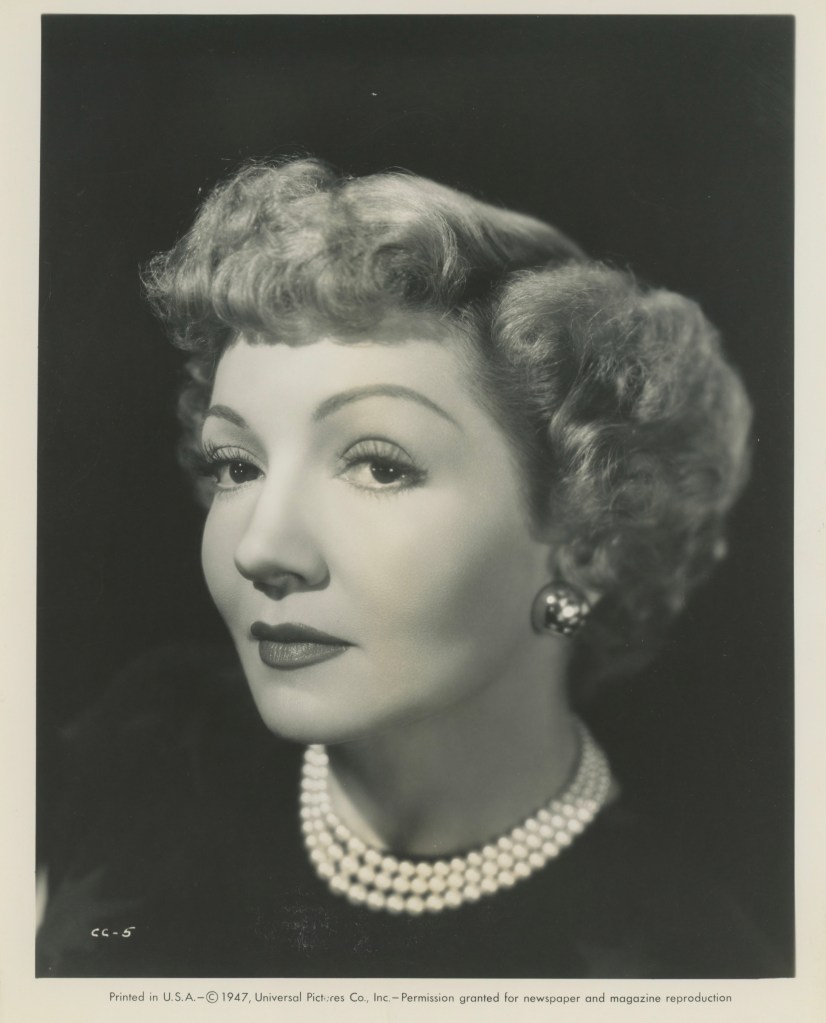
Who was it that said “I shall do my very best to be of aid to anyone who has a problem, large or small”? If the title of this, the 824th entry into the broadcastellan journal did not give away the answer, it might have been anyone’s guess. And perhaps it still is, the black-and-white of legacy media notwithstanding. According to Photoplay – a publication leaving more room for doubt than any self-respecting sceptic would require – that Nightingalean sentiment emanated from the pen of none other than Claudette Colbert, a leading lady most widely known for her Academy Award-winning performance in It Happened One Night – a lady, no less, who gave anyone involved in making movies no end of problems by not letting a Hollywood studio lamp shine on the right side of her face, a cheek that came to be dubbed the dark side of the moon.
“And what might you want?” Colbert seems to be asking in this original publicity photograph from my collection.
Dear me, I thought, when, quite by accident, I discovered that I my favorite film star lent her name to a “Dear Abby” column over a decade before the pseudonymous Abby started answering letters from all and sundry. Having written two letters to Ms. Colbert myself – albeit not until 1991, mind – I was anxious to find out just what advice was given in her name to alleged Photoplay readers whose last names were, as is both customary and convenient, reduced to initials.
“As all the pleasures of intellect arise from the association of ideas,” Richard Payne Knight reasoned in An Analytical Inquiry into the Principles of Taste (1805), “the more the materials of association are multiplied, the more will the sphere of these pleasures be enlarged.” He argued that, to a
mind richly stored, almost every object of nature or art, that presents itself to the sense either excites fresh trains and combinations of ideas, or vivifies and strengthens those which existed before: so that recollection enhances enjoyment, and enjoyment brightens recollection.
While I am not convinced that the “association of ideas” always brings “pleasures” or ‘brightens recollection” – experiences that are not strictly a matter of “intellect” to begin with – I am so prone to raids on the store of memories, in varying states of neglect and disrepair, that any and all matter may turn up and, often unexpectedly, turn into reassembled “materials of association.”
Tracing the proverbial dots that speckle – or perhaps constitute – my mindscape, I invariably connect the tell-tale marks that, like splotches of blood, lead right to the heart of what is the matter with me, and, without any recourse to science, make themselves felt to match my DNA. I am dotty that way.
Call it egocentrism, call it empathy, such provoked but uncalled-for recall can lead to discoveries decidedly beyond “enjoyment.” The compulsion to relate – to find associations relevant and revelatory rather than beside whatever the point of anything may be, according to some – keeps driving home that the past, however processed or pasteurized, like spilled milk made longer-lasting to be cried over anew – keeps repeating on us. Hold our tongue as we may, we can still taste it. I am tasting it now.
“A thing can sometimes be too extraordinary to be remembered.” With that intriguing overthrow of conventional wisdom opens “The Fad of the Fisherman,” a short story by G. K. Chesterton, first published in 1921. “If it is clean out of the course of things,” Chesterton expounds, “and has apparently no causes and no consequences, subsequent events do not recall it; and it remains only a subconscious thing, to be stirred by some accident long after. It drifts apart like a forgotten dream….”
A contemporary illustration for Chesterton’s story by William Hatherell, showing the “extraordinary” incident.
In light of the extraordinary and memorable events unfolding over the last few days like a crumpled serviette disclosing the spat-out remains of a prolonged Partygate feast – the rules-breaking incident that contributed to the eventual if only reluctantly heeded call for the resignation of Prime Minister Boris Johnson – the notion that something might be “too extraordinary to be remembered” does not quite ring true. So much in politics these days is head-scratchingly, gut-churningly out of the ordinary, the Trump Presidency and its aftermath being a prime example. And yet, the violation of established codes of conduct have become so flagrant and frequent that we, or some – or, I suspect, many – of us no longer recognize them to be unprecedented, unethical or unconstitutional.
It now takes greater effort to remember, if ever we knew, what once were assumed to be formal matters of procedure and protocol. And we struggle as well to connect the tell-tale dots that, if they were examined closely – like some seemingly random Rorschach blots – and in relation to each other, might enable us not only to arrive at the “causes” – the egoistic and downright egomaniacal roots – of socio-political developments but also to realize the “consequences” of our inattention to pattern-forming details whose neglect profoundly compromises our ability to draw meaningful inferences from the reality of facts and fictions with which we are confronted: the erosion of trust in political figures who, instead of serving their country, help themselves and cling to power as if they were absolute monarchs. How reassuring, then, are the ratiocinations that bring many a murder mystery to its logical if not always satisfactory conclusion.
It is the conclusion rather than the opening lines of Chesterton’s story – a story involving the unlawful actions of a Prime Minister – that brought to mind the astonishment with which I first reached it – a solution that I, appropriating shelved products of popular culture rather than reviewing them, am under no compulsion to withhold. The by me highly anticipated conclusion to Mr. Johnson’s sorry and increasingly sordid Downing Street saga, meanwhile, remains unknown while I am writing this, the 822nd entry in my journal. I might as well say it flat out: the Prime Minister in Chesterton’s story is a murderer who gets away with his crime.
The original dust jacket makes no mention of The Lodger; instead, it reminds readers of a more recent crime novel by Lowndes, which was adapted for the movies in 1932: Letty Lynton.
There is a lot of talk these days about ‘toxic masculinity.’ Making a strong case for the correlation of venom and virility, war criminal Vladimir Putin recently mocked the physique of world leaders who, by rolling their eyes at his shirtless posing, permitted themselves a moment of levity at his expense amid a crisis talk on Ukraine. Meanwhile, COVID-19-rules violating British Prime Minister Boris Johnson, himself a noxious cocktail of mendacity and indiscretion, opined that, had Putin been born female, the invasion of Ukraine would not have happened. Seriously, would the US Supreme court have decided differently on undoing environmental protection if more earth mothers were among the judges?
I thought the claim that toxicity is masculine had been conclusively laid to rest by Lucretia Borgia – or by Margaret Thatcher, at the very latest. That the flip side of our fancies is still deemed to be “another man’s poison” makes me long for gender fluidity, itself a noisome notion to some. Apart from lamenting the bane of binaries, I have nothing further to say here about exposed torsos or the merits of any remarks made by a disreputable Prime Minister. And yet, there is no escaping the everyday – not even in the attempt to retreat into the presumably out-of-date, of pop past its sell-by date, for the sampling of which this journal was conceived.
Marlene Dietrich (1951) by Angus McBean, SoAM&G, Aberystwyth University Purchase: Adrian Woodhouse (2016) Funding support: ACE/V&A Purchase Grant Fund and The Art Fund
What draws me in is the blankness of Dietrich’s face, her eyes looking not at us but beyond us, at nothing in particular, with a lack of any definable expression, emotion or urgency. The vacant gaze, bespeaking an unavailability and a refusal to engage, suggests the subject’s control over an image that is all surface: like theatrical curtains, the lids may come down on those eyes any moment now, shutting us out entirely.
It is a blankness that is not nothingness, invested as it becomes with the spectacle it makes of our longing. It is a blankness that is not openness; it gives nothing away while it commands our attention and inspires our awe at its sublime perfection – a perfection that belies the sprezzatura, the rehearsed effortlessness and nonchalance of the performance.
Nothing here encourages us to imagine what those eyes are looking at; nothing that invites us to see anything through those eyes. Those eyes are the event in a face – a site – that is all look. I am glamor, this face says, and what else, what more could you – or anyone – possibly be looking for!
The photograph holds me because the look withholds so much. What we are not getting is a portrait of the sitter, then in her fiftieth year. This photograph, clearly, is not of Dietrich, the person. It is the image of a mask that is already a persona. In this masquerade, as intriguing as anything conceived by Cindy Sherman in her film stills, the image is a simulacrum – the fiction of a fiction of a fiction.
“Theater Is Not for Fags,” the sign reads. It was brandished, among other such boards, in a rather unconvincing crowd scene in “The Other Vibrator,” the possibly well-intentioned but insipid eleventh episode of Grace and Frankie’s third season, with which I eventually caught up only a few days ago. The morning after, I finished reading Ngaio Marsh’s Killer Dolphin (1966). And the way that my wayward mind works, I put it down with that slogan in mind.
Retitled Death at the Dolphin, Marsh’s mystery novel was published in Britain in 1967, half a century before the Grace and Frankie episode first aired. That means it came before the public just as the Sexual Offences Act 1967 decriminalized consensual – and private – homosexual acts among adult males in England and Wales. This being Gay Pride month, I am perhaps especially alert to anxieties surrounding gender and queer identity. At any rate, I detected an unease – or a playful response to public misgivings, actual or perceived –about homosexuality in Marsh’s narrative, which features a single gay character, and a minor one at that, while most of the other players – actors and creatives all – are carefully coupled in more or less, and mostly less, cosy heterosexual bonds.
Could it be, I wondered, that Marsh, herself a theater director, was sharing the sentiment that public playhouses – in swinging London, to boot – are not a platform for gay men?
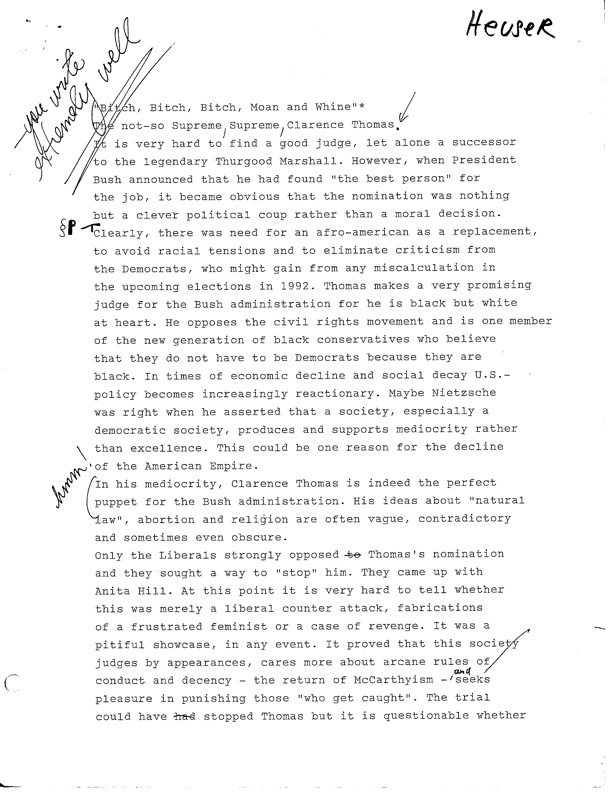
First page of a college essay, dated 17 October 1991
Bitch. Moan. Whine. I certainly do a lot of that. Always have. The complaining probably started around the time my mother first pulled away her nipple. These days, though, there just seems to be more to “bitch, moan and whine” about; from the cumulative fallout of the unending pandemic, the new normal of war in Europe and the aftermath of Brexit and the Trump presidency to the burnout and sense of deflation I experience in my line of work as a newly promoted ‘Senior Lecturer’ whose recent and long-fought-for £8 a week pay increase feels more like a slap in the face than a patronising pat on the back for services rendered, albeit not without bitching.
Quit whining about that last one, you might well say; indeed, I try to remind myself that it is nothing compared to what others are suffering, possibly of necessity in the silence that does not necessarily translate into acquiescence.
Seeing things in proportion – which is proper, according to some – or putting them into the perspective that, by definition, depends on your angle, tends to be more difficult when you feel ever more keenly that everything is related rather than being relative by default. When you are living in that fragile ecosystem of despair that some might deride as egocentricity, anything is apt to become everything, and it can weigh you down something awful.
“Bitch, bitch, bitch, moan and whine.” That is hardly a comprehensive, let alone compassionate, assessment of the voicing of dissatisfaction by your contemporaries, however motivated. It is a derision and dismissal of criticism as selfish, pointless and downright destructive. As the quotation marks indicate, that does not reflect my general views on disaffection.
In fact, those words – “Bitch, bitch, bitch, moan and whine” – were uttered in the 1980s by Clarence Thomas, now a US Supreme Court Justice. And they were voiced not in response to finicky folks rolling their eyes at just about anything – the kind of ‘why me’ injustices of our everyday – but to civil rights leaders who, in their rejection of the status quo, aim to address actual, momentous and seemingly insoluble inequalities.
The illusion of the stage. The magic of the movies. The glamour of fashion. In a career spanning half a century, Angus McBean (1904–1990) turned instances of make-believe and masquerade into enduring records of enchantment.
Poster design by Neil Holland, from a photograph of Angus McBean by Robert Greetham
McBean was born and raised in South Wales. His father had worked in the collieries. Encouraged by his mother to make art his life, McBean moved to London. After working in banking and retail, he became a theatrical mask-maker and designer before achieving international fame as a photographer.
This year’s exhibition at the School of Art, Aberystwyth University, showcases McBean’s work in advertising, his commissioned portraits, and his annual Christmas cards. It offers rare glimpses of McBean’s private life, holidaying on the continent, as captured in two unique photo albums. Also featured in the exhibition are portraits of McBean at home, in later life, by the contemporary photographer Robert Greetham.
Make/Believe installation view
Not all the personalities on view in this exhibition – Marlene Dietrich, Ruth Draper, Audrey Hepburn, Vivien Leigh, Claire Luce, Laurence Olivier, Maggie Smith, and Welsh icon Ivor Novello among them – are as familiar today as they once were, even though some of them, including Rosemary Harris and Maggie Smith are acting to this day. All of them, like McBean, lived by their passions, whether performing on stage and screen or playing on the tennis court, as Wimbledon champion Helen Wills Moody did.
Make/Believe installation view
McBean’s photographs were made in the pre-digital age of the medium. Using scissors and paste, montage and collage, as well as elaborate sets and props, McBean employed every trick of the trade to bring out the beauty, vitality and personality of his subjects. His photographs were staged, not taken.
Drawing inspiration from Salvador Dalí, whose exact birthday he (incorrectly) claimed to share, McBean ‘surrealized’ many of them. ‘This thing of truth doesn’t really come into it,’ MacBean said in late life of his portraits.
Make/Believe installation view
The theater, to McBean, was ‘fantasy.’ It was ‘what you wished it to be.’ It was also the refuge McBean needed at a time when being queer was a crime. During the Second World War, he endured a two-and-a-half-year sentence of imprisonment and hard labour. His work is a testament to the imperatives of making, believing, and make-believe.
Make/Believe, which draws almost entirely on the School’s collection, opened to the public on 16 May 2022 and runs until 30 September 2022.
Curators: Hannah Beach, David Eccles, Helen Flower, Ellie Hodnett, Mayu Maruyama, Ekene Okoliachu, Lucija Perinic, Joanna Reed, Katerina Vranova, Portia Sastawnyuk, Anna Slater, and Helena Zielinska. with support from Senior Lecturer Harry Heuser (text and concept) and Senior Curator Neil Holland (staging and design).
Page from the published script of Archibald MacLeish’s “The Fall of the City” (1937)
As the world awaits news from Ukraine and its people awake daily to the sounds of shelling, many of us, having survived the pandemic that at once isolated and united us, become alive anew to our connectedness to world events and to the urgency, the necessity, of connecting dots in plain sight, and of listening out for tell-tale signs, be it the rumble of tanks or the roar of tyrants. We should have seen this one coming, we might suspect; but such hindsight provides no relief in the face of local destruction and global upheaval.
I am reminded of the events that came to be known as 9/11 – an attack that did not, as some claimed and many felt, hit us ‘out of the blue’ on that bright September morning – and of feeling both helpless and useless in the wake of the terror that would shape history. I was teaching writing in the Bronx, and I was researching radio drama of the 1930s. None of that seemed to matter at a moment when digging in and digging up – literally and figuratively – was felt to be needed to uncover lives lost and recover the history that had gotten us to that point. I kept on teaching writing, and I kept on researching radio – and I strove to find the usefulness and relevance of both. That is, I did not carry on “regardless.”
Instead of retreating into the past of broadcasts decades old, I tried to retrieve messages pertinent to the present. And while we might think that messages are merely repeated rather than being heeded, we may also find that we did receive them and that we are capable of learning from history even as a world leader insists on repeating it.
Take, for instance, Archibald MacLeish’s “The Fall of the City.” First produced and broadcast in the US on 11 April 1937 – with a cast including Orson Welles and Burgess Meredith, and a score by Bernard Herrmann – it was a response to the rise of a dictator who, unchecked and unresisted, conquers a city despite warning voices from the past – the ancient and the dead. In MacLeish’s allegory, the ‘conquerer’ is not a person: it is fear. It is fatalism. It is the surrender of freedom to fascism.
In “The Fall of the City,” a radio announcer (played by Welles in the 1937 production) serves as our eyes, an observer by proxy reporting from the scene of an unnamed city. MacLeish’s plays – from “Air Raid” to “The Trojan Horse” – are never simply plays for the medium of radio but also plays about that medium – about tuning in from a distance, about mediation and reception, and about misinformation and deception. The listeners are implicated, their role in the event of listening reflected upon in the shared act of telling stories and hearing histories in the making.
“The sun is yellow with smoke,” the announcer informs the audience, “the town’s burning…. The war’s at the broken bridge.” It is impossible to listen to those lines now without seeing the cities under siege in Ukraine; and yet, “The Fall of the City” – which was broadcast just two weeks prior to the arial bombing of Guernica in April 1937 but written some months earlier, in 1936 – not about the reality of any particular invasion but about the real threat posed by evasiveness. It caution against giving in to ideas and being enslaved by ideologies, for which it was criticised during the Second World War: “In these last years,” Randall Jarrell, himself a poet, wrote in 1943:
many millions of these people, over the entire world, have died fighting their oppressors. Say to them that they invented their oppressors, wished to believe in them, wished to be free of their freedom; that they lie there.
Jarrell wrote this in the aftermath of air raids, and the war of ideas were not uppermost on his mind.
I do not know whether I am writing at a moment that future records might document to be days or weeks before the start of a Third World War. I know I am writing it in wartime. Unlike in the scenario envisioned by MacLeish, the world is not only watching the atrocities perpetrated by Russians in the towns and cities of Ukraine; it is responding, both to aid Ukrainian civilians (my sister in Germany has welcomed Ukrainian refugees into her home) and to avoid an escalation of military conflict. Unlike the abstract “citizens” of MacLeish’s play, men and women are resisting. Cities do not fall. They are attacked. They are defended. They are fought over. And it is citizens – civilians – that are doing the fighting.
How different this fight is from the defeat as MacLeish conceived it. “The city is doomed,” the Voices of Citizens in his play declare,
The age is his! It’s his century!
Our institutions are obsolete.
He marches a mile while we sit in a meeting.
Opinions and talk!
Deliberative walks beneath the ivy and the creepers!
His doubt comes after the deed or never.
He knows what he wants for his want’s what he he knows.
He’s gone before they say he’s going.
He’s come before you’ve barred your house.
He’s one man: we are but thousands!
Who can defend us from one man?
Bury your arms! Break your standards!
Give him the town while the town stands!
We know the price of such surrender. Putin might have believed that his invasion would meet with little or no resistance, and that the global community, understood as a community, is powerless in the face of his aggression. Putin’s methods date from the past; his mind, however made up it may be, was made up last century. It is no match for what humanity can achieve if we – and that includes the people of Russia – put our minds and methods to it. Right now, his thinking and his tanks, his misfiring strategies and his unwillingness to listen, are being answered by the rallying cries of the present that will help us secure a future.
Betty White, Bea Arthur and Rue McClanahan as I met them at a DVD signing at Barnes & Noble in downtown Manhattan in November 2005
What a fitting end this was to a mostly “stinky” 2021. Just as I was plonking myself down to subject my unsuspecting husband to a viewing of Ernst Lubitsch’s Design for Living (1933), news reached me of Betty White’s death. The year could hardly have expired on a more cheerless note, with the last of the Golden Girls not living to see her hundredth birthday in January 2022. Like so many other celebrations these days, that centenary now has to be called off as well. As the clock ticked relentlessly toward midnight, I shed a tear, remembered the laughter and called to mind the many years I spent in the company of … Rose Nylund.
I know that White, who started out on radio, played many roles on screens small and big. I also know better than to confuse an actor interpreting a script with a person inhabiting a character. Nevertheless, it was as Rose on The Golden Girls that White had the most profound influence on my life, especially in the late 1980s and early 1990s, when I was trying to adopt a more colloquial American English, to make the vernacular mine and make it work for me to boot.
Now, I’m not one to “blow my own gertögenflögen” – or however you might spell Rose’s pseudo-Scandinavian additions to my vocabulary – but, with the aid of White’s Rose, I managed to find the joy in speaking in at least two tongues, resigned to the likelihood that none quite conveys what I am aiming to say, particularly in the face of that “precise moment when dog do turns white.”
Peroxide blonde like me, White’s Rose was reassuringly naïve, curious and enthusiastic. She was generally good-natured and, trusting in fellow human beings she remained even after the end of her relationship with the man she had assumed to be Miles, was especially kind to animals, among them Mr. Peepers, the cat she reluctantly gave up on the day she met her future housemate Blanche Devereaux; Count Bessie, the piano-playing chicken she dreaded consuming; and Baby, the aged pig she agreed to adopt – or indeed to all the injured animals back on the farm on which she grew up. Rose’s character and the situations in which she found herself reflected White’s commitment to animal activism.
Rose was an outsider, too, an adopted child (with a monk for a father, no less). After the death of her husband, Charlie – of whom the bull on her family farm “would have been jealous” – she moved from Minnesota to Florida, struggling to acclimatize. She felt even more out of place visiting the “Big Potato.” Never having “seen so much of everything” in her “whole life,” she did not know “how people live here.”
Rose was also highly competitive, filled as she was with the “bitter butter memories” of having lost Butter Queen – a disappointment she revisited on the night she was arrested for prostitution – and occasionally exhibited a sarcastic streak, all qualities that I possessed anno 1990 without quite having the language to give them adequate expression in my temporary home of NYC.
Rose, as brought to life by White, never left me; indeed, the Girls helped me when I relocated from Manhattan to Wales, ill equipped as I was in my knowledge of that nation. Only yesterday, in the shower, I was making up another St. Olaf story that Rose might have tried to spring on Blanche, Dorothy and Sophia – a story sure to sound incomprehensible beyond that shower door.
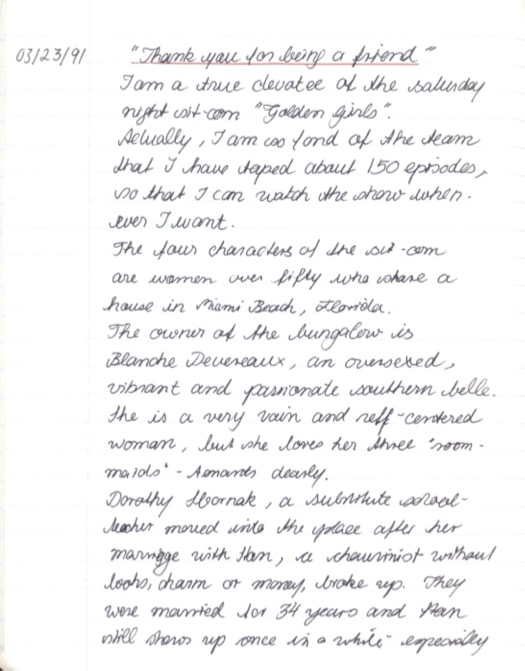
A page from my ENG 101 journal
I am used to talking to myself, unable to make myself understood about my distant past, which is another country not on anyone else’s map. Like Rose, though, I never quite stopped trying.
On 23 March in 1991, during my first semester of college at BMCC in downtown Manhattan, and toward the end of what would be the final season of The Golden Girls, I devoted an entry to the girls in my journal – an assignment for my English 101 class with Ms. Padol – insisting that those “four women [we]re not just knitting sweaters.” After all, there were “episodes on artificial insemination, gay marriage, racial problems, Alzheimers, homeless[ness] and death.” As I pointed out to my audience of one, “the show is liberal but does not come along too preaching or moralising.”
When you keep watching the show you come to know the characters[,] learn a lot about their relationship. And even though the four leading ladies are slightly off-beat you can get a lot out of the show; you can often relate to some of their various problems.
There is life and sex after 50. Some youngsters seem to forget that and some old people find it hard to compete or fight for their rights in the fast-paced world of today
As a queer young man growing up at the height of the AIDS crisis in the West, I certainly could relate to Rose and her agony of waiting for the result of an HIV test. I found comfort in the fiction that they had made it past the age of forty and envied the close and safe commune of the Girls. When I taught an English literature class on friendship back in the late 1990s, I played the theme song that had inspired the theme of my class.
Now that I am over fifty (Rose was 55 in the first season of the show, even though White was already in her sixties then), I think of The Golden Girls as a cultural product that made it easier for me to transition from silver to gold. And while I did not pick up many medals along the way, I did it all without access to the professional services of Mr. Ingrid of St. Olaf and his moose. Rose never divulged which part of the moose he used. “But,” she declared, “it’ll keep your hair in place in winds up to 130 miles an hour.”
I could always count on Betty White to see me through a storm.





 Harry Heuser