
 Well, that didn’t last long, did it? The wireless connection in our hotel room in Budapest, I mean. It pretty much collapsed after about 48 hours, even though we had paid a small bundle to be online for the week. Not that I find it easy to keep this journal, to keep up with the out-of-date while being out and about on my travels. Our days were filled with taking in the sights; our evenings (and bellies) with goulash, goose liver, and Hungarian wines—from which culinary excesses arose the most curious and vivid dreams. I was paying my respects at the bedside of the by me previously pooh-poohed Zsa Zsa Gabor, shared a moldy piece of decades-old cake with Madonna, who told me my gray roots needed a fresh coating of dye, and was set to teach “My Fair Lady” (whatever that might entail) at a soberingly conservative village school. Those subconscious night flights of fancy were not nearly as strange, though, as the experience of going to the Budapest Opera House to see Gone With the Wind transformed into a Hungarian ballet.
“I bet you, if it was handled right, that picture would make a great book.” That is what the aforementioned Fibber McGee told his wife Molly after watching the premiere of Gone With the Wind at their local theater in early 1940. And there I was, 67 years later, hundreds of miles from my local theater, asking myself whether it could make a great ballet. I had never considered the question; but when we walked into the magnificent Operaház to find out what was playing, we could not resist snatching up what might have been the last as well as the best tickets to the pop-cultural and historical confrontation that was the world premier of Elfújta a Szél.
In her introduction to the piece, US ambassador April H. Foley made a somewhat desperate effort to stress the connections between Gone With the Wind and Hungarian culture, reminding readers of the playbill that the novel was awarded a prize named after Hungarian-born newspaper mogul Joseph Pulitzer; that the production of the movie had involved Hungarian-born director George Cukor; and that it starred a leading lady once “under contract to Hungarian filmmaker Alexander Korda.” Such connecting-the-dottiness rather reminds me of the treatment I am giving American radio drama, which I am wont to work into just about any conversation; especially into this one, given that a scene from Margaret Mitchell’s 1936 bestseller had been dramatized for radio more than three years before it hit the big screen in December 1939.
But, back to the ballet. The last time I exposed myself to the spectacle of cinema gone tiptoeing, my response was less than rapturous. Matthew Bourne’s Edward Scissorhands seemed to rely overmuch on fanciful costumes and fantastic sets than on the footwork that had made Bourne’s earlier Swan Lake such breathtaking theater. Choreographed by Lilla Pártay (to the music of Anton Dvorak, whose “New World” was not the bygone one romanticized by Gone), Elfújta was decidedly more traditional in its approach to ballet, even though its retelling of the contrived melodrama that is Gone often felt like a danced synopsis—a series of tiptoe tableaux. However charming or thrilling the moves, it was the tiptoeing around American history that had me wriggling in my seat.
Commenting on Gone’s depiction of the American Civil War, Foley remarked that the “attitudes toward slavery and stereotypes of African Americans are consistent with the historical era” and that “[a]lthough we certainly do not share these views today, we appreciate Gone With the Wind for what it is: an icon of American historical fiction that is still enjoyed by millions the world over.” Now, aside from feeling that Scarlett’s struggles are so much less interesting than the period in which they are set, I was disconcerted to see that there was next to nothing “historical” about Elfújta, that its love story might as well have taken place on the banks of the Danube—had it not been for those three white actors grinning and swaying in unconvincing dark makeup that was nearly as cartoonish as blackface.
I am not sure in which way Elfújta could “enrich an already close and thriving bilateral relationship” between Hungary and America, other than celebrating a mutual dumbing down of the social sciences. Having long been oppressed and subjected to foreign terrors under the communist regime, Hungarians might be better equipped to identify with the suppressed stories of the slaves than with tales involving Scarlett, Melanie, and Rhett. Now, I don’t know what the role of ballet should or could be in today’s culture; but, for all its splendor, the frivolous Elfújta struck me as an ambassadorial misstep.

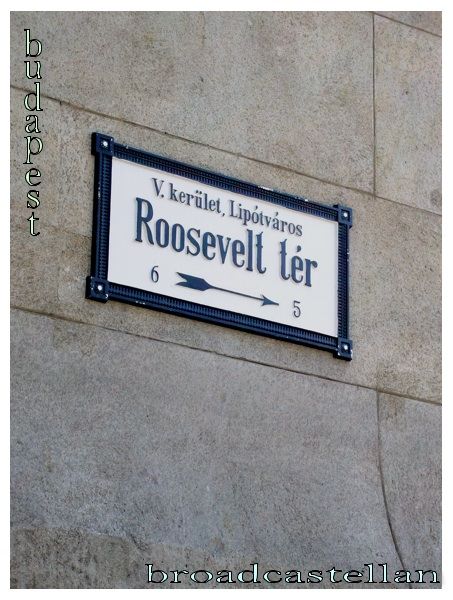
 Well, this is it. My last entry into the broadcastellan journal before I’m off to Budapest, from which spot I hope to be reporting back on 12 April with a snapshot of Roosevelt Square, in commemoration of FDR’s death in 1945. Supposedly, our hotel room has wireless access; so I might not have to share my impressions retrospectively (as I have done on almost every previous occasion, after trips to London and Madrid, Istanbul and Scotland, Cornwall and New York City). This time, perhaps, I won’t have to catch up with myself as well as our pop cultural past.
 I’ve been told to stay away from district eight; but I don’t suppose I’ll return home with impressions so graphic or lurid as to feel compelled to pen a thriller titled Murder in Budapest. BBC radio producer Val Gielgud did just that, back in 1937, after his return from the Hungarian capital. Val, brother of famed thespian Sir John Gielgud, was in town in the early fall of 1936 to accompany his colleague and friend Eric Maschwitz (both pictured above, on location) to “give a broadcasting impression of night-life in the Hungarian capital.”

 Okay, so, I tend to overdramatize. I can’t help it. I was born with a hyperbole on my lips. Turns out, I am still a man of the world wide web, despite the scheduled (and currently ongoing) landline repairs I lamented previously. At least, the prospect of not having access to the internet motivated us to realize some last-minute holiday plans by booking a trip to . . . Budapest. However eager I might be to share my experience, the challenge, as always, is not to drift too far from the format and subject of this journal and yet to make it reflect my everyday life, whether I am spending An Evening with Queen Victoria (as I will be on 22 April) or going back to my old neighborhood in New York City (on 14 May). Still, it is going to be (almost) all about Budapest from now until my royal visit.

 It is the fuel that keeps the search engines humming. It is fodder for loudmouthed if often unintelligible webjournalists thriving on the divisive. It is the foundation of many a rashly erected platform by means of which the invisible make a display of themselves. The so-called war on terror, I mean, and the time, the shape, and the lives it is taking in Iraq. My position becomes sufficiently clear in those words, as tenuous as it sometimes seems to myself. Experiencing the uncertainty, the turmoil and sorrow that was New York City during the days following the destruction of the World Trade Center, I was anxious to see prevented what then felt like an out and out war against the democratic West; but as a descendant of Nazi sympathizers who is convinced that putting an end to thralldom is a noble cause and conflicted about the use of military force to achieve this end, I could only work myself up to a restrained fervor, which soon gave way to bewilderment, anger, and frustration.
 Harry Heuser