
 The afternoon couldn’t be any less gloomy. The sky is of a deep blue, the air is fresh, and—until the health hazard that is Tony Blair gets his death wish to turn the West of Britain into a nuclear powerhouse (as if the radioactive Irish Sea weren’t enough of a warning against atomic energy)—a plain and reliable sign that nature, or what remains of it, is still providing an atmosphere in which even those among the ostensibly superior animals may thrive who are least protective of its balance.
Long gone are the days when peril could be apprehended with the naked eye, the days before pesticides made our apples look appealing and generals fought wars with missiles to keep their hands clean. Those were the days when shields and fortresses were things of iron and stone, rather than metaphors for our lack of security. The Middle Ages, in short.
Yet even during those presumably darker days, the invisible was more terrifying than any clear sign of danger, which is how superstitions, sanctioned or otherwise, could capture and enthrall our imagination. The untraceable was always ominous, and clarity suspicious. After all, even if threats eventually manifest themselves, the absence of any such ocular proof of safety or danger is valid only for the moment of looking; it is no insurance against impending peril or against the human failings of sight and oversights.
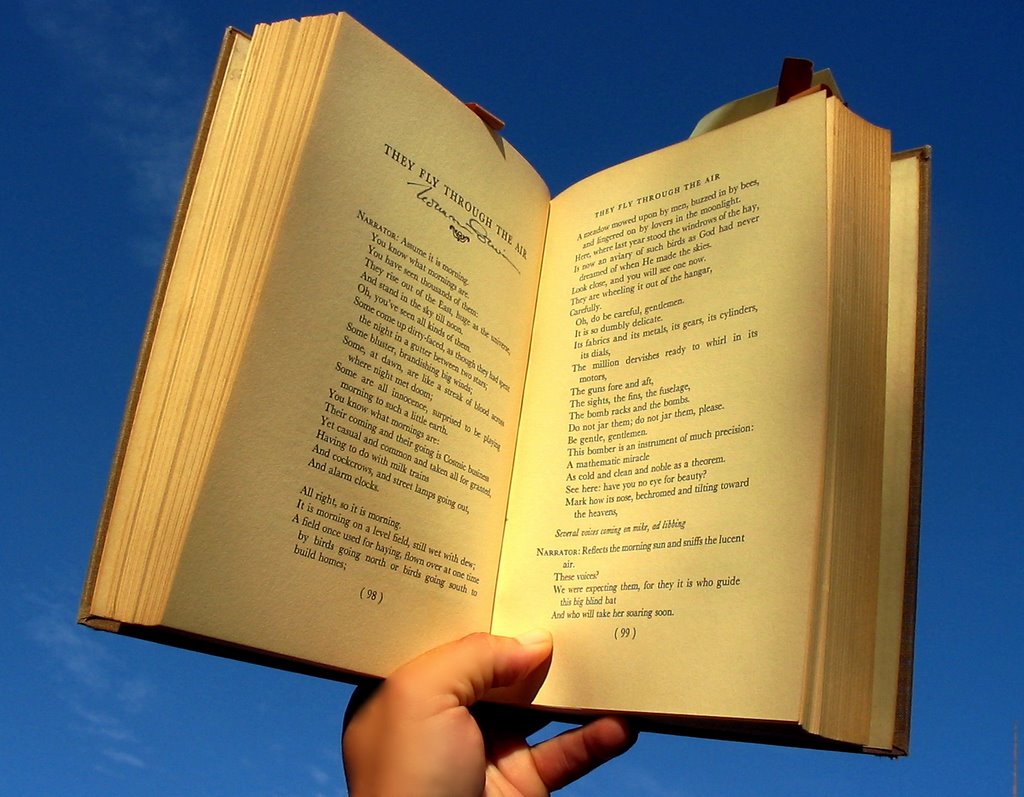
Every technological means of capturing danger and thereby defusing it gives rise to invisible counterterrors, to elusive weaponry, to secrecy and stealth. No artistic medium was more suited to tapping into those fears of the unseen than radio, the mass medium that, back in 1938, was capable of causing widespread terror by virtue of sound alone.
The man largely responsible for this terror attack—known as “The War of the Worlds”—was an ambitious 23-year-old whose voice was familiar to millions of American as that belonging to Lamont Cranston and his alter ego, The Shadow (introduced here). On this day, 11 July, in 1938, the theatrical Wunderkind took on another, rather more grand and prestigious radio project by mounting his Mercury Theater on the air.
Lurking underneath the cloak of artistic pretensions was the melodramatic excess that had made The Shadow such a radio triumph—the ghastly and lurid that generated chills more pleasant than any news from Europe, darkening in the shadow of fascism. The opening attraction of the now legendary Mercury Theater on the Air was an adaptation of Bram Stoker’s Dracula, which, during those days, was not yet the academically respectable narrative it today, despite Welles’s insistence that it could be found in “every representative library of classic English narratives.”
The Mercury‘s “Dracula” (recently podcast, with an excellent introduction by Jim Widner) is unabashed blood and thunder. And, despite its toning down of the novel’s overt sexuality and its counterbalancing installation of an intellectual woman like Mina Harker (played by Shadow sidekick Agnes Moorehead), this adaptation for radio is more in keeping with the original novel than any filmic adaptation. Tearing down the house with neo-Gothic hooey, Welles and fellow adaptor John Houseman retain some of the structure of Stoker’s novel, a story assembled from various manuscripts, gathered by those who join forces to make sure that Dracula is out for the count.
Like the novel, the radio adaptation emphasizes the use of modern technology (train and typewriter, telegram and phonograph) as weapons against an ancient curse, a past insisting on making its presence felt. It is a past so present that, ultimately, it can only be conquered by forces as old as itself: the solidarity of individuals rising against a despotic power and the reassuring solidity of a piece of wood driven through a heart of darkness.
The Mercury‘s “Dracula,” like its subsequent production of “The War of the Worlds” (discussed here), may be read as a comment on fascisms: the rallying of western democracy against the threat of a blood-sucking dictator to the east of them. It is a comforting romance, this triumph of unity—and of radio as a unifying force. Yet, as those under the influence of that instrument of are often unaware, the prominent figures casting shadows in our midst—more ingratiating and integrated than the lonesome Count—can be much more difficult to hold accountable, discount or counter.

 Mine is not an illustrious one. There are a few others who fared well enough with it; but none among them are my relations. It is uncommon enough to catch my eye or ear whenever it is mentioned, even though my own is frequently misspelled or mispronounced. My surname, I mean. As I shared a while ago
  My students never knew it, but I can be a right pushover when it comes to sentiment. I weep, publicly and almost unabashedly, at the sight of a Landseer painting like “His Only Friend.” I enjoy being manipulated that way and am pleased to find my senses receptive to the melodramatic, the dubious arts some denounce as kitsch and others approach only as camp. Nor do I mind being aware of being taken in—unless the trick doesn’t quite come off and I am left disappointed, unmoved, or get downright cross. Disappointed because I was promised a chance to exercise my passions in the relative safety of the controlled environment that is an aesthetic experience. Cold because the passions could not be provoked, despite appreciable effort; and hostile because my intellect rebukes me for having been put on hold for something clearly not worth the shutting down of reason.
 This is one of those lazybones, slow coach, watch-your-toe-nails-grow afternoons. A moment of ease and drowsy repose, a moment so slight as to be of no matter, so carefree as to be of no consequence. A now to outweigh any later, to balance any yesterdays on a scale of time perfectly still. It is an instant fit for nothing—which is just what I intend to do. Am I doing nothing? Are not my senses responsive to the rays of the sun, my skin receptive to the cooling breeze, and my ears alive to the slightest of sounds—sounds so soothing as to render highly unlikely the chance of this missive being shared before evening?
 Well, sir, it’s a few minutes or so past six o’clock in the evening as our scene opens now, and here in the garden of the small house halfway up in the Welsh hills we discover Dr. Harry Heuser setting the table for a barbecue dinner. Sorting the flatware, he still keeps an eye on Montague, his Jack Russell terrier. Meanwhile, the side dishes are being prepared in the kitchen and the telephone is ringing. Listen.
 I could tell things wouldn’t go my way today. The evidence was right there on the carpet, and next to it, with a wet cloth, was I, trying to ameliorate the situation. Jack Russell terrier Montague, who has been our companion for a week now, has finally made his mark. I guess I should be thankful that it was only exhibit number one, not number two. Then was the computer giving me grief by making it impossible for me to access my own homepage. Now, I am no fastidious Phileas Fogg; but such vagaries are the antithesis of an orderly, well-structured existence.
 Harry Heuser