On This Day in 1936: Silent Vamp Talks of Revamping

Well, it can be cruel. It can be tempting and frustrating. It may be doing something for you—but it can also be your undoing. And just when you think you’ve caught up with and mastered it, it dashes off and kicks the dust of your futile endeavours straight into your bloodshot eyes. Technology, I mean—the vamp that demands constant revamping. As a blogger and tyro podcaster, I am not sure whether I reproduce myself by means of technology or whether I am myself the product of technology. These perhaps overly binary reflections were brought on, at least, by an encounter with Elbot (whose wit, I learned today, is inspired in part by an episode of the old-time radio thriller anthology Quiet Please). Apparently, even a supposedly outmoded medium like radio can continue to be regenerative. A consummate tease, radio enjoys being turned on by receptive minds.

Rather counting on that garrulous generatrix was Theda Bara, cinema’s original vamp, who, on this day, 8 June, in 1936, was media savvy enough to grab a microphone and announced to the world (or some western region of it) that she was back in business. Oh, but how that business had changed since the queen of silent melodrama last tempted audiences, anno 1926.

In Hollywood, a ten-year hiatus is a one-way ticket to oblivion. And when your metier is quite dead, a comeback is just about out of the question. Bara was nonetheless asking for a return engagement. She could count on an audience of millions—the “public” she was in hopes of recapturing—when she stepped inside the Lux Radio Theatre for a chat with motion picture director W. S. Van Dyke. “Woody” Van Dyke admitted to having “admired” Bara “from afar when she was doing such magnificent spectacles as Cleopatra” and he was “just an extra.” Considering that Van Dyke had the voice of a gruff senior, that must have sounded a lifetime ago even then.

Reminiscing about that role, Bara talked of the challenges of silent moviemaking. Yes, Hollywood entertainment had “developed amazingly” since Cleopatra was released in 1917; but film is an actor’s medium, and dedicated performers like herself could do and did much to turn nickelodeon thrills into cinematic art. Preparing for that role, Bara claimed to have worked for months with a curator of Egyptology at the Metropolitan Museum in New York City. Now that silent movies were treated like the ancient history she once studied, it may have been too late to excavate her own career.

Her bold announcement that she was “going to do some motion picture work” was followed by a more tentative explanation: “I am considering an offer now, running through scripts and ideas. Oh, I just hope everyone will be as happy about another Theda Bara picture as I am. The public has been very good to me in the past.” The public—good, bad or indifferent—never heard her emote on the screen thereafter.

Ms. Bara, as you may hear in my next podcast, had a charming voice, quite capable of delivering lines of sophisticated comedy. She would have done well on the air, even as the lines in her face might have argued against her reappearance in sizeable movie roles. Perhaps, producers were not willing to see the vamp in any other way. When confronted by the narrow minds of big business, dazzling technology has the tendency to turn into a mute siren. She isn’t tamed, mind you. She is just not turned on by the calculating kind.
On This Day in 1955: After Twenty Years of Pushing Stars and Peddling Soap, a Hollywood Institution Closes Down

Well, I have no knack for it. Storytelling, that is. Not that I haven’t dabbled in fiction and drama—everything from attempting that great American novel (a Germanic variation, mind you) to co-authoring a college soap opera for public access television. I even wrote my memoirs, at age sixteen, and passed them around to my classmates so that they might have something sensational to read. Teenage angst notwithstanding, I was fairly certain that my story wasn’t finished; and I didn’t bother pretending it had a beginning I could recall, a middle I could make sense of, or an end I could foresee.

When it comes to connecting loose strands of thoughts to form something amounting to a composition, the essay is my yarn of choice. I guess I find it easier to write about or around something than getting around to writing something worth writing home about.

Making sense is as satisfying a creative activity as it is problematic. Just when you have put it all in a nutshell (granted, a cocoanut shell, given my prolixity), you should force yourself to go nuts and smash it all to pieces again. It is the only way to find out whether you have been rather too proud of the husk at the expense of ensuring the proper development of the kernel.

I doubt that I could take on the challenge of rendering the essence of someone else’s life, for instance. I would be too conscious of the act of imposing a structure, of connecting the dots and erasing others for the sake of providing a clear picture. After all, a dotted line with a beginning, middle, and end is an Aristotelian construction that, the blogging phenomenon notwithstanding, most of us still expect in a written composition. It is a dotted line on a contract between reader, writer, and subject I can’t bring myself to sign.

All this occurred to me again last night, when I watched the television premiere of Stan, a biographical drama about the friendship of comedy stars Stan Laurel and Oliver Hardy. In one hour, Stan creates a double portrait and sums up the relationship between its two sitters. Indeed, even the sitters are doubled—Stan and Ollie at the end of their lives looking back at the beginning and height of their career in film. I am looking forward to discussing the challenges of writing such a piece with its author, Neil Brand, who will be our houseguest next weekend. Perhaps, there’ll be an essay in that.

In the meantime, this is getting rather too long as an exposition to what I wanted to relate in the first place. Something about soap, and stars, and radio, the hook of which is the anniversary of the closing of a great Hollywood institution on this day, 7 June, in 1955. The institution in question was the Lux Radio Theatre, a highly popular program featuring adaptations from stage and screen as performed by practically all the great actors of the studio era.

Now, historical facts are not particularly interesting to me. You can always look those up, as I did this morning. To reproduce them is no great feat, unless you also question their veracity or ponder their significance. There is not enough storage space in my cranium to squander it on trivia. Besides, there’s a fine reference text on the subject by Connie Billips and Arthur Pierce, called Lux Presents Hollywood, which I frequently consult.

To me, the most fascinating aspect of the Lux program is its design, which is rather too intricate to be called a three-act drama interspersed with toilet soap commercials. The Lux Radio Theatre, which was my introduction to , is not so much a dramatic program as it is a theatrical one. Instead of attempting dramatic realism, it created the illusion of putting on a show. It celebrated its own composition, which brought together the diverging strands of promoting Hollywood and pushing soap, of packaging its familiar (if at times unrecognizable) stories with bits of backstage talk that gave listeners the impression of being theater insiders, of acting as creators and patrons of a show, rather than simply being its audience. After all, something more than sitting at home enjoying free entertainment was expected of them.

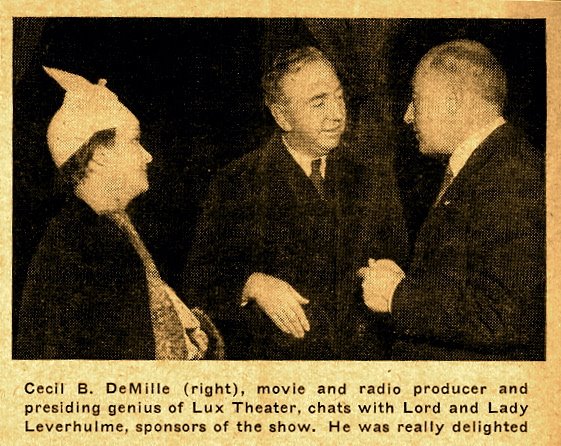
The masters of ceremony (most notably among them Cecil B. DeMille) reminded listeners that their loyalty to the sponsor’s product kept it going. The stars, who promoted themselves as well as the studios that employed them, came across as working citizens rather than distant idols. They, too, used that soap, or at least claimed as much when they delivered the sales talk. Sometime, as the host did not hesitate to point out to the home audience, they were even spotted in the crowd of the Music Box Theater, from where the broadcasts originated.

It all sounds like a friendly family business; in fact, DeMille was practically born into the job of hawking the wares of Lord and Lady Leverhulme (the show’s sponsors, pictured above), considering that, as he pointed out to the listener, the motto on his family crest was “Lux Tua Vita Mea.”

Now there’s a story of British industry and American showmanship, a success story not unlike the fortuitous if complicated Hollywood teaming of Englishman Stan Laurel with that big guy from Georgia. I won’t be telling it, though. I am too busy weaving the voices heard on the Lux into another podcast, this one featuring Marilyn Monroe’s 1947 broadcasting debut as an “intermission guest” on Lux—before the young starlet had even been cast in a single motion picture. Three-and-a-half decades later, such a commercial association did wonders for the career of Michelle Pfeiffer, who made a name for herself peddling the aforementioned soap in the early 1980s by creating the illusion that she already was a big name in Hollywood.

Our lives are compositions co-authored by a great many people, which is why some of us are so eager to assume control over this muddle of influences by turning it into our very own story. It’s the victory of the elaborate shell over the elusive kernel.

On This Day in 1938: New York Planetarium Sends Astrologer on an Interplanetary Mission of Peace

Selena Royle

Well, they should all be out tonight. The stars, I mean. One of the great joys of living in the country is seeing millions of them lighting up the sky. On a clear night, you can read by the light of the moon. I grew up in an industrial and smog-shrouded region of western Germany; and when I moved to brightly lit New York City, I got to see no more than a dozen of those distant suns, even on a cloudless night. As if to make up for that firmamental deficiency of our modern world, the Hayden Planetarium in Manhattan once offered Americans an opportunity to commune with the universe by taking a microphone to the heavenly bodies.

On this day, 6 June, in 1938, the planetarium was the site of a dramatic radio broadcast of The Planets, a verse play inspired by the Gustav Holst’s popular orchestral suite and written especially for the medium by New York City poet Alfred Kreymborg. Soundstaged in the planetarium’s Solar Room and broadcast over WEAF and affiliated NBC stations, The Planets was performed by seasoned New York stage actors with experience in radio theatricals, including Charles Webster, Burford Hampden, and Selena Royle (pictured above, all dressed up for an earlier radio play, The Finger of Darkness).

Unfortunately, no recordings of this impressive event seem to have survived; and, as much as I argued against such readings only yesterday, I am left with nothing but the publish script, some cues and an on-the-air-conditioned imagination, to gather how it might have sounded.

Kreymborg took to the airwaves because, as he put it, the “world we live in now is so closely knit that a sudden event touches all people, no matter how far removed from one another. Our local or personal spheres have become universal.” The impending war in Europe was such an “event” touching all—and radio was the medium to bring faraway crises into the living rooms of America. The allegory of The Planets, according to its author,

concerns the earth from the World War up to now [that is, 1938] and then tomorrow. An old astrologer, pointing his glass toward the heavens searching for peace somewhere, is the central figure. In the course of his starry adventure he encounters the planetary gods, roaming the earth as in Grecian times: Mars, Venus, Mercury, Jupiter, Saturn, Uranus, Neptune.

The gods represent the stages of world political events from 1931 to 1938, with Uranus, the father of magic, standing for the global crises of the years just prior to the Second World War. As the earth spins from one age of war to another, the astrologer attempts to dissuade soldiers from going into combat, but dies prophesying “[a]nother hell”

Far greater than the hells of yesteryear,
And greater than the hells of ancient time
When gods laid heaven low and men fought men.

The play, which one contemporary reviewer dismissed as a “diatribe against war,” proved prophetic in this regard; but its author was less of a visionary in his hopes that the theater of the mind might some day attract noted poets and mature into an art akin to the drama of ancient Greece.

“We have all been too impatient with radio in the past,” Kreymborg remarked, “and have based our judgment on the very worst things we could listen to.” Today, we base our judgment of old-time radio on the average thriller and sitcom, rather than on the occasional experiments that, however flawed, suggest what the aural arts might have been or may yet become.

Unless we are content to dig in the muck of culture or delve into the mire of war, it might be worth our while to keep reaching for the stars . . .

Have Script, Will Listen: "Death Across the Board"

After a May that had all the cheer of a pea-souper, summer is approaching at last. Great or small, the outdoors beckons. In light of this momentary brightening, it seems wrong somehow, or at any rate incongruous, to turn away from my scenic surroundings here in Wales to contemplate the largely generic fare that is popular culture. The challenge is always to make it matter; but sometimes it appears too much of an effort, a tiresome exercise in digging up what might have lain justly buried. Entirely worthy of excavation this weekend was A Cottage on Dartmoor, a gloomy love-gone-wrong melodrama that was shown by the BBC as part of a series of British silent films and documentaries on the subject.

A Cottage was filmed as the silent era drew to a close in the late 1920s. Like The Jazz Singer, it was conceived as a partial talkie, even though its soundtrack is no longer extant. Like the groundbreaking Al Jolson vehicle, A Cottage comments on the filmmaking tradition from which it departs even as it partakes of it; but unlike the former, it does not look forward to the dawn of the talkie with anything amounting to “You ain’t heard nothing yet” enthusiasm.

One scene of A Cottage is set in a movie theater transitioning from silents to sound pictures. The camera shows us an audience thrilling to the non-verbal slapstick of Harold Lloyd, presented with orchestral accompaniment. When the main feature, a talkie, is shown, the musicians abandon their instruments and turn to their sandwiches instead. The spectators are getting quiet as the people on the screen begin to talk; there is less interaction in the crowd as attention is being paid to the spoken word.

The once animated crowd becomes as static as the actors on the screen, huddling around their appointed microphones. An elderly woman with an ear trumpet struggles to follow the action, frequently turning to her less-than-pleased neighbor for voice-over narration and some instant dubbing. The talkies, Anthony Asquith’s stunningly photographed A Cottage on Dartmoor suggests, are threatening to fossilize the fluid medium of the moving image, rather than serving as its revitalizing force.

In this sense, talkies are to silent movies what television is to radio—a death warrant. Who, besides Charles Chaplin or Norman Corwin, managed to defy technology with any success or integrity? Yet whereas silent moviemaking had about a quarter of a century to develop into an art, radio’s golden age, which also lasted about a quarter of a century, was relatively short on artistic highlights. Broadcasting demanded such a mass of mass entertainment and imposed such massive restrictions on its creators that radio drama was on the verge of extinction before ever getting much of a chance to come into its own.

On the other hand, the crudity of radio drama is often being exaggerated, used as a justification for its demise. No movie critic would mistake a screenplay for the experience of the play unfolding on the screen; and even though radio drama depends more heavily on the spoken word than the visual storytelling medium of film, they do not—and should not—rely exclusively on words to convey moods, set scenes, or create dramatic tension. To reduce an aural art to the merely oral is nearly as misguided as looking upon silent films as a series of close-ups and title cards.

On this day, 5 June, in 1945, the thriller anthology Inner Sanctum Mysteries presented “Death Across the Board,” a drama of pursuit starring acclaimed stage and screen actor Raymond Massey as a madman who regards his fellow man as so many pawns on a chessboard. When the script, written by Robert Newman, appeared in a handbook for the instruction of writers in radio and television, it was accompanied by the following remarks:

The reader’s first impression, if he is a person of any taste at all, is one of surprise at the actual crudeness of much of the writing, and the seeming clumsiness of construction.  Furthermore, everything seems preposterously convenient for the writer, doesn’t it? He whirls from one improbability to another in a way that would earn any student the censure of his teacher—and quite properly—were he to do the same thing in any other form of writing.

Radio plays, however, are quite apart from “any other form of writing.” They are best appreciated—and most satisfying—when their limitations are understood to be creative opportunities rather than shortcomings. Like silent movie melodramas, radio thrillers are more than mere precursors to an ostensibly superior form of entertainment. And to give them a chance to work upon our imagination, it helps to listen to the medium for which they are created.

Old-time Radio Primer: E Stands for Escape

We are all in pursuit of it, at least for as long as we can get away with getting away from it all. Escape, I mean. It is the art of not facing facts—or whatever we call the limitations we are conditioned to regard as reality. In its figurative sense, “escape” is synonymous with the quest for pleasure, guilty or otherwise. A vast industry is devoted to the manufacture of ready retreats. Catering to our desire for vicarious thrills, sly entrepreneurs are making us pay for the investments in our future we cannot bring ourselves to make.
Before television ran away with our imagination, radio was the medium most often relied upon as a gateway to worlds beyond our own. “Escape” being such a prominent aspect of radio culture, it is just the word to follow “Drama” in our radio primer, today’s entry into which opens with an ode to the dial remedial:

The stove ran out of fire,
You’re out of dimes to scrape.
The companies won’t hire,
It’s taxes and red tape. 

Of politics you tire,
though journalists go ape.
Why wallow in the mire
Squeeze wrath from your last grape? 

No need for Brokenshire
To say we’re in bad shape.
What you want from the wire-
less—Flash!—It’s more escape.

Sure, the enterprise of creating diversions has had its share of detractors. So-called “escapism”—the programmatic avoidance of the problematic—has often been denounced as a rather dirty and shameful business. A racket akin to operating a beach resort for ostriches, it encourages a head-in-sand approach to life’s challenges, an attitude that is looked down upon as not merely foolish but as socially and morally irresponsible.

During the Second World War, producers of radio entertainment were expected to temper their leisure time offers with timely reminders of the tasks at hand: there was a war on, which meant scaling down consumption, serving the community, and staring the consequences of caving in or giving up straight in the lazy eye.

Any kind of escapist fare can be peddled as essential by being labelled “uplifting” or “morale-boosting”; but no radio program could entirely escape doing propaganda duty as outlined by the governmental Office of War Information. In the summer of 1945, the years of civic service and moderation came to an end at last.

Bold and brash, network radio of the mid- to late-1940s—roughly the interlude between V-J Day and the Korean War—cashed in on the spirit of post-war consumerism. As one of the popular novels of the day, Frederic Wakeman’s The Hucksters, drove home, it was a time of profits and promotion. If Americans needed a break, it might as well be a commercial one.

Broadcasters turned the pursuit of happiness into opportunities to get something for nothing on newly developed giveaway programs and into occasions for fast getaways on a growing number of thriller and adventure series.

The creators of Escape (1947-54) even supplied specific reasons for tuning out the everyday. Its melodramas were prefaced by an announcer’s inquiry whether tuners-in were “Fed up with the housing shortage” or “Worried about the United Nations,” references to a troubling reality that were followed by a straightforward “Want to get away from it all?” and a hard-to-resist proposal: “We offer you . . . Escape!”

On this day, 2 June, in 1950, Escape presented a play that suggested the dangers of mass hypnotism, the very mind-numbing of which radio itself was being accused. In “Mars Is Heaven,” adapted from a story by Ray Bradbury, falling for the pleasant and failing to question those who promise it, getting away from earthly cares and going out of one’s way to find contentment elsewhere, rather than making an effort to strive for it at home, are elusive and delusional actions demonstrated to have disastrous consequences.

In the search for routes of escape, the most neglected one is the way leading away from such impulses. Escape, after all, is valued by what we get out of it, which amounts to nothing if we can’t get out of it at all.

Many Happy Reruns: Marilyn Monroe at Eighty

I have been accused, at times, of exaggerating matters; but this just about proves it: radio, as a storytelling medium, is dead. I’ve conducted searches on Google and Technorati this morning, using the keywords Gelbart and Abrogate. The result: only 28 mentions in well over 40 million blogs! And no more than 444 via Google, the first entry of which refers searchers to broadcastellan. Considering that thousands of web journals are devoted to American politics and thousands more to the media in general, the lack of publicity a broadcast satire about the Bush administration has been receiving is remarkable.

I am referring, of course, to M*A*S*H creator Larry Gelbart’s “Abrogate,” a recording of which is still available on the BBC homepage. Had Barbara Bush been levitating on television (as she is in Gelbart’s utopia), had her son been denounced as the spawn of Satan (as he is in the fictive senate hearing of “Abrogate”), had Condoleezza Rice, Lynn Cheney and Ms. Bush been likened to the three hags in Macbeth (an image suggested by the radio play), there sure would have been some noise about it.

Radio used to popularize products and people, plays and personalities; now it appears to be the black hole of the multi-media universe. A few weeks ago, I recalled how Marilyn Monroe was being sent on the air to promote her studio, Fox, which had so little use for the young contract player during the late 1940s. She got flustered and faltered, delivering her few lines with less than confidence.

Her radio debut on 24 February 1947 (previously discussed here) was less than auspicious. The play presented that night on the Lux Radio Theatre was an adaptation of the costume drama Kitty. Marilyn was not in it, but was heard instead during a commercial break, peddling soap and plugging the latest film of Betty Grable, her future co-star. She had just been subjected to her first Technicolor screen test, but would remain limited to walk-ons in lesser black and white fare for years to come.

Such rare broadcasts reveal something about the personality of a performer that can be obscured on the screen. On live radio, unlike in the movies, there were no second (or twenty-second) takes. There was the microphone, demanding and daunting. There was the crowd of spectators, gawking at the performers in the studio. And there was Monroe, a nervous young woman, not yet twenty-one, clutching the script she had been instructed to read.

Monroe would have become an octogenarian today; not a pretty picture, perhaps—at least to those who see the aging process as a series of cumulative imperfections. How would the girl formerly known as Norma Jean have matured as a performer? Were she alive and among us now, would she be appearing in television dramas? Would she be discussing her latest autobiography with Larry King? Or would she be hiding from prying eyes, living in seclusion and hoping instead to be recalled as young as she was when Fox finally revealed her charms in Technicolor and Cinemascope? Given Western culture’s obsession with youth, she might now be embracing the microphone she once feared.

Recalling her not as she was or was made out to be, but calling her forth as she is to me, I am going to close my eyes now and listen to Marilyn as she returned to radio on 13 December 1952, with somewhat more assurance and considerably more box-office draw. By then she was being romanced by Charlie McCarthy, the first voice thrown into a ring littered with neglected hats.

Going on the air with Edgar Bergen’s wooden friend was risky business, considering what that chip of a chap had done to the broadcasting career of Mae West (as reported here). Not satisfied with fantasizing about her, Charlie was determined to woe and wed her, taking her home on behalf of us. Theirs was a short-lived engagement. Mine is a lasting passion . . .

Silents, Please!; or, How to Prepare for the World Cup Doldrums

Well, it is supposed to be busting out all over tomorrow. June, that is—the month during which television entertainment goes bust. In the US, at least, a generally enforced leave-taking from your favorites is a programming pattern that predates television. Looking through my radio files, I came across an article in the June 1932 issue of The Forum, discussing what Americans could expect to find “On the Summer Air.” It is an interesting piece, especially since it serves as a reminder that, during the early years of broadcasting, the summer hiatus was a response to technical difficulties. The shutting down of broadcast studios, like the closing of Broadway theaters, was directly related to the rising mercury, to the heat that made the asphalt buckle and urbanites escape to their vernal retreats.

“Formerly,” the reviewer remarks,

June marked the beginning of the radio doldrums, an enjoyable period lasting through three splendidly quiet months. Hot weather static raised so much hell with radio transmission that many sponsors permitted their public to amuse itself until September. But no longer! This year modern superheterodyne radio sets, the new pentode tubes, and more powerful, efficient transmitting equipment will help to put the Indian sign on summer static.

Did such technological advances improve matters for the home audience? Did static give way to ecstasy?

The gentleman from the Forum suggested that programmers made ample use of the re-conditioned air, but did not quite live up to the medium’s potential. There was Broadway legend Florenz Ziegfeld, for instance, who promised to widen the Great White Way with his Ziegfeld Follies on the Air. He also promised to present listeners with the lovely Lupe Velez. “We need television for a program like this,” the frustrated reviewer commented, and Ms. Velez was “the victim” of such a visual approach to sound-only broadcasting. “The microphone has yet to be built which will bring gestures and wriggles, no matter how seductive and amusing, to your front room.” The home audience was not likely to join in the applause with which the performers were greeted in the studio.

Even in its heyday, some two decades before television finally took off as a mass medium, radio was being compared to the supposedly superior medium that offered images and noise. Television, of course, is no less superior to radio than talkies are to silent films. The creators of art are called upon to explore the limitations and strength of the medium in which they work; but commercial radio rarely received such respect for the arts. In fact, the producers of broadcast entertainment often counted on its alleged defects.

Radio could be tantalizing by virtue of its inability to show, by hinting at rather than revealing. It could be tame or racy, largely depending on the imagination of the listener. Such teasing could be exploited, employed to draw listeners out of their homes and into the theaters, the lack of visuals reminding them that what they heard was a mere substitute, rather than the real thing. It was a concept ideal for advertisers, but at times frustrating to those who were hoping for free home entertainment.

Flicking through the Radio Times, anno June 2006, I was pleased to discover that television, though no longer free, occasionally offers programming that fits the medium as well as the moment: silent movies, the storytelling that is most purely vision. There will be quite a few silent nights in the next few weeks, UK television going eloquently speechless with moving pictures such as Chaplin’s The Immigrant, British classics like A Cottage on Dartmoor, Hindle Wakes, and Piccadilly, as well as Lubitsch’s Eternal Love, starring John Barrymore and Camilla Horn (which is shown on the digital channel artsworld). These small-screenings coincide with a series paying tribute to cinema’s Silent Clowns (Keaton, Laurel and Hardy, Chaplin, and Lloyd), as well as the biographical drama Stan (as in Stan Laurel), by the aforementioned writer/composer and silent film aficionado Neil Brand.

It is the calm before the storm, the madness that is World Cup soccer. If only the BBC offered an hour of silence for every shout of “Gooooooal.”

In Search of Sounds; or, How I Wound Up Podcasting

Well, I was about to head out for The Island. Athol Fugard’s Island, that is, the Johannesburg Market Theatre production of which is currently on tour in England and Wales. Apparently, the company got lost on its way through the wilds of Wales and is, as I just learned, a no show for tonight. A second attempt at staging the play has been scheduled for 12 June, giving the navigationally challenged troupe from South Africa ample time to check their compass.

I was introduced to Fugard’s prisoners on Robben Island as a graduate student in the mid-1990s, a time during which I was happily drowning myself in a sea of sound. I had just discovered the thrills of old-time radio, tuning in to Max Schmid’s “Golden Age,” still broadcast weekly over WBAI, New York (and archived here). For someone who grew up watching dubbed Hollywood movies, hearing my favorite actors of the 1930s and ’40s emote in their own voices—and by way of their voice boxes alone—was as much of a revelation to me than it must have been to those twisting the dial back then to catch shows like Hollywood Hotel or the Lux Radio Theater.

The experience of listening in was more immediate, more intimate than watching someone act on the big or small screen. On radio, actors are not idols. They are too close and familiar to be worshiped. They are, after all, right there with you in your living room or under the covers, if only you close your eyes to imagine them there. The Hollywood a-listers appearing on the Lux program did not appeal to listener by being unreachable; Stanwyck, Dietrich, Grant or Gable were one in a million, all right, but they were decidedly among and part of rather than apart from those millions tuning in. And whereas images are generally dated (an actor’s hair, make-up, or apparel telling time, especially in comparison with other images), radio voices (unless the sound is particularly low-fi) waft right into your presence and become now, even on recordings.

Soon after getting “the wondering ear” (as I expressed it previously), I began to conduct Frankensteinean experiments in resurrections through electricity. Listening in itself was not unlike a séance, as voices from the past came alive at my bidding, just as, many years earlier, I had preserved on tape the sounds of my everyday, my friends and family members in a series of audio diaries. So, I am beginning my experiments in podcasting with such a sonic revivification, by calling forth the legendary Tallulah Bankhead.

As I explain it at the beginning of the introductory podcastellan episode, I have been “in search of sounds” ever since I got my first radio. Tuning in, I was eavesdropping on a hidden realm the passage to which was the canal of an eager ear pressed close against the speaker. It was my keyhole to the world about which I knew yet little, a world to which I did not yet belong.

Magnetic tape has given way at last to podcast technology; and however high tech today, podcastellan is the continuation of a project begun in childhood—the enjoyment of close encounters with those presumably distant or gone. Indeed, playing around with historic records may strike some aficionados of old-time radio as an act amounting to sacrilege; to be sure, it is an entirely unacademic venture, a reckless sampling, an appropriation of and engagement with sound, which I have the nerve to make a regular feature of podcastellan.

What’s more, my calling forth of Ms. Bankhead seems to have brought about unexpected results: above image, a 1932 newspaper clipping which fluttered into our home only yesterday. Having stuck (as mere padding) behind a framed work of art for nearly seventy-five years, it reemerged promptly after I had sent my podcast tribute to Tallulah out into the world. Welcome back, Dahlink, in all your Craven Abandon!

The Immaculate Misconception of George W. Bush, Ex-President

Well, this is a day to remember the fallen. Perhaps that includes those fallen from grace; and according to M*A*S*H creator Larry Gelbart, the fallen one to be recalled this Memorial Day is none other than George W. Bush, Ex-President. I am referring to Gelbart’s radio play Abrogate, which aired on BBC Radio 4 on Friday, 26 May. Memorial Day roughly coincides with Ascension, which the British insist on celebrating as “Spring Bank Holiday.” I rather resent this government-imposed erasure of traditions, as if the “holi” of this “holiday” were the culture of saving and spending, and the miracle to behold and recall were the power of Mammon.

The holiday-by-any-other-name broadcast of Gelbart’s play is well-timed, considering that the futuristic satire Abrogate not only serves as a memorial to the Bush and Cheney years—which it imagines to have given way to a Hillary Clinton administration—but also serves up a miracle, revealing, in an act of levi(tationali)ty, that Baby W. was the product of Barbara Bush’s immaculate conception, his rise to office being decreed from above. Ascension meets condescension in what is itself a high-spirited, irreverent, but less than immaculate confection.

Abrogate is conceived as a broadcast by the fictional AGN (the All Gates Network), “devoted to the endless scandals and excesses which White House after White House also seem so endlessly devoted to.” Carrying on the tradition of truth-finding lowered to the level of scandalmongering, AGN presents

highlights of the recent hearings held by the Special Senate Committee that was charged by the present administration with the investigation of the extent to which the former administration was engaged in a campaign of secrecy and deception, as well as a thorough disdain for the law, the result of which was tantamount to a virtual second American Revolution that threatened to undo the first, a nullification no less of over two hundred years of this nation’s civil and social progress, as well as the alarming arbitrary banishment of recognizable order or, as it has come to be known throughout and within the media, Abrogate.

Or, as the Committee Chair puts it “at the onslaught” of the hearing, to answer the “sixty- four trillion dollar question”: “Did the powers that then were, the previous Bush administration, pursue with both malice and perhaps some aforethought certain actions which served to violate the letters and spirit of the laws of this land in a way never here before thought possible? And do the sum of these reactionary actions equal a total that smacks of a conspiracy [. . .]?” In other words, “What did the President know, aside from what the Vice President told him he already did?”

From Senator Fulsome (played by Vincent Spano), for instance, you will learn about the Secretive Service, the Center for Shame and Public Apology, and Bush’s POOP (Photo-op Operations Program). “[I]t has become more and less common knowledge that anyone who was everyone was a spy in those days,” Fulsome declares, excusing the administration’s errors in judgment by arguing that “Terrible times create terrible thinking.” Among those called to the microphone during the hearing are Condoleezza Rice (played by Theresa Randle), Lynn Cheney (Joanne Baron), and Barbara Bush (Pat Carroll), whose motherly defense of her heavenly-fathered child provides the outrageous climax of Abrogate.

It all may have sounded rather more radiogenic as it turned out: a series of voices denouncing and defending the present-turned-former president and his actions, criminal or otherwise. As a radio production, Abrogate does not quite come off, however. It is too verbose, for one, squandering many of its inspired oneliners (while drowning out some less than subtle puns). My prose, for instance, barely suited to a blog, would have no chance on the air. On the air, lines need to be snappy, delivered slowly and forcefully enough in well-timed intervals to be absorbed in a single sitting.

Nor does Abrogate succeed in sounding verisimilitudinous, in coming across like a real newscast, an actual Senate committee hearing, which is the setting of this satire. What exactly is being sent up here, other than the heavens-bound Ms. Bush? Is Abrogate deriding the former President, his family and staff; the subsequent (and presumably Democrat White House) that indulges in this fault-finding mission; or the media, for leaping at every opportunity to undermine the authority of a much-maligned administration? And while it is true that the speakers implicated themselves in their ineptitude, the dizzy spin of Gelbart’s fictive broadcast seems to be taking too many turns, ridiculing the medium of which it avails itself and thereby negating the valid (op)positions to which it gives voice.

Such shortcomings notwithstanding, Abrogate is worth a listen, especially since attempts at contemporary radio drama, let alone timely politically relevant plays, are so rare these days. For inconsequential folly, you can always tune in to my podcast, a new feature of broadcastellan about which I will have more to say in the near future.

Old-time Radio Primer: D Stands for Drama

Most of us can do without it. In our everyday lives, at least, where it strikes us as exasperating, discomfiting and generally inopportune. “Drama,” I mean, which follows “Crooner” in this, my Norman Corwin inspired “Radio Primer.” If encountered outside the theater and within the bounds we think of as our reality—a dichotomy well worth questioning—drama may be defined as any of those interludes during which other people insist on making a scene and drawing us into the action. We’d much rather leave those moments of emotional turmoil to the professionals, who get paid and applauded for enacting them.

There is plenty of drama going on elsewhere, I am pleased to report. After Wednesday night’s great evening of spectacle, taking in Gormenghast, I am looking forward now to Athol Fugard’s The Island, which is being staged at the same local venue next Tuesday. And only yesterday we got our hands on tickets to see Kevin Spacey at London’s Old Vic in A Moon for the Misbegotten by Eugene O’Neill (whose Ah, Wilderness! I discussed only a few days ago). Now, that Moon won’t rise until the fall. For more immediate drama, for private screenings and stages set under my direction, I’ve got the radio. So, what can those listening to old-time radio drama expect? Let me put it to you in the obligatory “Primer” rhyme:

Epics in a digest,
And jokes for the New Deal,
Thrills to fill the war chest,
And ample time for spiel. 

Interludes commercial,
And bowdlerized O’Neill,
And nothing controversial,
Since that makes sponsors reel. 

Broadway for the homebound,
And hoaxes sounding real,
And living rooms turned fairground—
That’s radio’s appeal.

This, at least, is why old-time radio appeals to me. Of course, radio drama is still being produced; and however marginalized in the US, it enjoys ongoing popularity in the UK and elsewhere. For those who can’t be bothered to plan ahead for a trip to the Moon, for those who want their future here and now, radio continues to offer cheap flights of fancy. At this moment—or whenever it is convenient for you to listen in—BBC Radio 4 presents M*A*S*H creator Larry Gelbart’s Abrogate, a radio play that imagines a post-Bush era in which Hillary Clinton takes over as US President and a Congressional committee is set up to investigate just what went wrong during the previous administration (a recording of which is available online for about a week).

Now, I don’t suppose anyone tuning in would confuse Abrogate with anything resembling reality, even though I have had my own War of the Worlds experience not too long ago, taking fiction for fact. As I was reminded last night, watching Barbara Stanwyck in Frank Capra’s The Miracle Woman (1931)—the story of a media-savvy evangelist avenging her father’s death by duping the public—radio was a medium to challenge these boundaries. It could make listeners believe by creating an alternate reality that, rather than being set aside for public display, seeped right into the ear canal and had the verisimilitude of daydreams and night terrors.

Having to leave our private sphere to see a performance, on stage or screen, assists in keeping drama separate from so-called real life, as does the opening and shutting of a book, which turns what we experience in fiction into a world apart. Beginning in the 1920s, the airwaves did away with the being away or setting apart; from the first live broadcast of a stage play (The Wolf, heard on 3 August 1922), the radio brought drama home; and throughout the 1930s and ’40s it did so daily, serially, and at times all too convincingly.

There were debates about the psychological effect of radio melodrama on women and children, the adult male apparently being deemed too levelheaded (or thick-headed, perhaps) to be thus influenced. Thrillers in particular—those “bloodcurdling broadcasts” that daily “gurgle[d] through the loudspeaker”—came under attack for threatening to “breed a race of neurotic impressionables” by virtue of radio’s “power to play on the ear with horror effects,” while so-called “washboard weepers”—or soap operas—had the youngsters’ elders in fits of pity and despair.

The creators of radio theater sure knew how to make a scene, the mind being a ready supplier of props and probabilities. Will such dramatics convince me tonight that Hillary Clinton got (or might get) into the White House? We shall hear . . .