On This Day in 1944: Montgomery Clift Gets Lost in Radio’s “Wilderness”

Before heading out on this appropriately wild and gloomy evening to see a touring production of Gormenghast at our local theater, I am going to listen to one the lesser known drama programs of American old-time radio: Arthur Hopkins Presents (1944-45), which took its name from the noted Broadway producer-director who hosted the series. On this day, 24 May, in 1944, Mr. Hopkins presented an adaptation of Eugene O’Neill’s popular comedy Ah, Wilderness! starring Broadway legend Dudley Digges and featuring a young if experienced stage actor who would become one of the most sought-after actors of 1950s Hollywood—Montgomery Clift.

In the spring of 1944, Arthur Hopkins took to the airwaves in hopes of introducing to radio a “people’s theatre and a repertory theatre.” Hopkins held that radio offered a temporary “solution to the unavoidable extravagance of the commercial theater in shelving a play when the immediate audience has been served,” and to the “economic encumbrances” that made repertory “impractical” in a Broadway venue. By reprocessing recent stage successes, Hopkins sought to “create adult theatre audiences for them and eventually for Broadway.”

The series premiered promisingly that April with Thornton Wilder’s Our Town, whose use of a narrator makes it one of the most radiogenic of stage dramas. Subsequent plays were not nearly as ideally suited to the airwaves; at least, they were not suited to the demands of the one-dimensional (that is, sound only) medium. Hopkins was vehemently opposed to making changes to the original scripts. He insisted that the “two pillars on which dramatic productions stand are identical in theater and radio. They are text and cast.”

Rejecting the addition of a narrator and keeping both music and sound effects to a minimum, Hopkins deemed the challenge of adaptation to be no more than a matter of sagacious cutting. As a result of such ill-advised fidelity, “Ah, Wilderness!” begins in medias res and ends in somewhat of a muddle. 

The mind receiving no assistance in setting the scene—help provided by a guiding narrator like the one installed in Arthur Arent’s Theater Guild version of the same play—what is left of O’Neill’s nostalgic recreation of small town Connecticut in the year 1906 is a Babel of voices, a sonic jungle that at times suggests a forest of microphones behind which performers, whose scripts you can hear rustling, rush to and fro in a frantic attempt to recite as much of the original text as possible within the allotted fifty-five minutes.

For all their shortcomings, such transcribed theatricals are living records of a tradition we can otherwise only glimpse at in a couple of still photographs. Digges (as Nat Miller) and Clift (as his young son Dick) turn in fine performances, Clift being most convincing in the scene at the notorious Pleasant Beach House, where he is easy prey for one of the “swift” dames who prefer cash over matrimony.

The young man, we readily believe, doesn’t understand what is going on; nor is he corrupted by it. His father is pleased to forgive a son who has been naïve rather than wayward. “I don’t believe in kissing between fathers and sons after a certain age,” Nat remarks, having just received such a token of filial love; “seems mushy and silly—but that meant something.” To Nat, it meant that his son was “safe—from himself.” In Cliff’s case, it might have meant something else altogether.

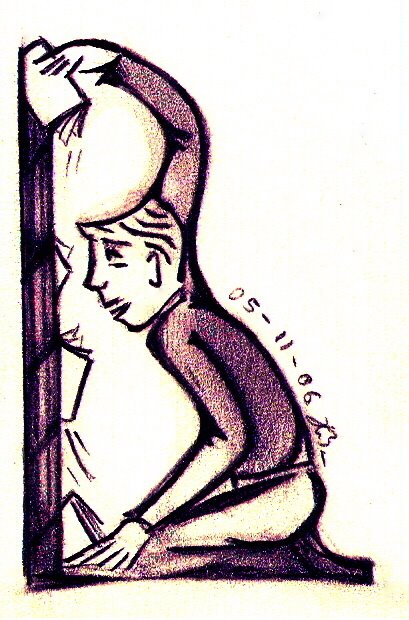
Surprisingly, the man responsible for this Arthur Hopkins adaptation was none other than Wyllis Cooper (pictured above), whose thriller programs were the finest and most literary ever to be soundstaged for American radio. Now, there was a man who’d done well bringing a Gothic nightmare like Gormenghast to the public’s ear. I wonder how the visualization of Mervyn Peake’s 1950 novel will succeed tonight. But more about that tomorrow . . .

On This Day in 1944: A Travelogue Introduces Americans to Tel Aviv

Well, it seems that the power lines are beginning to rot. The electric lights went out just after the sun had set, a sun, mind you, that had been hidden for days behind a wind-blown, tattered curtain of clouds. I was rather relieved to find my none-too-successful experimentations in podcasting cut short by this momentary outage, lit a large candle, and began to read a few pages of Mervyn Peake’s epic Gormenghast. In doing so, I was readying myself for a dramatization of this dreadful story—a study in dread—that I am going to attend tomorrow evening.

My reading aloud soon sent my audience (of one) to sleep, just as I have often dozed off listening to recordings of old-time radio programs—a sonically induced somnolence largely responsible for the delay in the completion of my doctoral study. In the image empire of the west, closing one’s eyes is generally associated with rest, rather than heightened attention.

Most of us are too visually trained, weaned on and preoccupied by the ocular, to become fully audile—that is, capable of learning through hearing. It was a challenge that radio producers had to meet when education—or indoctrination—by radio became an essential aspect of mobilizing the masses during the Second World War.

There are a number of radiodramatic techniques that assist listeners in taking in whatever needs to be conveyed; but rather than sharing information—factual specifics or intricate data—radio drama was most successful at creating impressions, stirring sensations, and instilling beliefs. One such belief, slow to take root, was that Americans were not fighting by themselves or for themselves alone, that it was not simply a war against an identifiable enemy, but a struggle for democratic ideals and their realization elsewhere.

In 1943, journalist, poet, and radio dramatist Norman Corwin was asked to create a series that would tell Americans at the home front something about their nation’s gobal allies. Passport for Adams was a sonic travelogue relating the impressions of a small-town newspaper editor assigned to report on the impact of the war on the world’s civilian population; weekly broadcasts transported listeners to Moscow and Marrakesh, to Monrovia and Belem.

As Corwin explains it in his notes on the play “Tel Aviv”—a second production of which was soundstaged by Columbia Presents Corwin on this day, 23 May, in 1944—the “idea was to pull for unity and victory.” The “omission of ugly details was quite beside the point. To have dwelt upon them would have been to play exactly the same tune as Goebbels, who was constantly reminding the world that the British, in their time, were dreadful imperialists.”

To counter the ignorance of his fellow citizens, Corwin created a comic sidekick more naïve than they—a culturally insensitive if good-natured news photographer who greets with wisecracks his colleague’s advice that he prepare for his assignment by “striking up an acquaintance” with Hebrew: “I know plennya Hebrew: aleph, baze, vaze, gimbel, dullard, kibitz, schlemiel, guniff, kosher, gefilte fish, Yehudi Menuhin. . . .”

Poet-journalist Corwin, who, pressed for time, gleaned most of his facts about life in Tel Aviv from a single interview with a former correspondent in Palestine—approached his subject linguistically by making a foreign tongue sound friendly and familiar—a language expressing the ideals known to and embraced by all who fought fascism.

During their tour of the city, Adams and his colleague gather information like pieces of vocabulary, from the shouts of a newsboy (“Davar Iton Erev”) to street signs such as “Rechow Umot Hameuchadot” (Street of the United Nations). Along the way, the ignorant photographer—a man dealing in images rather than words—is set right about the Hora, which he thought of as some “kind of a Jewish jitterbug dance,” while Adams talks to the people of Tel Aviv, among them a construction worker who, once a lawyer in Germany, is proud of having helped laying the bricks of the “Bet-Haam” (House of the People).

The broadcast ends with the word “shalom,” which Adams hopes will gain in a “future not too distant” a “new meaning and a more lasting one than we have ever known.” While “shalom”—or “peace”—is a dream that has yet to be translated into a global reality, radio, as a disseminator of sentiments, kept alive an ideal that kept home front Americans from abandoning the war as a means of achieving it.

Looking Back, Listening Ahead: A Year in the Blogosphere

Well, the clocks appear to have stopped to mark the occasion. Promptly as I commenced my second year as a web journalist, on 21 May, my counter turned contrary. Until I caught on, it suggested that broadcastellan had at last slipped into the ditch of oblivion at the edge of which it had been precariously poised since its inception. Now that the Black Sunday woes over at StatCounter have given way to business as usual, I am taking this opportunity to so some summing up, to reflect upon my niche market appeal (as I prefer to label my inconsequentiality) and share what I have learned, what I refuse to learn (or learned to refuse), and what I’ve got planned for the weeks ahead.

Once again, I am calling on the prickly, probing Wally Windchill to interview me. He’ll do what I am at a loss to accomplish if left to my own devices—give it to you straight, that is, and force me to be succinct. Here we go . . .

Windchill: Dr., er, broadcastellan, you . . .

broadcastellan: Call me Harry. It makes me sound more like a real person.

Windchill: It’s that easy, huh? Do you get the impression that people in the blogosphere are not real?

broadcastellan: Yes, sometimes. I mean, invisible visitors, faceless templates, nameless writers. I often wonder who’s behind what’s on the screen and what is not; what they are trying to tell me or dying to sell me . . .

Windchill: Before you slip into verse, tell me what you are trying to sell.

broadcastellan: I am simply sharing what matters to me, what I know and would like to know more about. My blog is a concept blog. It has a subject, a project, and a fairly well defined format.

Windchill: The subject is western popular culture of the past, as your profile tells us. Isn’t it a problem to keep a journal about the past? A journal is supposed to be current, no?

broadcastellan: That’s where the “project” comes in—to relate the past to the present, whether it be my personal present or current events. It doesn’t always come off, but I enjoy the challenge. I try not to come across as a lecturer, some know-it-all; I learn while I write. I enjoy being edited. In fact, I keep revising my work after posting it online. Sometimes it takes me a few days before I am done with an essay. For instance, it took me a while to realize that I had been wrong about Joseph Cotten’s date of birth. I was off by a year. And when someone came across my essay via Google, I noticed that his name had been repeatedly misspelled as well. According to my computer, “Cotten” is a fabrication gone against the lexical grain. If I waited to surrender the definitive version, I’d never get to share anything.

Windchill: That’s one way of excusing carelessness. And the “format”?

broadcastellan: I treat each entry as an essay; generally, I begin with something personal—what I have been doing, experiencing, how I feel. Then I try to relate the personal to the topic of the day. I enjoy finding patterns in the seemingly arbitrary. Writing, to me, is an opportunity to turn life into composition. We have no influence on our beginning and, unless we do away with ourselves, don’t determine its conclusion. Writing allows you to give shape to your everyday existence.

Windchill: Do you ever make anything up just to make an essay work, if indeed it does work?

broadcastellan: No, but I am selective in what I relate, even as I revel in the challenge of relating the seemingly unrelated. Why not compare apples and oranges? Or apples and elephants, for that matter? “Only connect,” as E. M. Forster put it. It’s a mind-opening motto.

Windchill: Are you satisfied with your work and its reception?

broadcastellan: It has been a quiet year. I know why that is so and learned to accept it. Call it integrity or idiocy, I am pretty much doing now—183 essays on—what I set out to do on that lonely day in May 2005. I live in a rather remote spot, you see. Most days I only see one person and talk to no more than two. It’s quite a change from New York City. On the web, I can be approached by anyone, which is not to say that I should endeavor to appeal to everyone. There wouldn’t be anything left of me.

Windchill: Only disconnect, then?

broadcastellan: No, but accept that others may choose not to connect because they don’t like what I have to say or how I put it. I have had one rather irritating experience. Since I carry no advertisement, the number of visitors is not as important to me as the number of readers. I still use traffic generators, but my current VARB rating tells me that such services and their clients are generally not for me.

Windchill: I see. You have a short blogroll, which probably means that you prefer to stick with what you know.

broadcastellan: I do look at a lot of blogs and leave comments on some. There are political blogs, diaries, and hobbyist sites I enjoy even if they don’t end up on my list of links.

Windchill: Your blog is rather low-tech. Any plans to jazz it up?

broadcastellan: I am working on my first podcast, which I hope to turn into a weekly feature.

Windchill: What’s it about? Old-time radio?

broadcastellan: Yes. Something playful and amusing, I hope. The first episode (if indeed it turns out to be episodic) features Ms. Tallulah Bankhead. I am going to share my fascination with sounds and voices, rather than just playing recordings. My voice will be heard as well, interacting with those voices from the past.

Windchill: Voices from the past, eh? I’m not sure whether to get out the Ouija board or the straitjacket. Well, good luck with your projects.

Old-time Radio Primer: C Stands for Crooner

Well, I am mad about music this weekend, or something remotely resembling it. After fifteen years of going without while living in the Eurotrash-resisting US, I finally got another hit of it last spring. The Eurovision Song Contest, I mean, the spectacle (or cultural war) in whose battles have fought the likes of Celine Dion, Olivia Newton-John, Abba, Lulu, Cliff Richards, Katrina and the Waves, and whoever it was first to belt out “Volare.” Thursday night’s semi-finals in Athens were predictably vulgar—short on fabric and long on fanfare, feuds and fanaticism.

Gone are the days in which a song could be sold without a dance, in which lyrics could catch the ear while the eye got a rest, on in which a chart-topper could have legs without the exposure of gams (assets that rarely hurt but failed Kate Ryan in her attempt to step up for Belgium).

So, my Norman Corwin-inspired Old-time Radio Primer, a lexical expedition of yesterday’s airwaves that got underway with definitions of “audience” and broadcastellan will pay tribute today to a craze that is as closely associated with radio as the set itself; to the vocal chords that, if Marion Davies’s experience in Going Hollywood is to be believed, ensnared a generation, made youngsters rebel and schoolmarm’s swoon; in short, the crooners and their tunes.

The crooners seized the advantage of the sonic close-up, the proximity to the microphone that can lend force to a whisper, a subtlety and intimacy hard to achieve in a crowded auditorium. They performed for an unprecedented multitude, but, coming home into parlor or boudoir, could always create the illusion of reaching everyone separately, singly, and, if imagined so by the listener, secretly as well.

Having no voice to match the tones of Rudy Vallée or Bing Crosby—whose “Temptation” still sends me—I will salute the much-mocked crooner with some slight but only slightly irreverent verse I penned for the occasion:

Well-oiled enough to wrestle
And steady enough to grind
It finds a niche to nestle
In the ever so obstinate mind.

Well-groomed enough for cocktails
And flashy enough to blind
It sticks when other crock fails
In the ever so obstinate mind. 

Well-heeled enough to dally
Obliging enough to bind:
The crooner and his sally
On the ever so obstinate mind. 

The crooner and his bally-
hoo,
of the
ever so obstinate
no-chance-you-will-forget
cure’s-not-discovered-yet
match-that-your-mind-has met
(more? how about a bet?) kind.

With the notable exception of Mr. Vallée, crooners quickly came to resent the term, insisting, like Crosby, to be billed or labeled otherwise (a simple “baritone” would do). After all, as much as they were adored by the radio listeners of the 1930s, who fantasized about American idols like Vallée, their “Vagabond Lover,” the crooners were widely dismissed or ridiculed by the press, whose writers might have felt threatened by these newly emerging voices, vocal Valentinos whose low, lavender tones seemed to have so much more erotic sway than can be generated by the most aggressive and boisterous Winchellean journalese.

To the chauvinists of the tabloids, radio had opened a Pandora’s voice box, and what poured out into the air to impregnate the imagination of millions was a provokingly and intimidatingly potent seed, strongly suggesting that such sounds could be mightier than the pen.

What Those Who Remembered Forgot: Cy Feuer (1911-2006) on the Air

Well, the marquee lights of New York City’s playhouses will be dimmed tonight at 8 PM (EST) in commemoration of Tony Award-winning theatrical producer and composer Cy Feuer, who passed away this week at the age of 95. Active for well over half a century on Broadway and in Hollywood, Feuer produced shows like Guys and Dolls and How to Succeed in Business Without Really Trying, wrote original scores for a great number of popular movies (including the much loved Adventures of Captain Marvel [1941], and served as musical director for numerous other motion picture projects.

I first heard the name Cy Feuer, who published his memoir in 2003, while listening to recordings of a late-1940s series of radio thrillers titled Escape. So, as I have done before in tributes to Shelley Winters and Don Knotts, I will provide a footnote to the obituaries you might find elsewhere.

Escape presented adaptations of adventure yarns, fantastic tales, and horror stories by noted authors like Joseph Conrad, H. G. Wells, and Robert Louis Stevenson. Among the stories rendered more exciting or eerie to the ear by Feuer, who composed the music as well as conducted the orchestra, were Edgar Allan Poe’s “The Fall of the House of Usher,” John Collier’s “Evening Primrose,” and—the stand-out of the series—Carl Stephenson’s “Leiningen Versus the Ants.”

The musical accompaniment for such high melodrama was generally less noticeable or noteworthy than the sound effects, and more often incidental rather than integral; unlike the terrifying animal sounds conceived and created by the Escape sound artists, music was employed mainly to set scenes or enhance atmosphere. It is only when you pay attention to those bridges and screens of sound that you appreciate them as being of some consequence.

Feuer—whose work was also featured on the Ford Theater program, the episodic thriller Case, Crime Photographer, and the short-lived adventure serial Shorty Bell, starring Mickey Rooney—was not given much of a chance to turn musical sounds into characters; like fellow Escape alumni Ivan Ditmars, Leith Stevens, and Wilbur Hatch, he had largely to content himself with producing the odd note to prop up or propel the plot, however odd or ordinary.

In order to fulfill their weekly assignments, radio composers commonly recycled stock music (like the musical crutches handed to The Lone Ranger when he came to television, for the supply of which Feuer is now being credited). Perhaps this is what compelled former radio composer Bernard Herrmann to emerge from the airwaves by making his music speak for and draw attention to itself, refusing to let film scores—such as the intense ones he created for Vertigo and Obsession—go under by pounding them into the viewer’s consciousness so as to let them take center stage in their minds.

On at least one occasion, however, Feuer was involved in something a trifle more ambitious, when, on 25 August 1946, he was called upon to conduct the orchestra assembled for the Columbia Workshop. Billed as “radio’s foremost laboratory of writing and production techniques,” the Workshop produced the experimental play “The Path and the Door” by newcomer Les Crutchfield (previously mentioned here), which boasted a score by modernist composer George Antheil, who had never before worked in or for broadcasting.

To intrigue audiences, radio producers were more likely to invite artists new or altogether alien to the medium, rather than permitting the reliable Girls and Guys Friday of the business to make a name for themselves. Making his escape from the radio (and B-movie thriller) mill, Cy Feuer eventually earned such distinction on the Great White Way, which will appear somewhat less dazzling during tonight’s 60-second salute to a man who managed to “Succeed in Business” these past six decades.

On This Day in 1938: Americans Are Invited to "Stump the Experts"

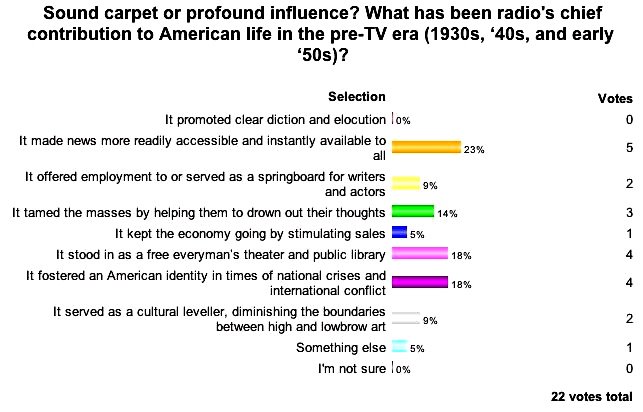
Well, it was time to close the sixth broadcastellan poll, if only to devise another in which you are herewith invited to participate. So, what, in my view, has been radio’s chief contribution to American life in the pre-TV era? There is some validity to all of the proposed replies (which I would not have bothered to list otherwise); and even though the statement that the medium “promoted clear diction and elocution” was endorsed by none, it was not meant to be facetious. Depending so much on the spoken word, radio producers certainly had more respect for it than today’s entertainers, artists whose mumblings are the Brad Pitt-falls of visual storytelling. And “Something else”? It might very well be broadcasting’s influence on the nation’s musical tastes, radio having served not only as an “everyman’s theater and public library,” but as a virtual concert hall.

Polls are nearly as fascinating to me as they are frustrating. I, for one, prefer not to give straight answers; I much rather respond or challenge, preferably after some reflection. The kind of question that can be answered decisively—the kind that requires one particular, supposedly right reply—is either unnecessary or suspect.

Nor can I rely upon my memory as a fail-safe system for the ready retrieval of data, pieces of trivia with which I’d rather not clutter up my mind. So, it is with some trepidation that I note a significant anniversary in American broadcasting: the quiz program Information, Please!, which had its radio premiere on this day, 17 May, in 1938 (and not, as the History Channel website will have you know, back in 1930).

Information, Please! was billed as a celebrity quiz program on which everyday citizens asked the questions that experts from the fields of literature, science, motion pictures or politics were called upon to answer. Noted guest panelists to appear on the show during its first two seasons (along with regulars like the aforementioned Oscar Levant) include movie director Alfred Hitchcock, playwright Moss Hart, as well as authors Ben Hecht, Rex Stout, Louis Bromfield, and Christopher Morley.

Here are some of the questions raised during the first program:

“Correct the following line and name its author. And the line is: ‘In the spring a young man’s fancy always turns to thoughts of love.'”

“In what well-known symphony did the composer include a chord in order to awaken a sleeping audience?”

“How is immigration to the United States from the following nations restricted: England, Brazil, China?”

“Kyosti Kallio is a Greek Island, a dictator of Peru, President of Finland, or the name of a Japanese political party?”

Unlike the quiz and giveaway programs of late 1940s—which had an even more devastating effect on the production of dramatic entertainment than the reality show format has on today’s television storytelling—Information, Please did not depend for its success on shrewdly engendered greed and promises of instant gratification, whether experienced by the participant or felt by the listener. This does not mean, however, that the instincts worked upon by the comparatively sophisticated Information, Please were any less basic.

“Now, folks,” moderator Clifton Fadiman greeted the audience, “any education that you and I may pick up for the next half hour or so is all to the good; but beyond that we’re out simply to play this as a game and have some fun at it.” And the “fun” of Information, Please! was not so much the thrill of getting it right, but of witnessing others of supposedly “towering intellect” (as Fadiman put it, mockingly) struggle and fail to meet the public’s challenge. To “stump the expert” was the objective, which was nothing less than an exercise in ridiculing the artist and the intellectual in a joyous vindication of mediocrity.

“Boom Bang a Bang”: Mae West, Eurovision, and the Re-education of Charlie McCarthy

Well, it’s one of those drab and dispiriting whatever-happened-to-summer kind of days on which even morale-boosting Carmen Miranda might have thrown in the technicolored towel. Yesterday, the house was shrouded in mist; and now, as if to mock the recently announced drought warning and water restrictions, the slow-moving clouds across the Welsh hills have assumed a washed-out shade of gray that looks about as cheerful as the fur of a middle-aged rat trying to waddle off with your last piece of cheese. Not that there was any more merriment to be had last night when I lowered the blind to screen the less-than-classic Mae West vehicle The Heat’s On (1943).

Watching West’s caricature of back-alley “come hither” cut the rug with dithering Victor Moore, whose hairpiece had just fallen off while hers remained as conspicuous as a comb-over, had all the gayety of a fancy dress party at a retirement home in a northern suburb of Minsk.

To be sure, West was already past her prime in the mid-1930s, an obsolescence determined not so much by biology than by the enforcement of the Hollywood Production Code, the same code that made similarly cartoonish Betty Boop lower her skirts. Such strictures notwithstanding, West continued to keep censors busy by causing the greatest sex scandal on US radio, when, in 1937, she impersonated the original lady Eve in a Garden of Eden sketch presented on the Chase and Sanborn Hour (as previously mentioned here). West’s delivery was so suggestive that she was subsequently deemed too hot for radio.

Now, the star of the Chase and Sanborn Hour, ventriloquist dummy Charlie McCarthy, got away with considerably more verbal tease and naughtiness than anyone else on the air. Saved by his image—the picture of a wooden chap on Bergen’s knee, that is—Charlie didn’t have to worry much about his reputation. Without such widely circulated likenesses, Charlie would undoubtedly have come across as a rather more adult toy—a stunted youth Peter-Pandering to the randy fantasies of the frustrated heterosexual middle-aged male.

While The Heat’s On made a farce out of censorship in the theaters, Charlie was amusing himself with many a leading lady of the silver screen—and a few misleading ones. On this day, 16 May, in 1943, for instance, Charlie’s heart went a-racing at the sight of Claudette Colbert, who invited the lucky log to spend his summer on her island farm. (At this point, I usually refer readers to my collection of Colbert memorabilia; but one of the finest sets of Claudette images are now on display at the glamour sanctuary known as Trouble in Paradise, a treat not to be missed.)

Charlie was soon disillusioned, however, when it became clear that Ms. Colbert had something other than romance in mind. He was to get busy on the farm, rather than enjoying the fruits without labor. There was a war on, and the Pinocchio among Romeos had to learn to be a little less selfish and irresponsible. As a piece of carved wood, he was certainly expendable—unless his antics could both delight and teach. After all, even old Victor Moore was seen promoting Victory Gardens in The Heat’s On, while Hazel Scott—the only performer to get The Heat up to temperature—tickled the ivories in an attempt to appease disenfranchised African-Americans, racial harmony being essential to the war effort.

On the same evening Charlie learned that flirting with Colbert was futile, Jack Benny’s valet Rochester took center stage singing a number from Cabin in the Sky on his boss’s program; meanwhile, Benny’s rival Fred Allen tried to sell a pan-American ditty to singing sensation Frank Sinatra. Like pleasure-seeking Charlie McCarthy, America’s musical entertainers had all become recruits in the fight against the Axis.

A decidedly more frivolous war will be waged all over Europe this weekend, when the Eurovision Song Contest, responsible for tunes like “Volare,” “Waterloo” and the abovementioned “Boom Bang a Bang” (also the title of a Eurovision documentary to air on UK television tonight) gets underway for the fifty-first time. Assault weapons include rap from the UK, Country from Germany, and Death Metal from Finland. It’s the showdown of the year on European television; and the US, slow to catch on for once, is planning to copy the concept.

And why not? As Shakespeare might have put it (had he not said otherwise): “If music be the [fuel of war], play on; / Give [us] excess of it, that, surfeiting, / The appetite may sicken, and so die.”

Many Happy Reruns: Joseph Cotten, Radio Actor

Well, I am finally done with Cousin Henry, the novel I was reading, soaking, drying and pressing, however intermittently, these past few weeks. I tend to read in the bathtub, you see, and my books get a fair dousing now and then. Cousin Henry is one of the shorter novels of prolific 19th-century author Anthony Trollope; and even though Trollopeans—those singing a Trollopaean to the less sentimental or melodramatic works of Victorian fiction—generally agree that Trollope’s shorter works are not nearly as satisfying as his enormous three-deckers, I thought Cousin Henry to be an engrossing portrait of a man riddled by guilt—a man too weak to enjoy the fruits of his own wickedness and too wicked to surrender them. Now that I have done with Cousin Henry, I might as well pay tribute to the man who played Uncle Charlie. Joseph Cotten, that is, who was born on this day, 15 May, in 1905.

Sure, I can relate most anything or anyone to radio; but in the case of Cotten, there is no need to stretch. Not that it would be difficult to highlight the wireless connections of some of the other notable film and theater personalities born on this day, a list including actress Constance Cummings, who was heard in a radio adaptation of Alice Duer Miller’s narrative poem The White Cliffs on the anthology drama series Romance (22 May 1945); Clifton Fadiman, editor and book critic, best known to American radio 1940s listeners as the moderator of the literary quiz program Information, Please; and playwright-novelist Max Frisch, whose Biedermann und die Brandstifter (Firebugs) was originally written for radio back in 1952.

Joseph Cotten was a radio actor, first if perhaps not foremost. He started out in radio drama in the mid-1930s, acting in a play produced by the American School of the Air, during the production of which he met and befriended Orson Welles, who subsequently gave Cotten his big screen break by casting him in Citizen Kane and The Magnificent Ambersons. On the air, Cotten was heard on programs like the aforementioned Romance, on the thriller anthology Suspense, the patriotic Cavalcade of America, and the Lux Radio Theater (taking Cary Grant’s part in Penny Serenade, for instance), as well as being featured on Welles’s own showcases, the Mercury Theatre on the Air and its commercial re-establishment, the Campbell Playhouse.

Radio listeners had several opportunities to hear Cotten on his birthday, namely in the 15 May 1949 production of “Breakdown,” as soundstaged by the Prudential Family Hour of Stars and a “Salute to Eugene O’Neill,” broadcast on 15 May 1954. Undoubtedly the least of these occasions was “Halfway to Reno,” a romantic trifle that aired on 15 May 1947 as part of the Radio Reader’s Digest. The play was an adaptation of one of the stories from the pages of Reader’s Digest magazine; it involves a husband and father who falls in love with another woman and seeks a divorce—until he is reminded of the wonders of parenthood, of playing ball with and reading to his son. It is a thoroughly undramatic play, a glossy treatment of marital discord, prefixed by the reminder that, in 1946, one out of three marriages ended in divorce.

Interviewed (that is, reading the script prepared for him) during the introduction to the pay, Cotten assured radio listeners that he was happily married. As I learned today, flicking through an edition of Hollywood Album, he claimed to owe his acting career to one Lenore Kipp, his first wife, who played the piano Cotten was pounding during a local theatre production of “Paris Bound” as far away from Broadway as Florida. When Ms. Kipp said “goodbye” go to New York, Cotten followed and eventually married her.

Most Victorian novels, of course, are concerned with matrimony. Comedies are said to end in marriage, while tragedy begin with it. Trollope, at least, had little interest in the conventional happy ending when he penned his Cousin Henry—a story about a secreted will and its ultimate detection—which concludes refreshingly unsentimental: “As any little interest which this tale may possess has come rather from the heroine’s material interests than from her love,—as it has not been, so to say, a love story,—the reader need not follow the happy pair absolutely to the altar.”

Cotten’s voice had a rough edge, an edge wasted on romances going smoothly. Right now, I am picturing him as the frustrated and disillusioned husband in Niagara, a spouse “Halfway to Reno” making a detour to those deadly falls.

Many Happy Reruns: Katharine Hepburn and Leslie Charteris

Well, I prefer doing it slowly, in narrow, dusty aisles, surrounded by strangers. Browsing for second-hand books, I mean. Nowadays, it is so much easier, and often cheaper, to pick up that elusive volume by going online, rather than making a day of it in out-of-the-way bookstores, antique shops, or flea markets. I’m not giving up on that experience, though—on the thrill of the hunt and the triumph of the catch. Hay-on-Wye, where I went yesterday, is the very place for such a literati safari. It is a tiny Welsh village with a population of about 1500; but its narrow streets are lined with about forty bookstores, some of which specialize in Hollywood cinema and crime fiction. That’s where Hepburn and Charteris, both born on this day in 1907, will come in . . . eventually.

Yesterday, I came home with a little something for my Claudette Colbert collection (pictured), with another copy of Norman Corwin’s Thirteen by Corwin (a fine one with dust jacket, previously owned by the BBC research department), and a title from the Directors Guild of America Oral History series, an interview with television pioneer Worthington Miner.

Prior to entering television in the late 1930s (yes, NBC did have a television schedule back then, even though only a few thousand Americans owned a set), Miner had been a theatrical producer in the 1930s; and, in March 1937, his leading lady was none other than Ms. Hepburn, who starred in an adaptation of Jane Eyre (previously discussed here).

According to Miner,

Katie was a wonderful Jane; it was her cup of tea, and she sparkled. But we had a dreadful Rochester and an even worse last act. [. . .] As a result, we decided to book it on the road for a few months and not risk bringing it into New York. For weeks on end it battled the elements, storms and tornados, floods and disasters, without an empty seat in the house. Katie’s name was already a prodigious drawn in the hinterlands. Jane Eyre made a tidy profit, but the kudos was nil for any of us, even Katie herself.

Years, later, Miner was involved in securing the rights Long Day’s Journey Into Night for another producer, with whom Miner strongly disagreed about Hepburn in the role of Mary Tyrone. Miner believed that Hepburn—a “mercurial, unpredictable performer”—was utterly “wrong” for the part. In the “right” role (Tracy Lord in The Philadelphia Story, for instance, which she reprised in several radio productions) she was “incomparable, a class unto herself.” When miscast, however, she could be “aggressively, monstrously bad.” To me, Undercurrent comes to mind; Hepburn was just not cut out to be the victim, even when permitted to fight back.

Someone very much angered by Hollywood casting was Saint creator Leslie Charteris, who shares Hepburn’s birthday. I have mentioned previously (and have been corrected on some muddled facts by Saint expert Burl Barer), that Charteris was not at all pleased when George Sanders took over the role of his Robin Hood of Modern Crime. He much preferred Louis Hayward, who had portrayed Simon Templar in The Saint in New York.

Now, one of the writers involved in adapting Charteris’s novel for the screen was Irwin Shaw, whose play Bury the Dead Miner had produced on Broadway and whose final radio play, “Supply and Demand,” he directed for the Columbia Workshop in the spring of 1937, when Hepburn was touring with Jane Eyre.

Perhaps I am overly fond of such six-degrees-of-separation games; but with some Miner assistance, I could almost send Hepburn and Charteris on a dinner date, discussing a role that might have been swell as a follow-up for Bringing Up Baby: a sophisticated screwball-mystery of The Thin Man variety.

Old-time Radio Primer: B Stands for broadcastellan

Well, before I was being whisked off for a daytrip in observation of one of those red-letter days on which we are expected to celebrate the gradual approach of our inevitable demise, I subjected myself to a rather probing interview, conducted by the eminent if irascible radio reporter Wally Windchill. Are we ready, Mr. and Mrs. North America, and all the ships at sea?

As the laundry basket said to the ironing board: let’s go to press.

Windchill: You call yourself “broadcastellan.”

broadcastellan: Yes. Only in the blogosphere, mind you.

Windchill: I get it, a surfname; but what does it stand for?

broadcastellan: Well, it all started about a year ago, when, one quiet afternoon . . .

Windchill: Please, we are pressed for time.

broadcastellan: Sorry. The handle is meant to suggest that I am writing about broadcasting and that I consider myself a keeper of records, one who manages a neglected vault of half-forgotten radio treasures. A castellan in the castles on the air.

Windchill: So, it’s another one of your awful puns, basically.

broadcastellan: A pun, at any rate.

Windchill: Never mind the rate; it’s cheap. But about radio. As your first and only reviewer on one of those traffic generator sites put it so succinctly in his single-word comment: “Why?”

broadcastellan: Well, I am very much intrigued by aural drama as an alternative to visual entertainment; and, having written a dissertation on the potentialities and shortcomings of these stories in sound, as they played out in the minds of millions during the 1930s and ’40s, I thought I had something to share that . . .

Windchill: You don’t do short sentence, do you?

broadcastellan: Not true! I even “do” incomplete ones. On occasion.

Windchill: Cute. But, about radio. Why the old stuff?

broadcastellan: Radio drama has a fascinating history. It’s a tradition that, in the US at least, has been all but abandoned in favor of television.

Windchill: And that’s bad?

broadcastellan: I think so, yes.

Windchill: But why American radio? You live in England, don’t you?

broadcastellan: Wales, actually.

Windchill: As if anyone outside the UK could tell the difference. Why not British radio, then? I hear it’s still going strong over there.

broadcastellan: I am just not that impressed by what’s being done nowadays. Back in the 1930s and ’40s, radio was it, not fringe culture. The voices, the sound effects, the storytelling—the commercials. It’s the showmanship I admire, the theatricality. And nobody does showmanship better than the Americans. What I love particularly about US radio is its strong connection to old Hollywood; hearing those great stars. Everyone did radio in the 1930s and ’40s—everyone, except Garbo, who very nearly did. They don’t have stars nowadays; just celebrities.

Windchill: I see.

broadcastellan: Besides, I didn’t grow up with those voices. In Germany, where I’m from, movies are dubbed. Radio taught me a lot about the sound of American English, about idiom and jargon.

Windchill: Not that you got it down. Some queer diction you’ve got going on there, Mr. “broadcastellan.” So, you’re going to keep exposing others to your . . . radiology? Not a lot of people out there care, you know.

broadcastellan: I am aware of that, but undaunted by the general indifference. Yes, I’ll keep on blogging. My first anniversary is coming up, on 22 May.

Windchill: I guess we’re going to read all about that in a few days, then.

broadcastellan: Probably. Perhaps we could do another interview.

Windchill: It would have to be a slow newsday.