Radio Rambles: Cornwall, Marconi, and the "Devil’s Foot"

St. Michael's Mount
St. Michael’s Mount

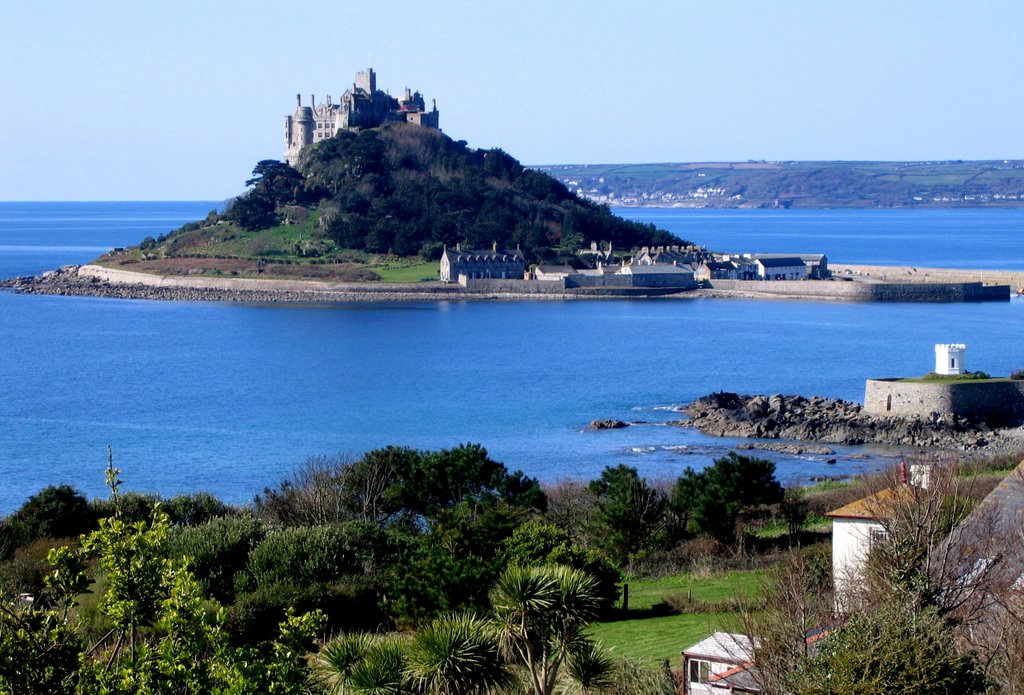
Well, I am back from my weeklong tour of the south-western most extremity of England. As it turns out, even in a place as remote and ancient as Cornwall—where I was deprived of a wireless network that might have permitted me to continue the broadcastellan journal on location—it is impossible not to be reminded of broadcasting. Especially not Cornwall, I should say. I had forgotten just how intimately the Cornish coast is connected with the efforts of wireless pioneer Guglielmo Marconi. It was on Mount’s Bay (pictured, left, in my snapshot of St. Michael’s Mount) that the first successful transatlantic transmission of a wireless signal took place on 12 December 1901. Having set up his station near Poldhu in Cornwall—away from the prying eyes of his competitors—Marconi received a signal from there all the way across the Atlantic at his post on Signal Hill, St. John’s, in Newfoundland, Canada. And it was near Poldhu, also, that the great Sherlock Holmes—who went on the air some three decades after this momentous event in wireless technology—solved one of his most puzzling cases: “The Devil’s Foot” or “The Cornish Horror.”

Having been prescribed “complete rest” by his Harley Street physician after his iron consitution was beginning to show signs of wear, Holmes travelled to Cornwall in March 1897 to recuperate and, as American radio listeners were left unaware, to engage in some philological studies. Surrounded by “weird ruins” and “strange monuments of stone” suggesting ancient pagan rituals and devil worship, the little whitewashed cottage Holmes and Watson shared on Mount’s Bay was hardly the right spot to ensure quiet study or relaxation. The scene was “grim” and “foreboding,” as Dr. Watson recalled in 1910 (and several radio broadcasts); the “old death trap” of Mount’s Bay looked positively menacing—a “sinister semicircle” with a “fringe of black cliffs and surge-swept reefs.”

“Bleak is putting it mildly,” Dr. Watson responded to radio announcer Joseph Bell on both 30 May 1936 and 11 January 1947, albeit in different voices (Harry West’s in the former broadcast, Nigel Bruce’s in the latter). Now, this is not the Cornwall I encountered on my first visit; instead, the scenery was invitingly fresh, bright—and, notwithstanding a late frost that had done some harm to the Camellias and Magnolia blossoms in the celebrated Cornish gardens—colorful and downright subtropically lush. Still, having seen the cliffs at Land’s End, the hidden villages along the Helford, the narrow streets of Mousehole and St. Ives, and the view of St. Michael’s Mount from Marazion, I can picture Holmes and Watson in their “Adventure of the Devil’s Foot,” of which I first partook thanks to the legacy of Marconi.

Radio plays, especially traditional American radio plays, often dispense with longer exposition; short on descriptive narration, they unfold mostly in dialogue, verbal exchanges supported by sound effects to establish background or enhance atmosphere. This gives listeners the opportunity to paint their own pictures of the surroundings in which characters are dwelling, moving and thinking. With this freedom, as with all freedoms, come responsibilities and challenges. Do we paint indiscriminately, according to our own fancy? Do we leave the brush alone or turn, perhaps, to other sources to assist us in creating a fit impression of costumes and scenery.

Working on the imagination, radio drama is not always the most reliable educator. It invites us to fill in the blanks—a task not readily accomplished with a clean slate, let alone in an obnubilated state of “Cornish Horror” as experienced by the impressionable, intoxicated Dr. Watson.

Up Frenchman’s Creek; or, How (Not) to Prepare for a Vacation

Well, I’ve been home barely twenty-four hours and already I am packing my suitcase again. After a weekend up north in Manchester, I’ll be off tomorrow on a weeklong trip down south to Cornwall. Instead of flicking through my travel guides this morning, I started reading Daphne du Maurier’s Jamaica Inn. Now, there’s a description of scenery you wouldn’t get from your travel agent:

[There] was a lashing, pitiless rain that stung the windows of the coach, and it soaked into a hard and barren soil. No trees here, save one or two that stretched bare branches to the four winds, bent and twisted from centuries of storm, and so black were they by time and tempest that, even if spring did breathe on such a place, no buds would dare to come to leaf for fear the late frost should kill them. It was a scrubby land, without hedgerow or meadow; a country of stones, black heather, and stunted broom. 

There would never be a gentle season here. [. . .] 

Not much more hospitable is the seascape depicted in the opening chapter of du Maurier’s Frenchman’s Creek:

When the east wind blows up Helford river the shining waters become troubled and disturbed and the little waves beat angrily upon the sandy shores [. . .].

The long rollers of the Channel, travelling from beyond Lizard point, follow hard upon the steep seas at the river mouth, and mingling with the surge and wash of deep sea water comes the brown tide, swollen with the last rains and brackish from the mud, bearing upon its face dead twigs and straws, and strange forgotten things, leaves too early fallen, young birds, and the buds of flowers.

Perhaps reading du Maurier’s Cornish romances is not such an ideal way to get into the spirit of things, especially not when one is hoping for spring and renewal. At least their author was familiar with the locations described. Listening to the 10 February 1947 Lux Radio Theatre version of Frenchman’s Creek, I got no sense of the locale at all; nor, for that matter, much sense of the story. There was too little of it left to suggest the illicit passion of a married woman for a dashing pirate.

The radio version is not so much an adaptation of the novel, but of radio dramatist Talbot Jennings’s screenplay for Paramount’s 1944 technicolor production, which cleaned up du Maurier’s act in accordance with Hollywood’s production code. Mitchell Leisen’s film, of course, was not shot in Cornwall either, but in Jenner, California, which also stood in as Devon in The Uninvited, an old-fashioned ghost story featuring the novelty of a sun rising in the west.

I don’t suppose Alfred Hitchcock’s reworking of Jamaica Inn is any more useful as an introduction to Cornwall; I’ve always confused it with Under Capricorn, another one of Hitchcock’s misguided forays into period piece froufrou (although I confess having enjoyed his Waltzes from Vienna). And since there is little time to dip into the poetry of John Betjeman, I think I’d better get back to my travel guide after all—and finish packing. I will try to relate my impressions upon my return next Wednesday—provided I can find a radio drama angle.

Rattigan’s “Tables” (Up)set at the Royal Exchange, Manchester

Well, I couldn’t get away from it after all, even at the theater. Not the protests-provoking Condoleezza Rice visit to Britain, from which, to my relief, business-as-usual Manchester is being spared during my stay there this weekend. The stereotyping, I mean. As I remarked in my previous entry, the English up north are tiresomely prejudicial in their approach to the Welsh. Now, I am not from Wales; but I happen to have moved there. And it is beginning to irk me that I am being subjected to scoffs, sneers, or petty remarks whenever my present residence, which is not readable in my Germanic features, becomes known.

Asked for my zip code at the box office of the Royal Exchange Theatre—a compliant response to which one ought to resist rather than giving it readily—I was treated to some mild sarcasm, partly encouraged by my generally self-deprecating sense of humor. Perhaps I am too sensitive, but I think a line is being crossed when a salesperson calls you “confused” for having relocated from New York City to Wales.

At any rate (and perhaps at a rather too high one, considering this low moment of high-hatting), I got myself a ticket for a production of Terence Rattigan’s Separate Tables (1954), which is on at the aforementioned Royal Exchange Theatre until 13 May 2006. The two plays so called are set at a hotel by the sea, just respectable enough to be tolerated by those who have seen better days and affordable enough to shelter them with a modicum of comfort in their waning ones.

The predominantly elderly clientele of the Beauregard Private Hotel, Bournemouth, exchange pleasantries—and unpleasantries—while seated apart from one another at their meals. Among them, the impoverished but stately Lady Matheson, the myopic, horse-betting Miss Meacham, the lonely ex-schoolmaster Mr. Fowler, and the formidable Mrs. Railton-Bell and her mousy daughter (excellently portrayed by Janet Henfrey and Clare Holman, respectively).

Now, the fastidious Mr. Rattigan, who insisted on writing plays of ideas—rather than character and narrative—had the seating arrangements all figured out, providing drawings of the stage with descriptions of each, reading, for instance,

Table (down L): white cloth, cruet, menu, napkin in ring, bottle of Vichy water, tumbler, sauce, table lamp, flowers, soup spoon, large knife and fork, small knife, dessert spoon and fork, side plate, roll, plate of soup, ashtray.

The Royal Exchange production does serve the food—which, if the staff is to be believed, is rather awful (“I shouldn’t have that, if I were you”); but does so with admirable swiftness and little clutter. While the tables are less personal than Rattigan prescribes, the isolation and forlornness of the characters and the tensions between them become more expressive, more tangible in an austere setting.

As it turns out, Rattigan’s play is far better suited to a theater in the round like the Royal Exchange than a more traditionally narrative drama like What Every Woman Knows, which I previously saw at the same venue. I felt like sitting at dinner (not at a dinner theater, mind you), at a table way in the back, observing fellow guests. Sure, I only saw the back of Mrs. Meacham for most of the time and did not catch her every word as a result; but I could appreciate the play’s ideas, its commentary on modernity, all the more for it.

Not having found a radio adaptation of this highly successful play, which was exported to America at a moment in theater history when radio was no longer seriously considered as a potential medium for drama, I am trying to imagine how a soundstaging of it could work, with varying levels of volume indicating the distance between the tables. Would the microphone sit in middle of the room? Would it move from table to table, along with the dishes being served? Would it favor any one character or would it eliminate differences in class and fortunes by having the neutrality of volume control?

Now, that’s what I call a play giving me ideas as I continue to think about my own attempts at radio playwrighting.

On This Day in 1952: “An Ideal Husband” Must Face Charges of Infidelity

Tomorrow, I am once again crossing the border for a weekend up north in Manchester, England. “Crossing the border” may seem a rather bombastic phrase, considering that I won’t have to show my passport, get fingerprinted or have my luggage inspected at customs. Yet, as I learned after moving from New York City to Wales, the border to England is much more than a mere line on the map, very much guarded by those whose thoughts are kept within that most rigid and impenetrable of confinements—the narrow mind. Urbanites can be most provincial. Thoroughly walled-in, they are often ignorant of a fact stated by Oscar Wilde in An Ideal Husband (1895): “Families are so mixed nowadays. Indeed, as a rule, everybody turns out to be somebody else.”

That the proud and prejudiced lack discernment is rather what I’m counting on when next I walk over to the Royal Exchange Theatre, which is currently promising seats at Separate Tables. During my previous visit to Manchester, I was fortunate to catch a splendid production of What Every Woman Knows (as mentioned here).

Indeed, Jenny Ogilvie portrayed Barrie’s heroine, the knowing Maggie Wylie, so brilliantly that I was quite disappointed when, sauntering over to the theater of the mind, I took in a Theatre Guild on the Air adaptation of the play only to find it wanting, notwithstanding the valiant efforts of Ms. Helen Hayes to act against the clock.

It was on this day, 30 March, in 1952, that the Theatre Guild presented An Ideal Husband, with Rex Harrison as Lord Goring and Lilli Palmer as the scheming Mrs. Cheveley. Now, An Ideal Husband, not unlike the plays of George Bernard Shaw, is scripted with such novelistic attention to stage business that it is nearly impossible to perform as the text attempts to dictate.

I mean, who, beyond the second row, would be able to discern that Mrs. Cheveley has “gray-green eyes” or that Sir Robert Chilterns’s “romantic expression” contrasted with a “nervousness in his nostrils”? That “Vandyck would have liked to have painted his head” is an interpretative aside reserved for the reader and unlikely to become legible to the theater audience, however attentive.

Plays like An Ideal Husband were designed to counter the crudeness of Victorian melodrama, which was appreciated for its staging rather than its writing, lines borrowed, bowdlerized, or anonymously penned. The late-Victorian playwrights insisted on being authors— and accordingly approached drama as a composition to be published as well as performed.

Radio theater can—and must—do without such minutiae. It must permit audiences some liberties in designing the set, in staging and casting a play. The voices of the actors will curtail that freedom, suggesting the age, gender, origin, and cultural background of the speaker. Harrison is not altogether suited for the part of Lord Goring, whom I picture as suave, rather than gruff; but perhaps my mind’s eye, long conditioned visually, simply could not see beyond Harrison’s memorable impersonation of Professor Henry Higgins. I have become too accustomed to his face to allow his voice to suggest another.

It is Lord Goring who takes center stage in Arthur Arent’s adaptation, whereas the “ideal” husband being put to the test in Wilde’s play is Sir Robert, a man who comes to regret having made his fortune by dubious means. The moral dilemma of a powerful politician who becomes the prisoner of his secret, both the telling or keeping of which may cost him not only his social standing, but his marriage to a morally upright woman, is sacrificed to telescope the intricacies of the plot, which are played strictly for laughs in the radio version.

I’m not sure whether this is altogether a loss, since Wilde’s paradoxical bon mots seem at odds with his less than convincing exploration of morality. The last time I saw a production of An Ideal Husband was in April 1996, at the Ethel Barrymore Theater in New York City. As I noted in my diary (still written in German at that time), the hideously chintzy production, starring Martin Shaw, was very much a disappointment. The staging was too Ibsenesque, I thought, and wit was its casualty. I would have been only too glad to do away with the moral ideals to savor the play’s beyond-good-and-evil twists. Arent’s adaptation made these cuts for me—but was the play being acted out for me still An Ideal Husband or an act of unprincipled imposture instead?

As I put it forward in the current broadcastellan survey, American radio of the 1930s, ‘40s, and 1950s often stood in as an everyman’s theater. Dating back to the early 1920s (as evidenced by the above picture, from a 1923 magazine), it is a concept and a function of broadcasting culture I explore at some length in my dissertation. The drama of the air is potentially boundless—and it often falters when it tries to recreate the stage or dwell in its precincts.

Wouldn’t You Rather Have . . . “picked up Anna May Wong at the Park Wilshire”?

There are days when you are in desperate need of vicarious living. While the world marvels at the latest solar eclipse, you wonder whether there’ll be any sun at all his spring, the prospects for your upcoming trip to Cornwall looking decidedly grim. So, you grab a book from your shelves and, presto, you assume the identity of some personage whose existence strikes you as being rather more colorful than your own present self. I wouldn’t have minded trading places with a certain Val Gielgud, who, on this day, 29 March, in 1938, “as nearly as possible passed out over the soup!” I should add that the soup was served at the home of Isabel Jeans, Hollywood actress, and that Mr. Gielgud, brother of distinguished thespian John Gielgud (whom I heard only last night in a 1951 radio production of Hamlet) and a noted radio writer-director in his own right, was on a month-long tour of Tinseltown.

Now, I’ve never been much of a namedropper, being that the only vintage Hollywood notable I’ve been around for any longer period of time was stage and screen actress Viveca Lindfors, whose dog Willie I used to walk during my college days in New York City. I’ve got pictures of the dog, but no mementos of his owner, save for a few messages she left on my answering machine. Gielgud, on the other hand, found himself surrounded by luminaries and duly recorded each encounter in his 1938 diary, excerpts of which he later shared publicly in his biography Years of the Locust. When he was not nearly passing out in a bowl of soup, he was dining or gambling or drinking among the late greats of the motion picture industry.

“So this is Hollywood!” Gielgud exclaimed upon his arrival in Beverly Hills on 26 March 1938. He was visiting his friend, Eric Maschwitz, a novelist-playwright then at work on an adaptation of Goodbye, Mr. Chips. “One’s first impression,” Gielgud noted,

is of a place without form and void, sprawling, unfinished; a forest of oil-derricks; wide roads and fast cars; low houses; far more lights than Budapest, infinitely less effective. Whirled up to Beverly Hills, where Eric has a charming little house that belongs to [screenwriter] John Balderstone. Our nearest ‘stellar’ neighbour in Rodeo Drive—nomenclature perfect—is Rosalind Russell, who has a big house about two blocks away, marked by a police patrol. Fears of Kidnapping or just Publicity?

In this manner the diary continues. On 17 March, Gielgud recorded having had lunch “at a tennis club, where Cesar Romero, looking regrettably unshaven, was playing backgammon with a concentration that seemed [. . .] excessively gloomy.” He then went on to dine at “‘La Maze,’ where among other people were Greer Garson and Tilly Losch.” Tilly Losch? Okay, I had to look that one up. Turns out, she was a Viennese-born actress-ballerina who played Lotus in The Good Earth. From there Gielgud sauntered over to the “Clover Club—dancing and gambling—which reminded [him] of a cross between a Corner House and one of the minor circles of hell. Charles Bennett and his wife, and [Henry] Wilcoxon among others. Dolores Costello, looking tragically passee, Claire Trevor, and various large-size executives with remarkable names represented the Studios. Most people were quite simple and normally drunk.”

On 28 March, Gielgud lunched at the Brown Derby, where he met director Lewis Milestone. In the evening, Eric “collected a party [ . . ] of people whom [Gielgud] had at one time or another known in London: Isobel Jeans [is it Isobel or Isabel, now?], looking as always just out of a band-box; Reggie Gardiner, of train-imitation fame; Heather Thatcher; Greer Garson, very decorative in a pink hat and green gloves.”

In the days to follow, he also spent some time on the MGM lot, where, as he put it, “[o]ne expected to run into Garbo or Shearer or Tracy any moment—and had to be contented with a sight of Robert Young.” Sure, he was less than impressed when being “introduced to John Barrymore, who looked pathetically old and flabby,” but he also got to shake hands with the “certainly most decorative” Dorothy Lamour, “that admirable actor Lloyd Nolan,” and “Una Merkel, who turned out to be as amusing in real life as on the screen, with the most charming manners to boot.”

Within a few weeks, the visitor from Britain got to drive around town alongside glamorous Anna May Wong, with whom he is pictured above. The lucky devil! I’d sure have risked conking out in a bowl of wontons for a few afternoons with Ms. Wong.

On 21 April 1938, Gielgud left Hollywood for New York City, where, on 30 April, he directed his play “Fours into Seven Won’t Go” for the Columbia Workshop. I don’t always agree with Gielgud’s view of American radio, or America in general. In fact, I find his attitude rather haughty and his dismissals too sweeping; but I sure envy his Hollywood excursion, of which I might have more to write anon, should I find myself in need of another dose of hobnobbing by proxy . . .

On This Day in 1943: The Man Behind the Gun Fires Into American Living Rooms

Well, if my “Do Not View” list over at blogexplosion may be drawn on as ocular proof, the blogosphere is the stomping ground for today’s self-styled propagandists. Operating in the relative anonymity of the internet, webjournalists have seized the new medium as their Hyde Park Corner, a space where they can whine and opine vociferously while hiding behind the latter-day scarves of generic skins and colorful pseudonyms. How effective is such ranting, however relevant or worthwhile the cause? Is debate, so rarely encouraged by loudmouthed badmouthing, still possible among the media-blitzing nobodies of feuding weblocs and those permitting themselves to be caught in between? That I don’t have any ready answers only makes such questions all the more worth raising.
Radio, the mass medium Gerald Nachman labelled “yesterday’s Internet,” was the first such means to penetrate the domestic stronghold and stranglehold the mind. Prior to World War II, the propagandistic uses of broadcasting were curtailed by the FCC, which apparently had fewer qualms about the sister art of sly manipulation known as advertising. The act of selling ideas was deemed more dubious or sinister than the peddling of wares, no matter how harmful.

During the war, however, the US government did much to exploit wireless omnipresence, radio’s firm and welcome entrenchment in the American home. Wartime movies, like the clever To Be Or Not to Be I watched last night, took far longer to make and were decidedly more costly to produce than broadcast dramas; and while magazines cajoled the public with bold-printed memoranda (such as the less-than-subtle war bonds appeal shown above), the airwaves carried jingles and jingoist speech that could penetrate the recesses of the mind more deeply and with greater frequency than film and print, shaking the complaisant or calling the recalcitrant to arms. And while Esther Williams was still poised on her swing, ready to leap into some technicolored Lethe, radio recruited everyone from Amos ‘n’ Andy to Young Widder Brown for war duty.

Even the commercials began to don camouflage. On this day, 28 March, in 1943, for instance, the Elgin National Watch Company reminded its former customers that it, too, had “gone to war,” turning out “tools of victory.” Being “completely devoted to the production of precision instruments for war,” it now manufactured compasses, tachometers, and time fuses.

And whether they were on civilian wrists or in the gun turret, Elgin watches, across whose faces the second hand swept “towards the zero hour,” were steadily measuring that “priceless ingredient of victory: time.” Few listening to such con-fusings of corporate greed and patriotism would have thought that the campaigners for Elgin had lost their marbles. It was all part of the war game no American could afford to lose.

The aforementioned war-time piece maker sponsored a program called The Man Behind the Gun (previously discussed here), which declared itself “dedicated to the fighting forces of the United States and the United Nations.” It was “presented in the hope” that its ostensibly “authentic accounts of men at war” might give civilians a “better understanding and deeper appreciation” of American and allied “fighting forces everywhere in the world.”

The noisy, in your face plays written for the series by Ranald MacDougall achieve a remarkable verisimilitude, despite the fact that sound recordings of wartime machinery were either unavailable or off-limits to civilians, as Jim Widner’s Adventures in Radio Podcast reveals in an introduction to another episode of the series. And since the radio, unlike the internet, gave home audiences little opportunity to talk back or speak up, MacDougall decided on second-person narration forcefully to transport listeners into the action. Quite literally, listeners were being shipped off to battle in a war fought in the air, on the waves, and on the airwaves.

To those who think that so-called old-time radio in America was all “Hi-Yo Silver” and “Jell-O everybody,” such less frequently circulated frontline dramatics might be an eye-opening earful indeed. I hope I am not being too blatantly manipulative when I suggest you keep that in mind should you care to respond to the current broadcastellan survey.

Being But Blogmad North-Northwest

Well, today is the birthday of Quentin Tarantino, the oddball director who started out inauspiciously if oddly enough playing bit parts such as the Elvis impersonator who mystified The Golden Girls at Sophia’s wedding. So, I am permitting myself to be a little more goofy than usual. As if the weekend’s diversions had not been daffy enough, considering that I witnessed Kevin “Chicken Little” Covais laying his last egg on American Idol; watched Julie Walters in Acorn Antiques, the straight-to-DVD release of the West End musical based on a series of TV sketches poking fun at shoddy soap operas; and followed the misadventures of Depression-weathered Marie Dressler and madcapitalist Polly Moran in Prosperity (1932).

My folly did not quite end there. Since it had been disquietingly quiet of late here at broadcastellan, I decided to give the much-talked-of referral service Blogmad a try. Sure enough, a few more quick-to-click onliners came galloping through; but I doubt there were any more readers, let alone interested ones. This general attention deficit can be gleaned from my recent survey, which remained largely unnoticed this weekend. In the relative sanity of my pre-Blogmad days, four bored passers-by lingered long enough, at least, to let me know they did not care, a response option omitted in the current poll. After all, I can surmise as much from silence.

Now, I have no commercial interest in blogging and write chiefly for my own amusement, partially derived from exposing myself publicly, and periodically at that. As I put it in the imitation Chanogram I composed shortly after inaugurating this journal, “Blog like hothouse flower: Must blossom for anyone.” It seems that the flora is being trampled rather than feasted on during the present stampede.

Services such as Blogmad or Blogadvance (which just awarded me credits for a “direct referral” in which I took no active part) are undoubtedly of greater use to those who wish to cash in on the thorough commercialization of the so-called blogosphere. Should I have stooped to adding my profile to a site that inquires about my “maritial status” (sic)—without giving me the opportunity to answer appropriately—and promises me certain “benifits” (sic) which I recieve (sic) for joining?

Such mis-spellbinding prospects notwithstanding, I am beginning to realize that I am reconciled to being cast as a marginalien—a stranger tossing in asides from the sidelines. In other words, I am not sure how long I will be indulging (in) the madness.

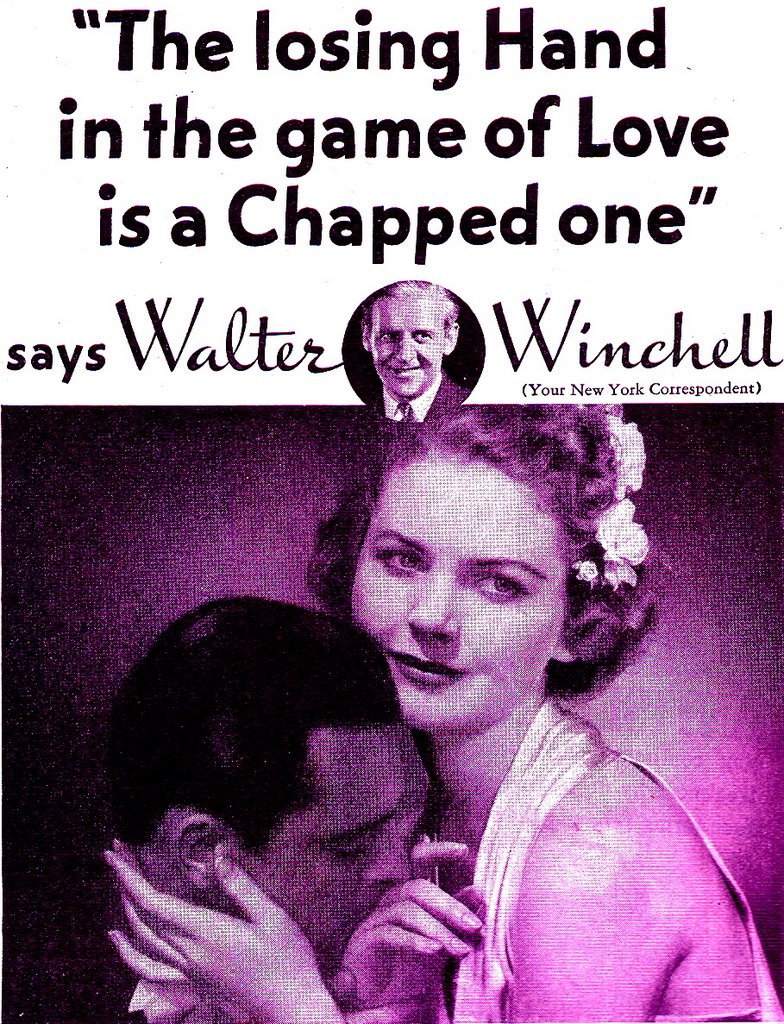
Clearly, bloggers are more forgiving of flawed spelling than of flowery speech, of which I spout enough to bar this metaphorical hothouse from becoming anything resembling a hotspot. How much easier was it for Walter Winchell, the high-school dropout who rags-to-enriched himself to become the most influential of all radio reporters during the 1930s and ’40s!

However dubious its reportorial integrity or merit, his program sure added some colorful blossoms to America’s garden-variety dictionary. In the 1930s, Winchell was ranked among the top contributors to American slang, whether or not he actually coined the saucy euphemism “making whoopie.”

“Good evening, Mr. and Mrs. North and South America and all the ships at sea—let’s go to press,” Winchell greeted listeners on this day, 27 March, in 1949, bombarding them with quick and random-fire newsflashes about a North Pole rescue and a deadly tornado, about Notre Dame University honors for actress Irene Dunne and trouble for Lois DeFee, “tallest of the striptease stars,” who had “just reported being robbed of all her gems.” Okay, considering that the Amazonian Ms. DeFee once tried to floor Americans by marrying a midget, such a flash was probably no more than another publicity shot.

Amid all that trivia, however, there were disturbing words. Not so much news, but signs of Winchell’s whole-hearted support for the McCarthy cause and his willingness to assist in turning the Soviet Union into an enemy fit to fill the spot left vacant after V-J Day.

Winchell talked of “changes in the soviet top command” and warned that Russia, having “put the big squeeze on Sweden,” was “getting ready for a military move of some kind.” He delighted in being denounced as a “radio liar” by Russian propagandists who labelled him the “pen gangster from the Hearst band.”

There sure was method in such red scare madness, which was as much a machination of the West as it was a menace from the East. Admiring the flowers of rhetoric, one must be prepared to step right into dung heap of history.

"This . . . is London": Casting John Donne’s Shadow

If Gothic Nightmares at the Tate Britain failed to send shivers down my receptive spine, the National Portrait Gallery’s Searching for Shakespeare sure did nothing less. I am generally not one to wax poetic at the sight of artefacts that may or may not have belonged to some literary so-and-so. For the most part, I don’t really care what a writer looked like, as long as his or her prose or poetry is to my liking. To be sure, having studied and taught Shakespeare during my college and university days, I am sufficiently impressed by the sight of an old Folio edition. Something else caught my mind’s eye at that exhibition; and it was not one of the supposed likenesses of Shakespeare—many of which have long been proven spurious—but the portrait of one of his contemporaries.

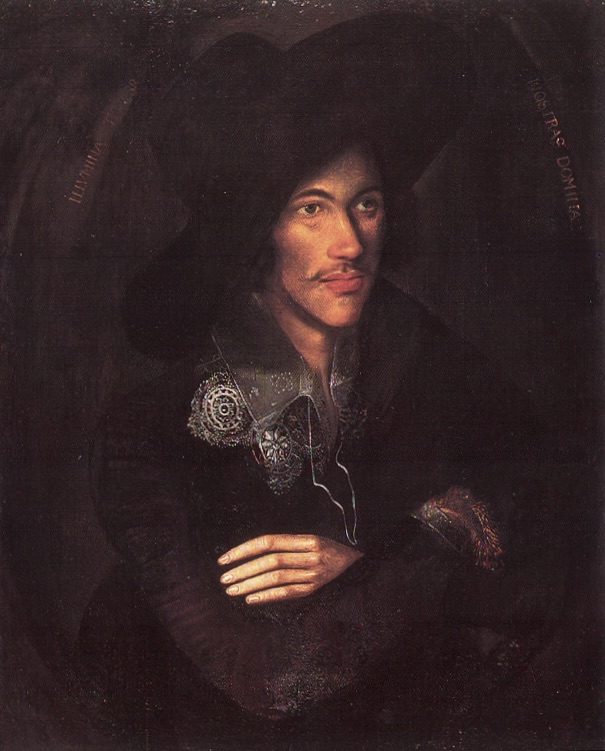
Portrait of John Donne by an unidentified artist (c. 1595) National Portrait Gallery, London

The portrait in question is that of John Donne, a painting currently being offered to the National Portrait Gallery, which is trying to raise funds in the amount of £1,652,000 to obtain it before the purchasing opportunity expires at the end of May. So, the picture now hangs in the Shakespeare exhibition, where visitors have to pay to get a glimpse of it. It is well worth a glimpse, I assure you. I confess the pleasures I derive from being moved by a work of art, whether considered trifling or momentous, and it is not rare that I stand before a painting with tears welling in my eyes or goose bumps sprouting on my skin. Composed by an unknown artist around 1595, the Donne portrait is decidedly of the gooseflesh variety.

It is in poems like “His Picture” and “Witchcraft by a Picture” that Donne speaks to us about attempts at portraiture, about the art or hubris of capturing life, the act of imitating nature or surpassing creation—troubling thoughts for a former Roman-Catholic growing up in the turmoil of the Reformation and its sanctioned smashing of images. In the former poem, Donne writes:

I fix mine eye on thine, and there
Pity my picture burning in thine eye;
My picture drown’d in a transparent tear,
When I look lower I espy;
Hadst thou the wicked skill
By pictures made and marr’d, to kill,
How many ways mightst thou perform thy will?

But now I’ve drunk thy sweet salt tears,
And though thou pour more, I’ll depart;
My picture vanished, vanish all fears
That I can be endamaged by that art;
Though thou retain of me
One picture more, yet that will be,
Being in thine own heart, from all malice free.

In the latter piece, Donne suggests the mental image and the imaged man to be at odds; a painting is a memento mori, which, fixed in time, turns into an unlikeness of fleeting life.

Here take my picture; though I bid farewell,
Thine, in my heart, where my soul dwells, shall dwell.
‘Tis like me now, but I dead, ’twill be more,
When we are shadows both, than ’twas before.

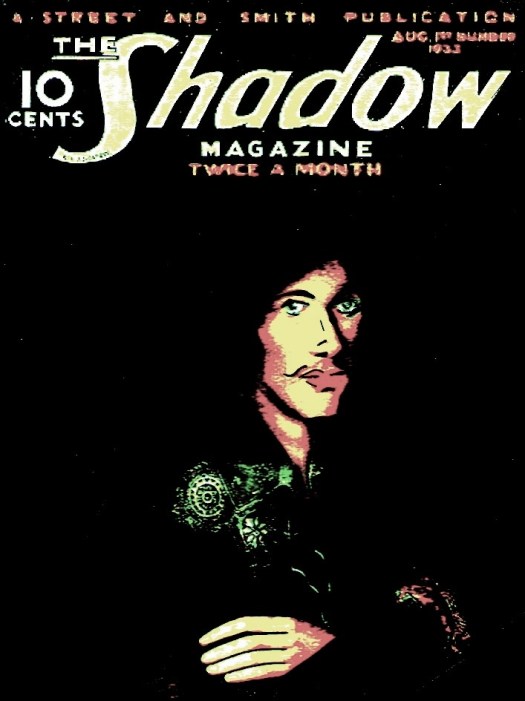
To his own portrait, lost and mislabeled for centuries, Donne referred as “that picture of mine which is taken in shadows.” In my irreverent mind, the striking features of Donne’s shadow-cast face began to resemble that of The Shadow, Lamont Cranston—the secret avenger who, striking hidden from view, laughed death in the face and had a sermon for all who dared to defy the law: “The weed of crime bears bitter fruit.”

Sermonizing Donne, who once wrote “A Lecture upon the Shadow,” approached the challenge of death in one of his most famous sonnets:

Thou art slave to fate, chance, kings and desperate men
And dost with poison, war and sickness dwell,
And poppy or charms can make us sleep as well
And better than thy stroke; why swell’st thou then?
One short sleep past, we wake eternally,
And death shall be no more; death, thou shalt die.

Donne’s portrait has captured my imagination; yet, having too often crossed—and all but crossed out—the uncertain boundaries between high art and low, it is The Shadow who now runs away with it. In my mind, I hear Lamont Cranston’s defiant laugh as I gaze at the poet’s likeness, “taken in shadows.”

"This . . . is London": "Searching for Shakespeare" at the Novello, the National Portrait Gallery, and on My iPod

Well, I hardly need to travel all the way down to London to go in search of him. After all, the man—or a stained-glass likeness of him—looks over my shoulder each time I fetch a volume from my bookshelves. His raised eyebrow and faint smile seem to say, “Come now, there must be something else beside radio drama to pique your interest.” For some time now, Shakespeare’s works, along with those of many other acknowledged topnotchers of western prose and poetry, have been relegated to the shelves upstairs to make room for my growing collection of books on American broadcasting and radio dramatics. Yet the bard need not consider himself debarred; even on American radio, he enjoyed a prominent position.

The Radio Guild, the first major American drama anthology for the airwaves, chose Romeo and Juliet for its premiere back in 1929. Subsequently, Orson Welles brought his acclaimed production of Julius Caesar to radio’s Mercury Theater (as discussed here), the irreverent Norman Corwin invited audiences to “[s]tand by to hear a Dane evaporate” as he faded out a production of Hamlet, and the CBS Radio Workshop went so far as to stage an interview with the playwright to investigate just “who wrote the works of William Shakespeare?”

As has often been argued, few dramatic works are as radiogenic as Shakespeare’s plays. They were written for the “wooden O” of an almost bare stage and, though hardly without action, rely much more on the spoken word than the elaborate masques, pantomimes, and melodramas of subsequent generations of playwrights.

When Shakespeare is translated for the contemporary boards, for big screen or small, text is often in competition and at times at odds with context, as costumes and stagecraft conspire to make the spoken word sound dated or the settings seem anachronistic. On the other hand, producers who opt for the blank canvas of a stripped stage in an effort to let Shakespeare’s words speak for themselves, give the eye so little to play with or feast on that they might as well lead us to the theater of the mind by handing out headphones and recordings.

The Royal Shakespeare Company production of As You Like It, now playing at the newly refurbished Novello Theatre in London’s West End, reduces the forest of Arden (or Ardenne) to a single tree. Yet it proves entirely sufficient to suggest a pastoral setting, to allow for some hide and seek among lovers, and to give poor Orlando, pining for his Rosalind, the requisite branches on which to pin his clumsy (and double entendre peppered) verse:

If a hart do lack a hind,
Let him seek out Rosalind.
If the cat will after kind,
So, be sure, will Rosalind.
Wintered garments must be lined,
So must slender Rosalind.
They that reap must sheaf and bind,
Then to cart with Rosalind.
“Sweetest nut hath sourest rind,”
Such a nut is Rosalind.
He that sweetest rose will find
Must find love’s prick, and Rosalind.

Orlando, of course, doesn’t altogether mind the prick of Rosalind (charmingly portrayed by a somewhat Ellen DeGeneresque Nia Williams); professing to cure his aching heart, she makes love to him while disguised as Ganymede, a simulated shepherd whose name spells boytoy of the gods. To be sure, the gender illusions of dramas designed for an all-male cast play out differently for today’s audiences (unless those of the all-male Propeller Company, whose production of The Winter’s Tale I saw last December). It is in these explorations of gender that radio can be more sophisticated and mature by being less provoking.

Non-visual theater can either obscure differences and tone down what may strike some as Charley’s Auntics and encourage us to look past gender markers like skirts and trousers to discover the humanity underneath. As cross-dressing all but fades into thin air, the sexual confusions take on a new subtlety, however drastic the cuts and unfortunate the synopsizing. Hear for yourself in Margaret Webster’s soundstaging of As You Like It, which was produced by the Columbia Workshop on 7 December 1939, and in which Webster gives her vocal chords a winningly understated if all too brief Victor/Victoria workout.

Regrettably, the single-trunk woods where Orlando woos Rosalind will be felled this weekend, when the Novello will stoop so low as to present an adaptation of the faux ’60s musical Footloose. If you care to go “Searching for Shakespeare” elsewhere, there is an exhibition of artifacts and portraits on display at the nearby National Portrait Gallery, my impressions of which I shall share tomorrow.

"This . . . is London": Fuseli’s Nightmare Revisited

Sometimes it takes questionable taste in art to make us realize how unpalatable or insipid our ready-meal answers to life’s challenges can be. In the bourgeois mediocrity of German suburbia, where I was obliged to wade through the quagmire of adolescence, an installation by performance artist Santiago Sierra is currently creating no inconsiderable controversy by daring to turn a synagogue into a gas chamber.

Media Nightmare

I suspect that quite a few of Sierra’s detractors who think such confrontations of violent history with artistic violence reprehensible will be less disturbed to learn that, some forty years after the end of World War II, the building had been a symbol of Germany’s inability to deal with its horrible past: obscured from public view and unknown to schoolboys like myself, who passed it daily, it had been permitted to deteriorate to such a state of dereliction that it was only deemed fit to serve as a barn or pigsty.

Fuseli’s Nightmare

Iconoclasm, barbarism, and unreason—these were also pre- occupations of 18th-century Gothic art, samples of which are now on display at the Tate Britain. Unfortunately, Gothic Nightmares: Fuseli, Blake and the Romantic Imagination suggests nothing more forcefully than that visual representations of horror are often less than horrifying; less horrifying, that is, than the terrors of which a fertile imagination can conceive and a methodic mind rent from humanity can implement without scruple. Instead, the shock-and-schlock artistry of Fuseli and his followers comes across as juvenile rather than rejuvenating, as cheap rather than free-spirited, as exhausted rather than inspired.

Gothic images are often too crude and obvious to stir the emotions, not unlike the gag-reflex testing effects achieved by today’s horror movies. Aiming at our throats, these lesser Romantics often extract mere giggles and at times guffaws.

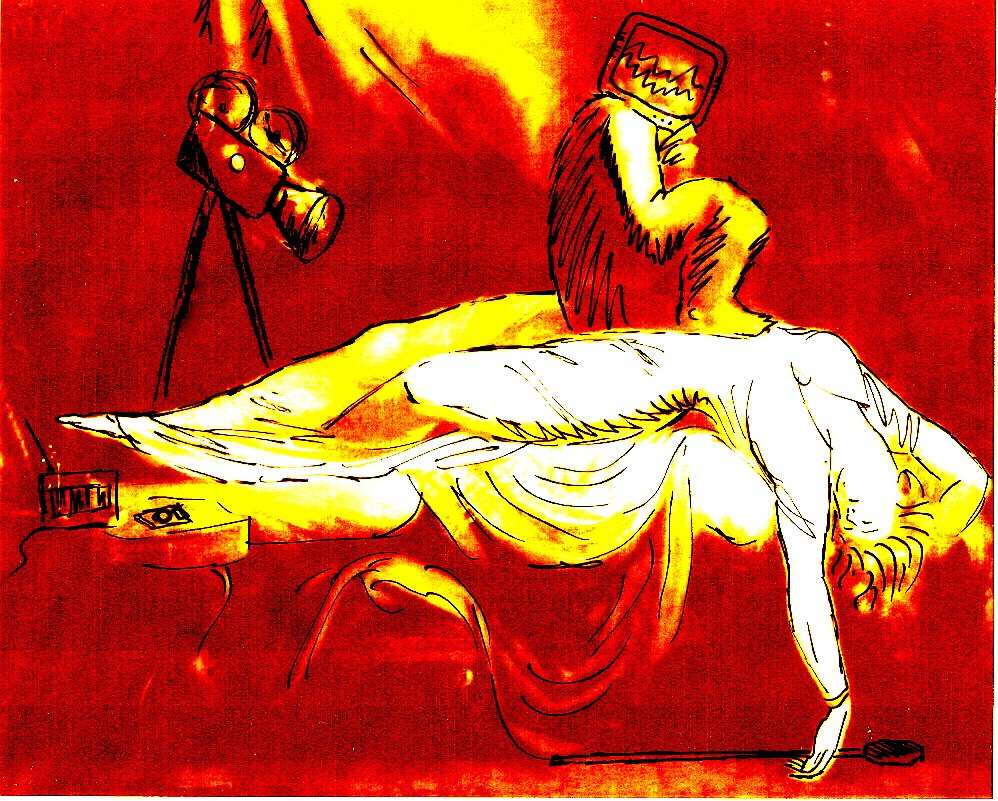
Another version of Fuseli’s Nightmare

Not surprisingly, Fuseli’s (in)famous Nightmare painting was frequently mocked, especially in its day, when it served as a template for political caricatures such as the one attempted by me here, one in which liberty is being haunted by images of the Middle East (the camel in our bedrooms) and the ineptitude or rampant ambitions of a certain world leader.

How infinitely more stimulating, I thought, while wandering through the exhibition—which does some violence of its own by pairing sublime Blake with silly Fuseli, or by confronting the pre-cinematic Phantasmagoria with French-revolutionary Romanticism—is the suggestive terror of the airwaves, compared to the horror of the image, whether still or moving.

Of course, I am resorting to another caricature of my own to support—and thus undermine—my point: that the imagination, stifled or silenced by clamorous images, suffered its greatest defeat with the deposition of short-reigning radio by the matter-over-mind medium of television.