
 I was inclined to put the “wireless women” on hold for today. I have been feeling rather poorly as a result of an exposure to noxious fumes emanating from a fresh coat of paint in our conservatory. My evening with Claudette Colbert, starred in the rarely screened melodrama The Man from Yesterday (1932) was utterly spoiled. I also missed the BAFTAs, the new Marple (controversially, not a mystery in which the old sleuth was placed by her creator), and found little enjoyment in Crack Up (1946), a noirish thriller directed by radio dramatist Irving Reis, which aired on BBC Two early last Saturday. Dizziness, mood swings, fatigue and nausea are my mental and bodily responses to a thankfully small number of chemical solutions including household cleaners, varnishes, and insecticides.
Having spent some time in the crisp winter air this afternoon, I am ready to carry on about those fabulous radio ladies. I was thrilled to hear from a relative of Ms. Minerva Pious, one of the “wireless women” I have been commemorating here over the past few weeks. Her rags-to-riches-to-rags story sure seems worth exploring, particularly by someone who has ready access to personal correspondences and can draw on childhood memories.
The series will come to an end this Friday, when the (to the best of my knowledge) correct answer to the quiz will be disclosed in a tribute to radio playwright Lucille Fletcher. The “microphonic men” will be honored in the fullness of time (meaning, the emptiness of my schedule).
Earlier today, after a few exchanges via email, I was pleased to send off excerpts from my doctoral study to one of those old-time radio greats: none other than poet-journalist Norman Corwin, who will be very much a man of the hour come Oscar night, considering that a documentary about his work is up for an award. Now, on to the current column.
Judging from above picture, I seem to have quite a bit in common with ditzy dame Joan Davis. I am lousy at housework (particularly after taking a whiff of those detergents), tend to break things around the house (even when not intoxicated), and am inclined to sweep many of my mishaps under the proverbial carpet. Of course, Davis merely “enacts a housecleaning drama for Tune In,” a 1940s broadcasting magazine. According to that periodical (an issue of which I picked up years ago at a Chicago memorabilia store), Davis’s career was a “New Example of Rudy [Vallee]’s ability to Pick and Make Stars.”
No “clueless men” here, so far (except for me, of course). Certainly not Vallée, whose oleaginous radio persona I never found particularly prepossessing (give me John D. Hackensacker III anytime). He was a poor reader of lines, and his singing, too, had an air of carelessness about it. I gather he relied rather too much on the superstardom to which he became accustomed and used it to propel others instead of making any further efforts to push himself. Among those who came out of Vallée’s star factory were Carmen Miranda, Milton Berle, Edgar Bergen and Beatrice Lillie, the article claims.
Joan Davis, anno 1943, was hailed as Vallée’s “newest discovery,” notwithstanding the fact that she had already appeared on the screen in comedies like Sally, Irene, and Mary (1938) and Sun Valley Serenade (1941). “To many who have seen her in films,” the article continues, “Miss Davis may not seem a new discovery. But it was Vallee who lifted her out of a medium in which she was but little known, a minor success, and built her into the radio’s outstanding find of the season.”
When Vallee left his show to join the Coast Guard in the summer of 1943, he chose Joan to mind the Store. Here you can tune in to Joan’s remodelled Sealtest Village Store. It becomes clear just who took care of business, even though clueless executives thought for a while they needed to throw in Jack Haley for support. Davis, in fact, slightly improved on Vallee’s Hooper ratings, outscreeching competitors like Abbott and Costello, Burns and Allen, Eddie Cantor, Fannie Brice, Fred Allen, and Jimmy Durante. Obviously, his time was her time—and America made time for it.
 Fair weather convinced me to spend the afternoon in the garden, where I busied myself with saw and secateurs. All that vigorous communing with nature felt like a tonic, especially after last night’s screening of Humoresque, an acrid Joan Crawford melodrama co-starring John Garfield and Oscar Levant, all of whom (but particularly Levant) rather overdid the acerbic one-liners with which the screenplay is riddled. Just about everything is wrong with this overwrought picture, from the drearily predictable and uninvolving plot to Crawford’s atrocious eyewear, the exceptions being J. Carroll Naish as Garfield’s father and the to me intriguing Peg La Centra as an underappreciated nightclub singer.

 Well, it is time to light the candles, open that bottle of champagne, and count the ways in which we love . . . Mrs. Living- stone’s husband? Comedian Jack Benny, I mean, who would have turned thirty-nine all over again on this Valentine’s Day. Americans may declare their love for the man by
  Well, I am back from my three-day getaway to Manchester, my makeshift Manhattan. And what a poor substitute it has proven once again. The only bright spot of an otherwise less than scintillating weekend was the production of James M. Barrie’s comedy What Every Woman Knows at the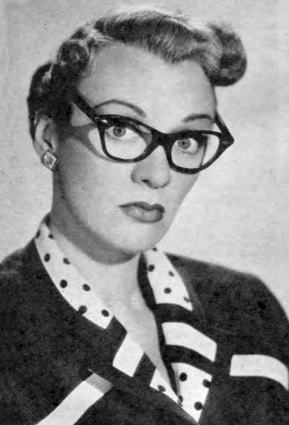
 Have you taken the broadcastellan quiz yet? I’ve got a few more laudable larynxes lined up to commemorate women in American radio dramatics. There is certainly a renaissance of old-time radio underway, an iPod regeneration infinitely more satisfying than my phrasing here; after all, just how long can a birthing or rebirthing process take? It’s the nurturing that matters now. And while some of those names on my list of leading ladies no longer ring the proverbial bell, they sure spelled “stardom” when radio took center stage in American living rooms. Perhaps, “star” isn’t the word for being it on the radio. Stardom requires visibility, screen close-ups and paparazzi snapshots that define an individual’s status as being removed enough from the crowd to demand admiration and near enough to encourage our approach. A broadcast voice can make an actor; but it is the circulated image that makes a star.
 Last night, I watched The Damned Don’t Cry (1950), a seedy but glamorous rags-to-riches-to-rags melodrama starring Joan Crawford. Crawford was a perfectionist on screen, even though producers like Jerry Wald determined that, by the mid-1940s, her physiognomy was less than ideal and called for that extra layer of gauze in front of the lens to soften her mature looks (because most leading roles in Hollywood are, to this date, a little too young for anyone over forty). No doubt, Crawford’s need for control contributed to what those in the radio business called mike fright. When Crawford went on the air, starring in dramatic programs like Suspense, she insisted on being recorded for later broadcast rather than going on the air live. Apparently, to someone as protective of her persona as Crawford, any screw-up in radio insinuated something tantamount to crow’s feet on screen. Not to Crawford’s Johnny Guitar (1954) co-star and rival, though, the radio-trained and true Mercedes McCambridge.
 Well, are you ready to tap your toes to the “The Cabinet Shuffle,” sing “The Tory Blues” or stand up for the “Thatcher Anthem”? That’s right, the Iron Lady is back in business. Show business, that is. Thatcher: The Musical is
  Harry Heuser