
ANNOUNCER: Well, sir, it is the middle of the afternoon as we enter the small house half-way up in the Welsh hills. In the conservatory we find our friend Dr. Harry Heuser in less than scholarly pursuits as he stares out of the windows to witness the birth of the first lamb of the season. He has taken a few pictures and now picks up the phone to relate the news to his pal in the old country. Listen!
Okay, you won’t get to listen. As you may have gathered from the above imitation, I was determined to keep the old-time radio comedy Vic and Sade—but especially Sade—in my ear and on my mind this afternoon when I got distracted by the opening of an outdoors birthing center just beyond the hedge.
Being an old urbanite, the opportunity of witnessing the spectacle of a lamb being born in full view is something too fascinating to pass up. I seem to be averting my eyes too often as it is, you might think, as I rarely mention the headlines of the day, be it the rise of cartoon riots or the spread of avian flu, Holocaust denier trials or Winter Olympics scandals. Indeed, I generally have such strong opinions that it is not always easy to refrain from speaking up. Ish!
The privilege of this online journal, as I see it, is not so much to go on indiscriminately about anything, but to show the restraint that is the requisite of all artistic expression. Rather than the illusion of being altogether ungoverned, art is the reality of adhering chiefly to our own rules. So, let’s go visit Mrs. Victor Gook, shall we?
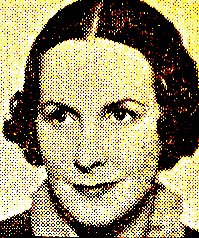
As imagined by radio writer Paul Rhymer and brought to life by former stage actress Bernadine Flynn (pictured), Sade Gook was neither a desperate housewife nor a dainty one. She was her husband’s equal, and sometimes his superior. She got along well with her adopted son, Rush, but did not always find it easy to keep her cool when confronted with the antics and outrageous anecdotes of her visiting Uncle Fletcher.
Rhymer’s imaginary small house was only occupied by those four characters; and sometimes Sade was left all to herself (something she relished, rather than dreaded). Through their exchanges and their one-sided telephone chats with others, however, listeners got to hear about a lot of different folks. Indeed, these talked-about or talked-to personages are so frequently mentioned and vividly described by Sade, Vic, Rush, and Uncle Fletcher that you might sense having heard them after all.
When the men of the menage are gone, Sade Gook enjoys settling down at last to one of her telephonic exchanges with confidante Ruthie Stembottom; never heard, always there. Unlike Uncle Fletcher’s outlandish acquaintances, recalled from the past or made up for the sole purpose of yarnspinning, Mrs. Stembottom is decidedly real.
Rhymer’s writing and Flynn’s well-timed monologue make it so. Yet, by not being imaged forth through voice, she becomes, by extension, our imaginary friend. We know her because we are her genetrix, giving birth to her in our minds.
The noisy men in Sade’s life are about to leave now. Once again we are being teased with a bit of intimacy; but, as in this conclusion to one of Rhymer’s scripts, little more than Sade’s satisfaction is conveyed. Let’s listen in as she cherishes the momentary stillness—by talking, of course:
VIC and RUSH. Telephone is ringing, telephone is ringing.
SADE. I’ll get it.
FLETCHER. (off a ways) Good-bye.
SADE. Good-bye, Uncle Fletcher. So long, fellas.
VIC. (moving off) So long, kiddo.
RUSH. (moving off) So long, Mom.
SADE. [into the imaginary telephone receiver] Hello? (warmly) Oh, yes, lady. Why, bless your old sweet heart, you did call back. (giggles affectionately) Gee, lady, I still haven’t got anything to say. It was just such a still quiet lonesome afternoon I felt like I had to talk to somebody. Isn’t it quiet though. Person runs into quiet afternoons like this every so often. Yes. (giggles) Well . . . quietness is nice sometimes. Gollies . . . I don’t think I’ve spoken to a soul all day. No. (and then briskly) Who had an operation, Ruthie? Mis’ McFreemer? Which Mis’ McFreemer? The one on South Morris Avenue or the one on West Monroe Street?
ANNOUNCER. Which concludes another interlude . . . at the small house half-way up in the Welsh hills.
 I was inclined to put the “wireless women” on hold for today. I have been feeling rather poorly as a result of an exposure to noxious fumes emanating from a fresh coat of paint in our conservatory. My evening with Claudette Colbert, starred in the rarely screened melodrama The Man from Yesterday (1932) was utterly spoiled. I also missed the BAFTAs, the new Marple (controversially, not a mystery in which the old sleuth was placed by her creator), and found little enjoyment in Crack Up (1946), a noirish thriller directed by radio dramatist Irving Reis, which aired on BBC Two early last Saturday. Dizziness, mood swings, fatigue and nausea are my mental and bodily responses to a thankfully small number of chemical solutions including household cleaners, varnishes, and insecticides.
 Fair weather convinced me to spend the afternoon in the garden, where I busied myself with saw and secateurs. All that vigorous communing with nature felt like a tonic, especially after last night’s screening of Humoresque, an acrid Joan Crawford melodrama co-starring John Garfield and Oscar Levant, all of whom (but particularly Levant) rather overdid the acerbic one-liners with which the screenplay is riddled. Just about everything is wrong with this overwrought picture, from the drearily predictable and uninvolving plot to Crawford’s atrocious eyewear, the exceptions being J. Carroll Naish as Garfield’s father and the to me intriguing Peg La Centra as an underappreciated nightclub singer.

 Well, it is time to light the candles, open that bottle of champagne, and count the ways in which we love . . . Mrs. Living- stone’s husband? Comedian Jack Benny, I mean, who would have turned thirty-nine all over again on this Valentine’s Day. Americans may declare their love for the man by
  Well, I am back from my three-day getaway to Manchester, my makeshift Manhattan. And what a poor substitute it has proven once again. The only bright spot of an otherwise less than scintillating weekend was the production of James M. Barrie’s comedy What Every Woman Knows at the
 Have you taken the broadcastellan quiz yet? I’ve got a few more laudable larynxes lined up to commemorate women in American radio dramatics. There is certainly a renaissance of old-time radio underway, an iPod regeneration infinitely more satisfying than my phrasing here; after all, just how long can a birthing or rebirthing process take? It’s the nurturing that matters now. And while some of those names on my list of leading ladies no longer ring the proverbial bell, they sure spelled “stardom” when radio took center stage in American living rooms. Perhaps, “star” isn’t the word for being it on the radio. Stardom requires visibility, screen close-ups and paparazzi snapshots that define an individual’s status as being removed enough from the crowd to demand admiration and near enough to encourage our approach. A broadcast voice can make an actor; but it is the circulated image that makes a star.
 Last night, I watched The Damned Don’t Cry (1950), a seedy but glamorous rags-to-riches-to-rags melodrama starring Joan Crawford. Crawford was a perfectionist on screen, even though producers like Jerry Wald determined that, by the mid-1940s, her physiognomy was less than ideal and called for that extra layer of gauze in front of the lens to soften her mature looks (because most leading roles in Hollywood are, to this date, a little too young for anyone over forty). No doubt, Crawford’s need for control contributed to what those in the radio business called mike fright. When Crawford went on the air, starring in dramatic programs like Suspense, she insisted on being recorded for later broadcast rather than going on the air live. Apparently, to someone as protective of her persona as Crawford, any screw-up in radio insinuated something tantamount to crow’s feet on screen. Not to Crawford’s Johnny Guitar (1954) co-star and rival, though, the radio-trained and true Mercedes McCambridge.
 Harry Heuser