An Invitation to Murder by Installments!

Last night I was in on Charlie Chan’s Secret (1936). If somewhat deficient in atmosphere, this old whodunit has many of the key elements of early twentieth-century mystery melodramas like Seven Keys to Baldpate and The Cat and the Canary. Let’s see: there’s a large family fortune and plenty of heirs who’d like to lay claim to it; bogus visitations from the realm the dead; murders ingeniously plotted but thwarted; and a wealthy elderly matriarch in a neo-gothic mansion who is in desperate need of a detective to sort out the family closet.

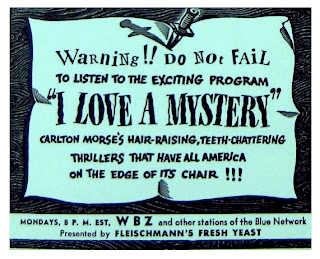
Come to think of it, that sounds rather a lot like “The Thing That Cries in the Night,” one of the sequences of Carlton E. Morse’s radio thriller I Love a Mystery. Now, there’s a serial I wouldn’t mind reviewing . . . again.As I said previously, I don’t have anything against radio serials, if only they did not insist on such a commitment on my part to be intelligible, let alone enjoyable. Of course, I Love a Mystery is not one of those open-ended daytime serials that go anywhere, and nowhere fast. By the way, I did follow up what happened to Mrs. Goldberg and her chicken venture, but still couldn’t make much sense of the not-going-ons over at Molly’s house.

Morse’s storytelling is byzantine, to be sure, but it is not interminable; each cliffhanger takes you closer to a solution, even though the inevitable conclusion is never as satisfying as our journey and gradual advancement toward it.

On 31 October 1949, the East Coast revival of I Love a Mystery began its investigation of “The Thing That Cries in the Night.” For fifteen nights, listeners were invited to follow the bizarre adventures of three soldiers of fortune—Jack, Doc and Reggie—in an old house whose closets were filled with the proverbial family skeletons. Even though I devoted a lengthy chapter to it in my dissertation, I have never enjoyed this serial as it was offered to the radio audience—as a mystery whose solution is purchased on an installment plan.

So, inspired by the shared viewings going on over at the Charlie Chan Family Home, I am proposing a shared listening experience of “The Thing That Cries in the Night.” It would require little more than ten minutes each day to listen to each of the fifteen episodes (available online here) and a few minutes more to exchange ideas about it on this blog. If you miss an episode, you can always catch up with the convoluted plot here. I will even continue my reviews while away for a visit to my former home, the Big Apple.

Anyway, let me know whether you accept my invitation to go in search of the mysterious “Thing,” starting this Halloween . . .

On This Day in 1930: Old Sleuth Re-emerges in New Medium

Well, before taking a moment to give my page a bit of a makeover and getting all gimmicky by setting up a poll to encourage reader participation (despite my own difficulties with such surveys), I tuned in again to BBC 4 last night and watched another fine British thriller: Edward Dmytryk’s Obsession (1949). Sufficiently motivated by the experience, I promptly cast my vote at IMDb, which is something I am just getting into the habit of doing.

Obsession is told mainly from the perspective of the criminal, a jealous husband determined to do away with his wife’s lover; eventually, Scotland Yard is on his case, and the storytelling loses some of its focus as the inspector keeps calling and occasionally takes the camera along with him. Still, with its emphasis on the execution and prevention rather than the detection of a crime, Obsession is a psychological thriller as opposed to a whodunit, the genre revolutionized in the 1880s by Conan Doyle and his famed Sherlock Holmes stories.

I have always enjoyed a solid whodunit, even though I prefer them in print instead of visualized on the screen or dramatized for radio, as I explained previously. I nonetheless put aside my copy of Agatha Christie’s Poirot puzzler The Clocks to commemorate a milestone in radio mystery drama. It was on this day, 20 October, in 1930, that master detective Holmes and his sidekick-chronicler, the logic-deficient Dr. Watson solved their first mystery on the air.

The mystery, “The Speckled Band,” was a familiar one, to be sure, as was the actor who assumed the role of the brilliant if conceited armchair detective. The performer before the microphone that night was none other than William Gillette, who had not only played Holmes more than a thousand times before but had rewritten some of his adventures to create a stage melodrama that was to serve as his star vehicle for over three decades.

As a Theatre Magazine critic pointed out, Gillette “himself cut the radio score, arranged by Edith Meiser [. . .], directed his cast, and spoke into the microphone from the special glass-curtained stage of the National Broadcasting Company’s Times Square studio” atop the theater that had been “the scene of Gillette’s farewell return to the footlights” earlier that year.

Gillette was already in his late 70s and did not return to the microphone for subsequent episodes; but, being described by a New York Times reviewer as standing “erect and unbending” and as having a “clear, precise, vibrant” voice, the aged thespian was lured out of retirement now and again to play the part for several years longer, returning to the airwaves once more for the 18 November 1935 Lux Radio Theatre production of his stage success.

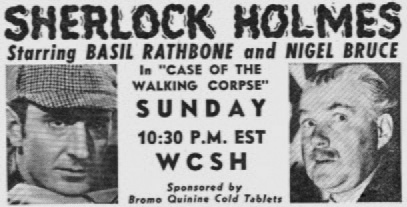
Holmes survived Gillette’s death in 1937 and continued for another decade to solve mysteries on US radio, even though he had to face plenty of competition on the blood-speckled bandwidths. Like the motion picture series starring Basil Rathbone and Nigel Bruce, the Holmes adventures on the air also played an important role in home front motivation, endearing Americans to their at times veddy peculiar and snobby sounding allies in Britain. After the war, the British reclaimed Holmes and continued to dramatize his adventures on BBC radio.

Although I was not immediately taken by such pastiche, the American dramatizations eventually won me over with their charm. Retaining Watson as the narrator added much to the cozy atmosphere of these miniature mysteries; the banter between Holmes and his friend supplied the wit; and the thrills were not wanting either, as aforementioned writer-adaptor Meiser managed to keep the guessing game going despite the challenge of making the short plays intelligible by reducing the number of suspects and dropping fairly conspicuous hints.

So, as the sun is setting earlier or refuses to appear altogether on these gray autumn days, I will sit back more often to join Dr. Watson at his fireside, listening attentively to his tales of intrigue and murder. Just don’t call it an obsession . . .

Loving (and Judging) Harold Lloyd

Well, thanks to a much needed and greatly appreciated contribution to our DVD library (courtesy of my nostalgic pal Danny), I had the good fortune of screening Harold Lloyd’s Movie Crazy (1932) last night. I know, Lloyd did not direct this film, but calling it Clyde Bruckman’s Movie Crazy hardly clarifies matters. In most cases, the ultimate and highest credit is given to the director; but just as often it rightly belongs to the actors, writers, or cinematographers who hold a film together and make it worth watching.

I have always preferred the middle-class milquetoast portrayed by Lloyd over the melancholy tramp created by Chaplin. Perhaps it is Chaplin’s ego that has shattered my belief in his sincerity. Perhaps, being partial to old-time radio, it irked me that Chaplin, unlike Lloyd, kept his eyes closed to broadcast drama. Perhaps, and more likely, it is easier for me to identify with Lloyd’s bespectacled fool coping with modern times than to ingest foolish spectacles steeped in pseudo-Dickensian treacle.

It is tiresome to explain one’s predilections. “What is there to say about what one loves except: I love it, and to keep on saying it?” This is how Roland Barthes expressed the difficulty of writing intelligently—and intelligibly—about our passions. I might flaunt my tastes yet by sharing some of my top-ten lists on this blog, whenever my fount of ideas dries out. Anyway, I decided to cast my vote for Movie Crazy over at the Internet Movie Database. My voting history is on public display for anyone registered at the IMDb.

So, how do I rate motion pictures? It sure is easier to review them than to determine how many stars (or thumbs up or rotten tomatoes) a film warrants (ten stars being the highest rating on IMDb, which I have given only once thus far, in recognition of this previously discussed masterpiece). Supposedly, we are to judge the entire picture, not some aspect of it. Am I to boost or lower a film’s overall ratings if I find it unfairly appraised? Am I to root for my favorite actress? And how do I rate a comedy on a melodrama day?

I have always had difficulties with such seemingly simple tasks as voting by numbers or grading by letters; for the same reason, I have done poorly when being put to the multiple choice test. I would rather share my thoughts about a work of art than declare my approval by adding numbers to a graph. Still, I am going to cast my vote, remembering Harold’s awkward courting of Mary and her alter ego (Constance Cummings, whom I had just seen in Blithe Spirit and, like Lloyd’s character, did not recognize in another role); bearing in mind a few slapstick routines that did not quite come off; recalling the superbly executed finale of the film; and unwilling to dismiss that I watched it with someone I love.

On This Day in 1942: Orson Welles Lures Fred Allen into the Sewers

Last night, watching BBC 4, I was in for a cinematic treat: Carol Reed’s Odd Man Out (1947). Cinematographically stunning and compellingly told, it is not unlike Reed’s best-known film, The Third Man, particularly in its investigation of that most dangerous game, the manhunt. Both films are 20th-century updates of novels like Caleb Williams or Les Miserables, stories of pursuit that challenge readers to distinguish between what is right and what is just, between law and ethics. The backdrops are often dark and seedy—the slums, dumps, the sewers. Contrasted with the dwellings of the elite, they serve as reminders that the dregs of society are not commoners but discarded ideals.

Welles found himself trapped in the sewers in both Les Miserables and The Third Man; and both stories were adapted for radio, starring Welles. On this day, 18 October, in 1942. Welles made another descent into the muck of humanity, this time to have his revenge on Fred Allen, the radio wit who had mocked him once too often.

The confrontation between Hugo’s Javert and Jean Valjean, that clash between ethics and law, was reduced to a mismatch of lowbrow and highbrow art as played out by two quintessential middlebrow artists, radio comedian Fred Allen and Shadow graduate-turned-thespian Wunderkind Orson Welles. Could radio and literature be reconciled? Could the airwaves be a fount of high culture?

Presumably, Welles had come to the realization that he was “getting along in years” and that he could “no longer carry on alone.” In search of a co-star “with a flair for the buskin,” he turned to Allen and offered him the role of Javert in Les Miserables.

As it turns out, however, Welles was not prepared to share the stage. He had to remain in charge of every aspect of the production and could not bring himself to letting Allen utter even a single line. Flattery soon turned into humiliation, and Allen began to protest:

ALLEN. Now look, Orson, I don’t want to hog the whole thing.  But in two acts all I’ve done so far is knock on a door and blow a whistle.  Now, after all, I’m an actor, not a soundman.  When do I get to read some lines?

WELLES.  The next scene is all yours, Fred. Your speech is the climax of the entire play.

ALLEN.  Well now we’re getting some place. What’s next?

WELLES.  In this final scene you trail me through the sewers of Paris.

ALLEN.  Oh, the sewers.

WELLES.  You finally corner me single-handed.  There we stand, face to face.  I have just a few words and then you speak.

ALLEN.  I speak.  Well, that sounds good.  Let’s go.

(Music: heavy, then fades.)

WELLES.  Mon Doo! Alone in this sewer! Trapped like a rat who nightly crawls through this hideous muck of the city.  The gloomy darkness, this narrow archway above my head, these two slimy corridor walls.  (Hysteric laugh.) Oh, but hark! That sloshing through the muck. Javert! At last you’ve cornered me, Javert! Don’t talk, Javert! Before you seal my doom, I would speak for the last time. You will never take Jean Valjean alive, Javert. (Laughs.)  The water in this sewer is rising, Javert.  I am six feet nine.  You, Javert, are five feet two.  The water rises, Javert.  There is no turning back.  The water! Higher, higher.  Now, Javert, you have Jean Valjean at your mercy.  Pronounce my doom.  Speak, Javert.  Speak.

ALLEN.  (Gargles.)

Thus, the wit of Fred Allen, radio’s smartest satirist, is drowned in a display of misguided aspirations. As I put it in Etherized Victorians, the promise of radio as a purveyor of great literature is “exposed as so much hogwash.” US radio artists were often called upon to ridicule that which neither sponsors nor network executives were willing to touch: so-called high art (including popular literature of the past that, like Hugo’s novel, had just enough patina to appear precious).

It was easier for producers and audiences alike to deride and dismiss as affected anything that might effectively challenge the status quo or the intellect. In the best games of pursuit, the lines between wrong and right become blurred; in the radio game, at its commercial best, the distinctions between what is wrong and right for the greater American public were always made with comforting clarity.

On This Day in 1948: Boris Karloff Gets Himself In and Out of a “Beastly Silly Wheeze of a hole!”

“Hole!” said Mr. Polly, and then for a change, and with greatly increased emphasis: “‘Ole!” He paused, and then broke out with one of his private and peculiar idioms: “Oh! Beastly Silly Wheeze of a hole!” —H. G. Wells, The History of Mr. Polly (1909)

Well, we’ve all been there, I guess; call it a rut, a depression, or down in the dumps. A hole by any other name is just as deep. To look on while someone you love is stuck in one can make you as miserable as dwelling there yourself; it seems difficult to find a way out either way. One could throw a book, I suppose, in lieu of a rope. Light enough to be hit by without sustaining injury, but profound enough to make what you might call an impact, The History of Mr. Polly is just the right volume to toss. While not exactly a guide to better living without chemistry, it sure is comforting—a friendly reminder to anyone who is deeply dissatisfied with the “hole” of life that it is possible to get out or on with it somehow.

In Mr. Polly’s case, getting out involves a botched suicide attempt, arson and insurance fraud, an unreliable pistol, a pair of stolen trousers, and the fortuitous departure of an abject scoundrel. I didn’t suggest there’s an easy way out, and neither does the author, H. G. Wells.

Middle-aged, mismatched, and miserable, Mr. Polly has very nearly gone crackers; but he learns, at last, that a change of luck or pace is not beyond his own powers. On this day, 17 October, in 1948, Boris Karloff assumed the role of the man in the proverbial ditch, seizing the rare opportunity to step onto the stage for a noteworthy stab at reinvention.

Karloff could probably identify with Wells’s antihero, considering that the actor had been in the beastly hole of typecasting for far too long and was, after a string of horror movies, in danger of becoming a mere caricature. The Grinch of box office calculations had absconded with his thespian options.

The NBC University Theater, a radio program that featured adaptations of literary works of fiction and provided brief lectures between the acts, gave the soft-spoken Londoner an opportunity to take off the Halloween costume he’d been dealt by Hollywood’s costume department and put on the mask of comedy instead.

Some three years later, when Anthony Pelissier’s motion picture adaptation of the novel opened in New York City, the audience was faced with a Mr. Polly who had the features and figure of John Mills; but on radio, it was Karloff who inhabited the role in a moving study of malady conquered and hope restored.

Let’s assume life is a broadcast studio. Consider the possibilities. Grab that microphone, my friend. I’ll be listening.

On This Day in 1941: Molly Goldberg Nearly Chickens Out

Today, I spent so much time updating my homepage, surfing for internet television channels, and catching up with yesterday’s X Factor (rooting for Brenda, Andy, and Maria), that I neglected to commemorate the birthdays of Eugene O’Neill and Angela Lansbury (and discuss their respective radio connections). Instead, given the temporal restrictions, I decided to take in a 9-minute episode of one of radio’s earliest domestic serials, The Goldbergs.

I don’t mind listening to daytime radio serials. I certainly don’t condemn them outright; nor do I call them “soap operas,” for the same reason I don’t label crime dramas or variety shows “after shave thrillers” and “cigarette follies.” True, the so-called soaps (or washboard weepers) were largely manufactured by the makers of bubble baths and detergents. Still, it is wrong to single them out as being mere product placement opportunities, since promotional efforts also defined (or at least influence the content of) Jack Benny’s Lucky Strikes Program, The Lux Radio Theatre, and a great many other sponsored series.

The main problem I have with serials, as opposed to episodic or anthology dramas, is that I don’t give them enough time to grow on me or that too many installments are no longer extant to assist me in fostering an appreciation. In other words, I do not want to get engrossed and could not, anyway.

I do like Molly Goldberg; but she can—and occasionally does—get on my nerves. She is too frazzled, too neurotic, too much of a stereotype at times; whatever her accomplishments as a wife and mother, she too often fishes for sympathy, rather than compliments. Take the confession, for instance, that she was nearly too embarrassed to make on this day, 16 October, in 1941.

The entire episode could be summed up in one sentence: With considerable difficulty, Molly can be induced to admit that she has invested money in a friend’s possibly dubious poultry business. In this particular script, Gertrude Berg left out the story and depended solely on her portrayal of the kindhearted matriarch she created.

The stalling becomes a bit too obvious, and eventually desperate and tiresome. I’ve got nothing tonight, you can just hear Berg saying as she sits at her desk (pictured above), but I’ll pull it off because my public loves to hear Molly struggle.

Sure, I love you, Molly, and I appreciate the fact that you didn’t expect I’d be listening to your radio program today (with avian flu on my mind); still, parcel out a more generous piece of plot for me and I might stop by for another visit. After all, quite a few successive installments are available from October 1941, a period rife with war anxieties and home front preparations for inevitable shortages in food and consumer goods. Don’t count your chickens, Molly—there’s trouble ahead!

How a Picture Perfect Brief Encounter Dissolved into a Not-So-Still Life

Last night, when it was time to dim the lights, set up the screen, and decide upon a movie to take in, I could be convinced to leave Broadway and Hollywood behind to make it David Lean’s Brief Encounter (1945). Mind you, it did not require much coaxing. I purchased a copy of the film a few weeks ago, but believed myself to be not deserving of experiencing it just yet. Some motion pictures are so grand that they demand not only our attention but our emotional receptiveness.

I have always thought it possible, and indeed imperative, to approach art with a keen eye and an open heart, to feel it and to feel like thinking about it at the same time. To examine Brief Encounter without being enveloped by it would be tantamount to noting the ingredients of a great meal without taking time to savor it.

Only after I had dried the tears I was neither inclined nor able to hold back, did I go in search of another interpretation of the story—cinema reconstituted as radio drama. A while back, I did as much with Lean’s Blithe Spirit, but knew right away that, in this case, radio could not hold a candle to a portrait so delicately outlined and exquisitely lit.

When the Theatre Guild reworked both Brief Encounter and Still Life, the Noel Coward play of which the film is an adaptation, the show’s producers made a number of sensible choices. They managed to bring Ingrid Bergman to the microphone to assume the role of Laura Jesson, the married woman who inwardly rehearses the miracle and misery of her recent indiscretion rather than confessing it openly to the husband beside her. Subtle and dignified, Bergman is perfect for the part, her emotive voice well suited to capturing moments of dignity under the assault of passion.

At the time of the broadcast (6 April 1947), Bergman starred on Broadway in Maxwell Anderson’s Joan of Lorraine, along with Sam Wanamaker and Romney Brent. Both her costars were heard in the Guild’s “Still Life,” with Wanamaker as Laura’s lover and Brent as her husband. Unlike Bergman, the two male leads do not quite communicate the vulnerability with which Trevor Howard and Cyril Raymond invested their parts.

Watching the film, I was under the impression that Laura was tormented by her overwhelming emotions, whereas the radio version suggested that she was torn apart by the two disparate men in her life, by the one wanting so little and the other demanding so much. What contributed to this impression was the way in which the adaptation by radio playwright and noted broadcast historian Erik Barnouw reframed Laura’s narrative without having access to a camera’s perspectival manipulations.

Lean’s film opens with the lovers’ last parting at the train station, a final farewell rendered furtive and mute by the sudden intrusion of one of Laura’s chatty acquaintances. Before the story of Laura’s affair unfolds in retrospect, the viewer already knows that something went terribly wrong for her, that the man who merely touches her shoulder has a stronger hold over her than she can permit herself to make public. Close-ups convey Laura’s grief, her isolation.

The radio version, on the other hand, opens with a scene of domestic life, as Laura’s husband struggles to control his two children who are unwilling to go to sleep before their mother returns home, presumably from a day of shopping. The listener is thus encouraged to prejudge Laura’s actions, to question the indiscretion of an inattentive mother who leaves her charge in the care of her husband while amusing herself with another man. Before she utters even one word of remorse, Laura is already a marked woman. In other words, whereas radio listeners are invited to accuse or pardon her, the film audience is given access to Laura’s own sense of guilt, her inner turmoil.

Generally, radio plays are quite capable of performing close-ups by means of whispered or closely-miked narration; in this particular cinematic challenge, however, the camera suggests so much more than unillustrated speech can express. When Laura acts on the impulse to end her life, her movements and features (pictured above) bespeak the horror that is her emotional imbalance.

In Barnouw’s adaptation, Laura merely talks in retrospect of having wanted to “throw [herself] under his [that is, her lover’s] train”—an unfortunate prosaic shortcut for the sweep and sway of Lean’s storytelling, aurally underscored images that reminded me, despite my love for the non-visual medium, what a sacrifice it can be to take leave of one’s complementary senses.

On This Day in 1953: Business as Bloody Usual on the “gaudiest, the most violent, the lonesomest mile in the world”

Well, Broadway is no longer the stuff of romance; having cleaned up its act in the dull spirit of corporate greed, it no longer is the “gaudiest, the most violent, the lonesomest mile in the world,” as it was once eulogized in hard-boiled and slightly over-cooked prose on the US radio thriller series Broadway Is My Beat (1949-54). Still, since I am returning to the Big Apple next month, having just booked my flight, I am going to rekindle my own romance with Manhattan by following Detective Danny Clover on his beat somewhere between or around Times Square and Columbus Circle.

On this day, 14 October, in 1953, Clover walked once again past “the hawkers, the gawkers, the ‘hurry up’ boys and the ‘slow down’ girls” to find himself confronted with some suitably sordid business of jealousy and murder—the “Cora Lee” case.

It’s “party time” on East 63rd. The shrill laughter of a drunken woman and the breaking of glass tells us at once that this ain’t a black tie affair. College graduate Cora Lee is in hot water; anyway, her head’s in a tub filled with it. The young woman very nearly drowned, and the bruise on her head suggests that she didn’t take the dive on her own free will. Now, the woman who reported the incident resents being thought of as a suspect. “You’re a stinker,” she tells Clover’s assistant. “And that’s the word I use in mixed company.” Cora comes to, eventually; but everyone around her, including her husband and her father, is too drunk to be of any use to her or the police.

A few days later, the “wild dame” celebrates her recovery with a few drinks in the company of husband and friends, party people who keep living it up while Cora is stretched out dead on the floor with a knife in her heart. Good-natured bunch, ain’t it?

“I was in college with Cora,” one of the drunken guests, a gal with feathers in her hair, tells Clover without a hint of compassion. “I knew her for two weeks, and I said to myself: there’s a classmate who’ll never see thirty. One way or another, she’ll never make it.” The deceased, she claims, was “the most, jealous, vicious, detestable, beautiful girl in the class of 1950.” Who might have killed her? Well, “anyone with a knife,” she sneers, especially the young woman who is so eager now to take Cora’s place as hostess of the merry gathering, offering highballs and sandwiches to the detective while threatening to do “damage” with her “high heel” if the feathered one doesn’t keep her mouth shut.

With all that talk going on, there isn’t time left to weave much of a mystery; but the thrill of listening to realist crime dramas like Gangbusters, Dragnet, or Twenty-first Precinct is not generated by suspense or surprise anyway. The criminal, whoever it happens to be, will in all likelihood be apprehended somehow. The excitement lies in going along for the ride, in the privilege of being in the presence of criminal elements, of witnessing the tawdry and treacherous, the vile and violent from a comforting distance.

With a dash of purple prose and a helping of humor, Broadway Is My Beat is as gaudy and violent as the formerly “lonesomest” mile it evokes in word and sound. As white as the Great White Way is nowadays, you just won’t get that kind of kick out of strolling past the Olive Garden or watching the out-of-towners going around on the Toys “R” Us ferris wheel. Let Detective Clover take you on a tour . . .

Hoping for More Scandal; or, When the “head’s modern, though the trunk’s antique”

As I mentioned yesterday, I had the pleasure of being lectured on sentiment and sensationalism in one of the back rows of The School for Scandal. It was a lesson conveyed with great wit and delivered without frills by the Northern Broadsides theatre company. I didn’t expect Sheridan’s characters to gossip in marked northern accents and thought Maria was less of a prize now that she was shouting just as angrily as the “odious” and “disagreeable” people around her. Generally, however, the coarseness of tongue lent realism to the idle chatter of the upper crust.

The Radio Guild players in 1930

Gone was the Cowardian disparity between elocution and vulgarity, between high class and mean instincts. Rather than being vocal acrobats in a Wildean vein, the graduates of this School were crass, brazen, and dangerous mudslingers. Only Joseph Surface was given the slick treatment in voice and appearance, a suitable gloss to reflect his falsehood. What might an American radio production do with such caricatures, I wondered, and went in pursuit of more Scandal on the air.

When aiming at respectability, US radio of the 1930s and 1940s not infrequently availed itself of British drama. Soap operas were for the kitchen—but Shakespeare and Pinero were for the parlor. As I put it in Etherized Victorians, my doctoral study on so-called old-time radio, Sir Benjamin Backbite’s remark about Mrs. Evergreen is an apt comment on US radio drama, a novel form of production that often exhausted itself in re-productions.”

“[W]hen she has finished her face,” Sir Benjamin quips, the unseen Mrs. Evergreen “joins it on so badly to her neck, that she looks like a mended statue, in which the connoisseur may see at once that the head’s modern, though the trunk’s antique.” Now, radio drama truly was a “mended statue,” a patched-up art form that rarely resembled the genuine article it tried to copy.

In radio, the trunk (the smart console) was modern, but the head, the boardroom of executives in charge of programming, was decidedly “antique,” that is, backward-looking rather than avant-garde when it came to defining wholesome or commercially viable entertainment. To be sure, in the case of Pre-Victorian plays like Sheridan’s Scandal, mending the statue might have required some whitewash to tone down its display of adultery and cover up its hints of abortion.

Unfortunately, the productions of Scandal as heard on the Radio Guild program are no longer extant, since no transcription have been preserved or recovered. Indeed, nearly the entire series seems to have been destroyed, an act as scandalous as the reputation of Sheridan’s characters. This is all the more lamentable considering that the Radio Guild (pictured above, anno 1930) was the first major theater anthology on US network radio. Beginning in 1929, just days after Wall Street laid its infamous egg, it brought free theater into the homes of millions, producing plays ranging from Shakespeare to Wilde, from Goldsmith to Boucicault.

Even if its producers kept their heads mainly in antique trunks, Radio Guild surely sounds like a statue worth mending, if only its pieces had been scattered instead of obliterated. So, if you find a fragment, please fling it my way.

On This Day in 1937: “Saints preserve us,” Here Comes Mr. Keen

“So shall my theme as far contrasted be, / As saints by fiends, or hymns by calumny.” Well, pardon me, but I just attended a touring production of Sheridan’s comedy The School for Scandal (1777), notes on which will have to wait until tomorrow—because tonight, I feel compelled to acknowledge, however half-heartedly, the anniversary of a radio program preposterous enough to be deemed food for foolery by noted on-air lampoonists Bob Elliott and Ray Goulding (pictured).

I am referring, of course, to Mr. Keen, Tracer of Lost Persons, whose melodramatic excesses—with its strongly contrasted “saints” and “fiends”—were first endured on this day, 12 October, in 1937.

The Mr. Keen parody, “Mr. Trace, Keener Than Most Persons” became a recurring sketch on the Bob and Ray program.

Sure, radio drama chronicler Jim Cox has devoted an entire volume to the story of the “kindly old investigator”; and considering that the series managed to stay on the air for eighteen years, from 1937 to 1955, it must have had its unfair share of followers.

Each week, Mr. Keen was grandiloquently and misleadingly announced as “one of the most famous characters of American fiction” in “one of radio’s most thrilling dramas.” Take that fiction and debunk it, Sam Spade, Philip Marlowe, and Nero Wolfe!

The series’ musical theme—the incongruously sentimental strains of “Some Day I’ll Find You,” appropriated from Noel Coward’s Private Lives (1930)—always struck me as a hollow promise at best. Find happiness already, old tracer, and settle down with a woman past the age of … 35! Call it Helen Trent’s last case.

Not that making his last find resulted in Mr. Keen’s retirement. “When Mr. Keen first came on the air as a fifteen-minute evening mystery ‘thriller,” Ohio State University graduate student Charlene Betty Hext observed in a 1949 MA thesis devoted to “Thriller Drama on American Radio Networks,” “he was a tracer of lost persons.

In fact,” Hext pointed out, Mr. Keen remained a tracer of lost persons when the program became a once-a-week half-hour show in the fall season of 1945.” It was a few years after the Second World War, a period when the missing persons theme reverberated particularly, that the plots began to deviate from the premise and Mr. Keen began to solve any case not already handled by the sleuths of the networks’ growing number of competing radio mysteries.  “The present program still uses the old theme music,” Hext noted, and the “announcer regularly refers to Mr. Keen as ‘the kindly old tracer’; but the plots of the radio program bear no witness to that effect.”

Whether retrieving the missing or apprehending miscreants, Mr. Keen’s methods of deduction rarely changed, and they were not of the most sophisticated sort. As Cox points out in his Radio Crime Fighters, Keen’s cases were poorly constructed, their solution relying on “minimal logic,” on coincidence and slip-of-the-tongue-shodness.

None of this bothered me as much as the condescension with which the sanctimonious hero with the soothingly avuncular voice interfered in the lives of those who sought his help or came under his scrutiny. He was an officious, moralizing hound who went about what was often none of his business at all.

I am not usually one to embrace camp, which, to me, is a cavalier act of willful misreading; but I was tickled all the same when a recreation of a Mr. Keen episode—”The Case of the Inherited Fear”—was performed and greeted with refreshing irreverence at the 25th Friends of Old Time Radio Convention in Newark, New Jersey.

The case involved a young naval officer who, as the narrator puts it, “disappeared after he’d been discharged from the navy for medical causes. He was obsessed with a fear of being in confined places.” I could identify with the runaway right away, for what could be more stifling than being clap-trapped by old Mr. Keen?

The unfailing tracer manages to get hold of the claustrophobe in a mining town in Pennsylvania, engaged in an attempt to overcome his anxieties by toiling underground. Just when he is about to make his first descent, an alarm is sounded and his efforts are temporarily thwarted: a cave-in has occurred, endangering the lives of 140 miners.

Keen “seized the occasion” to lecture the fearful man, insisting that he go below to rescue the workers. The old fellow single-handedly (or, make that, single-mindedly) unlocks the mystery of the ex-officer’s phobia by unearthing its true cause: “Your fear is nothing more than a symbol in your subconscious mind, a symbol of what happened the day you were locked in the closet with your mother.”

Such a mother lode of pop-psychological drivel could only trickle from the busy pen of radio melodramatists Anne and Frank Hummert, who decreed that, thanks to Mr. Keen, sanity be restored and social ties mended as the thoroughly rehabilitated young man rushes to the aid of the miners with the “same calm, untroubled expression” his mother has when she turns to her bible.

“Saints preserve us,” indeed, as Mr. Keen’s stereotypical Irish-American sidekick Mike Clancy would put it. The aged tracer had done it again, dispensing another dose of sentiment to which suspense would have been a welcome antidote, or at least a measure of temporary relief.

If only the tracer had gotten stuck in a closet that even the most tenacious grip of nostalgia could not help to unlock and that few friends of Fibber McGee would ever bother to reopen.