Well, as I’ve been casting it broadly in the previous three posts, I’m off on a weeklong visit to Madrid. Sure, I could have taken my laptop along with me to continue my journal while away; or I might have taken a mobile phone to send messages and images (like the one here, of this morning’s glorious Welsh sunrise) on the go. Instead, I decided to leave both computer and phone at home and to sign off for the duration.
The privilege of being away appears to be one of the disappearing pleasures of privacy. It is a concept no longer readily grasped by those born in the cellular, wireless, and instant-message age. Perhaps that is why the television series Lost has become such a success (surely it is not the writing): to be unavailable to the world is now thought of as a loss tantamount to being shipwrecked. Treat yourself to a retreat some time. Avail yourself of a chance at being unavailable. Experience the abandon of abandoning your everyday. To have something to write home about . . . and keep it.
You don’t have to get all Piano Manly about your getaway. Just tell those you care about that you’re out of town or country and enjoy the freedom of being incommunicado. Tell the world to get lost, then shroud yourself in silence. As long as there is someone or something worth coming back for, eventually . . .
One of the many attractions of Madrid I will make sure not to miss is Picasso’s Guernica (1937), the most famous 20th-century painting in the Reina Sofía collection. A report from the commonplace-turned-combat zone, Guernica is a piece of anti-totalitarian propaganda commemorating the world’s first civilians-targeting air attack: the 26 April 1937 raid on the busy market town of Gernika-Lumo, masterminded by General Franco and carried out by the Condor Legion of Nazi Germany.
Holding up to the sky my copy of Corwin’s play “They Fly Through the Air,” signed by its author
For a long time, the painting was kept out of Spain and was mostly on display at the MoMA in New York City, where, during the Vietnam War, it became a site for vigils held by members of the peace movement, one of whom went so far as to deface it with red spray paint. It was Picasso’s wish that Guernica be returned to his homeland only after the reestablishment of democratic rule. A swiftly executed and brutally manipulative commentary on modern warfare, it invites comparisons to the three best-known American verse plays for radio, Archibald MacLeish’s “Air Raid,” Edna St. Vincent Millay’s “Murder of Lidice,” and Norman Corwin’s “They Fly Through the Air with the Greatest of Ease.”
MacLeish’s “Air Raid,” in contrast to Picasso’s painting, overtly implicates the civilian population, including his radio listeners, castigating them for their supposed ignorance and inertia. As in “The Fall of the City,” MacLeish attacks those falling rather than sentimentalizing their plight. His are bold performances, but his cruel warning turns listeners eager for news into silent partners of war who are asked to “stand by” as they tune in while women and children, refusing to heed warnings of an impending blitz, are being attacked and annihilated:
You who fish the fathoms of the night With poles on roof-tops and long loops of wire Those of you who driving from some visit Finger the button on the dashboard dial Until the metal trembles like a medium in a trance And tells you what is happening in France Or China or in Spain or some such country You have one thought tonight and only one: Will there be war? Has war come? Is Europe burning from the Tiber to the Somme? You think you hear the sudden double thudding of the drum You don’t though . . .
Not now . . .
But what your ears will hear with in the hour No one living in this world would try to tell you. We take you there to wait it for yourselves. Stand by: we’ll try to take you through. . . .
Millay’s “Murder of Lidice” recalls the innocent lives of those slain by Richard Heydrich, Deputy Reich Protector of Bohemia and Moravia, in Lidice. Artistically, the play is indefensible and shockingly inept in its bathos. In Millay’s Grand Guignol of Nazi terror, Heydrich the Hangman, whom the villagers have assassinated, is heard, from the beyond, planning his revenge:
He howls for a bucket of bubbly blood— It may be man’s or it may be of woman, But it has to be hot, and it must be human! Oh, many’s the sweet warm throat he’ll suck.
In “They Fly Through the Air,” Corwin’s narrator goes in search of a language appropriate to the negotiation of art and propaganda. As I point out in Etherized Victorians, the play is a response to the perversion of poetic diction by the fascist cause. Viewed from above, Mussolini reportedly remarked, exploding bombs had the beauty of a “rose unfolding.” Throughout the play, metaphors are at war with plain speech, both in the service of motivating the masses:
What words can compass glories such as we have seen today? Our language beats against its limitations [. . .].
Our rhythms jangle at the very start. Our similes concede defeat, For there is nothing that can be compared to that which lies beyond compare. You see? We are reduced already to tautologies. It’s awe does that. The wonder of it all has set us stammering.
What is the language of war? How does it differ from the idiom of peace? And how shall war—often furious but not always futile—be rendered, recorded, and remembered in words or images? When I look at Guernica this week, I will ask myself these questions. Quite possibly, I will shiver when exposing it to the limitations of my shrinking lexicon.
Archibald MacLeish (right) with (from left to right) Orson Welles, Betty Garde, and Ray Collins in rehearsal for Air Raid (1938)
Well, I thought I’d better carry on with my Spanish lessons, having discovered, upon leafing through the travel guides, that I am not merely linguistically challenged but culturally ignorant as well.
According to one guidebook (admittedly, a someone dated volume), the citizens of Madrid—the madrileños—have a “lingering suspicion of foreigners” and are reluctant to speak English. Granted, it’s been a while since conquistadors rather than tourists filled Spain’s coffers, but the Spaniards have been known to be somewhat insensitive when it comes to other cultures. There sure is dirt under the old welcome mat.
On this day in 1533, for instance, Francisco Pizarro put an end to the Incan empire by doing away with emperor Atahuallpa. The Incas were not a chirographic people and did not appreciate having the book flung at them—especially not the good book. Intrigued by the thought that the demise of the Inca meant not only the loss of their aureate treasures but of their aural tradition, I flung my travel guides aside and tuned in again to one of the more ambitious if lesser known American radio series of the 1940s, Archibald MacLeish’s American Story.
A Pulitzer Prize winner for his poem Conquistador (1933), MacLeish (above, right, in a photograph reproduced in Irving Settel’s Pictorial History of Radio), was one of the first American writers to take radio seriously and to encourage others to emerge from their ivory towers by broadcasting their choice words to the masses. After all, he remarked in the foreword to The Fall of the City, his first and most significant contribution to the aural arts, “what poet ever lived who was really satisfied with writing the thin little books to lie on the front parlor tables?”
As a Librarian of Congress, MacLeish enjoyed ready access to many an obscure document—and radio offered an opportunity of sharing this wealth of unheard words. Rather than dramatizing scenes from history books, MacLeish wanted to let ancient texts speak for themselves:
To place historical personages in historical situations and then imagine the words they must have spoken to each other is to imitate the historical dramas of the stage at the expense of radio’s unique function and unique opportunity. Because radio is limited mechanically to sound, and particularly to the sound of speech, radio is capable of a concentration upon the speech itself, the text itself, which can give words a life and a significance they rarely achieve outside the printed page—and which they achieve there only for the most gifted and fortunate readers.
In “The Many Dead,” one of the scripts for the American Story series, MacLeish drew on the writings of Pizarro’s secretary Francisco de Xeres to recount the death of emperor Atahuallpa. In order to convey this sobering story without turning it into sensational melodrama, the poet-historian chose to deliver the “pertinent excerpts” of Xeres’s official account in the somber and matter-of-fact voice of a clerk, a newscaster of his time:
The Governor [Pizarro] asked the Father Friar Vicente if he wished to go and speak to Atahuallpa with an interpreter. He replied that he did wish it, and he advanced with a cross in one hand and the Bible in the other [. . .] and [. . .] thus addressed him: “I am a Priest of God, and I teach Christians the things of God, and in like matter I come to teach you. What I teach is that which God says to us in this Book [. . .].”
Atahuallpa asked for the book that he might look at it, and the priest gave it to him closed. Atahuallpa did not know how to open it, and the Priest was extending his arm to do so, when Atahuallpa, in great anger, gave him a blow on the arm, not wishing that it should be opened [. . .]. Then he opened it himself, and, without any astonishment at the letters and paper, as had been shown by other Indians, he threw it away form him five or six paces . . . .
Then the Governor put on a jacket of cotton, took his sword and dagger, and, with the Spaniards who were with him, entered amongst the Indians most valiantly. Then the Governor put on a jacket of cotton, took his sword and dagger, and, with the Spaniards who were with him, entered amongst the Indians most valiantly.
According to Xeres’s account, Pizarro and his men “fearlessly seized” Atahuallpa and the infantry of the Spaniards “made so good an assault” on the fleeing natives that “in a short time most of them were put to the sword.” Pizarro was said to have protected the emperor from the Spaniards—to give him the benefit of a proper execution—and was slightly wounded as a result. “It was a very wonderful thing,” the clerk concludes, “to see so great a lord taken prisoner in so short a time [. . .].”
The men with the books have generally proved victorious over the vocal but readily muted thinkers who spread their words without the benefit of the printing press. Atahuallpa, bereft of his voice after rejecting the book, chose death by strangulation. Even MacLeish, as Librarian of Congress, largely failed in his attempt to return written records to the air and revive the breath that gave them life. Who, after all, still listens to his American Story today?
Now, I hear that the madrileños are a noisy, boisterous people; perhaps the powerful, silencing, and not-so-good book instilled them with confidence. . . .
Well, “gracias, muchisimas!” Thanks to some last-minute planning on my behalf, I’ll be off on a trip to sweltering Madrid, starting next Wednesday. It will be my first visit to continental Europe since I left my native Germany for New York City in 1990; and it has been even longer since last I’ve traveled to a country whose primary language I neither speak nor comprehend. Although I lived just below Spanish Harlem for many years and the majority of my students at City University colleges were Hispanic, I never picked up more than the odd word or phrase. Indolence and impatience aside, my main excuse is that I was too busy appropriating English and promoting it as a common language, the thorough knowledge of which would benefit all who choose to live in the United States.
These days, resisting such study—and missing out intellectually and economically as a result—is being celebrated as multiculturalism, I suppose. Aware that I would miss out on Spanish culture unless I made a valiant if belated effort to train my tongue linguistically as well as culinarily, I popped in a DVD last night and watched Eran Trece. What better introduction to a foreign language than a lesson delivered by a Spanish re-interpreter of an American conception of the aphorism-peppered speech of a Chinaman! Charlie Chan, that is.
Eran Trece (1931) is the Spanish version of Charlie Chan Carries On, a copy of which has not yet resurfaced. It was produced in the early days of the talkies, when recasting rather than dubbing was being explored as a means of broadening the market for English and American films after the end of the silent era threatened to fragment the movie industry and diminish the potential of major studios like 20th Century Fox to generate global box-office successes. It was a costly enterprise that dubbing soon made redundant.
For anyone who has been exposed to dubbed films and the consequent muffling of cultural differences, the advantages of recasting will be readily appreciated, even though it meant that international audiences did not get to see the well-trained stars of Hollywood or Elstree, unless these performers were multilingual. Claudette Colbert, for instance, acted in both The Big Pond and its French version Le Grand Mer (1930).
Restaging also demanded a few rewrites to make an originally American or British film more intelligible or palatable to the international audience. For instance, when remarking upon a photograph of Chan’s many-headed family, characters in the original are reminded of Birth of a Nation, whereas the Spanish commentators liken it to a soccer team; apparently, not all silent movies translate quite so easily either. Eran Trece certainly has some Spanish blood in it; and even though much of it is spilled, the scenario includes a cheerful party scene with a fiery musical interlude that does not appear to be matched by the American original.
I neglected to mention that the copy I screened did not have English subtitles; so, being only vaguely familiar with the novel I read ages ago in a German translation, I availed myself of the scenario for the missing American film version, which is being shared online by the most generous and kindly guardian of the Charlie Chan Family Home. It was one of the most curious cinematic experiences I had since attending a MoMA screening of the fragmentary British-German coproduction of The Queen Was in the Parlor (1927), a silent film (neither scored nor accompanied by piano) . . . with Danish titles.
So, did I learn any Spanish last night? Well, not really, apart from Charlie’s frequently reiterated “Gracias, muchisimas”; but I’m sure I’ll remember the folly of this odd encounter with the Oriental hombre when confronted with the task of deciphering the dinner menus next week.
Moving from Manhattan to Mid-Wales was bound to lower my chances of taking in some live theater now and then (not that Broadway ticket prices had allowed me to keep the intervals between “now” and “then” quite as short as I’d like them to be). I expected there’d be the odd staging of Hamlet with an all-chicken cast or a revival of “Hey, That’s My Tractor” (to borrow some St. Olaf stories from The Golden Girls). Luckily, I’m not one to embrace the newfangled and my tastes in theatrical entertainments are, well, conservative. I say luckily because even if you’’re living west of England rather than the West End of its capital, chances are that there’s a touring company coming your way, eventually.
What came my way last night was a well-oiled production of Oliver!, with Peter Karrie in the role of Fagin. It was my second reunion with Oliver Twist this year, having watched playwright/composer Neil Brand at work on a new score for the 1922 silent screen version in his London studio last June. Apparently, the age of political correctness has not yet torn down or effaced all the melodramatic caricatures in the western portrait gallery of villains and scoundrels.
Never mind the play’s eponymous tyke, who wriggled through the miseries of his youth predictably well, in keeping with the plans laid out for him by “Mr. Popular Sentiment” (as Dickens was mockingly called by fellow novelist Anthony Trollope). Aside from Lionel Bart’s eminently hummable tunes, it was Karrie’s con brio portrayal of Fagin that kept this superannuated warhorse of a melodrama from coming across as lame and lumbering.
While often considered sure-fire, revivals are not quite so easy to pull off; too often they are self-conscious about the dateness of the material. Apart from the half-heartedness of uneasy reverence (as achieved by the Old Vic production of The Philadelphia Story I saw earlier this summer), there’s nothing worse than camp, the postmodernist disease of arrogant, willful misreading and flaunted emotional impoverishment. Oliver! was refreshingly, that is unabashedly, old-fashioned, brought to life by force of Karrie’s sense of bathos, at full throttle in the musical number “Reviewing the Situation.”
Well, it was not difficult for me to identify with the situation under review, that is, with Fagin’s assessment of his outsider status and his pondering of the pressure to adjust: “I’m finding it hard to be really as black as they paint,” he sighs, addressing the audience. Twice authored—by the creators of the play and the society they depict—Fagin conforms both to melodramatic conventions and societal expectations (he’s a “bad ‘un” who cannot change) while all along defying such standards (aware of his “situation,” he grapples with it and implicates the class system that stamped him an outcast):
Left without anyone in the world, And I’m starting from now, So how to win friends and to influence people? So how? I’m reviewing the situation: I must quickly look up ev’ryone I know [. . .].
So where shall I go—somebody? Who do I know? Nobody! All my dearest companions Have always been villains and thieves. So at my time of life I should start Turning over new leaves?
There simply aren’t enough leaves in the book for old Fagin. So, having reviewed the situation, he is very nearly resigned to a condition that a less reflective person would call fated:
I’m a bad ‘un and a bad ‘un I shall stay! You’ll be seeing no transformation, But it’s wrong to be a rogue in ev’ry way.
I don’t want nobody hurt for me, Or made to do the dirt for me. This rotten life is not for me. It’s getting far too hot for me. Don’t want no one to rob for me. But who will find a job for me? There is no in between for me, But who will change the scene for me? I think I’d better think it out again!
Between a rock and a hard place, between Scylla and Charybdis, Fagin is forever reviewing a situation he is at a loss to improve; for him, there’s no silver lining (like the one above, which I spotted in the sky this morning). Taking advantage of the anonymity and visibility technology can offer the latter-day rogue with a touch of Hamlet and Werther, he would probably be blogging about it today.
Well, the case of the “Piano Man” has been solved, it appears—and another mystery disappears. The denouement could hardly have been more disappointingly prosaic. It tends to be so with mysteries: unraveling them means to explain them away. “Mystery,” as I discovered when I looked up the word in my etymological dictionary, has its roots in muein, “to close the eyes,” as well as mu, a “slight sound with closed lips; of imitative origin.” Mystery is a condition, a state in which the people and things we perceive remain unclear; it is the temptation to discover and the pleasure of delaying the solution.
To “love a mystery,” as I put it in Etherized Victorians, suggests a delight in suspension rather than solution—a reveling in the act of unravelling in which what matters is a good yarn, not the clew one walks away with when it’s all done, or undone. It is a precarious and wondrous state of twilight and hushed voices, of bewilderment and speculation. That the biographical impulse to shed light on and make sense of things are at odds with the mysterious was conclusively demonstrated by a documentary I caught on BBC2 last night.
It was Antony Beevor’s account of his endeavor to tackle The Mystery of Olga Chekhova, a book I picked up a few months ago after having attended a screening of the silent movie Moulin Rouge, starring the alluring Ms. Chekhova. Niece of the playwright Anton Chekhov, major film star in Nazi Germany, and a spy for Russian intelligence, Chekhova sure is an intriguing personality; but little of that came across in the matter-of-fact sleuthing to which Beevor subjected her story.
In the documentary, we see him peeping through windows and rummaging through files in hopes of finding compelling evidence of her espionage activities; we hear him in conference with his translator, piecing together fragmentary data to forge causal relationships and force romance into patterns of logic. It was a dull display of diligence, only occasionally brightened by glimpses of his enigmatic subject.
The book itself, to be fair, is rather superior to the documentary, even though it nearly drowns the subject in heaps of historical detail surrounding her existence. As David Edgar remarked in his review, “somehow [Chekhova] seems smaller than her story, and it’s tempting to wonder what she would look like in the hands of a writer who could indulge in more speculation and extrapolation than the historian can allow.”
In search of truth, Beevor dismisses Chekhova’s brazen autobiographies as spurious. Factual lies, such embellished memoirs may tell so much more of the writer’s desire to be the author of her own life, to obfuscate and overwrite, to put pen to paper and eraser to past.
Over the years, “[r]umours about her mysterious life continued to grow,” Beevor writes in the concluding paragraph of his book. To me, the chief merit of his investigation is that it might give rise to further wonderings, that the rumors have not been quelled but quickened as a result. Grateful to the historian for having given me hooks on which to fasten my imaginings, I continue to dwell between the lines, where mystery lingers.
Right now, I am picturing Chekhova as a chameleonic adventuress, someone like the heroine of Top Secret, a radio series of spy thrillers starring “gorgeous Ilona Massey” (as she was tantalizingly announced). Here, as in Beevor’s documentary, mystery lies beyond tired phrases and contrived storylines; here, it is the allure of Ms. Massey’s voice that draws me in, just as Chekhova’s image captured my imagination when I saw her in the silent Moulin Rouge. Perhaps mystery is the willingness to take leave of at least one of your senses. Ahh, to be closing my eyes again . . .
He had no future. He disdained it. He was a force. His thoughts caressed the image of ruin and destruction. He walked frail, insignificant, shabby, miserable—and terrible in the simplicity of his idea calling madness and despair to the regeneration of the world. Nobody looked at him. He passed on unsuspected and deadly, like a pest in the street full of men.
Thus ends Joseph Conrad’s long-in-the-works novel The Secret Agent. First published in 1920, the story had been conceived decades earlier, inspired by the terrorist bombings that took place in London during the 1880s and 1890s. In particular, it was the infamous 1894 attempt to blow up the Greenwich Observatory that served as a plot for Conrad’s narrative.
While based on events that occurred well over a century ago, the above passage could describe any suicide bomber today. Of this—Conrad’s The Secret Agent and its obvious connections to the recent acts of terror in London—I was forcefully reminded when I screened Alfred Hitchcock’s 1936 thriller Sabotage last night. I had not seen this film in years and, being unprepared, was startled by its up-to-dateness.
Even though Hitchcock was not particularly pleased with it, Sabotage is one of his most mature earlier thrillers. It has none of the adventure or intrigue of his better known pre-Hollywood films, such as the seminal but perhaps overrated caper The Thirty-Nine Steps; nor does it have the romance and humor of his lesser efforts, such as Rich and Strange or Young and Innocent. Instead, it offers a portrait of a terrorist so stark, so dark, so nearly naturalistic that it remains startling today.
Hitchcock claims to have regretted the scene in which the innocent young boy, Stevie, the brother of the terrorist’s young wife, is blown up while unknowingly delivering a bomb as instructed by his stepfather. Compared to the inane Hollywood endings we are still expected to endure—such as the infuriatingly contrived reunion of Tom Cruise’s character with his teenage son in The War of the Worlds—Hitchcock’s Sabotage comes across as relentlessly true-to-life. According to the conventions of Hollywood storytelling, characters with whom we identify are not generally blown to bits—especially not children.
The reality of our everyday, however, does not heed such conventions. The innocent are victimized without remorse, either by indiscriminate terrorists or their persecutors, as the story of Jean Charles de Menezes, wrongfully shot as a terrorist suspect, forcefully drove home in recent weeks; his story continues to unfold as the probing into his death lays bare some of the criminal errors of anti-terrorist actions.
Hitchcock always enjoyed telling the story of The Wrong Man—innocent people unjustly pursued by the authorities the director had dreaded since childhood. During the chase that is essentially the Hitchcock experience, our sympathies are more often directed toward the hunted than the hunter, encouraging us to reexamine established roles of criminal and persecutor, to question our definition of justice.
Sabotage tells the story of flawed and guilty people—the saboteur, who risks a boy’s life to carry out his mission of destruction, and his young wife, sister of the victim, who ends up stabbing her husband in revenge, despair, or sheer confusion (this is being left ambiguous). Even the boy—whom we catch early breaking a plate and filching a bit of food—is not altogether innocent; his tardiness and negligence contribute to his death.
Killer, victims, and hapless messenger alike are sentenced to death brought on by ruthlessness and ignorance. Only a combination of knowledge and ethics, of smarts and decency, can save those caught in the web of terror that is our everyday.
Today marked the beginning of the second season of The X Factor on ITV1. It had pathos, it had romance, and it had its fair share of wackiness—just like Major Bowes’s Original Amateur Hour. The Major, pictured left in his lavish New Jersey home, was the first talent scout to enter broadcasting, to captivate and to make millions. According to radio historian John Dunning, the “rise of Major Edward Bowes in the summer and fall of 1934 led to a national rage of frantic and sometimes tragic proportions.” It offered hope to many a poor laborer and fueled the delusions of many a talentless wretch.
Major Bowes in a contemporary publicity photo
To get on Bowes’s programs, contestants were known to have sold their homes and hitchhiked to the studios of the Columbia Broadcasting System in New York City. Back in 1935, Bowes’s program attracted up to 10,000 amateurs a month, of which about 25% could audition each week. Of these 500 to 700 hopefuls, twenty were chosen to perform on the Major’s weekly broadcasts, a ratio of rejection that, during the Great Depression, caused hundreds of homeless rejects to apply for shelter in the Big Apple.
The X Factor does not come close to such real life drama, of course—drama, that, back then, was not part of the program, but the harsh reality behind the scenes. Still there were poignant moments of blind ambition on tonight’s X Factor premiere, snapshots that told of shattered dreams, thwarted ambitions, and years of therapy. How dairy farmer Justin, who returned as drag queen Justine to win over the flabbergasted judges, got through the audition process must be attributed to the producers’ desire to stir up controversy and keep reality-show fatigued audiences watching and voting.
Simon Cowell may have claimed to be in search of someone “normal” this time around, but the producers certainly seem to be after amateurs with the F factor—freaks to be gawked at, fools to be ridiculed, and frumps to be pitied. The Major, who cut off performers with his gong, was accused of setting up contestants for ridicule as well, even though he denied such charges. Then as now, the audience went for the joy ride and flocked to the public beheading of swellheaded nobodies and self-awareness lacking airheads.
The major auditioned all sorts of wannabes, such as jugglers, tap dancers, and mimes—which, to be sure, did not make for the best in aural entertainment. On The X Factor, the moves, the make-up, and the general stage presence is all part of the act, to be appreciated or, if wanting in quality, deplored by those tuning in. As in the case of 16-year-old Trevor, appearances and voice might be at odds, leaving viewers to decide whether vocal cords really matter more than personas in today’s celebrity business.
Once the audition clip shows are over, contestants will be given a chance to call in their votes. The Amateur Hour was interactive as well. Each week the program aired, an American town was chosen as a so-called “honor city,” which made its citizens eligible to cast their votes along with the NYC audience. Votes were phoned in or submitted in writing.
As is the case for programs like American Idol today, talent was later sent on tour across the country. Yet whereas today’s instant celebrities are given the opportunity to make a fortune, the Amateur Hour, which made Major Bowes a millionaire, at best secured found talent a salary of $100 per week.
Today, even the William Hongs among the contestants get lavished with record contracts. Don’t remember William Hong? Well, I guess his 15 minutes of infamy were up last fall. The main question for me as I tune in to The X Factor is whether there will be another Rowetta. Don’t remember her either? Major Bowes’s gong sure is beaten faster these days.
My headphones have been buried so deeply in the sands of time that I have only recently begun to pay attention to the mission of Cindy Sheehan, to the anti-war movement she seems to have reinvigorated, and to the controversy she is stirring by insisting on talking to the US president at his ranch down in Texas. The American home front is showing signs of battle fatigue. Well, perhaps the phrase “home front,” so commonly used during World War II, is inappropriate these days, considering the lack of universal support the Iraq-centered war on terror has been receiving.
Expressions of frustration, confusion, and anger seem to become more forceful and frequent as, after years of fighting, both the end of the war and the ends of it remain uncertain. Is it illusory or perhaps even misguided to hope for a voice of reason to unite the masses, a voice not strident yet unequivocal, not irate but assertive, not jingoistic but inspirational? Radio once seemed to have given nations such a voice, but was often in danger of becoming the medium of fascism.
Unlike those who go indifferently about their business while being mute beneficiaries of democratic freedoms, few protesters would deny that American ideals are worth fighting for in words and actions; indeed, people like Sheehan, a mother who lost her son in combat, are fighting for the realization of such ideals by insisting on publicly voicing their concerns, concerns that by now are shared even by many of those responsible for the reelection of the US president in 2004.
The question on the minds of many Americans and their allies today is, of course, whether the war in Iraq has in any constructive way contribute to the defense of their freedoms or whether it might not have further endangered them either directly (through increasing acts of global terrorism) or indirectly (through anti-terrorist measures curtailing civil liberties).
It is a mistake to assume, however, that, in 1942, US citizens were any more united about going to war then they are now, or that they had a clearer understanding of the stakes and aims of such an enterprise. As I learned from Gerd Horten’s book Radio Goes to War, a government survey revealed that half of those questioned just months after the attack on Pearl Harbor were not even sure what the war was about. Many had been convinced to embrace an isolationist position. Media tycoon Randolph Hearst was one of the most influential figures to warn Americans that war was bad because it was not good for business. And radio was big business.
Back then, noted American playwrights, journalists, and novelists spoke up against isolationist—that is anti-war—propaganda, reminding citizens that inertia could mean surrender to fascism, that there are nearly as many wrong reasons for not going to war than they are for engaging in it.
One such group of artists who set out to inspire the American public in the months prior to Pearl Harbor was the Free Company, a “group of leading writers, actors and radio workers who had “come together voluntarily to express their faith in American democracy.” They were “unpaid, unsponsored and uncontrolled. Just a group of Americans saying what they [thought] about [America] and about freedom.” And they chose a commerce-driven medium like radio to bring their point across.
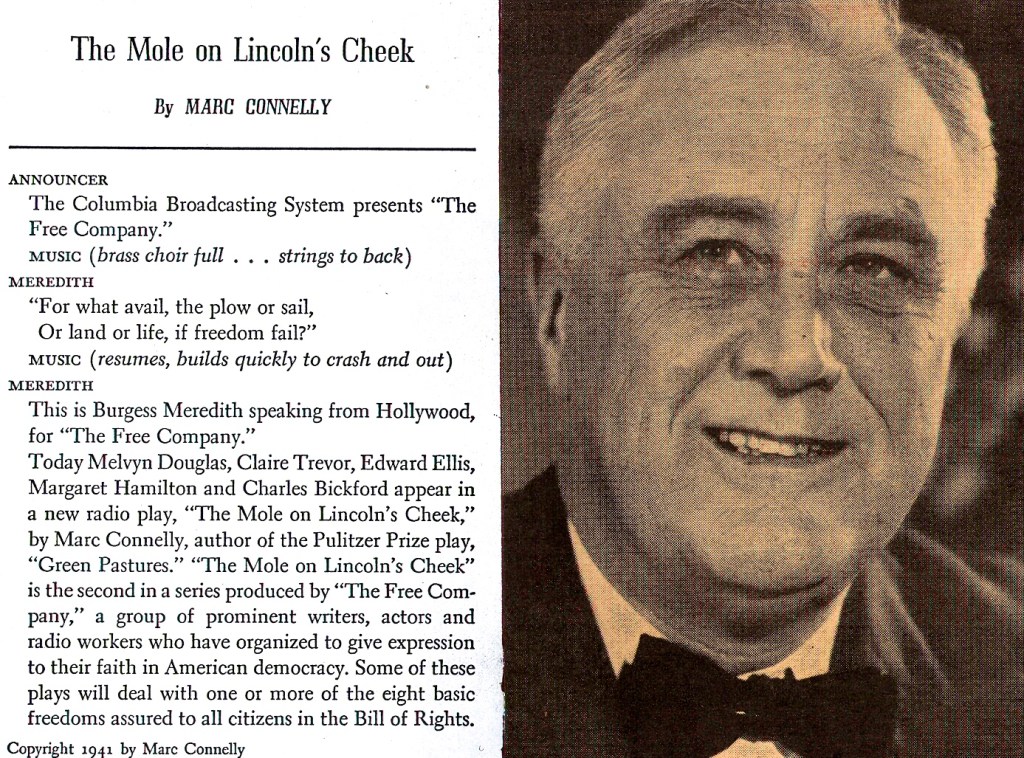
As Burgess Meredith told the radio audience of Marc Connelly’s play “The Mole on Lincoln’s Cheek”: “Our freedom [ . . . ] has this meaning . . . that here, in our land, the truth may be taught, always.” He urged Americans to “resist all attempt to suppress truth or to distort it. Let us consider again,” he continued,
the most powerful words ever spoken against the enemies of man—the lightning-charged words of Lincoln at Gettysburg. And let us renew, in this threatening hour, his high resolve that the government of the people, by the people and for the people shall not perish from the earth.
Could a group like the Free Company—which consisted of Pulitzer Prize winners including Maxwell Anderson, Archibald MacLeish, Stephen Vincent Benét, Marc Connelly, and Paul Green—unite for a series of radio (or television) broadcasts today to unite a largely disillusioned people divided by confusion and cynicism, a people more eager to expose the mole on Lincoln’s cheek than to conceal it?
Would they deem a continuation of the present war unjustifiable or argue a withdrawal from Iraq to be a surrender to terrorism? And just how open would a skeptical public be to any effort to “resist all attempts to suppress truth or to distort it,” how willing to accept any attempts to achieve a consensus?
It has come to my ears, from the lips of someone whose words matter much to me, that my recent journal entries were rather too disdainful of British culture, too shrill in my complaints about the poverty of television programming enjoyable to me or the media’s lack of regard for the old movies I cherish. Having studied British literature and culture of the 19th century, I have been dwelling here in spirit long before migrating; and whenever I travel in Britain, which I do quite frequently now, I find reminders of novels I read, films I have seen, and pieces of history I have studied and half forgotten. It might be, however, that by not engaging enough with 20th or 21st-century British culture as it surrounds me, I am having rather too much of a hankering after things made in or originating from the US. Am I being nostalgic after all?
Nostalgia. There are few words in the dictionary that offend me more. To be pining for the unattainable and imaginary seems to me such a waste of time. I’d much rather go after what is and make it my own, no matter how remote in time or culture it might be. So, I am forever in search of the old to be made present by wondering and writing about it.
The other night I recorded a British adaptation of Dickens’s Pickwick Papers after happening upon Bad Movies, a spot close on the dial and in spirit to the Horror Channel. When I discovered this satellite outpost not mapped by the Radio Times, I was treated to George Coulouris slumming it in a British cheapy titled Woman Eater (1959). A far cry from his days with Welles’s Mercury Players, to be sure; yet what a treasury of cultural trash.
So, a revision of my attitude toward the supposedly barren box is in order. It is a mistake to assume that “old” is a synonym for “classic.” A classic is merely something that happens to have survived or is revived in a later period. This is not simply a matter of quality, but depends on our ability and willingness to keep a certain work of art alive.
There are a great many agendas underlying such promotions. My only agenda is to give an old work some time to speak to me—and then to talk back. I am not particularly interested in arguing that a certain book or film or radio play ought to be considered a classic, even though this would greatly enhance its chances of becoming more readily available and appreciated by my contemporaries. To resist the label “classic” means to challenge the canon, to insist on giving neglected works another chance to work on and for us, of allowing them to tell us something about culture, about lives present and past, and about ourselves.
A fine example of a cultural product that is Victorian without being classic is the once hugely popular novel The Life and Adventures of Valentine Vox, the Ventriloquist by Henry Cockton. It came to my attention during my doctoral studies, since it deals with the phenomenon of ventriloquism, a kind of pre-microphonic broadcasting in the flesh . . . and out of it.
Throwing a voice, disembodying, and finally re-embodying it, is ancient-time radio drama, and Cockton’s eponymous hero is an expert at amusing himself casting his voice broadly and confounding his listeners. He is both Edgar Bergen and Lamont Cranston—irreverent, mischievous, and eager to expose the follies and evils of the world he inhabits. Here, in a typical scene of Valentine’s exploits, Cockton comments on the wonders of sound effects, on the thrills exploited by later radio terrorists like the men and women behind Lights Out! and Inner Sanctum Mysteries:
“Ha! ha! ha!” cried Valentine [. . . ,] at melodramatic intervals throwing his voice [. . . ]. There is nothing in nature which startles men more than a noise for which they cannot account. However strongly strung may be their nerves: however slight may be the sound which they hear, if they cannot account for that sound, it at once chills their blood, and in spite of them, sets their imagination on the rack.
Cockton, too, is a ventriloquist. He uses Valentine to voice his own concerns about the legal system in Britain, a system that made it quite easy to do away with certain individuals by locking them up in lunatic asylums, a fate that befalls one of Valentine’s friends. “During the progress of this work,” Cockton claims in his Postscript, that a number of “influential journalists” objected to the “essentially humorous” treatment of the subject. However, the author, thought otherwise, arguing
that to embellish fact with fiction would be to render truth more attractive; that, by surrounding those revolting scenes with scenes of harmless playfulness and gaiety, the contrast would be more striking, would take deeper root, and yield more extensive sympathy; that where dozens only would know of the existence of the evil if treated in a less popular style, thousands would become cognizant of it, and would exclaim, with feelings of horror, “Can such things be!”—that those thousands would ascertain if such a system were in existence, and, having satisfied themselves on this point, they would denounce it from one end of the kingdom to the other; the effect of which would be all-powerful, seeing that, in its sublime love of Justice and of Truth, the Voice of the People is indeed the Voice of God.
This might well have been a justification for a work of fiction at time frivolous and, on the whole, thoroughly commercial; yet Cockton’s bathetic piece of marketable propaganda is nonetheless worth revisiting. Aside from the to me intriguing connections to broadcasting, Valentine Vox reverberates strongly today as it deals with the endangerment of privacy, liberty, and identity as we sense it at the present time. There are many rewards in digging up something decidedly un-Classic.

 Well, as I’ve been casting it broadly in the previous three posts, I’m off on a weeklong visit to Madrid. Sure, I could have taken my laptop along with me to continue my journal while away; or I might have taken a mobile phone to send messages and images (like the one here, of this morning’s glorious Welsh sunrise) on the go. Instead, I decided to leave both computer and phone at home and to sign off for the duration.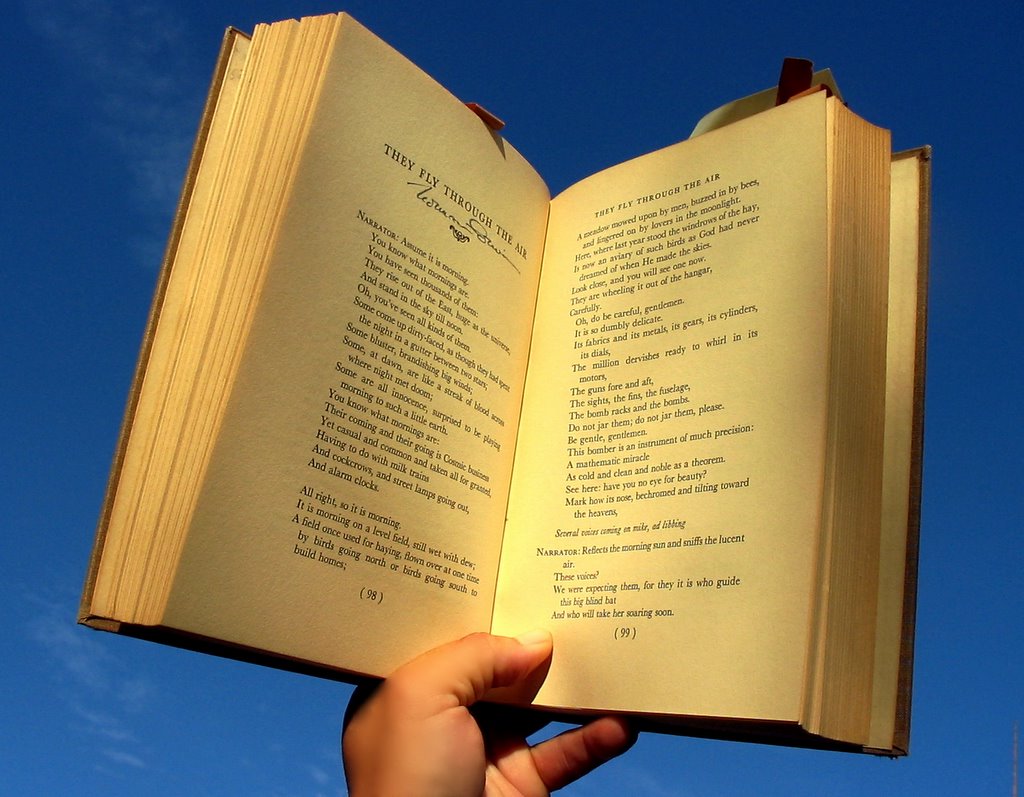

 Well, “gracias, muchisimas!” Thanks to some last-minute planning on my behalf, I’ll be off on a trip to sweltering Madrid, starting next Wednesday. It will be my first visit to continental Europe since I left my native Germany for New York City in 1990; and it has been even longer since last I’ve traveled to a country whose primary language I neither speak nor comprehend. Although I lived just below Spanish Harlem for many years and the majority of my students at City University colleges were Hispanic, I never picked up more than the odd word or phrase. Indolence and impatience aside, my main excuse is that I was too busy appropriating English and promoting it as a common language, the thorough knowledge of which would benefit all who choose to live in the United States.
 Moving from Manhattan to Mid-Wales was bound to lower my chances of taking in some live theater now and then (not that Broadway ticket prices had allowed me to keep the intervals between “now” and “then” quite as short as I’d like them to be). I expected there’d be the odd staging of Hamlet with an all-chicken cast or a revival of “Hey, That’s My Tractor” (to borrow some St. Olaf stories from The Golden Girls). Luckily, I’m not one to embrace the newfangled and my tastes in theatrical entertainments are, well, conservative. I say luckily because even if you’’re living west of England rather than the West End of its capital, chances are that there’s a touring company coming your way, eventually.
 Well, the case of the “Piano Man” has been solved, it appears—and another mystery disappears. The denouement could hardly have been more disappointingly prosaic. It tends to be so with mysteries: unraveling them means to explain them away. “Mystery,” as I discovered when I looked up the word in my etymological dictionary, has its roots in muein, “to close the eyes,” as well as mu, a “slight sound with closed lips; of imitative origin.” Mystery is a condition, a state in which the people and things we perceive remain unclear; it is the temptation to discover and the pleasure of delaying the solution.


 Harry Heuser