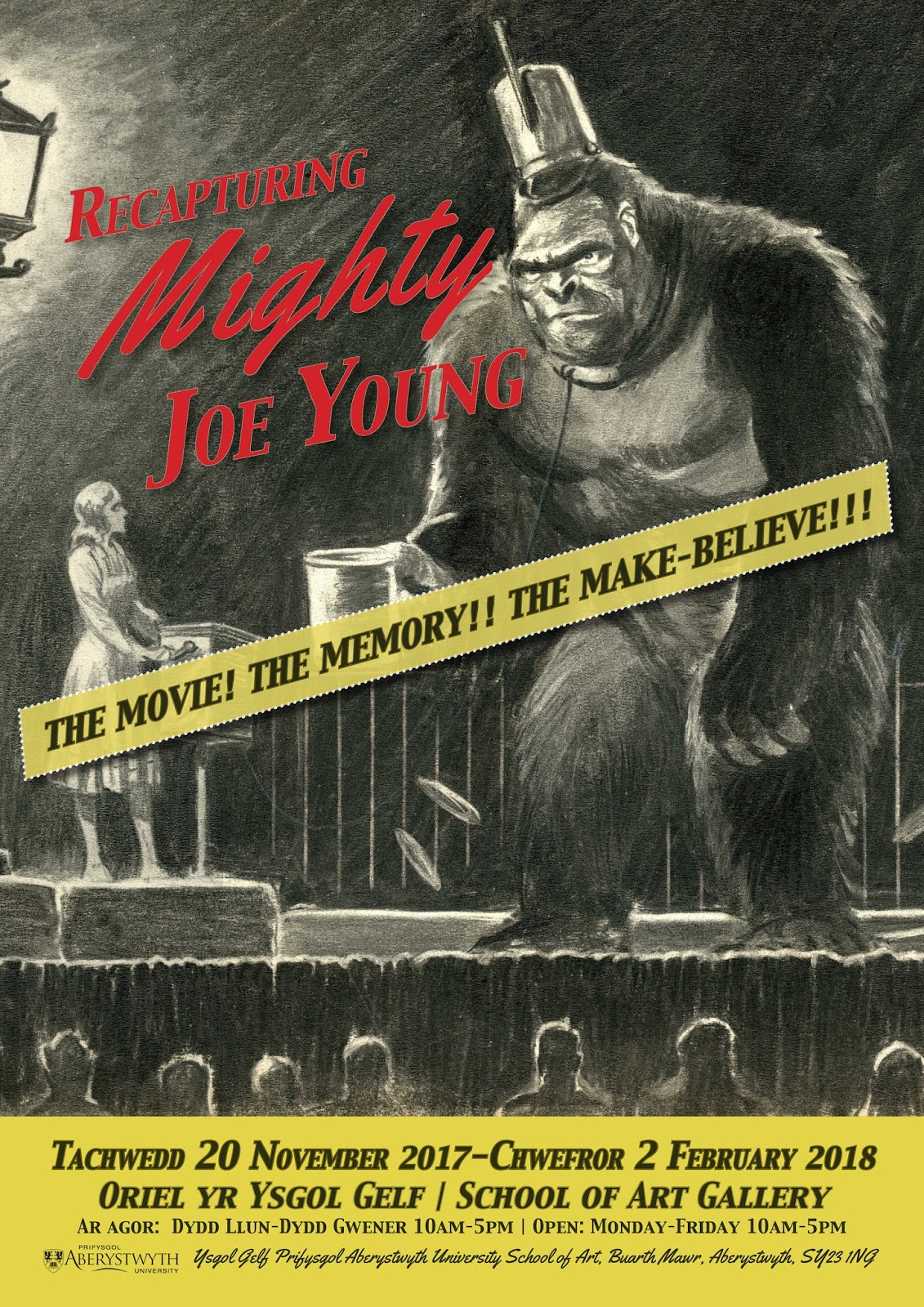
Poster design by Neil Holland using a 1940s concept drawing for Mighty Joe Young
As announced in my previous post, I am staging the exhibition Recapturing ‘Mighty Joe Young’ at the School of Art, Aberystwyth University (see poster for details).
This is my introductory text panel for the show:
From adaptations of Edgar Allan Poe’s “Murders in the Rue Morgue” (1841) to the latest installment in the Planet of the Apes saga, non-human primates have played a prominent part in the evolution of motion pictures. Ridiculous and sublime, they act as uncanny doubles of our uncouth selves.
Until well into the 1980s, silver screen simians were often aped by actors in hairy suits. A memorable exception is the original Kong, the uncrowned King of Skull Island. Mighty Joe Young (1949) is one of his descendants.
Joe was brought to life by the creative team responsible for King Kong (1933) and its sequel, Son of Kong (1933). The large volume displayed in the centre of the gallery is Joe’s baby album.
The album commemorates the collaborative efforts that earned Mighty Joe Young an Academy Award for Special Effects. Showing off the tools and tricks of the trade, it contains documentarian photographs as well as drawings and watercolour paintings by Willis ‘Obie’ O’Brien, the film’s ‘Technical Creator.’ The album also records the work of Obie’s apprentice, Ray Harryhausen, whose name became synonymous with pre-CGI fantasy film and stop-motion animation.
The album is on public display for the first time. It was compiled retrospectively, probably by a member of the crew. Along with hundreds of books and journals, it was bequeathed to Aberystwyth University by the film historian Raymond Durgnat (1932–2002), to whose legacy this exhibition pays tribute.
Surrounding the album are posters, promotional materials as well as 1940s concept drawings for animated movies produced by Walt Disney and Fleischer Studios. Also on show are prints by Gustave Doré and John Martin. Their fantastic and awe-inspiring images were precursors of cinematic spectacles. Both O’Brien and Harryhausen referenced them in their work.
As a curator, educator and writer, I aim to promote interconnections between the arts as well as the creative industries and academic disciplines devoted to them. Instead of imposing a context in which our album might be contained, I let it take over the gallery to disclose its stories and open new associations.
The public is invited to shape this evolving display by sharing responses to Joe in animation workshops scheduled during the show’s run. Like the homage in Lego you encounter in our gallery, the videos created in those workshops will become part of this exhibition.
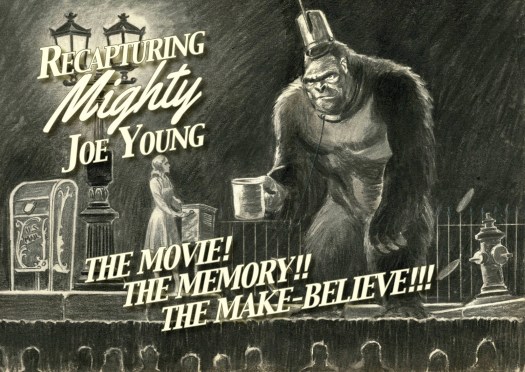
Preliminary poster design by Neil Holland using a 1940s concept drawing for Mighty Joe Young
This fall, I am curating an exhibition featuring a unique album commemorating the production of the 1949 Hollywood fantasy movie Mighty Joe Young. The brainchild of the creative team responsible for King Kong (1933), Mighty Joe Young earned an Academy Award for Special Effects.
The album contains over 100 stills from the film as well as documentarian photographs, drawings and watercolour paintings. It provides insights into the production of Hollywood movies, and in pre-CGI visual effects and the work of the celebrated stop motion animator Ray Harryhausen (1920–2013) in particular.
The album has never been on public display before, and little is known about its origins or provenance. Along with hundreds of books and journals, it was bequeathed to Aberystwyth University by the film historian Raymond Durgnat (1939–2002).
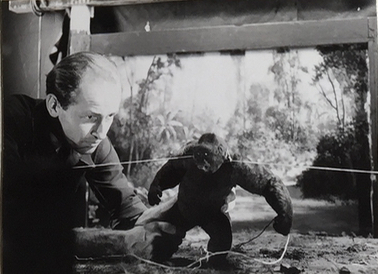
Ray Harryhausen and Mighty Joe Young
As a curator, I am keen to recover and display objects of visual culture that encourage us to explore connections between the arts as well as the creative industries and academic disciplines devoted to them. The Mighty Joe Young album tells stories of ingenuity and collaboration, of artistic influences and commercial enterprise. The film, meanwhile, is a story of friendship, a friendship that triumphs over greed and the exploitation of innocence.
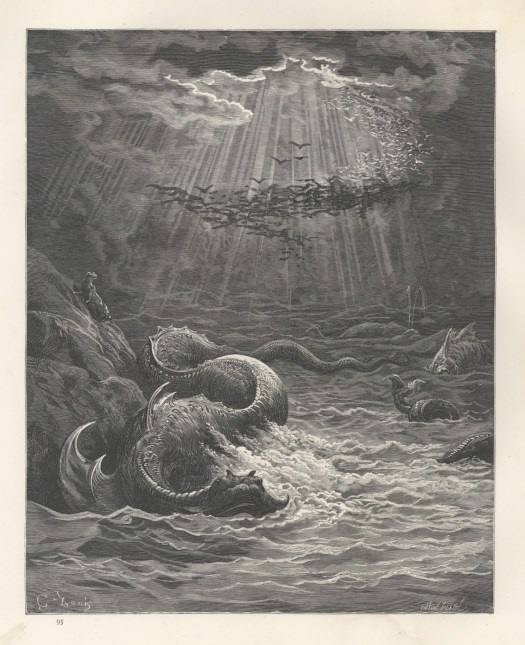
Gustave Doré, Leviathan for an 1866 edition of Milton’s Paradise Lost
The work of Ray Harryhausen has long attracted enthusiasts of fantasy and science fiction. Now, there is renewed interest in his artistry. Leading up to the centenary of Harryhausen’s birth, major institutions, including Tate Britain in London, have been staging exhibitions of his drawings and sculptures.
Our album has attracted the attention of the Ray and Diana Harryhausen Foundation, who will be giving a presentation in the School of Art galleries on 22 November. We will also hold animation workshops during the run of the exhibition, and the videos created as part of those workshops will be shown in our galleries.
The album will be displayed alongside film posters and promotional materials, as well as production drawings for animated movies of the 1940s. Also on show are prints by Gustave Doré whose sublime and fantastic imagery was a precursor to Hollywood magic and served as an inspiration to Harryhausen. Recapturing ‘Mighty Joe Young’: The Movie! The Memory!! The Make-Believe!!! is on display at the School of Art from 20 November 2017 to 2 February 2018.
I thought that I’d say a few words about the work of the man that brings us together here today – and perhaps about this place in relation to that man.
If Tunnicliffe could be with us today, chances are he wouldn’t be with us. London. The Academy. The artworld. That, he felt, was not his habitat. And yet, we wouldn’t be here if Tunnicliffe had not been elected a member of the Academy – as a printmaker, no less.
Tunnicliffe’s own accounts of his life emphasise his youth growing up and working on a farm. And much of that is reflected in his subject matter.
The Lederhosen were a bit of a gimmick, or a ruse.
Tunnicliffe certainly preferred the outdoors to the inside of institutions. He would rather study bulls than listen to what he would have considered to be so much academic BS. And even though he taught art, Tunnicliffe also said he much preferred birds to boys.
All of this fits the romantic view many of us have of the artist as an outsider. Perhaps, it fits rather too neatly. After all, the farm where Tunnicliffe grew up was near Macclesfield – and the signs of the Industrial Revolution were written in the wind.
Tunnicliffe was not removed from the world of industry or commerce. Nor was he resistant to change. Tunnicliffe, who studied at the Royal College of Art in London, owes his career not to any one institution but to his willingness to adapt.
For decades, far from the madmen crowd, Tunnicliffe produced images that served the advertising racket. His pictures promoted farming products (some toxic), spurious wonder drugs (for dogs) and the Midland Bank. Not exactly the messages of a lover of nature.
The thing is, Tunnicliffe’s pictures were not designed as vehicles for his own thoughts. He made products of visual culture to which messages could be attached by others, at a price, to suit their purposes.
Tunnicliffe also produced book illustrations. Many of his wood engravings – and the many more scraperboard images we are not even showing here – were secondary to a given text, enhancing or supporting it.
By the time he became an Associate of the Royal Academy, in 1944 (and a full member ten years later), Tunnicliffe had ceased to produce so-called ‘fine’ prints. The stock market crash had made it necessary for Tunnicliffe to rethink his career and to find his niche in order to make a living as a maker of images.
Partly as a result of this commodification, Tunnicliffe’s prints were never exhibited in a solo show here at the Royal Academy – until now.
You might well protest that what you see on display here today is not much of a print exhibition, either, given that his wood engravings are displayed alongside cheap reproductions and colourful paintings that might overpower them.
Print curator James Laver said nearly seventy years ago that it was ‘a pity’ that so few visitors to the Royal Academy come to ‘the little room in which the etchings and engravings are exhibited.’ Even those who did come visit had ‘neither the patience nor the strength to appreciate what is on the walls. For prints are intimate things. [They] need individual attention, like shy, sensitive children.’
I hardly think that individual attention span has increased over the last seventy years. And the Royal Academy seems to reflect that, or perhaps give in to it.
What Second Naturedoes bring across is the compromise that is Tunnicliffe’s work, and the way in which editioned prints and one-of-a-kind paintings compete with multiple copies: images of visual culture in the service of commerce, of advertising and the printed word. The purity or sanctity of art is, after all, little more than the modernist rubbishing of modernity.
As I said, this is Tunnicliffe’s first show here as a printmaker. Tunnicliffe regularly exhibited his watercolour paintings here at the Academy’s Summer Exhibitions, and they always sold. The one solo show he had here was an exhibition of post mortem studies of birds from his personal sketchbook back in the early 1970s.
That show was initiated by the Welsh painter Kyffin Williams, who, like Tunnicliffe and his wife, lived on Anglesey.
Well, the Royal Academy did not know quite what to do with those sketches. It consulted an ornithologist who vouched for their accuracy but also said that he had seen many like them just as accomplished. The works were arranged according to family, genus and species. In other words, those private studies, which Tunnicliffe lent only reluctantly, ended up portraying him as an imitator of nature.
Choosing a composition, combining pictorial elements and omitting detail – all that was important to Tunnicliffe. His pictures were designed to be decorative, as he called it. Faithful, decorative, or both at once, Tunnicliffe’s work can easily be coopted by those who say ‘now that is real art.’ Or, ‘when a farmer’s boy can become a Royal Academician, surely there cannot be any talk of inequality.’
Tunnicliffe was pragmatic rather than programmatic. He made images to make a living. But he did not promote a conservative agenda.
The gallery, shortly before the talk
Whether you find such a career uplifting or frustrating is a matter of politics. For me, it is intriguing because it confronts me with my own biases. A career like Tunnicliffe’s does not fit into the avant-garde narratives we resort to when we tell or teach the histories of twentieth-century art from modernism to postmodernism, or roughly the six decades during which Tunnicliffe worked professionally.
When I thought about a suitable title for our essay and the exhibition on display here, I set out by looking at what Tunnicliffe said about his work. I somehow wanted him – and his works – to stand on their own and let them do what most of them were not even intended to do – to speak for themselves or, if that is an impossibility, for Tunnicliffe.
In my research on Tunnicliffe, I came across a dramatic exclamation. ‘To hell with nature.’ Tunnicliffe said that in a nature lover’s magazine devoted to British birds. He said it toward the end of his career. To me, it expresses the frustration of a man whose work is generally judged on the strength of its resemblance to nature. As a kind of second-hand nature.
It would have made for a provocative title, don’t you think? But, even though I would have been quoting him, I would also have taking such a rare public outburst out of the context of a career predicated on compromise.
I wonder what would have happened if Tunnicliffe had dared to say ‘To hell with culture.’ He didn’t. In his work, at least, he did not question the socio-economics that restricted him to serve the market. His earlier work is autobiographical. His family members are worked into his subjects. After the stock market crash, commercial work kept him so busy, there was hardly time for the luxury of self-expression that we perhaps tend to overvalue today.
Tunnicliffe did not make environmental statements. He did not push any agenda. I wish he had. When we look at his work, we should perhaps acknowledge that, whether we perceive this as a lack or not, an apparent neutrality lends itself to being naturalized. A second nature is, after all, culture.
So, is it possible meaningfully to discuss the achievements of printmakers like Tunnicliffe without the politics? I am not sure. But I hope our book – and this exhibition here at the Academy – raises awareness of a printmaker whose work never quite made it into our art histories because it does not fit into the history of twentieth century art, a history that, to suit a grand narrative of progress, we have turned into the history of cultural products that we can lift up or push away as we deem fit.
Our Japanese ‘Merman’ made for a suitable poster boy. Poster design by Neil Holland, based on an idea by Sarah Selzer
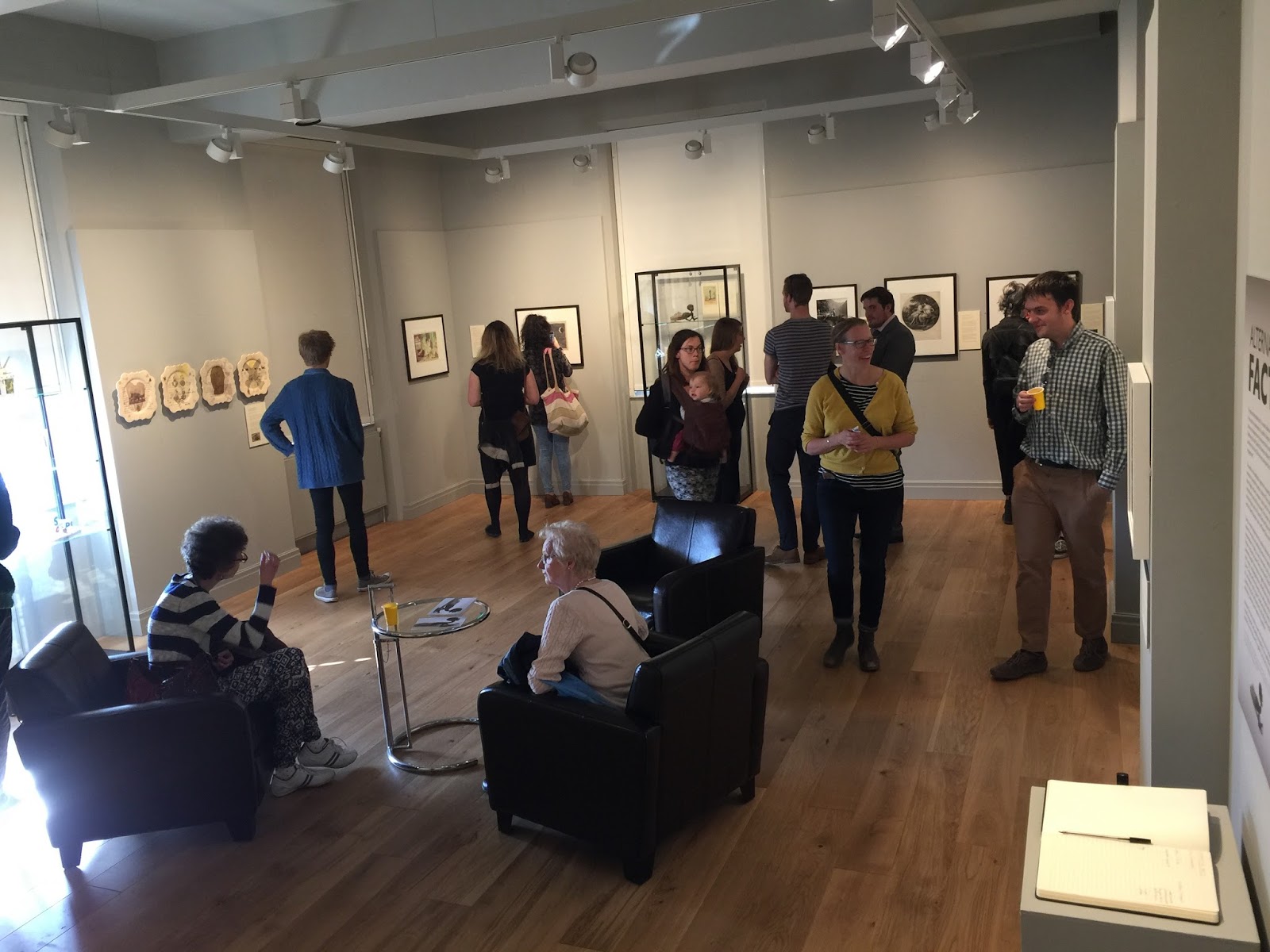
Once a year, with the help of the head curator of the School of Art, Aberystwyth University, I stage an exhibition with a group of students who are enrolled in my undergraduate module “Curating an Exhibition.” The shows draw on the University’s vast collection of art and artefacts. The student curators are given a theme and set out to create a narrative by selecting objects in response to it. That is quite a challenge, considering that the exhibition is put together in just over three months from initial planning to display.
Past exhibitions include Untitled by Unknown, Queer Tastes, andMatter of Life and Death. This year, I was all set to use the colour red and its connotations as a theme . . . until the inauguration of Donald Trump and the ensuing dispute about the size of the audience made me see red in a different way. This gave me the idea for a more urgent, topical show.
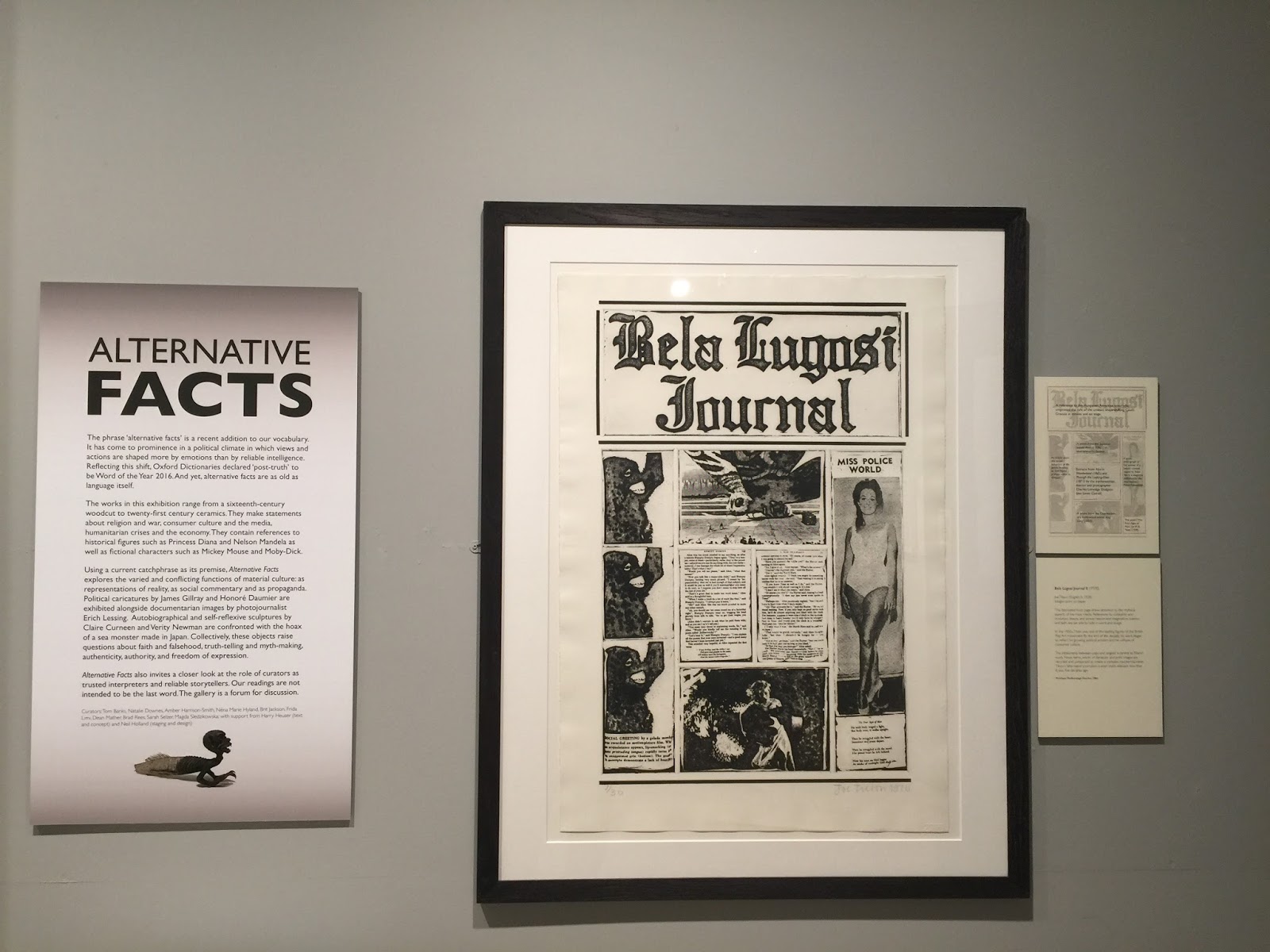
That show is Alternative Facts: Interpreting Works from the School of Art Collection. It opens on 22 May and will be on display until 29 September in one of the School of Art’s galleries in Aberystwyth, Wales.
The introductory panel explains the theme as follows:
The phrase ‘alternative facts’ is a recent addition to our vocabulary. It has come to prominence in a political climate in which views and actions are shaped more by emotions than by reliable intelligence. Reflecting this shift, Oxford Dictionaries declared ‘post-truth’ to be Word of the Year 2016. And yet, alternative facts are as old as language itself.
The works in this exhibition range from a sixteenth-century woodcut to twenty-first century ceramics. They make statements about religion and war, consumer culture and the media, humanitarian crises and the economy. They contain references to historical figures such as Princess Diana and Nelson Mandela as well as fictional characters such as Mickey Mouse and Moby-Dick.
Using a current catchphrase as its premise, Alternative Facts explores the varied and conflicting functions of material culture: as representations of reality, as social commentary and as propaganda. Political caricatures by James Gillray and Honoré Daumier are exhibited alongside documentarian images by photojournalist Erich Lessing. Autobiographical and self-reflexive sculptures by Claire Curneen and Verity Newman are confronted with the hoax of a sea monster made in Japan. Collectively, these objects raise questions about faith and falsehood, truth-telling and myth-making, authenticity, authority, and freedom of expression.
Alternative Factsalso invites a closer look at the role of curators as trusted interpreters and reliable storytellers. Our readings are not intended to be the last word. The gallery is a forum for discussion.
Curators: Tom Banks, Natalie Downes, Amber Harrison-Smith, Néna Marie Hyland, Brit Jackson, Frida Limi, Dean Mather, Brad Rees, Sarah Selzer, Magda Sledzikowska; with support from Harry Heuser (text and concept) and Neil Holland (staging and design)
As a product of postmodern culture, I lay no claim to originality. Indeed, I have always been thoroughly unoriginal, and, occasional anxieties of influence notwithstanding, often gleefully so. As a child, I ripped off comics, tore apart magazines and took whatever images were available to create collages and parodies. Using an audio tape recorder, I appropriated television programs by inserting my voice into mass-marketed narratives, transforming a saccharine anime like Heidi (1974) into a subversive adolescent fantasy.
My postmodern past (note my de Chirico take on a mass-produced vase)
No evidence of my early experiments is extant today; but adaptation became an enduring fascination and a field of study. As a student, I wrote essays on adaptations of Frankenstein and on Brecht’s revisitations of Galileo Galilei – Leben des Galilei (1938/39 and 1955), as well as Galileo (1947). I produced an MA thesis on translation (“Meister Remastered”) and a PhD dissertation on the relationship between stage, screen, print and radio (“Etherized Victorians”). The latter I recycled as Immaterial Culture, published in 2013.
Now a lecturer in art history, I have repurposed some of the above and pieced together a Frankenstein’s creature of an undergraduate module I call Adaptation: Versions, Revisions and Cultural Renewal. In a series of lectures and seminars, the course (at Aberystwyth University) investigates the processes involved in translative practices that range from the reworking of a literary classic into a graphic novel to drawing a moustache on a copy of the Mona Lisa. It explores relationships between form and content, genre and mode, integrity and hybridity, durability and transience, culture and commerce, as well as art and the environment.
As I state in the syllabus, many products of culture endure by shifting shape: stories are turned into sculptures, plays are reimagined as dramatic canvases and mass-produced ephemera are recycled for art. What survives such transformations? What is lost or gained in translation? What are the connections between – and interdependencies of – so-called originals and the works that keep coming after them?
Given the monstrous scope of the course, another question emerges: Just what is not an adaptation? It is a question that becomes more complex if tackled by anyone who, like me, regards originality as a myth.
Much of what is published on the subject is limited to matters of narrative, of what happens when telling becomes showing, or vice versa. Linda Hutcheon’s study A Theory of Adaptation opens promisingly – if somewhat patronizingly – with the following statement: “If you think adaptation can be understood by using novels and films alone, you’re wrong. The Victorians had a habit of adapting just about everything…. We postmoderns have clearly inherited this same habit….”
Hutcheon does not quite deliver on her promise of inclusivity. Unable or unwilling to break the “habit” of adaptation scholars who came before her, Hutcheon’s study also concentrates on “novels and films,” the word “film” appearing on 229 pages, compared to, say, “painting” on 17 pages, including index and bibliography. There is no mention at all of collage or assemblage. Left out are the projects of Dada, Neo-Dada and Pop, as well as the debates about Kitsch, Camp and Pastiche that were central to Postmodernism.
Hutcheon’s definition of “adaptation” is at once too broad and too narrow. Her brief statements on “What Is Not an Adaptation?” are welcome yet imprecise and contradictory. What is worse, her definition is at times arbitrary. She states, for instance, that “fan fiction” is not a form of adaptation, offering no explanation for its exclusion.
I agree with Hutcheon that adaptations need to be readable as a version, an acknowledged take on or taking of something we perceive as same yet different. Adaptations are not copies, and, as spurious as they may sometimes strike us, they are not fakes, either.
Hutcheon distinguishes between parody and adaptation, claiming that the former does not need to be acknowledged. If unacknowledged, parodies – or any other form of adaptation – cannot operate qua adaptation. They are like irony in that respect. You just can’t be ironic all by yourself. Any dance of the index fingers needs an audience.
As I see it, adaptations, be they parodies or pastiche, anarchic or reverent, have to exist as concrete products – rather than ideas or themes – that are distinct from yet related to other products with which they engage or from which they openly borrow in more or less creative acts of transformation.
Am I an adaptation?
Hutcheon, who does not insist on a change in medium as a criterion for adaptation, cites a source that identifies as a “new entertainment norm” the “process where integral elements of a fiction get dispersed systematically across multiple delivery channels for the purpose of creating a unified and coordinated entertainment experience.” The resulting products are not meant to exist independently but serve as a deliberate fragmentation for the sake of maximizing market potential and profits by increasing the potential audience. Is this still adaptation? Perhaps, if the audience rejects to buy the lot.
Buying the lot is something I rarely do. I pick and choose, take apart and transform according to my own desires and limitations. And pick apart I must when I read Hutcheon’s comments on radio drama as a form of “showing” like “all performance media,” at which point her study recommends itself for recycling as pulp. Anyone who appreciates the hybridity of radio plays would balk at such simplifications.
Trying to make a case for elevating their cultural status, Hutcheon asks: “If adaptations are … such inferior and secondary creations why then are they so omnipresent in our culture and, indeed increasing steadily in number?” Well, junk food is “omnipresent” – and so are feebly argued studies – which does not make either any less “inferior.” Besides, the question is not whether adaptations are good, bad or indifferent. The question is: what are and what ain’t they?
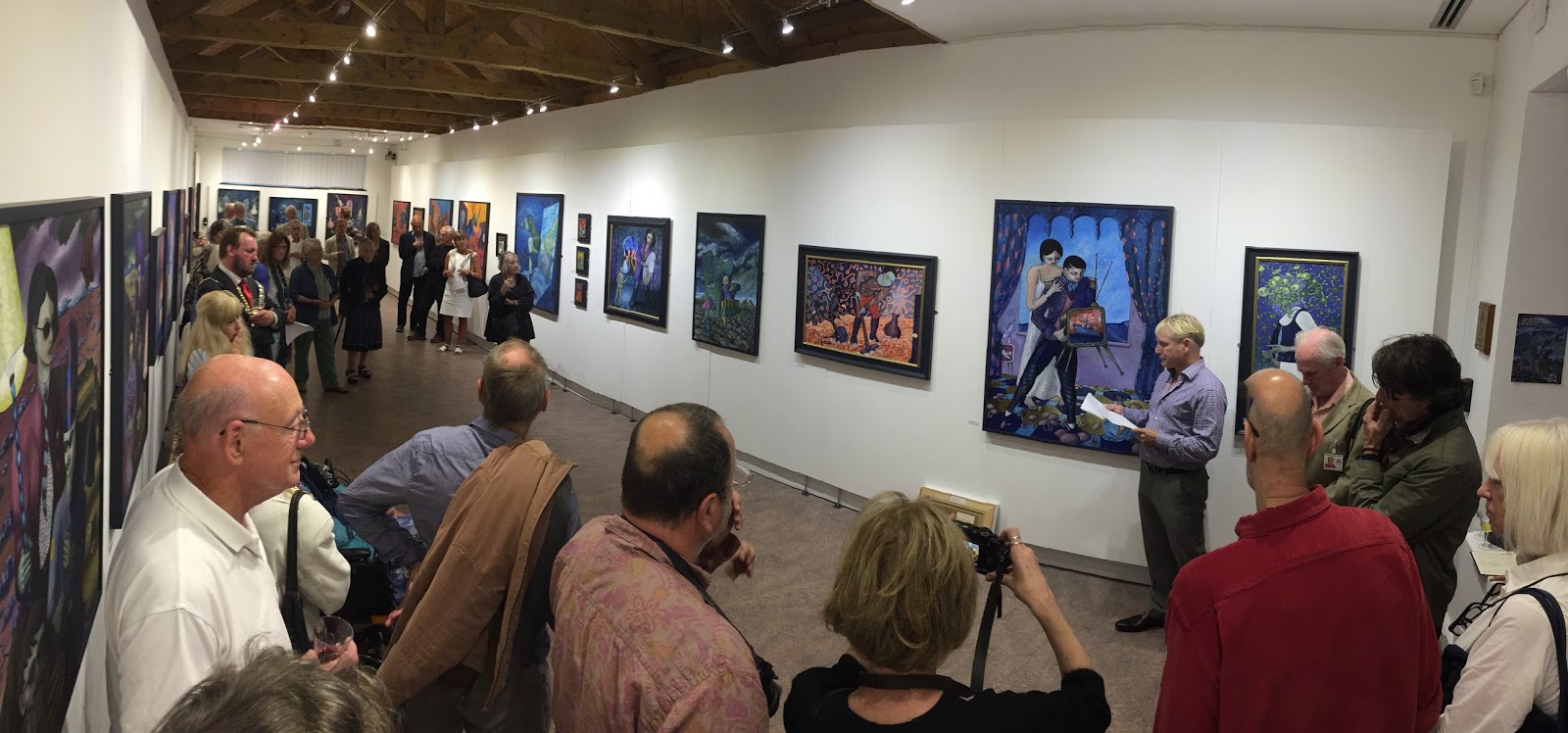
I was asked to say a few words at the opening of Ceri Pritchard’s solo exhibition The Strange Edge of Reality at Tenby Museum and Art Gallery on 6 August 2016. Here is what I said:
Opening Ceri Pritchard’s solo exhibition The Strange Edge of Reality, 6 August 2016, at Tenby Museum and Art Gallery, Tenby, Wales
Last December, Ceri Pritchard invited me to see some of his latest work, which he puts before us today in this gallery. Walking up the steps to his studio here in Tenby, I felt as if I were about to be let in on a secret: canvases that were still underway, waiting – ready or reluctant – to come out into the open.
That air of mystery hardly dissipated at the sight of those canvases. It was an unexpected, exciting introduction. And although introductions are rather more formalised in a gallery setting, anyone stepping into this room may experience what I felt then. Surprise, mystification. Yes, but also that sense of being prompted, compelled to take part in a narrative unfolding.
What we witness here are not interior monologues. We are not prying into someone else’s secrets, at least not without consent. Ceri’s compositions are carefully staged. They are spectacular set pieces with props, masks, and harlequin costumes fit for the Commedia dell’arte – if pantomimes were created by Franz Kafka and produced by Sigmund Freud. The dramatic lighting and overall theatricality of Ceri’s paintings set them apart from the illusionistic. We are not just taking in a performance. We wonder what’s happening behind the scenes.
These compositions are finished in execution only. In all other respects, they are incomplete – open to the complex mind games we call, for lack of a better word, “interpretation.”
Now, Ceri Pritchard is standing right over there. But it would be our loss to turn this into an opportunity for putting him on a psychiatrist’s couch, as it were, and ask him: just what were you thinking when you painted those figures? Where does all this come from?
As if artists had – or should have – all the answers, let alone the last word on whatever they bring into being.
Instead of pointing in Ceri’s direction, why not accept the invitation proffered by his paintings and ask: what might they tell us about ourselves? About our desires, our doubts and our demons?
What a work of art has to say depends to a large – and often underestimated – degree on our receptiveness, on our willingness to let it speak to us, and perhaps of us.
Ceri Pritchard, The Atomic Age (2016)
When I look at a painting like The Atomic Age, for instance, I am reminded of the Cold War – the space race and the terror of nuclear proliferation – that became the stuff of childhood nightmares and, in my case, gave rise to compensatory fantasies. There are plenty of mushrooms in Ceri’s paintings – not all of them suggestive of atomic clouds. Some may be sprouting alternatives that the sensible – or insensitive – among us call “pipe dreams.”
The Strange Edge of Reality is an apt title for this exhibition. The works we see here are on the verge, teetering between worlds, not only in their set of imagery but also in their sense of place in art history and the art world of today.
Edginess is almost a prerequisite in contemporary art. But few edges remain sharp for long. And some become very blunt indeed – smooth and safe like a well-trodden threshold – a boundary with which to maintain our footing. If it isn’t our voracious appetites that dull our senses to the cutting edge, it is our need to demarcate the terrain in which we might otherwise lose ourselves.
In our appreciation of art, we tend to rely on classifications. We might say, for instance, that Ceri’s work is surrealist, which would permit us to conclude that it is derived from or indebted to a certain, well-charted movement that originated in France in 1924.
Now, there is surrealist activity with a lower case “s.” Henry Moore, for instance, argued that
[a]ll good art has contained both abstract and surrealist elements, just as it has contained both classical and romantic elements—order and surprise, intellect and imagination, conscious and unconscious.
This may be so vague as to take the edge off surrealism altogether, which is why such general applicationsof the term were frowned upon by Surrealists to whom the movement was an imperative.
“Movement” implies the coherence of a group through the adherence to a manifesto. But Ceri, who adopted the term “neo-surrealist” to refer to his latest work, did not sign up to be part of a movement – there exists no Surrealist movement in Britain today. What makes Ceri’s work edgy is that it reclaims a visual language that has long been neglected, at least in the medium of painting.
Among the artists and writers who influenced him, Ceri names the Surrealists André Breton, Francis Picabia, Salvador Dalí, and Max Ernst. Not that Ceri’s work is an homage to them, much less a lament for a lost cause. Rather, it makes a case for our renewed engagement with practices associated with the movement – a movement that first startled the British public at the International Surrealist Exhibition in London eighty years ago, in 1936, at a moment in history when suspicion dawned that Britain was no longer a post-war society but a pre-war one.
The English poet David Gascoyne, who organised the London exhibition together with the artist Roland Penrose and the critic Herbert Read, declared surrealism to be a revolutionary “instrument” – a means of making us aware of the insufficiency – and the fallacy – of an order we accept as “reality.”
According to Gascoyne, the “fundamental ambition of surrealism is to dismantle all formal distinctions between dream and reality, and subjectivity and objectivity” – so that a new vision may emerge. We can see such dismantling operating in Ceri’s paintings, in which opposites not simply clash but fuse.
The strange edge of reality isn’t simply an outer limit. It is also a line along which meetings occur, as well as separations. The danger may lie not on the other side but in our tendency to take sides, to dismiss alternatives or to deny the other within our self.
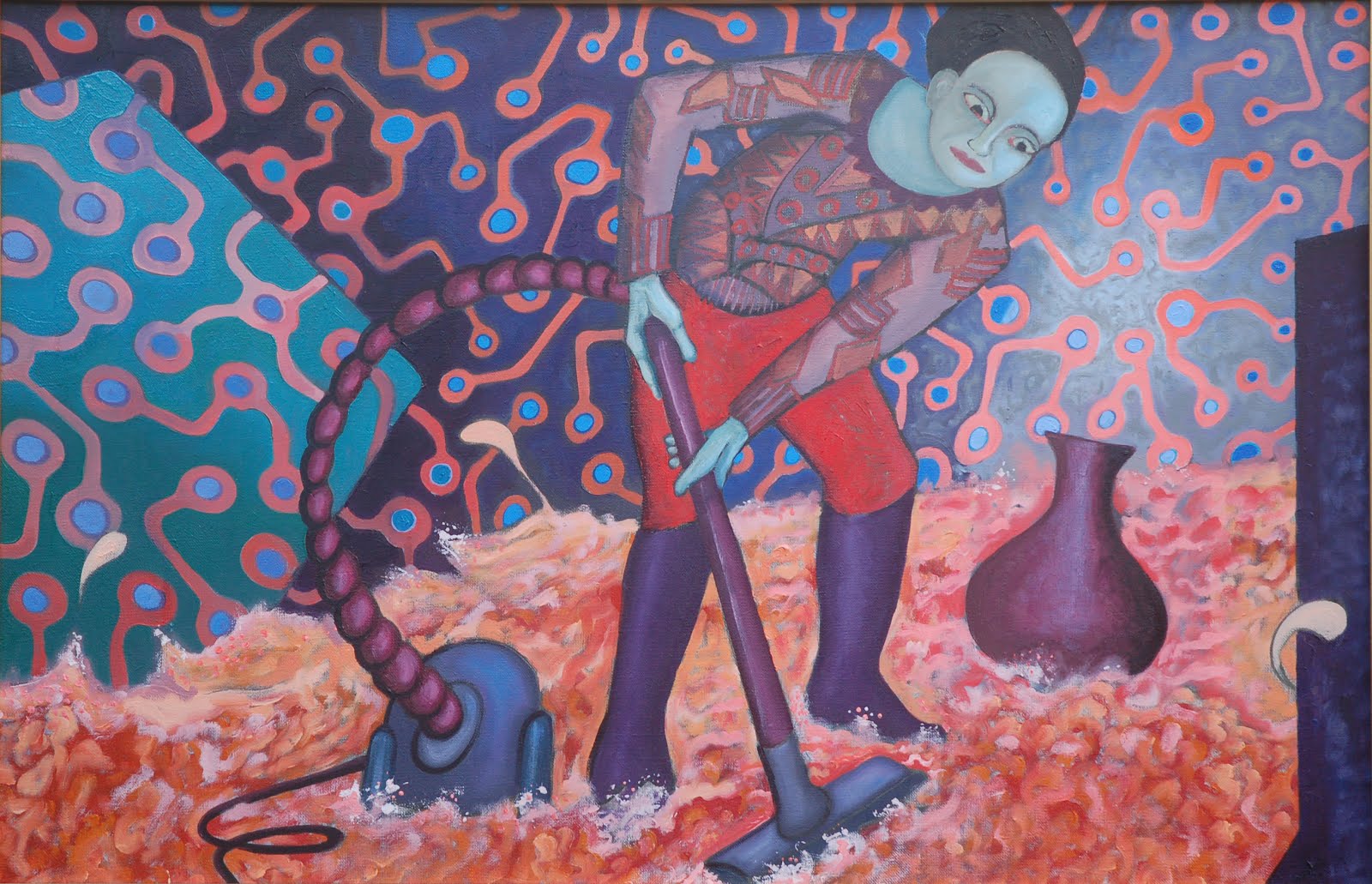
When it comes to making a clean break, to draw the line between chaos and order, there is nothing like a vacuum cleaner. You will come across a number of those in Ceri’s paintings. But, in Ceri’s invasion scenarios, hoovering proves futile. Whatever we try to push away or keep apart from us creeps in from the margins to assume centre stage: fungi spreading over an interior floor space, insects crawling toward artificial light, and microbes taking over our grey cells.
Ceri Pritchard, La Limpiadora
And who is handling the equipment, anyway? The cleaner in La Limpiadora, for instance. The creatures with which Ceri populates his scenes look like experiments conducted on the Island of Doctor Moreau, freaks of nature assembled in a game of Exquisite Corpse. Anthropomorphic, androgynous – they defy the polarities of either/or we find so reassuring.
Ceri’s paintings call to mind the disorientation we experience not while dreaming but at the stage of waking, the state of being in and out of it at once. It creates the unnerving sensation of estrangement that Freud termed the uncanny.
Such dislocations are also experienced when moving between cultures. Ceri has long lived abroad, away from his native Wales. Even the home that he has presumably come back to is not the Wales he knew as a child up in Anglesey. Ceri, who studied art in England, has worked and exhibited in France, the United States and in Mexico – all countries, coincidentally, in which Surrealism thrived.
Unlike ‘Modernism’ or ‘Art Deco,’ ‘Surrealism’ did not make it into the index of The Tradition: A New History of Welsh Art, 1400 – 1990, Peter Lord’s monumental new book on the visual culture of Wales. That is not to say that those who look for it won’t find surrealist connections in Wales. At that International Surrealist Exhibition in London, for instance, it was Dylan Thomas who handed out cups of plain water with a piece of string in it, which he offered to serve “weak or strong.” But as tempting as it may be to identify national or regional influences in these paintings, Ceri’s neo-surrealism, like the work of the Surrealists before him, is cosmopolitan rather than parochial, and its expressions of our inner worlds are universal.
Ceri’s work resists being defined by – or confined to – any one place. Trying to pin Ceri down by tracing his life story and his influences in his current paintings would mean to diminish the mystery and the trippy wondrousness of that work. It is clear that he has been under the influence. Ceri’s mind has altered many times. That is to say, it has defied the pressure of being made up.
Ceri has experimented in many media, including sculpture, video and collage. He has also been an abstract painter. Figurative painting is where he is at the moment. And that moment is also a time of introspection – a self-conscious exploration of the role of the artist and the function of art.
Many of the paintings in this exhibition are expressive of a tension between creative freedom and the demand placed on art to reflect the external world, that is, to be both mimetic and relevant, to resemble in order to matter.
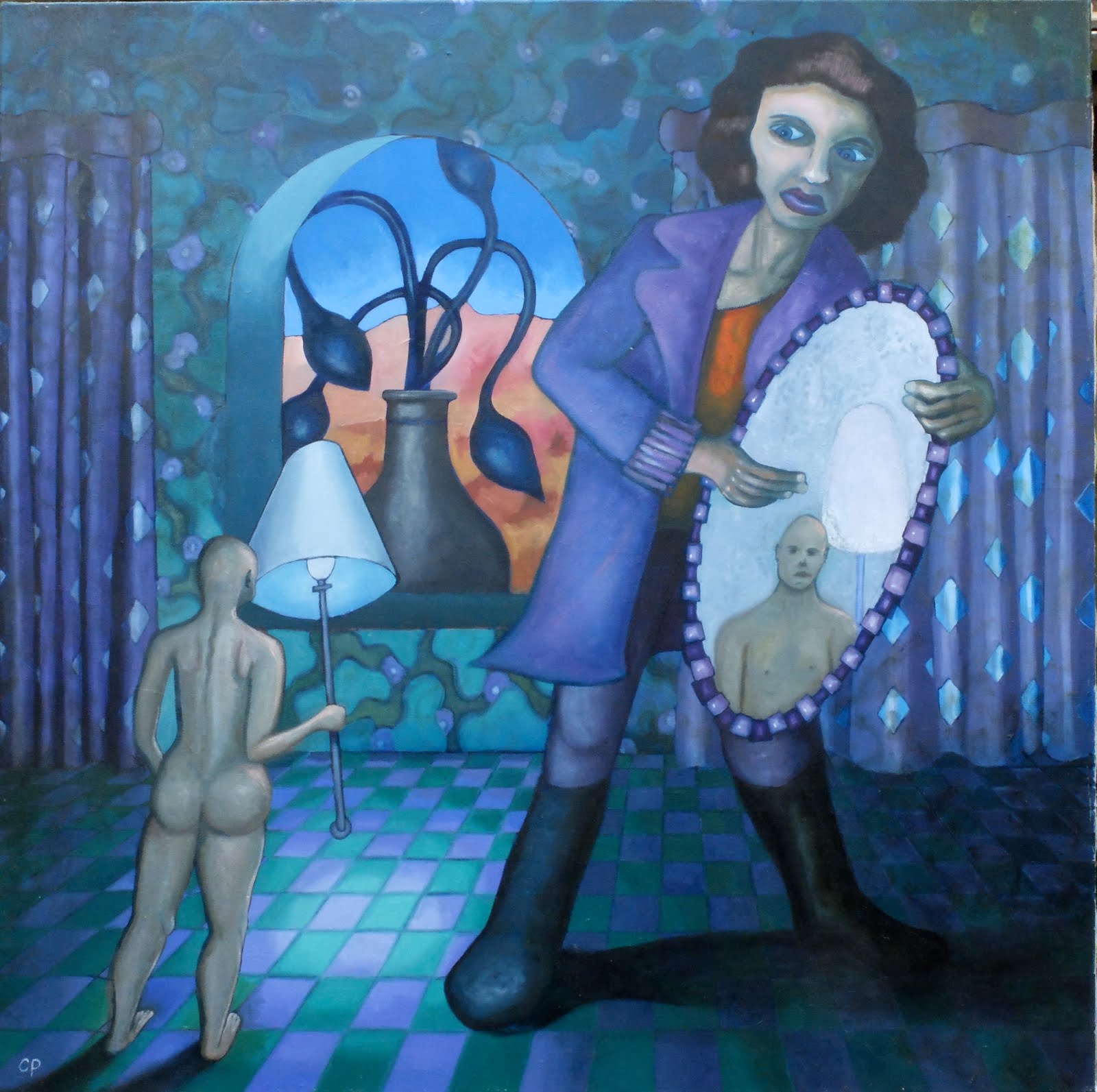
Ceri Pritchard, Golau y Myfyrio
This restrictive view is countered by an ambition to shine a light on our infinite inner world instead of reflecting the system that tends to delimit the world outside and our place in it. This dichotomy is summed up by the title Golau y Myfyrio – “Reflecting the Light” – and is rendered pictorial through the mirrors with which the figures in Ceri’s paintings are taunted and tormented, and the lamps that put them in another light.
That the title is Welsh suggests, in the absence of any stereotypically Welsh iconography, a continued processing of that ostensible homecoming.
Ceri’s current work has been described as “mature.” It is meant to be a compliment, no doubt, but there is to me something too finite about the word. What Ceri has managed through decades of artistic practice is to remain in his “formative years.”
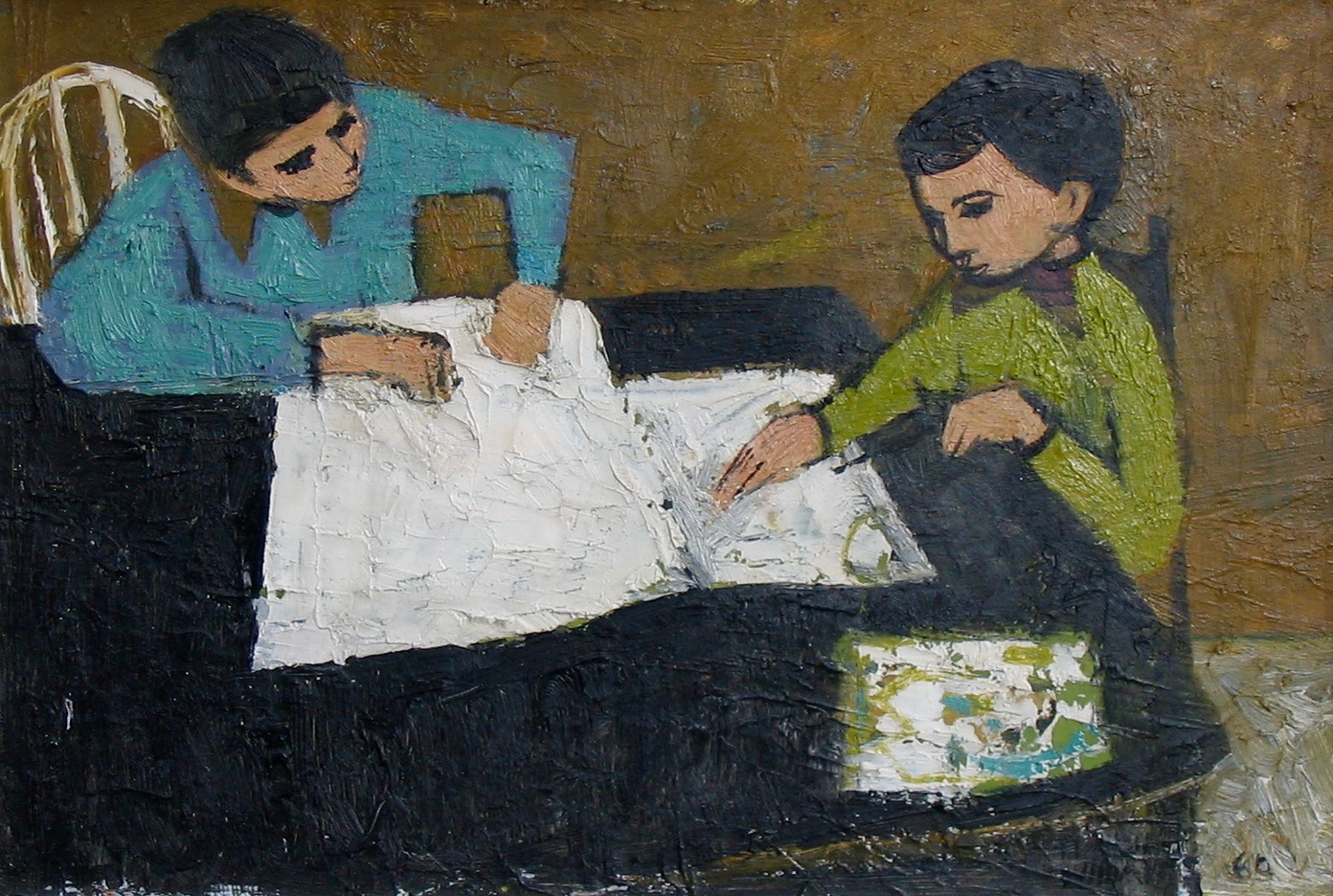
Claudia Williams, Children Painting (1960)
Now, I have, on a wall in my house, a reminder of Ceri’s lifelong creativity in the form of this painting of him by his mother, Claudia Williams. Here he is, aged six years old. And there he is, never mind how many years later. Ceri Pritchard has kept alive the urge to create by being alive to strangeness and by insisting on looking askance at “reality,” perched, as he is, on the edge.
Today it is easier than ever to produce and share photographs. Subjects diversify. Perspectives broaden. We no longer have to deal with precious materials or finite rolls of film when determining who or what is worth a shot. Yet images are also more readily manipulated. Realities are filtered and faked. The black-and-white photographs in Matter of Life and Death predate our digital age. Fragile and bold, these infinitely multipliable images of singular moments and individual lives were intended to live and matter as prints.
How do we measure the importance of a life? Who or what is worth remembering? These are some of the questions raised by photographs such as the ones on display in Matter of Life and Death, an exhibition on view from 16 May to 9 September 2016 in the gallery of the School of Art at Aberystwyth University in Wales.
Looking at images of people and places can make us aware of our cultural differences. But it is not difficult to find universals in photographs produced worlds apart. Struggling farm workers in 1930s Alabama are shown alongside striking miners in 1980s Sardinia and South Wales. The town of Aberystwyth, where the exhibition is staged, is featured next to Palermo and Bangkok. Visitors to our gallery will see the faces of children. But they will also face the aged, the dying and the dead.
All of the photographs are from the University’s collection. They were chosen by School of Art students who then debated how to exhibit them and create a narrative. Only the medium and the title had been decided beforehand by me, the instructor of Staging an Exhibition, a course in curating that each year culminates in a show like this one. Previous exhibitions include Queer Tastes, Untitled by Unknown, and Face Value.
The selections students made for Matter of Life and Death are journalistic and surrealist, propagandistic and personal, mass marketed and private. Some photographers – Walker Evans, Mario Giacomelli and Angus McBean among them – are famous. Others are unknown. Learning about the identity of a photographer may well influence the way we look at the work that photographer has produced. A child may look less innocent once we know that the man behind the camera was Erich Retzlaff, a photographer who supported and propagated fascist ideals.
All of the photographs are from the University’s collection. They were chosen by School of Art students who then debated how to exhibit them and create a narrative. Only the medium and the title had been decided beforehand by me, the instructor of Staging an Exhibition, a course in curating that each year culminates in a show like this one. Previous exhibitions include Queer Tastes, Untitled by Unknown, and Face Value.
There is no particular order in which these photographs should be experienced. Themes such as dying traditions or endangered environments are suggested, but there are no conclusions. As in life, material circumstances limit our choices. The paths we forge are our own.
Matter of Life and Death is open to the public until 9 September 2016. Admission is free.
Curators: Megan Evans, Rebecca Fletcher, Suzanne Fortey, Emma Game, Emily Griffin, Elizabeth Kay, Kirils Kirijs, Michael Kirton, Maria Lystrup, Kate Osborne, Amy Preece, Georgia Record, Emma Roberts, Samantha Robinson, Emily Smyth, Bethany Williams, Gemma Woolley; with support from Harry Heuser (text) and Neil Holland (design)
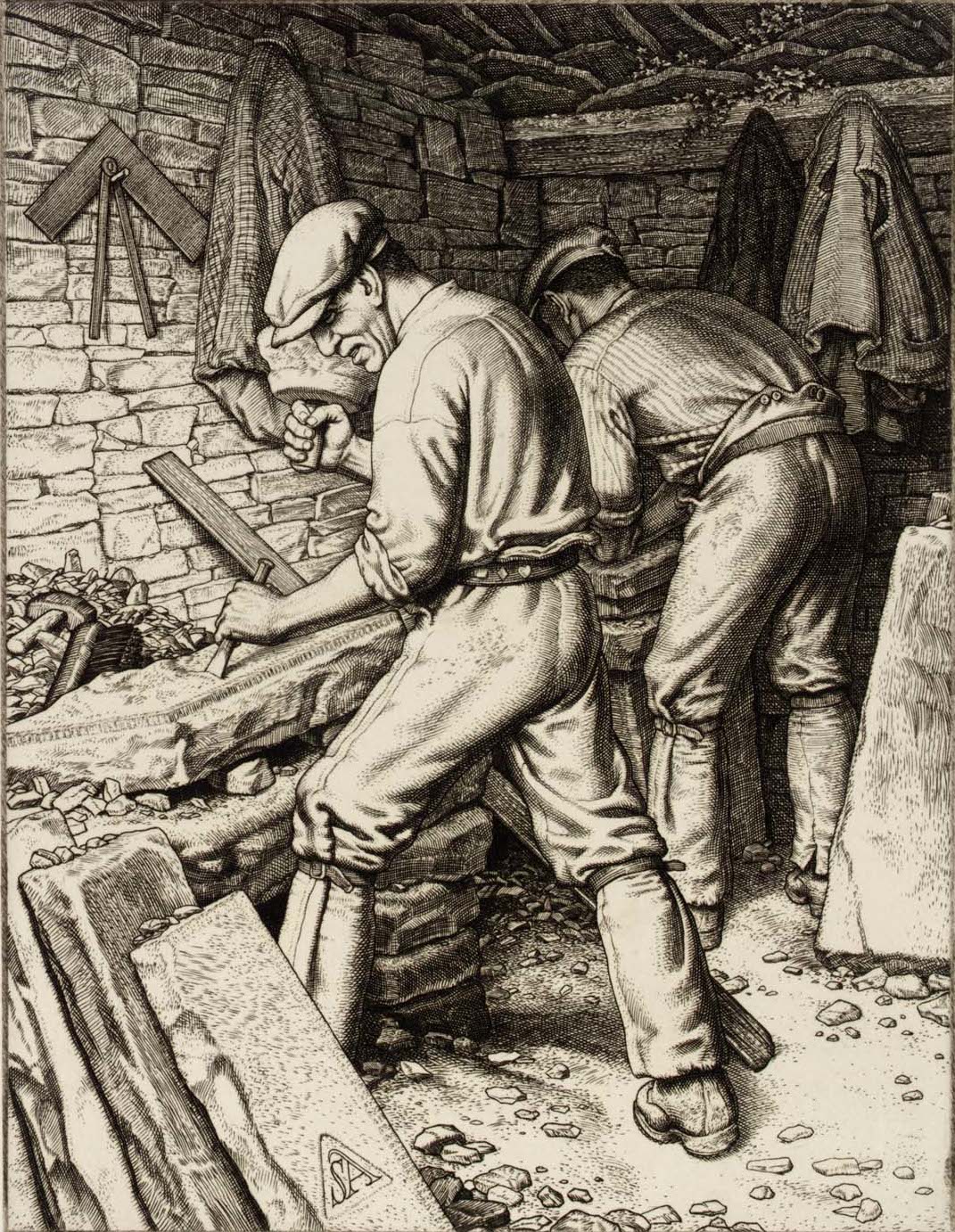
A “companionable thing.” That is how the English painter-printmaker Stanley Anderson (1884 – 1966) summed up what “art” should be. His work reflects this sentiment, even though much of it was produced in solitude – slowly and studiously. Staging the exhibition, Unmaking the Modern: The Work of Stanley Anderson, I was glad to have had another chance of giving my contemporaries an opportunity to get acquainted with Anderson, who died on this day fifty years ago, and to have a conversation with him as he, through his work, continues to communicate his beliefs.
Stanley Anderson, Purbeck Quarrymen (1936), engraving
I say “another chance,” as I had previously co-curated an exhibition of Anderson’s prints at the Royal Academy in 2015 and, getting to know Anderson through his prints and correspondences, written about him with my better half, Robert Meyrick, a book that was released to coincide with that show. Staging this second exhibition, Unmaking the Modern, a year later, I concentrated on Anderson’s efforts to bring about the conversation he hoped for – a conversation about the disregard for a generation of men like him who saw their lifetime commitment to traditions threatened by so-called progress.
Much of what Anderson chose to engage with and bring to our attention has disappeared: traditions gone and skills abandoned, rural communities destroyed and urban neighborhoods demolished, lives lost and often forgotten. This may well evoke a sense of nostalgia. But that nostalgia is ours, not Anderson’s.
Anderson did not refer to himself as an “artist” and rejected the idea that makers of cultural products should create such works for art’s sake or as a means of self-expression. Making art, like doing any other meaningful work, was to him a social act – a “companionable thing.”
Anderson observed those changes as they took place: the demolition of buildings, the erection of shrines to profit and temples devoted to the exchange of money. He responded concretely and in no uncertain terms to what he saw going on in his lifetime. His works are not so much a lament as they are public outcries and displays of solidarity with those who, like him, where threatened by a demand for speed and expediency.
Objects of visual culture, especially prints, are a way of reaching out and fostering connections among individuals who share the values that are made manifest in arts and crafts. Anderson’s works are the products and tokens of fellowship. He took careful note of how others around him carried out their jobs of creating furniture, of working the land, and of serving the community. He understood their labor and honored it with the work of his own hands. Each print bespeaks a communion, a faithful, generous and sustained engagement with his subjects.
Anderson also looked at – and insisted on making us see – the forgotten men of his day: the homeless, the destitute and the aged. He cast a light on individuals that society had turned into outcasts, misfits that could not or would not conform to the dramatic changes that progress demanded.
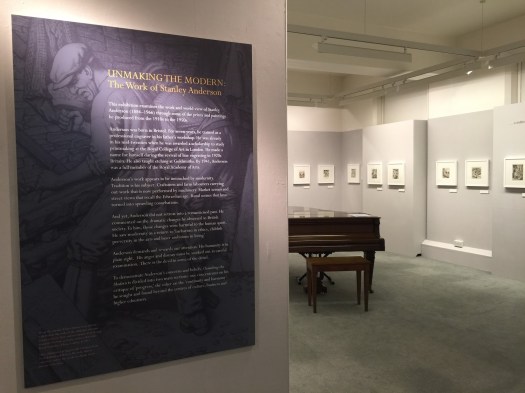
Installation view of the exhibition at the School of Art Museum & Galleries, Aberystwyth University
Anderson was not opposed to commerce; indeed, market scenes were among his favorite subjects. Born in Bristol, he had trained for seven years as a professional engraver in his father’s workshop. He was already in his mid-twenties when he was awarded a scholarship to study printmaking at the Royal College of Art in London. Art – and the teaching of printmaking – were jobs to him. Being a Royal Academician, meanwhile, was a privilege to him that came with the responsibility of making or promoting art that was not removed from the everyday but that brought people together and that got them looking at each other.
Long before Pop Art, Anderson bridged the divide between high and low culture that modernism had created. He united what modernity insisted on separating: the heart and the hand. This was a conscious decision, as his correspondence bears out, not a lack of awareness of Modernism. After years of studying and using a variety of printmaking techniques, he returned to engraving, which he had long associated with trade.
With those later engravings, he devoted himself to documenting the workaday activities of others – be they craftsmen or farmhands – who, like him, made a living from performing manual work for the benefit of others. Making art, like performing any other meaningful work, was to Anderson a social act – a ‘companionable thing.’
Unmaking the Modern: The Work of Stanley Anderson was on show at the School of Art galleries, Aberystwyth University, Wales, from 1 February to 11 March 2016. An online version is currently under construction.
“It’s not the end of the world.” How often do we utter those words, whether to calm ourselves or to dismiss the concerns of others. Well, I never found anything calming about that expression. It is the belittling by hyperbole that irks me. We tend to judge the gravity of a situation by the magnitude of its physical manifestations rather than the depth of feelings it produces in the experiencer. I, for one, have experienced the end of the world in early childhood; yet there is no evidence of an event having taken place, no trace of its existence save for the lachrymal salt on a crumpled pillow that, I suppose, was disposed of decades ago. No surface trace, that is.
How am I looking? Is this an expression of trust, apprehension, or a questioning of portraiture as truth?
One evening, in a working-class flat in the grim sterility of the German industrial town I was expected to call home, I overheard my parents make mention of the apocalypse. Someone had predicted that the world was going to end, and the date was set for the night to come. It was one of those doomsday prophecies that adults shrug off or subscribe to, depending on their intellect, faith and psychological make-up. As a child, I had no recourse to experience. I had no knowledge of having survived any number of doomsdays pronounced previously. Nor did I yet doubt that adults knew all and spoke true. I only had that night to go into, with a sense that it would be my last.
I was put to bed, and it felt as if I had been abandoned, cast out to face the unfathomable by myself. I was going to be no more. Everything I knew was to turn into unknowable nothingness. No one seemed troubled to prepare me for this chaos, the void that I already felt lying alone in the dark. I remember well the agony of that night, an angst that I now might term existential.
I have no recollection of the morning after. What followed, though, were years of nightmares involving the atom bomb, cold-war sweat inducing anxieties about nuclear fallout and the nihilism of the No Future generation, mingled, in my case, with an awareness of my queer otherness that made it seem impossible for me to go into those nights in a fellowship of the doomed.
No doubt, this is why Ernest Hemingway’s short story “A Day’s Wait” appealed to me when I first read it as a teenager. It is a story of a boy who, owing to a momentous misunderstanding, believes himself to be dying. It is that story I chose to write about as an undergraduate student in English literature, even though it has often been dismissed as a minor work of magazine fiction beyond the canon of Hemingway’s supposed greatest. I, on the other hand, was drawn to what I read as its theme of trivialized sublimity and the terror of that trivialisation.
Until recently, I did not consider that my first last night might have been the beginning of the end, not of childhood – a concept I have long come to question – but of trust, faith, love and a sense of order and stability. Now, as I am preparing for a lecture on gothic ruins, I am piecing together those haunting, Frankensteinean fragments of my past and present selves, and I wonder just how much fell apart that one nightfall …
[This entry is dedicated to the students of my Gothic Imagination class, whom, during the last few weeks, I exposed to visualisations of nightmares, sublime views and dystopian visions.]
“Etherized Victorians,” my doctoral study on American radio plays, had been lying for years in a virtual drawer. A string of rejection letters from publishers made me leave it for dead. Then, when I learned about an opportunity to get it out of that coma at last – with the aid of a reputable academic publisher to boot – I went for it. I have regretted that decision ever since. The anger welled up in me anew when I read “Academics are being hoodwinked into writing books nobody can buy,” an article in the Guardian, which a colleague of mine had shared via Facebook.
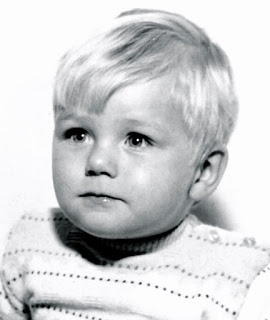
A toothy smile after years of anger and disappointment
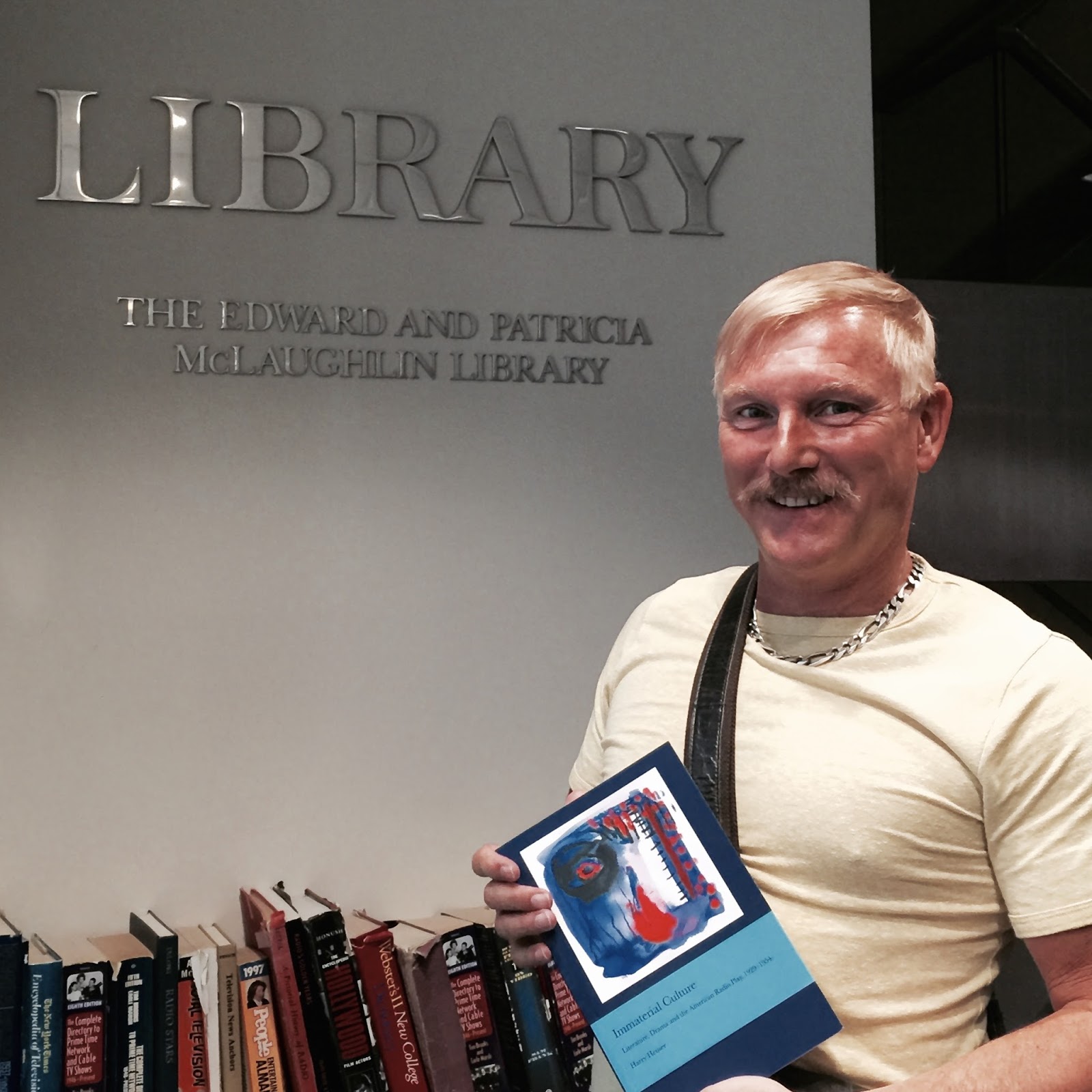
It is not that I believe that should have let my study lie, that it did not deserve to be revived. Rather, I feel it deserved a better home than the publisher provided for it. Funeral home is more like it. To send it there, I agreed to pay £1600 for the production of a book that contains no images, except for the cover art that was supplied to me by my artist friend Maria Hayes. Besides, I did all the editing, proofreading and indexing myself. There was no substantial input or support from the publisher, Peter Lang, other than a list of instructions and some rather frustrating feedback on my blurb for the back of the book, which, to my disappointment, has been issued as a paperback only.
Turning “Etherized Victorians” into Immaterial Culture meant cutting back and stripping bare. It was an instructive experience, painful though it was. I renegotiated but was nonetheless obliged to cut about 50,000 words, and I rue the quick decision to get rid of an entire chapter (available online, on my website, but since reworked for a chapter in the anthology Audionarratology: Lessons from Radio Drama). I also had to let go of the list I had compiled of my primary sources, the plays I discussed. When I asked for corrections of errors or inaccuracies I spotted close to the deadline, I was first told that no further changes were possible and then threatened with a £30 per hour editing fee. So much for academic standards.
Peter Lang did nothing, apparently, to promote the Immaterial Culture. Living up to its new name, my study did not even show up on Google books. I was mailed a few ‘complimentary’ copies, some of which I sent to a friend with connections to the BBC. Nothing came of that. I also walked one copy up to the theater, film and television department of Aberystwyth University, where I work for next to no pay, thinking I might give a lecture or make a course out of it. I have not heard from the department since.
And who else besides a library or an institution of higher learning would bother to purchase a text that is overpriced at £ 52.00 ($ 84.95), thus too expensive to attract radio drama aficionados? Not that anyone potentially interested would have even heard of the book. Apart from one long and highly complimentary review (in German), Immaterial Culture received no press, despite my filling out a great number of forms to assist in its promotion.
It is disappointing – let’s make that ‘pointless’– to write for an audience that proves allusive and impossible to reach. So, I decided to donate a copy of the book to the Paley Center for Media in New York City, where I conducted research for it. It would be rewarding and reassuring to me if someone made use of or derived pleasure from my work. Why else ‘publish’?
Academic publishing is tantamount to a vanishing act. I much rather carry on a supposed vanity project such as this journal, which is freely accessible to all and sundry, just like the once popular plays for broadcasting about which I go on in Immaterial Culture.






 Harry Heuser