
Ray Harryhausen: Influence and Inspiration
Ray Harryhausen, King Kong and Animation: ‘that added value of a dream’
In 1933, the thirteen-year old Ray Harryhausen went to see King Kong at Grauman’s Chinese Theater in Hollywood. The special effects by veteran artist Willis O’Brien’s enthralled him. Soon afterwards, Harryhausen began to experiment in stop-motion animation. ‘I owe everything to this giant gorilla and the people who made it,’ Harryhausen later said in an interview.
Most of the gorilla films of the 1930s, ‘40 and ‘50s – The Gorilla, Bride of the Gorilla, The Ape and White Pongo among them – featured actors in furry suits. Mighty Joe Young was the last attempt at a big budget stop-motion gorilla picture. Middling box office in relation to cost ruled out a proposed sequel.
The gorilla suit as a low-budget alternative to animation was used well into the 1980s. The daddy of them all, Kong, was brought back to life in more or, frequently, less convincingly staged derivations of King Kong’s themes. Queen Kong was unleashed in 1976.
The gorilla suit was largely retired with the advent of CGI. Harryhausen, who died in 2013, was uninspired by the new technology. He had a cameo in the 1998 remake of Mighty Joe Young; but he made no further feature films after Clash of the Titans (1981). ‘Stop-motion, to me, gives that added value of a dream world that you can’t catch if you try to make it too real.’
Ray Harryhausen and Gustave Doré
‘Many artists have directly and indirectly affected and influenced my work,’ Harryhausen acknowledged in retrospect, ‘but perhaps Doré has been the most influential.’
Doré instilled a theatricality into his illustrations that lent themselves so well to cinema compositions and in turn explains why many motion picture art directors were influenced by his engravings. Perhaps it can be said that Doré was the first real art director of the movies.
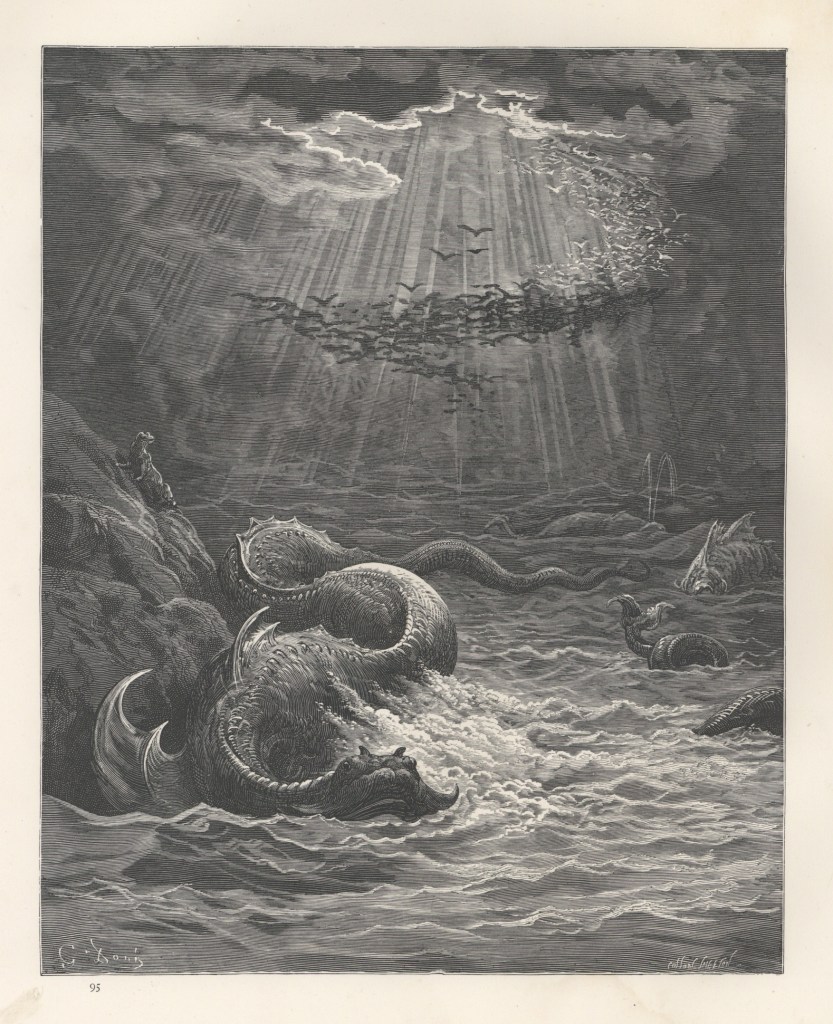


Top centre: illustrations for an 1863 edition of Atala by François-René Chateaubriand
Top right: The Death of Samson, illustration for an 1866 edition of the Holy Bible
Harryhausen credited his mentor Willis O’Brien for making him appreciate Doré’s cinematic style. In his conversations with O’Brien, Harryhausen learned just how much the jungle scenes in King Kong were indebted to Doré’s work. ‘For example, the fallen log was lifted right out of Atala,’ Harryhausen pointed out.

Still from King Kong (1933), co-directed by Mighty Joe Young director Ernest B. Schoedsack; reproduction for label display
The log features prominently in Harryhausen’s own ‘homage’ to Doré. Nearly three decades after King Kong uprooted it, the log returned to the screen in the Jules Verne fantasy The Mysterious Island (1961), on which Harryhausen worked as ‘special visual effects creator.’
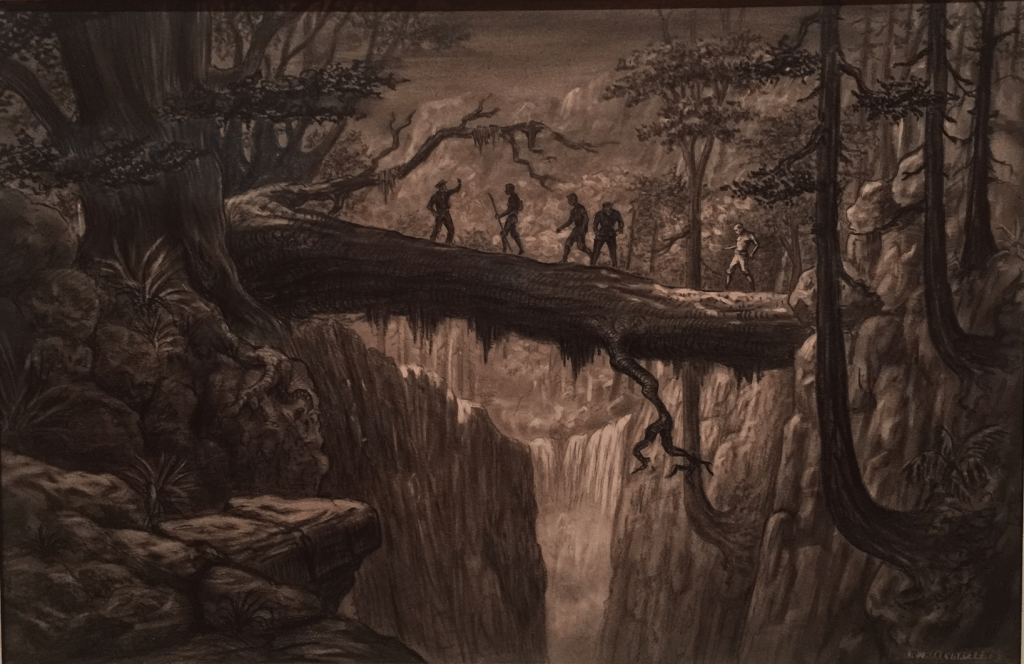
Harryhausen’s ‘homage to Doré,’ a key drawing for Mysterious Island (c. 1960); reproduction for label display
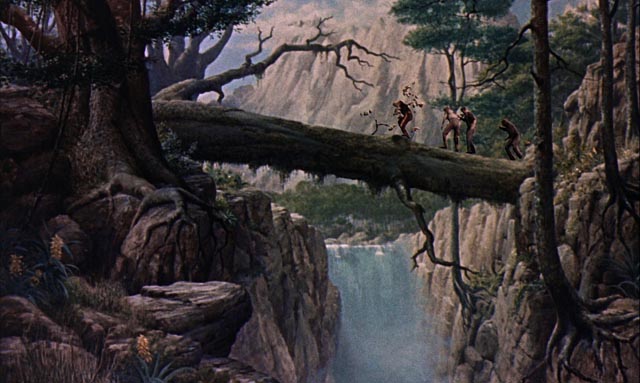
Scene from the fantasy film Mysterious Island (1961)
Ray Harryhausen and John Martin
Aside from Doré, an important influence on Ray Harryhausen – and on his Clash of the Titans (1981) in particular – was the Romantic painter, printmaker and illustrator John Martin (1789 – 1854). One of Martin’s most dramatic canvases – The Destruction of Pompeii and Herculaneum (1822) – was shown alongside Harryhausen’s models and drawings in The Art of Ray Harryhausen (2017) at Tate Britain in London.
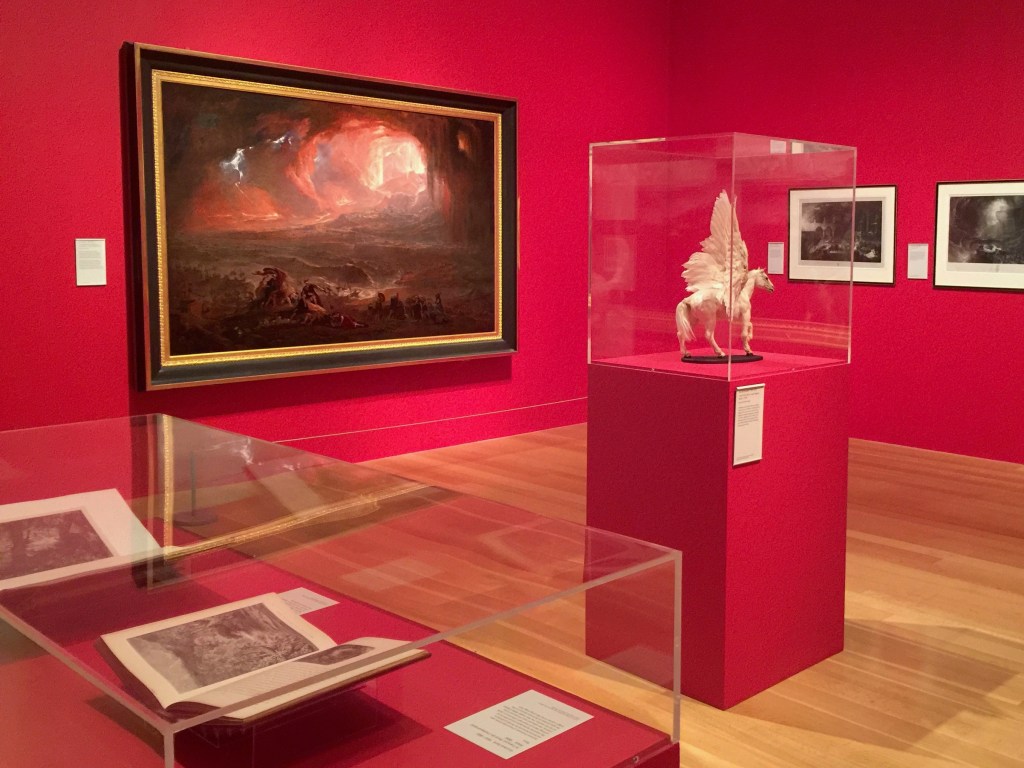
Installation view of The Art of Ray Harryhausen, Tate Britain (26 June – 19 November 2017); photograph: Harry Heuser
As curator Martin Myrone has pointed out, John Martin’s works were ‘copied extensively’ in the nineteenth century. This opened his work up to art collectors with a limited budget. Harryhausen created a private collection of prints, copies, and paintings by the lesser-known artists whose compositions were derived from Martin’s sublime performances.
Martin’s biblical scenes of destruction are a precursor to the epics of Cecil B. DeMille. Gradually, such spectaculars were divested of the Christian motifs that had served to justify them. The disaster movie was born. One of its early exponents, The Last Days of Pompeii (1935), was helmed by Mighty Joe Young director Ernest B. Schoedsack.
Navigating the Display
Recapturing Mighty Joe Young: Introduction
The Mighty Joe Young Album at Aberystwyth University
Ray Harryhausen: Influence and Inspiration
Mighty Joe Young: Cast and Crew
Mighty Joe Young: Promotion and Propaganda
 Harry Heuser