
History Listens: “The Fall of [No Other] City”

Page from the published script of Archibald MacLeish’s “The Fall of the City” (1937)

As the world awaits news from Ukraine and its people awake daily to the sounds of shelling, many of us, having survived the pandemic that at once isolated and united us, become alive anew to our connectedness to world events and to the urgency, the necessity, of connecting dots in plain sight, and of listening out for tell-tale signs, be it the rumble of tanks or the roar of tyrants.  We should have seen this one coming, we might suspect; but such hindsight provides no relief in the face of local destruction and global upheaval.  

I am reminded of the events that came to be known as 9/11 – an attack that did not, as some claimed and many felt, hit us ‘out of the blue’ on that bright September morning – and of feeling both helpless and useless in the wake of the terror that would shape history.  I was teaching writing in the Bronx, and I was researching radio drama of the 1930s.  None of that seemed to matter at a moment when digging in and digging up – literally and figuratively – was felt to be needed to uncover lives lost and recover the history that had gotten us to that point.  I kept on teaching writing, and I kept on researching radio – and I strove to find the usefulness and relevance of both.  That is, I did not carry on “regardless.”  

Instead of retreating into the past of broadcasts decades old, I tried to retrieve messages pertinent to the present.  And while we might think that messages are merely repeated rather than being heeded, we may also find that we did receive them and that we are capable of learning from history even as a world leader insists on repeating it.  

Take, for instance, Archibald MacLeish’s “The Fall of the City.”  First produced and broadcast in the US on 11 April 1937 – with a cast including Orson Welles and Burgess Meredith, and a score by Bernard Herrmann – it was a response to the rise of a dictator who, unchecked and unresisted, conquers a city despite warning voices from the past – the ancient and the dead.  In MacLeish’s allegory, the ‘conquerer’ is not a person: it is fear.  It is fatalism.  It is the surrender of freedom to fascism.

In “The Fall of the City,” a radio announcer (played by Welles in the 1937 production) serves as our eyes, an observer by proxy reporting from the scene of an unnamed city.  MacLeish’s plays – from “Air Raid” to “The Trojan Horse” – are never simply plays for the medium of radio but also plays about that medium – about tuning in from a distance, about mediation and reception, and about misinformation and deception.  The listeners are implicated, their role in the event of listening reflected upon in the shared act of telling stories and hearing histories in the making.

“The sun is yellow with smoke,” the announcer informs the audience, “the town’s burning….  The war’s at the broken bridge.”  It is impossible to listen to those lines now without seeing the cities under siege in Ukraine; and yet, “The Fall of the City” – which was broadcast just two weeks prior to the arial bombing of Guernica in April 1937 but written some months earlier, in 1936 – not about the reality of any particular invasion but about the real threat posed by evasiveness.  It caution against giving in to ideas and being enslaved by ideologies, for which it was criticised during the Second World War: “In these last years,” Randall Jarrell, himself a poet, wrote in 1943:

many millions of these people, over the entire world, have died fighting their oppressors.  Say to them that they invented their oppressors, wished to believe in them, wished to be free of their freedom; that they lie there.

Jarrell wrote this in the aftermath of air raids, and the war of ideas were not uppermost on his mind.

I do not know whether I am writing at a moment that future records might document to be days or weeks before the start of a Third World War.  I know I am writing it in wartime.  Unlike in the scenario envisioned by MacLeish, the world is not only watching the atrocities perpetrated by Russians in the towns and cities of Ukraine; it is responding, both to aid Ukrainian civilians (my sister in Germany has welcomed Ukrainian refugees into her home) and to avoid an escalation of military conflict.  Unlike the abstract “citizens” of MacLeish’s play, men and women are resisting.  Cities do not fall.  They are attacked.  They are defended. They are fought over.  And it is citizens – civilians – that are doing the fighting.

How different this fight is from the defeat as MacLeish conceived it.  “The city is doomed,” the Voices of Citizens in his play declare,

The age is his! It’s his century!

Our institutions are obsolete.

He marches a mile while we sit in a meeting.

Opinions and talk!

Deliberative walks beneath the ivy and the creepers!

His doubt comes after the deed or never.

He knows what he wants for his want’s what he he knows.

He’s gone before they say he’s going.

He’s come before you’ve barred your house.

He’s one man: we are but thousands!

Who can defend us from one man?

Bury your arms! Break your standards!

Give him the town while the town stands!

We know the price of such surrender.  Putin might have believed that his invasion would meet with little or no resistance, and that the global community, understood as a community, is powerless in the face of his aggression.  Putin’s methods date from the past; his mind, however made up it may be, was made up last century.  It is no match for what humanity can achieve if we – and that includes the people of Russia – put our minds and methods to it.  Right now, his thinking and his tanks, his misfiring strategies and his unwillingness to listen, are being answered by the rallying cries of the present that will help us secure a future.
Difficult as Pie: A Priestley Postscript

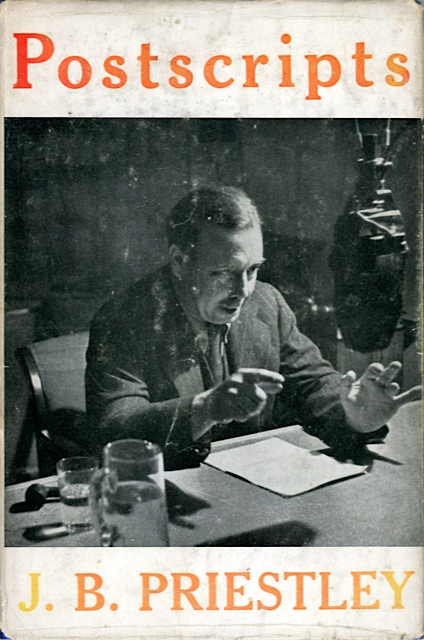
I have never heard J. B. Priestley deliver his famous Postscripts, a series of morale-boosting talks broadcast to the British public during those early, uncertain and hence no doubt most terrifying days of the Second World War.  Many decades later, actor Patrick Stewart returned Priestley’s lines to the airwaves that had once carried them into the homes of millions; but somehow I could not get excited about those recreations.  For, no matter how delayed an originally live broadcast, its recording yet retains the immediacy of a first-hand experience that no re-enactment can approach.

Recently, I came across the published Postscripts (1940).  Unlike Stewart’s voiceovers, the printed speeches are unabridged and, their author insists, “exactly as they were, without a speck of retouching.”  These are “wireless talks and not essays,” Priestley cautions the reader:

If I had my way they would never have re-appeared in this form, to be examined at leisure instead of being caught on the wing every Sunday at nine-fifteen, but the requests for a volume of them have come in so thick and fast during these last three months, that I felt it would be churlish to refuse.  So here they are, and please don’t blame them now, for they have already done the work they were intended to do.

Indeed, reading those scripts aloud now, I can, even in my own indifferent, untrained voice, hear them doing their work.  Priestley indulges in none of the hysterics and hyperboles that so often render alienating what is meant to be persuasive speech.  They are sentimental, these talks, and they are sane. 

As Priestley puts it in the Preface, the

tricks of the writing trade and some fortunate accidents of voice and manner are all very well, but what really holds the attention of most decent folk is a genuine sharing of feelings and views on the part of the broadcaster.  He must talk as if he were among serious friends….

Cover of Postscripts (1940) by J. B. Priestley

Priestley’s Postscripts are simply words of encouragement, gentle reminders that much of our seemingly inconsequential everyday is worth holding on to as it defines who we are, that the loss of even the slightest thing may be keenly felt as a threat to our identity.  Take a piece of pie, for instance—and make it a fake one.

That is just what Priestley did, on this day, 29 September, in 1940, when he talked about returning home to Bradford, the “solid real place” of his childhood.  The seemingly random devastation caused by a recent air raid, though far less grand in scale than the attacks on London, “made a far deeper impression” on Priestley “because it somehow brought together two entirely different worlds; the safe and shining world of my childhood, and this insecure and lunatic world of to-day.”

The local bakery, too, had suffered during the raid; but there, in the broken, half boarded up window, could still be glimpsed at the giant pie that had fascinated Priestley when, as a child, he saw emanating from it a steady flow of “fine rich appetising steam.” A wondrous, awe-inspiring sight it was to Priestley, the boy—and a wonder it was now to Priestley, the man, that, after all those years and after all those hours of bombing, the pie was still in its place, still in one piece, and still steaming away.

Mindful of the prosaic souls who needed to have their lessons spelled out for them, and who may well have resented as this “yapping about . . . pies and nonsense” at a time of acute crisis, Priestley added the reminder to “keep burnished the bright little thread of our common humanity,” a world in which that particular pie had “its own proper place.”

If only we had heard a voice like that during the dark days after 9/11, an opportunity seized by warmongers and profiteers.  If only there had been that sane and gentle voice, the raising of which in a time of terror is as difficult as pie.

"We must be prepared for anything at any time": A Word from the Little Flower

Lying in bed last night, I was troubled by the sensation that, should I fall asleep, I might never wake again. I thought of what I would leave behind, and the catalogue of my accomplishments was so short that I was forced to change the subject for want of material. It was a rare moment of anxiety brought on by the dizzying headache that, I presume, is one symptom of a five-week-old cold I cannot seem to shake. I wonder how many folks, even in the best of health, had that feeling back in December 1941 when, instead of mind’s eyeing the seasonal shop windows, they were confronted with the likelihood that their world was coming to an end.

The raid on Pearl Harbor on this day, 7 December, in 1941, forced many Americans to reexamine their life or, perhaps, examine it for the first time. Wondering about the future and their part in shaping it, civilians no doubt asked of themselves what, if anything, they might be able to contribute, although we should not rule out that some were busy conceiving ways of avoiding any such contributions.

I well recall that feeling of utter worthlessness during the days following the attack on the World Trade Center, when I dutifully took the train (or the bus, or whatever mode of transportation would run) up to the Bronx to teach college students not to split their infinitives or dangle their modifiers. In light of the deadly strike and the uncertainties ahead, making my mark in red ink struck me as petty and pointless. The most troubling sight, the most nauseating response was anything suggesting “business as usual.” It was not so much reassuring as offensive, this make-believe of “life goes on.”

In his radio address to the people of New York, Mayor Fiorello La Guardia, known as the Little Flower, still had to bring home that business in the city was going to be far from usual. Being that the city itself had not come under attack and there were no immediately signs of violent change, many of those tuning in to WNYC had to be reminded of the urgency of the situation and its possible effects on a city thousands of miles from either Hawaii or Europe.

“I want to warn the people of this city that we are in an extreme crisis,” La Guardia addressed the public:

Anyone familiar with world conditions will know that the Nazi government is masterminding Japanese policy and the action taken by the Japanese government this afternoon. It was carrying out the now known Nazi technique of murder by surprise. So there is no doubt that the thugs and gangsters now controlling the Nazi government are responsible and have guided the Japanese government in the attack on American territory and the attack on the Philippine Islands. 

Therefore, I want to warn the people of this city and on the Atlantic coast that we must not and cannot feel secure or assured because we are on the Atlantic coast and the activities of this afternoon have taken place in the Pacific. We must be prepared for anything at any time.

While ordering “all Japanese subjects to remain in their homes until their status [was] determined by [the] federal government,” La Guardia urged citizens to be “calm,” arguing that there was “no need of being excited or unduly alarmed.”

Listening to such historical recordings, I imagine myself in the moment, imagine the bewilderment of those who had stayed out of world politics, the irritation of those to whom such a disruption of the holiday season meant inconvenience or financial loss, the immigrant who would be subjected to the suspicion and the hatred of their neighbors.

Perhaps it is my own sense of historical insignificance that makes it possible for me to imagine what it was like to wake up on the morning of Monday, 8 December 1941, of feeling the burden of living, and of taking on the challenge of translating such an onus into a chance to matter, if only for a little while—to be prepared for death as well as life.

Terror of Judgment: "The Path to 9/11"

Firefighter memorial, Upper East Side, NYC

I decided to see for myself. So, I watched the first part of The Path to 9/11, which aired last night on BBC2. I am not sure whether or in how far this version differs from the one that aired, a few hours later, on ABC in the US; and aside from the word “Pathetic” hissed by John O’Neill (Harvel Keitel) in response to anti-terror efforts of the Clinton administration, I found little that smacked of partisan fingerpointing. This fictional documentary strikes me as far more significant, thought-provoking and accomplished than Oliver Stone’s World Trade Center, the subdued disaster movie I saw on its opening night in New York City and wrote about in the first of a series of Gotham impressions that is herewith coming to an end.

As I remarked previously, Oliver Stone’s film was exasperatingly a-political, reducing a world-historical event to an intimate portrait of personal suffering. It had more pathos than Path, which, in its first instalment, went astray only once, namely with the emotional outburst of the pseudonymous (and hence factually suspicious) CIA analyst “Patricia.” Otherwise, I commend the forgers of Path, whether they forged history or not, for driving home that the collapse of the Twin Towers was not a senseless tragedy but a hostile response to the west that had been long in the planning.

AOL Tower, NYC

To be sure, what a visual dramatizations like The Path to 9/11 cannot but fall short of showing is the ideological/theological conflict underlying the series of attacks in which we now find ourselves. A clash of ideologies is portrayed as a clashing of minds, and masterminds are made flesh so that they can be tracked, trapped, and presumably rendered innocuous. Fanaticism is far more hazardous than “The Most Dangerous Game.” However comforting the thought, however rewarding the execution, the terror it begets won’t end in the capture of a few ruthless misleaders, just as fascism—to which we still surrender many of our democratic ideals today—did not perish with Hitler in his bunker.

I am not about to reduce this anniversary of the attacks known as 9/11 to another opportunity to advocate sound (or radio) plays as the drama of ideas, even though we might do well to pay more attention to words the articulation of powerful ideas than absorb images of their physical manifestations. New York City is in need of visual reminders of its past. Too often, gleaming surfaces (like the façade of the post-9/11 AOL Tower, shown right) smooth over the scars that document the city’s path and its pathology.

On This Day in 1938: Broadcast “Air Raid” Assaults Like Sontag’s 9/11 Tirade

Sunlight and shadows across my
copy of MacLeish’s Air Raid

Well, only yesterday I wrote about the potentialities of broadcasting and blogging as means and modes of connecting with the world. Today I am going to mark the anniversary of an execrable “disconnect” by relating it to a disturbing episode in my life, a moment of outrage in a period of confusion and despair. Ready?

On this day, 27 October, in 1938, the Columbia Workshop laid an intellectual egg of such poor taste that I sometimes felt the only proper way of connecting to it would be to hurl it right back at its author, the American poet-pamphleteer Archibald MacLeish. The play produced by and broadcast over the US radio network CBS was “Air Raid,” an exercise in propagandist verse. Like “The War of the Worlds”, which aired a few days later over the same network, “Air Raid” entered the anti-fascist debate and commented on the political tensions then mounting in Europe by exploiting and fueling the anxieties of an American public divided between battle cries and isolationism. The nation’s enemies, such plays told in the abstract language to which pre-war radio playwrights were bound to adhere, were not quite so distant as to render their attacks futile.

In “Air Raid,” MacLeish went so far as to hold civilians whose lives were threatened or lost in fascist offensives responsible for their inaction. As in the previously discussed “Fall of the City,” the audience is taken to the scene of terror, listening in as carefree women, heedless of the warnings they receive, ar e going about their daily affairs until blown to bits by machine guns fired from above. The announcer, observing the raid from a secure post, reports and comments on the execution:

There’s the signal: the dip: they’ll
Dive: they’re ready to dive:
They’re steady: they’re heading down:
They’re dead on the town: they’re nosing:
They’re easing over: they’re over:
There they go: there they—

His coverage of the event is cut short by the stammering guns and the shrieking of women and ends in a boy’s calling of my name: “Harry! Harry! Harry!” I did not require such a prompt to feel personally offended.

MacLeish intellectualizing of terror and patronizing of the terrorized is the kind of disastrous argument that reminded me of Susan Sontag’s words shortly after the attacks on the World Trade Center. In an article published in the New Yorker, Sontag lamented the “disconnect” between the “monstrous dose of reality” that was 9/11 and the “self-righteous drivel and outright deceptions being peddled by public figures and TV commentators.”

Sontag opined that the “voices licensed to follow the event seem to have joined together in a campaign to infantilize the public,” a public lacking in “historical awareness” and subjected instead to the “psychotherapy” of “confidence-building and grief management.” Arguing the insistence on America’s strength to be not “entirely consoling,” Sontag concluded: “Who doubts that America is strong? But that’s not all America has to be.”

In retrospect, I find these words unremarkable; they have been uttered many times since. Living through the terror of those days in New York City, however, I was infuriated by such ill-timed chastising from afar (Sontag lived in Paris at the time). I sat down and cried and wrote a lengthy response to let out my anger, shared with the German friend who brought Sontag’s commentary to my attention:

Sie mag aus der Ferne spotten; sähe, fühlte, spürte sie die Stadt würde sie den New Yorkern kaum “Dummheit” vorwerfen.  Wenn ich ihr aus der Ferne auch weder Feigheit noch Dummheit unterstellen will, so muss ich doch feststellen, dass Abstand auch eine Freiheit von Anstand bedeuten kann.  Sontag schrieb einmal ein erfolgreiches, vielzitiertes, und feines Buch mit dem Titel Against Interpretation.  Sie täte gut daran, sich gegen ihre eigenen ‘Interpretationen’ zu sträuben.

In essence, I argued that Sontag should heed the words that formed the title of her book Against Interpretation, that she should have reserved her distant and distancing intellectualizing and her attacks on the supposedly infantile public and the media that pampered it for a period in which a bewildered public was more likely to stomach further humiliation and to respond with a kindness and dignity lacking in Sontag’s words to the unwise.

Attacking both the medium it employs and the masses it engages (that is, attempting to appeal to the latter by questioning the former), MacLeish’s “Air Raid,” like Sontag’s tirade, is a prime example of how not to connect.