NBC, CBS, and Abe

On the eve of the 200th anniversary of Abraham Lincoln’s birth, I am once again lending an ear to the Great Emancipator. Franklin Delano Roosevelt may have been America’s “radio president”; but in the theater of the mind none among the heads of the States was heard talking more often than Honest Abe. On Friday, 12 February 1937, for instance, at least six nationwide broadcasts were dedicated to Lincoln and his legacy. NBC aired the Radio Guild‘s premiere of a biographical play titled “This Was a Man,” featuring four characters and a “negro chorus.” Heard over the same network was “Lincoln Goes to College,” a recreation of an 1858 debate between Lincoln and Democratic senator Stephen A. Douglas. Try pitching that piece of prime-time drama to network executives nowadays.

Following the Lincoln-Douglas debate was a speech by 1936 presidential candidate Alf Landon, live from the Annual Lincoln Day dinner of the National Republican Club in New York. Meanwhile, CBS was offering talks by Lincoln biographer Ida Tarbell and Glenn Frank, former president of the University of Wisconsin. From Lincoln’s tomb in Springfield, Illinois, the Gettysburg Address was being recited by a war veteran who was privileged to have heard the original speech back in 1863. Not only live and current, the Whitmanesque wireless also kept listeners alive to the past.

Most closely associated with portrayals of Lincoln on American radio is the voice of Raymond Massey, who thrice took on the role in Cavalcade of America presentations of Carl Sandburg’s Abraham Lincoln: The War Years; but more frequently cast was character actor Frank McGlynn.

According to the 14 June 1941 issue of Radio Guide, Lincoln “pop[ped] up” in Lux Radio Theater productions “on the average of seven times each year”; and, in order to “keep the martyred President’s voice sounding the same,” producers always assigned McGlynn the part he had inhabited in numerous motion pictures ever since the silent era. In the CBS serial Honest Abe, it was Ray Middleton who addressed the audience with the words: “My name is Abraham Lincoln, usually shortened to just Abe Lincoln.” The program ran for an entire year (1940-41).

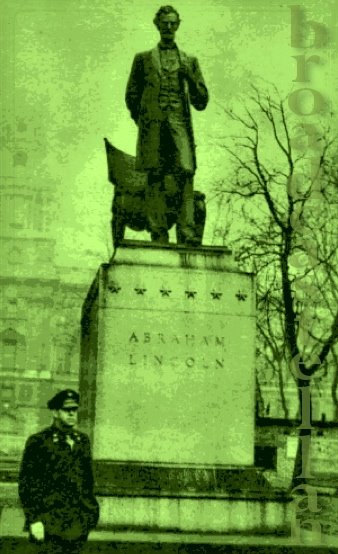
The long and short of it is that, be it in eulogies, musical variety, or drama, Lincoln was given plenty of airtime on national radio, an institution whose personalities paid homage by visiting memorials erected in his honor (like the London one, next to which singer Morton Downey poses above). Nor were the producers of weekly programs whose broadcast dates did not coincide with the anniversary amiss in acknowledging the nation’s debt to the “Captain.” On Sunday, 11 February 1945—celebrated as “Race Relations Sunday”—Canada Lee was heard in a New World A-Coming adaptation of John Washington’s They Knew Lincoln, “They” being the black contemporaries who made an impression on young Abe and influenced his politics. Among them, William de Fleurville.

“Yes,” Lee related,

in Billy’s barbershop, Lincoln learned all about Haiti.  And one of the things he did when he got to the White House was to have a bill passed recognizing the independence of Haiti.  And he did more than that, too.  Lincoln received the first colored ambassador to the United States, the ambassador from the island home of Billy the Barber.  And he was accorded all the honors given to any great diplomat in the Capitol of the United States.  Yes, the people of Harmony have no doubt that Billy’s friendship with ole Abe had more than a lot to do with it.

Six years later, in 1951, Tallulah Bankhead concluded the frivolities of her weekly Big Show broadcast on NBC with a moving recital of Lincoln’s letter to Mrs. Bixby. That same day, The Eternal Light, which aired on NBC under the auspices of the Jewish Theological Seminary of America, presented “The Lincoln Highway.” Drawing on poet-biographer Sandburg’s “complete” works, it created in words and music the “living arterial highway moving across state lines from coast to coast to the murmur ‘Be good to each other, sisters. Don’t fight, brothers.’”

Once, the American networks were an extension of that “Highway,” however scarce the minority voices in what they carried. Four score and seven years ago broadcasting got underway in earnest when one of the oldest stations, WGY, Schenectady, went on the air; but what remains now of the venerable institution of radio is in a serious state of neglect. An expanse of billboards, a field of battles lost, the landscape through which it winds is a vast dust bowl of deregulation uniformity.

Related recording
“They Knew Lincoln,” New World A-Coming (11 Feb. 1945)
Toward the close of this Big Show broadcast, Bankhead recites Lincoln’s letter to Mrs. Bixby (11 Feb. 1951)
“Lincoln Highway,” The Eternal Light (11 February 1951)
My Tallulah salute

Related writings
“Spotting ‘The Mole on Lincoln’s Cheek'”
”Langston Hughes, Destination Freedom, . . .”
A Mind for Biography: Norman Corwin, ‘Ann Rutledge,’ and . . .”
”Carl Sandburg Talks (to) the People”
“The Wannsee Konferenz Maps Out the Final Solution” (on the Eternal Lightproduction of “Battle of the Warsaw Ghetto”)

On This Day in 1941: Carl Sandburg Talks (to) the People

Well, the castellan is back in his element, which is air, preferably arid. Surely it is not water. I am still drying out—coughing, sneezing, and slowly recovering—from the why-not folly of riding a rollercoaster on a rain-soaked night in Blackpool, England. Listening to the soundwaves of old broadcasts seems a comparatively safer contact with the air—and a more edifying one at that—than having one’s aged bones twirled and one’s addled brains twisted in a series of gravity-defying thrill rides.

Yet while there might have been little instruction in this bathetic experience of fairground gothics, there still was a thought to be distilled thereafter from the confines of my soused cranium. It was the thought of one who stood by in spirit that night, one taking notes while passing through a sea of everyday people; it was a passing thought of one once known as the people’s poet, America’s Carl Sandburg.

A while ago, I asked what a soundscape of Britain might turn out to be, if ever there were such an exhibition devoted to regional noise. The voicescape of the United Kingdom has been quite thoroughly mapped since then, with the BBC’s voices project capturing the diverse accents of the British Isles in hundreds of recordings now online, including a group of Blackpool Romany.

For anyone moving here with memories of Dick Van Dyke Cockney, finding everyday British voices charted like this is a revelation (even though I doubt whether my own German high school English gone Nu Yawk and Wales is represented in this mix). Carl Sandburg, who set out to render and represent the thought and speech of the American every(wo)man in the 1920s and ‘30s, might have embraced such a charting of diction—even though a map like this still calls for the voice of a poet to make it sing and signify. Sandburg attempted just that.

On this day in 1941, when the United States anxiously eyed a United Kingdom at war, Sandburg addressed American radio listeners on the long-running Cavalcade of America program in an effort to celebrate a unified diversity. The play, “Native Land,” opened with words read by actor Burgess Meredith, who reminded all tuning in of the timeliness of the lines to follow:

Monday, September 22, 1941. A number on a calendar, arrived at after a million years of watching the stars, of telling the time of harvest by a shadow foreshortening, and the time of planting by the sun in the equinox. September 22, 1941. We will start at the beginning; for the beginning was the land and the stars moving overhead. And that is today, this week, the land America—a beginning. And the land is what people have made of it, what people are making of it in this fourth week of September. . . .

The ensuing broadcast, which interwove excerpts of Sandburg’s verse with its author’s autobiography, expounded on the thought that a “poet must do a lot of listening before he begins to talk.”

“Where do we get these languages?” Sandburg wondered, as actor’s voiced snippets from everyday speech picked up on the streets of the poet’s home turf, Chicago. Now that the “people in cities had forgotten the old sayings,” they “talked a new lingo,” a vocal vibrancy to which the program was meant to be an anything-but-mute testimonial. The voices of the people were worth preserving, the broadcast suggested. Yet, with war in the offing, a task larger than one to be undertaken by a librarian and curator of sounds was at hand—the preservation of the people itself.

In keeping with the at times sanctimonious patriotics of the DuPont-sponsored Cavalcade program, the broadcast concluded with Sandburg’s appropriation of words from Abraham Lincoln’s Second Annual Message to Congress (1 December 1862); they were, Sandburg remarked, “Lincoln words for now, for this hour”:

The dogmas of the quiet past are inadequate to the stormy present. The occasion is piled high with difficulty, and we must rise with the occasion. As our case is new, so we must think anew, and act anew. We must disenthrall ourselves, and then we shall save our country.

In his own words compiled and adapted from his 1936 voice-collage The People, Yes, Sandburg insisted in cautious optimism that the “learning and blundering people will live on”:

This old anvil,
the people, yes,
This old anvil laughs at many broken hammers. . . .

Today, in our own “stormy present,” the internet has become the new smithy of thought. It is the workshop in which the “old anvil” is sounded anew, where people may “think anew” and speak anew, not only to suit new cases, but to revisit old. Now, I wonder whether my own language is suited to the task to revisit and reacquaint, whether I should not spent more time listening before speaking.

It sure felt comforting to hop on the rollercoaster in Blackpool, just to scream and laugh for a change. Queer and quaint, my verbiage seems ill-chosen at times to communicate my thoughts, to argue my cases old and new. . . . Still, it is my tongue, and I must have it out.

Spotting “The Mole on Lincoln’s Cheek”; or, The Free Company We Didn’t Keep

My headphones have been buried so deeply in the sands of time that I have only recently begun to pay attention to the mission of Cindy Sheehan, to the anti-war movement she seems to have reinvigorated, and to the controversy she is stirring by insisting on talking to the US president at his ranch down in Texas. The American home front is showing signs of battle fatigue. Well, perhaps the phrase “home front,” so commonly used during World War II, is inappropriate these days, considering the lack of universal support the Iraq-centered war on terror has been receiving.

Expressions of frustration, confusion, and anger seem to become more forceful and frequent as, after years of fighting, both the end of the war and the ends of it remain uncertain. Is it illusory or perhaps even misguided to hope for a voice of reason to unite the masses, a voice not strident yet unequivocal, not irate but assertive, not jingoistic but inspirational? Radio once seemed to have given nations such a voice, but was often in danger of becoming the medium of fascism.

Unlike those who go indifferently about their business while being mute beneficiaries of democratic freedoms, few protesters would deny that American ideals are worth fighting for in words and actions; indeed, people like Sheehan, a mother who lost her son in combat, are fighting for the realization of such ideals by insisting on publicly voicing their concerns, concerns that by now are shared even by many of those responsible for the reelection of the US president in 2004.

The question on the minds of many Americans and their allies today is, of course, whether the war in Iraq has in any constructive way contribute to the defense of their freedoms or whether it might not have further endangered them either directly (through increasing acts of global terrorism) or indirectly (through anti-terrorist measures curtailing civil liberties).

It is a mistake to assume, however, that, in 1942, US citizens were any more united about going to war then they are now, or that they had a clearer understanding of the stakes and aims of such an enterprise. As I learned from Gerd Horten’s book Radio Goes to War, a government survey revealed that half of those questioned just months after the attack on Pearl Harbor were not even sure what the war was about. Many had been convinced to embrace an isolationist position. Media tycoon Randolph Hearst was one of the most influential figures to warn Americans that war was bad because it was not good for business. And radio was big business.

Back then, noted American playwrights, journalists, and novelists spoke up against isolationist—that is anti-war—propaganda, reminding citizens that inertia could mean surrender to fascism, that there are nearly as many wrong reasons for not going to war than they are for engaging in it.

One such group of artists who set out to inspire the American public in the months prior to Pearl Harbor was the Free Company, a “group of leading writers, actors and radio workers who had “come together voluntarily to express their faith in American democracy.” They were “unpaid, unsponsored and uncontrolled. Just a group of Americans saying what they [thought] about [America] and about freedom.” And they chose a commerce-driven medium like radio to bring their point across.

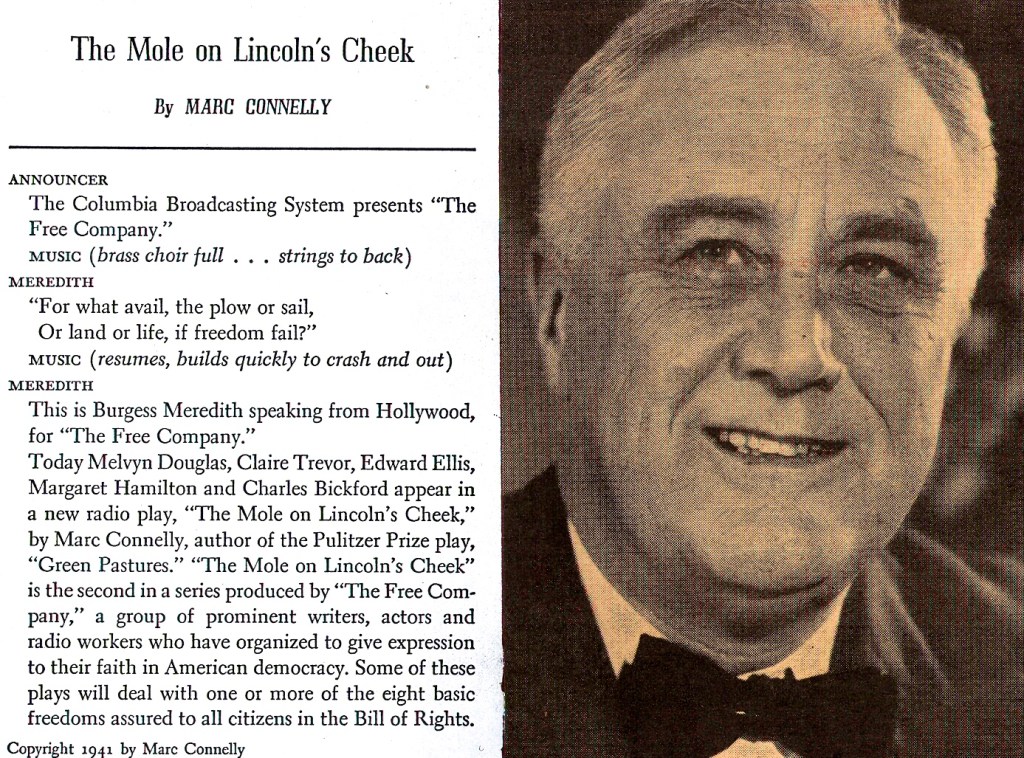
As Burgess Meredith told the radio audience of Marc Connelly’s play “The Mole on Lincoln’s Cheek”: “Our freedom [ . . . ] has this meaning . . . that here, in our land, the truth may be taught, always.” He urged Americans to “resist all attempt to suppress truth or to distort it. Let us consider again,” he continued,

the most powerful words ever spoken against the enemies of man—the lightning-charged words of Lincoln at Gettysburg. And let us renew, in this threatening hour, his high resolve that the government of the people, by the people and for the people shall not perish from the earth.

Could a group like the Free Company—which consisted of Pulitzer Prize winners including Maxwell Anderson, Archibald MacLeish, Stephen Vincent Benét, Marc Connelly, and Paul Green—unite for a series of radio (or television) broadcasts today to unite a largely disillusioned people divided by confusion and cynicism, a people more eager to expose the mole on Lincoln’s cheek than to conceal it?

Would they deem a continuation of the present war unjustifiable or argue a withdrawal from Iraq to be a surrender to terrorism? And just how open would a skeptical public be to any effort to “resist all attempts to suppress truth or to distort it,” how willing to accept any attempts to achieve a consensus?