Static and Spirits: Anarchic Airwaves, Prohibition, and the Return of Philo Gubb, Correspondence School “Deteckative”

Illustration for โ€œThe McNoodle Brothersโ€™ Radio Mystery” in Radio News, Sept. 1923

Philo โ€ฆ Gubb? Never heard of him.ย ย Nor, in all my yearsโ€”make that decadesโ€”as a reader of detective fiction, had I come across, or become aware of, Ellis Parker Butler (1869โ€“1937), the writer who brought Philo Gubbโ€”โ€œa tall, thin man, with the face and gait of a flamingo,โ€ a paperhanger with a hankering for โ€œdeteckativeโ€ workโ€”into a flurry of being.ย ย Not until recently, that is.

Generally, I do not mind stumbling onto what might have been got at with greater ease and efficiency through methodical research.ย ย I am aware that any perceived surprise on my partโ€”that โ€œEureka!โ€-inducing moment of discoveryโ€”may be owing to an absence of assiduity.ย ย That said, some of the most memorable encounters are made by chance, along circuitous routes.

In the case of Ellis Parker Butler and his brainchild Philo Gubb, though, I regret not having made the acquaintance of either of them sooner, given that this particular route led me back, unexpectedly, to the early days of broadcasting, about which Butler had much to say that might have been of interest and use to me in Immaterial Culture, my study of so-called old-time radio.

Now,ย Immaterial Cultureย does not pick up on the story of broadcasting until the network days of the late 1920s.ย ย To gain an understanding how radio evolved, a look at prehistoric transmissions, albeit largely in the absence of sound recordings, is nonetheless instructive.ย ย You cannot expect to โ€œgetโ€ the cream of old-time broadcasting if you neglect an inspection of the catโ€™s whiskers for traces of same.

โ€œโ€ฆ I prefer to explain all differentlyโ€: A Specious Rationalization of the Criminal Impulse to Possess Forbidden Fruit in Eden Phillpottsโ€™ โ€œThe Iron Pineappleโ€

The Bookshop by the Sea, where I purchased A Century of Detective Stories

The Welsh seaside town of Aberystwyth, where I live, has no shortage of bookstores, first-hand and otherwise.  At one of themโ€”The Bookshop by the Sea, which sells both old and new volumesโ€”I purchased, some time ago, A Century of Detective Stories.  Published in 1935, it is an anthology of crime and mystery tales introduced by G. K. Chesterton, whose outrageous โ€œFad of the Fishermanโ€ I found occasion to discuss here previously.

Ystwyth Books, where I purchased Death by Marriage by E. G. Cousins on the day I posted this blog entry.

Trying to live up to its title, A Century of Detective Stories is a brick of pulp, and it is not easy to handle when you are reclining in a lounge chair hoping to catch those rare vernal rays that are the oft unfulfilled promise of summer on the typically temperamental and frequently bleak west coast of Britain.  

Oxfam Bookshop, Aberystwyth, where someone beat me to a large selection of Three Investigators books on the day of writing this entry.

Aberystwyth and its environs have, in part for that reason, been the setting of murder mysteries, among them the noirish detective series Hinterland and the quirky retro-noir novels of Malcolm Pryce.  And, as I am writing this, the place is a veritable crime scene, with local booksellers displaying mystery novels and hosting literary events dedicated to the art of murder.  It is all part of Gwyl Crime Cymru, billed as โ€œWalesโ€™ first international crime fiction festival.โ€

Waterstones, Aberystwyth, where I tend to purchase copies of British Library Crime Classics.

Meanwhile, I am still catching up with A Century of Detective Stories.  Selections include narratives by Edgar Allan Poe, Wilkie Collins and Marie Belloc Lowndes, as well as works by some of the biggest names in crime fiction written between the two World Wars: Agatha Christie, H. C. Bailey, Dorothy L. Sayers, and Edgar Wallace, to drop just a few.  The diversity of this collection is part of its strength and appeal.  Its title is nonetheless misleading.

Continue reading “โ€œโ€ฆ I prefer to explain all differentlyโ€: A Specious Rationalization of the Criminal Impulse to Possess Forbidden Fruit in Eden Phillpottsโ€™ โ€œThe Iron Pineappleโ€”

Mother, She Wrote

โ€œThere’s no family uniting instinct, anyhow; it’s habit and sentiment and material convenience hold families together after adolescence. There’s always friction, conflict, unwilling concessions. Always!โ€ Growing up in a familial household whose microclimate was marked by the extremes of hot-temperedness and bone-chilling calculation, I amassed enough empirical evidence to convince me that this observationโ€”made by one of the characters in Ann Veronica (1909), H. G. Wellsโ€™s assault on Victorian conventionsโ€”is worth reconsidering. It is not enough to say that there is no โ€œfamily uniting instinct.โ€ What is likely the case during adolescence, rather than afterwards, is that the drive designed to keep us from destroying ourselves becomes the one that drives us away from each other. Depending on the test to which habit, sentiment and convenience are put, this might well constitute a family disuniting instinct.

Not even a motherโ€™s inherent disposition toward her childโ€”to which no analogous response exists in the offspring, particularly once the expediencies that appear to increase its chances of survival are being called into questionโ€”is equal to the impulse of self-preservation. I was twenty when I made that discovery; the discovery that there was no love lost between my mother and myself, or, rather, that whatever love or nurturing instinct, on her part, there had been was lost irretrievably.

Years ago, I tried to capture and let go of that moment in a work of fiction:

An early evening in late October. She stands in the dimly lit hallway, a dinner fork in her right hand, blocking the door, the path back inside. The memory of what caused the fight is erased forever by its emotional impact, its lasting consequences. The implement, picked up from the dining table during an argument (some trifle, no doubt, of a nettlesomeย disagreement), has not yet touched any food today.

In one variant of this recollection, she simply stands there, defending herself. She wants to end the discussion on her terms. In another version (which is the more comforting, thus probably the more distorted one) she keeps attacking with fierce stabs, brandishing the fork as if it were a sword. Was it self-control that kept her from taking the knife instead? She is right-handed, after all.ย 

Though never hitting its target, the fork, brandished or not, becomes indeed an effective weapon in this fight. Itโ€™s an immediate symbol, a sudden and unmistakable reminder that it is in her hands to refuse nourishment, to withhold the care she has been expected to provide for so many years, and to drive the overgrown child from the parental tableโ€”and out of the house.ย 

โ€œGet out. Now!โ€

She is in control and knows it. She will win this, too, even though the length of the skirmish and the vehemence of the resistance are taxing her mettle. It has been taxed plenty. In this house, coexistence has always been subject to contest, as if decisions about a game of cards, a piece of furniture moved from its usual spot, or even the distribution of a single piece of pie were fundamental matters of survival. In this house, anything could be weaponized. In this house, which since the day of its conception has been a challenge to the ideals of domesticity and concord, has slowly worn down the respect and dignity of its inhabitants, and forced its dwellers into corners of seclusion, scheming and shame, it is only plaster and mortar that keeps those walled within from hurling bricks at each other.ย 

โ€œI want you out of here. Now. Get out. Out.โ€ Her terse wordsโ€”intelligent missiles launched in quick succession at the climactic stage of a traumatizing blitzโ€”penetrate instantly, successfully obliterating any doubt as to the severity of her anguish, and, second thoughts thus laid waste to, even the remotest possibility of reconciliation.

This time she really means it. She screams, screeches, and hisses, her words barely escaping her clenched teeth. It is frightening and pathetic at once, this sudden theatrical turn, an over-the-top rendition of the old generation gap standard. Yet somewhere underneath the brilliant colors of this textbook illustration of parent-child conflict and adolescent rebellion is a murky layer of something far more disquieting and unseemlyโ€”something downright oedipal.

Words, exquisitely vile, surface and come within reach but remain untransmitted, untransmissible. Addressing her in that way is a taboo too strong to be broken even in a moment of desperate savagery. Instead, the longing for revenge, for a reciprocal demonstration of the pain she, too, is capable of inflicting, will feed a thousand dreams.

Ultimately, it is fear that becomes overpowering. There is more than rage in her expression. It is manifest loathing. Two decades of motherhood have taken their toll.

At last, she slams the door. A frantic attempt to climb back inside, through the open bathroom window, fails when she, with a quick turn at the handle, erects a barrier of glass and metal.

The slippery steps leading to the front doorโ€”now away from itโ€”feel like blocks of ice, a bitterness stinging through thin polyester dress socks. There was no time to put on shoes. This is a time to evacuate. Humiliated, cold, and terrified. Thrown out of the house.

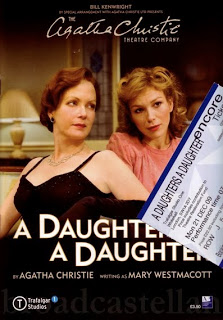
Now, contrary to what these fictionalized recollections suggest, Iโ€™m not one to cry over spilt motherโ€™s milk; besides, I did return homeโ€”through that doorโ€”and stayed at my parentsโ€™ house for another excruciating two years. It would have been far smarter and far more dignified to let go and move on. I had clearly outstayed my welcome. The realization came to me again the other night when I went to see the A Daughterโ€™s a Daughter, a cool examination of what may happen to close family ties once both mother and child reach maturity. The playwright, who resorted to the pseudonymous disguise of Mary Westmacott, was none other than mystery novelist Agatha Christie.

So, I oughtnโ€™t to have been surprised by the lack of sentiment in the portrayal of a parent-child relationship that goes sour once the expiration date has passed. Think Grey Gardens without the cats. After all, in guessing games like And Then There Were None and The ABC Murders, Christie reduced human suffering to a countdown. And when she went back to the nursery, it was mainly to borrow rhymes that provided titles for some of her most memorable imaginary murders, the ruthless precision of which was a kind of voodoo doll to me during my troubled adolescence.

Still, I was surprised by the chill of the unassuming yet memorable drama acted out by Jenny Seagrove and Honeysuckle Weeks in Londonโ€™s Trafalgar Studios that December evening. I was surprised by a playโ€”staged for the first time since its weeklong run in 1956โ€”that was not merely unsentimental but unfolded without the apparently requisite hysterics that characterize Hollywoodโ€™s traditional approaches to the subject.

To be sure, A Daughterโ€™s a Daughter is hardly unconventional. It is not A Daughterโ€™s a Daughterโ€™s a Daughter. Modest rather than modernist, controlled more than contrived, it is assured and unselfconscious, a confidence to which the apparent tautology of the title attests. Yes, a daughterโ€™s a daughterโ€”and just what acts of filial devotion or maternal sacrifice does that entail? How far can the umbilical bond be stretched into adulthood until someoneโ€™s going to snap?

The central characters in Christieโ€™s play reassure anyone who got away from mother or let go of a child that, whatever anyone tells youโ€”least of all arch conservatives who urge you to trust in family because itโ€™s cheaper than social reformโ€”survival must mean an embrace of change and a change of embraces.


Related writings
โ€œIstanbul (Not Constantinople); or, There’s No Boat โ€˜Sailing to Byzantiumโ€™โ€
โ€œCaught At Last: Some Personal Notes on The Mousetrapโ€
โ€œEarwitness for the Prosecutionโ€
โ€œOn This Day in 1890 and 1934: Agatha Christie and Mutual Are Born, Ill-conceived Partnership and Issue to Followโ€

Caught At Last: Some Personal Notes on The Mousetrap

Well, we ended the year in a jam. None too comfortable in a tight squeeze, I nonetheless joined the throng on Waterloo Bridge for the customary year-end countdown and fireworks. We had just gotten out of The Mousetrap, which snapped shut for the 22957th time last night. Opening in 1952, Agatha Christie’s thrillerโ€”which started out as a radio play titled โ€œThree Blind Miceโ€ back in 1947โ€”is still packing them in like red herrings in a jar at the St. Martin’s Theatre (pictured below). So, whatโ€™s the attraction?

Like most readers, I discovered Christie’s mysteries in my early teens; as a gay male, I did not feel myself represented by the average juvenile fare and was too puzzled and scared to seek out works that might hold a mirror to my androgynous if pimply visage. The impersonal killings perpetrated and neatly solved in the quaint whodunits of the late โ€œQueen of Crimeโ€ were just the kind of rest cure my troubled mind seemed to demand.

There was something reassuring in the curlings of Hercule Poirotโ€™s mustachios, the armchair as an intellectual retreat, the assorted young neโ€™er-do-goods among Christieโ€™s long lists of suspects, as well as the less-than-physically fit busybody of that little old lady who could. It inspired me to try my brains at composing a whodunit, even though, despite numerous attempts, I only managed a revenge comedy whose German title loosely translates as โ€œAnd All the Worst for the New Year.โ€

Nowadays, the Christie puzzlers with their lazy prose and perfunctory characterizations do no longer seem quite so satisfying to me; but, as if in gratitude for seeing me through those terrible years, I still catch up with Christie and her works from time to time, whether on television, in the theater, or on my travels. A few years ago, quite by chance, I found myself in the author’s quarters at the Pera Palas Hotel in Istanbulโ€”on the anniversary of her birth, no less.

Back in December 2005, I took in a stage adaptation of And Then There Were None (briefly discussed here). And Then is one of the few works in the Christie canon that is not merely clever but genuinely unnerving.

While well oiled, The Mousetrap is rather less snappy and gripping, despite its opening in the dark to the strains of โ€œThree Blind Miceโ€ and a womanโ€™s piercing scream. The rather superior Gay Lambert (as the troublesome Mrs. Boyle) aside, the current cast of The Mousetrap, which originally starred Sir Richard Attenborough (pictured here on the poster for the play), is as capable as a group of figures in a game of Clue. Little more is expected of Christieโ€™s characters, which fall flat when they are meant to be round.

There is, of course, that queer young fellow named Christopher Wren, just the kind of chap whose welcome presence in the generally impersonal board game tableaux of Agatha Christie, told me, all those years ago, that there was a place for the likes of me in a world filled with hazards, traps, and processed cheese.

Earwitness for the Prosecution

Being that this is the anniversary of the birth of Guglielmo Marconi, a scientist widely, however mistakenly, regarded as the inventor of the wireless, I am once again lending an ear to the medium with whose plays and personalities this journal was meant to be chiefly concerned. Not that I ever abandoned the subject of audio drama or so-called old-time radio; but efforts to reflect more closely my life and experiences at home or abroad have induced me of late to turn a prominent role into what amounts at times to little more than mere cameos. Besides, โ€œWriting for the Earโ€ is a course I am offering this fall at the local university; so I had better prick ’em up (my auditory organs, I mean) and come at last to that certain one of my senses.

The English lexicon amply documents the western bias against listening, generally “seen” as being secondary to sight. Compared to the commonly used “eyewitness,” for instance, the expression “earwitness” sounds rather unusual. What’s more, it is rejected by my electronic dictionary and, when typed in defiance, promptly marked as a spelling error. That is perhaps the victorious eye thumping its nose at the once superior ear, which, prior to the invention of the printing press, played a greater or at any rate more respected role in the sharing and absorption of information than it does in this our age of gossip and hearsay. If the always favored ocular proof cannot be discovered, it is the eyewitness report that carries more weight than the overheard.

I am going to refrain from channeling McLuhan, however, and concentrate instead on a notable fictional witness whose testimony was brought before an audience in the strictest sense of the word. I am referring to Agatha Christie’s Witness for the Prosecution, a courtroom melodrama initially conceived as a short story and subsequently adapted, albeit not by Dame Agatha herself, for US radio, whose early experiments in courtroom dramatics have been previously discussed here.

According to the Wikipedia, the “very first performance of Witness for the Prosecution was in the form of a live telecast which aired on CBS’s Lux Video Theatre on 17 September 1953. Now, this is accurate only if Witness is meant to denote Christie’s stage play, rather than her story. The latter had already been dramatized nearly four and a half years earlier. Produced by NBC’s Radio City Playhouse, it was broadcast on this day, 25 April, in 1949.

Such a hold has visual storytelling on our imagination today that it is difficult to approach this audio performance of Witness without seeing before oneโ€™s mind’s eyes the features and the legs of the legendary Marlene Dietrich (of whom I have seen quite a bit this year [see my movie lineup on the right] and to whose voice I intend to devote my next podcast). Then there is that prominent scar in the face of the titular character, more prominent still than Ms. Dietrich’s invaluable German accent. Can a sound-only adaptation without access to Dietrich’s features or voice succeed in rendering Christieโ€™s cheeky deception?

Unlike the character of Leonard Vole, the accused, whose innocence is laid on rather too thickly by David Gothard in the Radio City Playhouse production to escape the listener’s suspicion, the mysterious woman who comes to his aid (ably portrayed by theater actress Lotte Stavisky) might just manage to pull the wool over your ears. The radio dramatization handles the challenges of duping the audience, both the listeners at home and in the fictional courtroom, remarkably well, the scar being made audible in the gasp of its beholder. Like the members of a jury, when called upon to examine accusations and protestations of innocence, the listener deals with interpretations of reality, on someoneโ€™s word taken for an otherwise unknowable โ€œit.โ€

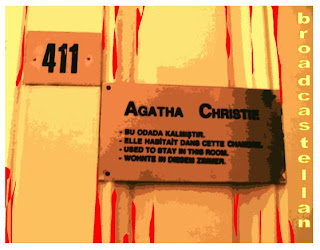
I confess, though, that, as much as I value my hearing, I frequently feel compelled to see for myself; which is why, on the anniversary of Dame Agathaโ€™s birthday, I went up to her room at the Pera Palas Hotel in Istanbul last fall and had a look. There wasnโ€™t much to see, really; not so much as an air of her presence. And, after paying the concierge who escorted us up to room 411, which the enterprising management has shrouded in a mystery of its own, I felt as if I were getting a box on the ear for not having had more sense.

Istanbul (Not Constantinople); or, There’s No Boat "Sailing to Byzantium"

Well, I have returned from a weeklong trip to Istanbul, Turkey. I did not bother to go in search of the aforementioned Rocky Jordan or look for his Cafรฉ Tambourine in the Grand Bazaar, a shopping maze I, being slightly claustrophobic and averse to haggling, was glad to escape. A man like Jordan bey would probably be lost as well in present-day Istanbul, a sprawling metropolis whose population continues to grow at an environment and infrastructure challenging rate and may well have surpassed twelve million. And yet, you are not likely to encounter the populace in Sultanahmet, the old part of town, which, despite its ancient buildings and monuments, comes across as spuriousโ€”and thoroughly commercialโ€”as an American pulp serial like A Man Named Jordanโ€”a western reconception of Istanbul as a Disney theme park.

Walking from the Blue Mosque to the Haghia Sophia, the erstwhile site of the Byzantine Hippodrome, you will find yourself amid hordes of British, American, Australian, and German tourists. I rarely got an opportunity to pull out the Turkish phrase book I had purchased for the occasion. Nor did the dishes served at restaurants just off the Hippodrome strike me as authentic; then again, many of the menus were written in English or German, however ill spelled. You will have to cross the Golden Horn to BeyoฤŸlu better to appreciate that foreign influences other than commercial tourism have been shaping the city for centuries.

Tourism might have been somewhat more discreet and less detrimental when the Orient Express first stopped in Istanbul, but the tracks for the seasonal invaders, many of whom flock to the cinematically commodified Topkapi (it having been on worldwide display since the 1964 movie of the same name), were already being laid during the late-19th century.

One of the oldest hotels catering to western visitors is the Pera Palas, where, among other well-known personages including Mata Hari and her Hollywood impersonatrix Greta Garbo, the previously discussed whodunit writer Agatha Christie stayed during the journey that inspired her Murder on the Orient Express. On the anniversary of her birth (15 September 1890), an enterprising concierge took us up into her room, now itself shrouded in a mystery contrived, no doubt, by the operators of said establishment; but more about that another time.

I grew up among Turks who were lured to Germany by the thousands during the post-World War II economic boom known as the Wirtschaftswunder and stayed there despite much hostility and humiliation. I lived among Turks, but rarely got to interact with them. I cannot say from experience how the situation is nowadays; but until I left Germany in 1990, Turks were still regarded as little more than servants who cleaned our streets and tidied our houses, a cleanliness ascribed to German efficiency but actually owning to foreign guest workers desperate enough get their empty hands dirty for a people known for its ethnic cleansing, a supposedly reformed nation enjoying the US support that ought to have gone to Blitzkrieg-devastated ally Britain.

Apparently, Germans have not reformed altogether. After strolling around remnants of glorious Constantinople and Byzantine ruins such as the Medusa head that, lying upside down, adorns the cavernous 6th century Basilica Cistern (pictured above) or taking a ferryboat across the Bosphorus to the Asian side of Istanbul, where we enjoyed lunch talking culture and politics with a descendant of the Ottoman rulers, CNN kept us up-to-date about the return of the Nazis in Germany’s local elections and gave us the jitters when the German Pope, who is supposed to visit Turkey in November, made some inflammable remarks about Islamic faith.

To avoid having to explain that I spent most of my adult life in the United States and just where my present home, Wales, is on the map and in relation to England, I often found myself replying “Germany” to the often voiced query “Where are you from?”โ€”but I could not say it either with pride or a sense of veracity.

To be sure, as today’s news reminded me, Turkey faces its own struggle to match the ideals of Western democracy, ideals rarely met anywhere but most conveniently found wanting elsewhere. Apparently, it is still deemed a criminal offence for any Turkish citizen openly to criticize the state, past or present, so that even a fictional characterโ€™s voicing of controversial remarks may get its author-creator into serious legal trouble.

Turkey might be a more dangerous place than Agatha Christie or the creators of A Man Named Jordan could have dared to imagine, lest they were prepared to divest this gateway to the Orient of its fabled and profitable enchantments.

As I have always insisted writing this journal, I am not one to be carried away by bouts of nostalgia. When poet William Butler Yeats imagined “Sailing to Byzantium,” one year before Constantinople’s name was officially changed to Istanbul, he talked of visiting antiquity by reading about an illustrious golden age so that he might dwell in the “artifice of eternity.” Arriving by plane and walking in present-day Istanbul, such reveries seem out of place.

What kind of place is Istanbul now? What is its place in the West as Turkey strives to join the European Union but rejects or refuses to embrace much of what strikes us as Western (money and consumerism aside)? Having caught a couple of fragmentary chapters of the country’s history, I, for one, will stay tuned . . .

On This Day in 1949: US Listeners Are Transported to Mexico

Well, it might just make it after all. Our elm tree, that is. It was uprooted and replanted over a year ago and did not take kindly to the forced relocation. This morning, when I replenished the bird feeder that dangles from its bare branches, I noticed a few tentative buds. Encouraged by those signs of life, I am going pay more attention to this horticultural casualty over the next few weeks. The uprooted and transplanted don’t always adjust well to their new environs. Sometimes, they seem altogether out of place. Take Miss Marple, for instance.

Last night, a new dramatization of Agatha Christie’s Sittaford Mystery premiered on British TV channel ITV1. Now, what was Miss Marple doing at Sittaford? She sure wasn’t sent there by her brainmother, who created Sittaford without Marple in mind.

Nothing quite fits together in this adaptation, which tries to update Christie’s early 1930s sรฉance mystery with noirish touches and hard-boiled wit. Transport the story into the 1950s, throw in an ex-James Bond (Timothy Dalton), a dash of Indiana Jones, a taste of not-so-sweet honey (an enigmatically skeletal Rita Tushingham), and some hints at lesbianismโ€”and, voila (now I am being Poirot), you’ve got yourself a caper with a serious identity crisis.

I have always been driven by and torn between two impulses: to stick to what I know and try to stay away from it. The familiar can be comforting and reassuring. In my readings, for instance, or in my appreciation of drama, I tend to be downright Victorian in my tastes. As much as I was intrigued by the story of (or behind) Bennett Miller’s Capote, with which I caught up this weekend, I would have preferred it to be a little less analytical. I did not get to feel for or identify with any of the characters, as fascinated as I was by the situation in which they found themselves.

Miller seems to have taken a Terrence Rattigan approach by trying to concretize ideas rather than plots and characters. Such attempts are, perhaps, best left to essays, writings in which blossoming ideas are more likely to reach maturity and take root in the mind of an audience to whose efforts in abstraction any singled-out specifics might be distracting.

And yet, the familiar can also be stultifying and stifling, making the getting away from it seem a matter of life and death. On this May Dayโ€”the celebration of spring and renewal, that, not altogether inappropriately, shares its name with the internationally recognized distress callโ€”I am looking westward, toward my former home, observing how the subject of immigration develops in the country of immigrants, and how US-Mexican relations received yet another blow, as millions are encouraged to stay away from work or refuse the purchase of US goods. However contentious the subject, it is not one to be avoided; and, rather than being a vehicle for escape, old-time radio, once again, serves as a reminder of some of Mexico’s other migratory misfortunes.

On this day, 1 May, in 1949, listeners of You Are There, a series of fictionalized radio documentaries, were given the opportunity to witness the assassination of emperor Montezuma, presumably by his own people. Among the voices from the past “interviewed” for the program, Canada Lee can be heard as an Aztec prince, the oppression of African-Americans being thereby likened to the life of the Aztecs under Montezuma.

Also on mike to give her views of the situation is the emperor’s daughter, who vows to leave Mexico with her husband, the invading Spaniard Cortez: “If the house of my father must be overthrown to deliver my people from hideous darkness, I say let it be overthrown.” That Cortez returns to Mexico to plunder its treasures is offered as a “footnote” at the conclusion of the broadcast.

On that same day, conceited skinflint Jack Benny went down to Mexico (or some Hollywood simulacrum of it, such as the above scene from Masquerade in Mexico) in hopes of a better lifeโ€”one enriched by foreign gold or by a shiny Oscarโ€”in an irreverent take on The Treasure of the Sierra Madre. He neither succeeded in the quest, nor in its dramatization, but delighted his audience as he died trying.

The radical tourism we label “immigration” has frequently been romanticized as adventurous or trivialized as opportunist; to criminalize it now will do still less to explain, let alone discourage, such wayward and often desperate acts of displacement. I, for one, have not set foot on my country of origin for nearly sixteen years. Anxious to fall away from the family tree, to take root elsewhere or rot, I migrated to New York City. A decade and a half (and some degrees) later, I moved on, to Britain, a country that seems stranger to me than I had anticipated.

Many who leave their native land are not unlike that elm tree in our garden, struggling and unstable; but I know that whatever it is that uproots us must be stronger than that which holds us in place.

Agatha Christie and Mutual: The Case of the Airlifted Detective

Well, my gray cells had little to do with it, mes amis. Once again, coming up with the facts merely required some amateur sleuthing inside the ever-widening web. Both Agatha Christie (the Dame who gave birth to Hercule Poirot and Miss Marple) and the Mutual Broadcasting System (the network that delivered The Lone Ranger and The Shadow) came into being on 15 September, albeit decades apart. It was in the stars that the two would team up some day, but the meeting itself proved a not altogether fortuitous one.

Christie, whose Mousetrap opened in 1952 and just won’t shut, is still the most widely known exponent of the British whodunit. Her novels, particularly those involving her two most celebrated detectivesโ€”Miss Marple and Hercule Poirotโ€”are frequently adapted for television. Such page-to-screen transfers rarely turn out to my satisfaction. A cleverly convoluted whodunit is best enjoyed at oneโ€™s own leisure, allowing ample time for the careful consideration of clues and an occasional consultation of oneโ€™s own roster of likely suspects.

Dramatizations dictate the duration of this experience, turning the reader-detective into a mere observer of the fictional one at work. Sure, there are pause and rewind buttons to be touched if one is not pressed for time or pressured by fellow viewers; but technological gadgetry gets in the way of the pleasures derived from being absorbed in the chase for the culprit. This was hardly the only problem mystery lovers faced when Hercule Poirot was airlifted to America back in 1945.

Listeners tuning in to the premier broadcast (22 February 1945) were greeted with the following promise:

From the thrill-packed pages of Agatha Christie’s unforgettable stories of corpses, clues and crime, Mutual now brings you, complete with bowler hat and brave mustache, your favorite detective, Hercule Poirot, starring Harold Huber, in โ€œThe Case of the Careless Victim.โ€

The Poirot impersonated by Huber, a character actor who had screen-tested his affected French accent in Charlie Chan in Monte Carlo, was far removed from the โ€œunforgettableโ€โ€”and very Britishโ€”stories conceived by Christie. Indeed, this Poirot, sent overseas for a series of โ€œAmerican adventures,โ€ was nothing but an impostor. And the very authority who was called upon to offer her endorsement, the famed authoress herself, acknowledged as much in her peculiar shortwaved message from London:

I feel that this is an occasion that would have appealed to Hercule Poirot. He would have done justice to the inauguration of this radio program, and he might even have made it seem something of an international event. However, as he’s heavily engaged on an investigation, about which you will hear in due course, I must, as one of his oldest friends, deputize for him. The great man has his little foibles, but really, I have the greatest affection for him. And it is a source of continuing satisfaction to me that there has been such a generous response to his appearance on my books, and I hope that his new career on the radio will make many new friends for him among a wider public.

So, who then was being washed onto Americaโ€™s shores if the great detective was engaged elsewhere? As I put it in Etherized Victorians, Christieโ€™s preface attempted at once to sanction the broadcast fraud and to distinguish such ersatz from the authentic portrait only the artist friend of the “great man” himself could render. It was a case of careless writingโ€”but listeners to the spurious, anonymously penned misadventures that followed refused to be victimised.

Suffice it to say that the series died quickly, quietly, and largely unlamented, whereas the happily separated partners in crimeโ€”Mutual and Christieโ€”continued their respective careers for decades to come.