Apart/in Parts: โ€œSignificant Otheringโ€ inย The Lodger (1927)

In conjunction with โ€œGothic Imagination,โ€ a visual culture module I teach at the School of Art, Aberystwyth University, I host an extracurricular festival of films by way of which to skirt the boundaries of the gothic beyond the landmarks and hallmarks of the Gothic as genre.

The Alfred Hitchcock-helmed silent romance thrillerย The Lodgerย (1927), a loose adaptation of a short story (1911) and novel (1913) by the suffragette Marie Belloc Lowndes, has featured in each of these series of film screeningsโ€”โ€œTreacherous Territoriesโ€ (2019), โ€œUneasy Thresholdโ€ (2021) and โ€œSignificant Otheringโ€ (2023). Approaching The Lodger anew, โ€œSignificant Otheringโ€ concentrates on the gothic or gothicized bodies thatโ€”in whole or in partsโ€”figure in the sprawling landscape of movies in the gothic mode.

None of the prime embodiments of the literary Gothic materialize in the films screened.  The modally gothic does not depend on the presence of Frankensteinโ€™s creature, Jekyll and Hyde, or Dracula; the multiplicity and hybridity that characterize those familiarly strange bodies are aliveโ€”make that “undead”โ€”in the mutations of the gothic mode beyond the permutations of the genre.

As The Lodger drives home, what makes bodies what we might call gothicโ€”although others may argue otherwiseโ€”is their otherness or, more precisely, the othering of them.

Continue reading “Apart/in Parts: โ€œSignificant Otheringโ€ inย The Lodger (1927)”

Gaslight Express: Ethel Lina Whiteโ€™sย The Wheel Spins, the Vanishing Spinster, and the Freewheeling Single Englishwoman

Winifred Froy spelling her name for Iris Carr in the Alfred Hitchcock directed adaptation of Ethel Lina White’s novel The Wheel Spins (1936)

I was determined to read at least a few chapters ofย The Wheel Spinsย (1936) in transit.ย ย The novel is, after all, set aboard a train, hundreds of miles from what the main character, Iris Carr, regardsโ€”and at times calls into questionโ€”as home.ย ย Written by a female novelist born in Wales, it is a story concerned with Englishness, with patriotism, prejudices and pretenses, and with feeling foreign in strange, peculiarly European, company.

So, after booking a last-minute vacation in the Europe that is now foreign territory to the Britishโ€”living though they may be alongside European expatriates like myselfโ€”I made sure to slip the 2023 British Library paperback edition of Whiteโ€™s mystery into my hand luggage before departure for Vienna.ย ย Habitually slow to turn the pages, I was certain there would be more left in store for me than the dรฉnouement on the short onward rail trip a few days later to the capital of Slovakia, just as it was turning on besieged Ukraine in the matter of grain exports.

Continue reading “Gaslight Express: Ethel Lina Whiteโ€™sย The Wheel Spins, the Vanishing Spinster, and the Freewheeling Single Englishwoman”

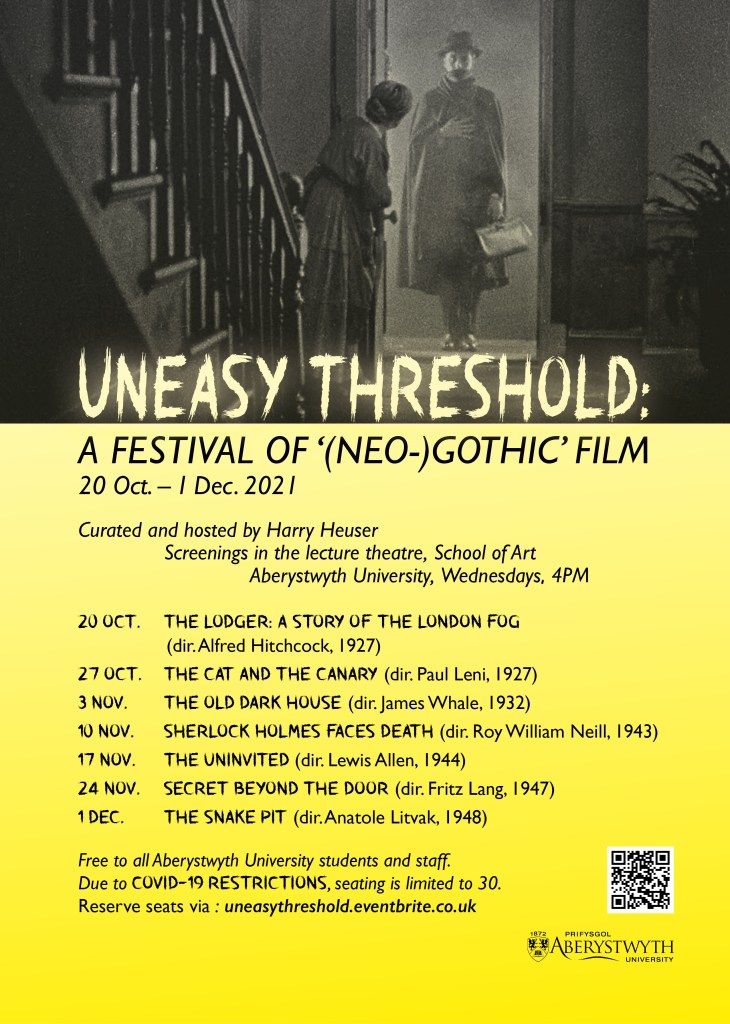
“Uneasy Threshold”:ย The Lodgerย (1927), Trespassing and the Unhomely

I am not an academic.  I am a human being.  Thatโ€™s not just me misquoting The Elephant Man.  It is a cri de cล“ur expressive of what is at the core of my identity as a creative person who happens to have transmogrified into an art history lecturer. To interrogate what that even means, I teach โ€œGothic Imaginationโ€ at the School of Art, Aberystwyth University. 

As part of that class, I present an extracurricular series of film screenings exploring the boundaries of the ‘gothic’ beyond the furnishings of the genre ‘Gothic.โ€™  That โ€˜gothicโ€™ is a term so broadly applied and ill-defined as to render it practically useless is a by now thoroughly predictable way of opening a debate about its practical uses.  Then again, the gothic has little to do to with practicalities.  

I have no intention to make the term, โ€œsalonfรคhig,โ€ that is, reverting here to my native German, to make it acceptable or viable in an academic setting.  Rather, I use the word, which I am applying to visual culture instead of literature, to contest progress or avant-garde narratives traditionally espoused by academies in order to suggest alternative histories and alternatives to the teaching of art history.  Attention to the popular, presumably lesser arts is essential to this strategy.

The first series of screenings, coinciding with my previous iteration of โ€œGothic Imagination,โ€ was titled โ€œTreacherous Territories.โ€ The phrase was meant to capture that challenge of defining and the dangers of inserting a mutable term such as โ€˜gothicโ€™ into the lecture theaters and seminar rooms that cannot quite accommodate, let alone confine it. 

The current series, โ€œUneasy Threshold,โ€ continues that playful investigation.  What, for instance, carries a mystery or a romance over the threshold of โ€˜gothicโ€™? What is that threshold? And what is the โ€˜gothicโ€™ interior โ€“ the environment in which โ€˜gothicโ€™ may be contained both as a subject for discussion and as an experience to be had by the viewer of, say, a crime drama, a thriller, a film noir or a horror movie?

As a literary genre, the Gothic began in and with a house โ€“ in Strawberry Hill and with the Castle of Otranto, both conceived by Horace Walpole long before Frankenstein, Jekyll/Hyde and Dracula came onto the scene.  Those names are on the letter box of the Gothic mansion of our imagination, and I do not mean to evict their bearers; but might there be room as well โ€“ be it a closet, a cellar or a boudoir โ€“ for a few hundred other, less usual suspects, such as the title character of The Lodger (1927)?

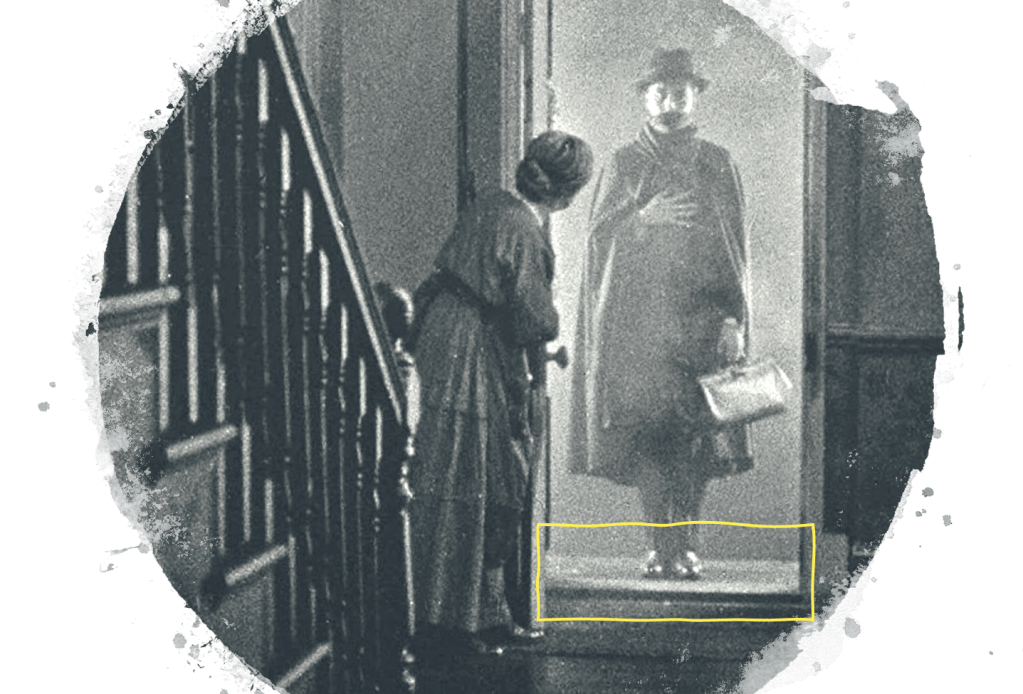
The Lodger insists on moving in on the party assembled at the Gothic castle, just as the Lodger โ€“ who may or may not be a serial killer called The Avenger โ€“ emerges out of the fog. edges himself into the home of the Buntings, and comes to preoccupy their thoughts and nightmares.  Invited, perhaps, but deemed suspect or queer all the same.

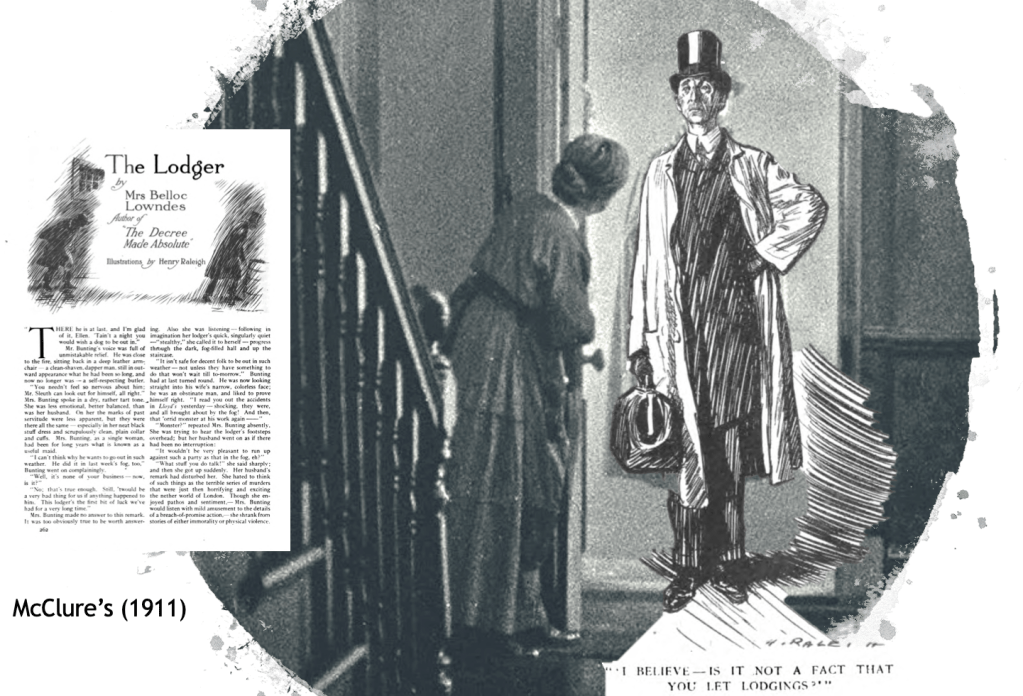
When the Lodger first made his appearance, in 1911, in a short story by Marie Belloc Lowndes, the figure was already lodged in the collective consciousness of urban dwellers who, like the author, were old enough to recall the Whitechapel Murders of 1888 or else were raised with the legend of Jack the Ripper, an alternative to a nursery rhyme all the more terrifying for having neither rhyme nor reason.

The Lodger transforms the story, which Belloc Lowndes turned into a novel, by pouring more sex into the mix.  That the layered cake did not quite rise to Hitchcock’s satisfaction was, legend has it, due to the casting of Ivor Novello in the title role: a queer Welsh matinee idol who, Hitchcock argued, was not allowed to get away with murder but was to be pronounced blameless by virtue of his status as a star. 

Whether or not that is the true reason for the direction the movie adaptation takes, it does not make the story any less intriguing โ€“ or gothic.

The Lodger is the story of a home that becomes โ€œunhomelyโ€ โ€“ German for โ€œuncanny.โ€  The lodger is no architect or bricklayer; rather, he transforms the dynamics of the group of people dwelling in the house he enters.  Blameless he may be, but he is an Avenger all the same, as Sanford Schwartz points out in โ€œTo-Night โ€˜Golden Curlsโ€™: Murder and Mimesis in Hitchcockโ€™s The Lodgerโ€ โ€“ not the killer, but the victim of the killer avenging her death, a victim-turned-vigilante who, misunderstood, dreaded and feared, becomes the subject of her other loverโ€™s revenge. 

 It is the other, ostensibly sane and safe lover, a police officer, who trespasses โ€“ who abuses his power โ€“ to trap the innocent man who threatens his supremacy as a prospective husband. The handcuffs he suits to his own pursuits prove harmful to his lover’s trust and nearly cause the death of his rival even after that rival is proven innocent of crime.

The Lodger is gothic as Jamesโ€™s Hoggโ€™s The Private Memoirs and Confessions of a Justified Sinner (1824) is Gothic.  It is a story of injustice and sanctioned tyranny.   Like Frankensteinโ€™s creature, the Lodger is hunted and tormented. Law, reason and morals are being questioned; and the pillars of civilisation are proven to be unsafe as houses.

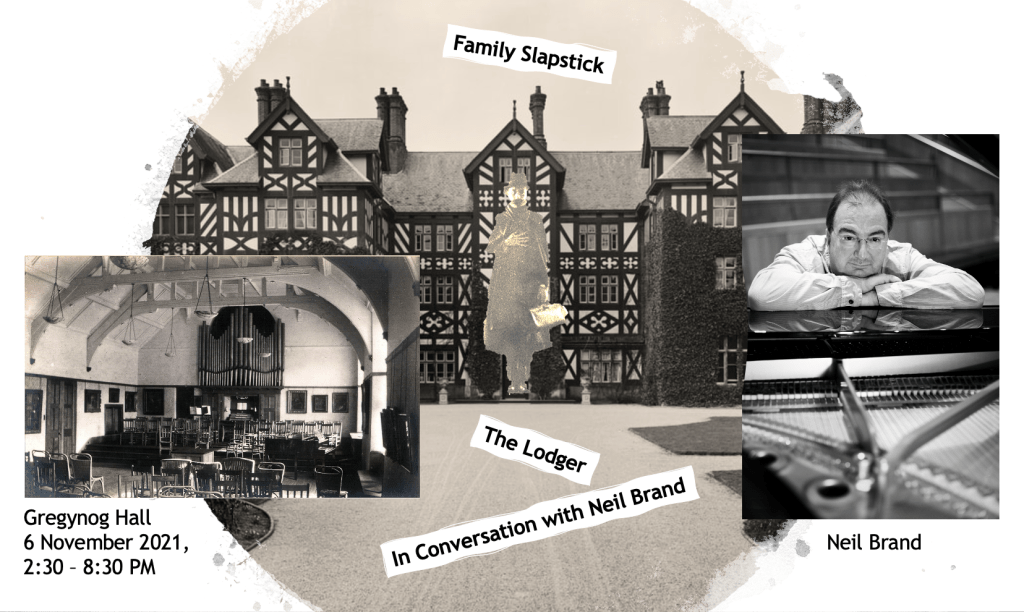
The next time I am (re)viewing The Lodger, the film will be accompanied by Neil Brand at Gregynog Hall, 6 Nov. 2021, when I shall be in conversation with the playwright-composer about silent film music and the language of pre-talkie cinema.

Kitsch as Hitch Can: Waltzes, Missteps, and a Sense of Direction

Ernst Lubitsch, Preston Sturges, and Alfred Hitchcockโ€”those were the Hollywood directors in whose films and careers I became interested in my youth, a by now but vaguely remembered period in my life during which most movie-going adolescents associated the business of making pictures with names like Rocky Balboa, Indiana Jones, or Luke Skywalker. My folks rarely went to the cinema, least of all together; so, my image of Hollywood emerged on the small screen and its dated, black-and-white offerings. Owing to my fatherโ€™s lingering doubt about the advances of tube technology, film to me had been chiefly a monochrome medium anyway; and as much as it irked me at the time to be missing out on the colorful and the current, I am retrospectively grateful for this early if belated introduction to classic filmmakingโ€”the happy by-product of a less happy family life.

Prolific, long-lived and distinctive, Hitchcock is a particularly good usher into the world of traditional cinema, to dramatic and filmic technique, even though we are rather too readily drawnโ€”with him and by himโ€”into the mythos of auteurism, of a directorโ€™s control of what is presumed to be his work. Why is it that we think of classic cinema as being โ€œdirected by,โ€ whereas stage and radio drama are primarily thought of (if thought of at all) as being written? Granted, from the framing of a shot to the editing of the reels, the director of a motion picture is called uponโ€”or in a positionโ€”to supervise and coordinate more aspects of the creative process than the director of a stage play or radio production. Still, filmmaking is much more collaborative than we tend to recognize.

Quite a few pictures directed by Alfred Hitchcock are hardly what we think of as Hitchcock, for which reason we conveniently overlook or dismiss them, just as Hitch tended to brush them aside to preserve his auteur image. One of those non-Hitch Hitches is the 1934 confection Waltzes from Vienna, shot during a period when the director was not yet in a position to choose his projects. Irreverent as I am, I screened it last night in commemoration of the 110th anniversary of the celebrated suspense meisterโ€™s birth.

โ€œIt had no relation to my usual work,โ€ Hitchcock told Franรงois Truffaut in an interview that served as the source for one of the most insightful books on filmmaking. I bought my first (German) copy of it when I was sixteen; my mother and I were about to visit my father, who was working at a plant in Libya at the time. Faced with the prospect of spending seven weeks in a land hostile to Western culture (those visa stamps sure looked suspicious to the immigration officials when first I traveled to the US), I decided to pack plenty of page-turners, the Truffaut volume among them. Too excited to sleep on the night before our journey, I had turned the pages of the Truffaut volume before we headed for the airport. I donโ€™t recall ever reading a non-fictional book quite this fast and with such enthusiasm.

Still, familiar only with the directorโ€™s most iconic works, I was unable to enter the conversation, let alone contest Hitchcockโ€™s self-assessment. It was not until 1999, the centennial of Hitchcockโ€™s birth, that I caught up with Waltzes at the Museum of Modern Art in New York City; before then, the supposed misstep had been little more than a few brusque words and a couple of stills to me.

As it turns out, Waltzes, a “musical without music,” is not quite the, “cheaply” done and โ€œvery badโ€ movie its director made it out to be; nor is it true that it bears โ€œno relationโ€ to his โ€œusual work,โ€ unless โ€œusualโ€ refers strictly to genre, in which case one would have to regard as unrelated comedies and costume dramas like The Trouble With Harry and Jamaica Inn. What relates these and most of Hitchcockโ€™s works to each other is not suspense but irony, not thrills but bathos. Waltzesโ€”which tells of Johann Strauss Jr.โ€™s attempt to come into his own as a composer and the intervention on his behalf of a sly benefactress who, in turn, is a threat to the sonโ€™s loverโ€”may have been a more suitable project for Lubitsch, just as Hitchcockโ€™s Mr. and Mrs. Smith is the kind of screwball material in which we expect Preston Sturges to excel; but it is only when Hitchcock looks more like Fritz Lang that he strikes me as The Wrong Man for the job.

In his setting of scenes, as in his staging of the battle of the sexes, Hitchcock relies on queer juxtapositions that elicit laughter even as they excite us. In the opening scenes of Waltzes, set in and around a burning building, those most at risk are entirely indifferent to danger, consumed as they are by the flames of passion.

In the climactic scene, a confrontation between young Strauss and the jealous husband of his benefactress, the crowds cheer the new composer, believing him to be having the time of his life, while the rhapsodized one is being thrashed by his ostensible rival, just as the true competitor, Strauss Sr., over at a deserted bandstand, comes to term with the fact that he has been upstaged. Whether employed to unsettle or amuse, incongruity plays a key role in Hitchcockโ€™s storytelling.

While hardly danced as masterly or memorably as The Thirty-Nine Steps, Waltzes, too, benefits from clever and far from haphazard cinematography, as well as a strong interplay between image and sound, be it word or music. I suppose that in most cases, the collaborative effort is so successful that we ultimately give credit chiefly to the one we assume to have been at the helm of it all.

These days, though, a director seems to matter far less than an investor in pulling the strings, which are mostly wrapped around purses. Now that popular motion pictures are increasingly, if not primarily, a medium for special effects artists, one might be forgiven for turning to a misstep like Waltzes for a sense of direction, and for pursuing the auteurโ€”a mere Hitchcock-and-bull story such a romance may beโ€”along the meandering, mythical and nominally blue Danube.


Related writings
The (T)error of Their Ways: Conrad, Hitchcock, and the Aftermath of the London Bombings
Hang On! It’s That Girl from Number Seventeen

Hitler or Miss: When Nazis Take a D(r)ubbing

The last time I was greeted with โ€™Allo โ€˜Allo! (1982-92), I was stepping into the Carne Di Hall in Budapest. As the restaurant sign already warned me, I was in for the slaughter of languages and had to prepare for the Wurst. I was too busy though poring over the menu to ponder whether a British sitcom set in Nazi-occupied France might be in poor taste. Sipping my instant coffee this morning, I once again caught a few snippets of the show when I came across this item on the BBC News online. According to the report, Allo โ€˜Allo! has by now aired in forty countriesโ€”but I did not grow up in one of them. You see, was born and raised in Germany.

Before moving to the US, I was unaware just how popular The Sound of Music is elsewhere; I had never seen it. Before relocating to Britain, I had never even heard of The Colditz Story (1955), without a screening of which it would not be Easter in the United Kingdom. Coming of age in West Germany, I was being sheltered from words and images that would make my grandparents uneasy. I may not have gotten stuck behind the Wall, but the worldโ€™s views of my grandfatherland were being carefully filtered for me all the same. Some decade and a half after its last original episode aired in Britain, โ€™Allo, โ€˜Allo! is being readied for its Deutsch debut. Is it springtime for Hitler in Germany? Is it all right for the offspring of Hitlerโ€™s children to laugh at the extreme right? Are my fellow countrymen and women ready to redefine the โ€œCampโ€ in Concentration Camp? I am not sure whether Germans find it difficult to laugh at caricatures of their former selves because they cannot make light of their past or because they so desperately want to feel proud of themselves.

Perhaps, the reception of Heil Honey, Iโ€™m Home! is going to be the ultimate test. Even the British considered that one too hard to stomach. Then again, so much depends on the dubbing; and when it comes to pop cultural imports, Germans do quite a bit of cleaning up.

I realized that when I first watched the Marilyn Monroe comedy The Prince and the Showgirl in its original version. The German translation does away with all the German, turning Monroeโ€™s character into a French-American. โ€˜Allo, โ€˜allo? Whatever historical context there was in The Prince โ€”the Balkan crisis leading to World War Iโ€”is being erased to leave nothing but a fairytale. Now, the original is mostly that, but youโ€™ve got to wonder at the pains the German film industry took during the late 1950s to change the background of this innocuous piece of popular culture so as to keep from those who came to see a bombshell any memories of bombs and shell shock.

Germans get edgy when confronted elsewhere with language that recalls their past. I remember going to Coney Island with my sister. We walked past the famous rollercoaster; and when I told her its name, she thought it “geschmacklos” (“tasteless”). The word Cyclone reminded her of Zyklon B, the poison with which our grandparents’ generation had exterminated thousands of their Jewish neighbors, colleagues, and relations.

This afternoon, BBC 2 broadcast Hitchcockโ€™s Notorious (1946), the spy thriller whose premise it was that VE-Day had not taken care of the Nazis altogether. Not having seen it since the 1999 Hitchcock centenary screenings at the MoMA, I am going to revisit Notorious in a moment; and I shall keep in mind that, when the film premiered in Germany, it was reduced to the story of drug smuggling.

To leave no doubt as to the kind of villainy depicted, Notorious was retitled โ€œWeisses Giftโ€ (โ€œwhite poisonโ€). How can a people get the picture if it does not get the sound to go with it?

All About Tallulah! (Never Mind “Wardrobe, make-up, or hair”)

Well, Tallulah Hallelujah! How could I pass up the chance to pass on this anniversary double treat? On this day, 16 November, in 1950, Tallulah Bankhead grabbed the microphone to entertain the multitude, first in a recreation of her role in Alfred Hitchcock’s Lifeboat. Two year later, she was heard in the part that might have gone to Claudette Colbert (had she not given her all to make sure that Three Came Home) but is now almost exclusively thought of as belonging to Bette Davis: All About Eve (previously discussed here in its pre-filmic radio version). When I featured clips from these performances in first adventure in podcasting, I was unaware that both “Lifeboat” and “All About Eve” were broadcast on the same day, two years apart.

Now, la Bankhead is more often thought of as a legend than an actress; that is, she is foremost a star, and only secondarily a performer. We generally do not have access to the stage appearances of Hollywood stars of the studio era, a couple of stills and reviews aside. Radio theatricals, however, can give us an inkling of those ephemeral performances. So, once again, I am conjuring up the Tallulah spirit, as I did when last I placed her image on my Quija board.

Bankhead’s performance in the Screen Directors Playhouse production of “Lifeboat,” broadcast on this day, 16 November, in 1950, serves to remind us how good an actress an icon can be. As an uncommonly humble Alfred Hitchcock tells the audience in the introduction to the play,

. . . I think you should know that Lifeboat is not what we call a director’s picture. ย There are no trick sets, no camera tricks, in fact, no tricks at all. ย When the director approaches such a picture, he offers up a little prayer and delivers himself wholly into the hands of his actors. ย Since they are very good actors, the result is just as you should hear it now.

Indeed, the production is very fine, with Bankhead serving as narratrix of her character’s experience aboard that ill-fated vessel. That time around, there were no calls for “Wardrobe, make-up, or hair,” no matter how many times the eccentric star uncrossed her legs.

The Theater Guild adaptation of “All About Eve” was more in keeping with the Bankhead persona in those Big Show days. “Thank you, Mr. Brokenshire,” Bankhead seizes the microphone from her announcer,

and good evening, darlings. ย The play we are performing for you this evening on Theater Guild on the Air is calledโ€”and I never could understand whyโ€” All About Eve. ย All About Eve. ย True, there is an Eve in it, and what a part that is. ย There is also a glamorous and brilliant leading lady of the theatre whose true identity has been kept a secret too long. ย Tonight, darlings, tonight baby intends to do something about that.

What a bumpy night it turned out to be. Those two years sure made a difference. You might say, that the campy “Eve” is an extension of or promotional vehicle for the Big Show and the Tallulah image in general. Character had given way for caricature.

How odd it is that such camp is so personal to me; and yet, when I think of Bankhead, I am inevitably reminded of my years in New York City. Sitting in my favorite local park by the East River while preparing for my dissertation on radio drama by listening to a few programs (oh, the hardship a doctoral candidate has to endure), I got to talk to a fellow sun worshipper who, learning about my uncommon soundtrack, asked whether I had come across the name of Florence Robinson, who was an old friend of his. No, I could not say I had; but I soon discovered that Robinson had been Tallulah’s co-star in “All About Eve.”

Just about that time, in those early days of the 21st century, I got to see the Tallulah Hallelujah! starring Tovah Feldshuh in the title role (no, not Hallelujah). A few years later I became friends with the “producing associate” of the show. So, listening to Bankhead, however outrรฉ or larger than life she might sound, triggers many a personal memory.

Then again, listening is always personal, as sounds pass the threshold of my ears, entering my body in a way images never could, and keep reverberating in my mind. While no longer surprised, I am still disappointed when I flick through biographies like the one by Joel Lobenthal I am clutching above, accounts of an actor’s life that make so little of their roles on radio and the role radio played during the 1930s, ’40s, and ’50s.

Sure, the The Big Show was not being ignored (even though George Baxt, who novelized Bankhead’s broadcasting experience in the volume shown here, barely gets a mention). Beyond that, though, Bankhead’s “many radio appearances” are summed up as involving “acting in sketches or trading patter with Hildegarde, Fred Allen, Kate Smith, and others.”

Given that recordings are now so readily available, the general disregard for the medium, expressing itself in a line like “[r]adio was Tallulah’s only medium for the next six months,” becomes an intolerable distortion of American popular culture. I wish more attention was being paid to the cultural force of the old wireless, a wish that, aside from all the nonsense and dross you might expect here, is the raison d’รชtre of broadcastellan.

Please, Mr. Memory: Concussion on The Thirty-Nine Steps

I felt torn last night. Torn between The Falcon’s Brother (in which George Sanders passes the thriller franchise to sibling Tom Conway) and John Buchan: Master of Suspense, a television documentary about the author of The Thirty-Nine Steps. Quandaries like these are peculiar to life in a single-TV household. Considering that I am going on a New Year’s trip to Glasgow (where Buchan grew up) and just saw a dramatization of his classic spy novel in London, I decided in favor of the latter. Not that the documentary (part of BBC Four’s Adventures for Boys season) did much to clear the muddle my mind, at work under the influence of Patrick Barlow’s stage adaptation, has made of the Steps, one of those books everyone claims to know but few ever read, let alone without preconceptions.

Now, I have read Buchan’s 1915 novel (available online here); and, like most readers who come to it by way of Alfred Hitchcock’s 1935 adaptation, I was astonished at the film’s brazenfaced infidelity. I was disappointed, as well. Missing was the wit that Hitchcock and writer Charles Bennett brought to the original by reworking it in the screwball comedy tradition. It Happened One Flight, they might as well have called what amounts to conclusive proof that tying a male hero to a dame (absent in Buchan’s story) does not have to slow down a fast-paced chase. Infusing sex appeal rather than sentimentality, Hitchcock’s cinematic update created a new adversary for the already much-beleaguered hero, Richard Hannay, who finds that a lot can go wrong in the effort to do right.

Barlow’s dramatization, by comparison, aims at demonstrating that a lot can go right in the effort to do wrong. When I read that John Buchan’s “The 39 Steps” was playing at London’s Criterion Theatre (where it can bee seen until April 2007), I had reason to expect an update of the novel, rather than a recreation of the film, however farcical the treatment (as reviews and poster art suggested).

As it turns out, Buchan’s novel has little to do with the nightly frivolities at the Criterion. The attribution to Buchan in the title of Barlow’s play (based on an “original concept” by Simon Corble and Nobby Dimon) seems to be part of an elaborate practical jokeโ€”a set-up in which spectators gladly take the fall since they are being coddled by travesty into assuming themselves superior to the material, whatever its source. Being tongue-in-cheek is a convenient escape, a laughing away of what couldโ€”and perhaps ought toโ€”have been an engagement or confrontation with Buchan’s story, a tale of espionage and persecution anxities so relevant in this age of terror and so-called anti-terrorism.

Aside from the material of which John Buchan’s “The 39 Steps” makes light, the main attraction of the play lies in its being performed by a cast of only four actors, who dare to take on well over a hundred characters. With a small supply of basic props, those nimble four are shown in the ludicrous struggle to recreate the screenplay as realized by Hitchcock (who, in one of the many inspired moments of silliness, makes a cameo appearance in silhouette). This minimalist-absurdist approach to adaptation was not entirely a novelty act to me, having previously attended a production of The Importance of Being Earnest acted out by a cast of two.

Overly familiar as well felt the play’s reflexivity, its awareness of and delight in the improbability of being equal either to Buchanโ€™s spy story or Hitchcockโ€™s screwball caper. Many self-conscious remakes operate in this manner, escaping the challenge of finding the new in the old by making a mockery of the attempt at renewal and a mess of what is presumably so outmoded that it deserves nothing more than a send-up.

There is enjoyment in seeing things go awry, no doubt; and John Buchan’s “The 39 Steps” rewards theatergoers for their knowledge of the Hitchcock version (one of three film adaptations of the story). Cineastes will appreciate the effort that went into finding ways of making it almost work, whereas those who read and respect Buchan may regret how much is being squandered by ignoring his paradigm. After all, his thrills, too, depend on the pleasure derived from seeing things go awfully wrong, albeit with far higher stakes for the protagonist and his world.

Calling the play John Buchan’s The 39 Steps obscures the fact that the first motion picture adaptation was already a comic revision of Buchan’s rip-roaring yarn. Going after Buchan, Hitchcock managed to be fresh (both new and irreverent) without losing sight of the hunter-on the-run formula that would serve him so well, without neglecting the task of dusting off this decades-old story for action-seeking motion picture audiences. Forgoing thrills, sentiment, and politics alike, Barlow is strictly after laughs.

That said, the bungled dramatization is a chuckles-filled joyride for those who take pleasure in playing fast and loose with supposed literary classics. I gladly go along, provided I can still pride myself in being able to tell a sly impostor from the real thing. Instead, the theatrical experience has given me somewhat of a concussion, leaving me in a state of confusion that neither the aforementioned documentary nor the numerous American radio dramatizations (by the Lux Radio Theater and the Mercury Players, for instance) are likely to clear up. Was Richard Hannay a South African, a Canadian, or a Scotsman? Was he driven by the impulse to save a crumbling empire, to counter boredom, or to clear his name? Come to think of it: just who built The Thirty-Nine Steps, an unstable architectural composite of which now arises before my mind’s eye?

Even Mr. Memory wonโ€™t be of much assistance to me, I suspect. Besides, he is . . . but you know the story.

Up Frenchman’s Creek; or, How (Not) to Prepare for a Vacation

Well, I’ve been home barely twenty-four hours and already I am packing my suitcase again. After a weekend up north in Manchester, I’ll be off tomorrow on a weeklong trip down south to Cornwall. Instead of flicking through my travel guides this morning, I started reading Daphne du Maurier’s Jamaica Inn. Now, there’s a description of scenery you wouldn’t get from your travel agent:

[There] was a lashing, pitiless rain that stung the windows of the coach, and it soaked into a hard and barren soil. No trees here, save one or two that stretched bare branches to the four winds, bent and twisted from centuries of storm, and so black were they by time and tempest that, even if spring did breathe on such a place, no buds would dare to come to leaf for fear the late frost should kill them. It was a scrubby land, without hedgerow or meadow; a country of stones, black heather, and stunted broom.ย 

There would never be a gentle season here. [. . .]ย 

Not much more hospitable is the seascape depicted in the opening chapter of du Maurier’s Frenchman’s Creek:

When the east wind blows up Helford river the shining waters become troubled and disturbed and the little waves beat angrily upon the sandy shores [. . .].

The long rollers of the Channel, travelling from beyond Lizard point, follow hard upon the steep seas at the river mouth, and mingling with the surge and wash of deep sea water comes the brown tide, swollen with the last rains and brackish from the mud, bearing upon its face dead twigs and straws, and strange forgotten things, leaves too early fallen, young birds, and the buds of flowers.

Perhaps reading du Maurier’s Cornish romances is not such an ideal way to get into the spirit of things, especially not when one is hoping for spring and renewal. At least their author was familiar with the locations described. Listening to the 10 February 1947 Lux Radio Theatre version of Frenchman’s Creek, I got no sense of the locale at all; nor, for that matter, much sense of the story. There was too little of it left to suggest the illicit passion of a married woman for a dashing pirate.

The radio version is not so much an adaptation of the novel, but of radio dramatist Talbot Jennings’s screenplay for Paramount’s 1944 technicolor production, which cleaned up du Maurier’s act in accordance with Hollywood’s production code. Mitchell Leisen’s film, of course, was not shot in Cornwall either, but in Jenner, California, which also stood in as Devon in The Uninvited, an old-fashioned ghost story featuring the novelty of a sun rising in the west.

I don’t suppose Alfred Hitchcock’s reworking of Jamaica Inn is any more useful as an introduction to Cornwall; I’ve always confused it with Under Capricorn, another one of Hitchcock’s misguided forays into period piece froufrou (although I confess having enjoyed his Waltzes from Vienna). And since there is little time to dip into the poetry of John Betjeman, I think I’d better get back to my travel guide after allโ€”and finish packing. I will try to relate my impressions upon my return next Wednesdayโ€”provided I can find a radio drama angle.

The (T)error of Their Ways: Conrad, Hitchcock, and the Aftermath of the London Bombings

He had no future. He disdained it. He was a force. His thoughts caressed the image of ruin and destruction. He walked frail, insignificant, shabby, miserableโ€”and terrible in the simplicity of his idea calling madness and despair to the regeneration of the world. Nobody looked at him. He passed on unsuspected and deadly, like a pest in the street full of men.

Thus ends Joseph Conradโ€™s long-in-the-works novel The Secret Agent. First published in 1920, the story had been conceived decades earlier, inspired by the terrorist bombings that took place in London during the 1880s and 1890s. In particular, it was the infamous 1894 attempt to blow up the Greenwich Observatory that served as a plot for Conradโ€™s narrative.

While based on events that occurred well over a century ago, the above passage could describe any suicide bomber today. Of thisโ€”Conradโ€™s The Secret Agent and its obvious connections to the recent acts of terror in Londonโ€”I was forcefully reminded when I screened Alfred Hitchcockโ€™s 1936 thriller Sabotage last night. I had not seen this film in years and, being unprepared, was startled by its up-to-dateness.

Even though Hitchcock was not particularly pleased with it, Sabotage is one of his most mature earlier thrillers. It has none of the adventure or intrigue of his better known pre-Hollywood films, such as the seminal but perhaps overrated caper The Thirty-Nine Steps; nor does it have the romance and humor of his lesser efforts, such as Rich and Strange or Young and Innocent. Instead, it offers a portrait of a terrorist so stark, so dark, so nearly naturalistic that it remains startling today.

Hitchcock claims to have regretted the scene in which the innocent young boy, Stevie, the brother of the terroristโ€™s young wife, is blown up while unknowingly delivering a bomb as instructed by his stepfather. Compared to the inane Hollywood endings we are still expected to endureโ€”such as the infuriatingly contrived reunion of Tom Cruiseโ€™s character with his teenage son in The War of the Worldsโ€”Hitchcockโ€™s Sabotage comes across as relentlessly true-to-life. According to the conventions of Hollywood storytelling, characters with whom we identify are not generally blown to bitsโ€”especially not children.

The reality of our everyday, however, does not heed such conventions. The innocent are victimized without remorse, either by indiscriminate terrorists or their persecutors, as the story of Jean Charles de Menezes, wrongfully shot as a terrorist suspect, forcefully drove home in recent weeks; his story continues to unfold as the probing into his death lays bare some of the criminal errors of anti-terrorist actions.

Hitchcock always enjoyed telling the story of The Wrong Manโ€”innocent people unjustly pursued by the authorities the director had dreaded since childhood. During the chase that is essentially the Hitchcock experience, our sympathies are more often directed toward the hunted than the hunter, encouraging us to reexamine established roles of criminal and persecutor, to question our definition of justice.

Sabotage tells the story of flawed and guilty peopleโ€”the saboteur, who risks a boyโ€™s life to carry out his mission of destruction, and his young wife, sister of the victim, who ends up stabbing her husband in revenge, despair, or sheer confusion (this is being left ambiguous). Even the boyโ€”whom we catch early breaking a plate and filching a bit of foodโ€”is not altogether innocent; his tardiness and negligence contribute to his death.

Killer, victims, and hapless messenger alike are sentenced to death brought on by ruthlessness and ignorance. Only a combination of knowledge and ethics, of smarts and decency, can save those caught in the web of terror that is our everyday.