“Don’t gimme no back talk, now. Do what I tell yo’ to do. I is de president o’ dis comp’ny.” That’s what Andy told his pal Amos when the blackface comedy team of Freeman Gosden and Charles Correll was first heard on network radio back in 1929. The Presidency in question was that of the Fresh Air Taxi Company of America, Incorpulated; and its fictitious head was thick, black, and halfway in the clouds. Millions of Americans followed the adventures of Amos ‘n’ Andy on their wireless sets each weekday, laughed at their then celebrated brand of English and their audacity to believe that, given their perceived and actual limitations of ethnicity, intellect, and education, they could succeed in their enterprise:
Yo’ see, Amos, no matteh whut bizness you is in, de business is gotta have a head man to tell ‘em whut to do and when to do it. So dat’s de way ‘tis wid us. I strains my brain an’ figgehs out whut you gotta do. Yo’ see de brain work is de most reportant thing.
They certainly were no role models, which is what made Amos ‘n’ Andy such a popular and commercial success: Andy Brown and Amos Jones did not inspire blacks to achieve nor cause whites to perspire at the thought that they might. The status quo was never at stake.
On the eve of President Franklin D. Roosevelt’s inauguration, as Arthur Frank Wertheim reminds us in Radio Comedy, Amos, Andy, and the Kingfish all expressed their confidence (or the confidence of their financially secure creators) that “ev’rything goin’ be alright pretty quick” with Depression-stricken America. To which Amos added, “Tonight ‘fore I go to bed I’se gonna pray dat Mr. Roosevelt will even do more fo’ de country dan he’s promised to do.”
Amos and Andy never dared to pray for a black President. They were, after all, not the children of a utopian imagination. They were dreamed up before Martin Luther King Jr. had and expressed the dream “that one day this nation will rise up and live out the true meaning of its creed: ‘We hold these truths to be self-evident: that all men are created equal.’”
That dream, long deferred, is looking more like a reality today – the day of the inauguration of Barack Obama as the 44th president of the United States – than ever before. Now, that really is “sumpin’”!
A lot was left out of the picture, no matter how vividly it was being painted by the brush of sound on the canvas of the mind. Radio. No other mass medium could create pictures at once so generic and genuine, as invested as they were with the desires and experiences of those tuning in. And yet, in its soundscapes of the nation, in its portraits of the multitude, US broadcasters too often brushed aside or airbrushed what they dared not echo or evoke; too often they resorted to caricature and counterfeit, unless they altogether erased the experiences and memory of millions of citizens on whom broadcasters turned a deaf ear.
The Southernaires
In the 1930s and ‘40s, when Amos ‘n’ Andy was America’s most popular work of comic serial fiction, commercial radio rarely permitted the minority population mimicked and minstrelized by the program the privilege of a voice, unless to sing gospel music (as delivered by the Southernaires, pictured here) and the hep tunes to which white folks would try to dance. Two notable exceptions to this misrepresentation of, adopting the parlance of the day, the ‘Negro’ experience on American radio were New World A-Coming and Destination Freedom.
On this day, 15 January, in 1950—when Martin Luther King, Jr. celebrated his twenty-first birthday—Destination Freedom presented “Birth of a League,” a dramatization of the exodus of some two million African-Americans from the South to the urban centers of the North—the “greatest internal migration in American history”—as it accelerated in the years just prior to the first World War. As “The Birth of a League” recounts, this led to the formation of the “Urban League” movement. You might say it was the real story behind Amos ‘n’ Andy, the white fiction of two black boys from Georgia who made their way up to Chicago in the late-1920s.
Appended to Richard Durham’s episodic and chronologically somewhat muddled play was an interview with Sidney Williams, the executive secretary of the League’s Chicago branch, with whose co-operation Destination Freedom was presented by station WMAQ, Chicago—the same station that had introduced America to Amos ‘n’ Andy back in 1928.
Williams deplored that “what other Americans expect and get as a matter of right, we Negro workers have to beg and fight for.” The fight, however, was not to be construed as a violent one. The League’s motto—”Not arms, but opportunity”—and the involvement of white businessmen “of good will” in its foundation made this depiction of the segregated South and the struggle for integration in the North more acceptable both to broadcasters and to a larger audience.
The challenge of such broadcasts was to inform and appeal, to protest yet placate. Despite the hope expressed in its title, taken from the book by Roi Ottley), New World A-Coming was at times cynical in its exposure of the injustices suffered by the Negro population. On 16 April 1944, for instance, the series promised the “Story of Negro Humor” as seen through the eyes of Langston Hughes. While it was filled with laughter, the program offered little amusement. Instead, it recalled Hughes’s own experience of Southern inhospitality, which Hughes had previously shared in his article “White Folks Do Some Funny Things.”
Hughes, who at one time was considered for a radio serial project of his own, found little amusement in the treatment the Negro—as character and creator of characters alike—received on American radio (as previously discussed here). In “The Story of Negro Humor,” and its somewhat toned-down reworking a year later (on 8 April 1945) under the article’s original title, Hughes was portrayed by Canada Lee, who acted out various scenes of humiliation personally witnessed or suffered by the American poet and novelist.
The program presented the prejudice and hatred toward black Americans as an American problem, rather than one faced by the minority population alone. Commenting on those who “practice Jim Crow at home and preach democracy abroad,” Hughes expressed himself puzzled at their “lack of humor concerning their own absurdities.” Having “read that Hitler has no sense of humor either,” he concluded that “the greatest killers cannot afford to laugh” and that those “most determined to Jim Crow” were “grimly killing democracy in America.”
Both New World A-Coming and Destination Freedom are rarities in so-called old-time radio. They are programs seldom discussed or traded by those who twist the dial by proxy and distort its history to meet their needs for light or wholesome entertainment. These two programs should not be dug up in defense of the ignorant or indifferent; they should not be aired for the chief purpose of clearing American radio of charges of misrepresentation. Yet, however marginal their role, it would be equally wrong to neglect or dismiss them, and the talent involved in their production, thereby to propagate the image of American radio drama as historically irrelevant and relegate it to the neither-here-nor-there that is nostalgia.

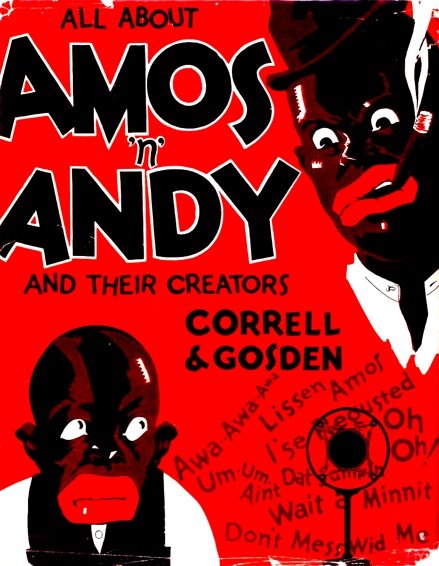 “Don’t gimme no back talk, now. Do what I tell yo’ to do. I is de president o’ dis comp’ny.” That’s what Andy told his pal Amos when the blackface comedy team of Freeman Gosden and Charles Correll was first heard on network radio back in 1929. The Presidency in question was that of the Fresh Air Taxi Company of America, Incorpulated; and its fictitious head was thick, black, and halfway in the clouds. Millions of Americans followed the adventures of Amos ‘n’ Andy on their wireless sets each weekday, laughed at their then celebrated brand of English and their audacity to believe that, given their perceived and actual limitations of ethnicity, intellect, and education, they could succeed in their enterprise:
 Harry Heuser