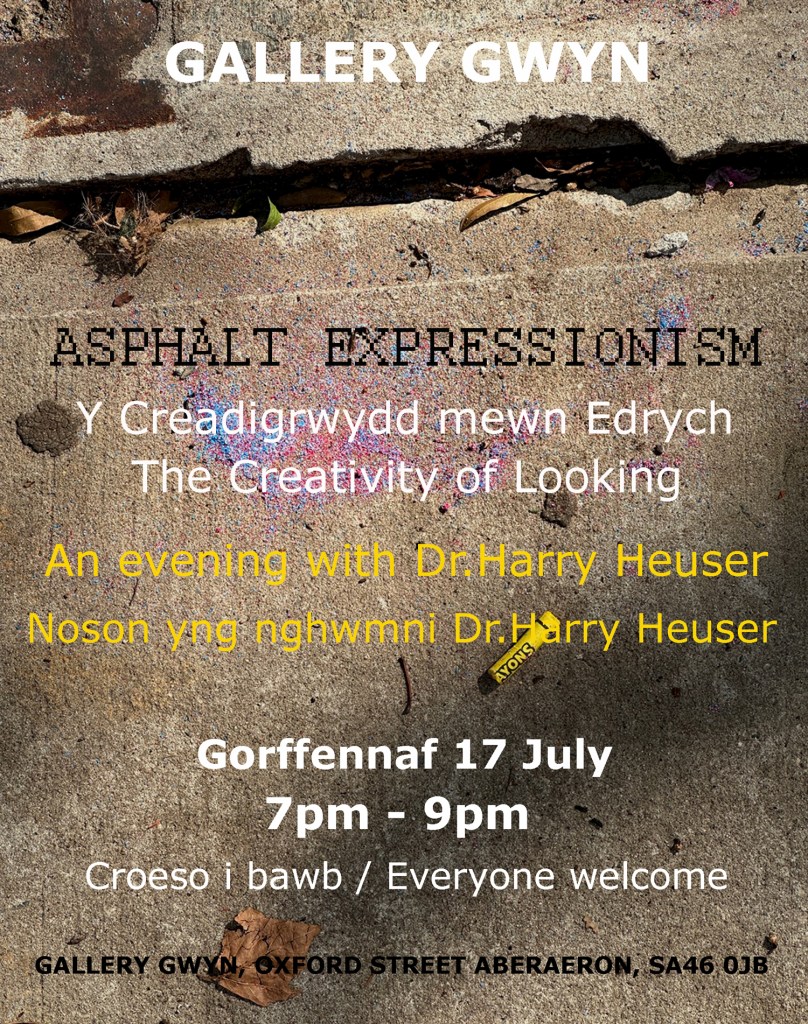
I have been asked, at some point during the run of my exhibition at Gallery Gwyn, to give a talk. I requested that the event be announced as ‘an evening with.’ Asphalt Expressionism was intended to be inclusive and interactive, and the scheduled get-together, likewise, should promote exchange. A conversazione, perhaps, but not a lecture.
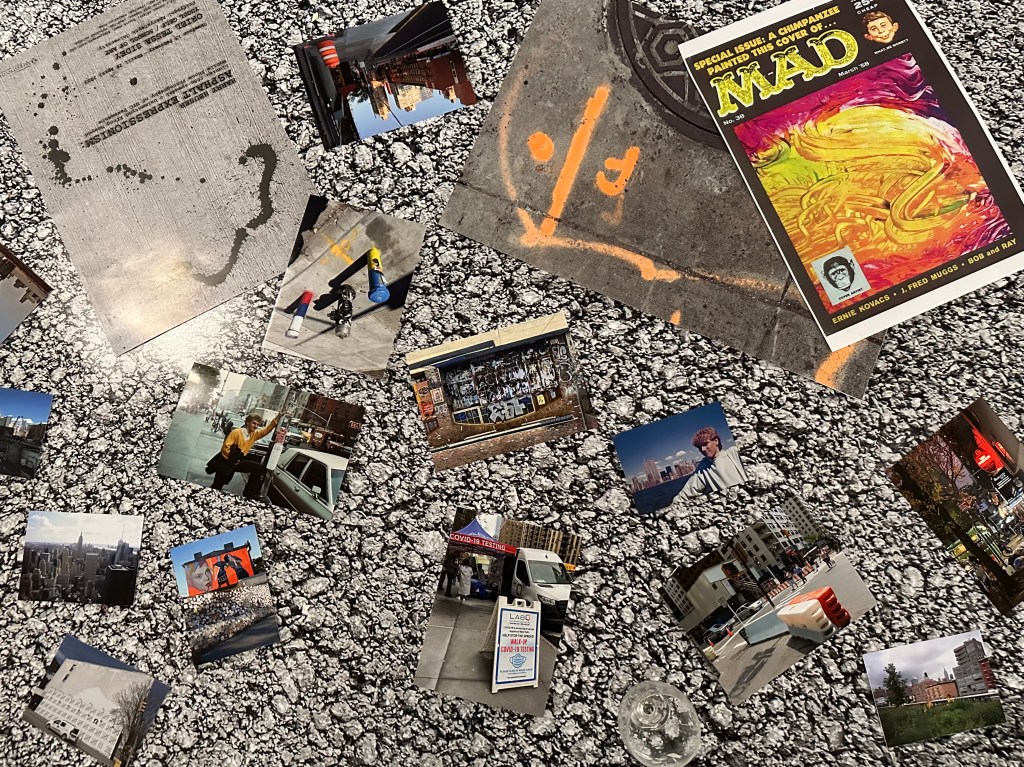
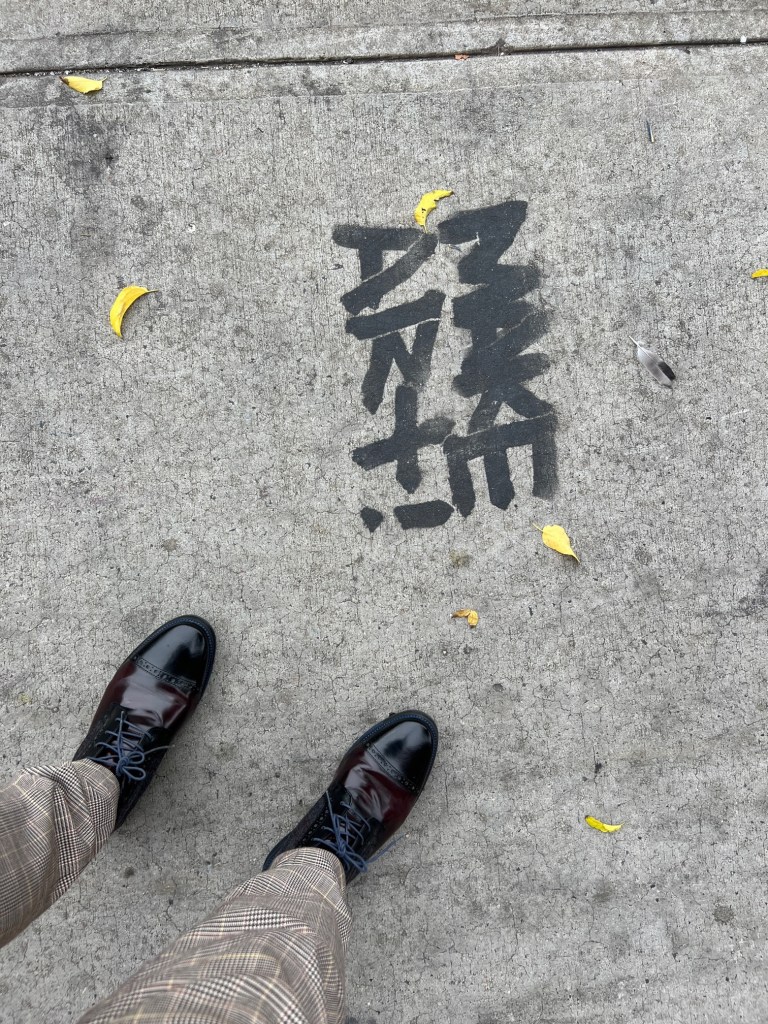
Given that the smartphone is my primary means of creating the images huddled under the fanciful umbrella of Asphalt Expressionism—a series of digital photographs of New York City sidewalks—reference to the ubiquitous technology strikes me as an effective way of connecting with those who, phone no doubt in hand, might be joining me that evening.
From where I’m standing: My Asphalt Expressionism project continues with a new exhibition
“I have resigned,” I keep on insisting whenever folks, however well-meaning, fallaciously refer to my retreat from academia as “retirement.” After all, I am not quite of retirement age; nor am I eligible for a state pension. My only recourse being a chance to set the record straight, it is incumbent on me to counter the tiresomely predicable visions that “retirement” conjures and dispel the mirage of a slow fade or a ride into an illusory sunset.
Sunset indeed! I just dodged a deluge. Such are the hazards of a life abroad: one day you are wet behind the ears, the next—and it sinks in only belatedly just how much later “next” is—you are trudging through a torrent of foul weather (let’s not call it the gutter just yet) you doubt will ever end up under the proverbial bridge. If my figures of speech were not quite so waterlogged already, the expression “sea change” might be dredged up to capture the mood at this point of departure.
As I browsed those old albums, I was reminded of an unsettling homecoming in 2022, when, on a dark December afternoon, I returned to my mother’s house for the first time in about thirty-four years. I had lived in that house – one in a row of unassuming bungalows in a small town in the dull flatness of North-Rhine Westphalia – for about fifteen years, during which time, in the process of growing up that many deem concluded all too prematurely, I gathered a great many memories, not many of them great, that made me eager to forget the place. And although my skin never developed the thickness of an elephant’s hide, I cannot but remember.
You can’t go home again, Thomas Wolfe reminds us; but when we do return to the places we once called home – whether by choice or not – it can hit home hard that whatever home may be is a construct the mind makes even when it is not made up on that point. A lot of what happened or befell us where we come back for a second or umpteenth look is bound to topple from the shelves to which we relegated some of those none-too-precious but relentlessly durable mental keepsakes.
The living room in my parents’ house was never my place, even though it held several attractions: a good stereo system, courtesy of my maternal grandmother, and, after years of resistance from my father, who held that the technology had not been perfected yet, a colour television set. My room was more of a listening post; apart from drawings I made, the comics I consumed and the magazines I scoured for material to luxuriate in, vivid dreams were produced there, many with the aid of a radio and cassette recorder.
Since then, my Kinderzimmer had been repurposed, although its current state said nothing more distinctly about its present purpose than “spare.” None of the cheap furnishings had survived, and the change of décor did little to revive, revise or confirm the images that, originating there, I had been carrying in my mind since the late 1980s.
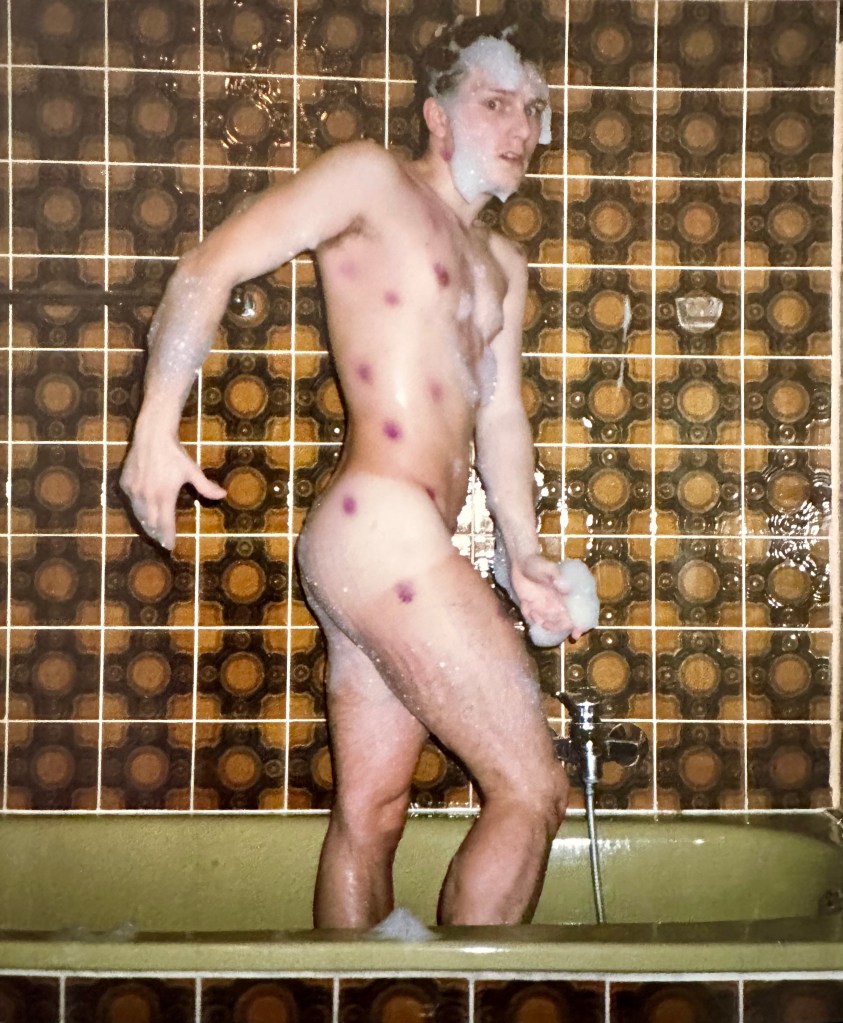
It was the most private place in the house – the shared bathroom – that brought back the identity crises I experienced growing up queer: the shame of developing breasts that waited long for the development of pectoral muscles; the attempts at concealing the unseemly tissue by stretching my t-shirts and tying them around my genitals; the anxieties that caused me to scratch the skin off my ankles that, raw and oozy, were then soaked, doctor’s orders, in a bidet filled with salty water.
Memories tend to come back faster and with greater force when we return to the places where there were made. That was certainly the case when I stepped into Mutti’s abode (my father having left and since died decades ago). The interior was like a time capsule. Not only the furniture was unchanged, but all the bric-a-brac was still in the same spots my mother had set aside for their display and regular dusting.
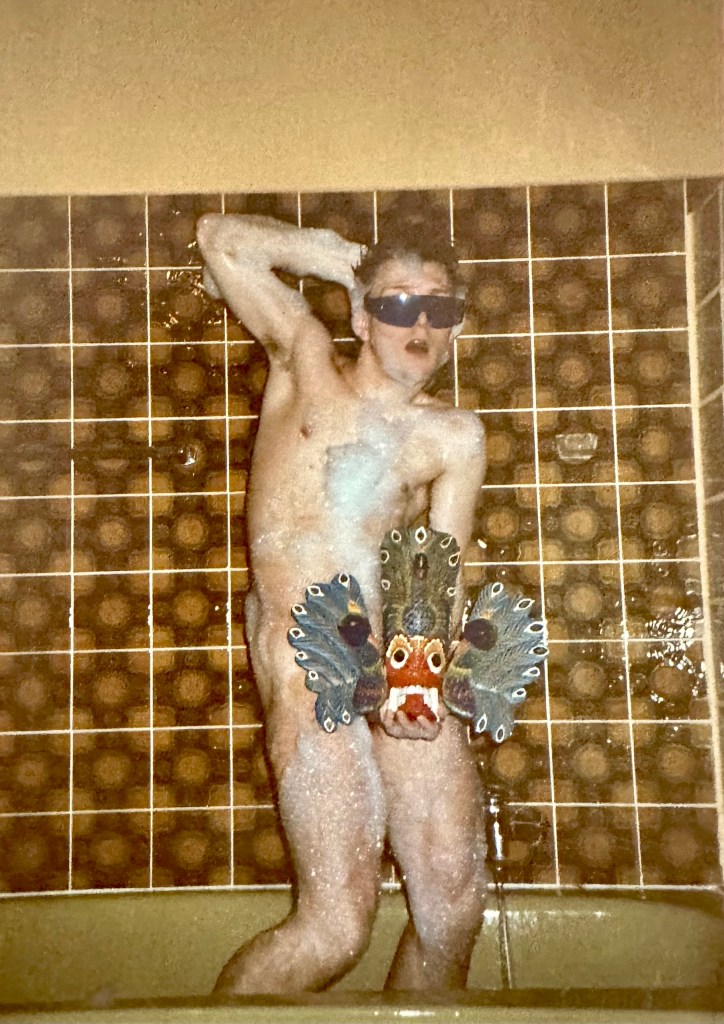
The self-exploration that happened in that room also took a creative turn, as, transitioning from adolescence to dreaded adulthood, I took what I now call retroactive selfies: photographs of my body that I initially produced mainly for my eyes only but that I am now, in this post, making public for the first time via the social medium of blogging so as further to blur boundaries the maintenance of which can cause so much sustained and needless suffering.
Once we do decide to “come out,” we soon realize that we do not come out once only: we must do so over and over again, and each time we come out – and come out looking – differently, like an inadvertent burst of digital photographs that, owing to a finger staying put too long, shows our poses changing and our masks slipping.
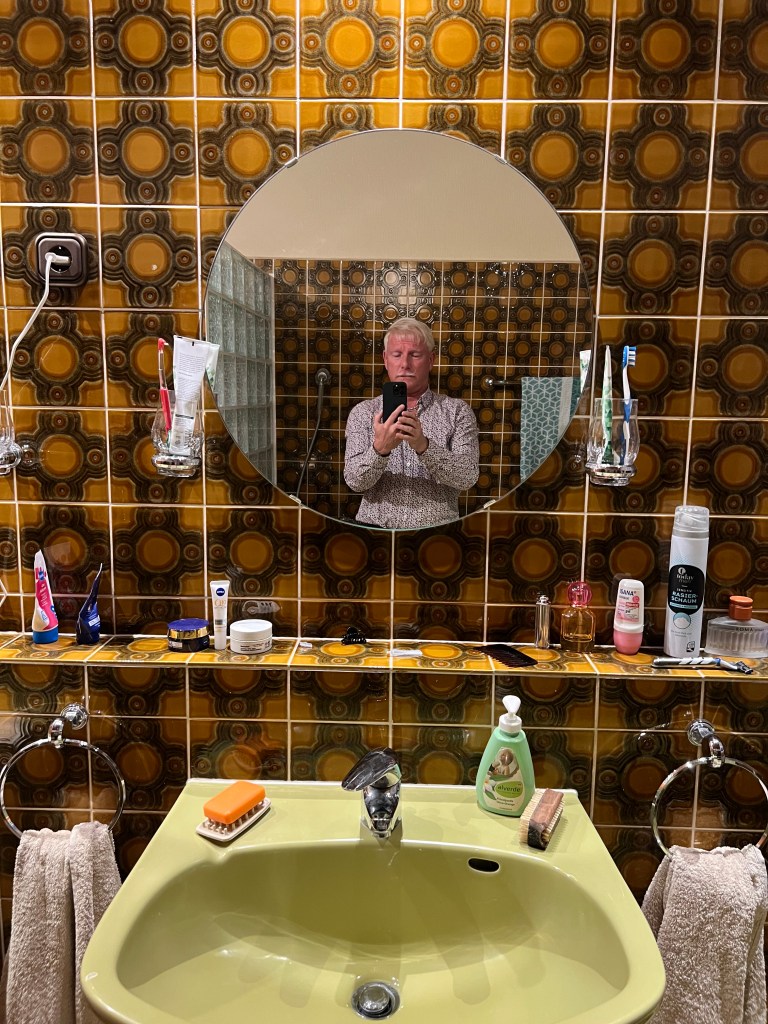
Excusing myself from the dinner table during my short visit to my mother’s, I secreted myself in the bathroom, that anti-parlour of abjection. Not that I needed to go. What I needed was to go look at myself in the mirror that, in my youth, became a lens of self-exploration. I needed to return to the spot where I had once stood and posed – donning masks and dappled in spraypainted dots – a young person, once called “the battle of the sexes” by a classmate, learning to live in and with the strangeness of a changing body, an organism that I seemed to be invading and that rejected me as much as I was rejecting it.
Uneasy, curious and ever self-reflexive, the boy in the avocado bathroom is not gone, though none may recognize him now. He is a persona still grappling with the challenge of achieving personhood: a retroactive selfie.
My memory is poor, generally, and getting worse. My desire to remember the forgotten – the ostensibly unmemorable – remains strong. It is a love rooted in the need to champion the unloved, or, rather, the dis-loved, and to abandon myself to the abandoned. It is a queer thing, to my thinking, which is queer always and could not be otherwise. To love, perversely, what has been discarded or deemed unworthy of consideration, means disregarding what is widely held to matter and instead be drawn – draw on and draw out – what is devalued as immaterial. It involves questioning systems of valuation and creating oppositional values.
Commenced in 2005, this journal was dedicated to what I termed “unpopular culture,” the uncollected leftovers that linger on a trash heap beyond our mythical collective memory. To this day, down to my current project, Asphalt Expressionism – a curated collection of images engaging with the visual culture of New York City sidewalks – I carry on caring about the uncared-for and neglected, the everyday past which others tend to walk without taking notice.
There is no such thing as trivial matter. Nothing is negligible in itself. What makes something worthless is not a particular quality or lack thereof. Rather, it is an attitude, an approach, a judgment – itself often a product of a cultural conditioning. Nothing is intrinsically trivial, but anything may be trivialized. As I put it, years ago, when I curated (Im)memorabilia, an exhibition largely of mass-produced prints entirely from my collection – “Trivia is knowledge we refuse the potential to matter,” whereas “Memorabilia is matter we grant the capacity to mean differently.”
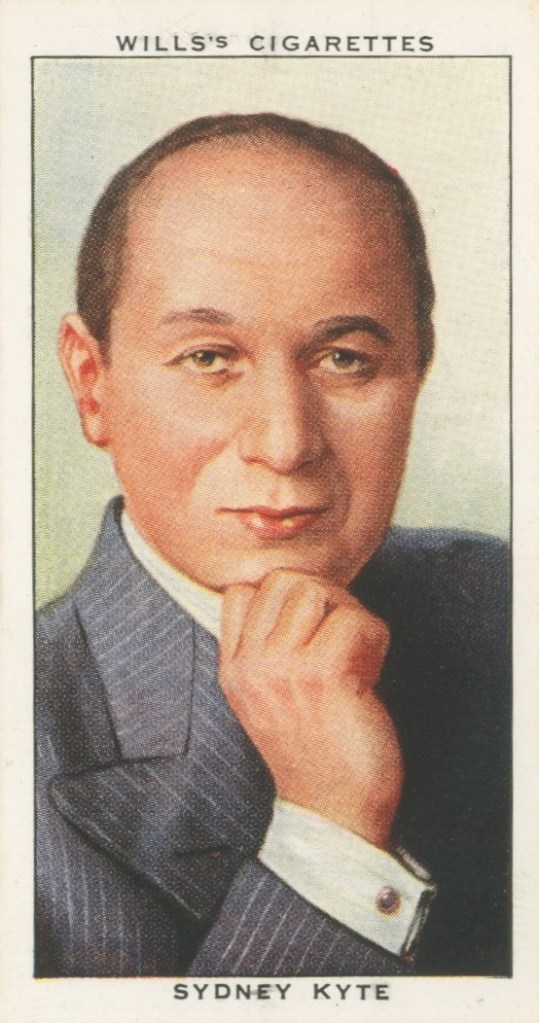
Low as a Kyte? A 1934 Wills’s Cigarette card featuring Sydney Kyte, a bandleader to whom no Wikipedia page is dedicated. The card sells online for under £1.
A 1930s cigarette card, for instance, may have once served the purpose of boosting sales by prompting smokers to collect cheaply mass-produced images of film stars or flowers or tropical fish. Collecting them nearly a century later – long after the advertising campaign has folded and the image has become removed from the product it was designed to promote – means to extend the lives of such devalued objects by moving them into the sphere of our own temporary existence of which they in turn become extensions.
Whether or not we take measures to preserve their afterlife, we instill collectibles with new meaning, give them value by investing them with our longings. I, for one, never regard my belongings as financial investments; I do not collect calculatedly, anticipating that what I gather might be the worth something to someone else some day.
I also refuse to intellectualize my desires; I am wary of turning passion into an academic exercise. That is, I do not rescue the marginalized for the purpose of demarginalizing my own existence by convincing others of the cultural value or historical significance of devalued objects – and of the case I make for their value. Still, there is that longing to be loved, to feel validated, for all the reasons that many, I suspect, would regard as wrong.
Why waste time on what is waste? Why dig up – and dig – what has become infra-dig through the process of devaluing, a hostile attitude toward the multiple, the unoriginal and commercially tainted to which we appear to be conditioned in a capitalist system that makes us feel lesser for consuming the mass-produced within our means so that we aim to live beyond those means, always abandoning one product for another supposedly superior? There can be no upgrading without degradation, no aspiration without a looking down at what has been relegated to refuse.
I remember a gay friend telling me, decades ago, that when he was a child, drawing in kindergarten or elementary with other children, he would pick the color that was least liked by his fellow creatives. I did the same thing when toys were being shared. This unwanted thing could be me – this is me – is what must have gone through my mind when I took temporary ownership of the object of just about nobody’s affection. And this, I believe, is at the heart of my impulse to make keepsakes of the largely forsaken.
I started writing this on the one-hundredth anniversary of the first radio broadcast in Britain – 14 November 1922 – by what was then not yet the BBC. Sound, after all, is the ultimate ephemera, fleeting if uncollected, lost if not cared for. The BBC used to erase recordings of its broadcasts, turning the potentially memorable into the immemorabilia beyond my grasp, and, in turn, turning my determination to lift them into my presence into futile longing, a nostalgia for the unrecoverable past.
Chalk drawing on the pavement at Union Square. Not that I need an invitation.
Inhale. Exhale. Inhale. Exhale. I must try that some time without using a brown paper bag. Just kidding – but only just. It’s been a breathless few weeks. Now that I am coming up for air, I’d like to say, if it were not such a hackneyed phrase, that I have returned from my long and long-delayed New York trip with a suitcase full of memories. Not that I care to be reminded about my luggage, given that, owing to an absent-mindedness brought on by physical exhaustion and an acute state of all-over-the-placeness, my carry-on case continued its journey by rail without me.
Argh. Among other things, the valise gone astray contained a rare copy of Mr. Fortune Finds a Pig (1943), a curiosity of a mystery about which, had I not, through my negligence, forfeited the opportunity of its perusal, I would have liked to say considerably more here, especially given that its story is set in Wales, whereto its English author, H. C. Bailey (1878–1961) retired at the end of his career.
My copy of the novel, before it got lost in transit.
While in New York, I did a bit of research at the New York Public Library’s Billy Rose Theatre Division on lost recordings of Bailey’s “Mr. Fortune” stories, nineteen of which were adapted for US radio in the mid-1930s and are extant as scripts. More about that, and the pig, some other time, the lost-and-found department of Transport for Wales permitting. Never mind flying. Pigs might travel by rail.
Pardon the rustling of mental notes; but as recounted here previously, fortune did not exactly smile on me during my stay in New York, entirely overshadowed as it was, at least initially, by my former partner’s heart attack and my bout of Covid, which barred me from the ICU and turned my legs to lead as I dragged myself from one testing site to another.
Rasp. Not that my sojourns in the metropolis are ever an unalloyed joy, tinged as they invariably are with a sense of loss and estrangement. Each year, the city I knew most closely when I lived there from 1990 to 2004, is becoming less familiar, less recognizable, and generally less worth revisiting, especially since what was particular and once characteristic is gradually being replaced by the generic and corporate.
The pandemic has speeded up this process, with many of the remaining one-of-a-kind sites going under in a sump of sameness. A few years ago, when I researched the career of the English printmaker Stanley Anderson for a catalogue raisonné and a series of exhibitions, I was struck by the sense of dislocation some of his etchings communicate. A kindred spirit, I am alive to Anderson’s visual commentaries on a world that was vanishing – or was made to disappear – before his very eyes.
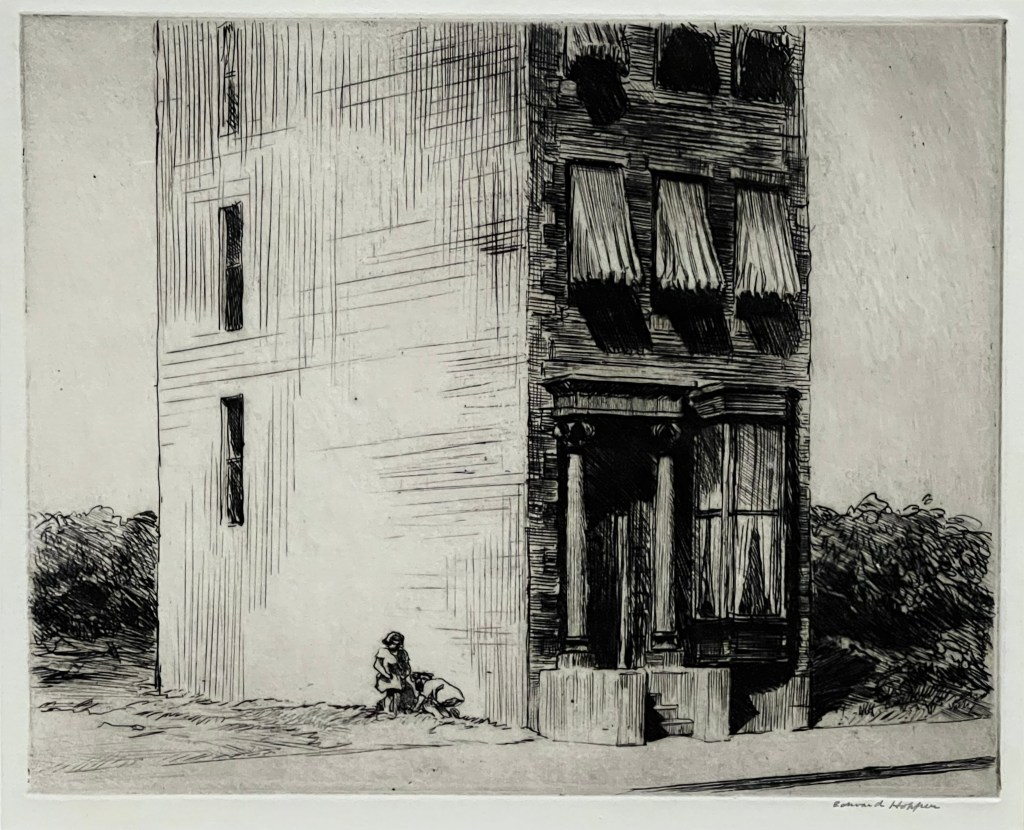
Edward Hopper, The Lonely House (1920)
I was reminded of Anderson’s alternative views of 1920s London – of construction sites and demolitions – when I came across the etching The Lonely House (1920) in the exhibition Edward Hopper’s New York at the Whitney. New York City, as the show’s curators put it with platitudinous generality, “underwent tremendous development” during Hopper’s lifetime; and instead of focussing his attention on landmarks that are more likely to stay in place than the architecturally commonplace – an assumption proven false decades later by the pulverization of the World Trade Center, an act of religious fanaticism bringing home that iconoclasm on any scale demands the iconic – Hopper “turned his attention” to “unsung utilitarian structures” and was “drawn to the collisions of the new and old” that “captured the paradoxes of the changing city.”
However, it is not visuals alone that vanish or material culture only that is subject to erasure. Sounds, too, face neglect and extinction. Unless they are voices or musical compositions, aural environments are largely unheard of in most records of our experiences, public or private. Sounds may survive as a backing track to our home videos, but rarely do they become the main event, the real thing of our conscious engagement with sensed reality.
Well, it ain’t over ‘til the proverbial — and stereotypically plus-sized — diva, binary or otherwise, puts down her lozenges to launch a final attack on the lorgnette-clutching, socially-distanced crowds. In as plain a variety of English as I can bring myself to adopt: we haven’t heard the last of COVID-19. Done as we might think we are with the pandemic the US President declared over, the virus continues to catch us unawares and mess with our lives.
It sure is messing with mine right now, in a number of ways. Almost immediately on arrival in New York City two weeks ago, I caught some resilient variant of the bug I had managed to steer clear of for so long. And it caught up with me despite all vaccinations and boosters, having taken advantage of the first opportunity to have my last antiviral top-up just two days before my departure.
Imperative mood
This is my first return visit to my old Manhattan neighborhood in three years … but clearly things did not go as planned or hoped for. What makes matters worse is that I had intended to be of some use to an old friend and former domestic partner, who, just days prior to my arrival, suffered a massive heart attack and has been in intensive care ever since. Here I am, stuck in his apartment, just a 20-minute walk away from the hospital that is now off limits. No doubt, millions of New Yorkers felt like that during lockdown — when everything and everyone close by was suddenly out of reach.




 Harry Heuser