
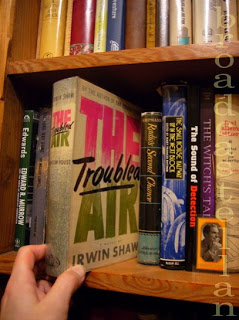
 This being the birthday of novelist Irwin Shaw (1913-1984), I dusted off my copy of The Troubled Air (1951) to pay tribute to a radio writer who successfully channelled his anger and frustration by feeding it to the press, a rival medium that was only too pleased to get the dirt on broadcasting. Like his previously mentioned short story “Main Currents of American Thought,” published in 1939, The Troubled Air is a blistering commentary on the business to which Shaw was introduced by radio writer-producer Himan Brown, for whom he penned the aural comic strip The Gumps. For details on the novelist’s experience in radio, I refer you to Michael Shnayerson’s insightful 1989 biography; here, I am drawing on a few passages of The Troubled Air to document a hack-turned-published author’s urge to let off steam at a time (the McCarthy era) when the old radio mill seemed on the verge of blowing up.
Clement Archer, a former history teacher with hopes of becoming a playwright, enters radio after being persuaded by one of his students that a “ two-headed Zulu could do it. As long as you can type fast enough, you have nothing to worry about.” Archer has his doubts:
“My natural prose style,” he [tells his student], “is something of a cross between Macaulay and the editorial page of the New York Times, and my idea of how people should behave in fiction comes mostly from James Joyce and Proust. And I never had Bright’s disease and I never tried to seduce a twenty-year-old immigrant, and I actually believe that the innocent always suffer and the evil always prosper in real life. So I can’t say I feel boyishly confident about my equipment on a Monday morning when I sit down and know I have to write five fifteen-minute heart-breaking episodes before Friday. I have a lovely idea for next week. Little Catherine (the name of the program was Young Catherine Jorgenson, Visitor from Abroad) is going to California and she’s going to get caught in an earthquake and be arrested for looting when she goes into a burning building to rescue an old miser in a wheelchair. Ought to be good for ten programs, what with the arrest, the examination by the police, the meeting with the cynical newspaper reporter who is reformed by her, and the trial.
In fact, life in radio’s fiction factory turns out to be “murderously hard work.” After years of it, Archer gets a break at last when he becomes the producer-director of University Town, a series of anthology drama under the sponsorship of a drug company. When his actors and musicians are accused of Communist affiliations by Blueprint, a “belligerent” and “mysteriously” financed magazine “dedicated to exposing radical activities in the radio and movie industries,” the advertising agency in charge of the program gives Archer two weeks to find out from the five people involved—a Jewish immigrant composer, an aging actress, a gorgeous ingénue, a black comedian, as well as Archer’s best friend and former student—whether the accusations are false.
When asked by Archer why drastic measures such as the firing of his composer were deemed necessary, the agency representatives responds by arguing that radio
is not at the moment in a strong position. In fact, it is not putting it too vigorously to say that the medium is fighting for its life. A new form of entertainment, television, is gaining enormous momentum, capturing our clients and our audience; the economic situation of the country is uncertain and advertisers are retrenching everywhere—the old days when we could do anything and get away with every—are gone, perhaps forever.
Being supportive of his creative team, Archer is denounced as a Red sympathizer, even though the communists denounce him equally. His phone is tapped, his career is finished, his marriage in turmoil and a friendship exposed as a fraud.
Shaw was hardly alone in denouncing the industry in which he had worked; but, unlike former gag writer Herman Wouk (from whose satire Aurora Dawn I quoted here), he could not bring himself to make light of the experience.

 Meanwhile, no cross-promotion could save Arctic Manhunt (1949) from obscurity. Announced in the same issue of Radio and Television Mirror, it was meant to convince both the “man-hunting brunette” and the “girl whose man needs—a little encouragement” that lipstick was indispensable to the survival of the species. As yet, no five people of either sex could be found who saw and care to cast their vote for Arctic Manhunt on the Internet Movie Database. Whether or not the advertised product “lasts—and LASTS and L-A-S-T-S,” especially under the conditions endured in the forecast melodrama, I am in no position to say; but memories of those promised “pulse-quickening” scenes certainly faded fast. It takes more than corporate windbags to take them by storm.
 Harry Heuser