Dark of Day: "Danger" and the Drama Invisible

Well, it was a scorcher of a day—the first I experienced here in temperate Wales. The unexpected heat brings back memories of my many summers in New York City and will prepare me for my return to the asphalt jungle this August. Moving to rural Wales from that bustling metropolis took more of an adjustment than adding a few layers of clothing; but anyone ready to weave life according to E. M. Forster’s motto “Only connect,” which is not a bad motto to live by, there is the comfort of that web of relations that, however remote or isolated you might believe yourself to be, will place you smack in the middle of the world, like a spider resting in the assurance that flies are bound to drop in, by and by.

Here is one such moment in the web in which I find myself. You might have to stretch your antennae a bit to get caught up in it.

Picture this: New York City, on this day, 18 July, in 1936. It’s the premiere of The Columbia Workshop, the most experimental and innovative of all the radio dramatic series produced during the so-called “golden age” of old-time radio. For that first broadcast, the Workshop revived what is generally considered to be the first original play for radio: The Comedy of Danger, by British playwright-novelist Richard Hughes, better known for A High Wind in Jamaica (1929), an adventure story that has been ranked among the hundred best novels of the twentieth century.

Danger is a sort of Poseidon Adventure staged in utter darkness; a spectacular melodrama of disaster involving three people about to drown in a collapsed coal mine. It is a scenario mined for the theater of the mind, evoked by sounds and silence alone. Danger was first produced by the BBC on 15 January 1924, but was still a novelty act when the Workshop chose it for its inaugural broadcast more than twelve years later. Back in 1924, US radio had no use for such theatricals, Hughes remarked in an article about “The Birth of Radio Drama”:

A few months [after the BBC production], finding myself in New York, I tried to interest American radio authorities in the newborn child.  Their response is curious when you consider how very popular radio plays were later to become in the States.  They stood me good luncheons; they listened politely; but then they rejected the whole idea.  That sort of thing might be possible in England, they explained, where broadcasting was a monopoly and a few crackpot highbrows in the racket could impose what they liked on a suffering public.  But the American setup was different: it was competitive, so it had to be popular, and it stood to reason that plays you couldn’t see could never be popular.  Yet it was not very long before these specially written “blind” plays (my own “Comedy of Danger” among them) began to be heard in America, and on the European continent as well.

Other than creating a situation in which the characters are as much bereft of sight as the audience, Danger has no artistic merit. It purports to be philosophical about death; but the fifteen minutes allotted for this piece of melodramatic hokum are hardly time enough to probe deeply, and much of the dialogue is ho-hum or altogether laughable.

What makes this seemingly generic if radiogenic play more personally meaningful to me is that it was written by a Brit of Welsh parentage, by a man who chose to live in a Welsh castle, and who chose, for this, his first dramatic piece for radio, a story set not far from the very hills where I found myself after these long years of writing in New York City about American radio drama. Is it a coincidence that I came home to the birthplace of radio drama?

“Goodness knows!” exclaims one of the trapped visitors,

I’d expect anything of a country likes Wales! They’ve got a climate like the flood and a language like the Tower of Babel, and then they go and lure us into the bowels of the earth and turn the lights off! Wretched, incompetent—their houses are full of cockroaches—Ugh!

In the background, Welsh miners face their fears by singing “Aberystwyth”—the name of the town near which I now reside. The Welsh, of course, are known for their oral tradition, for their singing and poetry recitals; their most famous poet is Dylan Thomas, author of the best know of all radio plays, “Under Milkwood.” It is here that American radio drama is still being thought of and written about: Rundfunk und Hörspiel in den USA 1930-1950 (1992), for instance, by fellow German Eckhard Breitinger, was written here, as was Terror on the Air, by Richard J. Hand, published in 2006. It is here, in Wales, that I started communicating with radio dramatist Norman Corwin; and it is here that, after a short break from my journal, I will continue my visits to the theater of the mind.

Yes, it is a web all right, even though I am not sure whether it was woven by or for me. I am merely discovering connections that, upon reflection, are plain to see and comforting to behold.
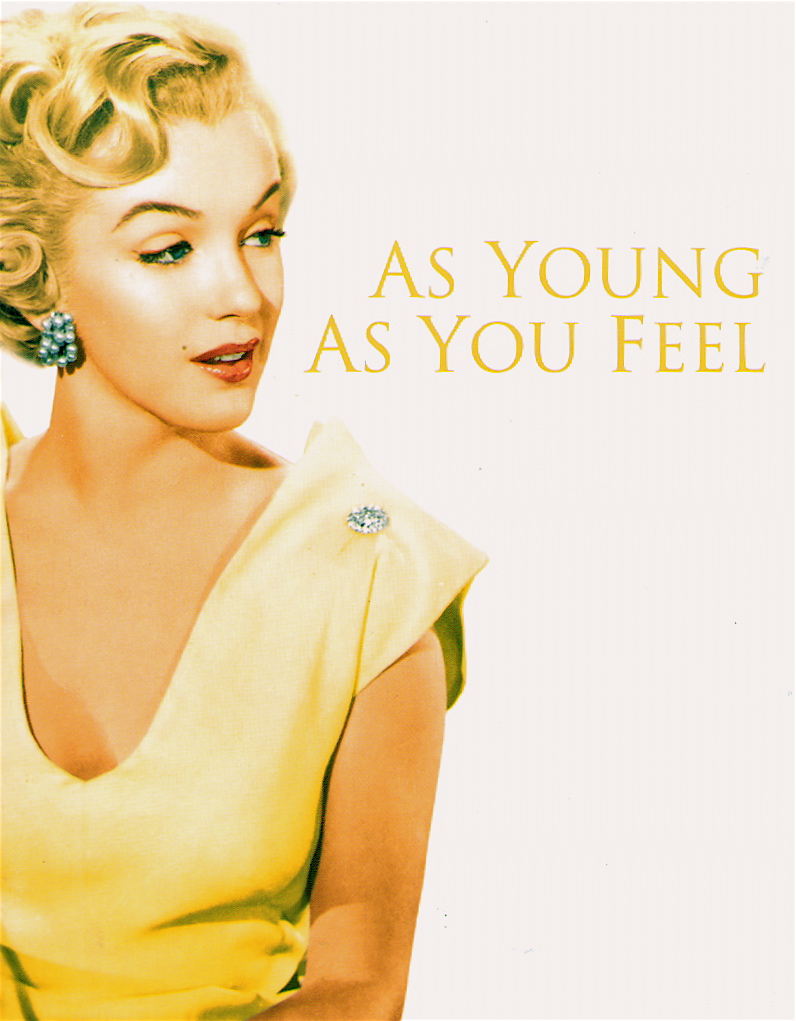
Many Happy Reruns: Marilyn Monroe at Eighty

I have been accused, at times, of exaggerating matters; but this just about proves it: radio, as a storytelling medium, is dead. I’ve conducted searches on Google and Technorati this morning, using the keywords Gelbart and Abrogate. The result: only 28 mentions in well over 40 million blogs! And no more than 444 via Google, the first entry of which refers searchers to broadcastellan. Considering that thousands of web journals are devoted to American politics and thousands more to the media in general, the lack of publicity a broadcast satire about the Bush administration has been receiving is remarkable.

I am referring, of course, to M*A*S*H creator Larry Gelbart’s “Abrogate,” a recording of which is still available on the BBC homepage. Had Barbara Bush been levitating on television (as she is in Gelbart’s utopia), had her son been denounced as the spawn of Satan (as he is in the fictive senate hearing of “Abrogate”), had Condoleezza Rice, Lynn Cheney and Ms. Bush been likened to the three hags in Macbeth (an image suggested by the radio play), there sure would have been some noise about it.

Radio used to popularize products and people, plays and personalities; now it appears to be the black hole of the multi-media universe. A few weeks ago, I recalled how Marilyn Monroe was being sent on the air to promote her studio, Fox, which had so little use for the young contract player during the late 1940s. She got flustered and faltered, delivering her few lines with less than confidence.

Her radio debut on 24 February 1947 (previously discussed here) was less than auspicious. The play presented that night on the Lux Radio Theatre was an adaptation of the costume drama Kitty. Marilyn was not in it, but was heard instead during a commercial break, peddling soap and plugging the latest film of Betty Grable, her future co-star. She had just been subjected to her first Technicolor screen test, but would remain limited to walk-ons in lesser black and white fare for years to come.

Such rare broadcasts reveal something about the personality of a performer that can be obscured on the screen. On live radio, unlike in the movies, there were no second (or twenty-second) takes. There was the microphone, demanding and daunting. There was the crowd of spectators, gawking at the performers in the studio. And there was Monroe, a nervous young woman, not yet twenty-one, clutching the script she had been instructed to read.

Monroe would have become an octogenarian today; not a pretty picture, perhaps—at least to those who see the aging process as a series of cumulative imperfections. How would the girl formerly known as Norma Jean have matured as a performer? Were she alive and among us now, would she be appearing in television dramas? Would she be discussing her latest autobiography with Larry King? Or would she be hiding from prying eyes, living in seclusion and hoping instead to be recalled as young as she was when Fox finally revealed her charms in Technicolor and Cinemascope? Given Western culture’s obsession with youth, she might now be embracing the microphone she once feared.

Recalling her not as she was or was made out to be, but calling her forth as she is to me, I am going to close my eyes now and listen to Marilyn as she returned to radio on 13 December 1952, with somewhat more assurance and considerably more box-office draw. By then she was being romanced by Charlie McCarthy, the first voice thrown into a ring littered with neglected hats.

Going on the air with Edgar Bergen’s wooden friend was risky business, considering what that chip of a chap had done to the broadcasting career of Mae West (as reported here). Not satisfied with fantasizing about her, Charlie was determined to woe and wed her, taking her home on behalf of us. Theirs was a short-lived engagement. Mine is a lasting passion . . .

Silents, Please!; or, How to Prepare for the World Cup Doldrums

Well, it is supposed to be busting out all over tomorrow. June, that is—the month during which television entertainment goes bust. In the US, at least, a generally enforced leave-taking from your favorites is a programming pattern that predates television. Looking through my radio files, I came across an article in the June 1932 issue of The Forum, discussing what Americans could expect to find “On the Summer Air.” It is an interesting piece, especially since it serves as a reminder that, during the early years of broadcasting, the summer hiatus was a response to technical difficulties. The shutting down of broadcast studios, like the closing of Broadway theaters, was directly related to the rising mercury, to the heat that made the asphalt buckle and urbanites escape to their vernal retreats.
“Formerly,” the reviewer remarks,

June marked the beginning of the radio doldrums, an enjoyable period lasting through three splendidly quiet months. Hot weather static raised so much hell with radio transmission that many sponsors permitted their public to amuse itself until September. But no longer! This year modern superheterodyne radio sets, the new pentode tubes, and more powerful, efficient transmitting equipment will help to put the Indian sign on summer static.

Did such technological advances improve matters for the home audience? Did static give way to ecstasy?

The gentleman from the Forum suggested that programmers made ample use of the re-conditioned air, but did not quite live up to the medium’s potential. There was Broadway legend Florenz Ziegfeld, for instance, who promised to widen the Great White Way with his Ziegfeld Follies on the Air. He also promised to present listeners with the lovely Lupe Velez. “We need television for a program like this,” the frustrated reviewer commented, and Ms. Velez was “the victim” of such a visual approach to sound-only broadcasting. “The microphone has yet to be built which will bring gestures and wriggles, no matter how seductive and amusing, to your front room.” The home audience was not likely to join in the applause with which the performers were greeted in the studio.

Even in its heyday, some two decades before television finally took off as a mass medium, radio was being compared to the supposedly superior medium that offered images and noise. Television, of course, is no less superior to radio than talkies are to silent films. The creators of art are called upon to explore the limitations and strength of the medium in which they work; but commercial radio rarely received such respect for the arts. In fact, the producers of broadcast entertainment often counted on its alleged defects.

Radio could be tantalizing by virtue of its inability to show, by hinting at rather than revealing. It could be tame or racy, largely depending on the imagination of the listener. Such teasing could be exploited, employed to draw listeners out of their homes and into the theaters, the lack of visuals reminding them that what they heard was a mere substitute, rather than the real thing. It was a concept ideal for advertisers, but at times frustrating to those who were hoping for free home entertainment.

Flicking through the Radio Times, anno June 2006, I was pleased to discover that television, though no longer free, occasionally offers programming that fits the medium as well as the moment: silent movies, the storytelling that is most purely vision. There will be quite a few silent nights in the next few weeks, UK television going eloquently speechless with moving pictures such as Chaplin’s The Immigrant, British classics like A Cottage on Dartmoor, Hindle Wakes, and Piccadilly, as well as Lubitsch’s Eternal Love, starring John Barrymore and Camilla Horn (which is shown on the digital channel artsworld). These small-screenings coincide with a series paying tribute to cinema’s Silent Clowns (Keaton, Laurel and Hardy, Chaplin, and Lloyd), as well as the biographical drama Stan (as in Stan Laurel), by the aforementioned writer/composer and silent film aficionado Neil Brand.

It is the calm before the storm, the madness that is World Cup soccer. If only the BBC offered an hour of silence for every shout of “Gooooooal.”

The Immaculate Misconception of George W. Bush, Ex-President

Well, this is a day to remember the fallen. Perhaps that includes those fallen from grace; and according to M*A*S*H creator Larry Gelbart, the fallen one to be recalled this Memorial Day is none other than George W. Bush, Ex-President. I am referring to Gelbart’s radio play Abrogate, which aired on BBC Radio 4 on Friday, 26 May. Memorial Day roughly coincides with Ascension, which the British insist on celebrating as “Spring Bank Holiday.” I rather resent this government-imposed erasure of traditions, as if the “holi” of this “holiday” were the culture of saving and spending, and the miracle to behold and recall were the power of Mammon.

The holiday-by-any-other-name broadcast of Gelbart’s play is well-timed, considering that the futuristic satire Abrogate not only serves as a memorial to the Bush and Cheney years—which it imagines to have given way to a Hillary Clinton administration—but also serves up a miracle, revealing, in an act of levi(tationali)ty, that Baby W. was the product of Barbara Bush’s immaculate conception, his rise to office being decreed from above. Ascension meets condescension in what is itself a high-spirited, irreverent, but less than immaculate confection.

Abrogate is conceived as a broadcast by the fictional AGN (the All Gates Network), “devoted to the endless scandals and excesses which White House after White House also seem so endlessly devoted to.” Carrying on the tradition of truth-finding lowered to the level of scandalmongering, AGN presents

highlights of the recent hearings held by the Special Senate Committee that was charged by the present administration with the investigation of the extent to which the former administration was engaged in a campaign of secrecy and deception, as well as a thorough disdain for the law, the result of which was tantamount to a virtual second American Revolution that threatened to undo the first, a nullification no less of over two hundred years of this nation’s civil and social progress, as well as the alarming arbitrary banishment of recognizable order or, as it has come to be known throughout and within the media, Abrogate.

Or, as the Committee Chair puts it “at the onslaught” of the hearing, to answer the “sixty- four trillion dollar question”: “Did the powers that then were, the previous Bush administration, pursue with both malice and perhaps some aforethought certain actions which served to violate the letters and spirit of the laws of this land in a way never here before thought possible? And do the sum of these reactionary actions equal a total that smacks of a conspiracy [. . .]?” In other words, “What did the President know, aside from what the Vice President told him he already did?”

From Senator Fulsome (played by Vincent Spano), for instance, you will learn about the Secretive Service, the Center for Shame and Public Apology, and Bush’s POOP (Photo-op Operations Program). “[I]t has become more and less common knowledge that anyone who was everyone was a spy in those days,” Fulsome declares, excusing the administration’s errors in judgment by arguing that “Terrible times create terrible thinking.” Among those called to the microphone during the hearing are Condoleezza Rice (played by Theresa Randle), Lynn Cheney (Joanne Baron), and Barbara Bush (Pat Carroll), whose motherly defense of her heavenly-fathered child provides the outrageous climax of Abrogate.

It all may have sounded rather more radiogenic as it turned out: a series of voices denouncing and defending the present-turned-former president and his actions, criminal or otherwise. As a radio production, Abrogate does not quite come off, however. It is too verbose, for one, squandering many of its inspired oneliners (while drowning out some less than subtle puns). My prose, for instance, barely suited to a blog, would have no chance on the air. On the air, lines need to be snappy, delivered slowly and forcefully enough in well-timed intervals to be absorbed in a single sitting.

Nor does Abrogate succeed in sounding verisimilitudinous, in coming across like a real newscast, an actual Senate committee hearing, which is the setting of this satire. What exactly is being sent up here, other than the heavens-bound Ms. Bush? Is Abrogate deriding the former President, his family and staff; the subsequent (and presumably Democrat White House) that indulges in this fault-finding mission; or the media, for leaping at every opportunity to undermine the authority of a much-maligned administration? And while it is true that the speakers implicated themselves in their ineptitude, the dizzy spin of Gelbart’s fictive broadcast seems to be taking too many turns, ridiculing the medium of which it avails itself and thereby negating the valid (op)positions to which it gives voice.

Such shortcomings notwithstanding, Abrogate is worth a listen, especially since attempts at contemporary radio drama, let alone timely politically relevant plays, are so rare these days. For inconsequential folly, you can always tune in to my podcast, a new feature of broadcastellan about which I will have more to say in the near future.

On This Day in 1949: My Favorite Husband Comments on “individual liberties” and Present-Day Politics

Government radio is a cross between a museum and a religious school, dispensing classics and credo, but not especially concerned with new works. Commercial radio is a department store, carrying in stock a few luxury items, a lot of supposedly essential commodities and perhaps too many cheap brands of goods. The radio [as imagined and desired by some who write for the medium] is an artist’s studio, dedicated to creation alone. As such, it is not yet able to stand on its own, and its product must be exhibited in the museum or the gallery of the department store.

That is how America’s foremost radio playwright, Norman Corwin, summed up the problems of writing for the theatre of the mind. While its sets are being created collaboratively by writers, actors, directors, sound effects artists, musicians, and audiences, radio plays must nonetheless be staged to be realized—and 1940s network radio was hardly a public access forum. 

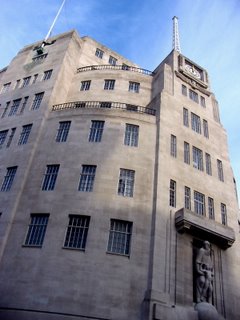
After World War II, even Pulitzer Prize-winning poet and Librarian of Congress Archibald MacLeish found it impossible to gain access to the broadcasting boards under the department store conditions of commercial US radio. He had to take his play “The Trojan Horse” to the “museum” of the BBC’s Broadcasting House (pictured above) to give it an airing. A hollow victory indeed.

Well, today I’ve been both to the museum and the department store, each time for some decidedly conventional fare. I gave Mike Walker’s 20-part adaptation of David Copperfield another try, after recording installments six to nine (the tenth having had its premiere this evening). I think that, as much as I like the quiet dignity of a museum, I’ve still got a department store ear.

Unlike Dickens, Walker does not seem to have a mind for either a dramatic or a proscenium arch. How anyone can manage to follow this adaptation while tuning in on a day-to-day basis is beyond me. It is all very pleasant, mind you, but I cannot quite piece it together, especially since Walker’s narrator makes little effort to help us make sense of it all. Instead, he suffers—and I along with him—from an identity crisis, now being an omniscient nobody, now a self-conscious author.

So, I took refuge again in the department store and listened to a Christmas-themed episode of My Favorite Husband, starring Lucille Ball. As much as I like Ms. Ball, this is only the second or third sample I took of this I Love Lucy precursor. The premise, as stated in the introduction of each episode, holds little promise. Where is the drama if a couple like Liz and George Cooper “live together and like it”? As is often the case in the realm of situation comedies, a stereotypical mother-in-law can be counted on to create the requisite domestic friction. And George’s busybody of a mother is downright Dickensian in her prissy hypocrisy—a match, to be sure, for Clara Copperfield’s sister-in-law, Jane Murdstone.

Making another visit on this day, 16 December, in 1949, Liz’s mother-in-law is at her belittling and bickering best, complaining about the lack of cleanliness in her son’s home and mocking Liz’s efforts to knit a sweater for George (“why are you holding that dirty old dust rag?”). After getting Liz all frazzled, she finally takes off, but not before unravelling her daughter-in-law’s handiwork. The last word on meddling, however, comes from the program’s announcer:

Ladies and gentlemen, the Christmas and New Year holiday season is a period of neighborly getting-together and renewing community ties. It’s a time when every American should be even more aware of the individual liberties he enjoys in the United States. And this freedom demands that each of us fulfils our duties as a citizen: to vote, to serve on juries, and to participate in community, state and national affairs. By making our form of government work better here, we strengthen democracy everywhere. We provide an example of a free government, which preserves the rights and the dignity of the individual. So, remember: freedom is everybody’s job.

Not quite the announcement you’d expect to emanate from a department store loudspeaker, is it?

Hope on the Bottom Shelf; or, What to Do When the Cable Box Seems Barren

Moving to the UK from the movie junkie heaven that is New York City meant having to find new ways of getting my cinematic fix. Gone are the nights of pre-code delights at the Film Forum; no more silent film matinees at the MoMA (which is just concluding a Gregory La Cava retrospective); and no more browsing at J&R Music World—and all just a cab ride away. And yet, judging by who is posting reviews at IMDb, it becomes obvious that cineastes are not exclusively city dwellers (a review of the rarely screened talkie The Hole in the Wall may serve as a case in point). Just don’t count on UK television.

The commercial-free BBC 2 has proven the most reliable source of classic Hollywood fare, even though the screenings of old movies are generally relegated to the after-hours or late-morning time slots. There have been a number of pleasant surprises, such as a Val Lewton series (including the literate horror of The Dead Ship), the film adaptation of the Suspense radio drama “To Find Help” (reworked, not altogether successfully, as Beware, My Lovely) and several Claudette Colbert films (including Texas Lady, which I had never seen in the US).

Silent movies are unheard of, however; nor do pre-1940s films get much airtime (the team efforts of Astaire/Rogers and Laurel/Hardy being a notable exception). Still, this beats the advertisement-riddled offerings at TCM Britain, whose one-shelf library even infrequent viewers are likely to exhaust within a few months.

Since I am not an online shopper and still enjoy hunting trips per pedes, I have been checking out the DVD sections of the major music/video retailers here in the UK. Virgin is least attractive, stocking mainly recent titles at largely unacceptable prices. It is little more than a snazzy second-run theater where all the so-called blockbusters are dumped and repackaged as soon as they are pulled from the movie houses.

Rather better are HMV and MVC. With some luck, DVDs of classics like All About Eve, Sunset Blvd., or The Third Man can be had for under £10, while lesser-known titles may be spotted (and left behind) sporting higher price tags bespeaking their exclusivity. At HMV, for instance, Tod Browning’s Freaks bears the label “An HMV Exclusive.”

And then there is FOPP. A smarter store with a larger number of classic or literary films, it boasts £5 and £7 DVD shelves. It’s a good place to set out from for anyone interested in setting up a library of essential Hollywood films. Many Hitchcock features can be had here for £5, and most DVDs are authorized studio releases, rather than the cheap transfers that end up in supermarket bargain bins. These copies are so washed out that it often difficult to distinguish the features of the players; even the rugged male leads seem to be getting the Doris Day treatment, as if shot through layers of gauze. The problem is exacerbated if the DVD image is projected onto a screen, as I am wont to enjoy my movies whenever possible.

Well, to FOPP I went last weekend; and, once again, hope lay on the bottom shelf: a copy of G. W. Pabst’s Pandora’s Box. So, tonight is going to be spent looking at Lulu, our decidedly other Miss Brooks.