
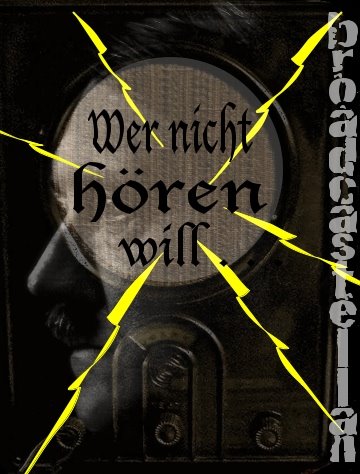
To Hear, to Belong, to Submit: The Volksempfänger Turns 75

Nowadays, the concept of not having a voice is so alien to most of us Westerners that we fool ourselves into believing that what we are saying is of consequence, that because words are sent into the world they may also change it. We are too used by now to telecommune via phone or internet that the one-sidedness of broadcasting strikes us as downright barbaric. Why listen and be still when we can chatter and twitter, why take in a thought when we can put out a great deal of thoughtlessness with the greatest of ease? Publishing online or opining about world events on our slick mobiles, we are apt to believe that we have the world at our lips and by the ear. We are given gadgets—or, rather, we purchase them at considerable cost—that encourage us to exhaust ourselves in gossip while permitting others to check that our talk is indeed idle.

The talking disease is the talking cure of our modern society: the comforting illusion of having the power to say anything, anytime serves a system that, if our words mattered, would have to resort to more drastic acts of silencing.

Back in early 1930s Germany, Bertolt Brecht rejected radio as a distribution apparatus, a machine through which the few addressed the many, generally in the guise of speaking on their behalf. The German for broadcasting itself is misleading.  “Rundfunk” (literally, sparking around) hardly captures the one-sidedness of transmission. Brecht was looking forward to the day in which broadcasting could be a system of exchange, the kind of wireless telephony now available to us, at least technologically speaking.

Instead, German radio cut off all means of response other than compliance. It removed from the dial any voices that might utter second opinions. Effectively, it removed the dial itself by tuning the public to the official channel, and to that channel alone. Today, 18 August, the Volksempfänger turns 75. It was not simply the furniture of fascism.  It was its furnisher.

The Volksempfänger (the people’s receiver) fed Germans with whatever was in the interest of the Reich, that is, the governing body rather than anybody being thus governed. This privilege of being talked down to, of being shouted at and being shouted down, was offered at a discount—a discount that ended dissent in the bargain. Dictatorships, after all, depend on dictation.

Brecht had reason to be wary of broadcasting, a means of listening that precluded response. Does not the German language suggest that the German people are prone to being led by the ear? The German for “hearing” is “hören,” a related form of which is “horchen.” Both are the root of a great many words, and some weighty ones at that.

Take “gehören,” for instance, which means to belong, while “verhören” means to interrogate. “Hörig sein,” in turn, means “to be submissive,” and “gehorchen” means to obey. “Auf jemanden hören” means to pay heed. Remove the “jemand” (the anybody), and you have “aufhören,” which means to end, as free speech did when the Volksempfänger became cheaply available to anybody.

Today, we have the opportunity to receive as well as broadcast. We can take in hundreds of channels and put out millions of words. It calms many of us to the point of not speaking up. We can, therefore we don’t. A system that does not take the microphone away from us, that permits us to air our concerns, must be fair system. Why listen to anyone who tells us otherwise? Well, “Wer nicht hören will muss fühlen,” a German saying goes. Its meaning? Those who don’t listen shall feel the consequences.

Chalk Circuits: Brecht, the Stage, and the Radio

Well, it rolled into town last night . . . and carted me right back to high school (in Germany, anno never-mind), where I was exposed to it first. The National Theatre’s “education mobile,” I mean, whose production of Brecht’s Caucasian Chalk Circle I went to see at the local Arts Centre. Despite the publicly staged custody battle at the Circle‘s center, I did not once think of the circus that has become the life and legacy of Anna Nicole Smith. Brecht’s parables of the filthy rich and dirt poor are hardly without tabloid appeal; but instead of drawing parallels between this story and history, I felt encouraged by the production’s interpretation of Brecht’s theory of Epic Theater to contrast the techniques of the theatrical stage with the potentialities of the sound stage, radio being a medium of which Brecht was suspicious at first (given its exploitation in Fascist Germany), but for which he was to write a number of plays.

Communism has always been big business in capitalist societies, both as fuel for wars, cold or otherwise, and as an artistic construct. A carnivalesque appreciation of his anti-capitalist allegories from the comfort of a loge might run counter to anything Brecht envisioned in his organon, but I suspect that such is the spirit in which most audiences take in his works for the stage. They are didactic, all right, but that does not mean theatergoers are ready, willing, or able to be instructed.

Instead, audiences might take in, take on or leave Brecht’s Epic theatricals, only to return to their shopping, to the latest installment of an American television serial featuring the works of Hollywood’s highest-paid plastic surgeons, or to their various modes of right-winging it in style. Episches Theater struggles against the complacency induced by the convenience and relative comforts of a reserved seat in a handsome theater. Theatergoing, after all, is little more than a costly interlude these days, a getting-away-from the everyday rather than a forum in which to face it.

Besides, Brecht’s apparatus seems by now more creaky than a well-oiled Victorian spectacle. Its stage was not the proscenium arch of melodrama, plays of sentiment and sensation that draw you in and, once the curtain is drawn, absolve you from any responsibility to engage further with whatever you had the privilege of witnessing. Never mind that The Caucasian Chalk Circle draws to a close with the potentially high-tension climax of two women called upon to tear at a child rightfully belonging to one of them (the verdict depending on the judge’s—and our—definition of “rightful”). Much lies outside this circle that invites onlookers to stray from the center.

The main principle of Epic Theater is not to let anyone watching get emotionally absorbed in the action. Brechtian drama challenges audiences to observe behavior, action and circumstance, however stylized, in order to assess and draw conclusions from it. Conceived as a theater of estrangement (or Verfremdung), it is meant to provoke thought rather than pity. The play (and the play within) remain an artifice rather than becoming—or assuming the guise of—reality.

In order to create this sense of estrangement, the National Theatre production lets the audience in on the stagecraft involved in the manufacture of realist theater, especially the motion picture variety whose special effects trickery has long surpassed traditional stagecraft. The stage was both scene and soundstage, a set peopled with foley (or sound effects) artists at work in the background and, to highten the effect of alienation, interacting with the performers or taking part in the drama they help to mount. Not since I last attended a production of a radio drama have I seen so many tricks of the trade displayed, from the production of a crackling fire to the imitation of a bawling infant.

I’m not sure whether Brecht would have approved of this interpretation of his theory, which results in a spectacle that was amusing rather than authoritative, a Marx Brother’s production during Karl’s night off, a staging that turned Verfremdungseffekt into an elaborate running joke. This Chalk Circle, replete with a narrator addressing the audience with a microphone in his hand, was a radio melodrama turned “epic” by virtue of being both played and displayed.

On the air, with its techniques obscured from view, it would have come across like the very stuff against which Brecht rebelled with his theory. The eye and the ear were pitted against each other, an “epic” battle of the senses whose enemy is realism but whose victim is engagement. For once, my ears were the channels of realism, while my eyes were instructed to see and disbelieve. Sure, I learned how to set a palace on fire; but Revolution had nothing to do with it.