
Greek to Me: Notes on an Identity Crisis

Well, I can relate to it. That black sheep on the brow of the hill behind our house. After well over two years of living in Wales, I still feel very much like an outsider. I’m not sure whether I am too resisting of this new, old culture—which is struggling, with a mixture of self-consciousness and pride, to assert itself against or alongside England—retreating and subsequently fading into the American pop culture gone stale to which this journal is largely dedicated.

My self-confidence and sense of belonging were not bolstered any last weekend, when I accompanied my better half (just returned from London) to a dinner party whose far from rustic guests included a Deputy Private Secretary to the Prince of Wales. I did not expect to be conversing about my doctoral study on old-time radio, let alone impart my enthusiasm about the subject. I would have settled for literature, or travel, or dogs (Camilla having ditched the royal Corgies in favor of a Jack Russell like—or perhaps quite unlike—our inimitable Montague). Unfortunately, I did not get to share much of anything that evening. The guests chose, for the most part, to speak in the native tongue, which, I assure you, does not sound anything like English.

Yes, I can relate to the black sheep on the hills. And I sure can relate to the two main characters in the inaugural broadcast of Great Plays. After all, the comedy that evening was Aristophanes’s The Birds, in which two disenchanted old Athenians—Pisthetairos and Euelpides—leave their native soil in search of . . . Cloudcuckooland. A weekly radio program offering adaptations of Western drama ranging from ancient Greece to modernity, Great Plays premiered on this day, 26 February, in 1938. Undoubtedly, it is not the easiest introduction to old-time radio, although the multitude was being accommodated (or patronized) by the deletion of most Greek references.

Pardon me for failing to come up with a rara avis of a metaphor suitable to the occasion, but it sure is difficult to take off for unknown territory and expect to be surrounded there by those who are of the same proverbial plumage.

Nor do I quite understand the recent influx in visitors to this site from China, presently accounting—to me still unaccountably—for over 25 percent of my, er, readership. They are not likely to find much of interest here, aside, perhaps, from my reflections on avian flu in relation to the famed story by Daphne du Maurier. Then again, “China” and “Chinese” have been mentioned in this journal on several occasions, including these essays on The Shadow, Mr. Moto and the passing of Tokyo Rose, and Pearl S. Buck.

In a word, an admittedly somewhat tacky one in this context, I am disoriented. Perhaps, a flight to New York City is in order. A slow boat to China just won’t do.

Having Legs: The Calm After the Storm

Well, I don’t know whether hard luck can be said to have them. Legs, I mean; but this one sure lingers. So, just in case you were wondering: the violent storm mentioned in my previous post caused greater problems than the alluded to runaway trash can. I have been without phone and internet ever since and am typing these lines while sipping tea at a wireless cafe, repairs (or, at any rate, inspection and assessment of the problem) being scheduled for next week. Until the service is restored, I am biding my time watching old movies, reading even older books while broadcastellan—not designed for hurried oneliners from a cell phone or anything requiring a rushed update—remains dormant. I bet I am missing this more than any of you. . . .

My comparatively trivial “affliction” is well expressed in these lines by Walter Scott, whose Guy Mannering; or, The Astrologer (1815) I picked up to while away the hours:

Here was a country gentleman, whose most estimable quality seemed his perfect good nature, secretly fretting himself and murmuring against others for causes which, compared with any real evil in life, must weigh like dust in the balance. But such is the equal distribution of Providence. To those who lie out of the road of great afflictions, are assigned petty vexations, which answer all the purpose of disturbing their serenity [. . .].

The legs on display here, by the way, belong to Claudette Colbert; I spotted them some time ago when flicking through an issue of the British Picture Post from December 1938. Ah, the joys of lagging behind the times . . .

Not Keeping Up with Myself: Still a Bloghead at 300

Well, it “is better than being totally unemployed.” Teaching, I mean. At least that’s what our disgruntled Miss Brooks told herself—and the audience of the situation comedy bearing her name—on this day, January 16, in 1949. She was asked to fill in for a colleague and was tempted respectfully to decline; but, educators being generally treated with less respect than the handouts lavished on their listless charges who promptly doodle themselves out of earshot, dutiful Connie Brooks showed up anyway.

Showing up! That has got to be the easiest and most elementary aspect of fulfilling any job requiring our leaving home. In my case, though, even that seems too much to ask. Apparently, I am too busy these days keeping up with the out-of-date to consult my personal calendar much, at least when appointments involving more than me and the radio are to be kept. At any rate, showing up was something I neglected to do this afternoon, scheduled as I was to start a teaching assignment—in Creative Writing, no less—at the local university.

There is small consolation in listening to absent-minded Dr. Hall of The Halls of Ivy, who, on this day in 1952 suffered the following blackout while hanging up some paintings with his wife:

Mrs. Hall: . . . put this one over the sofa.

Dr. Hall: What is that?

Mrs. Hall: It’s a painting I found up in the attic. Don’t you remember it?

Dr. Hall: No, and please don’t accuse me of having bought it. 

Mrs. Hall: Darling, you painted it!

There was reason for Toddy Hall to suppress the memory. Some fifteen years earlier, the painting had met with the assessment that “hanging is too good for it.”

Unlike Dr. Hall, Dr. Heuser tends to remember nothing more clearly than his past embarrassments, a failing that inevitably leads to further blunders. So, pardon me for not being in the mood to celebrate my three-hundredth entry into the broadcastellan journal and for cuddling up with my Mr. Boynton for a screening of Hitchcock’s Wrong Man (showing today on TCM UK).

Considering that I have fallen into the habit of editing my work online, you might find something new (or even worthwhile) in the previous posts. I am sure this short note will be revised before long. For now, it is rather a sour one, reflecting my current mood. Remind me to snap out of it—perhaps by divulging an incident involving a mental power failure of your own.

Being Here: Living Reconciled to Virtuality

Well, it has been two weeks since my last entry in the broadcastellan journal. I have been on trips to England’s two largest cities, London and Birmingham (pictured, in my rather futuristic snapshot), spending time with friends, taking in culture high and low. I rarely stay away that long from this virtual nook I call home. Whenever there is living to be done, I tend to fall behind with the chronicling of same; and when I finally catch up with myself in writing, the reporting seems pointless, the moment past. Perhaps it is this inability to reconcile actuality to virtuality that convinced me to keep a journal devoted to the presumably out-of-date.

Instead of summing up the fortnight that was, I am looking ahead, announcing the pieces I am going to share in the days to come. For what remains of the year (and of my time online), I shall file a few belated reports from the theaters, virtual and otherwise.

For the most part, it has been “otherwise” rather than otherwise. After my short trip to Birmingham, where I was introduced to Patrick Hughes’s mind-teasing “Superduperspective” (on view, free of charge, at the Waterhall until 17 February 2007), I went to see the aged Ron Moody as Scrooge in a touring production of Dickens’s A Christmas Carol. While in London, I took in A Moon for the Misbegotten starring Kevin Spacey (whose career I have been following ever since I was introduced to his work by a mutual friend); an irreverent adaptation of Hitchcock’s The Thirty-Nine Steps, performed by a cast of four; and the musical Daddy Cool, based on the once hugely popular songs of Frank Farian (of Milli Vanilli infamy), many of which provided a soundtrack for my childhood in Germany. I am going to devote one essay each to these diverse stage entertainments, and am likely to toss in the occasional reference to American radio dramatics, the formerly free theater for the multitude.

There isn’t much “free” theater to be had these days; and, judging from the American accents I picked up only infrequently while in the UK capital, London is rather too expensive to attract many Western travelers, particularly at this time of year, when many forgo culture for commerce in their search of bargains. Although I moved from the US to Britain quite some time ago, I still think in dollars and convert pounds into US currency to assess costs. It is a habit that made the ticket prices at London’s movie theaters seem all the more outrageous. I guess we laughed more at our folly than at the penguin antics when we found ourselves paying $25 per person to see Happy Feet. Somewhat less pricey were screenings of Casino Royale (an antemeridian matinee at London’s premier movie house, the Odeon Leicester Square) and Stranger Than Fiction, playing at a much smaller venue.

Going to the pictures has gotten pricey; and that applies not only to those in motion: the current exhibition of paintings by Velasques at the National Gallery requires the forking over of an eyepopping £12. As price tags raise expectations, the paintings seemed to lose some of their lustre when considered in the light losing itself in empty pockets. No wonder I keep turning to the comparatively cheap thrills of old-time radio drama for my day-to-day amusement.

Though no longer free, there was much on offer at home, if only I had been listening to the radio. Still to be enjoyed are Sir Ian McKellen in Sir Gawain and the Green Knight and a production of Shakespeare’s Cymbeline, both aired on BBC radio The BBC makes programming available online for a week, and I am now trying to catch up with some of the outstanding or noteworthy dramas presented in recent days—from the gay wedding at The Archers to the five-part adaptation of A Room to Let, a story collaboratively conceived by Charles Dickens, Wilkie Collins, and Elisabeth Gaskell—broadcasts I missed while wirelessly away in England.

Mind you, I could have enjoyed wireless access at our hotel—for the price of £15 a week; but, more than the cost itself, I resented being prompted to provide personal data in order to be granted a privilege that ought to be free like the air itself. Paying for air charged with the particles of commerce? Being charged yet again for exposing myself to a deluge of online advertising while depriving myself of an opportunity to recharge? Progress? Bah, humbug!

Wire(less): When Radio Answers the Phone

Well, it only took about five months, but, taking a break from the broadcastellan journal last night, I finally completed my fourth podcast. Titled “The Voice on the Wire,” it explores the relationship between radio and telephone. Its publication coincides with two BBC Radio 4 broadcasts, one documenting the history of radio sound effects (“Two Coconut Shells, a Blow Lamp and a Raspberry”), the other (“Down the Wires”) the development of the Electrophone, an early device for taking in theater over the telephone. I will discuss those two programs later this week; but today I’ll simply play the barker and do a bit of self-promoting:

Step inside, folks, step inside! This way to the big show. That’s your mind, ladies and gentleman, or at least it can be, with pulp-peddlers like me around to give you strange ideas. Be there when an invalid is strangled in her bed; listen to the disembodied voice of a man in the act of committing suicide, and witness assorted cases of murder, mayhem, and madness. Get your wires double-crossed here, folks! You’ll come across the most tremendous and terrifying tales of treacherous telephony. You’ve never heard such smooth operators, such neurotic callers. Busy signals, freak connections, hang-ups and heavy breathing—we’ve got it all. There’s nothing like a case of espionage and betrayal, of lines that go click in the night, of outcasts and shut-ins whose lives are being cut as short as an inconvenient call . . . as long as you are not at the receiving end.

I’ve gone on about thrillers like “Sorry, Wrong Number,” “Meridian 7-1212,” and “Long Distance” at some length in my doctoral study; unlike Roland Barthes, I find it easy to go on about what I love. It’s an even greater thrill to let radio speak for itself, to tune in and sample various melodramas from series including Inner Sanctum Mysteries, Suspense, The Whistler and Radio City Playhouse, and to put together this collage of telephone terror.

While it is the most famous of all plays written for American radio (“The War of the Worlds” being an adaptation, however innovative and radical), “Sorry, Wrong Number”—dubbed “radio’s perfect script”—was only one in a long line of audio dramas that took up the receiver and took it on by shouting across the wire, that means of point-to-point communication for the triumph over which the wireless was originally developed.

For decades, it was the wire that remained triumphant. In the 21st century, this failure has been rectified and “wireless,” an almost forgotten word in the early 1990s, now means both the intimate chat between two individuals and the broadcasting (or podcasting) of voices to the multitude. Still, whenever I see a sign saying “wireless”—and despite the fact that I am using such a network at home and, if lucky, on my travels—I still think of the old cat’s whiskers and the behemoth of a mass medium into which it had transmogrified by the 1930s—a culture of pre-internet voicecasting and sound-snatching turned into a one way operation and forced into commercial service.

As I argue, radio anathematized telephone as the anti-wireless, and for good reasons. Heard on an experimental program that glorified the sound medium and its potentialities, a play like “Meridian 7-1212” demonstrated how private talk, unlike public speech—once it was tele-communicated rather than delivered face to face—promoted selfishness and enabled sinister deeds. Pointing up the failures and dangers of telephonic exchanges, the radio, which has been accused of being a fascist medium, emphasized the public service it rendered by bringing and keeping a people together and glossing over or making a joke of differences, tasks of great importance during economic crises (as confronted in the 1930s) and war (from World War II and Korea to the installation of Russia as the new enemy to beat).

I rarely use the phone these days; and cellular ones are largely a nuisance or a mystery to me. I can manage to keep my appointments—and my distance—without them; but perhaps it was listening to all these tales of terror that convinced me to twist radio’s dial instead of running the risk of dialing wrong numbers.

Milestone, Millstone: Feeling Moody About Hitting 250

Well, as announced previously, this is the 250th entry in the broadcastellan journal. I don’t know how you do it—or why you keep it up; but this is my take on keeping a public if none too prominent journal. To keep this snappy (because I cannot trust myself to get to any point fast enough to keep anyone’s interest), I have once again called upon noted and notoriously bristly radio journalist Wally Windchill (previously heard here) to help me mark the occasion. Let’s go to press, Mr. Windchill.

Windchill: What are you still doing here?

broadcastellan: Gee, you are getting straight to the point, aren’t you?

Windchill: I know it’s practically a foreign concept to you; but let’s just say you’ve been handed a dictionary. So?

broadcastellan: I guess it is both compulsion and conviction that keeps me from calling it quits. That, and the debates I get into with fellow webjournalists like this, people who might not go on about the airwaves as I do but are equally fascinated by the medium and its messengers. And while it may take me some time to catch up with other old-time radio journals, like this one, I very much enjoy sharing my thoughts on the subject.

Windchill: Does it ever occur to you that many who stop by here might object to being subjected to it?

broadcastellan: Yes, it does. But, as Gertrude Stein put it, I write for myself and strangers. I know this journal is not what you might call popular, even though I am writing primarily about so-called popular culture.

Windchill: Don’t try to make it sound ironic. You are long-winded and refuse to mention Paris Hilton.

broadcastellan: I can’t say that I feel apologetic about the latter deficiency. My diction, I agree, is not entirely suited to blogging. But I have made a few adjustments in recent months. For one, my paragraphs have gotten shorter.

Windchill: That amounts to inserting a few spaces here and there. Not exactly a feat.

broadcastellan: I won’t comment further on style. Talk content, if you must.

Windchill: All right. Not that I want to encourage you, but have you ever considered keeping a second online journal, or a third? For anything that you can’t or won’t say here and would like to share?

broadcastellan: Yes, I’ve thought about that, often. But instead of branching out and fragmenting myself, I try to make this a personal journal reflecting my everyday. In fact, whenever I don’t remember what I did or how I felt on a certain day, I google myself and consult this journal.

Windchill: It’s hardly a confessional, though. It seems to be mostly about a past that’s not your own. Just how do you decide on the topic of the day? Do you pay attention to current events, or is it mainly a matter of ransacking your collection of scripts and recordings?

broadcastellan: Generally, I dig into my recordings library first to find out what I’ve got to match the day. Sometimes I look at the birthdays listed in the Internet Movie Database, which furnishes me with the occasional idea. Then there is the History Channel, which has a serviceable “On This Day” section. Then I set out to find a radio angle. I particularly enjoy it if the angle is not immediately apparent. I’m not so much writing about what I know, but about what I want to know. This is what keeps me interested in my subject. Nonetheless, I have often been dissatisfied with my own “On This Day” column; because whatever matches the day may not match my day at all. Or anyone’s present day, for that matter. As a result, my discoveries may seem trivial.

Windchill: And regardless of all the pointless anniversaries you insist on celebrating in your journal—including this anniversary of your journal—you resent nothing more than trivi-alienate your visitors.

broadcastellan: “Trivial” is about the most pitiful word in the lexicon. It means to squander the potential of any datum to matter in the present day. It is not just a way of disseminating meaningless information but of making information meaningless—like on one of those quiz programs that turn what is not current into currency and reward you for having a good memory. That is, an indiscriminate one.

Windchill: You are criminally forgetful. Is that it?

broadcastellan: True. I’ve learned to make the most of this deficiency. For one, it helps me to approach anything old anew, often without realizing it. At least I don’t end up reprocessing my own thoughts.

Windchill: You underestimate the importance of recycling. By the way, what’s with the pig?

broadcastellan: A picture from a recent trip to St. Fagans, a sort of recycling centre for Welsh culture. Now, if you’ll excuse me, I’ve got a stale cake to slice into . . .

The Next Voice You Hear; or, Blogging Away

The next voice you hear will still be mine; but it will come to you from the metropolis. Tomorrow morning, I am leaving Wales (my man and Montague, the latter, being more compact, pictured in my arm). After a stopover in Manchester, England, it’s off to New York City, my former home of fifteen years. Last time I was there, I found myself in the middle of an old-time radio serial (I Love a Mystery), the keeping up with which turned out to be somewhat of a chore, appreciated by too few. I also did not enjoy wireless access and was piggybacking wherever I could, a haphazard signal chasing that complicated the webjournalistic experience.
This time around I will suspend all regular programming and write instead about popular culture in relation to Gotham. I am planning to visit and report from various New York City locations where radio drama was produced, is being presented these days, or has been set. I’ll also conduct tours of second-hand bookstores, cultural sites that are fast becoming extinct in the corporately co-opted rental space for advertising opportunities that is today’s cityscape. In short, it will be an old-time radio travelogue.

I might also write about any play or movie I get to see while in town. Unfortunately, the Film Forum has decided upon a retrospective of swashbucklers, as well as a series of Buster Keaton features. Since I don’t care much about either (and went to see Keaton’s The General only a few weeks ago, with silent film music composer Neil Brand at the piano), I don’t think I’ll spend much time at the local movie houses, most of which play the fare that you get to see anywhere else in the western world or the non-hostile elsewhere. I’ll stack up on a few good DVDs while there, snatching whatever bargain I can get my hands on.

I might also flick through the US channels I miss here in the UK, such as the Independent Film Channel, Sundance, and Turner Classic Movies, which has scheduled a Carole Lombard day on August 17, and catch up on some of the television series I’ve read about on the web journals I regularly peruse. I might also take in a few Broadway or Off-Broadway shows. Whatever comes my way or catches my eye, you’ll read about it here.

So, to borrow from Archibald MacLeish’s “The Fall of the City” (previously discussed here), the next “broadcast comes to you from the city,” technology and the general vagaries of life permitting. I hope you’ll tune in.

More Milestone Reflections; or, Quo Vadis, broadcastellan?

Well, I have been away taking pictures. Taking pictures away, to be precise. It was an entirely manual engagement with the arts, involving nothing more than hauling some large canvasses—paintings by the late British artist David Tinker—for an upcoming exhibition. The things we do for a meal and a daytrip to a place where sheep are outnumbered by people (in this case, Cardiff). It so happens that the artist’s widow is Tracy Spottiswoode, who writes for television and radio. She is currently working on a radio play for the BBC, based on a story related to her by her father. It is an incident in the life of Hollywood actor Robert Vaughn, who found himself caught up in the turmoil of the Prague Spring while filming on location in Czechoslovakia, anno 1968. Considering that another successful radio writer, silent film music composer Neil Brand (last seen on UK television in Paul Merton’s Silent Clowns series, which concludes today with a portrait of Harold Lloyd) is coming to visit this weekend, I decided to give writing for the medium another try and return to my own audiodramatic tinkerings (first and last hinted at here).

I have written much about radio, but never for it. And since this 200th entry into my journal marks another milestone (the last one having been contemplated here) it is a convenient moment to reflect on my writings, their uses and purposes. “Quo Vadis” is meant here as a way of mapping out a way, of asking myself what to do next with and within this forum, another opportunity of looking back, listening ahead, and saying thanks to all those who have been reading and commenting over the past five months. Writing in such a marginalized field—and writing in such a marginalizing style about it—can be a rather lonely pursuit.

Perhaps I am craving a larger audience than I am enjoying here; but writing an audio play (for the first time since high school) is merely another creative response to my ongoing engagement with radio. And, if the lacking response to Larry Gelbart’s recent radio satire “Abrogate” (as discussed here) is any indication, there may not be a large audience—or a large vocal one—for such writing either.

That said, there will be less of me, here, in the next few weeks, weeks that will involve gathering new impressions elsewhere, in London and New York City. As you may recall, when last I was in New York, I very nearly went out of my mind going in search of a wireless network to post my writings—not the kind of part in the theater of the mind I had in mine.

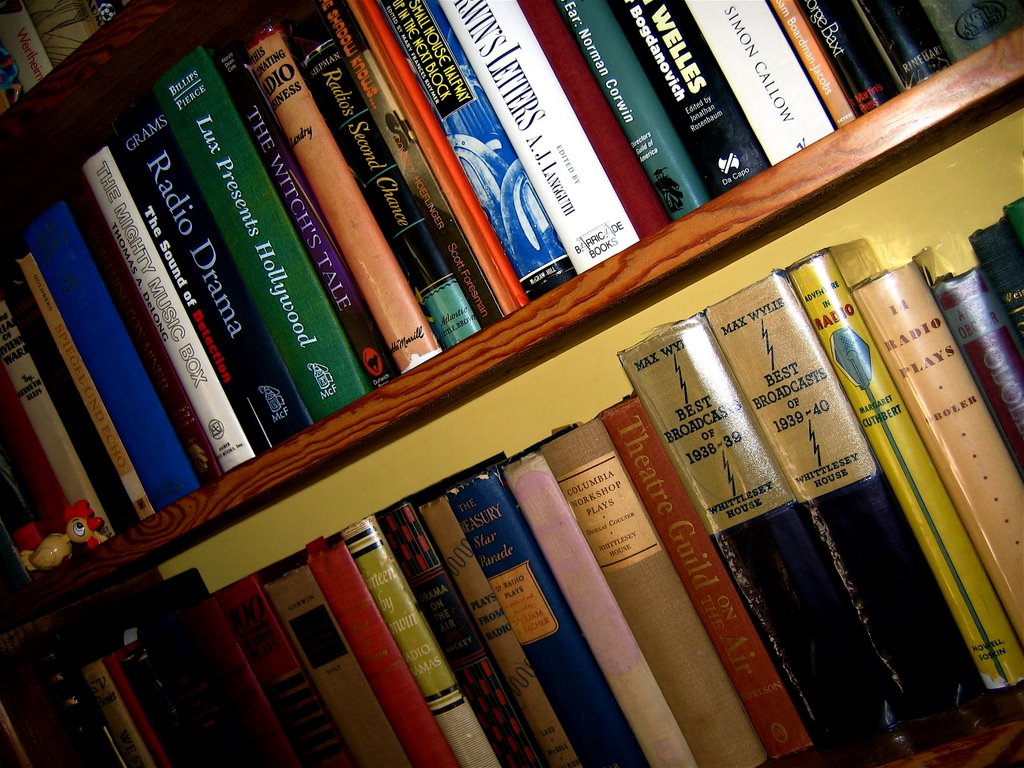
The recent acquisitions you will find on my bookshelf (including Arch Oboler’s Fourteen Radio Plays, Abbot’s Handbook of Broadcasting, and Wylie’s 1938/39 and 1939/40 Best Broadcasts, all pictured above) provide models and instructions for the wireless tyro. Today’s writers can learn a lot from the old practitioners, restraint as they were by commercial ties. Radio plays can be talky and tiresome, so intellectual as to become insipid. A healthy dose of melodrama and a helping of sound effects sure liven things up. At least, I hope they will in my efforts at soundstaging. I might exhibit some of my experiments in radio writing on my podcast site.

So, if you enjoy plays for the ear—or derive pleasure hearing about someone struggling to give prospective listeners an earful—you might find my forthcoming discussions about aural storytelling and sound effects of some interest. Please stay tuned . . .

In Search of Sounds; or, How I Wound Up Podcasting

Well, I was about to head out for The Island. Athol Fugard’s Island, that is, the Johannesburg Market Theatre production of which is currently on tour in England and Wales. Apparently, the company got lost on its way through the wilds of Wales and is, as I just learned, a no show for tonight. A second attempt at staging the play has been scheduled for 12 June, giving the navigationally challenged troupe from South Africa ample time to check their compass.

I was introduced to Fugard’s prisoners on Robben Island as a graduate student in the mid-1990s, a time during which I was happily drowning myself in a sea of sound. I had just discovered the thrills of old-time radio, tuning in to Max Schmid’s “Golden Age,” still broadcast weekly over WBAI, New York (and archived here). For someone who grew up watching dubbed Hollywood movies, hearing my favorite actors of the 1930s and ’40s emote in their own voices—and by way of their voice boxes alone—was as much of a revelation to me than it must have been to those twisting the dial back then to catch shows like Hollywood Hotel or the Lux Radio Theater.

The experience of listening in was more immediate, more intimate than watching someone act on the big or small screen. On radio, actors are not idols. They are too close and familiar to be worshiped. They are, after all, right there with you in your living room or under the covers, if only you close your eyes to imagine them there. The Hollywood a-listers appearing on the Lux program did not appeal to listener by being unreachable; Stanwyck, Dietrich, Grant or Gable were one in a million, all right, but they were decidedly among and part of rather than apart from those millions tuning in. And whereas images are generally dated (an actor’s hair, make-up, or apparel telling time, especially in comparison with other images), radio voices (unless the sound is particularly low-fi) waft right into your presence and become now, even on recordings.

Soon after getting “the wondering ear” (as I expressed it previously), I began to conduct Frankensteinean experiments in resurrections through electricity. Listening in itself was not unlike a séance, as voices from the past came alive at my bidding, just as, many years earlier, I had preserved on tape the sounds of my everyday, my friends and family members in a series of audio diaries. So, I am beginning my experiments in podcasting with such a sonic revivification, by calling forth the legendary Tallulah Bankhead.

As I explain it at the beginning of the introductory podcastellan episode, I have been “in search of sounds” ever since I got my first radio. Tuning in, I was eavesdropping on a hidden realm the passage to which was the canal of an eager ear pressed close against the speaker. It was my keyhole to the world about which I knew yet little, a world to which I did not yet belong.

Magnetic tape has given way at last to podcast technology; and however high tech today, podcastellan is the continuation of a project begun in childhood—the enjoyment of close encounters with those presumably distant or gone. Indeed, playing around with historic records may strike some aficionados of old-time radio as an act amounting to sacrilege; to be sure, it is an entirely unacademic venture, a reckless sampling, an appropriation of and engagement with sound, which I have the nerve to make a regular feature of podcastellan.

What’s more, my calling forth of Ms. Bankhead seems to have brought about unexpected results: above image, a 1932 newspaper clipping which fluttered into our home only yesterday. Having stuck (as mere padding) behind a framed work of art for nearly seventy-five years, it reemerged promptly after I had sent my podcast tribute to Tallulah out into the world. Welcome back, Dahlink, in all your Craven Abandon!

Looking Back, Listening Ahead: A Year in the Blogosphere

Well, the clocks appear to have stopped to mark the occasion. Promptly as I commenced my second year as a web journalist, on 21 May, my counter turned contrary. Until I caught on, it suggested that broadcastellan had at last slipped into the ditch of oblivion at the edge of which it had been precariously poised since its inception. Now that the Black Sunday woes over at StatCounter have given way to business as usual, I am taking this opportunity to so some summing up, to reflect upon my niche market appeal (as I prefer to label my inconsequentiality) and share what I have learned, what I refuse to learn (or learned to refuse), and what I’ve got planned for the weeks ahead.

Once again, I am calling on the prickly, probing Wally Windchill to interview me. He’ll do what I am at a loss to accomplish if left to my own devices—give it to you straight, that is, and force me to be succinct. Here we go . . .

Windchill: Dr., er, broadcastellan, you . . .

broadcastellan: Call me Harry. It makes me sound more like a real person.

Windchill: It’s that easy, huh? Do you get the impression that people in the blogosphere are not real?

broadcastellan: Yes, sometimes. I mean, invisible visitors, faceless templates, nameless writers. I often wonder who’s behind what’s on the screen and what is not; what they are trying to tell me or dying to sell me . . .

Windchill: Before you slip into verse, tell me what you are trying to sell.

broadcastellan: I am simply sharing what matters to me, what I know and would like to know more about. My blog is a concept blog. It has a subject, a project, and a fairly well defined format.

Windchill: The subject is western popular culture of the past, as your profile tells us. Isn’t it a problem to keep a journal about the past? A journal is supposed to be current, no?

broadcastellan: That’s where the “project” comes in—to relate the past to the present, whether it be my personal present or current events. It doesn’t always come off, but I enjoy the challenge. I try not to come across as a lecturer, some know-it-all; I learn while I write. I enjoy being edited. In fact, I keep revising my work after posting it online. Sometimes it takes me a few days before I am done with an essay. For instance, it took me a while to realize that I had been wrong about Joseph Cotten’s date of birth. I was off by a year. And when someone came across my essay via Google, I noticed that his name had been repeatedly misspelled as well. According to my computer, “Cotten” is a fabrication gone against the lexical grain. If I waited to surrender the definitive version, I’d never get to share anything.

Windchill: That’s one way of excusing carelessness. And the “format”?

broadcastellan: I treat each entry as an essay; generally, I begin with something personal—what I have been doing, experiencing, how I feel. Then I try to relate the personal to the topic of the day. I enjoy finding patterns in the seemingly arbitrary. Writing, to me, is an opportunity to turn life into composition. We have no influence on our beginning and, unless we do away with ourselves, don’t determine its conclusion. Writing allows you to give shape to your everyday existence.

Windchill: Do you ever make anything up just to make an essay work, if indeed it does work?

broadcastellan: No, but I am selective in what I relate, even as I revel in the challenge of relating the seemingly unrelated. Why not compare apples and oranges? Or apples and elephants, for that matter? “Only connect,” as E. M. Forster put it. It’s a mind-opening motto.

Windchill: Are you satisfied with your work and its reception?

broadcastellan: It has been a quiet year. I know why that is so and learned to accept it. Call it integrity or idiocy, I am pretty much doing now—183 essays on—what I set out to do on that lonely day in May 2005. I live in a rather remote spot, you see. Most days I only see one person and talk to no more than two. It’s quite a change from New York City. On the web, I can be approached by anyone, which is not to say that I should endeavor to appeal to everyone. There wouldn’t be anything left of me.

Windchill: Only disconnect, then?

broadcastellan: No, but accept that others may choose not to connect because they don’t like what I have to say or how I put it. I have had one rather irritating experience. Since I carry no advertisement, the number of visitors is not as important to me as the number of readers. I still use traffic generators, but my current VARB rating tells me that such services and their clients are generally not for me.

Windchill: I see. You have a short blogroll, which probably means that you prefer to stick with what you know.

broadcastellan: I do look at a lot of blogs and leave comments on some. There are political blogs, diaries, and hobbyist sites I enjoy even if they don’t end up on my list of links.

Windchill: Your blog is rather low-tech. Any plans to jazz it up?

broadcastellan: I am working on my first podcast, which I hope to turn into a weekly feature.

Windchill: What’s it about? Old-time radio?

broadcastellan: Yes. Something playful and amusing, I hope. The first episode (if indeed it turns out to be episodic) features Ms. Tallulah Bankhead. I am going to share my fascination with sounds and voices, rather than just playing recordings. My voice will be heard as well, interacting with those voices from the past.

Windchill: Voices from the past, eh? I’m not sure whether to get out the Ouija board or the straitjacket. Well, good luck with your projects.