
Being But Blogmad North-Northwest

Well, today is the birthday of Quentin Tarantino, the oddball director who started out inauspiciously if oddly enough playing bit parts such as the Elvis impersonator who mystified The Golden Girls at Sophia’s wedding. So, I am permitting myself to be a little more goofy than usual. As if the weekend’s diversions had not been daffy enough, considering that I witnessed Kevin “Chicken Little” Covais laying his last egg on American Idol; watched Julie Walters in Acorn Antiques, the straight-to-DVD release of the West End musical based on a series of TV sketches poking fun at shoddy soap operas; and followed the misadventures of Depression-weathered Marie Dressler and madcapitalist Polly Moran in Prosperity (1932).

My folly did not quite end there. Since it had been disquietingly quiet of late here at broadcastellan, I decided to give the much-talked-of referral service Blogmad a try. Sure enough, a few more quick-to-click onliners came galloping through; but I doubt there were any more readers, let alone interested ones. This general attention deficit can be gleaned from my recent survey, which remained largely unnoticed this weekend. In the relative sanity of my pre-Blogmad days, four bored passers-by lingered long enough, at least, to let me know they did not care, a response option omitted in the current poll. After all, I can surmise as much from silence.

Now, I have no commercial interest in blogging and write chiefly for my own amusement, partially derived from exposing myself publicly, and periodically at that. As I put it in the imitation Chanogram I composed shortly after inaugurating this journal, “Blog like hothouse flower: Must blossom for anyone.” It seems that the flora is being trampled rather than feasted on during the present stampede.

Services such as Blogmad or Blogadvance (which just awarded me credits for a “direct referral” in which I took no active part) are undoubtedly of greater use to those who wish to cash in on the thorough commercialization of the so-called blogosphere. Should I have stooped to adding my profile to a site that inquires about my “maritial status” (sic)—without giving me the opportunity to answer appropriately—and promises me certain “benifits” (sic) which I recieve (sic) for joining?

Such mis-spellbinding prospects notwithstanding, I am beginning to realize that I am reconciled to being cast as a marginalien—a stranger tossing in asides from the sidelines. In other words, I am not sure how long I will be indulging (in) the madness.

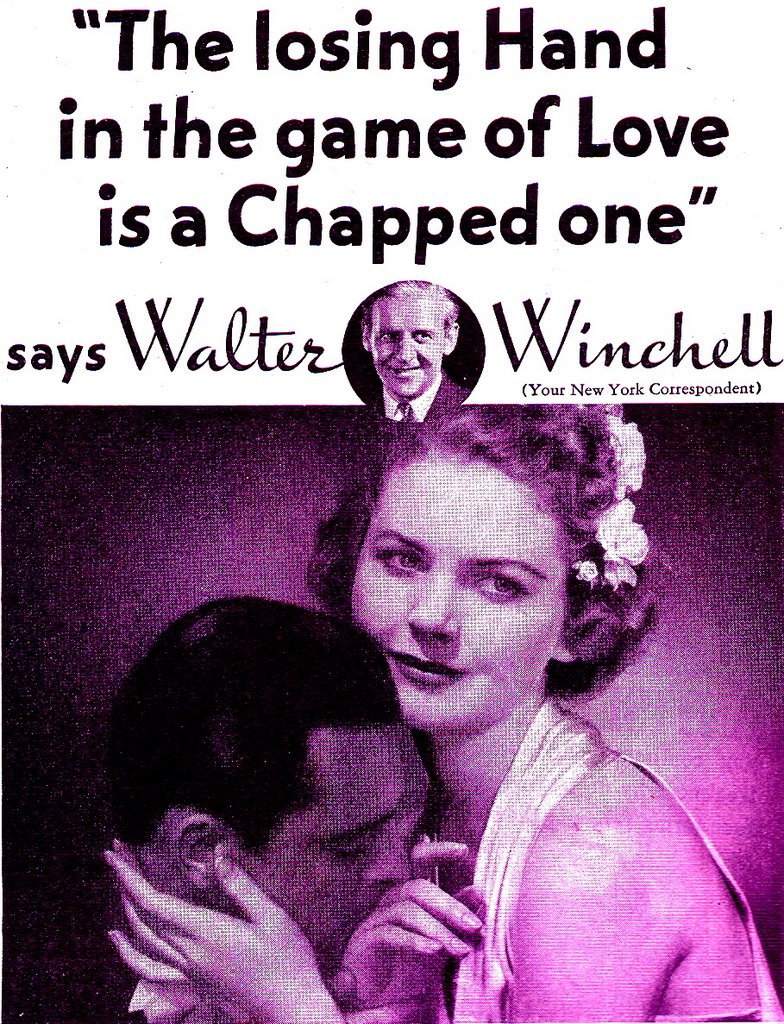
Clearly, bloggers are more forgiving of flawed spelling than of flowery speech, of which I spout enough to bar this metaphorical hothouse from becoming anything resembling a hotspot. How much easier was it for Walter Winchell, the high-school dropout who rags-to-enriched himself to become the most influential of all radio reporters during the 1930s and ’40s!

However dubious its reportorial integrity or merit, his program sure added some colorful blossoms to America’s garden-variety dictionary. In the 1930s, Winchell was ranked among the top contributors to American slang, whether or not he actually coined the saucy euphemism “making whoopie.”

“Good evening, Mr. and Mrs. North and South America and all the ships at sea—let’s go to press,” Winchell greeted listeners on this day, 27 March, in 1949, bombarding them with quick and random-fire newsflashes about a North Pole rescue and a deadly tornado, about Notre Dame University honors for actress Irene Dunne and trouble for Lois DeFee, “tallest of the striptease stars,” who had “just reported being robbed of all her gems.” Okay, considering that the Amazonian Ms. DeFee once tried to floor Americans by marrying a midget, such a flash was probably no more than another publicity shot.

Amid all that trivia, however, there were disturbing words. Not so much news, but signs of Winchell’s whole-hearted support for the McCarthy cause and his willingness to assist in turning the Soviet Union into an enemy fit to fill the spot left vacant after V-J Day.

Winchell talked of “changes in the soviet top command” and warned that Russia, having “put the big squeeze on Sweden,” was “getting ready for a military move of some kind.” He delighted in being denounced as a “radio liar” by Russian propagandists who labelled him the “pen gangster from the Hearst band.”

There sure was method in such red scare madness, which was as much a machination of the West as it was a menace from the East. Admiring the flowers of rhetoric, one must be prepared to step right into dung heap of history.

A Case for Ellery Who?: Detecting Prejudice and Paranoia in the Blogosphere

Well, only a few short hours ago I was writing about the constitutional freedoms that US citizens enjoy and the appeal American writers like Pulitzer Prize winner Marc Connelly made to 1940s radio listeners of the The Free Company (and “The Mole on Lincoln’s Cheek” in particular) to cherish and defend such liberties. I suppose that includes the freedom to sever one’s connections to anyone we realize to be incompatible or determine to be objectionable, regardless of any interests or passions we might otherwise share. Now, I don’t wish to make a Brokeback Mountain out of a molehill; but I have to confess that I am rather dismayed at the length one of my former readers went to in order to disassociate himself from my ramblings, sentiments he previously appreciated and endorsed. Allow me to expound.

I am always eager to read about and hear from others who, like me, are interested in early-to-mid 20th-century American popular culture; they need not be like me in other respects or feel themselves to be other, like me. Now that I am outside the academy and live somewhat remotely, I am thrilled to communicate with those who are drawn to the neglected yet fertile fields of silent movies, pre-code Hollywood, and old-time radio.

As may have become clear to the few who visit this site with some regularity, I am neither nostalgic nor flippant (or camp) in my approach to such marginalized topics. Nor am I an historian. The chief reason for keeping this journal is to share what I think matters to a few, regardless of how immaterial it may be to the many. Just who are these few, I sometimes wonder. And sometimes I get an answer that is disheartening if not, upon reflection, entirely uncommon.

Yesterday, I decided to add another online journal to my short list of links (see right). On said blog, I had left a comment about the sorry state of many old-time radio recordings, a remark that was kindly and publicly acknowledged, and received one in return regarding the career of actress Lurene Tuttle.

Pleased to have come across another old-time radiophile (I dislike lazy acronyms and refuse to stoop to letter combinations like OTR), I sent a message to the Tuttle expert, inviting him to be linked on my page. The response so startled me that I decided to drop today’s feature—much to my regret of disappointing an admirer of screen legend Kay Francis —and write instead about this sad case of blogophobia, the fear of being linked to and associated with someone as repulsive as myself.

I assure you, this is not a case of a bruised ego. I always assumed the most repellent aspect of broadcastellan to be its syntax and diction, its subject being merely inconsequential to most. It turns out, however, that the invitation was rejected as a direct response to . . . my blogroll.

According to the e-missive sent to me, one of the sites listed on the right is so offensive that said Tuttle-tale decided not only to refuse the link, but to erase the two comments I had left on his blog, even if doing so meant having to delete the posts to which they were attached—one of which journal entries having welcomed my “intelligent” remarks (about Vic and Sade) and greeting me as the first reader to leave a response. However obliging, I won’t go so far as to delete my essay about Ms. Tuttle in order to assist in this erasure, an obliterating not only of the former association but of the prejudice behind its severance.

What has this to do with Ellery Queen, apart from the double entendre intended? Well, even during the McCarthy era, in which small-mindedness reached its peak in the US, programs like The Adventures of Ellery Queen encouraged listeners to be open and embracing of those whose constitutionally protected beliefs, creeds, and pursuits of happiness differed from their own. Here, for instance, is the message attached to “One Diamond,” first heard on the Ellery Queen program on 6 May 1948:

This is Ellery Queen, saying goodnight ’till next week, and enlisting all Americans every night and every day in the fight against bad citizenship, bigotry, and discrimination—the crimes which are weakening America.

Should you find this message offensive and the people I chose to include in my blogroll abhorrent, I ask you—kindly but resolutely—to turn away and divest yourself of any associations with broadcastellan you might have sought or tolerated until now.

The Passing Parade: A Fat Tuesday Hangover

Perhaps I should not have been quite so surprised; nor pleased, for that matter. For twenty-four hours or so, broadcastellan ceased to be practically invisible—and it was all due to my tribute to video star Don Knotts. In an effort to be timely, for once, I dispatched the previous post before sunrise on Monday morning while those across the big pond still clung to what was left of their weekend. When next I checked for signs of life on this blog, I noticed a dramatic increase in the number of visitors, nearly three times as many as on an average day. Most of them found their way here through a topics exchange rather than the common traffic generators on which many e-diarists rely. Now, I won’t stoop to pinning my hopes of boosting my low voltage scribblings on the passing of aged celebrities with more or less marginal careers in old-time radio. Still, waking up to a Fat Tuesday hangover after this intoxicating surge in circulation, I decided that I’d rather give up cocktails than topicality for Lent.

Though it should not take an actor’s death to make others alive to a neglected dramatic medium, a revival of interest cannot take place if the world is dead to the subject you go on about. So, in effort to adhere to my own dictum, I must keep on trying to relate the presumably out-of-date to our present everyday. Not enough of this is being done elsewhere. As a result, radio drama is mostly appreciated as a font of nostalgia or camp.

In my current poll I ask, not for the first time, just why old-time radio drama does not enjoy the status granted to old movies. Even as video stores are slowly being replaced by online libraries, the shelves of the major DVD retailers are still stacked with copies of classic Hollywood films and, increasingly, not-so classy television fare. Saunter over to the CD section and try to find the radio plays of Norman Corwin. You might as well be browsing for recorded mating calls of the dodo, despite the fact that Corwin’s seminal works are the subject of one of the documentary shorts nominated for an Academy Award this year.

Sure, there is less demand for non-musical, non-visual dramatics; apparently, people would rather gawk at a giant squid on display than pay a few quid to take in a well-directed audio play; but, as we all know, demand is being created and kept alive through advertising, and old-time radio, with its uncertain copyrights and complicated commercial ties, has little chance at being thus promoted. Or is it just that much of radio ain’t any good?

As I am trying to push my own study on radio—and to push it forward—I am at times as disillusioned as the anti-hero of Frederic Wakeman’s best-selling novel The Hucksters (1946). “There’s no need to caricature radio,” he opined. “All you have to do is listen to it. Or if you were writing about it, you’d simply report with fidelity what goes on behind the scenes. It’d make a perfect farce.” I am going to refrain from scoffing, however; encouraged by the ongoing podcasting revolution, I defiantly if cautiously concur instead with Mr. Corwin, who, some sixty years ago, observed: “Seems Radio Is Here to Stay.”

Last Poll, First Quiz

Well, I said as much yesterday: I am neither a poet nor a psychoanalyst. Such self-awareness does not deter me, however, from getting myself into some metaphorical tangle while going on about old-time radio or from trying my interpretative skills at my last and, as always, altogether unscientific poll. Now, last things first.

In my fifth poll I had invited readers to close their eyes and wander off—an invitation perhaps too readily accepted. “What image,” I had asked, “appears foremost in your mind when you read the term ‘old-time radio’?” The replies were pretty much divided between two responses, just as had I expected.

There are those more likely to picture a radio set and those who imagine a microphone. To borrow some Brechtian terminology, the former look at radio as a “distribution apparatus, as a receiver that spouts out information and entertainment to be appreciated, taken in, disdained, derided, or ignored. Those who imagine a microphone seem to conceive of radio as a site of creation, consider the processes involved in the act of broadcasting.

In McLuhan’s terms, the former seem to look at the message, whereas the latter image forth the medium as a generator of that message. To imagine radio as a microphone suggests to me a willingness to participate and create, to look beyond the contraption (the “furniture that talks”) and toward conception instead; to investigate, question, or challenge the source of what is being received. In short, to imagine the wireless and see a box of wires seems to bespeak the triumph of eye over the ear, the sort of short-sighted literal-mindedness that is the product of visual culture and that ultimately contributed to the demise of radio as a creative force.

I’m not sure what to make of the reply “Nothing at all.” It may signal an indifference or a want of imagination. Yet it also suggests quite the opposite: a thoroughly radiogenic mind—one that does not resort to translating thoughts into pictures, one that conceives of ideas as being non-material, one to whom imagination is not imaged.

Now, onto the first quiz. Over the next few weeks, I am going to pay tribute to some of the dames, gals, and ladies of the airwaves, from the Lux beauties to the “First Lady of Suspense,” from the stars of the American stage to the girls-next-door who went over big on the small screen.

Radio was a stopover for many movie, stage, and television actresses; during the 1930s and ‘40s, it was a welcome source of supplemental income. In the early 1950s, with the emergence of syndication and magnetic transcription, it became a lucrative sideline for actors who appeared in dramatic series or hosted variety programs in order to promote a specific film or remain generally heard and spoken of by potential moviegoers.

Whenever I hear the voice of an actress like Sandra Bullock or Neve Campbell or Scarlett Johansson, I am disappointed at their lack of diction. Their mumbling is not realism; it is a want of craft. Screen actresses are no longer required to hold a tune while parading in glamorous gowns, dancing with Astaire, or leaping into a technicolored pool. Instead, they are expected to have their expressiveness botoxically erased and appear before us in unchanging sameness. Radio, which carried the threat of invisibility and disembodiment, forced actresses to explore the power and pull of their voices, to distinguish themselves in speech and song.

So, if you would like to participate and take the quiz, you may also want to leave your answer in the comments section, along with the name of your favorite actress of the 1930s, ’40s, or ’50s. Whether your answer is correct or not, I will feature your performer of choice—or her voice—in a future installment of this journal. Now, pardon me while I go in search of that lovely larynx, those thespians whose vocal chords ensnared and whose timbres did wonders for the voice box office.

Milestone Reflections; or, Who (Besides Me) Is Blogging about Old-Time Radio?

Well, this is my 100th entry into broadcastellan, a journal commenced, slowly and tentatively, one afternoon in May 2005, at which point in my life I decided to reintroduce myself to the world in the guise of “The Magnificent Montague.” Posting such a collection of essays over a period of eight months on matter I ventured to term (or perhaps mislabel) “unpopular culture” is not a particularly impressive achievement, to be sure, but one that might nonetheless serve as an occasion to sum up or, however uncharacteristic of me, look ahead.

Instead of going on about myself, however, I will lean against my soon to be toppled milestone to survey the so-called blogosphere in order to find out who else is blogging about these days. According to technorati, there has been at least one mention per day of the term “old-time radio” for the past thirty days. During three of those twenty-four hour periods, more than ten posts have been devoted to some aspect of this comprehensive subject. While not the most impressive display of interest, there sure are enough listeners out there to get a conversation going. Listening, to me, has always been an intimate experience. I much prefer headphones over loudspeakers, for instance, to take in the voices of comedy and the sounds of mystery.

Writing too, has long been a private matter, a momentary or prolonged exclusion of the world for the purpose of gathering thoughts and expressing ideas. While working on my dissertation, it took me years to compose something approaching a draft I felt confident enough to share. But now that writing and publishing happen almost simultaneously on the internet, I have become more eager to discuss and debate than to churn out a series of more or less engaging essays for the benefit of myself and the amusement of strangers.

Recent posts about old-time radio include the suggestion of listening to old mystery programs in the dark, reminiscences about a childhood enriched by the theater of the imagination, and an account of a first-time encounter with the Mercury Theatre‘s “The War of the Worlds.”

While other web journalists marvel at the dubious scientific advancement of breeding glow-in-the-dark pigs, this one describes the joy of taking The Great Gildersleeve, Jack Benny, Fred Allen, and The Shadow for an airing on his mobile phone, and this one provides a link to an internet tv channel featuring radio shows like The Saint. Someone else relates how pleased he was to have made a small investment in order to download recordings of programs like Inner Sanctum from the internet; and yet another confesses her love for the voice of Gale Gordon.

For the most part, these listening experiences are merely shared in passim rather than at any great length; but perhaps this is going to change as radio plays are becoming more readily accessible and more a part of everyday culture again. I sure hope so. In anticipation of such developments, I shall retreat to get some melodrama, comedy or variety streaming into my ears.

So, what’s on your iPod (or on whatever gadget you choose to catch up with old-time radio)?

Blogging Troubles and British Treats

I was all prepared to talk about today’s television and radio offerings in Britain, something I don’t often do. A new cable TV channel is being launched tomorrow: More4. Of chief interest to me, I have to admit, is that it will air Jon Stewart’s Daily Show, albeit yesterdaily. I’ve also been following this, the second season of the X Factor, which is the only British must-see for me this fall. I have commented on this improvement on American Idol (or Pop Idol) before in this journal. The at times tedious auditions are finally over and the contestants are going head to head each Saturday evening in live telecasts. I don’t have a favorite yet, other than judge and promoter Sharon Osborne. Last season, which I only caught midway (after moving here from the US), it was the wonderfully overwrought Rowetta who, it appears, has become somewhat of a queer icon.

What else was on yesterday? Well, there was Margaret Rutherford, again, on BBC 4, in the delightfully wacky high school farce The Happiest Days of Your Life. And then there was that atrocious documentary about Mae West last Friday on BBC 4 radio, part of a new series of talks celebrating Great Lives.

I have never heard a more off-the-mark impression of that glamorous dame, whose comic allure was so effectively evoked by the stage comedy Dirty Blonde.  The discussion about her conducted by the two supposed experts was tiresomely trite. I had hope for some clips from her films, or for a mention at least of Oboler’s “Adam and Eve” sketch, which got West banned from US radio. I mean, if you’re on radio, talk radio already!

I was prepared to expound on any of these viewing and listening experiences until I realized that many of my prior journal entries were littered with symbols and marks that rendered them, if not illegible, so at least highly unprofessional. It seems that my m-dashes—to which I am partial—are metastasizing into something ghastly once they are being left here for a few weeks.

How irksome this is to someone who knows little about html but makes an effort to adhering to the code of the standard English I cannot begin to express (I guess language fails me there, after all). I have made a few corrections, but some of the previous posts are still in shambles, I fear.

“We interrupt this broadcast”; or, How to Be Away

Well, as I’ve been casting it broadly in the previous three posts, I’m off on a weeklong visit to Madrid. Sure, I could have taken my laptop along with me to continue my journal while away; or I might have taken a mobile phone to send messages and images (like the one here, of this morning’s glorious Welsh sunrise) on the go. Instead, I decided to leave both computer and phone at home and to sign off for the duration.

The privilege of being away appears to be one of the disappearing pleasures of privacy. It is a concept no longer readily grasped by those born in the cellular, wireless, and instant-message age. Perhaps that is why the television series Lost has become such a success (surely it is not the writing): to be unavailable to the world is now thought of as a loss tantamount to being shipwrecked. Treat yourself to a retreat some time. Avail yourself of a chance at being unavailable.  Experience the abandon of abandoning your everyday.  To have something to write home about . . . and keep it.

You don’t have to get all Piano Manly about your getaway. Just tell those you care about that you’re out of town or country and enjoy the freedom of being incommunicado. Tell the world to get lost, then shroud yourself in silence.  As long as there is someone or something worth coming back for, eventually . . .