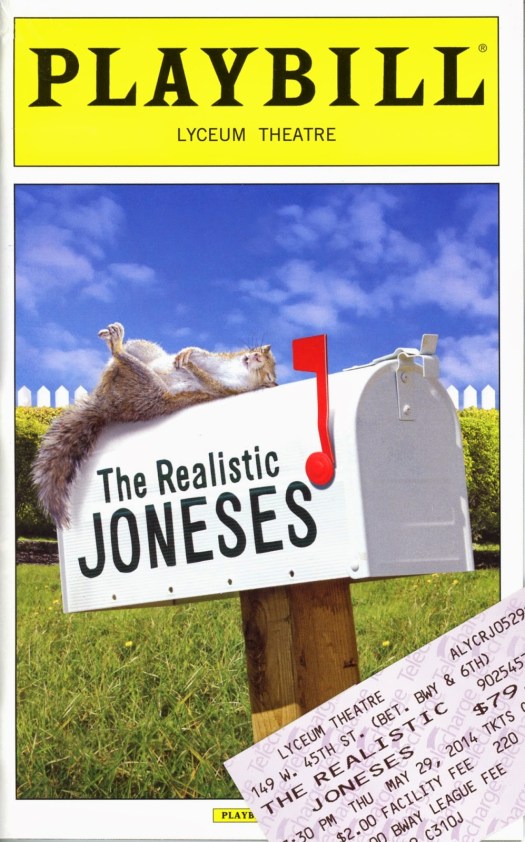
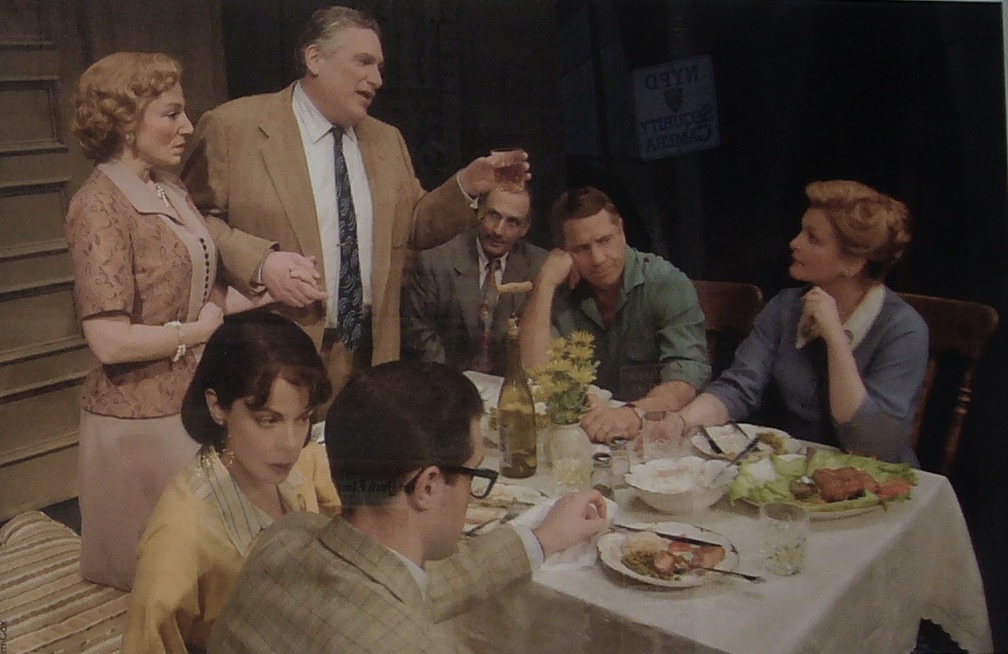
I don’t get it. No, I take that back. I didn’t get anything from it. No, that’s not it, either. I didn’t really like it is more like it, really. Will Eno’s The Realistic Joneses, I mean. It’s one of those plays that are nothing more than wordplay. The Joneses aren’t really Realistic. That much I got, and not much else.
The characters are just worders, if that’s the word for it. If it were a word. They are not word made flesh. I’m not sure whether they are mouthpieces because I’m not sure what they were meant to mouth, other than that we are mostly words to one another. Words that are no reliable access to thought or feeling, that are no substitute for flesh, for sensations and experiences.
A playwright who says as much as that – or as little – has got a real challenge. But that may be too charitable a word for a playwright’s “I’ve got nothing, really.”
The Realistic Joneses, to me, is a bad play. Even the wordplay isn’t that good. It is of a sitcom caliber, and the characters are a bunch of near flatlining oneliners. I mean, ‘Ice cream is a dish best served cold’? Seriously, is that bit of lame rhetoric – a cliché made obvious as a commonplace – a substitute for a plot twist? I didn’t feel the play was a moving comment on the increasingly disembodied state of twenty-first century humanity, much less a sensitive portrait of toxic malaise. I didn’t feel. That’s just it.
The Realistic Joneses is a play on the hollowness of words, and I don’t feel that that is a valid point to make in a play. Not any more. Not even for the middle-aged with a nostalgic yearning for some old-fashioned post-modern self-reflexivity. Well, post-modernism isn’t what it used to be because it just isn’t anymore. Or oughtn’t to be. The tongue has to come out of the cheek eventually, and it has to learn to speak again and say something other than, say, “What’s there to say?” Not just some piffle passing for the absurd. To me, surrealism isn’t anything goes nothing, at least not in the theater.
I walked out of the Lyceum Theatre thinking that I had just spent what amounts to a buck a minute on a rotten piece of ephemera – like that dead squirrel Tracy Letts picks up and throws into a trash bag, or the spoilt food Michael C. Hall takes out of the refrigerator – with little else but these few words of mine to show for it. If only that food had been served hot.
If only the squirrel had lived. If only. Or maybe not.
Once, as I recalled here before, I had the audacity to tell a well-known biographer, whose student I was, that I had no respect for writers of other people’s life stories. Unless content to be mere chroniclers, recording activities and recounting events, they are fabricators of interiorities that, I was—and am— convinced, are unknowable to anyone other than the single occupant of that interior. For all our confidences and intimations, we are ultimately unreadable to one another.
In order to turn life into story, biographers must impose a logic beyond chronology, a pattern to make unreason rhyme. They connect the dots on a timeline to create causal relationships designed to account for people’s behaviors and actions: because she couldn’t face her past, she couldn’t live with herself; because she lost her brother, she lost her trust in family; because he was in truth insecure, he became a make-believe gunslinger. Without being supplied with at least a hint of what we call “motivation,” we reject stories as lacking in psychological depth and moral complexity.
Back when I gave my professor a piece of my mind—proffered, mind you, with a smile—I thought of the biographer’s determination to make sense of other people’s existences as sheer hubris. Now, I am more inclined to look at biography as an act of desperation. Nothing is more disconcerting, more silencing and disabling, than the blank we have to call potentiality in order to face or overwrite and deface it. We cannot—will not—settle for zilch.
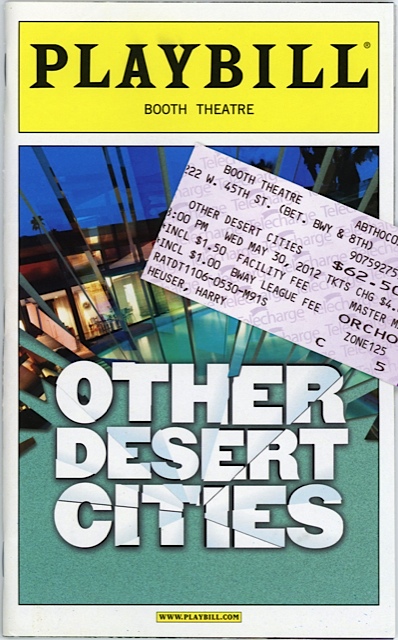
Secrets and duplicities, intimacy and detachment. Like all family dramas worth relating to, Jon Robin Baitz’s stage play Other Desert Cities measures the distance between folks who are biologically—and often physically—closest to each other: the flesh, the blood and the closeted skeletons of kinfolk.
Approaching Palm Springs (and Other Desert Cities)
Baitz’s American stage family, the Wyeths, could hardly be more traditional: a mother and father, married to one another, a daughter and son, offspring of that union. Then there is the dramatically expedient extension of that nucleus; in this case an alcoholic, don’t-give-a-damn aunt whom the audience looks at as a go-between, not only between characters but between those characters and ourselves. It is a well calculated constellation, this, as Other Desert Cities does not just explore relationships but the act of relating, of putting that relationship and all those relations into words, and of questioning the words and the unspoken.
Though most of us couldn’t live with Aunt Silda (Judith Light, in the Booth Theatre production), we love her for what we are encouraged to read as her forthrightness and free spirit. She, we assume, would be the person most likely to tell the true story of that family, as compromised as her memory and judgment might be after years of swilling the kind of spirits from which she is unable to free herself.
Hello Silda— The way I remember Palm Springs
After all, we cannot expect to get the inside dirt from her sister Polly (Stockard Channing), a staunch yet tarnished Republican who is terrified that her daughter Brooke (Elizabeth Marvel) has written a tell-all autobiography threatening to tear the façade right off the family’s sunny Californian home.
Yes, Silda tells it like it is. Criticized by her class-conscious sister of wearing knock-offs, she barks back:
Honey. News-flash: you’re not a Texan, you’re a Jew! We’re Jewish girls who lost their accents along the way, but for you that wasn’t enough, you had to become a goy, too. Talk about the real thing? Talk about ‘faking it.’ Honey, this Pucci is a lot more real than your Pat Buckley schtick.
As it turns out, neither Silda nor Polly are what we are led to believe them to be; and this is Brooke’s lesson, too, as she tries to piece together the life story of her lost brother, a left-wing radical whose act of terrorism forced Nancy Reagan pal Polly and her ex-Hollywood star husband Lyman (Stacey Keach) into retirement in the desert.
Desperate to figure out who or what made her brother Henry what the facts don’t quite tell her he was, Brooke turns from writing fiction to biography. Yet, in her attempt to expose the truth, she ends up with yet another version of the story rather than a definitive one. “She presents us as ghouls who drove [Henry] to become sort of a murderer,” her anguished, disconsolate father protests to his son (Thomas Sadoski), the “ADD riddled, junk-food-addicted porn surfing Trip Wyeth,” as Brooke calls him to his face.
“Christ, there’s something so vicious about what you’re doing here, Brooke, don’t you know that?” Lyman exclaims. Vicious and necessary, Other Desert Cities argues. And futile? As suggested by the closing scene, which may strike some as perfunctory or incongruously sentimental, Brooke’s ordeal—and the ordeal to which she put her family—has served a purpose.
What may seem like a coda or anticlimax I took as the point of the Baitz’s drama. As a biographer, Brooke has failed. She has been taken in, taken story for life and secrecy for guilt only to become complicit in her family’s cover-up. As an autobiographer, though, Brooke is to be envied. She has learned something about herself that she didn’t know before she came to investigate the lives of those around her. We may be unknowable to each other—but we can learn to know ourselves.
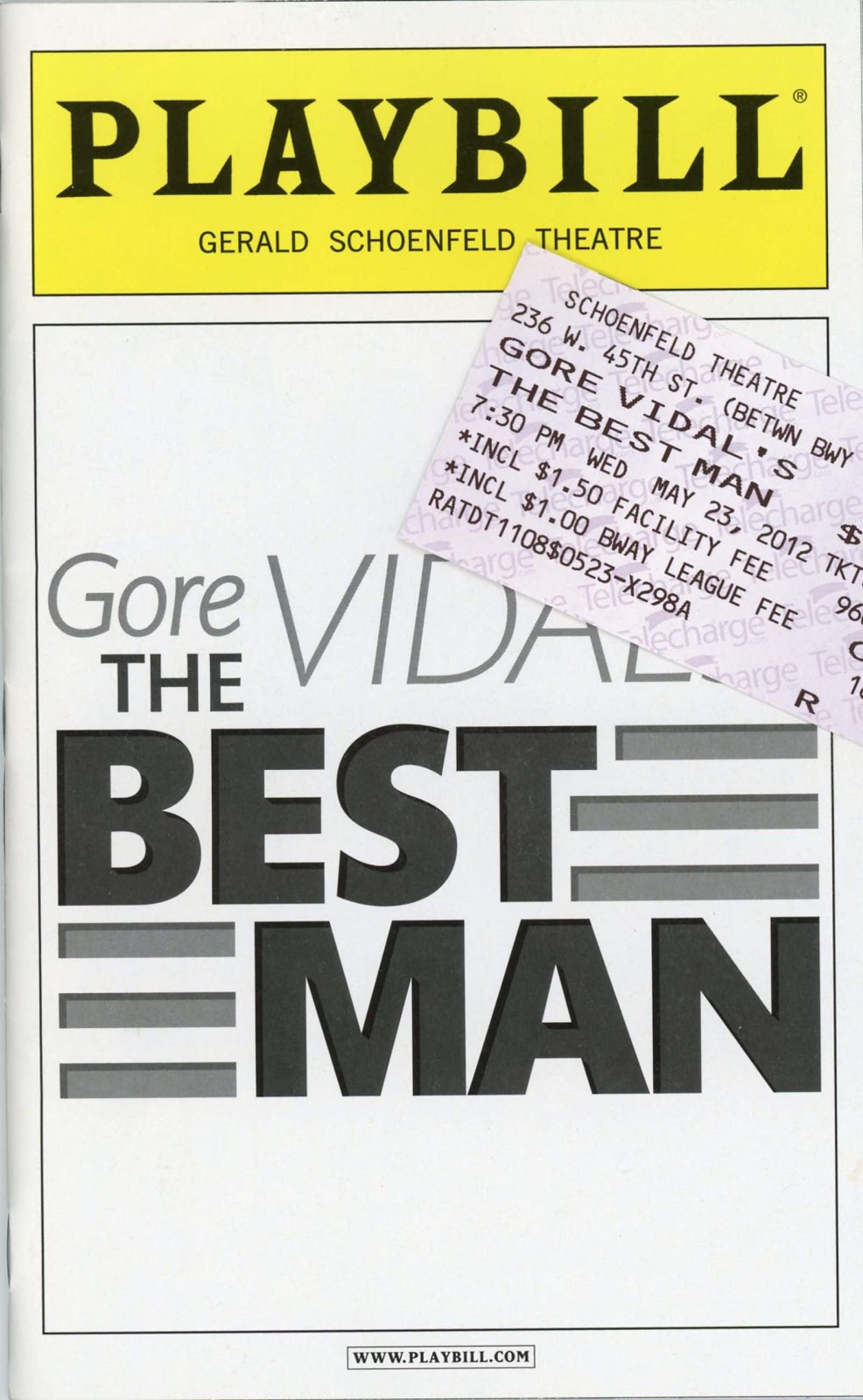
Anyone who has as much respect and appreciation for the niceties of the English language as Gore Vidal has will realize, if perhaps only after the final curtain has fallen on The Best Man, that the title is not simply ironic but prognostic: the best man, whoever he may be, cannot be declared if the fight and choice is between just two candidates. The ostensibly “better” one of them might win, but not, grammatically speaking, the “best.” Now, the man whom Vidal favors—and expects the audience of his political comedy The Best Man to root for in the play’s fictional contest for Presidential nomination—is not just a man of his word, he is a man who uses each word properly. The political banter is no mere wordplay: in The Best Man, grammar and morals are one.
Like any wit, Vidal’s central character, William Russell, takes language seriously. He is not beyond lecturing and flinging the grammar at anyone who doesn’t play by the rules of that book, a volume that the upright man carries in his head.
Russell, proper right down to that noun, is proud to have the last name of a noted philosopher; and, as a thinker, it strikes him as morally wrong to allow others to put words in his mouth. He would rather write his own speeches—“It’s a shameful business, speech by committee,” he declares—but has come to terms with the fact that his busy schedule dictates otherwise. What he will not brook, though, is ungrammatical speech. “Please tell the writers again that the word ‘alternative’ is always singular. There is only one alternative per situation.”
In the dramatic situation of The Best Man, “alternative” is clearly the wrong word, just as choosing the supposedly lesser evil is the wrong approach to casting votes. Like the dilemma of the two-party system, the either-or decision to which the unquestioning responder is restricted calls for something better: the rejection of the supposed choice as spurious and misleadingly restrictive.
“May the best man win!” is the choice platitude of Russell’s opponent, Joseph Cantwell, whose last name, more than the name of Russell, suggests that the playwright cares less about his characters than about the philosophies for which he makes them stand and fall: they are metaphors for what politics can reduce us to when all we care about is making a name for ourselves. Both Russell and Cantwell are stand-ins for the figures we imagine—hope and fear—politicians to be; beyond that, they aren’t at all. “A candidate should not mean but be,” the literary playwright has Russell quip; as a character, Russell is not meant to be anything other than the mouthpiece Vidal means him to be in this verbal play of true versus nominal values.
Asked whether he thought that “a president ought to ignore what people want,” Russell replies “If the people want the wrong thing, [. . .] then I think a president should ignore their opinion and try to convince them that his way is the right way.” How to do right and what is “right” are the questions The Best Man aims at encouraging us to ponder. Russell answers by taking his opponent by his clichéd expression and extricating himself from the either-or bind that threatens to turn him into a man no better than Cantwell.
Vidal, too, attempts a way out here, a synthesis of satire and sentimentality, cynicism and hopefulness, as he demonstrates Russell to be the “best” man, after all, by proving him to be the better one. The solution is as noble as it is grammatical—but it is rather too neat and ponderous, especially since the alternative “message” Vidal communicates is more tired than the dirty politics from which he derives a modicum of dramatic tension.
“And if I may bore you with one of my little sermons,” Russell and Vidal tell reporters and audiences early on:
Life is not a popularity contest; neither is politics. The important thing for any government is educating the people about issues, not following the ups and downs of popular opinion.
Who, today, would buy that little nugget of shopworn sentiment?
Few, no doubt, even bother, as they are more likely to have come to sample the wares on display in the latest Broadway production at the Gerald Schoenfeld Theatre. The cast is headed by two sentimental favorites—Angela Lansbury and James Earl Jones—whose presence, however lively, takes some of the bite out of the 1960 play, which now provokes nothing more effectively than nostalgia: a longing for politics that never were. Like politics, the business of staging a show is too much of a “popularity contest” to rely on a playwright’s words to win us over. Reading the script now without seeing the assembled personalities—Candice Bergen, John Larroquette, Eric McCormack—before me on that evening in May, I can better appreciate Vidal’s best lines—but, as a play, The Best Man remains ultimately unconvincing.
Sizing up his competition, Victorian novelist Anthony Trollope once interrupted one of his narratives by attempting witty remarks about Thomas Carlyle and Charles Dickens, labeling the latter “Mr. Popular Sentiment” and the former “Dr. Pessimist Anticant.” With his showdown between “Popular” Cantwell and “Anticant” Russell, Vidal demonstrates that wanting to be both satirical and sentimental means doing justice to neither; the sentiment feels calculated, the wit pointless. In the noble experiment of making dirty politics cleaner, everything comes out rather muddy in the wash.
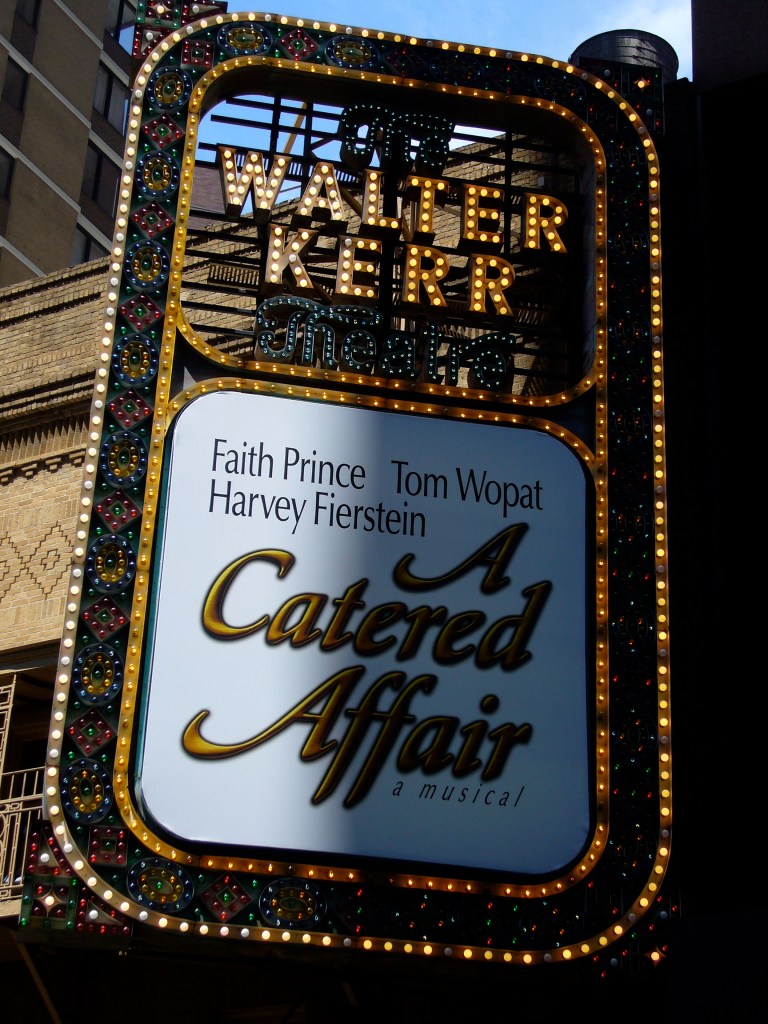
There was a sheet of paper pinned to each seat at the aforementioned Walter Kerr Theatre, asking patrons whether or not they had liked the current production and whether they would recommend the show. Now, I did not hand in my questionnaire. Who am I to caution theatergoers about a musical with such a wonderfully gifted group of players: Harvey Fierstein, who also wrote the libretto, Tom Wopat, whom I had previously seen, defenses way down, in Annie Get Your Gun, and the glorious Faith Prince (last featured here on the cover of the playbill for Bells Are Ringing)? Obviously, enough people had come to the Walter Kerr on that Tuesday evening in early June to relegate me, chancing it by getting a last-minute ticket at TKTS, to a seat way in the back.
Now, this might be all right when the stage is filled with a line of chorus girls making their way down a giant staircase, a set boasting an enormous showboat or an oil painting coming to life (as in the revival of Sunday in the Park with George I would see a few weeks later); but A Catered Affair is not that kind of a razzle-dazzler. It is a modest, earnest musical play; it examines characters rather than providing an opportunity for a series of show tunes. Modesty is its quiet strength, but, sitting in the back row, it still feels an awful lot like weakness.
I regret to report, however belatedly, that I did not warm to A Catered Affair, and not because its thin story felt somewhat warmed up. Sure, it is based on a 1955 television play by Paddy Chayefsky, himself not exactly a hot property these days; but then, most of today’s Broadway offerings are recycled.
A promotional close-up supplied by the theater to passers-by with a view no audience member would enjoy
No, it wasn’t that. I was simply too far removed from the hearth—even further than Uncle Winston, the sidekick Fierstein insisted on turning what, back in the 1950s, could only be an outsider. I appreciated him being there, as a reminder that homosexuals where always in the picture, even when they were kept well outside the frame of the camera. Unfortunately, Winston’s moment in the limelight is “Coney Island,” a dreadfully cliché-laden number in which he advises us to keep our eyes open as we ride the rollercoaster of life.
I had been told about the old stove, and that Ms. Prince actually prepared scrambled eggs during the scene. And that is a recommendation? Well, hand me a frying pan and start selling tickets! It rather reminded me of Gertrude Berg, who insisted on realism, and real eggs, even though The Goldbergs was a radio program. Yes, eggs were being prepared on the stage of the Walter Kerr that night, but, unable to smell the, that did nothing to whet my appetite. An intimate play deserves an intimate theater, especially a play that depends on character far more than on plot, of which there is little, and that anticlimactic.
Indeed, A Catered Affair would have made a fine radio musical, if something like that were ever to be reintroduced into American culture. This is not to say that it is cheap or second-rate. It just means that it does not require visuals for its staging of a family in crisis, a particular brand of problem play you might call Miller Light, even though Rheingold or Schlitz were more likely to be found in the family icebox.
The Walter Kerr was once a radio studio; back in the late 1930s, the playbill informed me, Alexander Woollcott broadcast from here. I would have enjoyed closing my eyes and listening to Ms. Prince, who wowed me many years ago as Adelaide and who keeps delighting me whenever I play selections from the Guys and Dolls cast album. Having kept my eyes peeled on a faraway stage with little to see (not even the event promised in the title), I did not recall a single tune upon exiting the theater shortly before 9 PM, after 90 minutes of intermission-free drabness.
Broadway does Family Tuesdays now, for the discerning “family,” however defined, that can afford to spend money on the less-than-spectacular.
Unlike the previously discussed play Deuce, this one came highly recommended: Tonys darling Spring Awakening (music by Duncan Sheik; book and lyrics by Steven Sater), with which I caught up during the week leading up to Broadway’s annual awards ceremony. It has been touted as the new Show Boat, the spectacle with a story that revolutionized musical theater back in 1927 (and revived on radio as a musical, a straight play, a musical serial, and a number of burlesques). “Old Man River,” take me now! I realize that I am filing a minority report here; but if this is the new face of Broadway, I just got to slap it.
For starters, that new face is partially obscured by hand-held microphones, props that, along with an audience seated onstage and a blackboard listing the tunes, are meant to suggest, in the by now tiresome postmodern mode of self-reflexivity, that what you see and get is only “Make Believe”—an Epic theatrical in the Brechtian vein designed to be stimulating rather than absorbing. Verfremdung, Broadway style, means to play out whatever is left of a story like a rock concert; that is, by playing to the audience rather than interacting with one’s fellow players.
Spring Awakening is not so much an adaptation of Franz Wedekind’s drama of youth, longing, and disillusionment as it is an assortment of clichés about hormonally-induced teenage Sturm and Drang. This high-Rent production (which won’t break even at the box office any time soon) may well appeal to youngsters who don’t know any better or refuse to listen, and to their parents who assume this noisy spectacle to be happening since it has an energetic and gifted cast that emotes in foul language and jumps up and down a lot, as if out to bring in ‘da punk. In its treatment of sexuality beyond the old boy-impregnates-girl-and-both-pay-for-it formula, however, the show betrays its conservative agenda, acknowledging the reality of alternative stirrings only in the form of comic relief.
Choreographed like an old Britney Spears number and outfitted in costumes left over from a touring production of Ah, Wilderness!, Spring Awakening revels in an identity crisis equal to that suffered by an acne-troubled, media-beleaguered high schooler set to pass out at a Goth concert—and it is just about as cheerful and endearing. “Mis’ry’s Comin’ Aroun’,” showtune lovers.
Well, I had been given ample warning. About Deuce, I mean, the Terrence McNally play starring American Theater Hall of Famers Angela Lansbury and Marian Seldes. Reviewers and friends uniformly panned it. Not content to take their word for it, I set out to see for myself, only to confirm that Deuce truly is an insipid trifle of a play, a plotless, actionless one-acter whose greatest offense is its squandering of talent: two captivating leads let down by a leaden script and reduced to longshots by an extravagant set on the large stage of Broadway’s Music Box theater.
That set—the impersonal space of a tennis stadium filled with electronically simulated spectators (or spectres)—echoes and amplifies the hollowness of the production, but appears to have been designed (by Peter J. Davison) to give audiences certain to tire something to look at or look out for—as if Lansbury and her accomplished co-star weren’t reason enough to head out for the theater. They aren’t, if onlookers cannot zoom in on and get close to these two, as is warranted and promised by the potentially intriguing premise, the opportunity to eavesdrop on a private exchange between two celebrities dragged out of retirement and forcefully reunited for a belated tribute.
Their talk, however ably delivered, is devoid of anything amounting to revelations. They are long-ignored and finally acknowledged tennis legends who (surprise!) happen to be real women with long personal histories and strong opinions—opinions shared in lines so insipid that the playwright felt obliged to spice them up with profanities in hopes of getting spectators to stir, gasp and guffaw at expressions supposedly too vulgar to escape the mouths of our venerable elders.
You know you are faced with a dramatic dud when you open the Playbill to discover that even leading lady Lansbury struggles to give it to you in a nutshell too rotten to contain much good: “The play is about age—about becoming old and not being in the mainstream in the world of tennis today.” Who is the target audience? Martina Navratilova? Then again, it is also a “metaphor for age and the problem that women have with old age.” Like finding good parts, I suppose.
The gimmick of the play (and it is little more than that) is the juxtaposition of the real women behind the legend with the shallowness and vanity of the television sportscasters prattling overhead like a pair of false gods, a vapid chat (reminiscent of the characters created, to far better effect, by Christopher Guest in mockumentaries like Best in Show and For Your Consideration) in contrast to which the play offers next to nothing.
Deuce might be better served on radio, which is the ideal medium for intimate talk and character studies. Radio plays do not suffer from a lack of action or circular construction, from being anecdotal and fragmentary. Radio theater, which does not lose sight of its actors on enormous sets, is well suited to the conveying of an impression (a sense of dread, say) or the imparting of an idea. On the stage that sort of thing or nothingness is a deucedly bad one.
Now, I don’t care whether I’ll ever get to see another play by Mr. McNally (who’s rather more amusing, if similarly trifling Love! Valour! Compassion!, starring Nathan Lane, I saw back in 1995). I do mind, however, that this might have been my last chance to see Ms. Lansbury on the stage. As a swansong, Deuce is tantamount to Trog.
Some fifty years prior to her nonetheless Tony award nominated performance in Deuce, Lansbury played a retired stage actress on radio’s “outstanding theater of thrills,” Suspense,” in a melodrama titled “A Thing of Beauty” (29 May 1947). A woman willing to kill for a good part or to forge an alliance with someone she does not respect, she ends up having, quite literally, lost face. Now, there’s a metaphor!
Yesterday’s gloomy afternoon gave way to a splendidly sinister evening at the theater. The play was J. B. Priestley’s An Inspector Calls, which I had previously seen back in 1995, with 80’s heartthrob Maxwell Caulfield in his Broadway debut. In that production, the set pretty much upset the text—a huge, dark house confronting the audience from behind a curtain of rain. It was an impressive spectacle calculated, it seemed, to veil or countermand Priestley’s directives, the stark simplicity and artifice of his didactic play. Yet, as I realized last night, watching a touring Clwyd Theatr Cymru production directed by Barry Kyle, An Inspector Calls loudest when the lines are clear and the stage bare.
I had prepared for the evening by reviewing the 1934 film adaptation of Priestley’s Dangerous Corner, starring Virginia Bruce and Melvyn Douglas. The movie struggles to open Priestley’s play to the demands of a dynamic camera. The cinema audience wants, or is at any rate accustomed to, something other talking heads and sedentary bodies. Even Martyn Bainbridge’s design, while effectively sparse compared to the melodramatic Broadway treatment of An Inspector Calls, at times displayed a doubt in the sufficiency of Priestley’s script by underscoring his words with visuals, turning walls into movie screens and tilting the stage to demonstrate the downfall of a supercilious and self-centered family.
Do we need images to get the picture? The theater of ideas is best accommodated by radio, a non-visual medium that forces our mind to focus on the spoken word and telling silences. Back in the early 1930s, Priestley may not have been convinced of this. After all, Dangerous Corner is a rather scathing commentary on the wireless as a soundcarpet under which the unspoken and unspeakable can be swept: the receiver has to break down to crack the surface of idle chatter among the civilized yet rotten.
In An Inspector Calls, which reworks the central idea of the earlier play, the part of the radio is performed by a telephone that rings to shut up a group of culpable and contemptible individuals talking themselves back into a state of calm. Unreliable or intrusive, both means of telecommunication are called upon to penetrate the walls of bourgeois conventions, obliging those standing apart to connect and disclose what has been carefully concealed from others.
Priestley could and did rely upon the wireless to spread the word and to popularize his ideas. His novels and plays were often heard on American and British radio during the 1930s and ‘40s, among them adaptations of Angel Pavement and Laburnum Grove, as well as the two works discussed here. The author-dramatist even made an appearance on Rudy Vallee’s show, as I read in a September 1939 issue of the Radio Times, and agreed to let the BBC serialize one of his novels prior to publication, with its author reading the first installment.
While expressing his reservations about the experiment and its effect on book sales, Priestley nonetheless decided to reach out to the populace he was eager to unite. Perhaps, some six years prior to the completion of An Inspector Calls, he had already gotten the call from his inquisitive messenger. It is a call that still resonates strongly today, not so much as socialist propaganda, but as an appeal to think beyond economics, beyond present self-interest, for the sake of turning a Dangerous Corner in the path of the planet we share.
Well, there I was this afternoon, walking Montague, our terrier, and picking sloes along the lane near our house halfway up in the Welsh hills. I was walking him in order to get to the sloes, truth be told. Unlike Montague, though, the sloes won’t be seen again until Christmas, as I learned, much to my dismay, after having spent half an hour pricking them. I had heard of a Sloe Gin some time ago; but I always assumed it to be spelled “slow” and work as fast as the regular kind. Now I know that my ear hadn’t led me altogether astray, considering that it will take so long to appreciate this potent concoction. At any rate, a predilection for booze is something I share with that celebrated Broadway dame known as The Drowsy Chaperone, who may currently be seen failing her charge in the Tony Award-winning “Musical Within a Comedy” of the same name, a show that reminded me of my love not only for stiff drinks but old-fashioned radio drama.
I might not have learned about The Drowsy Chaperone had it not been for some of my New York City pals, some of whom work in the theater. Now, Broadway isn’t exactly “My Beat.” As much as I enjoy “How Do You Solve a Problem Like Maria?” (a West End Sound of Music audition-turned-TV reality show starring Andrew Lloyd Webber presently unfolding on BBC television), I am rather selective in my choice of musical treats. I would not be caught dead watching Cats, to be sure, and have refused to attend a performance of Phantom even when a close friend of mine was one of its featured actors on Broadway.
A few years ago, I enjoyed Drowsy Chaperone‘s leading lady Sutton Foster in a revival of Thoroughly Modern Millie, and her presence, as long as it does not remind me of Leslie Caron (as indeed it sometimes does), suffices to make me shell out some $75, the highest price I have yet paid for a TKTS ticket, to see a show that is an amusing trifle rather than a certified classic.
Now, on that particular night (the date of which you may glean from the ticket displayed above), Ms. Foster was rather subdued and lackluster. Too bad, considering that her “Show Off” routine is the smartest number in the whole production, which opens with Mary Tyler Moore alumna Gloria Engel going on about her “Fancy Dress,” a tune that is insipid rather than comically inspired. Worse still, the eponymous character (the Drowsy one) was played by an understudy, as that dreaded white slip in my Playbill informed me. Understudy, in this case, meant second best. Luckily, the same was not true for the whole production.
There is a self-reflexivity about The Drowsy Chaperone that is so subtle and commercially slick as to render this musical comedy charming rather than clever. In fact, the play struck me as decidedly dumb—in a manner that ingratiates instead of irritates. The smartest thing about it all is the opening of the play and its concept. After all, The Drowsy Chaperone begins in utter darkness, with the voice of a middle-aged Broadway aficionado (who, traditionally, does not speak in a booming baritone) telling you about the costly experience of going to the theater these days before sharing a record (vinyl, no less) from his collection of show tunes.
One of those forgotten gems is The Drowsy Chaperone, the forgotten (and entirely fictional) 1929 musical our host (the “Man in a Chair”) has never seen but imagined often enough sitting in front of his outmoded home entertainment system and listening to an old and not altogether groove-proof record in his rundown New York City apartment. As he tells the audience about the show, the impressions made by the recording come to life and The Drowsy Chaperone materializes before us as it presumably might come alive in our MC’s mind. Of course, for seventy-five bucks or more, we demand to see our theater. Most of us go to a Broadway show for sheer dazzle, not dialectics. We rely on Off-off Broadway for the subversive and provocative—and the clear demarcation makes it easy for most to avoid such intellectual challenges.
And yet, nothing I saw onstage quite matched the excitement or warranted the enthusiasm of that middle-aged man (wonderfully portrayed by Bob Martin), an unassuming cardigan-clad homebody whose visions, no doubt, were more potent than anything devised by the set designers of this show. I wonder how theatregoers might have reacted had the scene been cast in darkness for the entire eighty-odd minutes (a short enough time for a Broadway play). They might have concurred with the guy.
Aside from “Show Off,” “Accident Waiting to Happen” and the surprising “Message from a Nightingale,” The Drowsy Chaperone wasn’t all that much to look at. Then again, who would pay this much for a single radio play? The eyes had it, as usual—but they did not quite have their fill . . .
Well, I am on my way to London in a few hours, even though I have barely recovered from my trip to New York City, a souvenir of which is a lingering cold. Still, I am looking forward to a weekend in the metropolis, where I’ll be reunited with my best pal to celebrate his birthday and the twentieth anniversary of our friendship. We used to have our annual get-togethers in the Big Apple, but the Big Smoke will do.
While there, I would love for us to take in a few shows, impervious as he is to the wonders of the “wooden O.” I, for one, have had some terrific theatrical experiences lately, including a rare staging of the outrageously bloody Revenger’s Tragedy at New York City’s Red Bull Theater, an all-male production of The Winter’s Tale by the touring Propeller company, and an out-of-tuneful Broadway evening with Judy Kaye in Souvenir.
True, the 9 December issue of Entertainment Weekly did not exactly endorse Souvenir, reviewer Thom Geier calling Stephen Temperley’s play “too broad, too shallow, and far too long for [its] modest pleasures.” Still, Kaye is marvellous in the role of Florence Foster Jenkins, the tone-deaf soprano and unlikely recording artist who managed to fill seats and thrill audiences in NYC’s Carnegie Hall, unaware that many came to gawk and deride, not to admire her.
I have seen musical-comedienne Kaye several times onstage and even had an after-theater drink with her, back in November 1992, when she played Sweeney Todd‘s Mrs. Lovett at the Paper Mill Playhouse in New Jersey. Her portrayal of the real-life phenomenon that was Florence Foster Jenkins managed at once to amuse and touch me, even though Souvenir, as written by Temperley, is slight, repetitive, and less than incisive.
You’ll have to get up close and zoom in on Kaye’s features—the snare and shelter of Jenkins’s oblivion expressing itself in innocent smiles and youthful exuberance, the firm belief in her musical disabilities as she refuses to heed the at fist cautioning then caustic words from her hapless accompanist, and the terror of recognition when at last she discerns the cruel laughter of the crowd—to wrest any oomphs from Temperley’s pleasant and chuckles-filled survey of the dubious diva’s odd career. Fortunately, I sat in the third row. Anyone back on the balcony is unlikely to get half as much out of this play, which is suited to a smaller venue than Broadway’s grand Lyceum.
Upon returning to the UK, I learned that another dramatization of Jenkins’s life, conceived by another playwright (Peter Quilter), is currently playing in London. Called Glorious, this version stars Maureen Lipman, whom I have last seen opposite Ian McKellen in the pantomime Aladdin at the Old Vic. Ms. Lipman hasn’t got Kaye’s pipes, but her acting garnered some favorable notices. I am sufficiently intrigued by Jenkins’s antics to judge her performance myself later this year.
How come there are two plays running simultaneously about a 1930s New York City curiosity, a novelty act who, like those making a spectacle of themselves during last year’s American Idol auditions, has become an old joke few can recall? It is encouraging, somehow. Ready to rediscover most anything, the public might yet turn a favourable ear to the golden age of radio. I sure wouldn’t mind having someone to talk to . . .
Well, Broadway is no longer the stuff of romance; having cleaned up its act in the dull spirit of corporate greed, it no longer is the “gaudiest, the most violent, the lonesomest mile in the world,” as it was once eulogized in hard-boiled and slightly over-cooked prose on the US radio thriller series Broadway Is My Beat (1949-54). Still, since I am returning to the Big Apple next month, having just booked my flight, I am going to rekindle my own romance with Manhattan by following Detective Danny Clover on his beat somewhere between or around Times Square and Columbus Circle.
On this day, 14 October, in 1953, Clover walked once again past “the hawkers, the gawkers, the ‘hurry up’ boys and the ‘slow down’ girls” to find himself confronted with some suitably sordid business of jealousy and murder—the “Cora Lee” case.
It’s “party time” on East 63rd. The shrill laughter of a drunken woman and the breaking of glass tells us at once that this ain’t a black tie affair. College graduate Cora Lee is in hot water; anyway, her head’s in a tub filled with it. The young woman very nearly drowned, and the bruise on her head suggests that she didn’t take the dive on her own free will. Now, the woman who reported the incident resents being thought of as a suspect. “You’re a stinker,” she tells Clover’s assistant. “And that’s the word I use in mixed company.” Cora comes to, eventually; but everyone around her, including her husband and her father, is too drunk to be of any use to her or the police.
A few days later, the “wild dame” celebrates her recovery with a few drinks in the company of husband and friends, party people who keep living it up while Cora is stretched out dead on the floor with a knife in her heart. Good-natured bunch, ain’t it?
“I was in college with Cora,” one of the drunken guests, a gal with feathers in her hair, tells Clover without a hint of compassion. “I knew her for two weeks, and I said to myself: there’s a classmate who’ll never see thirty. One way or another, she’ll never make it.” The deceased, she claims, was “the most, jealous, vicious, detestable, beautiful girl in the class of 1950.” Who might have killed her? Well, “anyone with a knife,” she sneers, especially the young woman who is so eager now to take Cora’s place as hostess of the merry gathering, offering highballs and sandwiches to the detective while threatening to do “damage” with her “high heel” if the feathered one doesn’t keep her mouth shut.
With all that talk going on, there isn’t time left to weave much of a mystery; but the thrill of listening to realist crime dramas like Gangbusters, Dragnet, or Twenty-first Precinct is not generated by suspense or surprise anyway. The criminal, whoever it happens to be, will in all likelihood be apprehended somehow. The excitement lies in going along for the ride, in the privilege of being in the presence of criminal elements, of witnessing the tawdry and treacherous, the vile and violent from a comforting distance.
With a dash of purple prose and a helping of humor, Broadway Is My Beat is as gaudy and violent as the formerly “lonesomest” mile it evokes in word and sound. As white as the Great White Way is nowadays, you just won’t get that kind of kick out of strolling past the Olive Garden or watching the out-of-towners going around on the Toys “R” Us ferris wheel. Let Detective Clover take you on a tour . . .



 Unlike the previously discussed play Deuce, this one came highly recommended: Tonys darling Spring Awakening (music by Duncan Sheik; book and lyrics by Steven Sater), with which I caught up during the week leading up to Broadway’s annual awards ceremony. It has been touted as the new Show Boat, the spectacle with a story that revolutionized musical theater back in 1927 (and revived on radio as a musical, a straight play, a musical serial, and a number of burlesques). “Old Man River,” take me now! I realize that I am filing a minority report here; but if this is the new face of Broadway, I just got to slap it.
 Yesterday’s gloomy afternoon gave way to a splendidly sinister evening at the theater. The play was J. B. Priestley’s An Inspector Calls, which I had previously seen back in 1995, with 80’s heartthrob Maxwell Caulfield in his Broadway debut. In that production, the set pretty much upset the text—a huge, dark house confronting the audience from behind a curtain of rain. It was an impressive spectacle calculated, it seemed, to veil or countermand Priestley’s directives, the stark simplicity and artifice of his didactic play. Yet, as I realized last night, watching a touring
  Well, there I was this afternoon, walking Montague, our terrier, and picking sloes along the lane near our house halfway up in the Welsh hills. I was walking him in order to get to the sloes, truth be told. Unlike Montague, though, the sloes won’t be seen again until Christmas, as I learned, much to my dismay, after having spent half an hour pricking them. I had heard of a Sloe Gin some time ago; but I always assumed it to be spelled “slow” and work as fast as the regular kind. Now I know that my ear hadn’t led me altogether astray, considering that it will take so long to appreciate this potent concoction. At any rate, a predilection for booze is something I share with that celebrated Broadway dame known as The Drowsy Chaperone, who may currently be seen failing her charge in the Tony Award-winning “Musical Within a Comedy” of the same name, a show that reminded me of my love not only for stiff drinks but old-fashioned radio drama.
 Well, I am on my way to London in a few hours, even though I have barely recovered from my trip to New York City, a souvenir of which is a lingering cold. Still, I am looking forward to a weekend in the metropolis, where I’ll be reunited with my best pal to celebrate his birthday and the twentieth anniversary of our friendship. We used to have our annual get-togethers in the Big Apple, but the Big Smoke will do.
 Well, Broadway is no longer the stuff of romance; having cleaned up its act in the dull spirit of corporate greed, it no longer is the “gaudiest, the most violent, the lonesomest mile in the world,” as it was once eulogized in hard-boiled and slightly over-cooked prose on the US radio thriller series Broadway Is My Beat (1949-54). Still, since I am returning to the Big Apple next month, having just booked my flight, I am going to rekindle my own romance with Manhattan by following Detective Danny Clover on his beat somewhere between or around Times Square and Columbus Circle.
 Harry Heuser