
 I’ve had quite a few “silent nights” here at broadcastellan lately (to use an old broadcasting term); and yet, I have been preparing all along for the weeks and months to come, those dark and cheerless days of mid-winter when keeping up with the out-of-date can be a real comfort. Not that the conditions here in our cottage have been altogether favorable to such pursuits, given that we had to deal with a number of blackouts and five days without heating oil, during which the “room temperature” (a phrase stricken from my active vocabulary henceforth) dropped below 40F. Not even a swig of brandy to warm me. I have given up swigging for whatever duration I deem fit after imbibing rather too copiously during the New Year’s Eve celebrations down in Bristol.
Those are not the blanks (let alone the ones in my short-term memory) that I intend to fill here. The gaps in question are in my iTunes library, which currently contains some 17500 files ranging from the recent BBC adaptation of Anthony Trollope’s Orley Farm to World War I recordings. The vast majority of these files are American radio programs. They are readily gathered these days; but the work involved in cataloguing them for ready retrieval can be problematic and time consuming. For now, I am not lacking time; at least not until our long planned and much delayed move into town, real estate crisis be damned. Anyway . . .
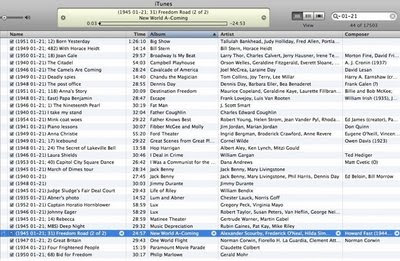
For the past few weeks, I have been filling in each of the fields as shown above, verifying dates, checking the names of performers, comparing the sound quality of duplicate files, and researching the source materials for adaptations. It took a while to arrive at a convenient system. When I started the project anew (after the crash of an earlier Mac), I made the mistake of entering the date after the title of the broadcast (entries in lower case denoting descriptive ones).
As a result, I could not readily listen to a serial in the order in which its chapters were presented. I would have been at a loss to follow and follow up today’s installment of Chandu the Magician (1949), as if having missing out on the chance of getting my hands on Chandu’s “Assyrian money-changer” by sending in a White King toilet soap box top sixty years ago were not difficult enough to bear.
The effort should pay off, though, as it allows me to select more carefully the programs worth my time. On this day, 21 January, the highlights, to me, are the second part of “Freedom Road” (1945), a dramatization of Howard Fast’s historical novel about the post-Civil War era (currently in my online library); Norman Corwin’s examination of life in post-World War II Britain on the previously discussed One World Flight (1947), a documentary featuring an introduction by Fiorello La Guardia and a brief commentary by author-playwright-broadcaster J. B. Priestley pop-psychologizing the causes of human conflict; and the aforementioned debut of The Fat Man (1946). Not that I’d turn a deaf ear to Ingrid Bergman in Anna Christie as produced by the Ford Theater (1949) or to the Campbell Playhouse presentation of A. J. Cronin’s Citadel (1940).
And then there is another address by Father Coughlin (1940), about whose Shrine a fellow web-journalist sporting Canary Feathers in his cap had much to say recently in his personal reminiscence.
Listing, though, is to me almost always less satisfying than listening; it is also far less difficult and engaging. Listening often results in research, in comparing adaptation to source, in reading up on the performers, or in finding contemporary reviews. About the 21 January 1946 premiere of I Deal in Crime, for instance, broadcast critic Jack Gould complained that it “creeps along at a snail’s pace” and that Ted Hediger’s monologue-crowded narrative style was “not helped” by William Gargan’s “rather lackadaisical” delivery.
While he did not have instant access to thousands of such programs, Gould nevertheless noted the sameness of such nominal thrillers and their “stock situations.” To him, Paul Whiteman’s Forever Tops was the “real lift” of the evening’s new offerings on ABC, a reference that compels me to find a recording of that broadcast . . . .
In this way I spend many an hour before once again sending another missive into the niche of space I, as keeper of past broadcasts, have grandiloquently styled broadcastellan.
 Harry Heuser